Clinical Workflow Solutions Market Summary
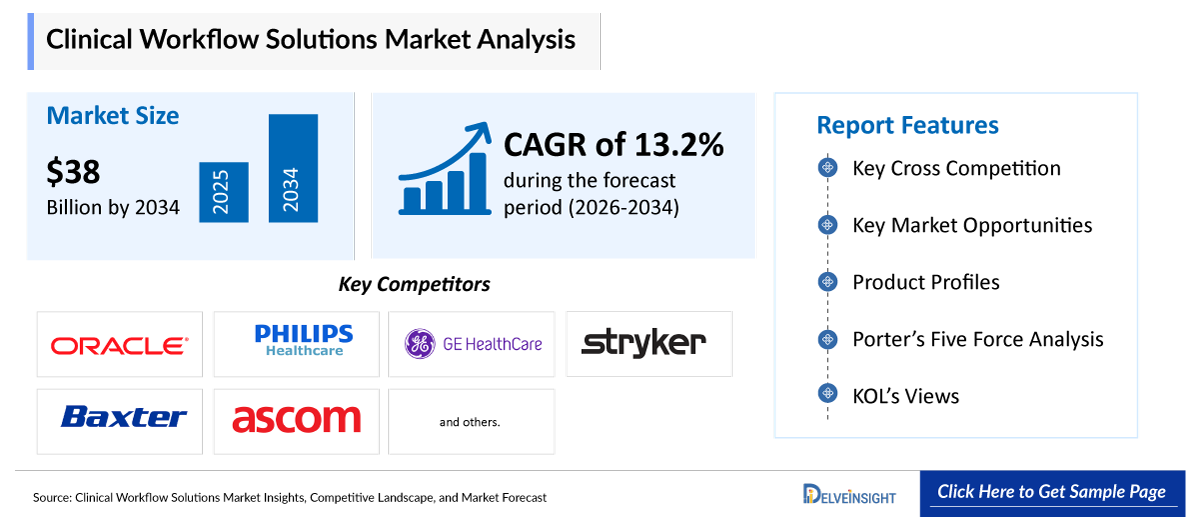
- The global clinical workflow solutions market was valued at USD 12.50 billion in 2025 and is projected to reach USD 38.00 billion by 2034.
- The market is expected to expand at a CAGR of 13.2% during the forecast period 2026-2034, supported by the imperative to reduce alarm fatigue and improve clinical alarm safety, the regulatory focus on staff communication and patient safety, the shift from legacy paging to secure clinical communication and collaboration, and the integration of clinical workflow solutions with the electronic health record.
- By type, the care collaboration solutions segment dominated the clinical workflow solutions market with a 30% share in 2025.
- By component, the software segment dominated the clinical workflow solutions market with a 55% share in 2025.
- By delivery mode, the on-premise segment dominated the clinical workflow solutions market with a 44% share in 2025.
- By end-user, the hospitals segment dominated the clinical workflow solutions market with a 72% share in 2025.
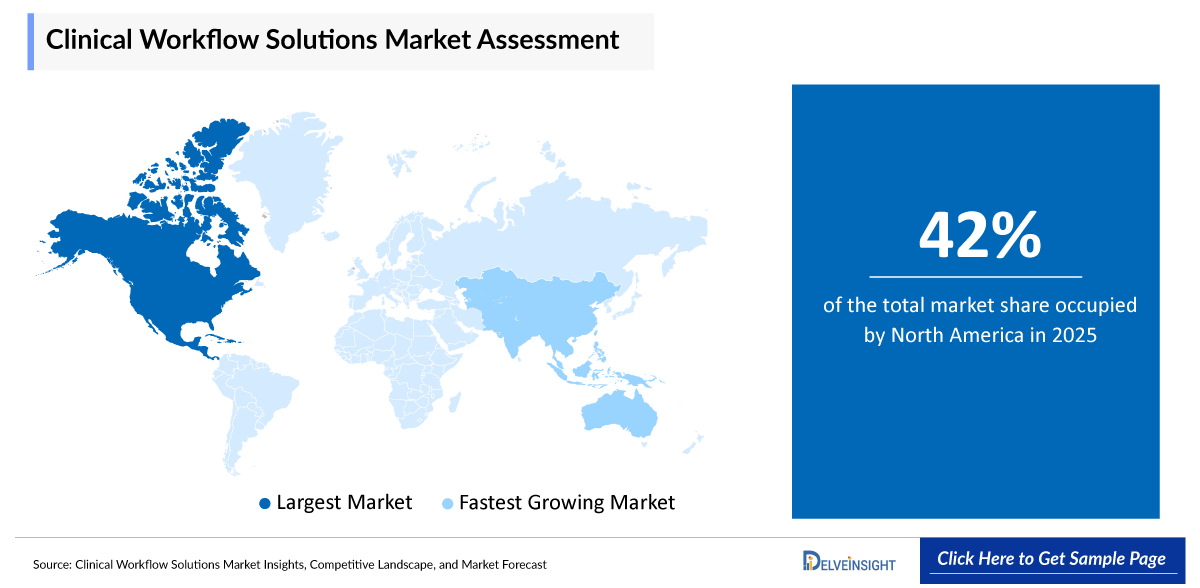
- North America accounted for the largest share of the clinical workflow solutions market at 42% in 2025, while Asia-Pacific is anticipated to register the fastest growth through 2034.
Clinical workflow solutions are the healthcare information technology systems that coordinate communication, care coordination, patient flow, alarm and alert management, real-time location, and data integration to streamline clinical workflows, improve patient safety, and enhance operational efficiency. The scope encompasses clinical communication and collaboration platforms that provide secure messaging, voice, and clinical alerting, care coordination and patient flow solutions, nurse call and alarm management systems, real-time location systems for the tracking of assets, staff, and patients, medical device and data integration, and enterprise reporting and analytics. Leading vendors provide comprehensive platforms and point solutions, and Stryker, through Vocera, provides hands-free wearable communication and clinical alerting; TigerConnect provides a cloud clinical communication and collaboration platform, Spok provides the Spok Care Connect communication and alerting platform, Baxter, through Voalte, provides mobile clinical communication uniting smartphones, nurse call, and physiological monitors, and Ascom provides mission-critical communication and alarm management. The solutions integrate with the electronic health record, monitoring devices, and nurse call systems, and the contemporary market is defined by the shift from legacy paging to secure communication, the integration of workflows with the electronic health record, and the regulatory focus on alarm and communication safety.
Clinical Workflow Solutions Market Key Growth Drivers
- The imperative to reduce alarm fatigue and improve clinical alarm safety, with The Joint Commission establishing Clinical Alarm Management as National Patient Safety Goal 06.01.01 following a Sentinel Event Alert on alarm-related patient deaths and injuries.
- The regulatory focus on staff communication and handoff, with The Joint Commission National Patient Safety Goals requiring hospitals to improve staff communication and to maintain a process for handoff communication.
- The shift from legacy paging to secure clinical communication and collaboration, with platforms such as TigerConnect replacing paging and documenting adoption across 5,300 hospitals worldwide.
- Integration of clinical workflow solutions with the electronic health record that surfaces patient context and streamlines the workflow.
- Rising need for care coordination, patient flow, and capacity management across the care continuum.
- Adoption of real-time location systems and medical device and data integration that track assets, staff, and patients and unify device data.
- Workforce shortages and the imperative to reduce clinician burden and improve efficiency through mobile and automated workflows.
Key Companies in Clinical Workflow Solutions Market
The leading participants in the clinical workflow solutions market include the following:
- Oracle Corporation
- Koninklijke Philips N.V.
- GE HealthCare Technologies Inc.
- Stryker Corporation
- Baxter International Inc.
- Ascom Holding AG
- Spok Holdings, Inc.
- TigerConnect, Inc.
- Securitas Healthcare LLC
- Cisco Systems, Inc.
For illustrative purposes, only the top 10 companies are listed in the Table of Contents. The report may include analysis and references to additional companies relevant to the market assessment.
Clinical Workflow Solutions Market Size
The following table summarizes the headline market metrics for the global clinical workflow solutions market across the base year and the forecast horizon.
|
Report Metrics |
Details |
|
2025 Market Size |
USD 12.50 billion |
|
2034 Projected Market Size |
USD 38.00 billion |
|
Growth Rate (2026-2034) |
13.2% CAGR |
|
Largest Market |
North America (42% share in 2025) |
|
Fastest Growing Market |
Asia-Pacific |
|
Market Structure |
Moderately Consolidated |
All market values are expressed in USD and represent DelveInsight estimates synthesized from primary and secondary research.
Factors Contributing to the Growth of the Clinical Workflow Solutions Market
Market Drivers
Imperative to Reduce Alarm Fatigue and Improve Clinical Alarm Safety
The foundational driver of the clinical workflow solutions market is the imperative to reduce alarm fatigue and improve the safety of clinical alarm systems, a recognized patient safety hazard. Physiological monitors and other devices generate a high volume of alarms, a large proportion of which are false or clinically insignificant, and the resulting alarm fatigue causes clinicians to miss, ignore, or disable alarms, contributing to patient harm. The Joint Commission published a Sentinel Event Alert on alarm-related patient deaths and injuries and established Clinical Alarm Management as National Patient Safety Goal 06.01.01, requiring accredited hospitals to make alarm system safety a priority and to establish policies and procedures for managing alarms, and alarm hazards have recurred on the list of top health technology hazards published by patient safety organizations. Clinical workflow solutions address alarm fatigue by intelligently filtering, prioritizing, and routing alarms and alerts to the right clinician on a mobile device, escalating unanswered alerts, and integrating alarms with communication so that clinicians receive actionable, contextual notifications rather than an overwhelming volume of undifferentiated alarms. As hospitals seek to comply with alarm safety requirements and to reduce the patient harm and clinician burden of alarm fatigue, they adopt the alarm management and communication solutions that clinical workflow platforms provide. The regulatory requirement and the patient safety imperative to manage alarms sustain demand for clinical workflow solutions across the forecast period.
Regulatory Focus on Staff Communication and Patient Safety
The regulatory focus on staff communication, handoff, and patient safety drives the adoption of clinical communication and workflow solutions. Communication failures are a leading contributor to patient safety events, and The Joint Commission National Patient Safety Goals require hospitals to improve the effectiveness of communication among caregivers and to maintain a process for handoff communication, while the requirement to receive and share patient information across care transitions reinforces the need for effective communication. Clinical workflow solutions support these requirements by providing secure, reliable, and documented communication among care team members, by structuring handoffs and the transfer of patient information, and by ensuring that critical results and messages reach the right clinician. The requirement to protect patient information under the Health Insurance Portability and Accountability Act drives the replacement of unsecured communication with compliant secure messaging, and clinical communication platforms provide the encryption, access controls, and auditability that compliance requires. As hospitals seek to comply with communication and patient safety requirements, to protect patient information, and to reduce the harm of communication failures, they adopt secure clinical communication and workflow solutions. The regulatory focus on communication, handoff, and patient safety, and the requirement to protect patient information, sustains demand for clinical workflow solutions across the forecast period.
Shift from Legacy Paging to Secure Clinical Communication and Collaboration
The shift from legacy paging and unsecured communication toward secure clinical communication and collaboration is a defining driver that concentrates demand in care collaboration solutions. Hospitals have long relied on pagers and unsecured communication, which are slow, one-directional, and lack the context, security, and integration that modern care requires; they are increasingly replacing these legacy systems with secure clinical communication and collaboration platforms. These platforms provide secure messaging, voice, and video, clinical alerting, and care team coordination on smartphones and wearable devices, and they integrate with the electronic health record and clinical systems to surface patient context. TigerConnect provides a secure communication and collaboration platform that replaces legacy paging and documents adoption across 5,300 hospitals worldwide; Stryker, through Vocera, provides hands-free wearable communication for high-acuity environments, and Spok provides communication that combines secure messaging with paging for hybrid environments. The replacement of legacy paging improves the speed, security, and context of communication, reduces delays, and integrates communication with the clinical workflow. As hospitals modernize communication, replace legacy paging, and adopt secure collaboration, demand concentrates in care collaboration solutions. The shift from legacy paging to secure clinical communication and collaboration sustains demand and reinforces the leadership of care collaboration solutions across the forecast period.
Integration with the Electronic Health Record and Interoperability
The integration of clinical workflow solutions with the electronic health record and clinical systems is a central driver that increases the value and adoption of these solutions. Clinical workflow solutions deliver the greatest value when they integrate with the electronic health record, monitoring devices, nurse call systems, and laboratory and other clinical systems, surfacing patient context, results, and alerts within the communication and workflow, and routing them to the right clinician. Clinical communication platforms integrate deeply with electronic health record systems such as those of the major vendors to provide patient context on clinician devices, to deliver critical results and orders, and to document communication, and workflow solutions integrate with monitoring and nurse call systems to route alarms and alerts. Interoperability standards enable the exchange of data between clinical workflow solutions and clinical systems, and the integration of communication, alerts, and patient data into a unified workflow improves the speed and quality of care. As hospitals seek to integrate communication and workflow with the electronic health record and clinical systems, and as integration becomes a decisive requirement, demand concentrates in solutions that integrate deeply and interoperate widely. The integration of clinical workflow solutions with the electronic health record and clinical systems increases their value and sustains demand across the forecast period.
Rising Need for Care Coordination, Patient Flow, and Capacity Management
The rising need for care coordination, patient flow, and capacity management drives the adoption of workflow solutions that coordinate care across the hospital and the care continuum. Hospitals face pressure to manage capacity, reduce length of stay, coordinate transfers and discharges, and move patients efficiently through the care process, and the coordination of care across departments, units, and facilities requires workflow solutions that provide visibility, communication, and coordination. Care coordination and patient flow solutions manage bed assignment, patient transfer, discharge, and throughput; transfer and command centers coordinate patient movement across facilities; and communication platforms coordinate the care team caring for the patient. The pressure of high occupancy, the imperative to reduce length of stay and avoidable delays, and the coordination of care across the continuum drive the adoption of care coordination and patient flow solutions. The integration of care coordination with communication and analytics enables the proactive management of capacity and flow. As hospitals seek to manage capacity, coordinate care, and improve patient flow, they adopt the care coordination and workflow solutions that provide visibility and coordination. The rising need for care coordination, patient flow, and capacity management sustains demand for clinical workflow solutions across the forecast period.
Adoption of Real-Time Location Systems and Data Integration
The adoption of real-time location systems and medical device and data integration extends clinical workflow solutions and drives demand for the tracking and integration they provide. Real-time location systems use tags and sensors to track the location of assets, staff, and patients in real time, enabling the location of equipment, the improvement of staff safety and workflow, the tracking of patient flow, and the automation of workflow events, and they integrate with communication and workflow solutions to trigger and route notifications. Medical device and data integration aggregates data from monitors and devices, unifies it, and delivers it to the electronic health record and to clinical workflow solutions, enabling the surveillance of patients and the routing of alarms and alerts. The adoption of real-time location systems improves asset utilization, staff safety, and workflow efficiency, and the integration of device data enables the intelligent management of alarms and the surveillance of patients. As hospitals adopt real-time location systems to track assets, staff, and patients and integrate device data to manage alarms and surveillance, demand for these solutions grows. The adoption of real-time location systems and medical device and data integration extends the clinical workflow solutions market and sustains demand across the forecast period.
Workforce Shortages and the Imperative to Reduce Clinician Burden
Workforce shortages and the imperative to reduce clinician burden and improve efficiency drive the adoption of clinical workflow solutions that streamline work and automate tasks. Healthcare faces persistent shortages of nurses and clinicians, and the workload, interruptions, and inefficiency of clinical work contribute to burnout and constrain capacity. Clinical workflow solutions reduce clinician burden by streamlining communication, automating the routing of alarms and alerts, reducing unnecessary interruptions, and enabling mobile access to information and communication, and they improve efficiency by coordinating care, reducing delays, and automating workflow events. Hands-free and mobile communication enables clinicians to communicate and access information without leaving the patient, intelligent alarm management reduces the interruptions of alarm fatigue, and workflow automation reduces manual coordination. The imperative to do more with constrained staff, to reduce the burden and burnout that drive turnover, and to improve the efficiency of care drives the adoption of solutions that streamline the clinical workflow. As workforce shortages persist and as hospitals seek to reduce clinician burden and improve efficiency, they adopt the communication, alarm management, and workflow solutions that streamline work. Workforce shortages and the imperative to reduce clinician burden and improve efficiency sustain demand for clinical workflow solutions across the forecast period.
Market Restraints
The clinical workflow solutions market faces several interrelated restraints that temper its growth. The foremost is the cost and complexity of deploying enterprise clinical workflow solutions, since these systems require investment in software, devices, and infrastructure, integration with the electronic health record and many clinical systems and devices, and configuration to clinical workflows, and the cost and complexity can be substantial, particularly for smaller facilities.
Integration and interoperability challenges are significant, since clinical workflow solutions must integrate with the electronic health record, monitoring devices, nurse call systems, and other clinical systems from many vendors, and incomplete interoperability and the diversity of devices and systems create complexity and cost. Data security and privacy obligations add compliance burden and risk, since clinical communication and workflow solutions process protected health information across networks and mobile devices and must protect it under regulation. Change management and clinician adoption are critical and challenging, since the introduction of new communication and workflow tools disrupts established practices, requires training, and can encounter resistance, and poor adoption undermines the value of the investment.
The risk of notification and alert overload, if solutions are poorly configured, can reproduce the alarm fatigue they are intended to reduce, requiring careful design and governance. The infrastructure requirements of on-premise deployment, including networks, servers, and devices, and the reliability requirements of mission-critical communication, add cost and complexity. The consolidation of the market and the diversity of point solutions can complicate procurement and integration. The indirect and difficult-to-quantify return on investment of some solutions can slow adoption. Together, these factors moderate the pace and scope of adoption and require vendors to demonstrate integration, usability, reliability, and clear clinical and operational value to sustain growth.
Clinical Workflow Solutions Market Segment Analysis
The global clinical workflow solutions market is segmented by type (data integration solutions, care collaboration solutions, real-time communication solutions, enterprise reporting and analytics solutions, nurse call and alarm management, others), by component (software, hardware, services), by delivery mode (on-premise, cloud-based, and web-based), by end-users (hospitals, ambulatory surgical centers, long term care facilities, and others), and by geography (North America, Europe, Asia-Pacific, and the Rest of the World).
By Type
Dominant Subsegment: Care Collaboration Solutions.
The care collaboration solutions category is expected to dominate the market. The care collaboration solutions segment accounted for a 30% share of the clinical workflow solutions market in 2025. Care collaboration solutions, which encompass the clinical communication and collaboration platforms that provide secure messaging, voice, video, and clinical alerting and coordinate the care team, are the largest type because communication is central to clinical workflow and because hospitals are replacing legacy paging with secure collaboration at scale. The dominance of the segment reflects the centrality of communication to clinical work, the widespread replacement of legacy paging with secure clinical communication and collaboration, and the integration of communication with alarms, the electronic health record, and the workflow. Vendors provide secure messaging, voice, and clinical alerting on smartphones and wearable devices, integrated with the electronic health record and clinical systems, and platforms document adoption across thousands of hospitals. Care collaboration is the foundation on which alarm management, care coordination, and workflow are delivered, since the routing of alarms, alerts, results, and coordination all depend on communication. As hospitals modernize communication, replace legacy paging, and adopt secure collaboration integrated with the workflow, demand concentrates in care collaboration solutions. The centrality of communication, the replacement of legacy paging, and the integration of communication with the workflow sustain the leadership of the care collaboration solutions segment across the forecast period.
By Component
Dominant Subsegment: Software.
The software category is expected to dominate the market. The software segment accounted for a 55% share of the clinical workflow solutions market in 2025. Software comprises the clinical communication and collaboration platforms, care coordination and patient flow applications, alarm management software, real-time location software, and integration and analytics software that constitute clinical workflow solutions, and it is the core deliverable that hospitals license and deploy. The dominance of the segment reflects the central role of software in coordinating communication, alarms, and workflow, the shift toward software-centric and mobile solutions, and the recurring nature of software licensing and subscription revenue. The intelligence of clinical workflow solutions, including the filtering and routing of alarms, the coordination of communication, the management of patient flow, and the integration with clinical systems, resides in the software, and vendors deliver their solutions as software platforms that run on mobile and enterprise devices. While hardware, including wearable communication devices, real-time location tags and sensors, and nurse call stations, and the services of implementation, integration, and support are essential components, the software platform is the foundation on which the solutions are delivered and the primary object of the investment. The shift toward mobile and cloud software and the recurring nature of software revenue reinforce the leadership of the software component. Its centrality to clinical workflow solutions and the recurring nature of software revenue sustain its leadership across the forecast period.
By Delivery Mode
Dominant Subsegment: On-Premise.
The on-premise category is expected to dominate the market. The on-premise segment accounted for a 44% share of the clinical workflow solutions market in 2025. On-premise deployment, in which clinical workflow solutions are hosted within the hospital's own infrastructure, has been the predominant model for mission-critical clinical communication and workflow because of the requirements for reliability, control, integration, and security in a clinical environment. The dominance of the segment reflects the mission-critical nature of clinical communication and alarm management, which demands high availability and reliability, the deep integration of these solutions with on-premise clinical systems, monitoring devices, and nurse call infrastructure, and the security and control that hospitals require for clinical communication. Mission-critical communication and alarm management cannot tolerate downtime, and the integration with on-premise devices and systems and the sensitivity of the data reinforce the preference for controlled, on-premise deployment. While cloud-based and web-based delivery is growing rapidly, as vendors offer cloud communication and collaboration platforms and as hospitals adopt cloud for its scalability and lower infrastructure burden, and while cloud options gain security certifications, the installed base and the mission-critical requirements of clinical communication and workflow sustain the leadership of the on-premise segment. The mission-critical nature of clinical communication, the integration with on-premise systems, and the installed base sustain the leadership of the on-premise segment across the forecast period, even as cloud and web-based delivery grows rapidly.
By End-User
Dominant Subsegment: Hospitals.
The hospitals category is expected to dominate the market. The hospitals segment accounted for a 72% share of the clinical workflow solutions market in 2025. Hospitals, including acute care hospitals, academic medical centers, and health systems, are the principal deployers of clinical workflow solutions because they operate the complex, high-acuity, and communication-intensive environments that require these solutions, and they have the scale and infrastructure to deploy enterprise communication, alarm management, care coordination, and location systems, which concentrates market value in this segment. The dominance of the segment reflects the complexity and acuity of hospital care, the density of communication, alarms, and coordination in the hospital, and the investment hospitals make in communication, alarm management, and workflow solutions to improve patient safety and efficiency. Hospitals deploy clinical communication and collaboration, alarm management, care coordination and patient flow, and real-time location solutions across their departments and integrate them with the electronic health record and clinical systems. The regulatory requirements for alarm safety and communication fall on hospitals, and the imperative to manage capacity, coordinate care, and reduce clinician burden is most acute in the hospital. While ambulatory care centers and long-term care facilities are growing end-users, the complexity, acuity, and scale of hospitals, and the depth of their investment, sustain the leadership of the hospitals segment across the forecast period, and it shapes the direction of the market.
Clinical Workflow Solutions Market Region Analysis
Dominant Region: North America
North America accounted for a 42% share of the global clinical workflow solutions market in 2025, representing the highest regional market share globally. The leadership of the region reflects the advanced adoption of healthcare information technology, the rigor of the regulatory framework for alarm and communication safety, the concentration of the leading vendors, and the scale of the healthcare system. The United States is the largest national market, supported by the advanced adoption of clinical communication and collaboration, alarm management, and workflow solutions, the requirements of The Joint Commission National Patient Safety Goals for alarm safety and staff communication, the protection of patient information under the Health Insurance Portability and Accountability Act, and the presence of the leading vendors. The imperative to comply with alarm and communication safety requirements, to replace legacy paging with secure communication, and to manage capacity and clinician burden drives the adoption of clinical workflow solutions. The leading vendors, including Stryker through Vocera, Baxter through Voalte, Spok, TigerConnect, and the other communication, location, and workflow companies, are headquartered and operate in the region, and the advanced adoption of the electronic health record supports integration. The advanced adoption of healthcare information technology, the regulatory framework, the concentration of vendors, and the scale of the healthcare system reinforce the leadership of the region. The combination of adoption, regulation, vendor presence, and system scale sustains the position of North America as the largest regional market across the forecast period.
Fastest Growing Region: Asia-Pacific
Asia-Pacific is projected to register the fastest compound annual growth rate through 2034. The region is expanding and modernizing its hospital infrastructure, adopting healthcare information technology, and investing in patient safety and efficiency, which drives the adoption of clinical workflow solutions. China, Japan, and India are the principal national markets, supported by the construction and modernization of hospitals, the adoption of electronic health records and healthcare information technology, the growth of healthcare investment, and the rising focus on patient safety and efficiency. The modernization of hospitals, the adoption of clinical communication, alarm management, and workflow solutions, and the growth of healthcare information technology enlarge the demand for clinical workflow solutions. As hospitals build and modernize, adopt healthcare information technology, and invest in communication and patient safety, the region increases its adoption of clinical workflow solutions from a growing base, and the scale of hospital construction and modernization creates substantial long-term demand. The combination of hospital modernization, healthcare information technology adoption, and investment in patient safety and efficiency positions Asia-Pacific as the fastest-growing regional market, and it attracts investment and commercial focus from the leading global vendors seeking presence in high-growth national markets.
Regional Commentary
North America
North America leads the market, supported by the advanced adoption of healthcare information technology, the rigor of the regulatory framework for alarm and communication safety, and the concentration of the leading vendors. The United States dominates the region through the advanced adoption of clinical communication and workflow solutions, the requirements of The Joint Commission for alarm safety and staff communication, and the protection of patient information under the Health Insurance Portability and Accountability Act. The imperative to comply with safety requirements and to modernize communication sustains demand.
Europe
Europe is a substantial market shaped by advanced healthcare systems, the adoption of clinical communication and workflow solutions, and the presence of vendors including Ascom and the European operations of global companies. Germany, the United Kingdom, France, Italy, and Spain are the principal national markets, supported by hospital modernization, the adoption of healthcare information technology, and the requirements of data protection and medical device regulation. Demand is sustained by the modernization of communication and the focus on patient safety and efficiency.
Asia-Pacific
Asia-Pacific is the fastest-growing region, driven by the construction and modernization of hospitals, the adoption of healthcare information technology, and investment in patient safety and efficiency across China, Japan, and India. Hospital modernization, the adoption of electronic health records and communication solutions, and healthcare investment sustain demand, and the region attracts commercial focus from the leading global vendors.
Rest of World
The Rest of World, spanning Latin America, the Middle East, and Africa, represents an emerging opportunity as hospital infrastructure expands and as healthcare information technology is adopted. Growth is supported by the construction and modernization of hospitals, the adoption of communication and workflow solutions, and investment in patient safety, though adoption varies by market. Vendors pursue these markets through solutions suited to modernizing hospitals.
Clinical Workflow Solutions Market Competitive Landscape
The global clinical workflow solutions market is classified as Moderately Consolidated. A group of medical technology and healthcare communication companies holds a substantial share of the market through comprehensive platforms and installed bases, while specialist clinical communication, real-time location, nurse call, and workflow vendors compete on differentiated solutions. Competition centers on the breadth and integration of the platform, the depth of integration with the electronic health record and clinical systems, the reliability of mission-critical communication, alarm management and intelligence, and real-time location and workflow capabilities, and acquisitions, product launches, and the shift to secure and cloud communication intensify the contest. The competitive landscape is evaluated across the following dimensions:
- Market concentration: Moderately consolidated, with a group of medical technology and healthcare communication companies holding a substantial share, alongside specialist clinical communication, real-time location, nurse call, and workflow vendors.
- Leading players: Stryker, through Vocera, and Baxter, through Voalte, lead in clinical communication and nurse call; Spok and TigerConnect lead in clinical communication and collaboration; Ascom leads in mission-critical communication and alarm management; Securitas Healthcare leads in real-time location, and Oracle, Philips, GE HealthCare, and Cisco contest care coordination, data integration, and infrastructure.
- Geographic reach: The leading vendors operate global commercial and service organizations, with deep presence in North America and Europe, while specialist vendors serve defined markets and segments.
- Product portfolio strength: Competitive advantage rests on the breadth across communication, alarm management, care coordination, real-time location, and data integration, and on the depth of integration with the electronic health record, monitoring devices, and nurse call systems.
- Pipeline strength: Development is concentrated in secure and cloud communication, alarm intelligence and integration, care coordination and patient flow, real-time location, and integration with the electronic health record.
- Strategic partnerships: Collaboration spans integration with electronic health record vendors, monitoring and nurse call systems, and clinical systems, and alliances that connect communication, alarms, location, and workflow.
- M&A activity: Consolidation has shaped the field, exemplified by the acquisition of Vocera by Stryker and the acquisition of Hillrom, with its Voalte communication and nurse call, by Baxter, alongside continued consolidation of communication, location, and workflow assets.
- Innovation focus: Innovation is shifting toward secure and cloud communication, intelligent alarm management, artificial intelligence, care coordination and patient flow, and integration with the electronic health record and clinical systems.
- Regulatory standing: Alignment with The Joint Commission National Patient Safety Goals for alarm and communication safety, compliance with the Health Insurance Portability and Accountability Act for secure communication, and support for interoperability standards are decisive competitive credentials and a principal axis of competition among the leaders.
Clinical Workflow Solutions Market Recent Developmental Activities
In 2022, Stryker Corporation completed its acquisition of Vocera Communications, a provider of hands-free wearable clinical communication and clinical alerting, integrating it into the Stryker portfolio. Strategic significance: the acquisition brought a leading clinical communication company into a major medical technology company and reinforced the convergence of communication and clinical workflow.
In 2021, Baxter International Inc. completed its acquisition of Hillrom, whose Voalte platform unites clinical communication with nurse call and physiological monitoring at the bedside. Strategic significance: the acquisition brought leading communication and nurse call solutions into a major medical technology company and reinforced the integration of communication with connected care.
In 2023, Stryker Corporation, through Vocera, announced fifteen product enhancements, including specialized modules for nurse and physician workflows. Strategic significance: the enhancements advanced the clinical communication platform and its support for specific clinical workflows.
In 2024 and 2025, TigerConnect, Inc. advanced its cloud clinical communication and collaboration platform, documenting adoption across 5,300 hospitals worldwide and adding security certifications for its cloud deployment. Strategic significance: the growth reinforced the shift from legacy paging to secure cloud communication and the position of a leading clinical communication and collaboration vendor.
In 2024 and 2025, Ascom Holding AG advanced its mission-critical communication and alarm management platform and expanded its deployments across European and other markets. Strategic significance: the developments reinforced the position of a leading communication and alarm management vendor across international markets.
In 2024 and 2025, Spok Holdings, Inc. advanced its Spok Care Connect platform, combining secure messaging, clinical alerting, paging, and directory services for hospitals. Strategic significance: the developments reinforced the position of a vendor serving hybrid communication environments that combine secure messaging with paging.
In 2024 and 2025, the leading vendors deepened the integration of clinical communication and workflow solutions with the electronic health record systems of the major vendors, surfacing patient context and delivering results and alerts within the workflow. Strategic significance: the deepening of integration reinforced the centrality of the electronic health record connection and the value of integrated workflow.
In 2024 and 2025, Securitas Healthcare LLC advanced its real-time location solutions for the tracking of assets, staff, and patients, and their integration with communication and workflow. Strategic significance: the developments reinforced the role of real-time location systems in extending clinical workflow solutions.
In 2024 and 2025, the leading vendors advanced intelligent alarm management, filtering, prioritizing, and routing alarms to reduce alarm fatigue and to comply with alarm safety requirements. Strategic significance: the advancement of intelligent alarm management addressed a central patient safety and regulatory imperative and reinforced the integration of alarms with communication.
In 2024 and 2025, Oracle Corporation, Koninklijke Philips N.V., and GE HealthCare Technologies Inc. advanced care coordination, patient flow, and clinical data integration solutions, including command center and surveillance capabilities. Strategic significance: the developments reinforced the role of care coordination, patient flow, and data integration in clinical workflow solutions.
In 2024 and 2025, vendors expanded cloud and mobile clinical communication and collaboration, adding security certifications and cloud deployment options alongside on-premise solutions. Strategic significance: the expansion of cloud and mobile communication broadened access and supported the shift toward cloud delivery.
In 2024 and 2025, the leading vendors advanced secure and cloud communication, intelligent alarm management, care coordination, real-time location, and integration with the electronic health record across clinical workflow solutions. Strategic significance: the convergence of the leaders on secure communication, alarm intelligence, care coordination, and integration confirmed these as the defining axes of competition and signaled a market advancing toward integrated, intelligent, and secure clinical workflow.
Clinical Workflow Solutions Market Segmentation
Clinical Workflow Solutions Market Assessment by Type
- Data Integration Solutions
- Care Collaboration Solutions
- Real-Time Communication Solutions
- Enterprise Reporting and Analytics Solutions
- Nurse Call and Alarm Management
- Others
Clinical Workflow Solutions Market Assessment by Component
- Software
- Hardware
- Services
Clinical Workflow Solutions Market Assessment by Delivery Mode
- On-Premise
- Cloud-Based
- Web-Based
Clinical Workflow Solutions Market Assessment by End-User
- Hospitals
- Ambulatory Care Centers
- Long-Term Care Facilities
- Others
Clinical Workflow Solutions Market Assessment by Geography
- North America
- United States Clinical Workflow Solutions Market Size in USD million (2023-2034)
- Canada Clinical Workflow Solutions Market Size in USD million (2023-2034)
- Mexico Clinical Workflow Solutions Market Size in USD million (2023-2034)
- Europe
- Germany Clinical Workflow Solutions Market Size in USD million (2023-2034)
- United Kingdom Clinical Workflow Solutions Market Size in USD million (2023-2034)
- France Clinical Workflow Solutions Market Size in USD million (2023-2034)
- Italy Clinical Workflow Solutions Market Size in USD million (2023-2034)
- Spain Clinical Workflow Solutions Market Size in USD million (2023-2034)
- Rest of Europe Clinical Workflow Solutions Market Size in USD million (2023-2034)
- Asia-Pacific
- China Clinical Workflow Solutions Market Size in USD million (2023-2034)
- Japan Clinical Workflow Solutions Market Size in USD million (2023-2034)
- India Clinical Workflow Solutions Market Size in USD million (2023-2034)
- Australia Clinical Workflow Solutions Market Size in USD million (2023-2034)
- South Korea Clinical Workflow Solutions Market Size in USD million (2023-2034)
- Rest of Asia-Pacific Clinical Workflow Solutions Market Size in USD million (2023-2034)
- Rest of the World
- Middle East Clinical Workflow Solutions Market Size in USD million (2023-2034)
- Africa Clinical Workflow Solutions Market Size in USD million (2023-2034)
- South America Clinical Workflow Solutions Market Size in USD million (2023-2034)
Clinical Workflow Solutions Market Recent Industry Trends and Milestones (2023-2026)
|
Category |
Key Developments |
|
Clinical Workflow Solutions Market Product Advancement |
The period was defined by the advancement of secure, integrated, and intelligent clinical workflow solutions. Stryker advanced the Vocera communication platform with workflow enhancements, Baxter advanced the Voalte platform uniting communication with nurse call and monitoring, TigerConnect advanced its cloud communication and collaboration platform across thousands of hospitals, and Ascom and Spok advanced communication and alarm management. Vendors deepened integration with the electronic health record and advanced intelligent alarm management. Together, these advances concentrated competition in secure, integrated, and intelligent clinical communication and workflow. |
|
Clinical Workflow Solutions Market Product Expansion |
Product expansion advanced along three axes. The first is secure and cloud communication, as vendors expanded secure messaging, voice, and video on mobile and cloud platforms with security certifications. The second is alarm and workflow intelligence, as vendors advanced the filtering, prioritization, and routing of alarms and the automation of workflow to reduce alarm fatigue and clinician burden. The third is integration, as vendors deepened integration with the electronic health record, monitoring devices, and nurse call systems and extended real-time location and data integration. Vendors also expanded care coordination, patient flow, and command center capabilities. |
|
Clinical Workflow Solutions Market Investment |
Investment was shaped by consolidation and by the shift to secure and cloud communication. Stryker acquired Vocera, and Baxter acquired Hillrom with its Voalte communication and nurse call, bringing communication into major medical technology companies, and vendors invested in cloud communication, alarm intelligence, care coordination, and real-time location. Investment also flowed into the integration of clinical workflow solutions with the electronic health record and clinical systems and into the security and reliability required for mission-critical communication. Vendors expanded across communication, alarms, location, and workflow. |
|
Company Strategy |
The unifying strategic theme is the building of integrated clinical workflow platforms that unite communication, alarms, care coordination, and location, integrated with the electronic health record. Stryker is advancing Vocera, Baxter is advancing Voalte and nurse call, TigerConnect and Spok are advancing communication and collaboration, Ascom is advancing communication and alarm management, and Securitas Healthcare is advancing real-time location, while Oracle, Philips, GE HealthCare, and Cisco are advancing care coordination, data integration, and infrastructure. Across the field, strategy centers on secure communication, alarm intelligence, care coordination, location, and integration. |
|
Emerging Technologies |
The defining emerging technologies are secure cloud and mobile communication and collaboration that replace legacy paging; intelligent alarm management that filters, prioritizes, and routes alarms to reduce alarm fatigue; real-time location systems that track assets, staff, and patients and trigger workflow; medical device and data integration that unifies device data for surveillance and alarm management; and integration with the electronic health record that surfaces patient context within the workflow. Supporting these are artificial intelligence for alarm and communication intelligence, care coordination and patient flow analytics, and command center capabilities. Across these, the trajectory is toward a clinical workflow that is integrated, intelligent, and secure, improving communication, patient safety, and efficiency across the hospital and the care continuum. |
Clinical Workflow Solutions Market Startup Funding and Investment Trends
Investment in the clinical workflow solutions field has concentrated on technologies that make clinical communication and workflow more secure, more intelligent, and more integrated, namely secure cloud communication and collaboration, intelligent alarm and notification management, care coordination and patient flow, and real-time location and data integration. Because the core market is moderately consolidated among medical technology and healthcare communication companies, innovators pursue differentiated communication, alarm, coordination, or location technologies that integrate with the electronic health record or that a larger vendor can absorb. The table below summarizes representative companies advancing the next generation of clinical workflow solutions.
|
Company |
Total Funding |
Funding Stage |
Main Product/Offering |
Core Technology |
|
TigerConnect, Inc. |
Venture-backed |
Commercial stage |
Clinical communication platform |
Cloud clinical communication and collaboration |
|
PerfectServe, Inc. |
Private equity-backed |
Commercial stage |
Communication and scheduling platform |
Clinical communication and scheduling |
|
Request for unlocking the report of the @Clinical Workflow Solutions Market | ||||
Capital formation in this field is shaped by the presence of medical technology and healthcare communication companies with comprehensive platforms and installed bases, so investors have favored companies that introduce differentiated secure communication, intelligent alarm management, care orchestration, or real-time location that integrates with the electronic health record and clinical systems. Secure cloud communication and collaboration is a clear thesis, replacing legacy paging with modern, integrated communication. Intelligent alarm and notification management constitutes a second thesis, addressing alarm fatigue and safety, care coordination and patient flow a third, and real-time location and data integration a fourth. The archetypal outcome is acquisition by a medical technology or healthcare communication company seeking to add capability, exemplified by the acquisition of communication and nurse call companies by major medical technology companies, which provides a defined exit that sustains earlier-stage investment. The principal risks are the comprehensive platforms and installed bases of the leaders, the integration required with the electronic health record and clinical systems, the security and reliability expectations of mission-critical communication, and the change management required for adoption.
Key Takeaways from the Clinical Workflow Solutions Market Report Study
- Market size analysis for the current clinical workflow solutions market size (2025), and market forecast for 9 years (2026 to 2034).
- Top key product and technology developments, mergers, acquisitions, partnerships, and joint ventures that happened over the last 3 years.
- Key companies dominating the global clinical workflow solutions market.
- Various opportunities available for competitors in the clinical workflow solutions market space.
- What are the top-performing segments in 2025? How will these segments perform in 2034?
- Which are the top-performing regions and countries in the current clinical workflow solutions market scenario?
- Which are the regions and countries where companies should concentrate their opportunities for clinical workflow solutions market growth in the future?
Target audience who can benefit from this clinical workflow solutions market report study
- Clinical workflow solutions, clinical communication, and healthcare information technology providers
- Research organizations and consulting companies
- Clinical workflow solutions-related organizations, associations, forums, and other alliances
- Government and corporate offices
- Start-up companies, venture capitalists, and private equity firms
- Distributors and traders dealing in clinical workflow solutions
- Various end-users who want to know more about the clinical workflow solutions market and the latest technological developments in the clinical workflow solutions market.

