Colonoscopes Market Summary
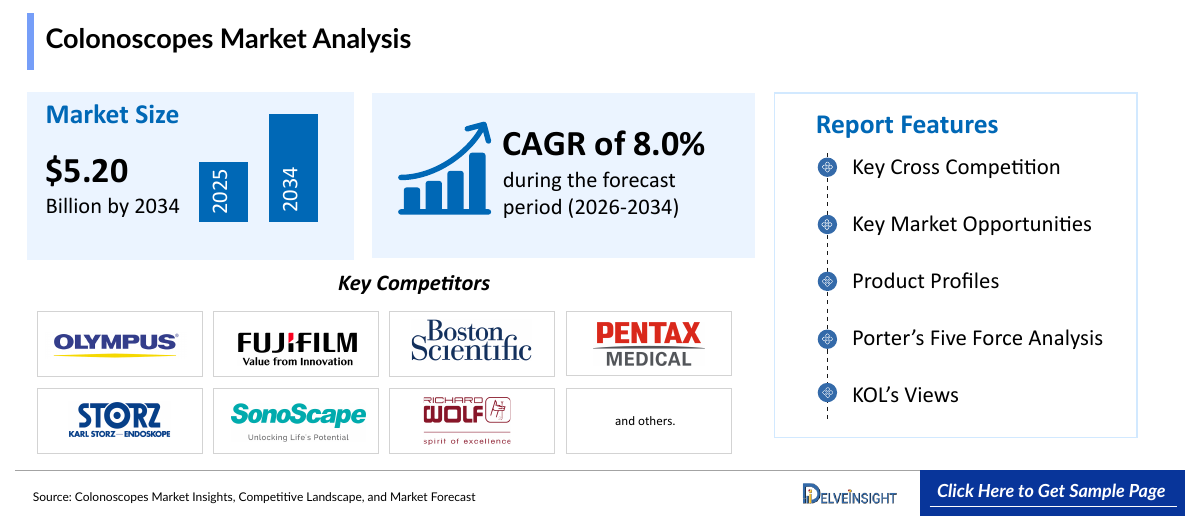
- The Colonoscopes market is estimated at USD 2.60 billion in 2025 and is projected to reach USD 5.20 billion by 2034. Growth is anchored in rising colorectal cancer screening volumes, the adoption of high-definition, 4K, and AI-assisted visualization, and the shift of procedures toward ambulatory surgical centers.
- The global Colonoscopes market is growing at a CAGR of 8.0% during the forecast period from 2026 to 2034.
- By product type, the flexible colonoscopes segment dominated the Colonoscopes market with a 78% share in 2025.
- By technology, the high-definition colonoscopy systems segment dominated the Colonoscopes market with a 46% share in 2025.
- By procedure type, the screening colonoscopy segment dominated the Colonoscopes market with a 43% share in 2025.
- By visualization technology, the white-light imaging segment dominated the Colonoscopes market with a 52% share in 2025.
- By application, the colorectal cancer screening segment dominated the Colonoscopes market with a 41% share in 2025.
- By end user, the hospitals segment dominated the Colonoscopes market with a 54% share in 2025.
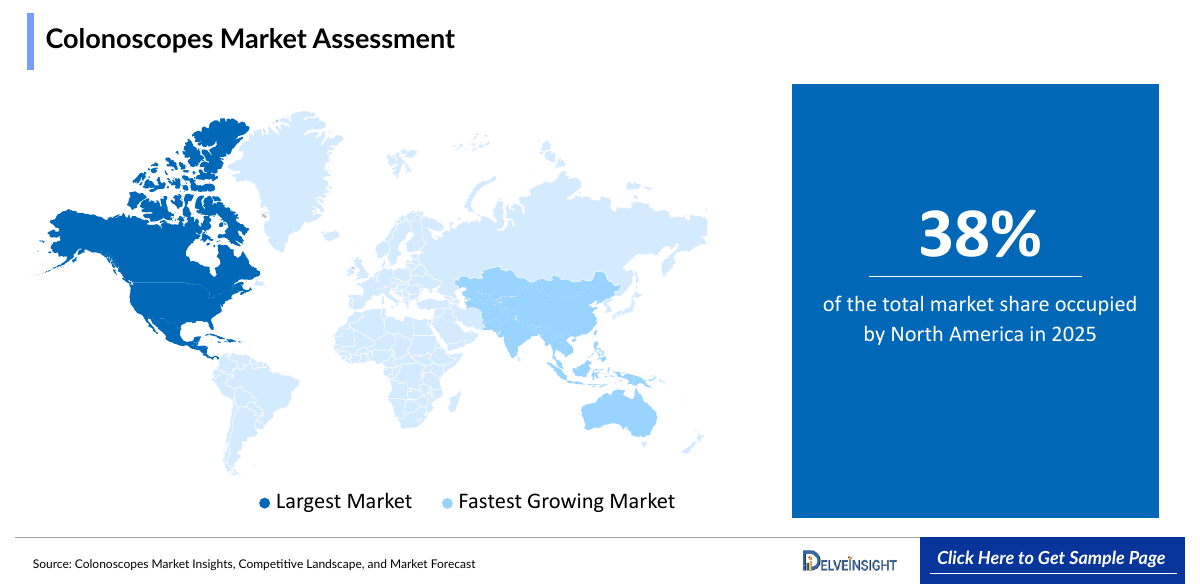
- North America dominated the global Colonoscopes market revenue with a 38% share in 2025, representing the highest regional market share globally.
A colonoscope is a long, flexible (or, in limited cases, rigid) endoscopic instrument fitted with a light source, an imaging system, and working channels that allows physicians to visualize the entire colon and rectum, detect and remove polyps, take biopsies, and control bleeding during a colonoscopy. Because colonoscopy is both the gold-standard examination for colorectal cancer detection and the only screening modality that allows detection and removal of precancerous lesions in a single session, colonoscopes sit at the center of gastrointestinal (GI) diagnostics and therapy. Modern systems combine the colonoscope with a video processor, light source, and monitor, and increasingly incorporate advanced optical and digital imaging and artificial intelligence-based computer-aided detection. The market is organized by product type across flexible, rigid, and capsule colonoscopes and robotic colonoscopy systems; by technology across conventional, high-definition, and 4K systems; by procedure type across diagnostic, screening, therapeutic, and surveillance colonoscopy; by visualization technology, including white-light imaging, narrow-band imaging, blue-light imaging, and linked-color imaging; by application, led by colorectal cancer screening; and by end user, led by hospitals. Driven by the growing colorectal cancer burden, expanding population-based screening programs, earlier screening ages, and rapid technological innovation, colonoscopes have become essential infrastructure underpinning early detection and prevention of colorectal disease.
Colonoscopes Market Key Growth Drivers
- The rising global burden of colorectal cancer is driving screening demand, with GLOBOCAN 2022 estimating about 1.9 million new colorectal cancer cases and roughly 900,000 deaths worldwide each year.
- Expanding population-based screening programs and lower recommended screening ages, including the move to begin average-risk screening at age 45 in the United States, are enlarging the eligible population.
- Adoption of high-definition, 4K, narrow-band, blue-light, and linked-color imaging is improving lesion detection and driving replacement of conventional colonoscopy systems.
- Integration of artificial intelligence and computer-aided detection is raising adenoma detection rates and encouraging upgrades to AI-ready endoscopy platforms.
- The shift of colonoscopy procedures to ambulatory surgical centers and specialty clinics is expanding equipment demand beyond traditional hospital endoscopy units.
- Infection-control concerns around reprocessing are accelerating adoption of single-use colonoscopes, while capsule and robotic systems broaden the technology landscape.
- The convergence of cancer burden, screening expansion, imaging innovation, and care-setting shifts is expected to sustain solid growth in the market through 2034.
Key Companies in Colonoscopes Market
The competitive landscape is led by the following active manufacturers:
- Olympus Corporation
- Fujifilm Holdings Corporation
- Boston Scientific Corporation
- PENTAX Medical
- KARL STORZ
- Ambu A/S
- SonoScape Medical Corp.
- Richard Wolf GmbH
- EndoMed Systems GmbH
- SMART Medical Systems Ltd.
For illustrative purposes, only the top 10 companies are listed in the Table of Contents. The report may include analysis and references to additional companies relevant to the market assessment.
Colonoscopes Market Size
The following snapshot summarizes the principal report metrics for the Colonoscopes market.
|
Report Metrics |
Details |
|
2025 Market Size |
USD 2.60 billion |
|
2034 Projected Market Size |
USD 5.20 billion |
|
Growth Rate (2026-2034) |
8.0% CAGR |
|
Largest Market |
North America |
|
Fastest Growing Market |
Asia-Pacific |
|
Market Structure |
Highly Concentrated |
All market values are expressed in USD and represent DelveInsight estimates synthesized from primary and secondary research.
Factors Contributing to the Growth of the Colonoscopes Market
Market Drivers
Rising Global Burden of Colorectal Cancer and Gastrointestinal Disease
The most powerful driver of the Colonoscopes market is the large and growing burden of colorectal cancer and related GI disease. Colorectal cancer is the third most commonly diagnosed cancer worldwide, and GLOBOCAN 2022 estimated about 1.9 million new cases and roughly 900,000 deaths globally in a single year. Incidence is also rising among adults under 50 in many countries, which is widening the population that clinicians want to evaluate. Colonoscopy is the reference examination for both detection and removal of precancerous polyps, and it is also central to the work-up of GI bleeding, unexplained changes in bowel habits, and positive results from non-invasive screening tests. In the United States alone, roughly 15 million colonoscopies are performed annually. As disease burden and referral volumes rise, hospitals, ambulatory surgical centers, and specialty clinics need more colonoscopes and supporting systems, anchoring demand for the market through 2034.
Expansion of Screening Programs and Lower Screening Ages
Population-based screening is a structural growth engine for the market. In 2021, the US Preventive Services Task Force recommended beginning average-risk colorectal cancer screening at age 45, bringing millions of additional adults into the eligible pool. Organized programs in Europe, supported by the 2022 EU Council recommendation on cancer screening, along with national programs in Japan, South Korea, Australia, and a growing number of other countries, generate steady downstream colonoscopy demand because positive stool-based tests must be followed by colonoscopy. Public awareness campaigns and expanded insurance coverage reduce barriers to screening. As participation rises and programs mature, procedure volumes grow, which directly increases the need for new and replacement colonoscopes across the forecast period.
Adoption of High-Definition, 4K, and Advanced Imaging Technologies
Imaging innovation is steadily upgrading the installed base of colonoscopy equipment. High-definition systems have become the standard of care in developed markets, and 4K platforms are now entering the market to deliver finer mucosal detail. Advanced visualization modes, including narrow-band imaging, blue-light imaging, linked-color imaging, and other digital and optical enhancement technologies, help endoscopists distinguish subtle and flat lesions that white light alone can miss. Because each 1% improvement in adenoma detection rate has been associated with roughly a 3% reduction in the risk of interval colorectal cancer, quality-focused providers have strong clinical and reputational incentives to invest in better imaging. Manufacturers use proprietary scope-processor ecosystems, so platform upgrades typically trigger replacement of both scopes and processors, creating recurring revenue across the forecast period.
Integration of Artificial Intelligence and Computer-Aided Detection
Artificial intelligence is emerging as a major differentiator in colonoscopy. Computer-aided detection software analyzes the live video feed and flags suspected polyps in real time, and it has been shown in clinical studies to raise adenoma detection rates. The FDA granted the first marketing authorization for an AI-based colonoscopy detection device in 2021, and leading manufacturers, including Olympus with its ENDO-AID platform, have since built AI into their endoscopy ecosystems, while PENTAX Medical and Fujifilm have signaled AI development roadmaps. AI-ready platforms require compatible processors and scopes, which encourages providers to upgrade rather than extend the life of older systems. As evidence accumulates, AI is expected to move from an optional add-on to a standard feature of new colonoscopy systems, expanding the value of each installed platform through 2034.
Shift of Procedures to Ambulatory Surgical Centers and Specialty Clinics
A steady migration of colonoscopy from hospital endoscopy units to ambulatory surgical centers, specialty clinics, and diagnostic centers is broadening the customer base. Ambulatory settings offer lower procedural costs, shorter wait times, and greater convenience, and payers increasingly favor them for routine screening and surveillance. Because screening colonoscopy is a high-volume, relatively standardized procedure, it is well suited to these settings. Many ambulatory centers prefer cost-effective, easy-to-use systems and, in some cases, single-use scopes that avoid investment in reprocessing infrastructure. This diversification of end users supports demand for a wider range of price points and product types and is one of the fastest-growing channels for colonoscopes over the forecast period.
Single-Use, Capsule, and Robotic Innovation Addressing Infection-Control Concerns
Concerns about cross-contamination and the cost and complexity of reprocessing reusable endoscopes are stimulating new product categories. Single-use colonoscopes, such as Ambu's aScope Colon, eliminate reprocessing and its associated infection risk, and they appeal to ambulatory centers and facilities with limited sterilization capacity. Capsule colonoscopes offer a less invasive way to visualize the colon for patients who cannot or will not undergo conventional colonoscopy, while robotic and self-propelled colonoscopy systems aim to reduce patient discomfort and operator skill dependence. Balloon-assisted designs, such as the G-EYE technology from SMART Medical Systems offered on Fujifilm's 700-series platform, improve visualization and stabilization. Although these categories start from a smaller base, they widen the addressable market and are expected to grow faster than conventional reusable scopes through 2034.
Growing Prevalence of Inflammatory Bowel Disease and Surveillance Needs
The rising prevalence of inflammatory bowel disease, including ulcerative colitis and Crohn's disease, creates recurring colonoscopy demand for diagnosis, disease-activity assessment, and dysplasia surveillance. Patients with long-standing colitis, a history of polyps, or a family history of colorectal cancer need repeat surveillance examinations at defined intervals, which produces a durable, repeat-procedure revenue base. Advanced imaging modes support targeted biopsy and accurate characterization of mucosal inflammation, increasing the clinical value of newer systems. With an aging population and a growing pool of patients in long-term surveillance, these needs add steady, non-cyclical demand that supports market growth across the forecast period.
Market Restraints
Despite strong momentum, the Colonoscopes market faces material constraints. The high cost of endoscopy platforms, which combine scopes, video processors, light sources, and monitors, is a significant barrier for smaller facilities and for healthcare systems in emerging economies, and proprietary scope-processor ecosystems limit flexibility and raise switching costs. Reprocessing of reusable colonoscopes is demanding, and regulators and clinicians continue to highlight infection-control risks when cleaning and disinfection are inadequate, adding compliance cost and reputational risk. Average selling prices of video colonoscopes have gradually declined, pressuring manufacturer margins even as unit volumes grow. Non-invasive screening alternatives, including fecal immunochemical tests, multitarget stool DNA tests, and emerging blood-based tests, can divert average-risk patients from primary colonoscopy, although positive results still require colonoscopic follow-up. Patient reluctance due to bowel preparation, procedural discomfort, and sedation requirements limits screening uptake, while a shortage of trained endoscopists and anesthesia resources constrains capacity in many regions. Stringent and evolving regulatory requirements, including the EU Medical Device Regulation and FDA clearance pathways for new imaging and AI technologies, lengthen development timelines and increase costs. Reimbursement variability across countries and downward pressure on procedure payments further temper investment. Together, these cost, infection-control, competitive, workforce, and regulatory barriers moderate the pace of growth, even as the underlying drivers of cancer burden, screening expansion, and technological innovation remain firmly intact.
Colonoscopes Market Segment Analysis
The Colonoscopes Market is segmented by product type (flexible colonoscopes, rigid colonoscopes, capsule colonoscopes, robotic colonoscopy systems, others), technology (conventional colonoscopy systems, high-definition colonoscopy systems, 4K colonoscopy systems, others), procedure type (diagnostic colonoscopy, screening colonoscopy, therapeutic colonoscopy, surveillance colonoscopy), visualization technology (white-light imaging, narrow-band imaging (NBI), blue-light imaging, linked-color imaging (LCI), other advanced imaging technologies), application (colorectal cancer screening, polyp detection and removal, inflammatory bowel disease diagnosis and monitoring, gastrointestinal bleeding detection, colorectal disease diagnosis, others), end user (hospitals, ambulatory surgical centers, specialty clinics, diagnostic centers, academic and research institutes, others), and geography (North America, Europe, Asia-Pacific, and Rest of World).
By Product Type
Dominant Subsegment: Flexible Colonoscopes.
The flexible colonoscopes segment accounted for 78% of the Colonoscopes market in 2025. Flexible colonoscopes are the leading product type because they are the standard instrument for examining the full length of the colon and rectum, and they combine reliable maneuverability with working channels that support biopsy, polypectomy, and hemostasis. Flexible video colonoscopes account for the vast majority of new sales, supported by a large installed base from Olympus, Fujifilm, and PENTAX Medical and by continuous improvements in imaging, insertion-tube design, and ergonomics. Rigid colonoscopes are limited to short-segment examinations of the distal colon and rectum and hold a small share. Capsule colonoscopes and robotic colonoscopy systems are earlier-stage categories that are growing quickly from a small base as they target patients who need less invasive options and operators who need easier navigation, while single-use colonoscopes within the Others category are gaining traction in settings that want to avoid reprocessing. Nonetheless, the clinical versatility and entrenched adoption of flexible colonoscopes secure their leadership across the forecast period.
By Technology
Dominant Subsegment: High-Definition Colonoscopy Systems.
The high-definition colonoscopy systems segment accounted for 46% of the Colonoscopes market in 2025. High-definition systems are the leading technology because they have become the standard of care in developed markets and are increasingly adopted in emerging ones, offering a clear improvement in mucosal detail over conventional standard-definition equipment at a price point that most hospitals and ambulatory centers can support. Their compatibility with advanced imaging modes and AI-based detection software further strengthens their position as the workhorse of modern colonoscopy. Conventional colonoscopy systems continue to decline as facilities replace aging equipment, while 4K colonoscopy systems are the fastest-growing technology as manufacturers introduce ultra-high-resolution platforms that promise finer visualization of flat and subtle lesions. Because HD platforms form the largest installed base and remain the default for new purchases and replacements, they hold leadership across the forecast period.
By Procedure Type
Dominant Subsegment: Screening Colonoscopy.
The screening colonoscopy segment accounted for 43% of the Colonoscopes market in 2025. Screening colonoscopy leads because it is the highest-volume use of the instrument, performed in asymptomatic average-risk adults under national and institutional screening guidelines, including the lower starting age of 45 now recommended in the United States. Screening procedures are standardized, schedulable, and widely reimbursed, which makes them the backbone of utilization at hospitals and ambulatory surgical centers. Diagnostic colonoscopy remains substantial as patients with symptoms, positive stool tests, or GI bleeding are referred for evaluation, and surveillance colonoscopy provides a steady repeat-procedure base for patients with prior polyps, inflammatory bowel disease, or elevated risk. Therapeutic colonoscopy is the fastest-growing procedure type as polypectomy and other interventions are increasingly performed during the same session. Nonetheless, the scale and recurring nature of screening secure its leadership across the forecast period.
By Visualization Technology
Dominant Subsegment: White-Light Imaging.
The white-light imaging segment accounted for 52% of the Colonoscopes market in 2025. White-light imaging leads because it is the baseline visualization mode built into every colonoscopy system and is used in the large majority of examinations, including during insertion and initial inspection. Its universality, familiarity to endoscopists, and lack of any additional training or cost make it the default across hospitals, ambulatory centers, and clinics worldwide. Advanced imaging modes are growing steadily: narrow-band imaging from Olympus, blue-light imaging and linked-color imaging from Fujifilm, and digital and optical enhancement from PENTAX Medical help characterize and detect subtle lesions, and other advanced technologies, including AI-assisted detection overlays, are expanding fastest. Because these modes are layered on top of white-light imaging rather than replacing it, white-light imaging retains the largest share across the forecast period.
By Application
Dominant Subsegment: Colorectal Cancer Screening.
The colorectal cancer screening segment accounted for 41% of the Colonoscopes market in 2025. Colorectal cancer screening is the leading application because early detection and removal of precancerous polyps meaningfully reduce incidence and mortality, and colonoscopy is both the primary screening test in several countries and the required follow-up for positive stool-based tests everywhere. Expanding eligibility, organized national programs, and public awareness campaigns sustain large, predictable procedure volumes. Polyp detection and removal is closely linked and benefits from advanced imaging and AI-assisted detection, while gastrointestinal bleeding detection and colorectal disease diagnosis contribute steady symptomatic demand. Inflammatory bowel disease diagnosis and monitoring is the fastest-growing application as prevalence rises and long-term surveillance becomes more common. Nonetheless, the breadth and scale of population screening secure the segment's leadership across the forecast period.
By End User
Dominant Subsegment: Hospitals.
The hospitals segment accounted for 54% of the Colonoscopes market in 2025. Hospitals are the leading end user because they operate the largest endoscopy units, handle the most complex diagnostic and therapeutic cases, including bleeding, large polyp resection, and inflammatory bowel disease management, and have the capital budgets and reprocessing infrastructure to buy and maintain full endoscopy platforms. They also serve as primary referral centers for positive screening results and are early adopters of AI-assisted detection and advanced imaging. Ambulatory surgical centers are the fastest-growing end user as payers and patients favor lower-cost, convenient settings for routine screening and surveillance, while specialty clinics, diagnostic centers, and academic and research institutes contribute additional demand, the latter also driving clinical validation of new technologies. Given their procedure volume, case mix, and purchasing power, hospitals secure leadership across the forecast period.
Colonoscopes Market Region Analysis
Dominant Region: North America
North America accounted for 38% of the global Colonoscopes market revenue in 2025, representing the highest regional market share globally. The region's dominance reflects high colorectal cancer screening participation, broad insurance coverage for screening colonoscopy, an early lowering of the recommended screening age to 45 in the United States, and a dense network of hospitals and ambulatory surgical centers. The United States performs roughly 15 million colonoscopies a year, supporting great and recurring demand for scopes, processors, and accessories. North American providers are also early adopters of high-definition, 4K, and AI-assisted platforms, and clear FDA pathways support the introduction of new imaging and single-use technologies. The presence of the leading manufacturers' commercial organizations, strong reimbursement, and a favorable quality-improvement culture anchor the region's continued leadership across the forecast period.
Fastest Growing Region: Asia-Pacific
Asia-Pacific is the fastest-growing region in the Colonoscopes market. The region's elevated CAGR is driven by rising colorectal cancer incidence linked to aging populations and Westernizing lifestyles, expanding national and regional screening programs, and growing healthcare investment across China, Japan, India, South Korea, and Australia. Japan and South Korea combine high endoscopy utilization with established screening infrastructure; China is scaling screening and upgrading hospital endoscopy capacity, while domestic manufacturers such as SonoScape offer cost-competitive systems; Australia operates a national bowel cancer screening program; and India is expanding private hospital and diagnostic center networks. Rising disposable incomes, growing awareness of early detection, and increasing availability of trained endoscopists are accelerating adoption of advanced systems. The combination of high disease burden, expanding screening, and infrastructure build-out positions Asia-Pacific as the principal source of incremental growth over the forecast period.
Regional Commentary
North America
North America accounted for 38% of the global Colonoscope market revenue in 2025. The United States dominates on the strength of its screening participation, reimbursement coverage, large base of ambulatory surgical centers, and early adoption of advanced imaging and AI-assisted detection, while Canada continues to expand provincial colorectal screening programs.
Europe
Europe is a large and advanced regional market, supported by organized population-based screening programs, the 2022 EU Council recommendation on cancer screening, and strong clinical research networks. The region is home to several leading participants, including KARL STORZ and Richard Wolf in Germany, Ambu in Denmark, and EndoMed Systems, and it is an early market for single-use colonoscopes and blue-light imaging. Demand is led by Germany, France, the United Kingdom, Italy, and Spain, where screening programs generate steady downstream colonoscopy volumes.
Asia-Pacific
Asia-Pacific is the fastest-growing region, propelled by rising colorectal cancer incidence, expanding screening programs, and growing healthcare investment across China, Japan, India, South Korea, and Australia. Japan's leading endoscopy manufacturers and high procedure rates, China's hospital upgrades and domestic suppliers, India's expanding private hospital sector, and Australia's national screening program are accelerating regional adoption.
Rest of World
The Rest of World region, spanning Latin America, the Middle East, and Africa, is an emerging growth frontier. Expanding hospital and diagnostic infrastructure, rising awareness of colorectal cancer, and the gradual introduction of screening initiatives are broadening access to colonoscopy, while distributor-led sales models and demand for cost-effective and refurbished systems shape the competitive landscape.
Colonoscopes Market Competitive Landscape
The Colonoscopes market is classified as Highly Concentrated. A small group of integrated endoscopy leaders, including Olympus Corporation, Fujifilm Holdings Corporation, and PENTAX Medical, controls the large majority of flexible video colonoscope sales through proprietary scope-processor ecosystems, broad imaging portfolios, and extensive service networks, while KARL STORZ, Richard Wolf, SonoScape Medical, Boston Scientific, Ambu, EndoMed Systems, and SMART Medical Systems compete through regional strength, cost-competitive systems, single-use endoscopy, therapeutic accessories, and specialized technologies such as balloon-assisted colonoscopy, increasing competition in the fastest-growing segments.
The competitive landscape can be evaluated across the following dimensions:
- Market concentration: Highly concentrated, with Japanese integrated endoscopy leaders dominating flexible video colonoscopes and a field of specialized challengers in single-use, capsule, and balloon-assisted technologies.
- Leading players: Olympus, Fujifilm, and PENTAX Medical anchor the top tier through large installed bases and proprietary platforms.
- Geographic reach: Leaders operate global sales and service networks, while SonoScape, KARL STORZ, and Richard Wolf compete strongly in specific regions and customer segments.
- Product portfolio strength: Top players offer complete systems spanning colonoscopes, processors, light sources, imaging software, and accessories.
- Imaging and AI differentiation: Proprietary visualization such as NBI, blue-light imaging, linked-color imaging, and AI-based computer-aided detection is a decisive competitive advantage.
- Strategic partnerships: Collaborations such as Fujifilm's offering of SMART Medical Systems' G-EYE technology on its 700-series colonoscopes extend portfolios without full in-house development.
- Single-use and disposable innovation: Ambu and Boston Scientific are expanding single-use endoscopy, challenging reusable scopes where reprocessing burden is a concern.
- Manufacturing capabilities: Precision optics, miniaturized image sensors, and quality-controlled scope assembly, together with reprocessing-friendly design, are key competitive moats.
- Innovation focus: 4K imaging, AI-assisted detection, improved scope ergonomics and insertion, single-use designs, capsule and robotic colonoscopy, and sustainability.
Colonoscopes Market Recent Developmental Activities
In August 2026, PENTAX Medical launched a new global brand identity and, at WEO ENDO 2026 in September, showcased its latest endoscopy innovations, including its AI developments. Strategic significance: Signals a renewed global positioning for the PENTAX Medical endoscopy portfolio and underscores its AI roadmap.
In 2025-2026, Olympus Corporation continued to expand its EVIS X1 endoscopy platform together with ENDO-AID computer-aided detection software for real-time polyp detection during colonoscopy. Strategic significance: Reinforces Olympus' leadership in AI-enabled, high-definition colonoscopy and deepens installed-base loyalty.
In 2025-2026, Fujifilm Holdings Corporation continued to advance its 700-series colonoscope family with blue-light imaging and linked-color imaging visualization. Strategic significance: Strengthens Fujifilm's position in advanced imaging and supports upgrades from conventional systems.
In 2025-2026, Boston Scientific Corporation continued to build its endoscopy and GI portfolio, spanning single-use endoscopes and therapeutic accessories used during polypectomy and hemostasis. Strategic significance: Extends Boston Scientific's reach in procedure-related products and single-use endoscopy.
In 2025-2026, KARL STORZ continued to extend its IMAGE1 S video endoscopy platform and flexible endoscope offering. Strategic significance: Broadens a strong European competitor's presence in GI endoscopy and video-guided procedures.
In 2025-2026, Ambu A/S continued to expand its single-use endoscopy portfolio, including the aScope Colon, to address reprocessing and cross-contamination concerns. Strategic significance: Advances adoption of disposable colonoscopes, particularly in ambulatory and resource-constrained settings.
In 2025-2026, SonoScape Medical Corp. continued to broaden its high-definition video endoscope portfolio for hospitals in China and international markets. Strategic significance: Provides cost-competitive alternatives that widen access in price-sensitive and emerging markets.
In 2025-2026, Richard Wolf GmbH continued to develop its endoscopy systems and visualization portfolio for clinical customers in Europe and international markets. Strategic significance: Supports a diversified European supply base and niche specialty positioning.
In 2025-2026, EndoMed Systems GmbH remained active in the European endoscopy equipment market, supporting hospital and clinic demand for colonoscopy systems and related solutions. Strategic significance: Contributes to regional competition and customer choice beyond the three largest manufacturers.
In 2023, SMART Medical Systems Ltd. (with Fujifilm) launched the G-EYE 700 Series colonoscope, with an integrated, reprocessable balloon at the bending section to improve visualization, stabilization, and control. Strategic significance: Demonstrates how partnerships bring differentiated, polyp-detection-focused technology into leading platforms.
Colonoscopes Market Segmentation
Colonoscopes Market by Product Type
- Flexible Colonoscopes
- Rigid Colonoscopes
- Capsule Colonoscopes
- Robotic Colonoscopy Systems
- Others
Colonoscopes Market by Technology
- Conventional Colonoscopy Systems
- High-Definition Colonoscopy Systems
- 4K Colonoscopy Systems
- Others
Colonoscopes Market by Procedure Type
- Diagnostic Colonoscopy
- Screening Colonoscopy
- Therapeutic Colonoscopy
- Surveillance Colonoscopy
Colonoscopes Market by Visualization Technology
- White-Light Imaging
- Narrow-Band Imaging (NBI)
- Blue-Light Imaging
- Linked-Color Imaging (LCI)
- Other Advanced Imaging Technologies
Colonoscopes Market by Application
- Colorectal Cancer Screening
- Polyp Detection and Removal
- Inflammatory Bowel Disease Diagnosis and Monitoring
- Gastrointestinal Bleeding Detection
- Colorectal Disease Diagnosis
- Others
Colonoscopes Market by End User
- Hospitals
- Ambulatory Surgical Centers
- Specialty Clinics
- Diagnostic Centers
- Academic and Research Institutes
- Others
Colonoscopes Market by Geography
- North America Colonoscopes Market
- United States Colonoscopes Market Size in USD million (2023-2034)
- Canada Colonoscopes Market Size in USD million (2023-2034)
- Mexico Colonoscopes Market Size in USD million (2023-2034)
- Europe Colonoscopes Market
- Germany Colonoscopes Market Size in USD million (2023-2034)
- United Kingdom Colonoscopes Market Size in USD million (2023-2034)
- France Colonoscopes Market Size in USD million (2023-2034)
- Italy Colonoscopes Market Size in USD million (2023-2034)
- Spain Colonoscopes Market Size in USD million (2023-2034)
- Rest of Europe Colonoscopes Market Size in USD million (2023-2034)
- Asia-Pacific Colonoscopes Market
- China Colonoscopes Market Size in USD million (2023-2034)
- Japan Colonoscopes Market Size in USD million (2023-2034)
- India Colonoscopes Market Size in USD million (2023-2034)
- Australia Colonoscopes Market Size in USD million (2023-2034)
- South Korea Colonoscopes Market Size in USD million (2023-2034)
- Rest of Asia-Pacific Colonoscopes Market Size in USD million (2023-2034)
- Rest of the World (RoW) Colonoscopes Market
- Middle East Colonoscopes Market Size in USD million (2023-2034)
- Africa Colonoscopes Market Size in USD million (2023-2034)
- South America Colonoscopes Market Size in USD million (2023-2034)
Colonoscopes Market Recent Industry Trends and Milestones (2023-2026)
|
Category |
Key Developments |
|
Colonoscopes Market Product Approval |
Regulatory and guideline momentum is expanding procedure demand and technology adoption. In 2021, the US Preventive Services Task Force recommended beginning average-risk colorectal cancer screening at age 45, and the FDA granted the first marketing authorization for an AI-based colonoscopy detection device. Single-use colonoscopes such as Ambu's aScope Colon are gaining adoption, and Fujifilm's G-EYE 700 Series added balloon-assisted options. Each clearance and guideline change supports durable demand for compatible scopes, processors, and software. |
|
Colonoscopes Market Expansion |
Manufacturers broadened their platforms across imaging, ergonomics, and care settings. Olympus advanced its EVIS X1 platform with ENDO-AID computer-aided detection, Fujifilm continued to extend blue-light and linked-color imaging across its 700-series scopes, and PENTAX Medical refreshed its global brand and showcased AI developments in 2026. Ambu and Boston Scientific expanded single-use endoscopy, while SonoScape widened access to high-definition systems. |
|
Colonoscopes Market Investment |
Capital and partnership activity focused on imaging, AI, and single-use technologies. Fujifilm partnered with SMART Medical Systems to offer the G-EYE balloon-integrated colonoscope on its 700-series platform; leading manufacturers continued to invest in AI-enabled endoscopy ecosystems, and Ambu committed resources to disposable endoscope platforms. |
|
Company Strategy |
Olympus Corporation: Platform leadership through EVIS X1, advanced imaging, and ENDO-AID AI detection. Fujifilm Holdings Corporation: Advanced imaging with blue-light and linked-color technologies and partnership-led innovation. PENTAX Medical: Ergonomic HD systems and an AI roadmap. Boston Scientific Corporation: Single-use endoscopy and accessories. KARL STORZ and Richard Wolf GmbH: Video endoscopy and European strength. Ambu A/S: Single-use colonoscopes. SonoScape Medical Corp.: Cost-competitive HD systems. EndoMed Systems GmbH and SMART Medical Systems Ltd.: Specialized and balloon-assisted solutions. |
|
Emerging Technologies |
Artificial intelligence is the leading edge of innovation, with computer-aided detection raising adenoma detection rates and moving toward standard inclusion in new platforms. 4K and advanced imaging modes, including narrow-band, blue-light, and linked-color imaging, improve lesion visibility. Single-use colonoscopes address infection-control concerns, capsule colonoscopes offer a less invasive option, and robotic systems aim to simplify navigation and reduce patient discomfort. Balloon-assisted visualization and improved insertion technology are expanding alongside sustainability initiatives. |
Colonoscopes Market Startup Funding and Investment Trends
|
Company |
Total Funding |
Funding Stage |
Main Offering |
Core Technology |
|
SMART Medical Systems Ltd. |
Privately held; funding undisclosed |
Commercial-stage; partnered with Fujifilm |
Balloon-assisted colonoscopy |
G-EYE integrated-balloon visualization and stabilization |
|
Request to unlock the report on the @ Colonoscopes Market | ||||
Investment in the Colonoscopes ecosystem has concentrated on AI-assisted detection, advanced imaging, and single-use and balloon-assisted technologies. The following companies illustrate recent investment activity and technology focus.
Capital is flowing toward technologies that improve detection quality and reduce reprocessing burden. Partnerships such as Fujifilm's offering of SMART Medical Systems' G-EYE technology demonstrate how incumbents add differentiated capabilities, while Ambu's focus on single-use endoscopy shows sustained commitment to disposable platforms. Leading manufacturers continue to invest in AI-enabled platforms, and emerging providers in capsule and robotic colonoscopy are developing less invasive alternatives. Collectively, these investments signal conviction that AI-assisted detection, advanced imaging, and single-use and less invasive technologies will define the next phase of competitive advantage in the global Colonoscopes market.
Key Takeaways from the Colonoscopes Market Report Study
- Market size analysis for the current Colonoscopes market size (2025), and market forecast for 9 years (2026 to 2034).
- Top key product/technology developments, mergers, acquisitions, partnerships, and joint ventures that happened over the last 3 years.
- Key companies dominating the global colonoscope market.
- Various opportunities available for competitors in the Colonoscopes market space.
- What are the top-performing segments in 2025? How will these segments perform in 2034?
- Which are the top-performing regions and countries in the current Colonoscopes market scenario?
- Which are the regions and countries where companies should concentrate their opportunities for Colonoscopes market growth in the future?
Target audience that can benefit from this Colonoscopes market report study
- Colonoscope product providers
- Research organizations and consulting companies
- Colonoscope-related organizations, associations, forums, and other alliances
- Government and corporate offices
- Start-up companies, venture capitalists, and private equity firms
- Distributors and traders dealing in Colonoscopes
- Various end-users who want to know more about the Colonoscopes market and the latest technological developments in the Colonoscopes market.