
Complex Regional Pain Syndrome (CRPS) Insights and Trends
- CRPS, also known as Reflex Sympathetic Dystrophy (RSD), causalgia, and algodystrophy, is a chronic and often progressive pain disorder that typically develops after trauma, surgery, or immobilization. It is broadly classified into CRPS Type I, where no confirmed nerve injury is present, and CRPS Type II, which occurs following a defined nerve injury.
- According to DelveInsight’s analysis, the total prevalent cases of CRPS were found to be 320,000 in the leading markets (the United States, the EU4 (Germany, France, Italy, and Spain), the United Kingdom, and Japan) in 2025.
- In the 7MM, the total number of gender-specific cases of CRPS was ~56,000 for males and ~120,000 for females in 2025.
- Diagnosis of CRPS is primarily clinical and is based on the Budapest criteria, which require the presence of continuing pain disproportionate to any inciting event.
- Among the severity-specific cases of CRPS, moderate to severe accounts for the majority of cases compared to mild.
- There are no FDA-approved medicines currently available in the US for CRPS.
- A combination of medications is used to manage symptoms in CRPS, like anti-inflammatories, nerve pain medication (gabapentin), antidepressants (amitriptyline), and bisphosphonates for bone loss.
- NERIXIA by Abiogen Pharma is an approved therapy for CRPS in Italy. Neridronate is administered in a single cycle of 4 IV infusions during 10 days.
Complex Regional Pain Syndrome (CRPS) Market Size and Forecast in the 7MM
- 2025 CRPS Market Size: ~USD 63 million
- CRPS Growth Rate (2026–2036): 1.5% CAGR
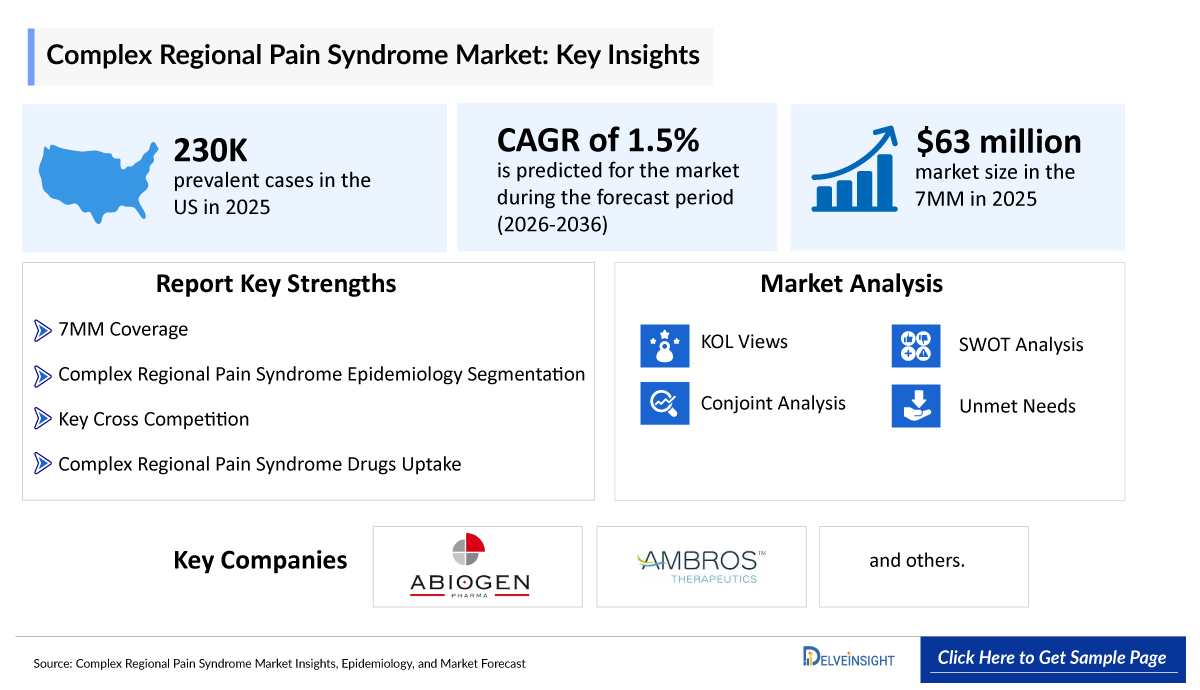
DelveInsight's ‘Complex Regional Pain Syndrome (CRPS) – Market Insights, Epidemiology and Market Forecast – 2036’ report delivers an in-depth understanding of the CRPS, historical and forecasted epidemiology, as well as the CRPS market trends in the United States, EU4 (Germany, Spain, Italy, and France), the United Kingdom, and Japan.
The Complex Regional Pain Syndrome (CRPS) market report delivers a comprehensive analysis of the current treatment landscape, including standards of care, clinical practices, and evolving therapeutic algorithms. It evaluates CRPS patient burden trends, revenue & market share dynamics, peak patient share & therapy uptake analysis, and provides an in-depth market size assessment, and growth rate projections (Historical & Forecast 2022–2036) across global regions. The report highlights key unmet medical needs in CRPS and maps the competitive and clinical landscape to uncover high‑value opportunities, providing a clear outlook on future market growth potential.
|
Study Period |
2022–2036 |
|
Historical Year |
2022–2025 |
|
Forecast Period |
2026–2036 |
|
Base Year |
2026 |
|
Geographies Covered |
|
|
Complex Regional Pain Syndrome (CRPS) Market CAGR (Forecast period) |
1.5% (2026–2036) |
|
CRPS Epidemiology Segmentation Analysis |
Patient Burden Assessment
|
|
CRPS Companies |
|
|
CRPS Therapies |
|
|
CRPS Market |
Segmented by
|
|
Analysis |
|
Key Factors Driving the Complex Regional Pain Syndrome (CRPS) Market
Rising prevalence of chronic pain and CRPS cases
An increasing global burden of chronic pain conditions, along with a growing number of trauma- and surgery-related cases, is expanding the patient pool. This increase contributes to higher demand for effective CRPS therapies and long-term pain management solutions.
Growing geriatric population and at-risk groups
An aging population more susceptible to fractures, surgeries, and nerve injuries represents a key risk group for CRPS, thereby contributing to sustained market demand over time.
Favorable regulatory and healthcare support
Regulatory incentives for innovative pain therapies, including government support mechanisms such as orphan drug designation and fast-track approval for rare diseases, help lower development barriers and speed up commercialization.
Complex Regional Pain Syndrome (CRPS) Understanding and Treatment Algorithm
Complex Regional Pain Syndrome (CRPS) Overview and Diagnosis
CRPS, also known as Reflex Sympathetic Dystrophy (RSD), causalgia, and algodystrophy, is a chronic and often progressive pain disorder that typically develops after trauma, surgery, or immobilization. It is broadly classified into CRPS Type I (formerly RSD), where no confirmed nerve injury is present, and CRPS Type II (causalgia), which occurs following a defined nerve injury. The condition is characterized by persistent, severe pain that is disproportionate to the triggering event, along with symptoms such as swelling, skin color and temperature changes, allodynia, and motor dysfunction. Its underlying mechanisms involve neuroinflammation, central and peripheral sensitization, and autonomic dysregulation.
Diagnosis is primarily clinical and is commonly established using the Budapest criteria, which evaluate sensory, vasomotor, sudomotor, and motor/trophic abnormalities. There are no definitive laboratory tests for CRPS. However, imaging techniques such as MRI or bone scintigraphy may support diagnosis and help exclude other conditions. Early diagnosis and intervention are critical to improving outcomes.
Further details are provided in the report.
Current Complex Regional Pain Syndrome (CRPS) Treatment Landscape
Management of CRPS requires a multidisciplinary approach, combining pharmacologic therapy, physical rehabilitation, and interventional strategies. Among available pharmacologic options, bisphosphonates have demonstrated consistent clinical benefit, particularly in early-stage disease. NERIXIA (neridronate) is an IV bisphosphonate that has shown significant efficacy in reducing pain and improving functional outcomes in patients with CRPS. Its mechanism involves inhibition of osteoclast activity along with modulation of inflammatory pathways implicated in disease progression.
Further details related to country-based variations are provided in the report.
Complex Regional Pain Syndrome (CRPS) Unmet Needs
The section “unmet needs of Complex Regional Pain Syndrome (CRPS)” outlines the critical gaps between the current state of patient care, diagnosis, and the ideal & effective management of the disease. It highlights the obstacles experienced by patients, clinicians, and researchers and identifies potential solutions for future progress.
- Delayed diagnosis
- Limited effective treatment options
- Inadequate support system
- Multidisciplinary Care, and others…..
Note: Comprehensive unmet needs insights in CRPS and their strategic implications are provided in the full report.
Complex Regional Pain Syndrome (CRPS) Epidemiology
Key Findings from CRPS Epidemiological Analysis and Forecast
- In 2025, among the 7MM, the US accounted for the highest prevalent cases of CRPS with approximately 230,000 cases. These cases are anticipated to increase during the forecast period.
- Among the types-specific cases of CRPS, Type I accounts for the majority of cases compared to Type II.
- The highest number of age-specific cases was among the age group 40-59 years.
Complex Regional Pain Syndrome (CRPS) Drug Analysis & Competitive Landscape
The CRPS drug chapter provides a detailed, market-focused review of approved therapies. It covers mechanism of action, clinical trial data, regulatory approvals, patents, collaborations, strategic partnerships upcoming Key catalyst for each therapy, along with their advantages, limitations, and recent developments. This section offers critical insights into the CRPS treatment landscape, supporting market assessment, competitive analysis, and growth forecasting for the CRPS therapeutics market.
Approved Therapies for Complex Regional Pain Syndrome (CRPS)
Sodium neridronate/Neridronate (NERIXIA): Ambros and Abiogen Pharma
NERIXIA, developed by Abiogen Pharma, is an aminobisphosphonate therapy used primarily in bone metabolism disorders. It works by inhibiting bone resorption and modulating inflammatory processes, which are believed to contribute to CRPS pathophysiology. It has been approved and marketed in Italy for CRPS since 2016. It is available in three pack sizes. Ambros licensed the rights to neridronate from the Italian pharmaceutical company, Abiogen Pharma S.p.A., under a strategic collaboration, providing Ambros with exclusive rights to neridronate in North America, with an option for broader market expansion. Neridronate was granted Breakthrough Therapy, Fast-Track & Orphan Designation by the FDA.
Note: Detailed marketed therapies assessment of therapies will be provided in the final report.
Complex Regional Pain Syndrome (CRPS) Marketed/Approved Therapies | ||||||
|
Drug/Therapy |
Company |
Indication |
Molecule Type |
MoA |
RoA |
Marketed Region |
|
Neridronate (NERIXIA) |
Abiogen Pharma |
CRPS |
Small molecule |
Osteoclastic bone resorption inhibitor |
IV infusion |
IT:2016 |
Complex Regional Pain Syndrome (CRPS) Key Players and Market Leader
- Abiogen Pharma
- Ambros
Complex Regional Pain Syndrome (CRPS) Drug Updates
- In March 2026, Ambros Therapeutics announced that the United States Patent and Trademark Office (USPTO) had issued a Notice of Allowance for a new U.S. patent application covering methods of selectively treating patients having CRPS-1. The granting of this patent will enhance the Company’s intellectual property (IP) portfolio and strengthen the potential for neridronate exclusivity through 2045.
- In December 2025, Ambros Therapeutics announced its launch as a clinical-stage biotechnology company advancing late-stage therapies for severe, underserved diseases, beginning with neridronate for CRPS-1.
- In June 2016, the Italian Medicines Agency (AIFA) officially released the data sheet for Nerixia for the treatment of CRPS. The approval was based on the EU CTR 2007-003372-18 study. The trial concluded that the primary endpoints of the study have demonstrated that Neridronate administered at the dosage of 100 mg, 4 IV infusions in a course of 10 days of treatment, is much more effective than placebo in reducing pain in patients with the syndrome.
Complex Regional Pain Syndrome (CRPS) Market Outlook
The therapeutic approach to CRPS has evolved from largely empirical symptom control toward more mechanism-oriented and evidence-supported interventions. Historically, treatment relied on physical rehabilitation, analgesics, and off-label neuropathic agents, often delivering inconsistent and short-term relief. However, growing insights into inflammatory and bone-related pathways in CRPS have enabled the introduction of more targeted pharmacologic options. The off-label therapies used for managing pain and symptoms in CRPS are anticonvulsants (gabapentin), antidepressants (amitriptyline), bisphosphonates, ketamine, low-dose naltrexone (LDN), and topical lidocaine.
One notable advancement has been the use of bisphosphonates, particularly NERIXIA (neridronate), developed by Abiogen Pharma. Neridronate has demonstrated clinically meaningful benefits in CRPS—especially in early-stage disease by reducing pain, inflammation, and functional impairment. Randomized clinical studies have shown significant reductions in pain scores and improvement in clinical symptoms compared to placebo, with sustained benefits observed over longer follow-up periods.
- Among currently available pharmacologic treatments for CRPS, therapy such as neridronate (NERIXIA) is expected to capture increasing clinical attention, driven by stronger evidence supporting its efficacy in pain reduction and disease modification.
- Conventional therapies, including neuropathic pain medications, corticosteroids, and physical therapy, are likely to remain essential components of care, particularly in combination regimens. At the same time, emerging neuromodulation techniques and investigational therapies are expected to further diversify the treatment landscape, contributing to a more structured and competitive approach to CRPS management over time.
Further details will be provided in the report….
Drug Class/Insights into Marketed Therapies in CRPS (2022–2036 Forecast)
The CRPS market comprises small-molecule targeting aspects of CRPS.
- Small molecule: NERIXIA (neridronate) has introduced a more targeted pharmacologic approach in the management of CRPS, particularly in patients with early-stage disease. It inhibits osteoclast-mediated bone resorption and modulates inflammatory processes, which are implicated in CRPS pathophysiology.
Small molecules define the core innovation landscape in CRPS.
Complex Regional Pain Syndrome (CRPS) Drug Uptake
This section focuses on the uptake rate of potential drugs in the market during the forecast period (2026–2036). The analysis covers the CRPS drug’s uptake, performance at peak, factors affecting performance during prime years of growth, patient uptake by therapy, and anticipated sales generated by each drug.
The uptake of therapies in CRPS is expected to vary based on clinical positioning, mechanism of action, and stage of development. NERIXIA is a bisphosphonate therapy used in CRPS and is expected to maintain a meaningful role in patients, particularly in early-stage disease, due to its clinically demonstrated ability to reduce pain and improve functional outcomes in a condition with limited disease-modifying options.
Detailed insights into emerging therapies' drug uptake are included in the report.
Market Access and Reimbursement of Approved Therapies in Complex Regional Pain Syndrome (CRPS)
The report further provides detailed insights on the country-wise accessibility and reimbursement scenarios, cost-effectiveness scenario of approved therapies, programs making accessibility easier and out-of-pocket costs more affordable, insights on patients insured under federal or state government prescription drug programs, etc.
The United States
|
Italy Reimbursement of Therapies Approved for CRPS | |
|
Drug/Therapy |
Access Program |
|
NERIXIA |
Class A and H |
Reimbursement is a crucial factor that affects the drug’s access to the market. Often, the decision to reimburse comes down to the price of the drug relative to the benefit it produces in treated patients. To reduce the healthcare burden of these high-cost therapies, many payment models are being considered by payers and other industry insiders.
NOTE: Further Details are provided in the final report….
Industry Experts and Physician Views for Complex Regional Pain Syndrome (CRPS)
To keep up with CRPS market trends, we take Key Opinion Leaders (KOLs) and Subject Matter Experts (SMEs) opinions working in the domain through primary research to fill the data gaps and validate our secondary research. Industry experts were contacted for insights on the CRPS emerging therapies, evolving treatment landscape, patient adherence to conventional therapies, therapy switching trends, drug adoption and uptake, accessibility challenges, and epidemiology and real-world prescription patterns in CRPS, including MD, PhD, Instructor, Postdoctoral Researcher, Professor, Researcher, and others.
DelveInsight’s analysts connected with 15+ KOLs to gather insights at the country level. Centers such as the Johns Hopkins University, University of Liverpool, and University of Campania, etc. were contacted. Their opinion helps understand and validate current and emerging CRPS therapies, highlight unmet medical needs, provide epidemiological context, and support strategic decisions for market access, therapy adoption, and pipeline prioritization in CRPS.
|
Region |
Key Opinion Leaders (KOLs) and Subject Matter Experts (SMEs) |
|
United States |
“While diagnosis has improved, therapeutic uncertainty persists, and CRPS treatments lack strong, high-quality evidence, with limited randomized controlled trial support.” |
|
Italy |
“CRPS is a rare, complex, and highly variable condition that follows trauma or surgery and presents with disproportionate pain and multisystem involvement. It is important to detect it early and have a structured rehabilitation-based management, as delayed treatment is associated with poorer functional outcomes. A multimodal approach combining rehabilitation, pharmacologic therapy, and physical modalities should be considered, tailored to individual patient presentation.” |
Qualitative Analysis: SWOT and Conjoint Analysis
We perform qualitative and market Intelligence analysis using various approaches, such as SWOT analysis and conjoint analysis.
In the SWOT analysis of CRPS, strengths, weaknesses, opportunities, and threats in terms of disease diagnosis, patient awareness, patient burden, competitive landscape, cost-effectiveness, and geographical accessibility of therapies are provided.
Conjoint analysis analyzes emerging therapies based on relevant attributes such as safety, efficacy, frequency of administration, route of administration, and order of entry. Scoring is given based on these parameters to analyze the effectiveness of therapy.
The team of analysts analyzes promising emerging therapies based on relevant attributes such as safety, efficacy, frequency of administration, route of administration, and order of entry. In efficacy, the trial’s primary and secondary outcome measures are evaluated, whereas the therapies’ safety is evaluated, wherein the acceptability, tolerability, and adverse events are mainly observed. In addition, the scoring is also based on the route of administration, order of entry, probability of success, and the addressable patient pool for each therapy. According to these parameters, the final weightage score and the ranking of the emerging therapies are decided.
Scope of the Report
- The report covers a segment of key events, an executive summary, a descriptive overview of CRPS, explaining its causes, signs and symptoms, pathogenesis, and currently available treatments.
- Comprehensive insight has been provided into the epidemiology segments and forecasts, the future growth potential of the diagnosis rate, and disease progression along treatment guidelines.
- Additionally, an all-inclusive account of both the current and emerging treatments, along with the elaborate profiles of late-stage and prominent therapies, will have an impact on the current treatment landscape.
- A detailed review of the CRPS market, historical and forecasted market size, market share by therapies, detailed assumptions, and rationale behind our approach is included in the report, covering the 7MM drug outreach.
- The report provides an edge while developing business strategies by understanding trends through SWOT analysis and expert insights/KOL views, patient journey, and treatment preferences that help in shaping and driving the 7MM CRPS market.
Report Insights
- Complex Regional Pain Syndrome (CRPS) Patient Population Forecast
- Complex Regional Pain Syndrome (CRPS) Therapeutics Market Size
- Complex Regional Pain Syndrome (CRPS) Pipeline Analysis
- Complex Regional Pain Syndrome (CRPS) Market Size and Trends
- Complex Regional Pain Syndrome (CRPS) Market Opportunity (Current and forecasted)
Report Key Strengths
- Epidemiology‑based (Epi‑based) Bottom‑up Forecasting
- Artificial Intelligence (AI)-Enabled Market Research Report
- 11-Year Forecast
- Complex Regional Pain Syndrome (CRPS) Market Outlook (North America, Europe, Asia-Pacific)
- Patient Burden Trends (By Geography)
- Complex Regional Pain Syndrome (CRPS) Treatment Addressable Market (TAM)
- Complex Regional Pain Syndrome (CRPS) Competitive Landscape
- Complex Regional Pain Syndrome (CRPS)) Major Companies Insights
- Complex Regional Pain Syndrome (CRPS) Price Trends and Analogue Assessment
- Complex Regional Pain Syndrome (CRPS) Therapies Drug Adoption/Uptake
- Complex Regional Pain Syndrome (CRPS) Therapies Peak Patient Share Analysis
Report Assessment
- Complex Regional Pain Syndrome (CRPS) Current Treatment Practices
- Complex Regional Pain Syndrome (CRPS) Unmet Needs
- Complex Regional Pain Syndrome (CRPS) Clinical Development Analysis
- Complex Regional Pain Syndrome (CRPS) Emerging Drugs Product Profiles
- Complex Regional Pain Syndrome (CRPS) Market Attractiveness
- Complex Regional Pain Syndrome (CRPS) Qualitative Analysis (SWOT and conjoint analysis)
FAQs
Market Insights
- What was the CRPS market size, the market size by therapies, market share (%) distribution in 2025, and what would it look like by 2036? What are the contributing factors for this growth?
- What are the anticipated pricing variations among different geographies for the emerging therapies in the future?
- What can be the future treatment paradigm of CRPS?
- What are the disease risks, burdens, and unmet needs of CRPS? What will be the growth opportunities across the 7MM concerning the patient population with CRPS?
- Who is the major future competitor in the market, and how will the competitors affect their market share?
- What are the current options for the treatment of CRPS? What are the current guidelines for treating CRPS in the US, Europe, and Japan?
Reasons to Buy
- The report will help in developing business strategies by understanding the latest trends and changing treatment dynamics driving the CRPS market.
- Bottom‑up forecasting builds from the affected population to product forecasts, delivering a robust, data‑driven approach ideal for new therapies and novel classes.
- Insights on patient burden/disease incidence, evolution in diagnosis, and factors contributing to the change in the epidemiology of the disease during the forecast years.
- Understand the existing market opportunities in varying geographies and the growth potential over the coming years.
- Identifying strong upcoming players in the market will help devise strategies to help get ahead of competitors.
- Detailed analysis and ranking of class-wise potential current and emerging therapies under the conjoint analysis section to provide visibility around leading classes.
- To understand KOLs’ perspectives on the accessibility, acceptability, and compliance-related challenges of existing treatment to overcome barriers in the future.
- Detailed insights into the unmet needs of the existing market so that the upcoming players can strengthen their development and launch strategy.
- This Artificial Intelligence (AI)‑enabled report summarizes and simplifies complex datasets within the report into clear, actionable insights for stakeholders, investors, and healthcare providers, enabling faster, data‑driven decisions.