
Cone Rod Dystrophy Market Summary
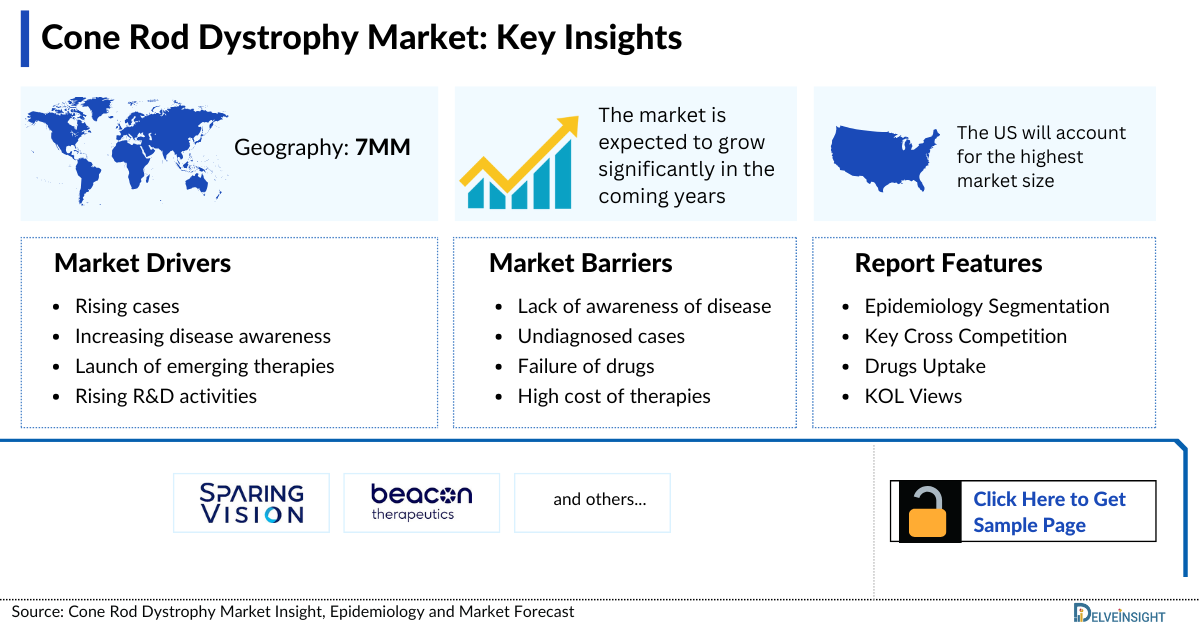
- The Cone Rod Dystrophy Market Dynamics are expected to change significantly in the coming years, with a shift towards personalized medicine and precision therapeutics. This shift is fueled by advancements in genetic research, allowing for the development of tailored treatments based on an individual's genetic profile.
- The leading Cone Rod Dystrophy Companies such as Sparing Vision’s, Beacon Therapeutics and others.
Cone Rod Dystrophy Market & Epidemiology Analysis
- Cone Rod Dystrophy, a rare inherited retinal disorder, is expected to see an increase in its epidemiology due to improved diagnostic capabilities and increased awareness among healthcare professionals. Additionally, advancements in genetic testing have led to more accurate diagnosis and identification of affected individuals, contributing to the growth in reported cases.
- In the majority of cases where the disease cause was identified at the molecular level, recessive inheritance was predominant. Variants in the ABCA4 gene constituted a significant portion, accounting for approximately 62% of autosomal recessive CRD cases.
- Progressive cone dystrophy is typically more common among people with Cone Rod Dystrophy compared to stationary cone dystrophy. This Cone Rod Dystrophy Prevalence can be attributed to the progressive nature of the disease, wherein individuals experience a gradual deterioration of cone photoreceptor cells in the retina, leading to worsening vision over time.
Request for Unlocking the Sample Page of the "Cone Rod Dystrophy Treatment Market"
Key Factors Driving the Cone Rod Dystrophy Market Growth
-
Growing Awareness and Early Diagnosis
Increased recognition of inherited retinal disorders and the adoption of advanced genetic testing are enabling earlier detection of cone rod dystrophy, expanding the identifiable patient pool.
-
Advancements in Genetic Testing Technologies
Next-generation sequencing, whole-exome sequencing, and panel-based testing have significantly improved diagnostic accuracy, encouraging more patients to seek proper treatment pathways.
-
Rising Focus on Gene Therapy Development
With cone rod dystrophy being a genetically driven condition, multiple research programs are exploring innovative gene replacement and gene editing approaches, fueling pipeline growth.
-
Emergence of Novel Therapeutic Modalities
Advancements in neuroprotective agents, optogenetics, and cell-based therapies are offering promising avenues for slowing or reversing disease progression.
-
Improved Access to Specialized Eye Care
The global expansion of retinal disease centers and the increased availability of ophthalmic specialists are enhancing diagnosis, treatment, and patient management.
-
Supportive Regulatory Environment for Rare Diseases
Regulatory incentives such as orphan drug designations, priority reviews, and accelerated approval pathways are encouraging innovation and speeding up the development of novel treatments.
-
Rising Advocacy and Patient Support Initiatives
Non-profit organizations and patient communities are playing a crucial role in promoting disease awareness, supporting research funding, and improving patient engagement.
-
High Unmet Medical Need
With no curative therapy currently available, the strong demand for disease-modifying treatments continues to drive intense research and commercial interest in this area.
DelveInsight’s comprehensive report titled “Cone Rod Dystrophy Treatment Market Insights, Epidemiology, and Market Forecast – 2034” offers a detailed analysis of Cone Rod Dystrophy. The report presents historical and projected epidemiological data covering Total Prevalent Cases of Cone Rod Dystrophies (CRD), Type-specific Preavlent Cases of Cone Rod Dystrophies (CRD), Inheritance-specific Prevalent Cases of Cone Rod Dystrophies (CRD), and Diagnosed and Treatable cases of Cone Rod Dystrophies (CRD). In addition to epidemiology, the market report encompasses various aspects related to the patient population. These aspects include the diagnosis process, prescription patterns, physician perspectives, market accessibility, treatment options, and prospective developments in the market across seven major markets: the United States, EU4 (Germany, France, Italy, and Spain), the United Kingdom, and Japan, spanning from 2020 to 2034.
The Cone Rod Dystrophy Treatment Market Size Report analyzes the existing treatment practices and unmet medical requirements in Cone Rod Dystrophy. It evaluates the market potential and identifies potential business prospects for enhancing therapies or interventions. This valuable information enables stakeholders to make well-informed decisions regarding product development and strategic planning for the market.
Scope of the Cone Rod Dystrophy Market | |
|
Study Period |
2020–2034 |
|
Forecast Period |
2024–2034 |
|
Geographies Covered |
US, EU4 (Germany, France, Italy, and Spain) and the UK, and Japan |
|
Cone Rod Dystrophy Epidemiology |
|
|
Cone Rod Dystrophy Market |
|
|
Cone Rod Dystrophy Market Analysis |
|
|
Cone Rod Dystrophy Companies |
|
|
Market Drivers |
The growth of the Cone Rod Dystrophy market is propelled by several key factors. The CRD market is driven by advances in genetic testing, promising developments in targeted and gene therapies, and increasing awareness among healthcare professionals and patients. |
Cone Rod Dystrophy Disease Understanding
Cone Rod Dystrophy encompasses a group of inherited retinal disorders marked by the gradual breakdown of cone and rod photoreceptor cells in the retina. These cells play vital roles in central and peripheral vision, with their degeneration leading to symptoms such as diminished visual acuity, color vision disturbances, light sensitivity, and challenges in adapting to changes in lighting conditions. The condition can manifest at any age, with symptoms typically worsening over time.
CRD arises from mutations in various genes involved in retinal function, resulting in photoreceptor dysfunction and eventual cell death. The severity of CRD varies widely among individuals, ranging from mild vision impairment to legal blindness, and its progression can be unpredictable, with some experiencing gradual vision loss over decades while others face a more rapid decline.
Cone Rod Dystrophy Diagnosis and Treatment Algorithm
The diagnostic pathway for Cone Rod Dystrophy involves a systematic approach. Patients suspected of CRD undergo a thorough ophthalmic assessment, including visual acuity testing, dilated fundus examination, and electrophysiological testing such as electroretinography (ERG) to evaluate photoreceptor function. Genetic testing plays a pivotal role in confirming the diagnosis, pinpointing specific gene mutations, and differentiating CRD from other retinal dystrophies. This is achieved through advanced techniques like next-generation sequencing and targeted gene panels. To exclude similar conditions such as retinitis pigmentosa and macular dystrophies, ancillary tests like optical coherence tomography (OCT) and fundus autofluorescence imaging are employed as part of the differential diagnosis process.
In managing CRD, regular monitoring of vision and retinal function is essential for tracking disease progression and implementing timely interventions. Treatment strategies often focus on optimizing remaining vision through the use of low vision aids and assistive technologies. Additionally, lifestyle adjustments, such as modifying lighting environments and implementing visual aids, can help individuals adapt to visual limitations and maintain their quality of life. While there is currently no cure for CRD, ongoing research into gene therapies and other innovative treatments holds promise for improving outcomes and potentially halting or slowing disease progression in the future.
Cone Rod Dystrophy Epidemiology
The epidemiology section on the Cone Rod Dystrophy market report offers information on the patient populations, including historical and projected trends for each of the seven major markets. Examining key opinion leader views from physicians or clinical experts can assist in identifying the reasons behind historical and projected trends. The Cone Rod Dystrophy Diagnosed Patient Pool, their trends, and the underlying assumptions are all included in this section of the report. This section also presents the data with relevant tables and graphs, offering a clear and concise view of the prevalence of Cone Rod Dystrophy. Additionally, the report discloses the assumptions made during the analysis, ensuring data interpretation and presentation transparency. This epidemiological data is valuable for understanding the disease burden and its impact on the patient population across various regions.
Key Findings from the Cone Rod Dystrophy Epidemiological Forecast
- CRDs affect roughly 1 in 40,000 individuals in Europe. The most frequently mutated genes include ABCA4 (1p22.1), responsible for 30 to 60% of autosomal recessive cases; CRX (19q13.33) and GUCY2D (17p13.1), implicated in numerous autosomal dominant cases; and RPGR (Xp11.4), linked to X-linked CRDs.
- Inherited cone function disorders are typically categorized into two subtypes: stationary and progressive. CRD can be attributed to mutations in numerous genes.
- Estimates suggest that approximately 56.3% of patients with Cone Rod Dystrophy have had disease-causing genes identified, while the remaining 43.7% of cases remain unresolved.
- The majority of molecularly defined diseases appear to be recessively inherited, with variants in the ABCA4 gene accounting for approximately 62.2% of autosomal recessive CRD cases. In autosomal dominant-inherited cases, variants in the GUCY2D gene constitute around 34.6%, while RPGR variants are prominent in approximately 73.0% of X-linked inherited cases.
- In cases of cone dystrophy occurring sporadically or inherited in an autosomal dominant or recessive pattern, both males and females are equally affected. However, in the X-linked form of cone dystrophy, the condition predominantly affects males, although some females may exhibit mild symptoms.
- Out of the total cases, approximately 50% were diagnosed with autosomal recessive macular dystrophy (arMD) or autosomal recessive cone-rod dystrophy (arCRD), 22.7% with autosomal recessive retinitis pigmentosa (arRP), and 27.3% with autosomal dominant RP (adRP).
Cone Rod Dystrophy Market Recent Breakthroughs
- In December 2025, Ascidian Therapeutics Inc. announced an open-label, single-ascending-dose clinical study in participants with ABCA4-related retinopathies. This first-in-human trial will evaluate the safety, tolerability, and preliminary efficacy of ACDN-01 following a single subretinal injection, marking an important milestone in the development of RNA-based therapies for inherited retinal diseases.
- In December 2025, BlueRock Therapeutics launched a Phase 1/2a, first-in-human, multisite, two-part interventional study to assess the safety, tolerability, and clinical outcomes of OpCT-001 in approximately 54 adults with primary photoreceptor disease. Phase 1 will focus on safety using a dose-escalation design, while Phase 2 will expand safety evaluation and examine the impact of OpCT-001 on visual function, functional vision, and anatomical engraftment across different patient subgroups.
Cone Rod Dystrophy Market Outlook
The primary goal of treating CRD is to slow disease progression, preserve remaining vision, and improve the quality of life for affected individuals. This involves addressing symptoms such as decreased visual acuity, color vision abnormalities, and photophobia, while also targeting the underlying genetic defects responsible for the disease. Currently, treatment options for CRD are limited, with management primarily focusing on supportive care and symptom relief. Low vision aids, including glasses, magnifiers, and adaptive technology, are commonly prescribed to optimize visual function and assist with daily activities. Additionally, lifestyle modifications and rehabilitation services help individuals adapt to visual impairment and maintain independence. While these approaches can improve quality of life, they do not address the underlying cause of CRD.
Some ophthalmologists believe that treatment with high doses of Vitamin A can slow the progression. Patients with specific forms of CRDs can be advised to adopt strategies to try to slow degeneration, based on the knowledge of gene function or investigation of animal models. Presently, there is no specific pharmacological treatment approved for Cone-Rod Dystrophy (CRD). However, ongoing research is exploring various potential therapeutic avenues, including gene therapies, pharmacological interventions targeting specific biochemical pathways involved in CRD pathogenesis, and neuroprotective agents aimed at preserving retinal function. While these approaches show promise in preclinical studies and early-phase clinical trials, further research is needed to establish their safety and efficacy before they can be widely implemented in clinical practice.
With ongoing research and continued dedication, the future holds hope for effective treatments and, ultimately, a cure for this challenging condition. According to DelveInsight, the Cone Rod Dystrophy market in the 7MM is expected to change significantly during the study period 2020–2034.
Cone Rod Dystrophy Drug Analysis
Cone Rod Dystrophy Emerging Drugs
The Cone Rod Dystrophy market is anticipated to undergo gradual transformations primarily due to limited emerging therapy introduction in this domain. Key market players, including SparingVision, Beacon Therapeutics, Applied Genetic Technologies Corp, and others, have demonstrated a keen interest in this rare condition and are actively pursuing the development of potential treatments.
-
SPVN06: SparingVision
SPVN06, developed by SparingVision, is a groundbreaking gene therapy designed to address Inherited Retinal Diseases (IRDs), particularly Retinitis Pigmentosa (RP). Unlike traditional gene therapies, SPVN06 does not target specific genetic mutations but rather aims to slow or halt the degeneration of cone photoreceptors, which are crucial for maintaining vision. It achieves this by delivering proprietary neurotrophic factors, RdCVF and RdCVFL, via a single subretinal injection. These factors promote cone cell survival and protect against oxidative stress. SPVN06 utilizes an Adeno-associated virus (AAV) vector for gene delivery, a method already proven safe and effective in gene therapy. Expected to provide long-lasting neuroprotective effects, SPVN06 holds promise for patients with moderate to severe RP pathology. A Phase I/II study is currently recruiting participants to evaluate the safety and tolerability of a single subretinal administration of SPVN06 gene therapy in individuals with Rod-Cone Dystrophy (RCD) caused by mutations in the RHO, PDE6A, or PDE6B gene.
Note: Detailed emerging therapies assessment and complete list will be provided in the final report.
Cone Rod Dystrophy Market Segmentation
DelveInsight’s ‘Cone Rod Dystrophy Market Insights, Epidemiology, and Market Forecast – 2034’ report provides a detailed outlook of the current and future Cone Rod Dystrophy market, segmented within countries, by therapies, and by classes. Further, the market of each region is then segmented by each therapy to provide a detailed view of the current and future market share of all therapies.
Cone Rod Dystrophy Market Size by Countries
The Cone Rod Dystrophymarket size is assessed separately for various countries, including the United States, EU4 (Germany, France, Italy, and Spain), the UK, and Japan. In 2023, the United States held a significant share of the overall 7MM (Seven Major Markets) Cone Rod Dystrophy market, primarily attributed to the country's higher prevalence of the condition and the elevated cost of the available treatments. This dominance is projected to persist, especially with the potential early introduction of new products.
Cone Rod Dystrophy Market Size by Therapies
Cone Rod Dystrophy Market Size by Therapies is categorized into current and emerging markets for the study period 2020–2034. One of the emerging drugs anticipated to launch during the forecast period is SPVN06 under the developmental pipeline of SparingVision.
Note: Detailed market segment assessment will be provided in the final report.
Cone Rod Dystrophy Drugs Uptake
This section focuses on the sales uptake of potential Cone Rod Dystrophy drugs that have recently been launched or are anticipated to be launched in the Cone Rod Dystrophy market between 2020 and 2034. It estimates the market penetration of Cone Rod Dystrophy drugs for a given country, examining their impact within and across classes and segments. It also touches upon the financial and regulatory decisions contributing to the probability of success (PoS) of the drugs in the Cone Rod Dystrophy market.
Note: Detailed assessment of drug uptake will be provided in the full report on Cone Rod Dystrophy
Cone Rod Dystrophy Market Access and Reimbursement
DelveInsight’s ‘Cone Rod DystrophyMarket Insights, Epidemiology, and Market Forecast – 2034’ report provides a descriptive overview of the market access and reimbursement scenario of Cone Rod Dystrophy. This section includes a detailed analysis of the country-wise healthcare system for each therapy, enlightening the market access, reimbursement policies, and health technology assessments.
Latest KOL Views on Cone Rod Dystrophy
To keep up with current Cone Rod Dystrophy market trends and fill gaps in secondary findings, we interview KOLs and SMEs’ working in the Cone Rod Dystrophy domain. Their opinion helps understand and validate current and emerging therapies and treatment patterns or Cone Rod Dystrophy market trends. This will support the clients in potential upcoming novel treatments by identifying the overall scenario of the market and the Cone Rod Dystrophy unmet needs.
Cone Rod Dystrophy: KOL Insights
DelveInsight’s analysts connected with 50+ KOLs to gather insights; however, interviews were conducted with 15+ KOLs in the 7MM. These KOLs were from organizations, institutes, and hospitals, such as the Physiopathologie et thérapie des déficits sensoriels et moteur, France; Institut des Neurosciences de Montpellier, Augustin Fliche, France; Genetics Department, Fundacion Jimenez Diaz, Madrid, Spain; Centro de Investigacion Biomedica en Red de Enfermedades Raras (CIBERER), ISCIII, Madrid, Spain; University of California San Francisco, School of Medicine,San Francisco, California, USA; among others.
“CRDs diagnosis involves clinical history, fundus examination, and genetic testing, with no current therapy to stop disease progression or restore vision. Prognosis for vision is poor, necessitating supportive care and a multidisciplinary approach.”
Note: Detailed assessment of KOL Views will be provided in the full report on Cone Rod Dystrophy
Cone Rod Dystrophy Competitive Intelligence Analysis
We conduct a Competitive and Market Intelligence analysis of the Cone Rod Dystrophy Market, utilizing various Competitive Intelligence tools such as SWOT analysis, Conjoint Analysis, and Market entry strategies. The inclusion of these analyses is contingent upon data availability, ensuring a comprehensive and well-informed assessment of the market landscape and competitive dynamics.
The emerging Cone Rod Dystrophy therapies are analyzed based on various attributes such as safety and efficacy in randomized clinical trials, order of entry and other market dynamics, and the unmet need they fulfill in the Cone Rod Dystrophy market.
Note: Detailed assessment of SWOT analysis and Conjoint analysis will be provided in the full report on Cone Rod Dystrophy
Cone Rod Dystrophy Pipeline Development Activities
The Cone Rod Dystrophy Therapeutics Market Report offers an analysis of therapeutic candidates in Phase II and III stages and examines Cone Rod Dystrophy Companies involved in developing targeted therapeutics for Cone Rod Dystrophy. It provides valuable insights into the advancements and progress of potential treatments in clinical development for this condition. The report covers information on collaborations, acquisition and merger, licensing, patent details, and other information for emerging Cone Rod Dystrophy therapies.
Cone Rod Dystrophy Market Report Insights
- Patient-based Cone Rod Dystrophy Market Forecasting
- Therapeutic Approaches
- Cone Rod Dystrophy Pipeline Analysis
- Cone Rod Dystrophy Market Size and Trends
- Cone Rod Dystrophy Market Opportunities
- Impact of Upcoming Therapies
Cone Rod Dystrophy Market Report Key Strengths
- 11 Years Cone Rod Dystrophy Market Forecast
- The 7MM Coverage
- Cone Rod Dystrophy Epidemiology Segmentation
- Key Cross Competition
- Highly Analyzed Cone Rod Dystrophy Market
- Cone Rod Dystrophy Drugs Uptake
Cone Rod Dystrophy Market Report Assessment
- Current Cone Rod Dystrophy Treatment Practices
- Cone Rod Dystrophy Unmet Needs
- Cone Rod Dystrophy Pipeline Product Profiles
- Cone Rod Dystrophy Market Attractiveness
Key Questions Answered in the Cone Rod Dystrophy Market Report
- How common is Cone Rod Dystrophy?
- What are the key findings of Cone Rod Dystrophy epidemiology across the 7MM, and which country will have the highest number of patients during the study period (2020–2034)?
- What are the currently available treatments for Cone Rod Dystrophy?
- What is the disease risk, burden, and unmet needs of Cone Rod Dystrophy?
- At what CAGR is the Cone Rod Dystrophy Drugs Market and its epidemiology expected to grow in the 7MM during the forecast period (2024–2034)?
- How would the unmet needs impact the Cone Rod Dystrophy market dynamics and subsequently influence the analysis of the related trends?
- What would be the forecasted patient pool of Cone Rod Dystrophy in the 7MM covering the United States, EU4 (Germany, France, Italy, and Spain), the UK, and Japan?
- Among EU4 and the UK, which country will have the highest number of patients during the forecast period (2024–2034)?
- How many companies are currently developing therapies for the treatment of Cone Rod Dystrophy?
Stay updated with us for Recent Articles @ New DelveInsight Blogs