
Connected Health and Wellness Solutions Market Summary
- The global connected health and wellness solutions market was valued at USD 78.00 billion in 2025 and is projected to reach USD 285.00 billion by 2034.
- The market is expected to expand at a CAGR of 15.5% during the forecast period 2026-2034, supported by the proliferation of wearables and connected devices, the expansion of remote patient monitoring and its reimbursement, the rising burden of chronic disease and the shift toward preventive and value-based care, and the integration of artificial intelligence and health data platforms.
- By product, the wearable devices segment dominated the connected health and wellness solutions market with a 44% share in 2025.
- By connectivity, the Bluetooth segment dominated the connected health and wellness solutions market with a 52% share in 2025.
- By application, the fitness and wellness monitoring segment dominated the connected health and wellness solutions market with a 34% share in 2025.
- By end-user, the individuals and consumers segment dominated the connected health and wellness solutions market with a 56% share in 2025.
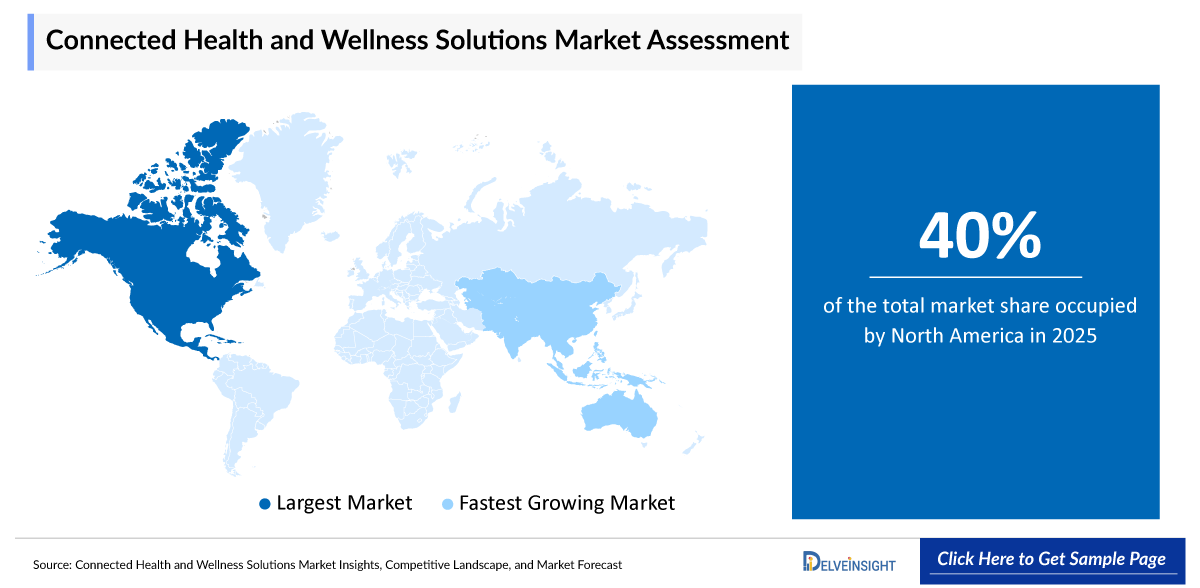
- North America accounted for the largest share of the connected health and wellness solutions market at 40% in 2025, while Asia-Pacific is anticipated to register the fastest growth through 2034.
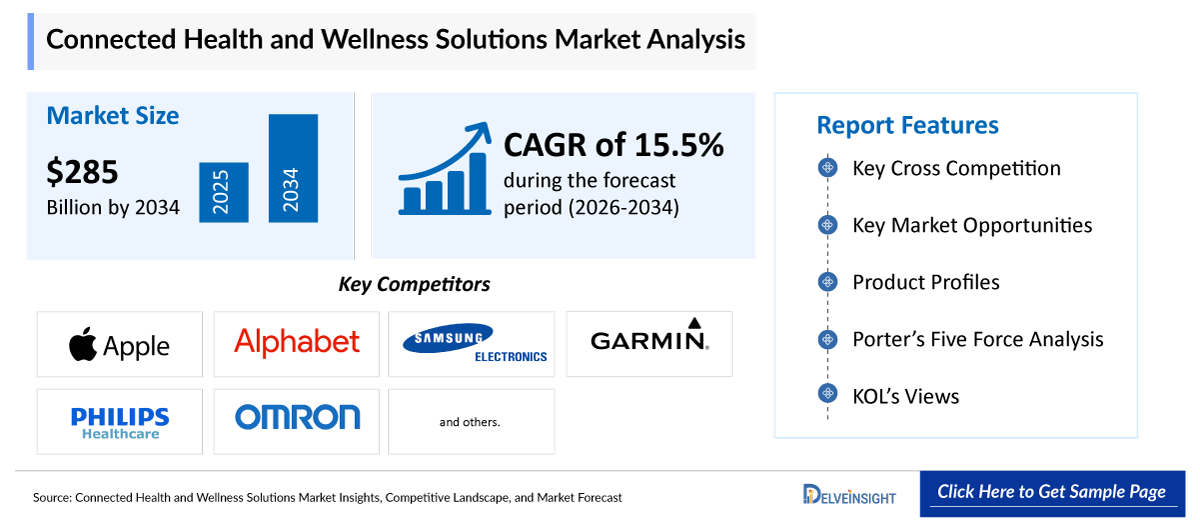
Connected health and wellness solutions are the connected devices, wearables, sensors, software platforms, and services that capture health and wellness data outside traditional clinical settings and transmit it to individuals, caregivers, clinicians, and health systems for tracking, monitoring, and management. The scope encompasses wearable devices such as smartwatches and fitness and health trackers, connected medical and diagnostic devices such as blood pressure monitors, glucose monitors, and pulse oximeters, remote patient monitoring platforms, and the health data platforms and applications that aggregate and analyze the data. Leading participants include consumer technology and wearable companies such as Apple, Google through Fitbit, Samsung, Garmin, Oura, and WHOOP, connected medical device companies such as Omron, Dexcom, Withings, iHealth, and Masimo, and remote patient monitoring and health platform providers. The solutions span consumer wellness and clinical care, and the convergence of consumer wearables and clinical-grade sensing, the expansion of remote patient monitoring, and the integration of artificial intelligence and health data platforms define the contemporary market.
Connected Health and Wellness Solutions Market Key Growth Drivers
- Proliferation of wearables and connected devices, with consumer and clinical wearables from Apple, Fitbit, Garmin, Oura, WHOOP, Withings, and Samsung producing health metrics used for wellness, prevention, and self-management.
- Expansion of remote patient monitoring and its reimbursement, with the Centers for Medicare and Medicaid Services establishing and expanding remote physiologic monitoring codes.
- Rising burden of chronic disease and the shift toward preventive, value-based, and home-based care that connected solutions support.
- Convergence of consumer wellness devices and clinical-grade sensing, with wearables gaining regulated health features.
- Integration of artificial intelligence and health data platforms that aggregate and analyze data from many devices.
- Growth of health and wellness awareness and consumer engagement in fitness, sleep, and preventive health.
- Interoperability and application programming interfaces that connect devices to wellness and clinical platforms and electronic health records.
Key Companies in Connected Health and Wellness Solutions Market
The leading participants in the connected health and wellness solutions market include the following:
- Apple Inc.
- Alphabet Inc.
- Samsung Electronics Co., Ltd.
- Garmin Ltd.
- Koninklijke Philips N.V.
- OMRON Corporation
- Dexcom, Inc.
- Withings SA
- ResMed Inc.
- Masimo Corporation
For illustrative purposes, only the top 10 companies are listed in the Table of Contents. The report may include analysis and references to additional companies relevant to the market assessment.
Connected Health and Wellness Solutions Market Size
The following table summarizes the headline market metrics for the global connected health and wellness solutions market across the base year and the forecast horizon.
|
Report Metrics |
Details |
|
2025 Market Size |
USD 78.00 billion |
|
2034 Projected Market Size |
USD 285.00 billion |
|
Growth Rate (2026-2034) |
15.5% CAGR |
|
Largest Market |
North America (40% share in 2025) |
|
Fastest Growing Market |
Asia-Pacific |
|
Market Structure |
Fragmented |
All market values are expressed in USD and represent DelveInsight estimates synthesized from primary and secondary research.
Factors Contributing to the Growth of the Connected Health and Wellness Solutions Market
Market Drivers
Proliferation of Wearables and Connected Devices
The foundational driver of the connected health and wellness solutions market is the proliferation of wearables and connected devices that capture health and wellness data. Wearable devices such as smartwatches and fitness and health trackers, and connected medical devices such as blood pressure monitors, glucose monitors, scales, and pulse oximeters, have become widely adopted by consumers and patients, and they provide continuous monitoring of vital health metrics including heart rate, heart rhythm, sleep, activity, oxygen saturation, glucose, and blood pressure. Consumer and clinical wearables from Apple, Google through Fitbit, Garmin, Oura, WHOOP, Withings, and Samsung produce health metrics that consumers use for wellness, prevention, and self-management, and connected medical devices from companies such as Omron and Dexcom provide clinically validated measurements. The widespread adoption of these devices, driven by the growth of smartphones, the falling cost and rising capability of sensors, and consumer interest in health, generates a large and growing base of connected devices and data. The proliferation of devices creates the foundation of the connected health and wellness market, generating the data that platforms and services aggregate and analyze. As wearables and connected devices proliferate and as their capabilities expand, the volume of connected health data and the demand for the platforms and services that use it grow. The proliferation of wearables and connected devices anchors the growth of the connected health and wellness solutions market across the forecast period.
Expansion of Remote Patient Monitoring and Reimbursement
The expansion of remote patient monitoring and its reimbursement is a defining driver that brings connected devices into clinical care and creates a sustainable business model. Remote patient monitoring uses connected devices to capture physiologic data from patients at home and transmit it to clinicians for the management of chronic and acute conditions, and its adoption has grown with the recognition of its clinical and economic value. The Centers for Medicare and Medicaid Services established remote physiologic monitoring reimbursement, with a foundational set of codes for device supply and data transmission and for treatment management, and the Centers have expanded reimbursement, with the calendar year 2026 Physician Fee Schedule introducing new codes that support shorter-duration monitoring and lower time thresholds. Reimbursement requires that devices meet the definition of a medical device under the Food and Drug Administration and that data be collected and transmitted through compliant systems, aligning connected devices with clinical and regulatory requirements. The availability of reimbursement creates a sustainable business model for remote patient monitoring and drives the adoption of connected devices and platforms by providers, and the expansion of reimbursement broadens the conditions and durations that can be monitored and billed. As remote patient monitoring and its reimbursement expand, providers adopt connected devices and platforms, driving the growth of the market. The expansion of remote patient monitoring and its reimbursement sustains demand for connected health solutions across the forecast period.
Rising Burden of Chronic Disease and Shift to Preventive and Value-Based Care
The rising burden of chronic disease and the shift toward preventive, value-based, and home-based care drive the adoption of connected health solutions that monitor and manage health outside the clinic. The rising prevalence of chronic conditions such as diabetes, hypertension, cardiovascular disease, and respiratory disease, driven by the aging population and lifestyle factors, increases the need for continuous monitoring and management, and connected devices and remote monitoring enable the ongoing tracking and management of these conditions at home. The shift toward value-based care, which rewards outcomes and cost management, and the shift toward preventive and home-based care, driven by cost and patient preference, create demand for the connected solutions that monitor patients, detect deterioration, support adherence, and enable care at home. Connected health solutions support the management of chronic disease, the prevention of complications and admissions, and the delivery of care at home, aligning with the goals of value-based and preventive care. The burden of chronic disease, the cost of managing it, and the shift toward value-based, preventive, and home-based care drive the adoption of connected health solutions. As chronic disease rises and as care shifts toward value, prevention, and the home, demand for connected health solutions grows. The rising burden of chronic disease and the shift to preventive and value-based care sustain demand for connected health solutions across the forecast period.
Convergence of Consumer Wellness and Clinical-Grade Sensing
The convergence of consumer wellness devices and clinical-grade sensing is a powerful driver that expands the role and value of connected devices. Consumer wearables have added clinical-grade and regulated health features, including heart rhythm detection, electrocardiogram, oxygen saturation, and other measurements, and clinical devices have added consumer-friendly design and connectivity, blurring the line between consumer wellness and clinical care. Consumer and clinical wearables increasingly produce health metrics that consumers use for wellness, prevention, and self-management and that clinicians use for care, and the strongest providers combine hardware reliability, clinical-grade sensing, regulatory compliance, data security, and workflow integration. The addition of regulated health features to consumer devices, cleared by regulators, brings clinical capability to widely adopted consumer devices, and the adoption of consumer devices for health monitoring expands the reach of connected health. The convergence increases the value and applicability of connected devices, expanding their use from wellness into prevention, screening, and care, and it broadens the market across consumer and clinical settings. As consumer wellness devices gain clinical capability and as clinical devices gain consumer reach, the value and adoption of connected devices grow. The convergence of consumer wellness and clinical-grade sensing sustains demand for connected health solutions across the forecast period.
Integration of Artificial Intelligence and Health Data Platforms
The integration of artificial intelligence and health data platforms is transforming connected health and driving investment in intelligent solutions. The proliferation of connected devices generates large volumes of health data, and artificial intelligence and health data platforms aggregate, normalize, and analyze this data to produce insights, detect patterns, and support decisions. Health data platforms aggregate data from many devices and applications into unified records, and artificial intelligence analyzes the data to detect anomalies, predict deterioration, personalize recommendations, and support clinical and wellness decisions. The integration of artificial intelligence turns the raw data of connected devices into actionable insights, and the aggregation of data across devices and platforms creates comprehensive health records, increasing the value of connected health. The application of artificial intelligence to connected health data supports personalized wellness, early detection, chronic disease management, and clinical decision-making, and it shifts competition toward the intelligence and integration of the platform. As artificial intelligence and health data platforms advance and as they turn connected data into insight, the value and adoption of connected health solutions grow. The integration of artificial intelligence and health data platforms sustains the growth and modernization of the connected health and wellness solutions market across the forecast period.
Growth of Health and Wellness Awareness and Consumer Engagement
The growth of health and wellness awareness and consumer engagement in health drives the adoption of connected wellness devices and platforms. Consumers are increasingly aware of and engaged in their health and wellness, tracking fitness, sleep, nutrition, stress, and other metrics and seeking to manage their health proactively, and this engagement drives the adoption of wearables, health applications, and wellness platforms. The growth of preventive and wellness-oriented health behavior, the interest in fitness, sleep, and mental wellness, and the desire to track and improve health drive consumers to adopt connected devices and applications that measure and support wellness. Employers and payers also adopt wellness programs that use connected devices to engage members and promote health, expanding the reach of connected wellness. The engagement of consumers in their health, the growth of the wellness market, and the adoption of connected devices for fitness, sleep, and wellness drive the consumer segment of the market. As health and wellness awareness and consumer engagement grow, demand for connected wellness devices and platforms grows. The growth of health and wellness awareness and consumer engagement sustains demand for connected health and wellness solutions across the forecast period.
Interoperability and Integration with Clinical Systems
Interoperability and the integration of connected devices with wellness platforms, clinical systems, and electronic health records drive the adoption and value of connected health solutions. Connected devices generate data in many formats through many application programming interfaces, and the integration of this data into wellness platforms, clinical systems, and electronic health records is essential to its use. Interoperability and unified application programming interfaces connect devices to the platforms and records that use their data. Health data integration platforms and application programming interfaces connect wearables and medical devices to wellness and clinical platforms, enabling the transfer of data for decision-making, personalized care, and engagement, and connected devices integrate with electronic health records to support clinical use. The integration of connected device data with clinical systems enables remote monitoring, the use of patient-generated data in care, and the aggregation of health data, and interoperability standards support the exchange of data. The requirement to integrate connected device data into wellness and clinical platforms, and the value of interoperability, drive the adoption of connected solutions and platforms that integrate widely. As interoperability and integration improve and as connected data flows into wellness and clinical platforms, the value and adoption of connected health solutions grow. Interoperability and integration with clinical systems sustain demand for connected health solutions across the forecast period.
Market Restraints
The connected health and wellness solutions market faces several interrelated restraints that temper its growth. The foremost is data privacy and security, since connected devices collect and transmit sensitive health data, and the protection of this data under the Health Insurance Portability and Accountability Act and data protection regulations, and the security of devices and platforms against breaches, impose obligations and risk, and privacy concerns constrain the sharing and use of data. Interoperability and data fragmentation are significant challenges, since connected devices use many proprietary and open application programming interfaces and data formats, and the inconsistency of these interfaces creates integration effort, data normalization challenges, and fragmentation that limit the use of the data.
The regulatory complexity of connected devices, since some are regulated medical devices requiring clearance and others are unregulated wellness devices, creates uncertainty about the clinical use and reliability of data, and the accuracy and validation of consumer devices for clinical use vary. Reimbursement, while expanding for remote patient monitoring, is limited and complex, and the conditions, devices, and durations that qualify are constrained, limiting the clinical business model. The clinical adoption of connected health and patient-generated data faces barriers of workflow integration, data overload, clinician acceptance, and integration with clinical systems. The engagement and adherence of consumers and patients to connected devices can decline over time, limiting sustained value. The cost of devices and platforms, and the digital divide in access to devices and connectivity, constrain adoption among some populations. Together, these factors moderate the pace and scope of adoption and require providers to demonstrate privacy, security, interoperability, accuracy, and value to sustain growth.
Connected Health and Wellness Solutions Market Segment Analysis
The global connected health and wellness solutions market is segmented by product (wearable devices, connected medical and diagnostic devices, remote patient monitoring platforms, and software and applications), by connectivity (bluetooth, cellular, Wi-Fi, and others), by application (fitness and wellness monitoring, chronic disease management, remote patient moniotirng, and others), by end-users (inidvidulas and consumers, helathcare providers, payers and employers, and others), and by geography (North America, Europe, Asia-Pacific, and the Rest of the World).
By Product
Dominant Subsegment: Wearable Devices.
The wearable devices category is expected to dominate the market. The wearable devices segment accounted for a 44% share of the connected health and wellness solutions market in 2025. Wearable devices, including smartwatches, fitness and health trackers, and other worn sensors, are the leading product category because they are the most widely adopted connected health devices, tracking a broad range of health and wellness metrics for large populations of consumers and patients. The dominance of the segment reflects the widespread consumer adoption of wearables, the breadth of metrics they track, and the convergence of consumer and clinical capability in wearable devices. Wearables from Apple, Google through Fitbit, Garmin, Oura, WHOOP, Withings, and Samsung track heart rate, heart rhythm, sleep, activity, oxygen saturation, and other metrics, and they have added clinical-grade and regulated features, expanding their role from wellness into prevention and care. The large consumer base, the breadth and growth of metrics, and the addition of clinical features drive the wearable devices segment, and wearables are the primary connected device for the largest population of users. While connected medical and diagnostic devices, remote monitoring platforms, and software are important categories, the widespread adoption, breadth, and convergence of wearables sustain the leadership of the wearable devices segment across the forecast period.
By Connectivity
Dominant Subsegment: Bluetooth.
The Bluetooth category is expected to dominate the market. The Bluetooth segment accounted for a 52% share of the connected health and wellness solutions market in 2025. Bluetooth connectivity, through which connected devices transmit data to smartphones and hubs, is the leading connectivity technology because it is the predominant means by which wearables and connected medical devices communicate, offering low power consumption, wide device support, and convenient pairing with smartphones. The dominance of the segment reflects the widespread use of Bluetooth in wearables and connected medical devices, the low power and convenience of Bluetooth for battery-powered devices, and the ubiquity of Bluetooth in smartphones that serve as hubs. Wearables and connected medical devices predominantly use Bluetooth to transmit data to companion smartphone applications, which relay the data to platforms and clouds, and the low power consumption of Bluetooth suits the battery constraints of small worn devices. While cellular connectivity, which enables devices to transmit directly without a smartphone, and other connectivity technologies are important and growing, particularly for standalone and remote monitoring devices, the predominance of Bluetooth in the large base of wearables and connected devices sustains the leadership of the Bluetooth segment. The widespread use, low power, and convenience of Bluetooth sustain the leadership of the Bluetooth segment across the forecast period.
By Application
Dominant Subsegment: Fitness and Wellness Monitoring.
The fitness and wellness monitoring category is expected to dominate the market. The fitness and wellness monitoring segment accounted for a 34% share of the connected health and wellness solutions market in 2025. Fitness and wellness monitoring, encompassing the tracking of activity, exercise, sleep, heart rate, stress, and general wellness, is the leading application because it is the primary use of the large base of consumer wearables and health applications and engages the largest population of users. The dominance of the segment reflects the widespread consumer adoption of wearables and applications for fitness and wellness, the breadth of wellness metrics tracked, and the growth of health and wellness awareness and consumer engagement. Consumers use wearables and applications to track fitness, sleep, and wellness for personal health management and engagement, and the large consumer base drives the fitness and wellness application market. While chronic disease management, remote patient monitoring, and other clinical applications are important and growing, and increasingly valuable as connected devices move into clinical care, the widespread consumer adoption and engagement in fitness and wellness sustain the leadership of the fitness and wellness monitoring segment. The large consumer base, the breadth of wellness metrics, and the growth of consumer engagement sustain the leadership of the fitness and wellness monitoring segment across the forecast period.
By End-User
Dominant Subsegment: Individuals and Consumers.
The individuals and consumers category is expected to dominate the market. The individuals and consumers segment accounted for a 56% share of the connected health and wellness solutions market in 2025. Individuals and consumers, who purchase and use wearables, connected devices, and health applications for personal health and wellness, are the leading end-user because they represent the largest base of connected health users and drive the consumer wearable and wellness market. The dominance of the segment reflects the widespread consumer adoption of wearables and health applications, the consumer-driven nature of the wellness market, and the large base of individuals tracking their health and wellness. Consumers purchase and use connected devices for fitness, sleep, wellness, and increasingly health monitoring, and the consumer market drives the volume of connected devices and the growth of the wellness segment. While healthcare providers, payers, and employers are important and growing end-users that adopt connected health for care, monitoring, and wellness programs, the large base of individual consumers and the consumer-driven nature of the wellness market sustain the leadership of the individuals and consumers segment. The large consumer base, the consumer-driven wellness market, and the widespread adoption of wearables sustain the leadership of the individuals and consumers segment across the forecast period, and it shapes the direction of the market.
Connected Health and Wellness Solutions Market Region Analysis
Dominant Region: North America
North America accounted for a 40% share of the global connected health and wellness solutions market in 2025, representing the highest regional market share globally. The leadership of the region reflects the advanced adoption of wearables and connected devices, the reimbursement of remote patient monitoring, the concentration of the leading technology and device companies, and the high awareness of health and wellness. The United States is the largest national market, supported by the high adoption of wearables and connected health devices, the reimbursement of remote patient monitoring by the Centers for Medicare and Medicaid Services, the presence of the leading consumer technology and connected device companies, and the strong consumer engagement in health and wellness. The reimbursement of remote patient monitoring creates a clinical business model; the regulation of connected medical devices by the Food and Drug Administration and the protection of data under the Health Insurance Portability and Accountability Act shape the market; and the advanced digital health ecosystem supports adoption. The leading participants, including consumer technology, wearable, and connected device companies, are headquartered or operate extensively in the region, and the adoption of wearables, remote monitoring, and health platforms is advanced. The advanced adoption, the reimbursement of remote monitoring, the concentration of companies, and the engagement in health and wellness reinforce the leadership of the region. The combination of adoption, reimbursement, company presence, and engagement sustains the position of North America as the largest regional market across the forecast period.
Fastest Growing Region: Asia-Pacific
Asia-Pacific is projected to register the fastest compound annual growth rate through 2034. The region combines large and growing populations, rising smartphone and wearable adoption, growing health and wellness awareness, and the expansion of digital health, which drives the fast growth of the market. China, India, Japan, and South Korea are the principal national markets, supported by the large and growing adoption of smartphones and wearables, the rising middle class and health awareness, the growth of chronic disease and the aging population, and the expansion of digital health and connected devices. The adoption of wearables and connected devices, the growth of health and wellness awareness, and the expansion of digital health and remote monitoring enlarge the demand for connected health solutions. As smartphone and wearable adoption grows, as health awareness rises, and as digital health expands, the region increases its adoption of connected health solutions from a growing base, and the scale of the population and the growth of the middle class create substantial long-term demand. The combination of population scale, wearable adoption, health awareness, and digital health expansion positions Asia-Pacific as the fastest-growing regional market, and it is a central focus of the global technology, wearable, and device companies.
Regional Commentary
North America
North America leads the market, supported by the advanced adoption of wearables and connected devices, the reimbursement of remote patient monitoring, the concentration of the leading technology and device companies, and the high awareness of health and wellness. The United States dominates the region through the high adoption of connected health devices, the reimbursement of remote monitoring, and the presence of the leading companies. The regulation of connected devices and the protection of data shape the market, and consumer engagement sustains demand.
Europe
Europe is a substantial market shaped by the adoption of wearables and connected devices, the growth of digital health, and the presence of vendors including Philips, Withings, and the European operations of the global companies. Germany, the United Kingdom, France, Italy, and Spain are the principal national markets, supported by the adoption of connected health, the growth of preventive and digital health, and the requirements of data protection and medical device regulation. Demand is sustained by health and wellness engagement and the growth of connected and remote care.
Asia-Pacific
Asia-Pacific is the fastest-growing region, driven by large and growing populations, rising smartphone and wearable adoption, growing health awareness, and the expansion of digital health across China, India, Japan, and South Korea. Wearable adoption, the rising middle class, and the expansion of digital health sustain rapid growth, and the region is a central focus of the global technology, wearable, and device companies.
Rest of World
The Rest of World, spanning Latin America, the Middle East, and Africa, represents an emerging opportunity as smartphone and wearable adoption grows and as digital health expands. Growth is supported by the growth of smartphones and connectivity, the rising awareness of health and wellness, and the expansion of digital health, though adoption and access vary by market. Global and regional players pursue these markets through connected devices and platforms suited to growing digital adoption.
Connected Health and Wellness Solutions Market Competitive Landscape
The global connected health and wellness solutions market is classified as Fragmented. A large and diverse group of participants competes across the categories of connected health, including consumer technology and wearable companies, connected medical and diagnostic device companies, remote patient monitoring and health platform providers, and health data and application companies, and no single participant holds a dominant share across the diverse market. Competition centers on the capability and design of devices, the breadth and accuracy of sensing, the intelligence and integration of platforms, interoperability, data security, regulatory clearance and reimbursement relevance, and consumer and clinical engagement, and product launches, regulatory clearances, and platform investment intensify the contest. The competitive landscape is evaluated across the following dimensions:
- Market concentration: Fragmented, with consumer technology and wearable companies, connected medical and diagnostic device companies, remote patient monitoring and health platform providers, and health data and application companies, and no single participant holding a dominant share across the diverse market.
- Leading players: Apple, Alphabet through Fitbit, Samsung, and Garmin lead in consumer wearables; Philips, Omron, Dexcom, Withings, ResMed, and Masimo lead in connected medical and diagnostic devices; and remote patient monitoring and health platform providers contest the clinical and platform segments.
- Geographic reach: The leading consumer technology and device companies operate globally, and connected device, remote monitoring, and platform companies serve consumer and clinical markets across regions.
- Product portfolio strength: Competitive advantage rests on the capability, design, and accuracy of devices and sensing, the breadth across consumer wellness and clinical care, and the intelligence, integration, and interoperability of platforms.
- Pipeline strength: Development is concentrated in advanced sensing and clinical-grade features, artificial intelligence and health data platforms, remote patient monitoring, and interoperability and integration.
- Strategic partnerships: Collaboration spans integration between devices and platforms, partnerships with health systems, payers, and employers, application programming interface and interoperability partnerships, and alliances that connect devices to clinical systems.
- M&A activity: Consolidation has shaped the field, exemplified by the acquisition of Fitbit by Google and the acquisitions of connected device and health platform companies, alongside continued consolidation of wearable, remote monitoring, and platform assets.
- Innovation focus: Innovation is shifting toward advanced and clinical-grade sensing, artificial intelligence and health data platforms, remote patient monitoring, and interoperability and the integration of consumer and clinical health.
- Regulatory standing: Clearance of connected medical devices and health features by the Food and Drug Administration, alignment with remote patient monitoring reimbursement, and compliance with data protection under the Health Insurance Portability and Accountability Act are decisive competitive credentials and a principal axis of competition among the leaders.
Connected Health and Wellness Solutions Market Recent Developmental Activities
In 2021, Alphabet Inc. completed its acquisition of the wearable company Fitbit, integrating its wearables, health-tracking platform, and health data into its ecosystem. Strategic significance: the acquisition brought a leading consumer wearable and health platform into a major technology company and reinforced the convergence of wearables, data, and artificial intelligence.
In 2024 and 2025, the Centers for Medicare and Medicaid Services expanded remote patient monitoring reimbursement, with the calendar year 2026 Physician Fee Schedule finalized in October 2025 introducing new codes supporting shorter-duration monitoring and lower time thresholds. Strategic significance: the expansion broadened the reimbursement of remote patient monitoring and reinforced the clinical business model for connected devices.
In 2024 and 2025, Apple Inc. advanced the health and wellness capabilities of its Apple Watch and health platform, including regulated health features and the aggregation of health data across connected devices. Strategic significance: the developments reinforced the leadership of a major technology company in consumer and clinical wearables and advanced the convergence of wellness and clinical sensing.
In 2024 and 2025, Dexcom, Inc. advanced its continuous glucose monitoring systems and their integration with health applications and electronic health records, including consumer-oriented glucose sensing. Strategic significance: the developments reinforced the leadership of a continuous glucose monitoring company and advanced the convergence of clinical and consumer health sensing.
In 2024 and 2025, OMRON Corporation advanced its connected blood pressure and cardiovascular monitoring devices and its OMRON Connect digital health platform, integrating clinically validated device data into health management. Strategic significance: the developments reinforced the leadership of a connected medical device company in cardiovascular monitoring and connected care.
In 2024 and 2025, Withings SA advanced its connected health devices, including blood pressure monitors, scales, and health-tracking devices, and its health platform. Strategic significance: the developments reinforced the position of a connected health device company bridging consumer wellness and clinical monitoring.
In 2024 and 2025, ResMed Inc. and Masimo Corporation advanced their connected respiratory, sleep, and monitoring devices and their integration with digital health platforms. Strategic significance: the developments reinforced the role of connected clinical monitoring in sleep, respiratory, and physiologic health.
In 2024 and 2025, remote patient monitoring and health platform providers advanced their platforms, integrating connected devices, electronic health records, and analytics to support the monitoring of chronic and acute conditions. Strategic significance: the developments reinforced the role of remote patient monitoring platforms in bringing connected devices into clinical care.
In 2024 and 2025, health data integration and interoperability providers advanced application programming interfaces that connect wearables and medical devices to wellness and clinical platforms and electronic health records. Strategic significance: the developments addressed the fragmentation of connected device data and advanced the interoperability essential to connected health.
In 2024 and 2025, artificial intelligence was integrated across connected health, aggregating and analyzing data from connected devices to detect anomalies, predict deterioration, and personalize recommendations. Strategic significance: the integration of artificial intelligence turned connected data into insight and advanced the value of connected health platforms.
In 2024 and 2025, employers and payers expanded wellness and connected health programs that use wearables and connected devices to engage members and promote health. Strategic significance: the expansion of programs broadened the reach of connected wellness beyond individual consumers.
In 2024 and 2025, the leading participants advanced sensing, artificial intelligence and platforms, remote patient monitoring, and interoperability across connected health and wellness. Strategic significance: the convergence of the leaders on sensing, artificial intelligence, remote monitoring, and interoperability confirmed these as the defining axes of competition and signaled a market advancing toward intelligent, integrated, and clinically relevant connected health.
Connected Health and Wellness Solutions Market Segmentation
Connected Health and Wellness Solutions Market Assessment by Product
- Wearable Devices
- Connected Medical and Diagnostic Devices
- Remote Patient Monitoring Platforms
- Software and Applications
Connected Health and Wellness Solutions Market Assessment by Connectivity
- Bluetooth
- Cellular
- Wi-Fi
- Others
Connected Health and Wellness Solutions Market Assessment by Application
- Fitness and Wellness Monitoring
- Chronic Disease Management
- Remote Patient Monitoring
- Others
Connected Health and Wellness Solutions Market Assessment by End-User
- Individuals and Consumers
- Healthcare Providers
- Payers and Employers
- Others
Connected Health and Wellness Solutions Market Assessment by Geography
- North America
- United States Connected Health and Wellness Solutions Market Size in USD million (2023-2034)
- Canada Connected Health and Wellness Solutions Market Size in USD million (2023-2034)
- Mexico Connected Health and Wellness Solutions Market Size in USD million (2023-2034)
- Europe
- Germany Connected Health and Wellness Solutions Market Size in USD million (2023-2034)
- United Kingdom Connected Health and Wellness Solutions Market Size in USD million (2023-2034)
- France Connected Health and Wellness Solutions Market Size in USD million (2023-2034)
- Italy Connected Health and Wellness Solutions Market Size in USD million (2023-2034)
- Spain Connected Health and Wellness Solutions Market Size in USD million (2023-2034)
- Rest of Europe Connected Health and Wellness Solutions Market Size in USD million (2023-2034)
- Asia-Pacific
- China Connected Health and Wellness Solutions Market Size in USD million (2023-2034)
- Japan Connected Health and Wellness Solutions Market Size in USD million (2023-2034)
- India Connected Health and Wellness Solutions Market Size in USD million (2023-2034)
- Australia Connected Health and Wellness Solutions Market Size in USD million (2023-2034)
- South Korea Connected Health and Wellness Solutions Market Size in USD million (2023-2034)
- Rest of Asia-Pacific Connected Health and Wellness Solutions Market Size in USD million (2023-2034)
- Rest of the World
- Middle East Connected Health and Wellness Solutions Market Size in USD million (2023-2034)
- Africa Connected Health and Wellness Solutions Market Size in USD million (2023-2034)
- South America Connected Health and Wellness Solutions Market Size in USD million (2023-2034)
Connected Health and Wellness Solutions Market Recent Industry Trends and Milestones (2023-2026)
|
Category |
Key Developments |
|
Connected Health and Wellness Solutions Market Product Advancement |
The period was defined by the advancement of sensing, platforms, and clinical integration. Apple advanced its Apple Watch and health platform with regulated features, Dexcom advanced continuous glucose monitoring, Omron and Withings advanced connected cardiovascular and health devices, and ResMed and Masimo advanced connected monitoring. Health platform and remote patient monitoring providers advanced their platforms, and artificial intelligence and interoperability were integrated across connected health. Together, these advances concentrated competition in advanced, intelligent, and clinically relevant connected health. |
|
Connected Health and Wellness Solutions Market Product Expansion |
Product expansion advanced along three axes. The first is advanced and clinical-grade sensing, as devices added regulated health features and clinical-grade measurements. The second is artificial intelligence and platforms, as providers aggregated and analyzed connected data to produce insights and personalize care. The third is remote patient monitoring and interoperability, as providers connected devices to clinical systems and integrated data through application programming interfaces. Providers also expanded chronic disease management and wellness programs for consumers, providers, payers, and employers. |
|
Connected Health and Wellness Solutions Market Investment |
Investment was shaped by the convergence of consumer and clinical health and the expansion of remote monitoring. Technology companies acquired and advanced wearable and health platform assets, exemplified by the acquisition of Fitbit by Google, and connected device, remote monitoring, and platform companies invested in sensing, artificial intelligence, and interoperability. The expansion of remote patient monitoring reimbursement drove investment in connected devices and platforms for clinical care, and investment flowed into artificial intelligence, interoperability, and the integration of consumer and clinical health. |
|
Company Strategy |
The unifying strategic theme is the delivery of intelligent, integrated, and clinically relevant connected health across consumer and clinical settings. Apple, Alphabet, Samsung, and Garmin are advancing consumer wearables and platforms; Philips, Omron, Dexcom, Withings, ResMed, and Masimo are advancing connected medical devices, and remote monitoring and platform providers are advancing clinical platforms. Across the field, strategy centers on advanced sensing, artificial intelligence and platforms, remote patient monitoring, and interoperability across consumer and clinical health. |
|
Emerging Technologies |
The defining emerging technologies are advanced and clinical-grade sensing that brings regulated health measurements to wearables and connected devices; artificial intelligence and health data platforms that aggregate and analyze data to produce insight; remote patient monitoring that brings connected devices into clinical care with reimbursement; and interoperability and application programming interfaces that connect devices to wellness and clinical platforms and electronic health records. Supporting these are cellular and standalone connectivity, longitudinal health data records, and the integration of consumer and clinical health. Across these, the trajectory is toward connected health that is intelligent, integrated, and clinically relevant, improving wellness, prevention, and the management of chronic disease across consumer and clinical settings. |
Connected Health and Wellness Solutions Market Startup Funding and Investment Trends
Investment in the connected health and wellness field has concentrated on technologies that make health data more capable, more intelligent, and more integrated, namely advanced wearables and sensing, remote patient monitoring, artificial intelligence and health data platforms, and interoperability. Because the market is fragmented across consumer technology, connected device, and platform companies, innovators pursue differentiated sensing, monitoring, platform, or interoperability technologies that serve consumer or clinical needs or that a larger company can absorb. The table below summarizes representative companies advancing the next generation of connected health and wellness.
|
Company |
Total Funding |
Funding Stage |
Main Product/Offering |
Core Technology |
|
Oura Health Oy |
Venture-backed |
Commercial stage |
Oura smart ring |
Wearable sleep and readiness sensing |
|
WHOOP, Inc. |
Venture-backed |
Commercial stage |
WHOOP wearable band |
Continuous physiologic and recovery sensing |
|
Request for unlocking the report of the @Connected Health and Wellness Solutions Market | ||||
Capital formation in this field is shaped by the presence of large consumer technology and connected device companies and a broad ecosystem of platform and monitoring providers, so investors have favored companies that introduce differentiated wearables and sensing, remote monitoring and analytics, health data platforms, or interoperability that serve consumer or clinical needs or that a larger company can absorb. Advanced wearables and sensing are a clear thesis, delivering novel form factors and metrics for wellness and health. Remote patient monitoring and analytics constitute a second thesis, bringing connected devices into clinical care with reimbursement, and health data platforms and interoperability a third, aggregating and integrating connected data. The archetypal outcome is acquisition by a consumer technology, connected device, or health company seeking to add capability, exemplified by the acquisition of wearable and platform companies, or growth into a consumer or clinical brand, which provides a path that sustains investment. The principal risks are the scale and reach of the large technology and device companies, the fragmentation and interoperability of connected data, the privacy and security of health data, and the engagement and reimbursement required for sustained value.
Key Takeaways from the Connected Health and Wellness Solutions Market Report Study
- Market size analysis for the current connected health and wellness solutions market size (2025), and market forecast for 9 years (2026 to 2034).
- Top key product and technology developments, mergers, acquisitions, partnerships, and joint ventures that happened over the last 3 years.
- Key companies dominating the global connected health and wellness solutions market.
- Various opportunities available for competitors in the connected health and wellness solutions market space.
- What are the top-performing segments in 2025? How will these segments perform in 2034?
- Which are the top-performing regions and countries in the current connected health and wellness solutions market scenario?
- Which are the regions and countries where companies should concentrate their opportunities for connected health and wellness solutions market growth in the future?
Target audience who can benefit from this connected health and wellness solutions market report study
- Connected health, wearable, connected device, and digital health providers
- Research organizations and consulting companies
- Connected health and wellness-related organizations, associations, forums, and other alliances
- Government and corporate offices
- Start-up companies, venture capitalists, and private equity firms
- Distributors and traders dealing in connected health and wellness solutions
- Various end-users who want to know more about the connected health and wellness solutions market and the latest technological developments in the connected health and wellness solutions market.

