Connective Tissue Disease associated with Interstitial Lung Disease Market
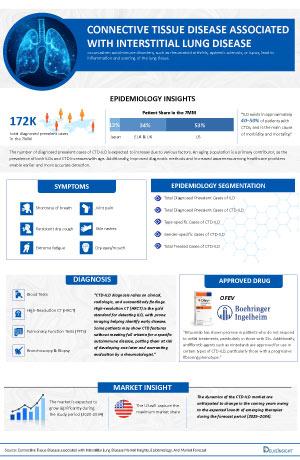
- According to DelveInsight’s estimates, the total Connective Tissue Disease associated with Interstitial Lung Disease Diagnosed Prevalent Cases in the 7MM were estimated to be 1,163 thousand cases in 2023, of which the total diagnosed prevalent CTD-ILD population was 293 thousand; the number of these cases is expected to increase by 2034.
- In 2023, the Connective Tissue Disease associated with Interstitial Lung Disease Treatment Market Size was highest in the US among the 7MM, accounting for approximately USD 1,044 million which is further expected to increase by 2034.
- Various therapies are employed to treat Connective Tissue Disease associated with Interstitial Lung Disease, primarily falling into the categories of Corticosteroids, Immunosuppressants, Biologics, DMARDs, Antifibrotic drugs such as OFEV (nintedanib) and other antibrotic drugs, and Others. Among these, Biologics had the highest market share in 2023, accounting for approximately USD 842 million in the 7MM, according to our analysis.
- The current Connective Tissue Disease associated with Interstitial Lung Disease Treatment includes OFEV (market size of USD 530 million in 2023, in the 7MM), an approved drug for SSc-ILD and other chronic fibrosing CTD-ILDs.
- The Connective Tissue Disease associated with Interstitial Lung Disease Emerging Drugs GSK1550188 (BENLYSTA) and is expected to launch in the US by 2027, in EU4 and the UK by 2028, and in Japan by 2029, which have the potential to reduce the disease burden of Connective Tissue Disease associated with Interstitial Lung Disease in the forecasted years.
Request for Unlocking the Sample Page of the "Connective Tissue Disease associated with Interstitial Lung Disease Treatment Market"
DelveInsight’s “Connective Tissue Disease associated with Interstitial Lung Disease Market Insights, Epidemiology, and Market Forecast – 2034” report deliver an in-depth understanding of the Connective Tissue Disease associated with Interstitial Lung Disease, historical and forecasted epidemiology as well as the Connective Tissue Disease associated with Interstitial Lung Disease market trends in the United States, EU4 and the UK (Germany, France, Italy, Spain) and the United Kingdom, and Japan.
The Connective Tissue Disease associated with Interstitial Lung Disease Treatment Market Report provides current treatment practices, emerging drugs, and market share of the individual therapies, current and forecasted 7MM Connective Tissue Disease associated with Interstitial Lung Disease market size from 2020 to 2034. The Report also covers current Connective Tissue Disease associated with Interstitial Lung Disease treatment practice, market drivers, market barriers, SWOT analysis, reimbursement and market access, and unmet medical needs to curate the best of the opportunities and assesses the underlying potential of the market.
|
Study Period |
2020 to 2034 |
|
Forecast Period |
2024-2034 |
|
Geographies Covered |
|
|
Connective Tissue Disease associated with Interstitial Lung Disease Drugs Market |
|
|
Connective Tissue Disease associated with Interstitial Lung Disease Market Size | |
|
Connective Tissue Disease associated with Interstitial Lung Disease Companies |
|
Connective Tissue Disease associated with Interstitial Lung Disease Treatment Market
Interstitial lung disease (ILD) includes a diverse group of lung diseases involving inflammation and/or fibrosis throughout the lung tissue. Causes can be known (like drugs, environmental factors, occupational exposures, or systemic diseases) or unknown (like idiopathic interstitial pneumonia, granulomatous diseases, and lymphangioleiomyomatosis). Connective tissue disease (CTD) is a frequent systemic cause of ILD.
CTDs are systemic autoimmune disorders caused by excessive immune-activated inflammation that targets the connective tissues of the body, as seen in rheumatoid arthritis, systemic lupus erythematosus (SLE), Sjogren’s syndrome, idiopathic inflammatory myopathies such as dermatomyositis and polymyositis, systemic sclerosis (SSc), and mixed connective tissue disease. Each of the CTDs impacts the lungs in different ways. CTDs can cause serious complications for the pulmonary system, including bleeding in the lungs, inflammation, and scarring of the spaces between the lung’s air sacs and the blood vessels. This kind of inflammation and scarring are typical of ILD, and when CTDs cause ILD (CTD-ILD), it can prevent oxygen from being absorbed in the lung and lead to shortness of breath, cough, and fatigue.
Connective Tissue Disease associated with Interstitial Lung Disease Diagnosis
The diagnosis of CTD-ILDs is clinico-radiologic supported by the demonstration of autoantibodies. Plain chest radiographs are insensitive. The gold standard for ILD detection is high-resolution CT (HRCT), and very early disease may be better picked up on prone imaging. A careful and systematic approach to diagnosis in patients with ILD may reveal an unrecognized CTD or evidence of autoimmunity in those previously believed to have idiopathic ILD.
There is no established protocol for evaluating and monitoring CTD-ILD progression. When deterioration occurs, distinguishing ILD progression from other causes like infection or drug effects is challenging due to the lack of reliable biomarkers. High-resolution CT is the preferred diagnostic tool. Diagnosis is often delayed because CTD-ILD presents with diverse symptoms, ranging from cough to progressive shortness of breath. ILD may precede rheumatic symptoms in some patients and vice versa. Early recognition of pulmonary involvement is crucial for initiating proper treatment. A multidisciplinary approach is necessary for early diagnosis and personalized therapy.
Further details related to diagnosis are provided in the report…
Connective Tissue Disease associated with Interstitial Lung Disease Treatment
CTD-ILD is a challenging area with diverse entities and variable outcomes. Treatment decisions need to be individualized based on patient symptoms, lung function, radiologic abnormalities, and the risk of disease progression. The last decade has seen a sea change in the treatment of CTD-ILD from stem cell transplantation for systemic sclerosis (SSc)-ILD to the change in the dogma of avoiding methotrexate in CTD-ILD.
Also, of the antifibrotic agents for IPF, nintedanib has shown promise even in CTD-ILD. In general, medication therapy involves either immunosuppressive and/or antifibrotic therapy and depends on the subtype of ILD (i.e., the more inflammatory NSIP and OP or the more fibrotic UIP). The immunosuppressive agents most widely used are corticosteroids, cyclophosphamide, azathioprine, and mycophenolate mofetil. While corticosteroids are generally ineffective, other agents have demonstrated a modest beneficial effect. Precision medicine can play an important role in determining the optimal therapy for an individual patient in the future.
Further details related to treatment are provided in the report…
Connective Tissue Disease associated with Interstitial Lung Disease Epidemiology
As the market is derived using a patient-based model, the Connective Tissue Disease associated with Interstitial Lung Disease epidemiology chapter in the report provides historical as well as forecasted epidemiology segmented by, Total Prevalent Cases of Interstitial Lung Disease (ILD), Total Diagnosed Prevalent Cases of ILD, Total Diagnosed Prevalent Cases of CTD-ILD, and Type-specific Diagnosed Prevalent Cases of CTD-ILD, in the 7MM covering, the United States, EU4 countries (Germany, France, Italy, and Spain), United Kingdom, and Japan from 2020 to 2034.
- In the assessment done by DelveInsight, the estimated total Connective Tissue Disease associated with Interstitial Lung Disease prevalent cases in the 7MM were ~1,662 thousand in 2023.
- The highest total Connective Tissue Disease associated with Interstitial Lung Disease diagnosed prevalent cases were accounted by US in 2023 (~132 thousand), which are expected to show a rise in the future.
- Among the European countries, the UK had the highest diagnosed prevalent cases of CTD-ILD with ~27 thousand cases, followed by Germany, which had prevalent population of 25 thousand in 2023. On the other hand, Spain had the lowest prevalent population (~11 thousand cases).
- Japan had ~68 thousand total Connective Tissue Disease associated with Interstitial Lung Disease diagnosed prevalent cases in 2023, accounting for approximately 23% in 7MM.
- In 2023, in the US, the type-specific Connective Tissue Disease associated with Interstitial Lung Disease diagnosed prevalent cases were highest for pSS-ILD (~38 thousand), followed by SSc-ILD (~31 thousand), Other CTD-ILDs (~30 thousand), RA-ILD (~20 thousand), DM-ILD/PM-ILD (~8 thousand), and SLE-ILD (~5 thousand).
Unlock comprehensive insights! Click Here to Purchase the Full Epidemiology Report @ Connective Tissue Disease associated with Interstitial Lung Disease Prevalence
Connective Tissue Disease associated with Interstitial Lung Disease Drugs Market Chapters
The drug chapter segment of the Connective Tissue Disease associated with Interstitial Lung Disease therapeutics market report encloses a detailed analysis of Connective Tissue Disease associated with Interstitial Lung Disease off-label drug and late-stage (Phase-III and Phase-II) pipeline drug. It also helps to understand the Connective Tissue Disease associated with Interstitial Lung Disease clinical trial details, expressive pharmacological action, agreements and collaborations, approval and patent details, advantages and disadvantages of each included drug, and the latest news and press releases.
Connective Tissue Disease associated with Interstitial Lung Disease Marketed Drugs
- OFEV: Boehringer Ingelheim Pharmaceuticals, Inc.
OFEV is indicated for the treatment of adults with idiopathic pulmonary fibrosis (IPF), chronic fibrosing interstitial lung diseases (ILDs) with a progressive phenotype, and to slow the rate of decline in pulmonary function in adult patients with systemic sclerosis-associated interstitial lung disease. In 2020, the FDA approved OFEV for chronic fibrosing (scarring) interstitial lung diseases (ILD) with a progressive phenotype (trait). In September 2019, the US FDA approved OFEV (nintedanib) capsules to slow the rate of decline in pulmonary function in adults with interstitial lung disease associated with systemic sclerosis or scleroderma, called SSc-ILD. It is the first FDA-approved treatment for this rare lung condition.
Connective Tissue Disease associated with Interstitial Lung Disease Emerging Drugs
- Belimumab, GSK1550188 (BENLYSTA): GlaxoSmithKline plc.
BENLYSTA (Belimumab) is a fully human monoclonal antibody that prevents B cells from differentiating into immunoglobulin-producing plasma cells and prevents the extended survival of B cells, including autoreactive B cells, brought on by elevated B-lymphocyte stimulator (BLyS). The US FDA initially authorized BENLYSTA to treat active SLE and Lupus nephritis. In February 2023, the US FDA granted ODD to BENLYSTA to treat SSc.
|
Drug |
MoA |
RoA |
Company |
Logo |
Phase |
|
Belimumab |
B cell activating factor inhibitors |
Oral |
GlaxoSmithKline plc. |
|
II |
|
XXX |
Transforming growth factor beta1 and beta 3 inhibitors |
XXX |
XXX |
XXX |
II |
Note: Detailed emerging therapies assessment will be provided in the final report of Connective Tissue Disease associated with Interstitial Lung Disease.
Connective Tissue Disease associated with Interstitial Lung Disease Market Outlook
Connective tissue diseases (CTDs) encompass a range of systemic conditions marked by inflammation and fibrosis affecting multiple organs. Respiratory issues, notably interstitial lung disease (ILD), are common among CTD patients. Symptoms like joint and skin problems can also benefit from immunotherapy medications. ILD can develop in patients with various CTDs including mixed connective tissue disease (MCTD), rheumatoid arthritis, polymyositis/dermatomyositis, Sjögren’s syndrome, systemic sclerosis, and systemic lupus erythematosus (SLE).
Medications for treating CTD-ILD include corticosteroids, immunosuppressants (e.g., cyclophosphamide, mycophenolate mofetil, methotrexate, cyclosporin), antifibrotic drugs such as nintedanib and pirfenidone, and molecular-targeting biologics like tocilizumab. Recent clinical trials have evaluated drugs like tocilizumab and nintedanib, marketed as OFEV and ACTEMRA respectively, approved in 2019 and 2021 for SSc-ILD. These medications are effective in slowing the decline of lung function in adults with various forms of CTD-ILD.
Despite the increasing prevalence of CTD-ILD, no effective treatment is available. The approved drugs are effective but are limited to certain CTD-ILDs. The off-label immunosuppressive drugs show stable lung function, yet, a limited number of randomized controlled trials in CTD-ILDs exists. These unmet treatment gaps accentuates the launch of emerging therapies.
In the upcoming Connective Tissue Disease associated with Interstitial Lung Disease Treatment Market Landscape, there are plethora of companies investigating agents for use in the CTD-ILD which includes GlaxoSmithKline plc., and others. There are many more pharma companies which are conducting clinical trials for therapies of CTD-ILD.
- The Connective Tissue Disease associated with Interstitial Lung Disease Therapeutics Market Size in the 7MM was approximately USD 1,498 million in 2023.
- The United States accounted for the highest Connective Tissue Disease associated with Interstitial Lung Disease Therapeutics Market Size approximately 70% of the total market size in 7MM in 2023, in comparison to the other major markets i.e., EU4 countries (Germany, France, Italy, and Spain), and the United Kingdom, and Japan.
- Among the EU countries, Germany had the highest Connective Tissue Disease associated with Interstitial Lung Disease Treatment Market Size with nearly USD 84 million in 2023, while Spain had the lowest Connective Tissue Disease associated with Interstitial Lung Disease Therapeutics Market Size with USD 38 million in 2023.
- The Connective Tissue Disease associated with Interstitial Lung Disease Therapeutics Market Size in Japan was estimated to be USD 136 million in 2023, which accounts for 9% of the total 7MM market.
- With the expected launch of upcoming therapies, such as Benlysta the total Connective Tissue Disease associated with Interstitial Lung Disease Therapeutics Market Size is expected to show change in the upcoming years.
Connective Tissue Disease associated with Interstitial Lung Disease Drugs Uptake
This section focuses on the uptake rate of potential Connective Tissue Disease associated with Interstitial Lung Disease drugs expected to launch in the market during 2020–2034. For example, Benlysta in the US is expected to be launched by 2027 with a peak shared of 7%. Benlysta is anticipated to take 7 years to peak with a medium-fast uptake.
Further detailed analysis of emerging therapies drug uptake in the report…
Connective Tissue Disease associated with Interstitial Lung Disease Pipeline Development Activities
The Connective Tissue Disease associated with Interstitial Lung Disease therapeutics market report provides insights into different therapeutic candidates in Phase III, Phase II, and Phase I stage. It also analyzes key Connective Tissue Disease associated with Interstitial Lung Disease Companies involved in developing targeted therapeutics.
Pipeline Development Activities
The Connective Tissue Disease associated with Interstitial Lung Disease therapeutics market report covers information on collaborations, acquisitions and mergers, licensing, and patent details for Connective Tissue Disease associated with Interstitial Lung Disease emerging therapies.
KOL Views
To keep up with current market trends, we take KOLs and SMEs’ opinions working in the domain through primary research to fill the data gaps and validate the secondary research. Industry Experts were contacted for insights on Connective Tissue Disease associated with Interstitial Lung Disease evolving treatment landscape, patient reliance on conventional therapies, patient therapy switching acceptability, and drug uptake along with challenges related to accessibility, including KOL from Massachusetts General Hospital, Harvard Medical School, Boston, US; Center for Interstitial and Rare Lung Disease Unit, University of Duisburg-Essen, Germany; Département de Radiologie, Hospices Civils de Lyon, Lyon, France; University of Milano Bicocca, S. Gerardo Hospital, Italy; College of Medicine & Health, University of Exeter, UK; Department of Clinical Radiology, Graduate School of Medical Sciences, Kyushu University, Japan; and others.
Delveinsight’s analysts connected with 50+ KOLs to gather insights; however, interviews were conducted with 15+ KOLs in the 7MM. Their opinion helps understand and validate current and emerging therapies, treatment patterns, or Connective Tissue Disease associated with Interstitial Lung Disease market trends. This will support the clients in potential upcoming novel treatments by identifying the overall scenario of the market and the unmet needs.
Qualitative Analysis
We perform Qualitative and market Intelligence analysis using various approaches, such as SWOT and Conjoint Analysis. In the SWOT analysis, strengths, weaknesses, opportunities, and threats in terms of disease diagnosis, patient awareness, patient burden, competitive landscape, cost-effectiveness, and geographical accessibility of therapies are provided. These pointers are based on the Analyst’s discretion and assessment of the patient burden, cost analysis, and existing and evolving treatment landscape.
Conjoint Analysis analyzes multiple approved and emerging therapies based on relevant attributes such as safety, efficacy, frequency of administration, route of administration, and order of entry. Scoring is given based on these parameters to analyze the effectiveness of therapy.
Further, the therapies’ safety is evaluated wherein the acceptability, tolerability, and adverse events are majorly observed, and it sets a clear understanding of the side effects posed by the drug in the trials. In addition, the scoring is also based on the route of administration, order of entry and designation, probability of success, and the addressable patient pool for each therapy. According to these parameters, the final weightage score and the ranking of the emerging therapies are decided.
Connective Tissue Disease associated with Interstitial Lung Disease Therapeutics Market Market Access and Reimbursement
The high cost of therapies for the treatment is a major factor restraining the growth of the global drug market. Because of the high cost, the economic burden is increasing, leading the patient to escape from proper treatment. The Connective Tissue Disease associated with Interstitial Lung Disease therapeutics market report further provides detailed insights on the country-wise accessibility and reimbursement scenarios, cost-effectiveness scenario of approved therapies, programs making accessibility easier and out-of-pocket costs more affordable, insights on patients insured under federal or state government prescription drug programs, etc.
Connective Tissue Disease associated with Interstitial Lung Disease Treatment Market Report Scope
- The Connective Tissue Disease associated with Interstitial Lung Disease therapeutics market report covers a segment of key events, an executive summary, descriptive overview, explaining its causes, signs and symptoms, and currently available therapies.
- Comprehensive insight has been provided into the epidemiology segments and forecasts, the future growth potential of diagnosis rate, disease progression, and treatment guidelines.
- Additionally, an all-inclusive account of the current and emerging therapies and the elaborative profiles of late-stage and prominent therapies will impact the current treatment landscape.
- A detailed review of the Connective Tissue Disease associated with Interstitial Lung Disease treatment market, historical and forecasted Connective Tissue Disease associated with Interstitial Lung Disease market size, Connective Tissue Disease associated with Interstitial Lung Disease drugs market share by therapies, detailed assumptions, and rationale behind the approach is included in the report covering the 7MM drug outreach.
- The Connective Tissue Disease associated with Interstitial Lung Disease treatment market report provides an edge while developing business strategies, by understanding trends, through SWOT analysis and expert insights/KOL views, patient journey, and treatment preferences that help shape and drive the 7MM Connective Tissue Disease associated with Interstitial Lung Disease drugs market.
Connective Tissue Disease associated with Interstitial Lung Disease Treatment Market Report Insights
- Patient-based Connective Tissue Disease associated with Interstitial Lung Disease Market Forecasting
- Therapeutic Approaches
- Connective Tissue Disease associated with Interstitial Lung Disease Pipeline Drugs Analysis
- Connective Tissue Disease associated with Interstitial Lung Disease Market Size and Trends
- Existing and Future Connective Tissue Disease associated with Interstitial Lung Disease Drugs Market Opportunity
Connective Tissue Disease associated with Interstitial Lung Disease Treatment Market Report Key Strengths
- 11 years Connective Tissue Disease associated with Interstitial Lung Disease Market Forecast
- The 7MM Coverage
- Connective Tissue Disease associated with Interstitial Lung Disease Epidemiology Segmentation
- Key Cross Competition
- Conjoint Analysis
- Connective Tissue Disease associated with Interstitial Lung Disease Drugs Uptake
- Key Connective Tissue Disease associated with Interstitial Lung Disease Market Forecast Assumptions
Connective Tissue Disease associated with Interstitial Lung Disease Treatment Market Report Assessment
- Current Connective Tissue Disease associated with Interstitial Lung Disease Treatment Market Practices
- Connective Tissue Disease associated with Interstitial Lung Disease Unmet Needs
- Connective Tissue Disease associated with Interstitial Lung Disease Pipeline Drugs Profiles
- Connective Tissue Disease associated with Interstitial Lung Disease Drugs Market Attractiveness
- Qualitative Analysis (SWOT and Conjoint Analysis)
Key Questions
Connective Tissue Disease associated with Interstitial Lung Disease Treatment Market Insights
- What was the Connective Tissue Disease associated with Interstitial Lung Disease drugs market share (%) distribution in 2020 and how it would look like in 2034?
- What would be the Connective Tissue Disease associated with Interstitial Lung Disease treatment market size as well as market size by therapies across the 7MM during the forecast period (2024–2034)?
- What are the key findings pertaining to the market across the 7MM and which country will have the largest Connective Tissue Disease associated with Interstitial Lung Disease market size during the forecast period (2024–2034)?
- At what CAGR, the Connective Tissue Disease associated with Interstitial Lung Disease drugs market is expected to grow at the 7MM level during the forecast period (2024–2034)?
- What would be the Connective Tissue Disease associated with Interstitial Lung Disease market outlook across the 7MM during the forecast period (2024–2034)?
- What would be the Connective Tissue Disease associated with Interstitial Lung Disease market growth till 2034 and what will be the resultant market size in the year 2034?
- How would the market drivers, barriers, and future opportunities affect the market dynamics and subsequent analysis of the associated trends?
Connective Tissue Disease associated with Interstitial Lung Disease Epidemiology Insights
- What is the disease risk, burden, and Connective Tissue Disease associated with Interstitial Lung Disease Unmet Needs?
- What is the historical Connective Tissue Disease associated with Interstitial Lung Disease patient population in the United States, EU5 (Germany, France, Italy, Spain, and the UK), and Japan?
- What would be the forecasted patient population of Connective Tissue Disease associated with Interstitial Lung Disease at the 7MM level?
- What will be the growth opportunities across the 7MM with respect to the patient population pertaining to Connective Tissue Disease associated with Interstitial Lung Disease?
- Out of the above-mentioned countries, which country would have the highest prevalent population of Connective Tissue Disease associated with Interstitial Lung Disease during the forecast period (2024–2034)?
- At what CAGR the population is expected to grow across the 7MM during the forecast period (2024–2034)?
Current Connective Tissue Disease associated with Interstitial Lung Disease Treatment Market Scenario, Marketed Drugs, and Emerging Therapies
- What are the current options for the treatment of Connective Tissue Disease associated with Interstitial Lung Disease along with the approved therapy?
- What are the current treatment guidelines for the treatment of Connective Tissue Disease associated with Interstitial Lung Disease in the US, Europe, And Japan?
- What are the Connective Tissue Disease associated with Interstitial Lung Disease marketed drugs and their MOA, regulatory milestones, product development activities, advantages, disadvantages, safety, and efficacy, etc.?
- How many companies are developing therapies for the treatment of Connective Tissue Disease associated with Interstitial Lung Disease?
- How many emerging therapies are in the mid-stage and late stages of development for the treatment of Connective Tissue Disease associated with Interstitial Lung Disease?
- What are the key collaborations (Industry–Industry, Industry-Academia), Mergers and acquisitions, licensing activities related to the Connective Tissue Disease associated with Interstitial Lung Disease therapies?
- What are the recent therapies, targets, mechanisms of action and technologies developed to overcome the limitation of existing therapies?
- What are the clinical studies going on for Connective Tissue Disease associated with Interstitial Lung Disease and their status?
- What are the key designations that have been granted for the emerging therapies for Connective Tissue Disease associated with Interstitial Lung Disease?
- What are the 7MM historical and forecasted Connective Tissue Disease associated with Interstitial Lung Disease Drugs Market?
Reasons to Buy
- The Connective Tissue Disease associated with Interstitial Lung Disease Therapeutics Market Report will help in developing business strategies by understanding the latest trends and changing treatment dynamics driving the Connective Tissue Disease associated with Interstitial Lung Disease Drugs Market.
- Insights on patient burden/disease Connective Tissue Disease associated with Interstitial Lung Disease Incidence, evolution in diagnosis, and factors contributing to the change in the epidemiology of the disease during the forecast years.
- To understand the existing Connective Tissue Disease associated with Interstitial Lung Disease Drugs Market opportunity in varying geographies and the growth potential over the coming years.
- Distribution of historical and current patient share based on real-world prescription data along with reported sales of approved products in the US, EU4 (Germany, France, Italy, and Spain), the United Kingdom, and Japan.
- Identification of strong upcoming players in the market will help in devising strategies that will help in getting ahead of competitors.
- Detailed analysis and potential of current and emerging therapies under the conjoint analysis section to provide visibility around leading emerging drugs.
- Highlights of Access and Reimbursement policies of approved therapies, barriers to accessibility of off-label expensive therapies, and patient assistance programs.
- To understand the perspective of Key Opinion Leaders around the accessibility, acceptability, and compliance-related challenges of existing treatment to overcome barriers in future.
- Detailed insights on the unmet need of the existing Connective Tissue Disease associated with Interstitial Lung Disease Drugs Market so that the upcoming players can strengthen their development and launch strategy.
Stay Updated with us for Recent Articles @ Latest DelveInsight Blogs
-epidemiology.png&w=256&q=75)