Contraceptive Devices Market Summary
- The Contraceptive Devices market is estimated at USD 13.6 billion in 2025 and is projected to reach USD 23.6 billion by 2034. Growth is anchored in the rising adoption of long-acting reversible contraceptives, sustained demand for condoms as both contraception and sexually transmitted infection protection, and expanding public-sector, retail, and online access to family planning products.
- The global Contraceptive Devices market is growing at a CAGR of 6.3% during the forecast period from 2026 to 2034.
- By product type, the condom segment dominated the Contraceptive Devices market with a 53% share in 2025.
- By gender, the male contraceptive devices segment dominated the Contraceptive Devices market with a 51% share in 2025.
- By distribution channel, the retail pharmacy segment dominated the Contraceptive Devices market with a 41% share in 2025.
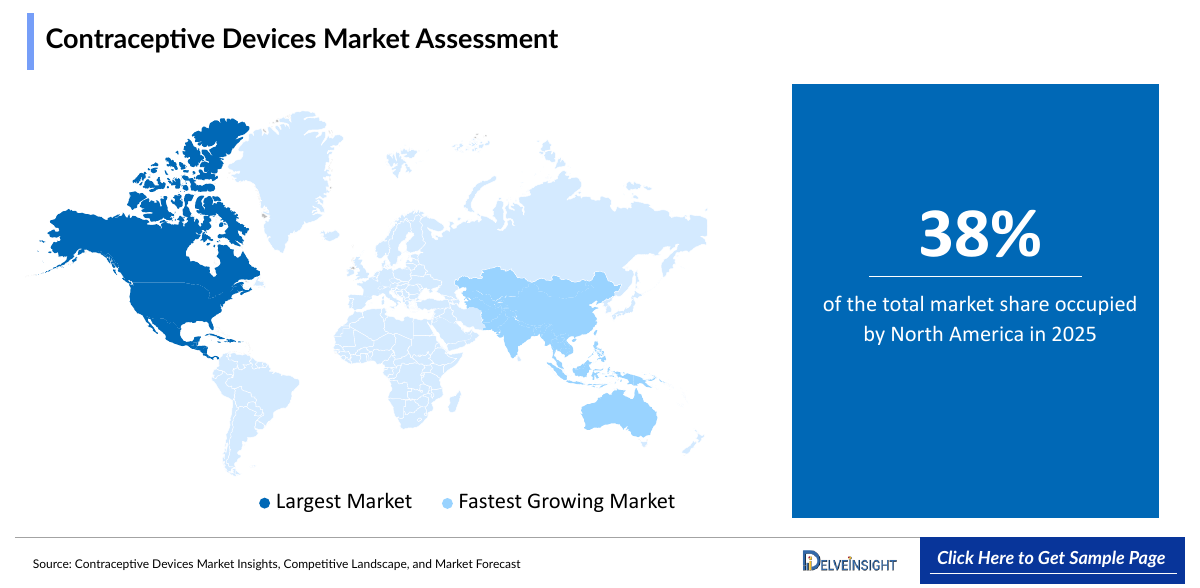
- North America dominated the global Contraceptive Devices market revenue with a 38% share in 2025, representing the highest regional market share globally.
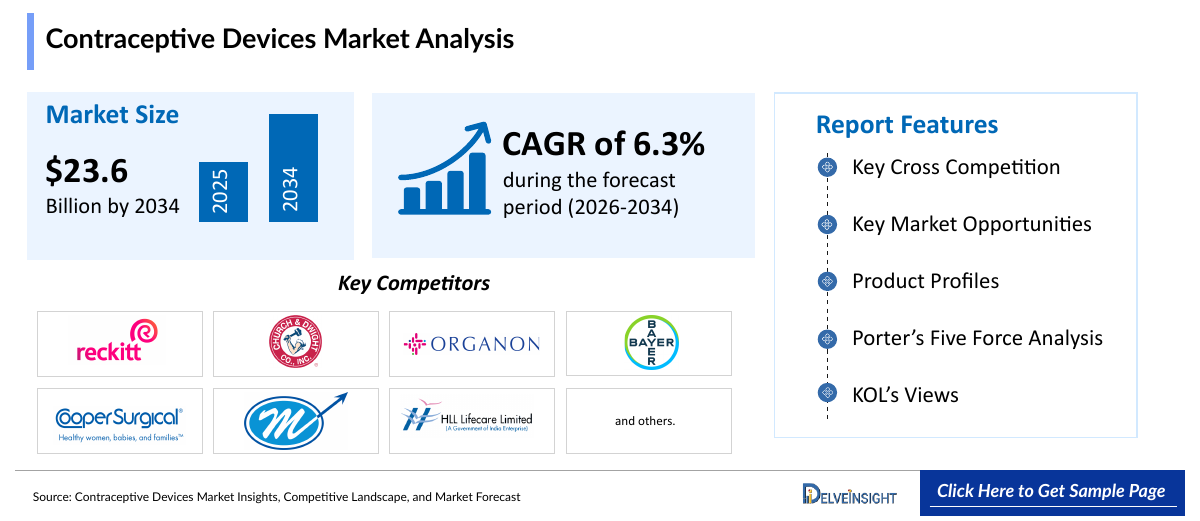
A contraceptive device is a medical or consumer product that prevents pregnancy through a physical, mechanical, or device-delivered mechanism rather than a daily oral pill. The category spans barrier methods that block sperm from reaching the egg, intrauterine devices that are placed in the uterus for years of protection, vaginal rings that release hormones or act as a barrier, and subdermal implants that release hormone from beneath the skin. Because these products serve both short-term, repeat-purchase needs and long-acting, clinician-administered needs, they are sold through a wide mix of channels, from hospital and retail pharmacies to online platforms and supermarkets, and are supplied by consumer-goods companies, pharmaceutical franchises, medical device makers, and public-sector manufacturers. Condoms also reduce the risk of sexually transmitted infections, which sustains very large and recurring volumes. The market is organized by product type across condoms, diaphragms, cervical caps, vaginal rings, intrauterine devices (IUDs), and subdermal contraceptive implants; by gender across male and female contraceptive devices; by distribution channel across hospital pharmacies, retail pharmacies, online pharmacies and D2C platforms, hypermarkets and supermarkets, and other channels; and by geography. Driven by rising modern contraceptive use, the shift toward long-acting reversible methods, condom innovation, government family planning programs, and expanding digital access, contraceptive devices have become essential components of global reproductive health and sexual wellness.
Contraceptive Devices Market Key Growth Drivers
- The persistent burden of unintended pregnancy and the growing modern contraceptive user base are sustaining demand, with United Nations estimates showing that users of modern methods rose from 552 million in 1994 to 871 million in 2024, while UNFPA estimates that nearly 224 million women in mainly developing regions still do not use safe and effective family planning methods.
- The shift toward long-acting reversible contraceptives is lifting the value of IUDs and implants, supported by label extensions such as the January 2026 US FDA approval of five-year use for Organon's Nexplanon and Bayer's Mirena labeling of up to eight years of pregnancy prevention.
- Condoms remain the only widely available contraceptive that also protects against sexually transmitted infections, and innovation in non-latex, ultra-thin, and graphene-based products, including Trojan G.O.A.T., HLL Lifecare's MOODS Graphene, and Karex's synthetic condom line, is supporting premiumization.
- Government family planning programs and public-sector procurement, including HLL Lifecare's supply to India's Ministry of Health and Family Welfare and international agency tenders, provide large and recurring volume demand.
- Expanding retail, online pharmacy, and direct-to-consumer access, including telehealth-enabled prescribing, is widening reach and improving privacy for contraceptive buyers.
- Regulatory approvals, label extensions, and device redesigns, such as the May 2026 MHRA approval of five-year Nexplanon use and the FDA-approved single-hand inserter for CooperSurgical's Paragard, are improving provider adoption and patient convenience.
- The convergence of rising modern contraceptive use, long-acting method adoption, condom innovation, public procurement, digital access, and changing social and economic patterns is expected to sustain steady growth in the market through 2034.
Key Companies in Contraceptive Devices Market
The competitive landscape is led by the following active manufacturers:
- Reckitt Benckiser Group PLC
- Church & Dwight Co., Inc.
- Organon & Co.
- Bayer AG
- CooperSurgical, Inc.
- Mankind Pharma Ltd.
- HLL Lifecare Limited
- Karex Berhad
- Okamoto Industries Inc.
- Veru Inc.
- Pregna International Limited
For illustrative purposes, only the top 10 companies are listed in the Table of Contents. The report may include analysis and references to additional companies relevant to the market assessment.
Contraceptive Devices Market Size
The following snapshot summarizes the principal report metrics for the Contraceptive Devices market.
|
Report Metrics |
Details |
|
2025 Market Size |
USD 13.6 billion |
|
2034 Projected Market Size |
USD 23.6 billion |
|
Growth Rate (2026-2034) |
6.3% CAGR |
|
Largest Market |
North America |
|
Fastest Growing Market |
Asia-Pacific |
|
Market Structure |
Moderately Concentrated |
All market values are expressed in USD and represent DelveInsight estimates synthesized from primary and secondary research.
Factors Contributing to the Growth of the Contraceptive Devices Market
Market Drivers
Rising Unintended Pregnancy Burden and Growing Modern Contraceptive Use
The most powerful driver of the Contraceptive Devices market is the large and growing population of women and couples seeking to space or avoid pregnancy. United Nations estimates show that users of modern contraceptive methods rose from 552 million in 1994 to 871 million in 2024, and UNFPA estimates that nearly 224 million women in mainly developing regions still do not use safe and effective family planning methods, indicating substantial headroom. Condoms, intrauterine devices, implants, vaginal rings, and barrier methods all benefit as governments, donors, and health systems extend access, and as individuals seek non-oral options that suit their health, lifestyle, and fertility intentions. Because contraceptive devices combine recurring consumption in the form of condoms with high-value, long-duration procedures in the form of IUDs and implants, rising prevalence translates directly into volume and value growth, anchoring market expansion through 2034.
Shift Toward Long-Acting Reversible Contraceptives
The growing preference for long-acting reversible contraception is lifting the value mix of the market. IUDs and subdermal implants offer high efficacy, reversibility, and freedom from daily or per-act adherence, and manufacturers continue to extend their duration of use. Bayer's Mirena is labeled for pregnancy prevention for up to eight years, CooperSurgical's Paragard for up to ten years, and Organon's Nexplanon received US FDA approval in January 2026 for use up to five years, followed by UK MHRA approval in May 2026. HLL Lifecare and Pregna International supply copper IUDs and have developed levonorgestrel-releasing intrauterine systems for the Indian market. As clinicians and family planning programs increasingly recommend long-acting methods for their effectiveness and cost-efficiency over multi-year use, demand for IUDs and implants expands, supporting growth across hospital and clinic channels through the forecast period.
STI Prevention, Sexual Wellness, and Condom Innovation
Condoms remain the only widely available contraceptive that also reduces the risk of sexually transmitted infections, giving the largest product segment durable, recurring demand. Leading brands are premiumizing through thinner materials, non-latex alternatives, and novel formulations: Church & Dwight reported that Trojan G.O.A.T. outperformed the earlier Trojan RAW launch, Karex scaled a synthetic condom line that generated about USD 10 million in sales in the first nine months of fiscal 2026 versus USD 3 million a year earlier, and HLL Lifecare has extended its MOODS range with graphene-based products. Reckitt's Durex and Okamoto's ultra-thin ranges reinforce the premium tier, while Mankind Pharma's Manforce shows how value-led brands expand reach across India's small towns and rural markets. Rising awareness of sexual health, younger consumer cohorts, and product differentiation together support steady volume and price-mix gains.
Government Family Planning Programs and Public-Sector Procurement
Public-sector procurement provides large, recurring baseline demand. HLL Lifecare, a Mini Ratna public sector enterprise under India's Ministry of Health and Family Welfare, manufactured about 162 crore condoms in 2024-25 and supplies condoms, Copper-T IUDs, and other products to the national family planning program, while international agencies and national health ministries procure condoms and other devices through competitive tenders that manufacturers such as Karex serve. These programs prioritize affordability, quality-assured supply, and reach into rural and underserved populations, and they shape the volume profile of the Asia-Pacific and Rest of World markets. While tender cycles and donor funding can be volatile, the long-term commitment of governments to family planning, supported by global initiatives such as FP2030, sustains demand for contraceptive devices across the forecast period.
Expanding Retail, Online Pharmacy, and D2C Access
Distribution is broadening beyond traditional pharmacies. Hypermarkets, supermarkets, e-commerce marketplaces, online pharmacies, and brand-owned direct-to-consumer platforms give buyers privacy, convenience, and wider choice, which is especially valuable for stigma-sensitive purchases. Church & Dwight noted that Trojan G.O.A.T. became the top-rated Trojan-branded condom on Amazon within months of launch, illustrating how online reviews and marketplaces now shape brand performance. Telehealth services increasingly prescribe and deliver contraception, and online pharmacies extend reach into smaller cities in India, China, and Southeast Asia. This omnichannel expansion lifts category penetration and supports the fastest growth in online and D2C channels through 2034.
Regulatory Approvals, Label Extensions, and Device Redesign
A steady stream of approvals and label changes is improving adoption. The FDA approved Nexplanon for up to five years in January 2026, supported by a study of 399 women in which no pregnancies were reported in years four and five and in which 38.1% of participants had a BMI of 30 or higher, and the UK MHRA followed in May 2026. CooperSurgical secured FDA approval for a single-hand inserter for Paragard that is intended to make placement easier, and Bayer began the Phase III SUNFLOWER study in December 2025 to evaluate Mirena in nonatypical endometrial hyperplasia, broadening the clinical rationale for hormonal intrauterine systems. In condoms, regulators have cleared products for specific uses, such as the FDA's authorization of Karex's ONE condom for anal intercourse. Each approval or redesign extends product lifecycles, strengthens provider confidence, and supports durable demand across the United States, Europe, and other regulated markets.
Rising Female Workforce Participation, Education, and Delayed Family Formation
Social and economic change is a durable structural driver. Greater female education and workforce participation, later marriage, and a preference for planned family sizes increase demand for reliable, convenient contraception, and long-acting devices suit women who prefer not to manage a daily method. Younger consumers in urban Asia-Pacific, Europe, and North America increasingly view contraception and sexual wellness as part of routine self-care, which supports branded condoms, vaginal rings, and premium formats. Public health campaigns and school and community education programs further normalize use and reduce stigma. These trends reinforce demand across product types and distribution channels and sustain growth even in mature markets where contraceptive prevalence is already high.
Market Restraints
Despite steady momentum, the Contraceptive Devices market faces material constraints. Policy and funding uncertainty is a significant near-term headwind: Organon reported that worldwide Nexplanon sales fell 19% in the first quarter of 2026, citing delayed reinsertions following the five-year label approval and uncertainty around US federal funding, while press reports attribute weaker tender demand at Karex partly to US foreign-aid cuts. Input-cost and trade volatility compound the pressure, as latex, packaging, lubricant, and synthetic-material costs have risen amid Middle East supply disruption, and US import tariffs and currency movements have weighed on export-oriented condom makers; Karex reported a nine-month fiscal 2026 net loss. Product-liability litigation, including a federal multidistrict litigation over Paragard breakage with more than 4,000 pending cases, raises legal costs and can erode provider and patient confidence in intrauterine devices. Tax and pricing changes, such as China's reintroduction of a 13% value-added tax on contraceptives from January 2026, can soften volumes in price-sensitive channels. Fear of side effects, cultural and religious stigma, and uneven access to trained providers limit uptake of IUDs and implants, particularly in low- and middle-income countries, and implants in the United States require clinician certification under a risk evaluation and mitigation strategy. Competition from oral pills, injectables, and emerging non-device methods, together with tender-driven price pressure in public-sector procurement, further restrains margins. Together, these funding, cost, legal, regulatory, and access barriers temper the pace of growth, even as the underlying drivers of rising modern contraceptive use, long-acting method adoption, and digital access remain firmly intact.
Contraceptive Devices Market Segment Analysis
The Contraceptive Devices Market is segmented by product type (condom, diaphragms, cervical cap, vaginal rings, intrauterine device (IUD), and subdermal contraceptive implants), gender (male contraceptive devices, female contraceptive devices), distribution channel (hospital pharmacy, retail pharmacy, online pharmacies and D2C platforms, hypermarkets and supermarkets, and others), and geography (North America, Europe, Asia-Pacific, and Rest of World).
By Product Type
Dominant Subsegment: Condom.
The condom segment accounted for 53% of the Contraceptive Devices market in 2025. Condoms are the leading product type because they are the most widely used device-based contraceptive worldwide, are purchased repeatedly with every use, and are the only widely available method that also reduces the risk of sexually transmitted infections. Broad availability across pharmacies, supermarkets, online channels, and public-sector programs, low unit cost, and the absence of a prescription or clinician visit sustain very large volumes. Established brands including Durex, Trojan, Manforce, MOODS, and Okamoto, together with scale manufacturers such as Karex that produce for numerous third-party brands, compete on thickness, materials, and sensation, and premiumization is lifting value. While intrauterine devices and subdermal implants are the fastest-growing product types, supported by label extensions such as five-year Nexplanon use and by the efficacy and convenience of long-acting methods, and while vaginal rings, diaphragms, and cervical caps serve more specific preferences, the recurring volume and breadth of condom demand secure the segment's leadership across the forecast period.
By Gender
Dominant Subsegment: Male Contraceptive Devices.
The male contraceptive devices segment accounted for 51% of the Contraceptive Devices market in 2025. Male contraceptive devices are currently represented by the male condom, whose high purchase frequency, low unit price, wide retail penetration, and STI-protection benefit generate the largest share of device revenue. Public-sector programs distribute male condoms in very large quantities, and brands invest heavily in marketing, premium materials, and variants that sustain consumer demand. Female contraceptive devices, which include female condoms, diaphragms, cervical caps, vaginal rings, IUDs, and subdermal implants, are the faster-growing segment because long-acting methods carry high unit value, multi-year duration, and strong clinical endorsement, and because the pipeline of hormone-free options, including the investigational Ovaprene vaginal ring in Phase 3, is expanding. Male-controlled innovation is also emerging, with Contraline raising USD 92.5 million in June 2026 to advance its male contraceptive candidates, but commercially available male options remain limited, so the sheer volume of condom use secures the male segment's leadership across the forecast period.
By Distribution Channel
Dominant Subsegment: Retail Pharmacy.
The retail pharmacy segment accounted for 41% of the Contraceptive Devices market in 2025. Retail pharmacies are the leading channel because they combine accessibility, trusted advice, privacy, and extended hours, and they stock the widest assortment of condoms alongside other sexual and reproductive health products, including vaginal rings and barrier methods in many markets. Chain pharmacies in North America and Europe, and dense networks of independent chemists in India, China, and Southeast Asia, give brands such as Durex, Trojan, and Manforce extensive reach. Hospital pharmacies remain essential for IUDs and subdermal implants that require clinician insertion, while online pharmacies and D2C platforms are the fastest-growing channel, driven by privacy, subscription models, and telehealth-linked prescribing, and hypermarkets and supermarkets capture impulse and family-shopping purchases. Nonetheless, the breadth of retail pharmacy coverage and its role as the default purchase point for condoms keep it the dominant channel across the forecast period.
Contraceptive Devices Market Region Analysis
Dominant Region: North America
North America accounted for 38% of the global Contraceptive Devices market revenue in 2025, representing the highest regional market share globally. The region's dominance reflects high contraceptive prevalence, strong adoption of long-acting reversible contraceptives, premium pricing, established reimbursement for prescription devices, and a mature retail and online pharmacy network, particularly in the United States. North America is the home market of Church & Dwight's Trojan, Organon's Nexplanon and NuvaRing, Bayer's Mirena and Kyleena, and CooperSurgical's Paragard, and brand owners benefit from provider training programs, direct-to-consumer marketing, and regulatory clarity under the FDA. The January 2026 approval of five-year Nexplanon use and the Paragard single-hand inserter illustrate continued product evolution. Although federal funding uncertainty, litigation, and tariff costs create near-term volatility, high per-unit values, strong clinical endorsement, and broad access anchor the region's continued leadership across the forecast period.
Fastest Growing Region: Asia-Pacific
Asia-Pacific is the fastest-growing region in the Contraceptive Devices market. The region's elevated CAGR is driven by large and young populations, rising incomes and awareness, expanding retail and e-commerce access, and sustained public family planning programs across China, Japan, India, South Korea, and Australia. India combines state-owned HLL Lifecare with Mankind Pharma's Manforce, which holds roughly 30% of the condom market, and Pregna International, an Indian IUD manufacturer, while Malaysia and Thailand are global manufacturing hubs for Karex and Okamoto. Japan is a mature, premium-oriented condom market led by Okamoto, and China is the largest consumer base, where Reckitt reported that a value-added tax introduced in January 2026 and heavier promotions softened early-2026 Durex performance even as management expects a recovery. Growing acceptance of long-acting methods, rising online sales, and local manufacturing scale-up position Asia-Pacific as the principal source of incremental growth over the forecast period
Regional Commentary
North America
North America accounted for 38% of the global Contraceptive Devices market revenue in 2025. The United States dominates on the strength of its high-value long-acting franchises, mature retail and online channels, and FDA regulatory clarity, while label extensions, new inserter designs, and a competitive condom premium tier reinforce leadership, even as federal funding uncertainty and product-liability litigation add near-term volatility.
Europe
Europe is a large and advanced regional market, supported by high contraceptive prevalence, established public reimbursement for long-acting methods in many countries, and regulatory oversight under the EU Medical Device Regulation and national authorities such as the UK MHRA, which approved five-year Nexplanon use in May 2026. Reckitt's Durex and Bayer's hormonal intrauterine systems are anchor brands, and demand across Germany, France, the United Kingdom, Italy, and Spain is supported by sexual health education and strong pharmacy networks.
Asia-Pacific
Asia-Pacific is the fastest-growing region, propelled by large populations, rising awareness, expanding e-commerce, and sustained public programs across China, Japan, India, South Korea, and Australia. India's HLL Lifecare, Mankind Pharma, and Pregna International, Japan's Okamoto, and Malaysia- and Thailand-based production by Karex and Okamoto make the region both a leading consumer market and the world's principal condom manufacturing base.
Rest of World
The Rest of World region, spanning Latin America, the Middle East, and Africa, is an emerging growth frontier. Donor-funded and government procurement of condoms, IUDs, and implants, expanding primary healthcare and community distribution, and a young, growing population are broadening access, although changes in international aid funding and currency volatility create variability in tender-driven demand.
Contraceptive Devices Market Competitive Landscape
The Contraceptive Devices market is classified as Moderately Concentrated. A group of global brand owners and pharmaceutical franchises, including Reckitt, Church & Dwight, Organon, Bayer, and CooperSurgical, anchors the top tier through trusted brands, clinical evidence, and broad distribution, while scale manufacturers and regional leaders such as Karex, Okamoto, HLL Lifecare, Mankind Pharma, and Pregna International compete through cost-efficient production, public-sector supply, and strong local brands. Veru Inc., which sold its FC2 female condom business in December 2024, illustrates ongoing portfolio reshaping in the category.
The competitive landscape can be evaluated across the following dimensions:
- Market concentration: Moderately concentrated, with global condom and long-acting contraceptive leaders alongside scale manufacturers and strong regional champions.
- Leading players: Reckitt (Durex) and Church & Dwight (Trojan) lead consumer condoms, while Organon, Bayer, and CooperSurgical lead prescription implants, hormonal IUDs, and copper IUDs.
- Geographic reach: Mirena is available in more than 120 countries and Karex exports to more than 130, while HLL Lifecare, Mankind Pharma, and Pregna International are anchored in India and Okamoto in Japan and Asia.
- Product portfolio strength: Leaders span condoms, vaginal rings, IUDs, and implants; HLL Lifecare offers male and female condoms, Copper-T IUDs, a levonorgestrel-releasing system, and tubal rings.
- Clinical evidence and label differentiation: Duration of use is a key differentiator, with Mirena labeled for up to eight years, Paragard for up to ten, and Nexplanon for up to five.
- Strategic partnerships and public tenders: Karex supplies third-party brands and institutional programs, and HLL Lifecare supplies India's national family planning program.
- Portfolio reshaping and M&A: Reckitt completed its Essential Home divestment and Church & Dwight its vitamin exit on December 31, 2025; Veru sold FC2 in December 2024; and CooperSurgical acquired Paragard from Teva in 2017.
- Manufacturing capabilities: Karex's capacity exceeds 5 billion condoms annually, Okamoto operates plants in Japan, Thailand, Vietnam, the United States, and China, and HLL Lifecare runs multiple contraceptive factories in India.
- Innovation focus: Non-latex, ultra-thin, and graphene-based condoms, longer-duration long-acting devices, simplified inserters, hormone-free vaginal rings, and male contraception.
Contraceptive Devices Market Recent Developmental Activities
In June 2026, Contraline closed a USD 92.5 million Series B financing to advance its male contraceptive candidates, including the implantable ADAM hydrogel and the NES/T topical gel, toward late-stage trials. Strategic significance: Signals growing investor conviction in male contraception and could eventually broaden the male segment beyond condoms.
In May 2026, Organon & Co. announced UK MHRA approval extending Nexplanon to five years of use, following the January 2026 US FDA approval. Strategic significance: Extends the product lifecycle, although Organon reported that first-quarter 2026 Nexplanon sales fell 19% as reinsertions were delayed and US federal funding was uncertain.
In May 2026, Karex Berhad reported nine-month fiscal 2026 revenue of RM361.3 million, down 4.3%, as lower tender-market condom and lubricant orders offset synthetic condom sales of about USD 10 million; the US tariff on its exports fell from 19% to 10% from March 2026. Strategic significance: Shows the exposure of export-oriented manufacturers to tenders, currency, and trade policy, while synthetic condoms add a premium growth vector.
In 2026, Reckitt Benckiser Group PLC said Durex had a softer first quarter in China after a value-added tax on contraceptives took effect in January and competitors increased promotions, while expecting a recovery, and reported double-digit growth in India. Strategic significance: Highlights the tax-policy sensitivity of Chinese condom demand and India's role as a growth market.
In January 2026, China ended a three-decade value-added tax exemption for contraceptives, applying the standard 13% rate to condoms and other contraceptives under its new VAT law. Strategic significance: Raises consumer prices in the largest Asian market and tests volume resilience for global and local condom brands.
In January 2026, Organon & Co. received US FDA approval of a supplemental new drug application extending the duration of use of Nexplanon (etonogestrel implant) 68 mg Radiopaque to up to five years. Strategic significance: Improves convenience and competitiveness versus other long-acting options, supported by data including participants with a BMI of 30 or higher.
On December 31, 2025, Church & Dwight Co., Inc., completed the sale of its vitamin business to Piping Rock and reported that Trojan G.O.A.T. condoms outperformed the earlier Trojan RAW launch. Strategic significance: Sharpens focus on organic growth and higher-growth brands, including Trojan.
On December 31, 2025, Reckitt Benckiser Group PLC completed the USD 4.8 billion divestment of its Essential Home division to Advent International, retaining a 30% equity stake. Strategic significance: Concentrates the portfolio on health and hygiene brands, including Durex, and funds emerging-market growth.
In December 2025, Bayer AG started the Phase III SUNFLOWER study of the 52 mg levonorgestrel-releasing intrauterine system Mirena for nonatypical endometrial hyperplasia. Strategic significance: Broadens the clinical rationale for hormonal intrauterine systems beyond contraception and heavy menstrual bleeding.
In 2025, CooperSurgical, Inc., won FDA approval for a single-hand inserter for its Paragard copper IUD, which is labeled for up to ten years of hormone-free pregnancy prevention. Strategic significance: Improves provider usability, while a federal multidistrict litigation over device breakage, in which the first bellwether trial ended in a defense verdict, remains a risk.
In fiscal 2024-25, HLL Lifecare Limited manufactured about 162.34 crore condoms and reported contraceptive sales of INR 470.48 crore, with a portfolio spanning MOODS, USTAD, and NIRODH condoms, female condoms, Copper-T IUDs, and tubal rings. Strategic significance: Underscores public-sector scale and range extension into premium and long-acting products.
In December 2024, Veru Inc. sold its FC2 female condom business for USD 18 million to clients managed by Riva Ridge Capital Management and co-investors, closing on December 30, 2024. Strategic significance: Marks Veru's exit from contraceptive devices to focus on biopharmaceuticals and moves the FC2 brand to new ownership.
Contraceptive Devices Market Segmentation
Contraceptive Devices Market by Product Type
- Condom
- Diaphragms
- Cervical Cap
- Vaginal Rings
- Intrauterine Device (IUD)
- Subdermal Contraceptive Implants
Contraceptive Devices Market by Gender
- Male Contraceptive Devices
- Female Contraceptive Devices
Contraceptive Devices Market by Distribution Channel
- Hospital Pharmacy
- Retail Pharmacy
- Online Pharmacies and D2C Platforms
- Hypermarkets and Supermarkets
- Others
Contraceptive Devices Market by Geography
- North America Contraceptive Devices Market
- United States Contraceptive Devices Market Size in USD million (2023-2034)
- Canada Contraceptive Devices Market Size in USD million (2023-2034)
- Mexico Contraceptive Devices Market Size in USD million (2023-2034)
- Europe Contraceptive Devices Market
- Germany Contraceptive Devices Market Size in USD million (2023-2034)
- United Kingdom Contraceptive Devices Market Size in USD million (2023-2034)
- France Contraceptive Devices Market Size in USD million (2023-2034)
- Italy Contraceptive Devices Market Size in USD million (2023-2034)
- Spain Contraceptive Devices Market Size in USD million (2023-2034)
- Rest of Europe Contraceptive Devices Market Size in USD million (2023-2034)
- Asia-Pacific Contraceptive Devices Market
- China Contraceptive Devices Market Size in USD million (2023-2034)
- Japan Contraceptive Devices Market Size in USD million (2023-2034)
- India Contraceptive Devices Market Size in USD million (2023-2034)
- Australia Contraceptive Devices Market Size in USD million (2023-2034)
- South Korea Contraceptive Devices Market Size in USD million (2023-2034)
- Rest of Asia-Pacific Contraceptive Devices Market Size in USD million (2023-2034)
- Rest of the World (RoW) Contraceptive Devices Market
- Middle East Contraceptive Devices Market Size in USD million (2023-2034)
- Africa Contraceptive Devices Market Size in USD million (2023-2034)
- South America Contraceptive Devices Market Size in USD million (2023-2034)
Contraceptive Devices Market Recent Industry Trends and Milestones (2023-2026)
|
Category |
Key Developments |
|
Contraceptive Devices Market Product Approval |
Regulatory momentum is extending the life and reach of long-acting devices. The US FDA approved Organon's Nexplanon for use up to five years in January 2026, supported by a study of 399 women with no pregnancies reported in years four and five, and the UK MHRA followed in May 2026, with a similar application submitted to EU and UK authorities in 2025. Bayer's Mirena is labeled for up to eight years of pregnancy prevention and CooperSurgical's Paragard for up to ten years, and CooperSurgical secured FDA approval of a single-hand inserter for Paragard. In condoms, regulators have cleared products for specific uses, such as the FDA's authorization of Karex's ONE condom for anal intercourse. Each approval or label extension improves convenience and provider confidence, supporting durable demand for compliant, quality-assured devices. |
|
Contraceptive Devices Market Expansion |
Manufacturers broadened portfolios across materials and price tiers. Church & Dwight launched Trojan G.O.A.T. in the fourth quarter of 2025, and Karex scaled a synthetic condom line that reached about USD 10 million in sales in the first nine months of fiscal 2026. HLL Lifecare extended its MOODS range with graphene-based products alongside female condoms, Copper-T IUDs, a levonorgestrel-releasing intrauterine system, and tubal rings, while Pregna International offers copper IUDs and the Eloira hormonal intrauterine system. Reckitt's Durex and Okamoto's ultra-thin condoms anchor the premium tier, and Mankind Pharma's Manforce serves value and premium segments in India. Retail, e-commerce, and D2C channels expanded availability and brand reach. |
|
Contraceptive Devices Market Investment |
Capital flows and portfolio reshaping accelerated. Contraline raised USD 92.5 million in a Series B round in June 2026, bringing total capital raised to about USD 127 million, to advance male contraceptive candidates, and Daré Bioscience's non-hormonal Ovaprene vaginal ring is advancing through a pivotal Phase 3 study supported by non-dilutive funding. Corporate portfolios were simplified: Reckitt completed the USD 4.8 billion divestment of Essential Home on December 31, 2025 and retains Durex among its focus brands; Church & Dwight sold its vitamin business on the same date; and Veru sold its FC2 female condom business for USD 18 million in December 2024. Karex launched a synthetic condom venture and owns Global Protection Corp. for North American distribution. |
|
Company Strategy |
Reckitt Benckiser Group PLC: Premium Durex and emerging-market growth in China and India after the Essential Home exit. Church & Dwight Co., Inc.: Trojan innovation and a portfolio focused on organic growth. Organon & Co.: Nexplanon five-year label and NuvaRing, while navigating US funding uncertainty. Bayer AG: Mirena and Kyleena hormonal intrauterine franchise and expanding indications. CooperSurgical, Inc.: Paragard ten-year copper IUD with a single-hand inserter while managing litigation. Mankind Pharma Ltd.: Manforce leadership in India. HLL Lifecare Limited: Public-sector scale and range extension. Karex Berhad: OEM scale, synthetic condoms, and tender supply. Okamoto Industries Inc.: Ultra-thin technology and multi-country manufacturing. Veru Inc.: Exit from FC2 to focus on biopharmaceuticals. Pregna International Limited: Copper and hormonal IUD manufacturing. |
|
Emerging Technologies |
Material science is the leading edge of condom innovation, with non-latex synthetic polymers, polyurethane films, and graphene-based formulations delivering thinner, stronger, and more sensitive products. In long-acting methods, longer-duration labels, single-hand and simplified inserters, and copper and levonorgestrel systems with improved tolerability are reducing barriers to adoption. Hormone-free vaginal rings such as Ovaprene, male contraceptive implants and gels such as Contraline's ADAM and NES/T, and non-hormonal oral candidates represent the next wave, while telehealth-enabled prescribing, subscription D2C models, and AI-driven personalization improve access. Sustainability initiatives, including recyclable packaging and responsible latex sourcing, are also gaining attention. |
Contraceptive Devices Market Startup Funding and Investment Trends
|
Company |
Total Funding |
Funding Stage |
Main Offering |
Core Technology |
|
Contraline |
USD 92.5 million Series B (June 2026); about USD 127 million in total |
Series B (growth venture) |
Male contraceptive implant and gel |
ADAM non-hormonal vas deferens hydrogel; NES/T hormonal gel |
|
Request to unlock the report on the @ Contraceptive Devices Market | ||||
Investment in the Contraceptive Devices ecosystem has concentrated on male and hormone-free innovation, premium and synthetic condom materials, and longer-duration long-acting devices. The following companies illustrate recent funding and investment activity and technology focus.
Capital is flowing toward innovators that expand method choice, particularly male and hormone-free options. Contraline's USD 92.5 million Series B in June 2026 and the advancing Phase 3 program for Daré Bioscience's Ovaprene underscore growing conviction in new device categories, while established manufacturers reshape portfolios and invest in premium and synthetic condoms and long-acting methods. Karex's synthetic condom venture, the lifecycle-extending innovations of Organon and CooperSurgical, and HLL Lifecare's in-house development of a levonorgestrel-releasing intrauterine system illustrate where incumbent investment is focused. Collectively, these investments signal conviction that long-acting methods, material innovation, male and non-hormonal options, and digital access will define the next phase of competitive advantage in the global Contraceptive Devices market.
Key Takeaways from the Contraceptive Devices Market Report Study
- Market size analysis for the current Contraceptive Devices market size (2025), and market forecast for 9 years (2026 to 2034).
- Top key product/technology developments, mergers, acquisitions, partnerships, and joint ventures that happened over the last 3 years.
- Key companies dominating the global Contraceptive Devices market.
- Various opportunities available for competitors in the Contraceptive Devices market space.
- What are the top-performing segments in 2025? How will these segments perform in 2034?
- Which are the top-performing regions and countries in the current Contraceptive Devices market scenario?
- Which are the regions and countries where companies should concentrate their opportunities for Contraceptive Devices market growth in the future?
Target audience who can benefit from this Contraceptive Devices market report study
- Contraceptive Devices product providers
- Research organizations and consulting companies
- Contraceptive Devices -related organizations, associations, forums, and other alliances
- Government and corporate offices
- Start-up companies, venture capitalists, and private equity firms
- Distributors and traders dealing in Contraceptive Devices
- Various end-users who want to know more about the Contraceptive Devices market and the latest technological developments in the Contraceptive Devices market