
Coronary Occlusion Market
- The Coronary Occlusion Market is expected to grow steadily during the forecast period (2023–2032). Factors driving this growth include the increasing prevalence, patients seeking effective treatment that can cure the condition and not just treat the complications, and the rise in the prevalence of cardiovascular diseases.
- Research suggests the prevalence of Chronic total occlusions (CTOs) could be higher than experts estimate. Some CTOs do not cause symptoms, so people may have a CTO without a formal diagnosis.
- DelveInsight’s analysts estimated that there had been an increase in Coronary Occlusion occurrences in recent years, which may be attributed to factors such as improved awareness of diagnosis advancements and a lifestyle change which includes increasing investment in research and development of coronary artery disease therapeutics, and rising comorbidities such as atherosclerosis and hypertension.
- To drive the Coronary Occlusion Market in future years, companies such as Matrizyme Pharma Corporation, and others are developing their assets in the mid-late stage of development. With the expected approval of these therapies during the forecast period (2023–2032), the overall therapeutic market of Coronary Occlusions is likely to witness a rise at a significant CAGR.
Download the Sample PDF to Get More Insight @ Coronary Occlusion Market
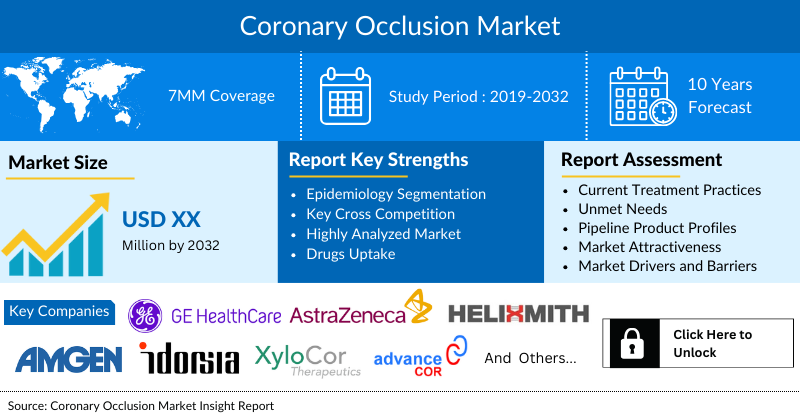
DelveInsight’s “Coronary Occlusion Market Insights, Epidemiology, and Market Forecast – 2032” comprehensively analyzes Coronary Occlusion. The report includes a detailed examination of the historical and projected epidemiology data that includes prevalent cases of Coronary Occlusion, diagnosed prevalent cases of Coronary Occlusion segmented by gender-specific, age-specific, and severity-specific cases. The Coronary Occlusion market report offers an in-depth understanding of the various aspects related to the patient population, including diagnosis, prescription patterns, physician perspectives, market access, treatment, and future market developments for the seven major markets, including the United States, EU4 (Germany, France, Italy, and Spain) and the UK, and Japan from 2019 to 2032.
The report discusses current Coronary Occlusion treatment practices, algorithms, and unmet medical needs to gauge the market’s overall potential and identify business opportunities.
|
Study Period |
2019–2032 |
|
Forecast Period |
2023–2032 |
|
Geographies Covered |
US, EU4 (Germany, France, Italy, and Spain) and the UK, and Japan |
|
Coronary Occlusion Epidemiology |
|
|
Coronary Occlusion Market |
|
|
Market Analysis |
|
|
Coronary Occlusion Market Players |
Occlutech GmbH, pfm medical ag, Abbott Laboratories, Atricure Inc, Boston Scientific Corp , Lifetech Scientific Corporation , W. L. Gore & Associates Inc, and others
|
|
Treatment Class |
|
Coronary Occlusion Treatment Market
The actual prevalence of CTOs could be higher than experts estimate. Some CTOs do not cause symptoms, so people may have a CTO without a formal diagnosis.
Healthcare providers typically diagnose a chronic total occlusion using a coronary angiogram. Some other tests are also utilized to confirm the presence of coronary occlusion, like Cardiac MRI, cardiac stress test, echocardiogram (ECHO), and electrocardiogram (EKG).
Differential diagnosis must be performed to differentiate it from Pulmonary embolism, aortic dissection, pneumothorax, esophageal rupture, and perforating peptic ulcer disease.
Coronary Occlusion currently lacks a cure. The goal of the current treatment is to manage symptoms. It often includes a percutaneous coronary intervention or a coronary artery bypass graft. Both options have high rates of successfully treating a CTO. Thrombolytic medications, such as tissue plasminogen activators (tPA) or alteplase, are administered intravenously to dissolve the blood clot, causing coronary occlusion. Alongside the above treatments, patients may receive medications to manage symptoms and reduce the risk of future coronary occlusions. Common medications include antiplatelet drugs (e.g., aspirin), blood thinners, beta-blockers, and statins to control blood pressure, prevent clot formation, and lower cholesterol levels.
Coronary Occlusion Overview
Chronic coronary total occlusion (CTO) occurs when plaque buildup blocks the coronary artery for more than 90 days, starving the heart of oxygen. If left untreated, CTO can cause chest pain, unusual fatigue, and lifestyle restrictions.
People with a previous heart attack or bypass surgery are more likely to develop a CTO. Some other risk factors for coronary occlusions include family history, age (45 years for men, 55 for women), tobacco use, overweight, diet, high blood pressure, diabetes, and excessive alcohol consumption.
Smoking is a significant risk factor for the development of coronary occlusion. The chemicals in cigarette smoke can lead to the thickening of blood and the formation of clots within veins and arteries. When a clot obstructs blood flow, it can result in a heart attack and sudden, potentially fatal consequences.
CTOs are more common as people get older. CTOs affect:
- About 37% of people under age 65.
- About 40% of people ages 65–79.
- About 41% of people older than 85.
The classic signs and symptoms of a heart attack include crushing chest pain or pressure, shoulder or arm pain, shortness of breath, and sweating. Women may have less typical symptoms, such as neck or jaw pain, nausea, and fatigue.
In addition to causing symptoms, CTOs have correlations with a worse overall prognosis, with higher rates of death and non-fatal adverse cardiovascular events in several populations. Patients with CTOs tend to be older and have more comorbidities and significant impairment of left ventricular function. Furthermore, patients with non-revascularized CTOs have higher mortality and a higher risk of major adverse cardiovascular events than patients with multivessel coronary artery disease who are completely revascularized.
Coronary Occlusion Epidemiology
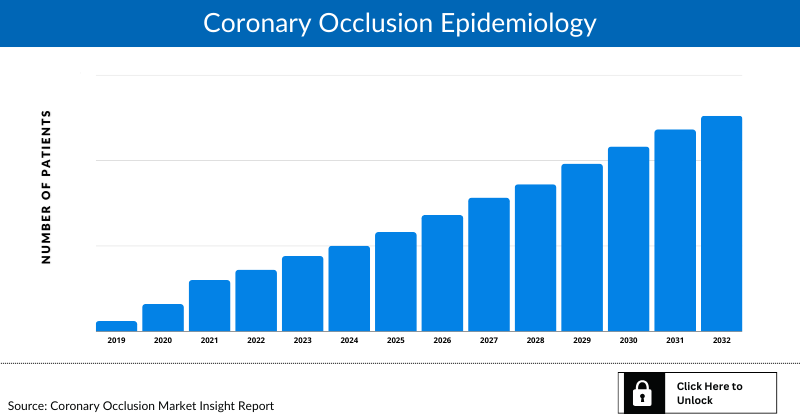
The Coronary Occlusion epidemiology section provides insights into the historical and current Coronary Occlusion patient pool and forecasted trends for the seven major countries. It helps recognize the causes of current and forecasted trends by exploring numerous studies and views of the key opinion leaders. This part of the report also provides the diagnosed patient pool, its trends, and assumptions undertaken.
The epidemiology section of the Coronary Occlusion market report offers information on the patient population, including historical and projected trends for each of the seven major markets. Examining key opinion leader views from physicians or clinical experts can assist in identifying the reasons behind historical and projected trends. The diagnosed patient pool, their trends, and the underlying assumptions are all included in this section of the report.
Key Findings
- According to a study by Jeroudi et al. (2014) in the US, among 1,699 patients who underwent angiography between 2011 and 2012, 20% did not have CAD, 20% had CAD, and prior coronary artery bypass graft surgery (CABG), and 60% had CAD but no prior CABG. The prevalence of CTO among CAD patients with and without prior CABG was 31%, respectively.
- As per the literature review by Bhatnagar et al. (2016), the prevalence of coronary artery disease (CAD) in the UK has been reported to be around 3%.
- According to a study by Matsuoka (2016), in Japan, it is reported that the prevalence of CAD patients with airflow limitation or COPD was 2.4–25.9%.
Coronary Occlusion Market Outlook
Historically, angioplasty and stenting was not an effective treatment for Coronary occlusion. People either had bypass surgery or received medication to treat their Coronary Occlusion.
Medications commonly used include an onyx frontier zotarolimus-eluting coronary stent system, which improves coronary luminal diameters in patients, Beta-blockers by reducing heart rate and decreasing blood pressure, increasing coronary blood flow, and Somatostatins, which help in heart rate deceleration, and decrease of myocardial contractility. Some other drug classes, like Angiotensin-converting enzyme (ACE) inhibitors, Angiotensin-2 receptor blockers (ARBs), Calcium channel blockers, and Diuretics, are also utilized for treating Coronary occlusion.
Promising emerging treatment options are under investigation for managing Coronary Occlusion. These include targeted therapies that modulate specific pathways involved in developing the disease. These emerging treatments offer hope for improving the management of Coronary Occlusion by addressing key mechanisms involved in the disease etiology.
The COVID-19 pandemic affected healthcare systems globally and interrupted usual care in many healthcare facilities, exposing vulnerable patients with cardiovascular diseases to significant risks. Similarly, the demand for coronary artery disease drugs was significantly impacted during the pandemic owing to the increased risk of COVID-19 infection among patients with cardiovascular diseases. A study by Maehl et al. (2021) published in the Frontiers in Medicine in December 2021 indicated that despite having Coronary artery Disease (CAD) symptoms, 9.1% of patients did not see a medical practitioner due to fear of becoming infected with COVID-19. This initially led to a decline in market growth during the pandemic due to a decrease in the diagnosis of coronary artery disease and the lack of adoption of CAD therapeutics due to stringent lockdowns, supply chain restrictions, and production shutdowns.
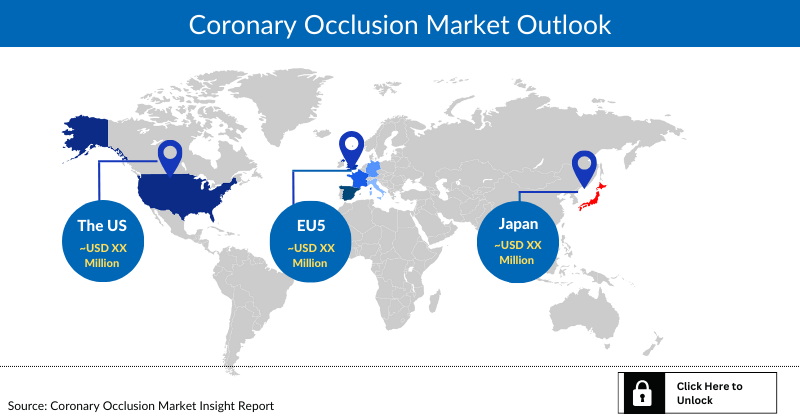
According to DelveInsight, the Coronary Occlusion market in the 7MM is expected to significantly change during the study period 2019–2032.
Coronary Occlusion Recent Developments
- In January 2025, Simpson Interventions, Inc., a leader in cardiovascular devices, announced significant milestones. Its Acolyte™ Image-Guided Crossing and Re-Entry Catheter System received FDA Investigational Device Exemption after being designated a Breakthrough Device. Additionally, the company’s Shadow Catheter™ obtained FDA 510(k) clearance.
Coronary Occlusion Drug Chapters
Coronary Occlusion Marketed Drugs
LODOCO (colchicine): Agepha Pharma
It is claimed to be the first anti-inflammatory atheroprotective cardiovascular treatment to receive approval from the regulator. The regulatory approval was based on the findings obtained from a double-blind, multinational, placebo-controlled, randomized clinical trial conducted in 5,522 chronic coronary disease patients. Carvedilol (Coreg) is a non-selective beta blocker. It is FDA-approved for treating and managing high blood pressure and is also used to manage coronary occlusion.
Compared to those treated with placebo, participants treated with LODOCO had a 31% reduction in the overall risk of cardiovascular death, spontaneous myocardial infarction or ischaemic stroke when added to statins and other cardiology prevention therapies.
Emerging Coronary Occlusion Drugs
The currently available treatments for Coronary Occlusion aim to mitigate the complications associated with the symptoms of the condition. The Coronary Occlusion market dynamics are expected to change, primarily due to increased healthcare expenditure worldwide. The rise in demand for novel therapies, increased awareness about treatment options, and increased research and development to develop safe and efficacious drugs for Coronary Occlusion treatment offer lucrative opportunities to key players in the Coronary Occlusion market. Coronary Occlusion Market players such as Matrizyme Pharma Corporation, Imbria Pharmaceuticals and others are actively developing Coronary Occlusion treatments.
MZ-004: Matrizyme Pharma corporation
MZ-004, a proprietary collagenase enzyme formulation, targets the underlying pathology of CTOs, rendering the CTO amenable to conventional angioplasty techniques, particularly with the use of soft-tipped guidewires, and thus providing all interventional cardiologists with a safer, easier-to-use, and more effective approach to the growing CTO problem.
The Matrizyme CTO System, comprising MZ-004 and a soft-tipped guidewire, has been designated a Device/Biologic Combination Product, with lead jurisdiction assigned to the FDA’s Center for Devices and Radiological Health (CDRH).
Note: Detailed emerging therapies assessment will be provided in the final report...
Coronary Occlusion Market Segmentation
DelveInsight’s ‘Coronary Occlusion Market Insights, Epidemiology, and Market Forecast – 2032’ report provides a detailed outlook of the current and future Coronary Occlusion market, segmented within countries, by therapies, and by classes. Further, the market of each region is then segmented by each therapy to provide a detailed view of the current and future market share of all therapies.
Coronary Occlusion Market Size by Countries
The total Coronary Occlusion market size is analyzed for individual countries (the United States Market, EU4 (Germany, France, Italy, and Spain) and the UK market, and Japan). The United States accounted for a larger portion of the 7MM market for Coronary Occlusion in 2022 due to the high prevalence of the condition and the higher cost of treatments. This dominance is predicted to continue with the potential early entry of new products.
Coronary Occlusion Market Size by Therapies
Market Size by Therapies of Coronary Occlusion is categorized into Somatostatins, calcium channel blockers, Beta-blockers, blood thinning medicines, corticosteroids, angiotensin-converting enzyme (ACE) inhibitors, and others.
Note: Detailed market segment assessment will be provided in the final report...
Coronary Occlusion Drugs Uptake
This section focuses on the sales uptake of potential Coronary Occlusion drugs that have recently launched or are anticipated to be launched in the Coronary Occlusion market between 2019 and 2032. It estimates the market penetration of Coronary Occlusion drugs for a given country, examining their impact within and across classes and segments. It also touches upon the financial and regulatory decisions contributing to the drug’s probability of success (PoS) in the Coronary Occlusion market.
The emerging Coronary Occlusion therapies are analyzed based on various attributes such as safety and efficacy in randomized clinical trials, order of entry and other market dynamics, and the unmet need they fulfill in the Coronary Occlusion market.
Note: Detailed assessment of drug uptake and attribute analysis will be provided in the full report on Coronary Occlusion...
Coronary Occlusion Market Access and Reimbursement
DelveInsight’s ‘Coronary Occlusion – Market Insights, Epidemiology, and Market Forecast – 2032’ report provides a descriptive overview of the market access and reimbursement scenario of Coronary Occlusion.
This section includes a detailed analysis of the country-wise healthcare system for each therapy, enlightening the market access, reimbursement policies, and health technology assessments.
KOL Views
To keep up with current Coronary Occlusion market trends and fill gaps in secondary findings, we interview KOLs and SMEs’ working in the Coronary Occlusion domain. Their opinion helps to understand and validate current and emerging therapies and treatment patterns or Coronary Occlusion market trends. This will support the clients in potential upcoming novel treatments by identifying the market’s overall scenario and the unmet needs of Coronary Occlusion.
Coronary Occlusion: KOL Insights
DelveInsight’s analysts connected with 50+ KOLs to gather insights; however, interviews were conducted with 15+ KOLs in the 7MM. These KOLs were from organizations, institutes, and hospitals, such as the National Heart, Lung, and Blood Institute, Cardio-Oncology Clinic in Minnesota, and Heart Disease and Stroke (HDS) Workgroup and American College of Cardiology.
“Rapid and accurate diagnosis of coronary occlusion is crucial for timely intervention. Advances in diagnostic tools, such as high-sensitivity troponin tests and point-of-care diagnostics, are needed to improve the speed and accuracy of diagnosis.”
“Addressing the long-term complications and quality of life in survivors of coronary occlusion, such as heart failure and post-heart attack depression, is an ongoing challenge.”
Note: Detailed assessment of KOL Views will be provided in the full report on Coronary Occlusion...
Competitive Intelligence Analysis
We perform Competitive and Market Intelligence analysis of the Coronary Occlusion Market using various Competitive Intelligence tools, including SWOT analysis, Market entry strategies, etc. The inclusion of the analysis entirely depends upon the data availability.
Coronary Occlusion Pipeline Development Activities
The Coronary Occlusion report provides insights into Coronary Occlusion Clinical Trials within Phase II and III stages. It also analyses Coronary Occlusion Companies involved in developing targeted therapeutics.
Pipeline Development Activities
The report covers collaborations, acquisition and merger, licensing, patent details, and other information for emerging Coronary Occlusion therapies.
Coronary Occlusion Report Insights
- Coronary Occlusion Patient Population
- Coronary Occlusion Therapeutic Approaches
- Coronary Occlusion Pipeline Analysis
- Coronary Occlusion Market Size and Trends
- Coronary Occlusion Market Opportunities
- Impact of Upcoming Coronary Occlusion Therapies
Coronary Occlusion Report Key Strengths
- 10 years Forecast
- The 7MM Coverage
- Coronary Occlusion Epidemiology Segmentation
- Key Cross Competition
- Highly Analyzed Coronary Occlusion Market
- Coronary Occlusion Drugs Uptake
Coronary Occlusion Report Assessment
- Coronary Occlusion Current Treatment Practices
- Coronary Occlusion Unmet Needs
- Coronary Occlusion Pipeline Product Profiles
- Coronary Occlusion Market Attractiveness
- Coronary Occlusion Market Drivers
- Coronary Occlusion Market Barriers
Key Questions Answered In The Coronary Occlusion Market Report
- What are the key findings of the market across 7MM, and what country will have the largest Coronary Occlusion market size during the forecast period (2023–2032)?
- Why smoking is such a big risk factor in Coronary Occlusion?
- At what CAGR is the Coronary Occlusion market, and is epidemiology expected to grow in the 7MM during the forecast period (2023–2032)?
- How would the unmet needs impact the Coronary Occlusion market dynamics and subsequently influence the analysis of the related trends?
- What would be the forecasted patient pool of Coronary Occlusion in the 7MM covering the United States, EU4 (Germany, France, Italy, and Spain), the UK, and Japan?
- What are the latest advancements in novel therapies, targets, mechanisms of action, and technologies being developed to address the limitations of existing therapies for Coronary Occlusion?
- How many companies are currently engaged in the development of therapies for the treatment of Coronary Occlusion?
-pipeline.png&w=256&q=75)