Cyclin-Dependent Kinase-Like 5 (CDKL5) Deficiency Disorder Market
Key Highlights
- Cyclin-Dependent Kinase-Like 5 (CDKL5) Deficiency Disorder or CDD is a rare genetic condition categorized as a developmental epileptic encephalopathy (DEE). It results from mutations in the CDKL5 gene, located on the X chromosome, essential for brain and neuron development. Identified in 2004, CDD has significant impacts on affected individuals and their families.
- The Cyclin-Dependent Kinase-Like 5 (CDKL5) Deficiency Disorder market is projected to experience a rise at a significant CAGR during the forecast period. The growth in market revenue is primarily driven by increasing awareness and diagnosis of the disorder, advancements in genetic testing technologies, and the development of new and innovative therapies. Additionally, growing support from research funding and initiatives aimed at improving treatment options and patient care contribute significantly to market expansion.
- CDD approximately accounted for ~4,300 diagnosed prevalent cases in 2023 in the 7MM, the treatment market of CDD lacks approved therapy specific to CDD treatment.
- The study conducted in the US indicates that CDKL5 deficiency disorder primarily affects females, who constitute about 90% of cases. However, there has been an increase in diagnoses among males, who display symptoms similar to those seen in females.
- Approved in March 2022 in the US and in 2023 in Europe, ZTALMY's efficacy was demonstrated in the Marigold trial, which revealed a notable reduction in major motor seizure frequency compared to placebo.
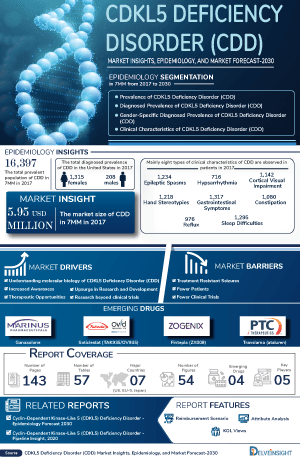
- Clinical characteristics of CDKL5 Deficiency Disorder are diverse, with notable distribution rates: epileptic spasms (12.1%), hypsarrhythmia (7.0%), cortical visual impairment (11.2%), hand stereotypies (11.9%), gastrointestinal symptoms (12.9%), constipation (10.6%), reflux (9.6%), and sleep difficulties (12.7%). These percentages underscore the multifaceted and widespread impact of CDKL5 Deficiency Disorder on patients.
 Deficiency Disorder Market.png)
DelveInsight’s “Cyclin-Dependent Kinase-Like 5 (CDKL5) Deficiency Disorder– Market Insights, Epidemiology, and Market Forecast – 2034” report delivers an in-depth understanding of Cyclin-Dependent Kinase-Like 5 (CDKL5) Deficiency Disorder, historical and forecasted epidemiology as well as the Cyclin-Dependent Kinase-Like 5 (CDKL5) Deficiency Disorder market trends in the United States, EU4, and the UK (Germany, France, Italy, Spain) and the United Kingdom, and Japan.
The Cyclin-Dependent Kinase-Like 5 (CDKL5) Deficiency Disorder market report provides current treatment practices, emerging drugs, market share of individual therapies, and current and forecasted 7MM Cyclin-Dependent Kinase-Like 5 (CDKL5) Deficiency Disorder market size from 2020 to 2034. The Report also covers current Cyclin-Dependent Kinase-Like 5 (CDKL5) Deficiency Disorder treatment practices, market drivers, market barriers, SWOT analysis, reimbursement and market access, and unmet medical needs to curate the best of the opportunities and assess the underlying potential of the market.
Geography Covered
- The United States
- EU4 (Germany, France, Italy, and Spain) and the United Kingdom
- Japan
Study Period: 2020–2034
Disease Understanding and Treatment Algorithm
Cyclin-Dependent Kinase-Like 5 (CDKL5) Deficiency Disorder Overview
Cyclin-dependent kinase-like 5 (CDKL5) deficiency disorder (CDD) is a remarkably rare and complex developmental epileptic encephalopathy (DEE) resulting from genetic mutations within the CDKL5 gene. This genetic condition is categorized as a DEE due to the fact that the mutations in the CDKL5 gene are responsible for both the onset of epileptic seizures and the severe developmental impairment experienced by affected individuals. CDKL5 was previously known as serine/threonine-protein kinase 9 (STK9), and it wasn't until 2004 that researchers first identified its association with disease.
CDD is characterized by the profound impact it has on the affected individual's neurological and cognitive development. Seizures in CDD often manifest within the first few months of life and can be challenging to manage. They typically require a multifaceted approach involving various antiepileptic medications and therapies.
The mutations in the CDKL5 gene disrupt the normal function of the CDKL5 protein, which plays a crucial role in regulating the development and function of neurons. This disruption in neuronal development leads to severe developmental delays, intellectual disabilities, and motor impairments, making CDD a highly debilitating condition.
Given the rarity of CDD, it has been the focus of extensive research to better understand its underlying mechanisms and to develop potential therapies. Although there is currently no cure for CDD, ongoing research aims to identify ways to alleviate symptoms and improve the quality of life for those affected. Additionally, genetic testing and early diagnosis are crucial for enabling families to access appropriate support and interventions to help manage the condition.
Cyclin-Dependent Kinase-Like 5 (CDKL5) Deficiency Disorder Diagnosis
Diagnosing Cyclin-Dependent Kinase-Like 5 (CDKL5) Deficiency Disorder involves a clinical evaluation of symptoms like severe developmental delays and difficult-to-control seizures. The definitive diagnosis is made through genetic testing for mutations in the CDKL5 gene. Additional tests may be needed to rule out similar conditions, and genetic counseling helps families understand the disorder and its implications. Early diagnosis is crucial for effective management and support.
Further details related to diagnosis are provided in the report…
Cyclin-Dependent Kinase-Like 5 (CDKL5) Deficiency Disorder Treatment
The existing treatment includes symptomatic and supportive care; a multidisciplinary team approach is vital to deliver appropriate care. Early interventions include physical therapy, occupational therapy, speech and augmentative communication therapy. On the other hand, seizure treatment includes Antiepileptic Drugs (AEDs), Steroid Treatment, Ketogenic Diet, Neurosurgery, Vagus Nerve Stimulation (VNS).
Further details related to treatment are provided in the report…
Cyclin-Dependent Kinase-Like 5 (CDKL5) Deficiency Disorder Epidemiology
As the market is derived using a patient-based model, the Cyclin-Dependent Kinase-Like 5 (CDKL5) Deficiency Disorder epidemiology chapter in the report provides historical as well as forecasted epidemiology segmented by Total Prevalent cases of CDKL5 Deficiency Disorder, Diagnosed Prevalent cases of CDKL5 Deficiency Disorder, Gender-specific Prevalence of CDKL5 Deficiency Disorder, Clinical Manifestation Specific Prevalent cases of CDKL5 Deficiency Disorder, and Treated cases of CDKL5 Deficiency Disorder, in the 7MM covering, the United States, EU4 countries (Germany, France, Italy, and Spain), United Kingdom, and Japan from 2020 to 2034.
- The total diagnosed prevalent cases of CDD in the United States were around 1,846 cases in 2023.
- The United States contributed to the largest diagnosed prevalent population of CDD, acquiring ~37% of the 7MM in 2023. Whereas, EU4 and the UK, and Japan accounted for around 48% and 15% of the total population share, respectively, in 2023.
- Among the EU4 countries, Germany accounted for the largest number of Prevalent CDD (2,772 cases) followed by Italy (1809 cases), whereas Spain accounted for the lowest number of cases (890 Cases) in 2023.
- In 2023, it was estimated that there were around 86% for female and 14% male diagnosed prevalent cases in the US.
- According to DelveInsight estimates, in 2023 there were approximately 491 cases of Epileptic Spasms, 285 cases of Hypsarrhythmia, 455 cases of Cortical Visual Impairment, 485 cases of Hand Stereotypies, 524 cases of Gastrointestinal Symptoms, 430 cases of Constipation, 388 cases of Reflux, 515 cases of Sleep difficulties diagnosed prevalent cases of CDD in Japan.
 Deficiency Disorder Epidemiology.png)
Recent Development
- In May 2026, Viralgen has forged a strategic manufacturing partnership with Elaaj Bio to advance a novel gene therapy program targeting CDKL5 Deficiency Disorder (CDD). CDD is a rare, severe neurodevelopmental genetic condition characterized by early-onset, treatment-resistant seizures, severe cognitive impairments, and profound motor deficits, currently lacking approved curative treatments. Under the agreement, Viralgen will deploy its world-class current Good Manufacturing Practice (cGMP) suspension-based AAV platform to scale the production of Elaaj Bio’s innovative adeno-associated virus vector pipeline. This collaboration bridges Elaaj Bio’s advanced neurotherapeutic engineering with Viralgen’s robust, scalable manufacturing expertise. Ultimately, the partnership accelerates essential preclinical development and streamlines the regulatory path toward upcoming clinical trials, moving closer to delivering a transformative, life-changing genetic therapy to pediatric patients suffering from this debilitating disorder.
- In May 2026, Viralgen has partnered with Elaaj Bio to advance a novel gene therapy program targeting CDKL5 Deficiency Disorder (CDD). CDD is a rare, severe neurodevelopmental genetic condition characterized by early-onset seizures, cognitive impairments, and motor deficits, currently lacking approved curative treatments. Under the agreement, Viralgen will leverage its world-class current Good Manufacturing Practice (cGMP) suspension manufacturing platform to scale the production of Elaaj Bio’s adeno-associated virus (AAV) vector pipeline. This partnership bridges Elaaj Bio’s innovative neurotherapeutic design with Viralgen’s robust manufacturing expertise, accelerating preclinical development and streamlining the path toward upcoming clinical trials to bring a transformative genetic therapy to CDD patients.
Cyclin-Dependent Kinase-Like 5 (CDKL5) Deficiency Disorder Drug Chapters
The drug chapter segment of the Cyclin-Dependent Kinase-Like 5 (CDKL5) Deficiency Disorder report encloses a detailed analysis of Cyclin-Dependent Kinase-Like 5 (CDKL5) Deficiency Disorder off-label drugs and late-stage (Phase-III and Phase-II) pipeline drugs. It also helps to understand the Cyclin-Dependent Kinase-Like 5 (CDKL5) Deficiency Disorder clinical trial details, expressive pharmacological action, agreements and collaborations, approval and patent details, advantages and disadvantages of each included drug, and the latest news and press releases.
Marketed Drugs
ZTALMY (ganaxolone): Marinus Pharmaceuticals, Inc.
ZTALMY (ganaxolone) is the first treatment approved specifically for seizures associated with cyclin-dependent kinase-like 5 deficiency disorder (CDD) in people 2 years of age and older. It functions by providing anti-seizure and anti-anxiety effects through its action on both synaptic and extrasynaptic GABAA receptors.
ZTALMY is the first seizure medicine that is a neuroactive steroid. Exactly how ZTALMY works to treat seizures in CDD is not fully understood, but it is thought to reduce seizures.
Further detail in the report…
Emerging Drugs
Fenfluramine: UCB
Fenfluramine, an investigational serotonin-releasing agent, is poised to make a significant impact on the treatment of CDKL5 Deficiency Disorder (CDD). This compound uniquely stimulates multiple 5-HT receptor subtypes, including 5-HT1D, 5-HT2A, and 5-HT2C, through the release of serotonin, and also interacts with the sigma-1 receptor.
By targeting these specific serotonin receptors, fenfluramine may effectively modulate neuronal excitability and reduce seizure frequency in CDD patients. Currently advancing through Phase III clinical trials, fenfluramine's potential as a novel therapeutic option is supported by its mechanism of action and early data.
Topline results from these trials are anticipated by the second half of 2024 as per the company’s pipeline, offering a promising glimpse into the drug’s efficacy and its potential to address a critical unmet need in managing this severe neurological disorder. This development underscores fenfluramine's innovative approach to seizure management and its potential to significantly enhance treatment options for those affected by CDD.
Further detail in the report…
UX055: Ultragenyx Pharmaceutical Inc.
UX055 represents a promising frontier in the treatment of CDKL5 Deficiency Disorder (CDD), currently in preclinical development. This investigational gene therapy employs an Adeno-Associated Vector Serotype 9 (AAV9) to deliver a functional copy of the human CDKL5 gene directly to the brain. Utilizing a neuron-specific promoter, UX055 ensures targeted expression of the CDKL5 protein exclusively within neurons. Administered via injection into the cerebrospinal fluid, UX055 aims to address the root genetic cause of CDD by correcting the underlying molecular deficits.
Early preclinical studies have demonstrated encouraging results, with motor and cognitive improvements observed in a mouse model of CDD and a notable correction of neuronal hyperexcitability in a human brain organoid model derived from patient-specific induced pluripotent stem cells. These findings underscore UX055's potential to offer a transformative approach to treating CDD, representing a significant advancement in gene therapy and bringing renewed hope to patients and families affected by this challenging condition.
Further detail in the report…
|
Drug |
MoA |
RoA |
Company |
Logo |
Phase |
|
Fenfluramine |
5-HT agonist |
Oral |
UCB |
|
III |
|
XXX |
XXX |
XXX |
XXX |
|
II |
Note: Detailed emerging therapies assessment will be provided in the final report of Cyclin-Dependent Kinase-Like 5 (CDKL5) Deficiency Disorder.
Cyclin-Dependent Kinase-Like 5 (CDKL5) Deficiency Disorder Market Outlook
CDKL5 deficiency disorder (CDD) is a rare X-linked developmental epileptic encephalopathy (DEE) marked by early-onset, resistant seizures and severe neurodevelopmental impairment. Classified as a DEE due to its dual impact on epilepsy and developmental delays, CDD was first linked to mutations in the CDKL5 gene in 2004. Previously termed serine/threonine protein kinase 9 (STK9), the CDKL5 gene is crucial for normal brain and neuronal development. Market insights highlight a need for targeted therapies due to the disorder’s complex symptomatology and limited treatment options.
However, treatment landscape for CDKL5 Deficiency Disorder faces several significant challenges. Currently, the emergence of gene therapy research highlights the urgent need for disease-modifying treatments, though developing effective therapies is hampered by the lack of validated clinical outcome measures for trial assessment. Additionally, CDKL5 Deficiency Disorder’s rarity contributes to limited awareness among healthcare providers, leading to potential delays in diagnosis and treatment. Enhanced awareness and earlier diagnosis are crucial for timely intervention. Furthermore, intractable seizures associated with CDKL5 Deficiency Disorder often resist conventional medications, underscoring the need for more effective, targeted treatment options.
In the 7MM CDKL5 Deficiency Disorder market, antiepileptic and anticonvulsant drugs currently dominate the therapeutic landscape. Further the treatment for CDKL5 Deficiency Disorder can be classified into First-line and Second-line treatment approaches. First-line therapies typically include ACTH, Prednisolone, and Vigabatrin. For persistent seizures, second-line options involve various drug combinations or monotherapies, such as the Ketogenic diet, Topiramate, Zonisamide, and Pyridoxine.
The FDA's approval of ZTALMY is a landmark development in the treatment of CDKL5 Deficiency Disorder, marking a significant advancement in therapeutic options. This milestone is based on compelling clinical trial results highlighting a substantial progress in addressing the complex symptoms of CDKL5 Deficiency Disorder and improving patient outcomes.
Despite these efforts, managing seizures in CDKL5 Deficiency Disorder remains highly challenging due to the refractory nature of the condition and the limited efficacy of current medications in addressing both seizures and neurodevelopmental symptoms. Advancing research and therapeutic strategies are essential to improve the quality of life and neurodevelopmental outcomes for patients with CDKL5 Deficiency Disorder.
 Deficiency Disorder Market Outlook.png)
Cyclin-Dependent Kinase-Like 5 (CDKL5) Deficiency Disorder Market Segmentation
DelveInsight’s ‘Cyclin-Dependent Kinase-Like 5 (CDKL5) Deficiency Disorder Market Insights, Epidemiology, and Market Forecast – 2034’ report provides a detailed outlook of the current and future Diabetic Neuropathic Pain (DNP) market, segmented within countries, by therapies, and by classes. Further, the market of each region is then segmented by each therapy to provide a detailed view of the current and future market share of all therapies.
Cyclin-Dependent Kinase-Like 5 (CDKL5) Deficiency Disorder Drugs Uptake
This section focuses on the uptake rate of potential drugs expected to launch in the market during 2020–2034. For example, Fenfluramine in the US is expected to be launched by 2025 with a peak share of XX%.
Further detailed analysis of emerging therapies drug uptake in the report…
Cyclin-Dependent Kinase-Like 5 (CDKL5) Deficiency Disorder Pipeline Development Activities
The report provides insights into different therapeutic candidates in Phase III, Phase II, and Phase I. It also analyzes key players involved in developing targeted therapeutics.
Pipeline Development Activities
The report covers information on collaborations, acquisitions and mergers, licensing, and patent details for Cyclin-Dependent Kinase-Like 5 (CDKL5) Deficiency Disorder emerging therapies.
KOL Views
To keep up with current market trends, we take KOLs and SMEs’ opinions working in the domain through primary research to fill the data gaps and validate the secondary research. Industry Experts were contacted for insights on Cyclin-Dependent Kinase-Like 5 (CDKL5) Deficiency Disorder evolving treatment landscape, patient reliance on conventional therapies, patient therapy switching acceptability, and drug uptake along with challenges related to accessibility, including KOL from Department of Neurology, New York University, New York, NY, United States; Division of Epilepsy and Clinical Neurophysiology, Department of Neurology, Boston Children’s Hospital, Boston, MA, US; Department of Pediatrics, University of Colorado, School of Medicine, Aurora, CO, US; Royal Hospital for Sick Children, University of Edinburgh, Edinburgh, United Kingdom; Rare and Complex Epilepsy Unit, Department of Neuroscience, Bambino Gesù Children's Hospital, IRCCS, Rome, Italy; Unit of Pediatrics, Campus Bio-Medico University, Italy; Department of Paediatric Neurology, University Hospitals Bristol and Weston, Bristol, UK; Department of Child Neurology, NHO Nishiniigata Chuo Hospital, Niigata, Japan; Department of Pediatrics, Osaka Hospital, Japan Community Healthcare Organization (JCHO), Osaka, Japan; and others.
Delveinsight’s analysts connected with 50+ KOLs to gather insights; however, interviews were conducted with 15+ KOLs in the 7MM. Their opinion helps understand and validate current and emerging therapies, treatment patterns, or Cyclin-Dependent Kinase-Like 5 (CDKL5) Deficiency Disorder market trends. This will support the clients in potential upcoming novel treatments by identifying the overall scenario of the market and the unmet needs.
Qualitative Analysis
We perform Qualitative and market Intelligence analysis using various approaches, such as SWOT and Conjoint Analysis. In the SWOT analysis, strengths, weaknesses, opportunities, and threats in terms of disease diagnosis, patient awareness, patient burden, competitive landscape, cost-effectiveness, and geographical accessibility of therapies are provided. These pointers are based on the Analyst’s discretion and assessment of the patient burden, cost analysis, and existing and evolving treatment landscape.
Conjoint Analysis analyzes multiple approved and emerging therapies based on relevant attributes such as safety, efficacy, frequency of administration, route of administration, and order of entry. Scoring is given based on these parameters to analyze the effectiveness of therapy.
Further, the therapies’ safety is evaluated wherein the acceptability, tolerability, and adverse events are majorly observed, and it sets a clear understanding of the side effects posed by the drug in the trials. In addition, the scoring is also based on the route of administration, order of entry and designation, probability of success, and the addressable patient pool for each therapy. According to these parameters, the final weightage score and the ranking of the emerging therapies are decided.
Market Access and Reimbursement
The high cost of therapies for the treatment is a major factor restraining the growth of the global drug market. Because of the high cost, the economic burden is increasing, leading the patient to escape from proper treatment.
The report further provides detailed insights on the country-wise accessibility and reimbursement scenarios, cost-effectiveness scenario of approved therapies, programs making accessibility easier and out-of-pocket costs more affordable, insights on patients insured under federal or state government prescription drug programs, etc.
Scope of the Report
- The report covers a segment of key events, an executive summary, and a descriptive overview of Cyclin-Dependent Kinase-Like 5 (CDKL5) Deficiency Disorder, explaining its causes, signs and symptoms, and currently available therapies.
- Comprehensive insight has been provided into the epidemiology segments and forecasts, the future growth potential of diagnosis rate, disease progression, and treatment guidelines.
- Additionally, an all-inclusive account of the current and emerging therapies and the elaborative profiles of late-stage and prominent therapies will impact the current treatment landscape.
- A detailed review of the Cyclin-Dependent Kinase-Like 5 (CDKL5) Deficiency Disorder market, historical and forecasted market size, market share by therapies, detailed assumptions, and rationale behind the approach is included in the report covering the 7MM drug outreach.
- The report provides an edge while developing business strategies, by understanding trends, through SWOT analysis and expert insights/KOL views, patient journey, and treatment preferences that help shape and drive the 7MM Cyclin-Dependent Kinase-Like 5 (CDKL5) Deficiency Disorder market.
Cyclin-Dependent Kinase-Like 5 (CDKL5) Deficiency Disorder Report Insights
- Patient Population
- Therapeutic Approaches
- Cyclin-Dependent Kinase-Like 5 (CDKL5) Deficiency Disorder Pipeline Analysis
- Cyclin-Dependent Kinase-Like 5 (CDKL5) Deficiency Disorder Market Size and Trends
- Existing and Future Market Opportunities
Cyclin-Dependent Kinase-Like 5 (CDKL5) Deficiency Disorder Report Key Strengths
- 11 years Forecast
- The 7MM Coverage
- Cyclin-Dependent Kinase-Like 5 (CDKL5) Deficiency Disorder Epidemiology Segmentation
- Key Cross Competition
- Conjoint Analysis
- Drugs Uptake and Key Market Forecast Assumptions
Cyclin-Dependent Kinase-Like 5 (CDKL5) Deficiency Disorder Report Assessment
- Current Treatment Practices
- Unmet Needs
- Pipeline Product Profiles
- Market Attractiveness
- Qualitative Analysis (SWOT and Conjoint Analysis)
Key Questions
Market Insights
- What was the Cyclin-Dependent Kinase-Like 5 (CDKL5) Deficiency Disorder market share (%) distribution in 2020 and what it would look like in 2034?
- What would be the Cyclin-Dependent Kinase-Like 5 (CDKL5) Deficiency Disorder total market size as well as market size by therapies across the 7MM during the forecast period (2024–2034)?
- What are the key findings pertaining to the market across the 7MM and which country will have the largest Cyclin-Dependent Kinase-Like 5 (CDKL5) Deficiency Disorder market size during the forecast period (2024–2034)?
- At what CAGR, the Cyclin-Dependent Kinase-Like 5 (CDKL5) Deficiency Disorder market is expected to grow at the 7MM level during the forecast period (2024–2034)?
- What would be the Cyclin-Dependent Kinase-Like 5 (CDKL5) Deficiency Disorder market outlook across the 7MM during the forecast period (2024–2034)?
- What would be the Cyclin-Dependent Kinase-Like 5 (CDKL5) Deficiency Disorder market growth till 2034 and what will be the resultant market size in the year 2034?
- How would the market drivers, barriers, and future opportunities affect the market dynamics and subsequent analysis of the associated trends?
Epidemiology Insights
- What are the disease risk, burden, and unmet needs of Cyclin-Dependent Kinase-Like 5 (CDKL5) Deficiency Disorder?
- What is the historical Cyclin-Dependent Kinase-Like 5 (CDKL5) Deficiency Disorder patient population in the United States, EU4 (Germany, France, Italy, Spain) and the UK, and Japan?
- What would be the forecasted patient population of Cyclin-Dependent Kinase-Like 5 (CDKL5) Deficiency Disorder at the 7MM level?
- What will be the growth opportunities across the 7MM with respect to the patient population pertaining to Cyclin-Dependent Kinase-Like 5 (CDKL5) Deficiency Disorder?
- Out of the above-mentioned countries, which country would have the highest prevalent population of Cyclin-Dependent Kinase-Like 5 (CDKL5) Deficiency Disorder during the forecast period (2024–2034)?
- At what CAGR the population is expected to grow across the 7MM during the forecast period (2024–2034)?
Current Treatment Scenario, Marketed Drugs, and Emerging Therapies
- What are the current options for the treatment of Cyclin-Dependent Kinase-Like 5 (CDKL5) Deficiency Disorder along with the approved therapy?
- What are the current treatment guidelines for the treatment of Cyclin-Dependent Kinase-Like 5 (CDKL5) Deficiency Disorder in the US, Europe, And Japan?
- What are the Cyclin-Dependent Kinase-Like 5 (CDKL5) Deficiency Disorder-marketed drugs and their MOA, regulatory milestones, product development activities, advantages, disadvantages, safety, efficacy, etc.?
- How many companies are developing therapies for the treatment of Cyclin-Dependent Kinase-Like 5 (CDKL5) Deficiency Disorder?
- How many emerging therapies are in the mid-stage and late stages of development for the treatment of Cyclin-Dependent Kinase-Like 5 (CDKL5) Deficiency Disorder?
- What are the key collaborations (Industry–Industry, Industry-Academia), Mergers and acquisitions, and licensing activities related to the Cyclin-Dependent Kinase-Like 5 (CDKL5) Deficiency Disorder therapies?
- What are the recent therapies, targets, mechanisms of action, and technologies developed to overcome the limitations of existing therapies?
- What are the clinical studies going on for Cyclin-Dependent Kinase-Like 5 (CDKL5) Deficiency Disorder and their status?
- What are the key designations that have been granted for the emerging therapies for Cyclin-Dependent Kinase-Like 5 (CDKL5) Deficiency Disorder?
- What are the 7MM historical and forecasted market of Cyclin-Dependent Kinase-Like 5 (CDKL5) Deficiency Disorder?
Reasons to Buy
- The report will help in developing business strategies by understanding the latest trends and changing treatment dynamics driving the Cyclin-Dependent Kinase-Like 5 (CDKL5) Deficiency Disorder Market.
- Insights on patient burden/disease prevalence, evolution in diagnosis, and factors contributing to the change in the epidemiology of the disease during the forecast years.
- To understand the existing market opportunity in varying geographies and the growth potential over the coming years.
- Distribution of historical and current patient share based on real-world prescription data along with reported sales of approved products in the US, EU4 (Germany, France, Italy, and Spain), the United Kingdom, and Japan.
- Identification of strong upcoming players in the market will help in devising strategies that will help in getting ahead of competitors.
- Detailed analysis and potential of current and emerging therapies under the conjoint analysis section to provide visibility around leading emerging drugs.
- Highlights of Access and Reimbursement policies of approved therapies, barriers to accessibility of off-label expensive therapies, and patient assistance programs.
- To understand the perspective of Key Opinion Leaders around the accessibility, acceptability, and compliance-related challenges of existing treatment to overcome barriers in the future.
- Detailed insights on the unmet needs of the existing market so that the upcoming players can strengthen their development and launch strategy.
-deficiency-disorder-pipeline-report.png&w=256&q=75)