Cyclosporine Drugs Market Summary
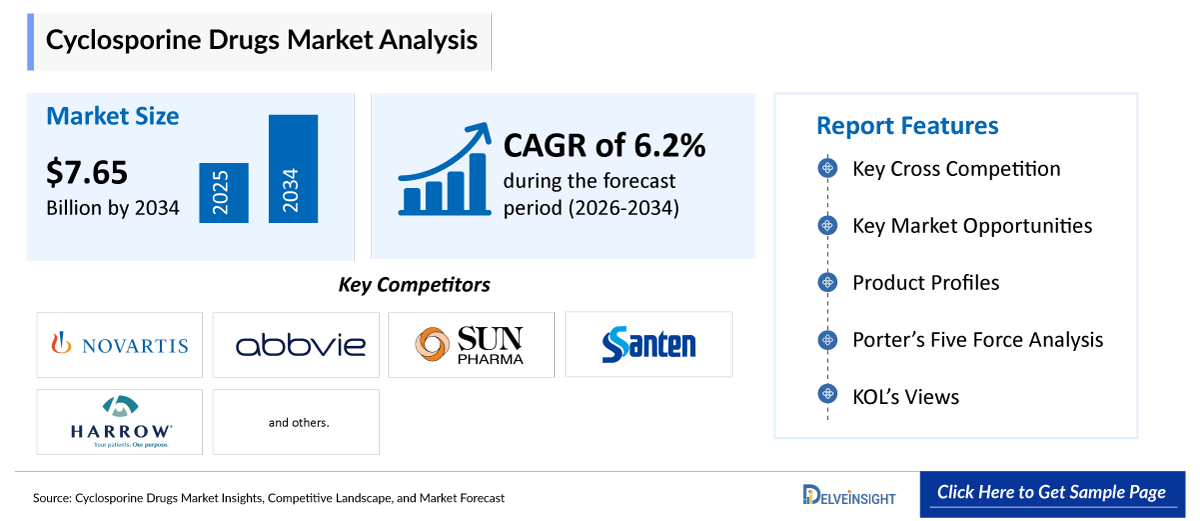
- The Cyclosporine Drugs market is estimated at USD 4.35 billion in 2025 and is projected to reach USD 7.65 billion by 2034. Growth is anchored in the rising global prevalence of dry eye disease, sustained demand for immunosuppression in organ transplantation, and continued commercial expansion of branded ophthalmic cyclosporine therapies.
- The global cyclosporine drugs market is growing at a CAGR of 6.2% during the forecast period from 2026 to 2034.
- By product type, the ophthalmic cyclosporine segment dominated the Cyclosporine Drugs market with a 57% share in 2025.
- By route of administration, the topical segment dominated the Cyclosporine Drugs market with a 55% share in 2025.
- By formulation, the ophthalmic emulsion segment dominated the Cyclosporine Drugs market with a 34% share in 2025.
- By indication, the dry eye disease segment dominated the Cyclosporine Drugs market with a 46% share in 2025.
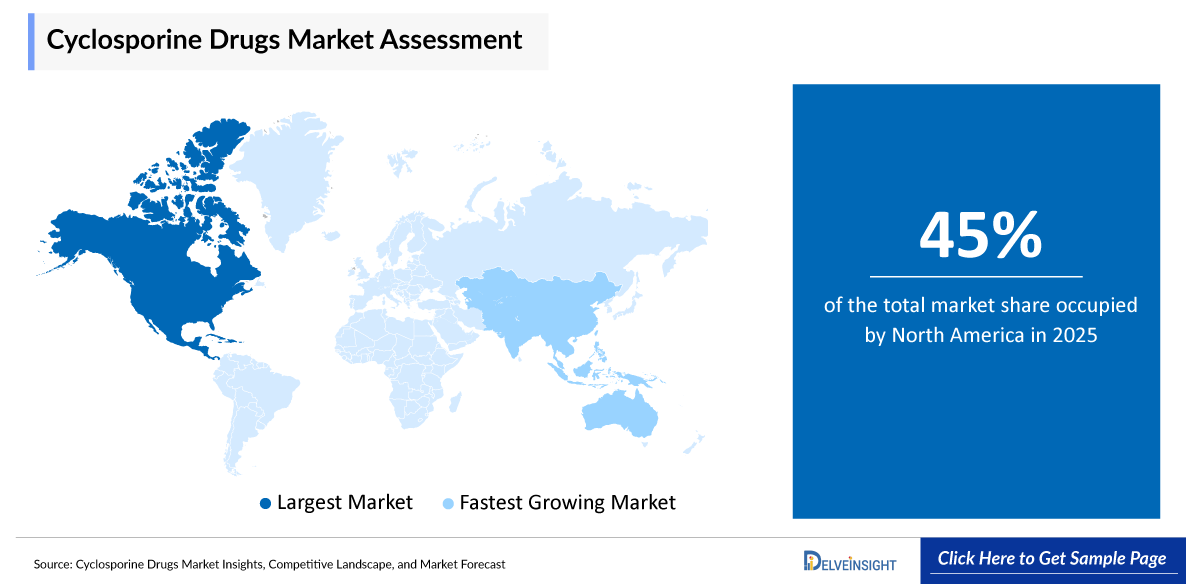
- North America dominated the global cyclosporine drugs market revenue with a 45% share in 2025, representing the highest regional market share globally.
Cyclosporine is a calcineurin-inhibiting immunosuppressive agent used both systemically to prevent organ transplant rejection and to manage autoimmune conditions such as rheumatoid arthritis and severe plaque psoriasis, and topically as an ophthalmic therapy to treat chronic dry eye disease and vernal keratoconjunctivitis by reducing ocular surface inflammation. Systemic formulations, including capsules, oral solutions, and injectable solutions, remain the standard of care for lifelong post-transplant immunosuppression, while ophthalmic emulsions and solutions have become central to the management of keratoconjunctivitis sicca as awareness of dry eye disease grows and diagnosis rates rise. The market is organized by product type across systemic and ophthalmic cyclosporine; by route of administration, including oral, intravenous, and topical delivery; by formulation, spanning capsules, oral solution, injectable solution, ophthalmic emulsion, and ophthalmic solution; and by indication, led by organ transplantation, rheumatoid arthritis, severe plaque psoriasis, dry eye disease, and vernal keratoconjunctivitis. Driven by the rising burden of dry eye disease, steady growth in transplantation volumes, expanding payer coverage for branded ophthalmic therapies, and the parallel entry of generic competition that broadens patient access, cyclosporine drugs remain foundational therapies across immunology and ophthalmology.
Cyclosporine Drugs Market Key Growth Drivers
• The rising global prevalence of dry eye disease is driving demand for ophthalmic cyclosporine, with IQVIA estimating U.S. annual sales of cyclosporine ophthalmic emulsion 0.05% at approximately USD 2.0 billion for the twelve months ended September 2025.
• Growing global organ transplantation volumes are sustaining lifelong demand for systemic cyclosporine as a cornerstone calcineurin-inhibitor immunosuppressant across kidney, liver, heart, and lung transplant regimens.
• Expanding branded ophthalmic portfolios and patient-access programs, including Harrow’s VEVYE Access for All initiative and national payer coverage wins effective January 2026, are broadening adoption of newer, higher-concentration cyclosporine ophthalmic therapies.
• The entry of generic cyclosporine ophthalmic emulsions, including Amneal’s December 2025 FDA approval and Upsher-Smith’s May 2026 launch of RESTASIS-equivalent products, is expanding affordability and overall prescription volume even as it pressures branded pricing.
• Continued formulation innovation, including preservative-free multidose packaging, nanoemulsion delivery, and higher-concentration topical solutions, is improving tolerability and supporting patient adherence across both systemic and ophthalmic segments.
• Rising diagnosis rates for autoimmune conditions such as rheumatoid arthritis and severe plaque psoriasis, alongside established use as a second-line therapy when biologics are unsuitable, sustain steady systemic cyclosporine demand.
• The convergence of dry eye disease awareness, transplantation growth, expanding access programs, and generic entry is expected to sustain steady, high-single-digit growth in the market through 2034.
Key Companies in Cyclosporine Drugs Market
The competitive landscape is led by the following active manufacturers:
• Novartis AG
• AbbVie Inc. (Allergan)
• Sun Pharmaceutical Industries Ltd.
• Santen Pharmaceutical Co., Ltd.
• Harrow, Inc.
Factors Contributing to the Growth of the Cyclosporine Drugs Market
Market Drivers
Rising Global Prevalence of Dry Eye Disease
The most powerful driver of the Cyclosporine Drugs market is the rising global prevalence of dry eye disease and the resulting growth of the ophthalmic cyclosporine category. Chronic dry eye, or keratoconjunctivitis sicca, affects a large and growing share of adults, particularly with aging populations and increased screen exposure, and cyclosporine-based anti-inflammatory eye drops have become a standard of care alongside artificial tears. IQVIA data show U.S. annual sales of cyclosporine ophthalmic emulsion 0.05% alone reached approximately USD 2.0 billion for the twelve months ended September 2025, reflecting sustained physician and patient reliance on this therapeutic class. Newer entrants such as Sun Pharmaceutical’s CEQUA and Harrow’s VEVYE are gaining share within this large base, with VEVYE reaching a 10.5% share of the national dry eye disease market by the third quarter of 2025 and surpassing XIIDRA on a monthly prescription basis in early 2026. As diagnosis rates rise and treatment-seeking behavior improves, demand for both branded and generic ophthalmic cyclosporine expands directly, anchoring market growth through 2034.
Sustained Demand from Organ Transplantation
Steady growth in global organ transplantation procedures continues to underpin demand for systemic cyclosporine as a foundational calcineurin-inhibitor immunosuppressant. Cyclosporine-based regimens have been shown to meaningfully improve graft survival outcomes relative to no immunosuppression, and lifelong maintenance therapy following kidney, liver, heart, and lung transplantation requires consistent access to oral capsules, oral solution, and injectable formulations. As global transplantation capacity expands, particularly in emerging markets where Novartis has broadened distribution of its cyclosporine-based therapies, the systemic product-type segment retains a large and durable base of chronic users even as the faster-growing ophthalmic segment gains overall market share.
Market Restraints
Despite steady momentum, the Cyclosporine Drugs market faces material constraints. Intensifying generic competition in the ophthalmic emulsion segment, exemplified by Amneal’s and Upsher-Smith’s 2025-2026 approvals, is compressing branded pricing and creating substitution risk for established franchises such as RESTASIS. Cyclosporine’s narrow therapeutic index and association with nephrotoxicity, hypertension, and increased infection risk in systemic use require close therapeutic drug monitoring, adding cost and complexity to long-term transplant management. Newer non-cyclosporine mechanisms, including biologics for autoimmune disease and alternative anti-inflammatory ophthalmic agents, provide competitive treatment options that can limit share gains. Reimbursement and step-therapy requirements in some markets and payer segments continue to slow adoption of newer, higher-priced branded ophthalmic therapies, while ocular burning and stinging on instillation remain a recognized driver of early discontinuation for topical formulations. Together, these pricing, safety-monitoring, competitive, and access-related barriers temper the pace of growth, even as the underlying drivers of dry eye disease prevalence, transplantation demand, and access-program expansion remain firmly intact.
Cyclosporine Drugs Market Segment Analysis
The cyclosporine drugs market by product type (systemic cyclosporine, ophthalmic cyclosporine), route of administration (oral, intravenous, topical), formulation (capsules, oral solution, injectable solution, ophthalmic emulsion, ophthalmic solution), indication (organ transplantation, rheumatoid arthritis, severe plaque psoriasis, dry eye disease, vernal keratoconjunctivitis), and geography (North America, Europe, Asia-Pacific, and Rest of World).
By Product Type
Dominant Subsegment: Ophthalmic Cyclosporine.
The ophthalmic cyclosporine segment accounted for 57% of the Cyclosporine Drugs market in 2025. Ophthalmic cyclosporine leads the market because chronic dry eye disease affects a very large and growing patient population, and prescription anti-inflammatory eye drops have become standard therapy alongside artificial tears. The scale of this segment is substantial: IQVIA estimated U.S. annual sales of cyclosporine ophthalmic emulsion 0.05% alone at approximately USD 2.0 billion for the twelve months ended September 2025, and newer branded entrants such as CEQUA and VEVYE continue to gain prescription share within this base. Expanding patient-access programs, growing payer coverage, and rising diagnosis rates for keratoconjunctivitis sicca reinforce the segment’s scale. While systemic cyclosporine retains a large and durable base tied to lifelong transplant immunosuppression, the sheer prescription volume, recurring dosing, and expanding branded and generic competition in ophthalmic cyclosporine secure the segment’s leadership across the forecast period.
By Route of Administration
Dominant Subsegment: Topical.
The topical segment accounted for 55% of the Cyclosporine Drugs market in 2025. Topical administration leads the market because it captures the full scale of ophthalmic cyclosporine use in dry eye disease and vernal keratoconjunctivitis, both of which require twice-daily, long-term instillation and generate high, recurring prescription volumes. The convenience of self-administered eye drops, combined with a growing base of branded and generic ophthalmic products, supports the segment’s scale. Oral administration remains essential for transplant maintenance therapy and autoimmune-disease management, and intravenous cyclosporine continues to serve acute in-hospital transplant settings, but the sheer breadth of the dry eye disease patient population keeps topical administration the leading route across the forecast period.
Cyclosporine Drugs Market Region Analysis
Dominant Region: North America
North America accounted for 45% of the global cyclosporine drugs market revenue in 2025, representing the highest regional market share globally. The region’s dominance reflects a large diagnosed dry eye disease population, established transplantation infrastructure, and strong branded-pharmaceutical commercial execution, particularly in the United States. North America hosts the largest concentration of branded ophthalmic cyclosporine prescribing, anchored by AbbVie’s RESTASIS, Sun Pharmaceutical’s CEQUA, and Harrow’s VEVYE and VERKAZIA, alongside a fast-growing base of generic entrants from Amneal and Upsher-Smith. Expanding patient-access programs, improving payer coverage, and sustained organ transplantation volumes reinforce the region’s scale. Strong reimbursement infrastructure, deep specialty-pharmacy penetration, and continued new-product launches anchor the region’s continued leadership across the forecast period.
Fastest Growing Region: Asia-Pacific
Asia-Pacific is the fastest-growing region in the Cyclosporine Drugs market. The region’s elevated CAGR is driven by rising organ transplantation volumes, growing diagnosis and treatment-seeking for dry eye disease amid increasing screen time and urbanization, and expanding healthcare investment across China, Japan, India, and South Korea. China is expanding transplantation infrastructure and broadening access to systemic immunosuppression, Japan benefits from Santen’s established ophthalmic cyclosporine portfolio led by IKERVIS, India leverages large-scale, low-cost generic manufacturing capacity, and South Korea is expanding specialty ophthalmology adoption. Government healthcare investment, a growing autoimmune and transplant patient base, and rising local manufacturing capacity are accelerating adoption across the region, positioning Asia-Pacific as the principal source of incremental growth over the forecast period.
Regional Commentary
North America
North America accounted for 45% of the global cyclosporine drugs market revenue in 2025. The United States dominates on the strength of its large diagnosed dry eye disease population, established transplantation infrastructure, and the commercial execution of AbbVie, Sun Pharmaceutical, and Harrow across branded ophthalmic portfolios, while a growing wave of generic entrants continues to expand overall prescription volume.
Europe
Europe is a large and mature regional market, supported by established EMA regulatory pathways, broad reimbursement for transplant immunosuppression, and Santen’s IKERVIS ophthalmic cyclosporine franchise. Growing dry eye disease diagnosis and steady transplantation volumes across Germany, France, the United Kingdom, Italy, and Spain reinforce the region’s role in both systemic and ophthalmic cyclosporine demand.
Asia-Pacific
Asia-Pacific is the fastest-growing region, propelled by rising transplantation volumes, growing dry eye disease diagnosis, and expanding healthcare investment across China, Japan, India, and South Korea. China’s transplantation infrastructure build-out, Japan’s established ophthalmic cyclosporine adoption led by Santen, India’s low-cost generic manufacturing base, and South Korea’s growing specialty ophthalmology market are accelerating regional growth.
Rest of World
The Rest of World region, spanning Latin America, the Middle East, and Africa, is an emerging growth frontier. Expanding transplantation and ophthalmology infrastructure, rising awareness of dry eye disease, and growing generic manufacturing partnerships are gradually broadening access, while efforts to align regulatory frameworks with global standards support the build-out of regional demand.
Cyclosporine Drugs Market Competitive Landscape
The Cyclosporine Drugs market is classified as Moderately Consolidated. A group of established originator and branded players, including Novartis, AbbVie (Allergan), and Santen, anchors the systemic and ophthalmic segments through long-standing product franchises, while fast-scaling branded ophthalmic competitors such as Sun Pharmaceutical and Harrow compete through differentiated formulations, patient-access programs, and payer coverage wins, increasing competition within the dry eye disease segment as generic entrants expand at the base of the market.
The competitive landscape can be evaluated across the following dimensions:
• Market concentration: Moderately consolidated, with established originator and branded ophthalmic players leading and a growing field of generic entrants at the base of the ophthalmic emulsion segment.
• Leading players: Novartis, AbbVie (Allergan), Sun Pharmaceutical Industries, Santen, and Harrow anchor the top tier through long-standing product franchises and expanding commercial infrastructure.
• Geographic reach: Leaders operate global commercial networks spanning transplant centers and ophthalmology practices; Harrow’s specialty-pharmacy partnerships support VEVYE distribution across the United States.
• Portfolio strength: Top players offer differentiated systemic and ophthalmic cyclosporine formulations spanning capsules, oral solution, injectable solution, ophthalmic emulsion, and ophthalmic solution.
• Formulation differentiation: Preservative-free multidose packaging, higher-concentration water-free ophthalmic solutions, and nanoemulsion delivery are decisive competitive advantages in the branded ophthalmic segment.
• Access and coverage: Patient-access programs and payer formulary wins, such as Harrow’s VEVYE Access for All initiative and January 2026 preferred-formulary placement, extend reach and reduce cash-pay dependence.
• Generic competition: Active new entrants, including Amneal Pharmaceuticals and Upsher-Smith (Bora Pharmaceuticals), are expanding access to cyclosporine ophthalmic emulsion 0.05% and pressuring branded pricing.
• Manufacturing capabilities: Sterile, preservative-free ophthalmic manufacturing and complex emulsion formulation expertise are key competitive moats in the ophthalmic segment.
• Innovation focus: Higher-concentration and water-free ophthalmic solutions, preservative-free multidose delivery, and expanded pediatric and vernal keratoconjunctivitis indications.
Cyclosporine Drugs Market Recent Developmental Activities
In May 2026, Upsher-Smith Laboratories (Bora Pharmaceuticals) launched a cyclosporine ophthalmic emulsion 0.05% therapeutically equivalent to RESTASIS following January 2026 ANDA approval. Strategic significance: Expands generic access within a category with an estimated USD 1.9-2.0 billion in U.S. annual sales.
In Q1 2026, Harrow, Inc. reported that VEVYE surpassed XIIDRA on a monthly total-prescription basis and issued 2026 revenue guidance of USD 350-365 million. Strategic significance: Confirms VEVYE’s emergence as a leading branded therapy within the cyclosporine dry eye disease category.
Cyclosporine Drugs Market Segmentation
Cyclosporine Drugs Market by Product Type
• Systemic Cyclosporine
• Ophthalmic Cyclosporine
Cyclosporine Drugs Market by Route of Administration
• Oral
• Intravenous
• Topical
Cyclosporine Drugs Market by Formulation
• Capsules
• Oral Solution
• Injectable Solution
• Ophthalmic Emulsion
• Ophthalmic Solution
Cyclosporine Drugs Market by Indication
• Organ Transplantation
• Rheumatoid Arthritis
• Severe Plaque Psoriasis
• Dry Eye Disease
• Vernal Keratoconjunctivitis
Cyclosporine Drugs Market by Geography
• North America Cyclosporine Drugs Market
▪ United States Cyclosporine Drugs Market Size in USD million (2023-2034)
▪ Canada Cyclosporine Drugs Market Size in USD million (2023-2034)
▪ Mexico Cyclosporine Drugs Market Size in USD million (2023-2034)
• Europe Cyclosporine Drugs Market
▪ Germany Cyclosporine Drugs Market Size in USD million (2023-2034)
▪ United Kingdom Cyclosporine Drugs Market Size in USD million (2023-2034)
▪ France Cyclosporine Drugs Market Size in USD million (2023-2034)
▪ Italy Cyclosporine Drugs Market Size in USD million (2023-2034)
▪ Spain Cyclosporine Drugs Market Size in USD million (2023-2034)
▪ Rest of Europe Cyclosporine Drugs Market Size in USD million (2023-2034)
• Asia-Pacific Cyclosporine Drugs Market
▪ China Cyclosporine Drugs Market Size in USD million (2023-2034)
▪ Japan Cyclosporine Drugs Market Size in USD million (2023-2034)
▪ India Cyclosporine Drugs Market Size in USD million (2023-2034)
▪ Australia Cyclosporine Drugs Market Size in USD million (2023-2034)
▪ South Korea Cyclosporine Drugs Market Size in USD million (2023-2034)
▪ Rest of Asia-Pacific Cyclosporine Drugs Market Size in USD million (2023-2034)
• Rest of the World (RoW) Cyclosporine Drugs Market
▪ Middle East Cyclosporine Drugs Market Size in USD million (2023-2034)
▪ Africa Cyclosporine Drugs Market Size in USD million (2023-2034)
▪ South America Cyclosporine Drugs Market Size in USD million (2023-2034)
Key Takeaways from the Cyclosporine Drugs Market Report Study
• Market size analysis for the current Cyclosporine Drugs market size (2025), and market forecast for 9 years (2026 to 2034).
• Top key product/technology developments, mergers, acquisitions, partnerships, and joint ventures that happened over the last 3 years.
• Key companies dominating the global cyclosporine drugs market.
• Various opportunities available for competitors in the Cyclosporine Drugs market space.
• What are the top-performing segments in 2025? How will these segments perform in 2034?
• Which are the top-performing regions and countries in the current Cyclosporine Drugs market scenario?
• Which are the regions and countries where companies should concentrate their opportunities for Cyclosporine Drugs market growth in the future?
Target audience who can benefit from this Cyclosporine Drugs market report study
• Cyclosporine Drugs product providers
• Research organizations and consulting companies
• Neurodegenerative disease therapeutics-related organizations, associations, forums, and other alliances
• Government and corporate offices
• Start-up companies, venture capitalists, and private equity firms
• Distributors and traders dealing in Cyclosporine Drugs
• Various end-users who want to know more about the Cyclosporine Drugs market and the latest technological developments in the Cyclosporine Drugs market.

