
Dental Equipment Market Summary
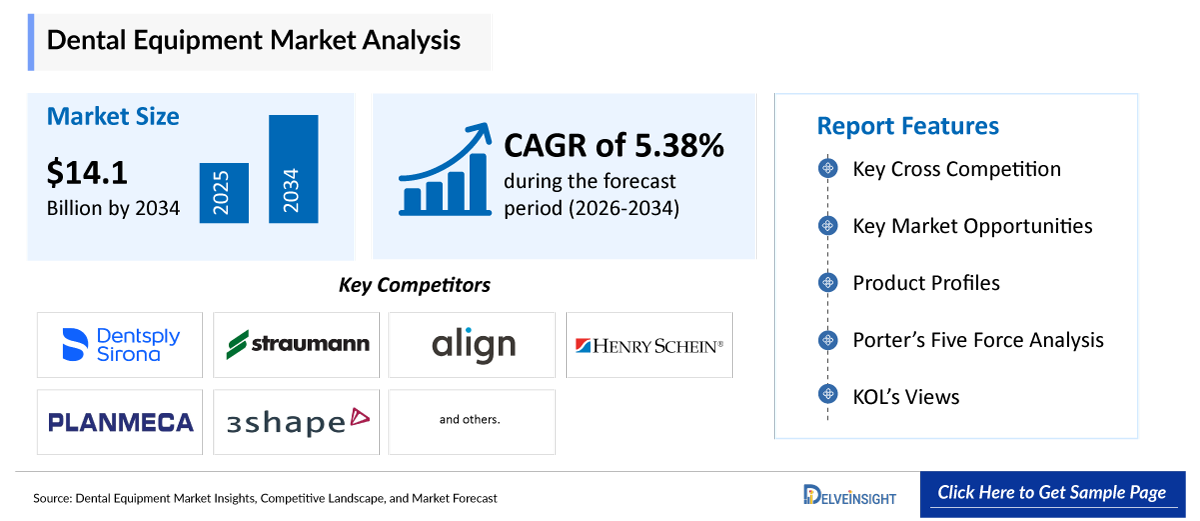
• The global dental equipment market was valued at USD 8,743.20 million in 2025 and is projected to reach USD 14,011.81 million by 2034.
• The market is expected to expand at a CAGR of 5.38% during the forecast period 2026-2034, supported by the growing prevalence of dental infections and periodontal disease, the increasing demand for dental care and cosmetic dentistry, and technological advancement in dental laser and radiology.
• By usage type, the therapeutic segment dominated the dental equipment market with a 62% share in 2025.
• By product type, the dental radiology equipment segment dominated the dental equipment market with a 28% share in 2025.
• By application, the prosthodontics segment dominated the dental equipment market with a 35% share in 2025.
• By end-user, the dental clinics segment dominated the dental equipment market with a 60% share in 2025.
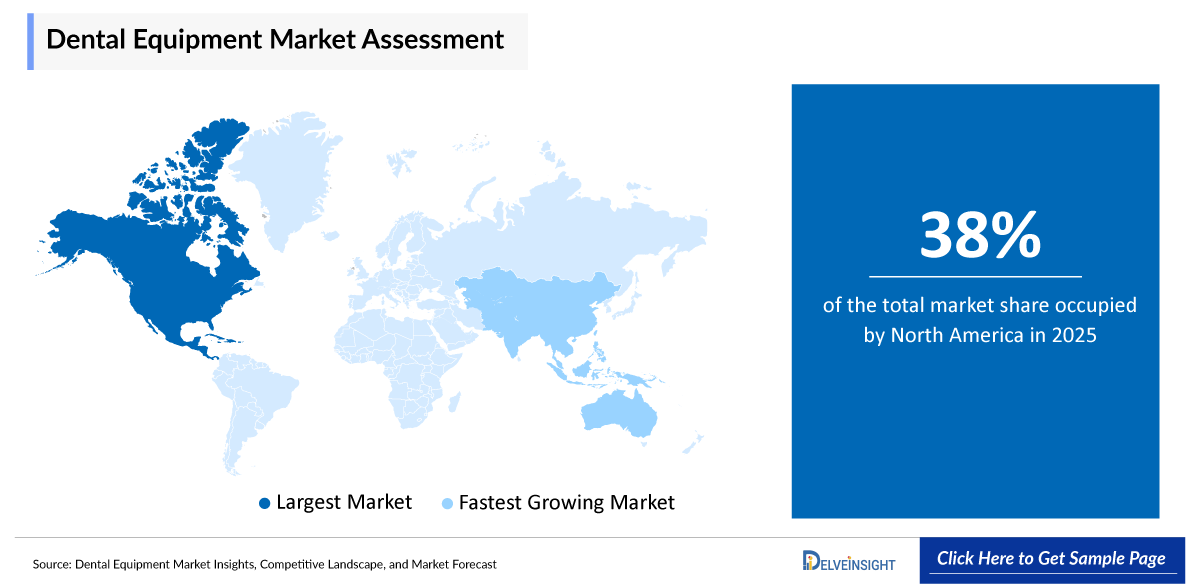
• North America accounted for the largest share of the dental equipment market at 38% in 2025, while Asia-Pacific is anticipated to register the fastest growth through 2034.
Dental equipment comprises the instruments, systems, and devices used by dental professionals to diagnose, treat, and manage the conditions of the teeth, gums, and oral cavity, spanning the imaging and diagnostic systems, the treatment systems and instruments, and the materials and consumables used in dental care. The market is organized by the usage of the equipment, the type of product, the clinical application, and the setting of care. By usage type, it is divided between the therapeutic equipment used to treat dental conditions and the diagnostic equipment used to detect and assess them. By product type, it spans dental lasers, dental radiology equipment in its intra-oral and extra-oral forms, dental chairs, dental lighting systems, dental consumables including biomaterials, implants, and crowns and bridges, and other equipment. By application, it spans orthodontic, endodontic, periodontic, and prosthodontic dentistry, and by end-user it spans hospitals, dental clinics, and other settings. The market is driven by the growing prevalence of dental infections and periodontal diseases that require treatment, by the increasing demand for dental care facilities and surgical procedures, by the rising demand for cosmetic dentistry, by technological advancement in dental laser, radiology, and computer-aided design and manufacturing, and by the aging of the population and its rising need for prosthodontic care.
Dental Equipment Market Key Growth Drivers
• The growing prevalence of dental infections and periodontal diseases, with the World Health Organization estimating that periodontal disease affects some 14% of the global adult population, representing over one billion cases.
• The increasing demand for dental care facilities and dental surgical procedures, driven by rising awareness of oral health and the growing burden of dental disease.
• The increasing demand for cosmetic dentistry, including tooth whitening, aesthetic restorations, and the intraoral cameras and imaging that support aesthetic treatment planning.
• Continuous technological advancement in dental lasers, radiology, and computer-aided design and manufacturing, including cone-beam computed tomography, intraoral scanners, and chairside systems.
• The aging of the global population, with the World Health Organization projecting that by 2030 one in six people will be aged 60 or over, increasing the demand for prosthodontic care for tooth loss and decay.
• The rising adoption of digital dentistry, including intraoral scanners, cone-beam computed tomography, chairside computer-aided design and manufacturing, and three-dimensional printing, is compressing laboratory workflows.
• The expansion of dental tourism and of dental support organizations and group practices, which increases the installed base of advanced dental equipment.
Key Companies in Dental Equipment Market
The competitive landscape is led by the following active manufacturers:
• Dentsply Sirona
• Institut Straumann AG
• Align Technology
• Henry Schein Inc.
• Planmeca Oy
• 3Shape A/S
• 3M
• GC Corporation
• Ivoclar Vivadent AG
• Carestream Dental LLC
Factors Contributing to the Growth of the Dental Equipment Market
Market Drivers
Growing Prevalence of Dental Infections and Periodontal Disease
The foundational driver of the dental equipment market is the growing prevalence of dental infections and periodontal diseases, because the burden of these conditions determines the volume of the dental diagnosis and treatment that dental equipment enables. The growing prevalence of dental infections such as tooth abscesses, gingivitis, and tooth caries and other periodontal diseases is a principal source of demand, and the scale of the burden is very large, with the World Health Organization estimating that periodontal disease affects some 14% of the global adult population, representing over one billion cases, and untreated caries affecting a substantial share of the population. The main causes of periodontal disease, poor oral hygiene and tobacco use, remain widespread, and the rising consumption of sugar-sweetened beverages and the prevalence of tobacco and electronic-cigarette use, particularly among the young, are increasing the burden of caries, decay, and gum disease that require treatment. Accidents and injuries add further demand, with millions of teeth knocked out each year in children and adults, requiring restorative and prosthodontic treatment. Each of these conditions requires the diagnosis and treatment that dental equipment enables, from the radiology that detects disease to the lasers, chairs, and instruments that treat it, so the growing burden translates directly into demand for equipment. Because the burden of dental disease is very large, rising, and dependent upon dental equipment for its management, this driver provides the most durable foundation for market growth.
Increasing Demand for Dental Care and Surgical Procedures
The increasing demand for dental care facilities and dental surgical procedures is a powerful driver of the dental equipment market, because the volume of dental care and procedures determines the demand for the equipment used to deliver them, and this volume is rising with awareness, access, and disease burden. Rising awareness of oral health and its importance, the growing recognition of the link between oral and general health, and the expansion of access to dental care in the developed and emerging markets are increasing the number of people seeking dental care and the volume of the procedures performed, and each procedure, from a routine examination and cleaning to a complex surgical or restorative treatment, requires dental equipment. The growth of dental surgical procedures, including implant placement, endodontic and periodontal surgery, and restorative and prosthodontic treatment, is a particularly important driver, since these procedures require the advanced imaging, laser, and treatment equipment that constitutes the higher-value part of the market. The expansion of dental care facilities, from private practices to the dental support organizations and group practices that are growing rapidly, installs the equipment base that delivers this care. Because the volume of dental care and procedures is large and rising, and because each requires equipment, this driver is a powerful and direct contributor to market growth.
Market Restraints
Despite a large and rising burden of dental disease and rapid technological advances, the dental equipment market faces several material constraints. The most significant is the high cost of advanced dental equipment, since the acquisition of imaging and radiology systems, including cone-beam computed tomography, lasers, the chairside computer-aided design and manufacturing systems, and other advanced equipment is substantial, and this cost restricts adoption particularly among the smaller practices, in the cost-sensitive markets, and in the developing countries, slowing the diffusion of advanced technology and constraining the equipment base. A second constraint is the shortage of trained dental practitioners able to use the advanced equipment, since the sophisticated digital, imaging, and laser systems require training and expertise to operate effectively, and the dearth of trained dental practitioners in the underdeveloped and developing countries constrains both the adoption and the effective use of advanced equipment, limiting the market in precisely the regions where the unmet dental need is greatest. A third constraint is the lack of access to dental reimbursement and insurance, since dental care is frequently poorly covered by insurance and reimbursement relative to general medical care, and the resulting out-of-pocket cost to patients limits the demand for dental procedures, particularly the higher-cost and elective procedures, that drive the demand for advanced equipment, so that the limited reimbursement of dental care constrains the market. Additional constraints include the disruption of dental care and supply chains during public health emergencies, as the experience of the pandemic demonstrated when the close patient contact of dental procedures led to a decline in visits and elective procedures; the long replacement cycles of durable equipment; and the intense competition of a market with many participants. Together, these cost, workforce, and reimbursement factors ensure that growth, while steady, proceeds against genuine constraint.
Dental Equipment Market Segment Analysis
The global dental equipment market is segmented by usage type (therapeutic and diagnostic), by product type (dental lasers, dental radiology equipment, dental chairs, dental lighting systems, dental consumables, and others), by application (orthodontic, endodontic, periodontic, and prosthodontic), by end-user (hospitals, dental clinics, and others), and by geography (North America, Europe, Asia-Pacific, and the Rest of the World).
By Usage Type
Dominant Subsegment: Therapeutic.
The therapeutic segment accounted for a 62% share of the dental equipment market in 2025. The therapeutic usage dominates the usage-type structure because the treatment of dental conditions constitutes the great majority of dental practice, and the lasers, chairs, instruments, restorative systems, and consumables used to treat dental disease account for the larger share of the equipment market. Therapeutic dental equipment encompasses the wide range of systems and instruments used to treat caries, periodontal disease, endodontic conditions, and tooth loss that constitute the burden of dental disease, from the dental lasers and handpieces used in operative and surgical procedures to the chairs, delivery systems, and restorative and prosthodontic equipment and materials, and the large and rising volume of dental treatment sustains the leading position of the segment. The growth of the restorative, surgical, and cosmetic procedures that treat and correct dental conditions reinforces the dominance of therapeutic equipment. The diagnostic usage constitutes the second category, encompassing the radiology, imaging, and intraoral camera equipment used to detect and assess dental disease, and it is a substantial and growing segment, driven by the advance of digital radiography, cone-beam computed tomography, and artificial intelligence that enhances diagnosis, but it remains smaller than the therapeutic segment because the treatment of disease consumes more equipment and materials than its diagnosis. The therapeutic segment is expected to retain its leading share throughout the forecast period, while the diagnostic segment grows with the advance of digital imaging.
By Product Type
Dominant Subsegment: Dental Radiology Equipment.
The dental radiology equipment segment accounted for a 28% share of the dental equipment market in 2025. Dental radiology equipment dominates the product-type structure because dental imaging is fundamental to the diagnosis, planning, and verification of dental treatment across every application, and the migration from film to digital radiography and to cone-beam computed tomography has both raised the value of the segment and driven the replacement of the installed base. Dental radiology equipment, in its intra-oral forms, including the digital sensors and intraoral cameras used at the chairside, and its extra-oral forms, including the panoramic, cephalometric, and cone-beam computed tomography systems, is used across orthodontic, endodontic, periodontic, and prosthodontic dentistry for the detection of disease, the planning of implants and treatment, and the assessment of the teeth and jaws, and the breadth of its application and the high value of the advanced systems sustain the leading position of the segment. The migration from film to digital radiography and the adoption of cone-beam computed tomography for three-dimensional imaging have raised the value of the segment and compressed its replacement cycle. Dental consumables, including biomaterials, implants, and crowns and bridges, constitute a large product category, and dental lasers constitute the fastest-growing category, driven by the rising frequency of dental disorders and the increasing awareness of the advantages of laser dentistry. Dental chairs, dental lighting systems, and other equipment complete the structure. The dental radiology equipment segment is expected to retain its leading share throughout the forecast period, while dental lasers grow fastest.
Dental Equipment Market Region Analysis
Dominant Region: North America
North America accounted for a 38% share of the global dental equipment market in 2025. The region is expected to account for the largest share of the global market, driven by the increasing prevalence of dental diseases, the rapid development in dental technology, the high adoption of advanced equipment, heightened consumer awareness of oral hygiene, and the presence of leading companies. The United States hosts a large, well-established, and technologically advanced dental care system, with a high density of dental clinics and practitioners, high adoption of advanced dental technologies including lasers, intraoral cameras, digital radiography, and computer-aided design and manufacturing systems, and high patient spending on dental and cosmetic care, and the rising prevalence of dental disease drives the demand for equipment. The prevalence of untreated caries in the United States adult population is high, estimated at over one in five adults, and the high consumption of sugar-sweetened beverages and the prevalence of tobacco and electronic-cigarette use increase the burden of caries, decay, and gum disease that require treatment, while accidents contribute further demand, with millions of teeth knocked out each year. The region leads in digital dentistry adoption, with high penetration of computer-aided design and manufacturing, intraoral scanners, and advanced imaging, and it benefits from strong infrastructure, regulatory support, and the growth of dental support organizations. The region is expected to retain its leading position throughout the forecast period.
Fastest Growing Region: Asia-Pacific
Asia-Pacific is projected to register the fastest compound annual growth rate in the dental equipment market through 2034. The region is emerging as the principal growth engine of the market, propelled by very large populations, a rising burden of dental disease, expanding access to dental care, rising healthcare investment and awareness, the growth of dental tourism, and government initiatives for oral health. The region combines the largest populations in the world with a rising burden of dental caries, periodontal disease, and tooth loss that require treatment, and the expansion of dental care access, the growth of the dental clinic and dental support organization base, and rising incomes and awareness are converting this burden into demand for equipment. Government policies favoring the dental sector, a growing elderly population, the presence of prominent regional manufacturers, and rising awareness of oral hygiene drive the market, and the region hosts rapidly growing dental tourism hubs, particularly in China, India, and Thailand, that attract patients from across the world with affordable, high-quality treatment and drive the installation of advanced equipment. China combines a very large population with a rapidly developing dental market and a growing domestic manufacturing industry; India combines a very large population and rising dental awareness with a fast-growing private dental sector and dental tourism, and Japan combines an aged population with an advanced and sophisticated dental market. The coexistence of demand for both advanced and cost-effective equipment creates opportunity for international and regional manufacturers alike. Regional growth is expected to exceed the global average across every segment.
Regional Commentary
North America
North America leads on value and adoption, holding a 38% share in 2025. The region combines a high prevalence of dental disease, wide development in dental technology, high adoption of advanced and digital equipment, high patient spending on dental and cosmetic care, and the presence of leading companies. It leads in digital dentistry adoption, with high penetration of computer-aided design and manufacturing, intraoral scanners, and advanced imaging, and benefits from strong infrastructure, regulatory support, and the growth of dental support organizations. Near-term dynamics are shaped by the digitization of the practice, the growth of clear-aligner and implant treatment, the embedding of artificial intelligence in imaging, and the consolidation of practices under dental support organizations.
Europe
Europe is a large and advanced market, and the home region of several of the leading companies, including the major Swiss, German, and Scandinavian implant, imaging, and scanner manufacturers, and it combines well-developed dental care systems, high adoption of advanced and digital equipment, and an aging population, with Germany, France, and the United Kingdom among the principal markets. The region combines a substantial and aging patient population, with its rising demand for implant and prosthodontic care, with strong adoption of digital dentistry and the presence of distinctive manufacturer strengths in implants, imaging, and scanners. The pace of adoption is shaped by national reimbursement and by the structure of the dental care systems, and the region sustains a competitive and advanced market served by both global and regional participants.
Asia-Pacific
Asia-Pacific is the fastest-growing region, propelled by very large populations, a rising burden of dental disease, expanding access to dental care, rising investment and awareness, the growth of dental tourism, and government initiatives for oral health. The expansion of dental care access and the growth of the clinic and dental support organization base are converting the large disease burden into demand for equipment. China combines a very large population with a developing dental market and growing domestic manufacturing; India combines a very large population and rising awareness with a fast-growing private sector and dental tourism; and Japan combines an aged population with an advanced market. Both advanced and cost-effective equipment find demand. Growth exceeds the global average across every segment.
Rest of World
The Rest of the World comprises the Middle East, Africa, and South America. The burden of dental disease is significant and rising across all three, and the region carries a substantial and growing demand for dental equipment. The Gulf states combine high healthcare investment with advanced dental infrastructure and a strong dental tourism sector, and the larger Latin American markets, particularly Brazil, support established dental care sectors, a strong culture of cosmetic dentistry, and growing dental tourism, together representing substantial growth. Much of Africa faces constrained dental care access and a shortage of practitioners and infrastructure, so equipment adoption is concentrated in the larger urban and private centers, with substantial unmet need. Regional growth will be driven by the rising disease burden, expanding access, dental tourism, and the availability of both advanced and cost-appropriate equipment from international and regional manufacturers.
Dental Equipment Market Competitive Landscape
The global dental equipment market is classified as Moderately Concentrated. The market is led by a group of large dental technology, imaging, implant, and clear-aligner companies, principally Dentsply Sirona, Straumann, Align Technology, and Planmeca, together with the distributors Henry Schein and Patterson and the scanner and materials specialists, complemented by a broad field of specialized manufacturers. Competition centers upon the breadth and integration of the digital and imaging portfolio, the innovation of scanners, imaging, lasers, and implants, the integration of the digital workflow from scan to design to manufacture, relationships with dental practices and support organizations, and increasingly upon artificial intelligence and the connected practice. The competitive landscape is evaluated across the following dimensions:
• Market concentration: Moderately concentrated, with a group of large dental technology, imaging, implant, and clear-aligner companies holding significant combined share alongside the major distributors and a broad field of specialized manufacturers, and with the portfolio breadth, digital-workflow integration, and installed base of the leaders constituting a barrier to entry.
• Leading players: Dentsply Sirona leads through its broad equipment, imaging, and computer-aided design and manufacturing portfolio, Straumann through its implant and clear-aligner and digital portfolio, Align Technology through its clear-aligner and intraoral scanner franchise, and Planmeca through its imaging and equipment, with the distributors Henry Schein and Patterson, the scanner specialist 3Shape, and the materials and equipment companies 3M, GC, Ivoclar Vivadent, and Carestream Dental holding strong positions.
• Geographic reach: The leading companies maintain global manufacturing, commercial, and distribution organizations, decisive because dental equipment requires broad reach, local sales and service, and training, while the major distributors provide a route to market across the fragmented dental practice landscape and regional manufacturers serve domestic and cost-sensitive markets, particularly across Asia-Pacific.
• Product portfolio strength: Competitive advantage rests upon the breadth and integration of the portfolio across imaging, scanning, design, manufacturing, lasers, implants, and materials, and upon the integration of the digital workflow from intraoral scan to computer-aided design to chairside or laboratory manufacture, with the leaders differentiating through comprehensive and integrated digital ecosystems and specialists through a superior scanner, implant, or imaging system.
• Pipeline strength: Development is concentrated in intraoral scanners, cone-beam computed tomography, chairside computer-aided design and manufacturing, three-dimensional printing, clear-aligner and implant systems, and the artificial intelligence that enhances diagnosis, treatment planning, and workflow.
• Strategic partnerships: Collaboration spans partnerships between equipment manufacturers and dental support organizations, exemplified by the partnership of a leading implant company with a major dental support organization, collaborations between equipment and materials companies to deliver integrated solutions, and the integration of scanners, imaging, and design software across the digital workflow.
• M&A activity: Acquisition and consolidation have shaped the field, including the acquisition of scanner, imaging, and digital capability, exemplified by the acquisition of an intraoral scanner business and its rebranding, the acquisition of three-dimensional printing and clear-aligner technology, and the broader consolidation of the equipment and the practice landscape.
• Innovation focus: Innovation is shifting toward the digitization of the practice through intraoral scanners, cone-beam computed tomography, and chairside computer-aided design and manufacturing, the artificial intelligence that enhances imaging diagnosis and treatment planning, three-dimensional printing that compresses laboratory workflows, and the integration of the connected digital practice.
• Regulatory standing: Regulatory clearance for dental devices in the major jurisdictions, including United States Food and Drug Administration clearance, exemplified by the clearance of dental artificial-intelligence solutions for two- and three-dimensional imaging analysis, is a decisive credential, and the regulation of imaging, laser, and implant devices rewards the scale and regulatory capability of the leading companies.
Dental Equipment Market Recent Developmental Activities
In May 2025, Pearl announced United States Food and Drug Administration 510(k) clearance for Second Opinion 3D, becoming the first dental artificial-intelligence company with cleared solutions for both two-dimensional and three-dimensional dental imaging analysis. Strategic significance: the clearance of a dental artificial-intelligence solution for both two- and three-dimensional imaging illustrated the entry of artificial intelligence into dental diagnosis and the extension of dental imaging from capture toward automated interpretation and decision support.
Dental Equipment Market Segmentation
Dental Equipment Market Assessment by Usage Type
• Therapeutic
• Diagnostic
Dental Equipment Market Assessment by Product Type
• Dental Lasers
• Dental Radiology Equipment (Intra-Oral and Extra-Oral)
• Dental Chairs
• Dental Lighting Systems
• Dental Consumables (Biomaterials, Implants, Crowns and Bridges, Others)
• Others
Dental Equipment Market Assessment by Application
• Orthodontic
• Endodontic
• Periodontic
• Prosthodontic
Dental Equipment Market Assessment by End-User
• Hospitals
• Dental Clinics
• Other End Users
Dental Equipment Market Assessment by Geography
• North America
▪ United States Dental Equipment Market Size in USD million (2023-2034)
▪ Canada Dental Equipment Market Size in USD million (2023-2034)
▪ Mexico Dental Equipment Market Size in USD million (2023-2034)
• Europe
▪ France Dental Equipment Market Size in USD million (2023-2034)
▪ Germany Dental Equipment Market Size in USD million (2023-2034)
▪ United Kingdom Dental Equipment Market Size in USD million (2023-2034)
▪ Italy Dental Equipment Market Size in USD million (2023-2034)
▪ Spain Dental Equipment Market Size in USD million (2023-2034)
▪ Rest of Europe Dental Equipment Market Size in USD million (2023-2034)
• Asia-Pacific
▪ China Dental Equipment Market Size in USD million (2023-2034)
▪ Japan Dental Equipment Market Size in USD million (2023-2034)
▪ India Dental Equipment Market Size in USD million (2023-2034)
▪ Australia Dental Equipment Market Size in USD million (2023-2034)
▪ South Korea Dental Equipment Market Size in USD million (2023-2034)
▪ Rest of Asia-Pacific Dental Equipment Market Size in USD million (2023-2034)
• Rest of the World
▪ Middle East Dental Equipment Market Size in USD million (2023-2034)
▪ Africa Dental Equipment Market Size in USD million (2023-2034)
▪ South America Dental Equipment Market Size in USD million (2023-2034)
Key Takeaways from the Dental Equipment Market Report Study
• Market size analysis for the current Dental Equipment market size (2025), and market forecast for 9 years (2026 to 2034).
• Top key product/technology developments, mergers, acquisitions, partnerships, and joint ventures that have happened over the last 3 years.
• Key companies dominating the global Dental Equipment market.
• Various opportunities available for competitors in the Dental Equipment market space.
• What are the top-performing segments in 2025? How will these segments perform in 2034?
• Which are the top-performing regions and countries in the current Dental Equipment market scenario?
• Which are the regions and countries where companies should concentrate their opportunities for Dental Equipment market growth in the future?
Target audience that can benefit from this Dental Equipment market report study
• Dental Equipment product providers
• Research organizations and consulting companies
• Dental Equipment -related organizations, associations, forums, and other alliances
• Government and corporate offices
• Start-up companies, venture capitalists, and private equity firms
• Distributors and traders dealing in Dental Equipment
• Various end-users who want to know more about the Dental Equipment market and the latest technological developments in the Dental Equipment market.

