
Dermal Regeneration Matrix Market Summary
● The Dermal Regeneration Matrix market is estimated at USD 1.85 billion in 2025 and is projected to reach USD 3.46 billion by 2034. Growth is anchored in the rising global burden of chronic and burn wounds, expanding adoption of advanced bilayer matrices in reconstructive and burn surgery, and continued innovation in collagen- and ECM-based scaffold technologies.
● The global Dermal Regeneration Matrix market is growing at a CAGR of 7.2% during the forecast period from 2026 to 2034.
● By product type, the bilayer dermal regeneration matrices segment dominated the Dermal Regeneration Matrix market with a 47% share in 2025.
● By material, the collagen-based matrices segment dominated the Dermal Regeneration Matrix market with a 39% share in 2025.
● By wound type, the chronic wounds segment dominated the Dermal Regeneration Matrix market with a 63% share in 2025.
● By end-user, the hospitals segment dominated the Dermal Regeneration Matrix market with a 51% share in 2025.
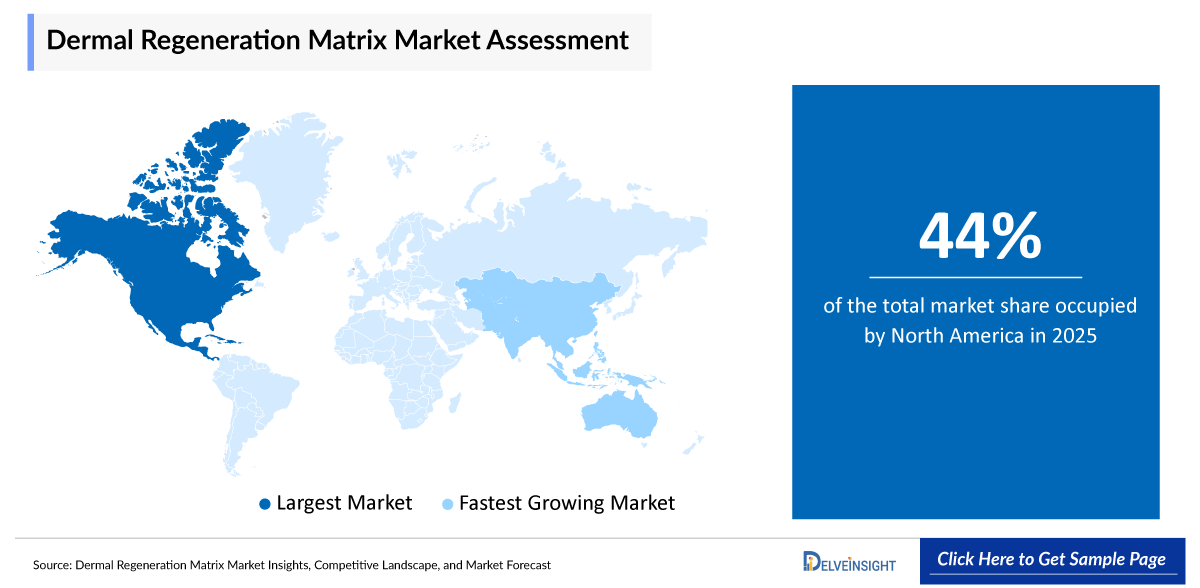
● North America dominated the global Dermal Regeneration Matrix market revenue with a 44% share in 2025, representing the highest regional market share globally.
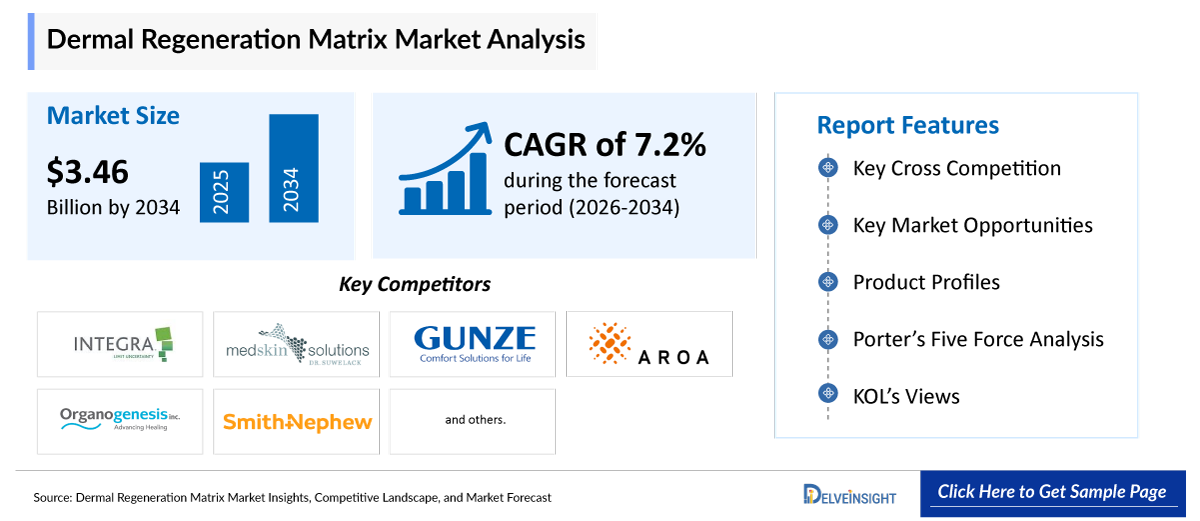
A dermal regeneration matrix is a bioengineered or biologically derived scaffold, typically composed of collagen, collagen-glycosaminoglycan (GAG) complexes, decellularized extracellular matrix, or synthetic polymers, that is surgically applied to full- and partial-thickness skin defects to support the ingrowth of a patient's own dermal tissue ahead of definitive wound closure. By providing a structural template that promotes fibrovascular infiltration, angiogenesis, and organized collagen deposition, dermal regeneration matrices reduce scarring and contracture relative to conventional grafting and are widely used in burn reconstruction, diabetic and venous ulcer management, trauma repair, and post-oncologic surgical defects. The market is organized by product type across single-layer, bilayer, and composite matrices; by material, spanning collagen-based, collagen-GAG, extracellular matrix (ECM)-based, and synthetic polymer-based scaffolds; by wound type across acute and chronic wounds; and by end-user, led by hospitals, specialty and burn centers, and ambulatory surgical centers. Driven by rising chronic wound prevalence, an aging population, growing burn-injury incidence, and continued clinical adoption of bilayer regenerative scaffolds as an alternative to autografting, dermal regeneration matrices have become a foundational technology in advanced wound care and reconstructive surgery.
Dermal Regeneration Matrix Market Key Growth Drivers
• The rising global prevalence of chronic wounds, including diabetic foot ulcers, venous leg ulcers, and pressure injuries, is expanding demand, with the diabetic population alone projected by the International Diabetes Federation to approach 850 million by 2045.
• The growing incidence of severe burns and increasing volumes of burn reconstruction and post-traumatic surgery are driving adoption of bilayer and composite dermal regeneration matrices in specialty and burn centers.
• An aging global population with thinner, slower-healing skin and a higher burden of comorbidities such as diabetes and vascular disease is increasing the addressable patient pool for advanced dermal substitutes.
• Continued clinical evidence supporting bilayer regenerative templates as an alternative to autografting, reducing donor-site morbidity and improving cosmetic and functional outcomes, is broadening surgeon adoption.
• Expanding reimbursement coverage for advanced wound care products and skin substitutes across the United States, Europe, and parts of Asia-Pacific is improving patient access and provider adoption.
• Ongoing innovation in single-application, off-the-shelf, and fish-skin- and ECM-derived matrices is reducing procedure time and expanding use into ambulatory and outpatient settings.
• The convergence of chronic wound burden, burn-care demand, reimbursement expansion, and product innovation is expected to sustain steady, above-GDP growth in the market through 2034.
Key Companies in Dermal Regeneration Matrix Market
The competitive landscape is led by the following active manufacturers:
• Integra LifeSciences
• MedSkin Solutions Dr. Suwelack
• Gunze Limited
• Aroa Biosurgery
• Organogenesis
• Smith+Nephew
• Mölnlycke Health Care
• Kerecis
• LifeNet Health
• MTF Biologics
• AlloSource
Factors Contributing to the Growth of the Dermal Regeneration Matrix Market
Market Drivers
Rising Global Burden of Chronic Wounds
The most significant driver of the Dermal Regeneration Matrix market is the escalating global burden of chronic wounds, including diabetic foot ulcers, venous leg ulcers, and pressure injuries. Chronic, non-healing wounds are becoming more common as the prevalence of diabetes, obesity, and vascular disease rises worldwide, and standard wound-care measures are frequently insufficient to achieve closure in these complex cases. Dermal regeneration matrices provide a structural scaffold that supports vascularized tissue ingrowth and accelerates durable wound closure, making them an increasingly standard component of advanced chronic wound management pathways. As diabetes prevalence and the associated chronic wound population continue to expand, particularly in aging societies, demand for dermal regeneration matrices used in outpatient, hospital, and specialty wound-care settings grows correspondingly, anchoring market expansion through 2034.
Increasing Incidence of Burns and Reconstructive Surgery
Growing volumes of severe burn injuries and reconstructive surgical procedures are expanding demand for bilayer and composite dermal regeneration matrices. Bilayer matrices, which combine a collagen-GAG dermal analog with a temporary silicone epidermal layer, are established as a preferred alternative to autografting in extensive burns, reducing donor-site morbidity and enabling staged reconstruction in patients with limited donor skin. Specialty and burn centers increasingly rely on these matrices for both acute burn management and delayed reconstructive procedures following trauma, oncologic resection, and congenital defect repair. As burn-care infrastructure expands, particularly across specialty and tertiary hospital networks, and as reconstructive techniques continue to favor regenerative scaffolds over traditional grafting, this driver sustains durable demand across the forecast period.
Market Restraints
Despite strong momentum, the Dermal Regeneration Matrix market faces material constraints. The high cost of advanced bilayer and composite matrices relative to conventional grafting and dressings limits adoption in cost-sensitive healthcare systems and constrains use to more severe or complex wounds where clinical benefit clearly justifies expense. Multi-stage bilayer procedures require a period of vascularization before definitive epidermal grafting, extending overall treatment timelines, requiring multiple clinical visits, and increasing the risk of infection or graft failure between stages. Reimbursement policies for skin substitutes remain inconsistent across geographies and payor systems, and in some markets remain narrowly restricted to specific indications, limiting broader adoption. The clinical skill and specialized surgical training required for optimal application constrain use to experienced burn and reconstructive surgeons, particularly in emerging markets with limited specialist availability. Collagen- and tissue-derived matrices also carry residual concerns among some clinicians and patients regarding disease transmission and immunogenicity, favoring continued innovation in synthetic and ECM-based alternatives. Together, these cost, procedural, reimbursement, and training barriers temper the pace of adoption, even as the underlying drivers of chronic wound burden, burn-care demand, and clinical evidence remain firmly intact.
Dermal Regeneration Matrix Market Segment Analysis
The dermal regeneration matrix market by product type (single-layer dermal regeneration matrices, bilayer dermal regeneration matrices, composite dermal regeneration matrices, others), material (collagen-based, collagen-glycosaminoglycan (gag) matrices, extracellular matrix (ecm)-based matrices, synthetic polymer-based matrices, others), wound type (acute wounds, chronic wounds), end-users (hospitals, specialty & burn centers, ambulatory surgical centers, others), and geography (North America, Europe, Asia-Pacific, and Rest of World).
Product Type
Dominant Subsegment: Bilayer Dermal Regeneration Matrices.
The bilayer dermal regeneration matrices segment accounted for 47% of the Dermal Regeneration Matrix market in 2025. Bilayer matrices are the leading product type because they combine a collagen-GAG dermal analog with a temporary silicone epidermal layer, most closely replicating native skin architecture and delivering the strongest clinical outcomes in extensive burns and complex reconstructive defects. Their established role as the preferred alternative to autografting in major burn centers, supported by an extensive body of long-term outcome data, sustains great and dependable procedural demand. Single-layer matrices remain widely used in smaller acute and chronic wounds where a simpler, faster application is preferred, and composite matrices are gaining traction as manufacturers combine dermal and epidermal analogs with novel biomaterials to shorten treatment timelines. While composite and single-layer formats are growing quickly as off-the-shelf convenience improves, the depth of clinical evidence, surgeon familiarity, and severity of the indications they address secure the bilayer segment's leadership across the forecast period.
By Material
Dominant Subsegment: Collagen-Based Matrices.
The collagen-based matrices segment accounted for 39% of the Dermal Regeneration Matrix market in 2025. Collagen-based matrices are the leading material category because collagen is the principal structural protein of native dermis, offering well-characterized biocompatibility, a long clinical track record, and broad regulatory acceptance across major markets. Collagen scaffolds support predictable fibrovascular ingrowth and are manufactured at scale from bovine, porcine, and other well-validated sources, underpinning their use across single-layer, bilayer, and composite product formats. Collagen-glycosaminoglycan (GAG) matrices, a specialized subset engineered to closely mimic the biochemical composition of native dermis, are expanding quickly on the strength of bilayer product adoption in burn and reconstructive surgery. Extracellular matrix (ECM)-based matrices, including fish-skin- and other tissue-derived scaffolds, and synthetic polymer-based matrices are the fastest-growing categories as manufacturers seek to reduce disease-transmission concerns and diversify sourcing. Nonetheless, the breadth of clinical use and manufacturing scale of collagen-based materials secure their leadership across the forecast period.
Dermal Regeneration Matrix Market Region Analysis
Dominant Region: North America
North America accounted for 44% of the global Dermal Regeneration Matrix market revenue in 2025, representing the highest regional market share globally. The region's dominance reflects a high prevalence of diabetes and chronic wounds, established burn-care infrastructure, favorable reimbursement policies for advanced wound-care products, and the concentrated presence of leading manufacturers, particularly in the United States. North America hosts extensive specialty and burn-center networks and benefits from strong clinical adoption of bilayer regenerative matrices as standard of care in major burn and reconstructive surgery programs. High healthcare expenditure, well-developed distribution channels, and continuous product innovation from regionally headquartered manufacturers further reinforce the region's leadership. Sustained investment in advanced wound-care pathways and expanding outpatient application of off-the-shelf matrices support continued regional growth across the forecast period.
Fastest Growing Region: Asia-Pacific
Asia-Pacific is the fastest-growing region in the Dermal Regeneration Matrix market. The region's elevated CAGR is driven by a rapidly rising diabetic population, increasing burn and trauma case volumes, expanding healthcare infrastructure, and growing healthcare investment across China, Japan, India, South Korea, and Australia. China is expanding hospital-based wound-care capacity and domestic manufacturing, Japan is advancing adoption of advanced regenerative scaffolds within its established reconstructive surgery base, and India is expanding access to advanced wound-care products alongside growing medical tourism for reconstructive procedures. Rising healthcare expenditure, an expanding base of trained reconstructive and burn surgeons, and growing awareness of advanced dermal substitutes as alternatives to traditional grafting are accelerating adoption, while regional manufacturers scale production to serve both domestic and export demand. The combination of high disease burden, infrastructure build-out, and rising clinical awareness positions Asia-Pacific as the principal source of incremental growth over the forecast period.
Regional Commentary
North America
North America accounted for 44% of the global Dermal Regeneration Matrix market revenue in 2025. The United States dominates on the strength of its high chronic wound and diabetes prevalence, established burn-care and reconstructive surgery infrastructure, favorable reimbursement pathways for advanced wound-care products, and the concentrated presence of leading manufacturers including Integra LifeSciences and Organogenesis.
Europe
Europe is a large and advanced regional market, supported by well-established reconstructive surgery and burn-care networks, a strong regulatory framework under the EU Medical Device Regulation, and the presence of leading manufacturers such as MedSkin Solutions and Dr. Suwelack. Growing adoption of advanced wound-care products across Germany, France, the United Kingdom, Italy, and Spain reinforces the region's role in both diagnostic and therapeutic wound management.
Asia-Pacific
Asia-Pacific is the fastest-growing region, propelled by rising diabetes prevalence, expanding burn and trauma case volumes, and growing healthcare investment across China, Japan, India, South Korea, and Australia. Expanding domestic manufacturing, including Gunze Limited's regenerative medicine portfolio in Japan, and rising hospital infrastructure investment are accelerating regional adoption and clinical-training activity.
Rest of World
The Rest of World region, spanning Latin America, the Middle East, and Africa, is an emerging growth frontier. Expanding hospital and burn-care infrastructure, rising diabetes and chronic wound prevalence, and gradual broadening of reimbursement and regulatory frameworks are slowly improving access, while international distribution partnerships support the build-out of regional demand.
Dermal Regeneration Matrix Market Competitive Landscape
The Dermal Regeneration Matrix market is classified as Moderately Concentrated. A group of established players with broad product portfolios and global distribution reach, including Integra LifeSciences, Smith+Nephew, and Organogenesis, secures large hospital and burn-center contracts and anchors the top tier, while specialized and fast-scaling providers such as Aroa Biosurgery, Kerecis, MedSkin Solutions, Dr. Suwelack, and Gunze Limited compete through differentiated biomaterials, regional manufacturing strength, and dedicated burn- and wound-care partnerships, increasing competition across product-type and material segments.
The competitive landscape can be evaluated across the following dimensions:
• Market concentration: Moderately concentrated, with established multinational players leading and a growing field of specialized biomaterial innovators.
• Leading players: Integra LifeSciences, Smith+Nephew, and Organogenesis anchor the top tier through broad bilayer and single-layer product portfolios and global distribution networks.
• Geographic reach: Leaders operate global, regionally distributed distribution and manufacturing networks essential for hospital and burn-center supply, spanning North America, Europe, and Asia-Pacific.
• Product portfolio strength: Top players offer end-to-end portfolios spanning single-layer, bilayer, and composite matrices across collagen, collagen-GAG, ECM, and synthetic biomaterials.
• Tissue and biomaterial sourcing: Ownership or secured supply of validated collagen, ECM, and tissue sources, including LifeNet Health, MTF Biologics, and AlloSource's tissue-processing capabilities, is a decisive advantage.
• Strategic partnerships: Tie-ups with hospital networks, burn centers, and distribution partners extend market reach and clinical adoption across specialty wound-care channels.
• M&A and expansion activity: Active portfolio expansion and manufacturing investment among leading and mid-tier players continues to reshape the competitive landscape.
• Manufacturing capabilities: Validated collagen and ECM processing, tissue-bank infrastructure, and regulatory-compliant manufacturing facilities are key competitive moats.
• Innovation focus: Off-the-shelf and single-application formats, fish-skin- and ECM-derived biomaterials, and synthetic polymer scaffolds designed to reduce disease-transmission concerns and procedure time.
Dermal Regeneration Matrix Market Recent Developmental Activities
In 2025-2026, Integra LifeSciences announced continued expansion of its regenerative technologies manufacturing capacity to support growing global demand for its bilayer dermal regeneration templates across burn and reconstructive surgery applications. Strategic significance: Reinforces Integra's position as the leading integrated provider of bilayer dermal regeneration matrices.
In 2025-2026, Kerecis expanded international distribution of its fish-skin-derived intact fish skin graft technology to additional hospital and specialty wound-care networks across Europe and Asia-Pacific. Strategic significance: Broadens access to a differentiated ECM-based biomaterial platform and strengthens Kerecis's international commercial footprint.
Dermal Regeneration Matrix Market Segmentation
Dermal Regeneration Matrix Market by Product Type
• Single-Layer Dermal Regeneration Matrices
• Bilayer Dermal Regeneration Matrices
• Composite Dermal Regeneration Matrices
• Others
Dermal Regeneration Matrix Market by Material
• Collagen-Based
• Collagen-Glycosaminoglycan (GAG) Matrices
• Extracellular Matrix (ECM)-Based Matrices
• Synthetic Polymer-Based Matrices
• Others
Dermal Regeneration Matrix Market by Wound Type
• Acute Wounds
• Chronic Wounds
Dermal Regeneration Matrix Market by End-Users
• Hospitals
• Specialty & Burn Centers
• Ambulatory Surgical Centers
• Others
Dermal Regeneration Matrix Market by Geography
• North America Dermal Regeneration Matrix Market
▪ United States Dermal Regeneration Matrix Market Size in USD million (2023-2034)
▪ Canada Dermal Regeneration Matrix Market Size in USD million (2023-2034)
▪ Mexico Dermal Regeneration Matrix Market Size in USD million (2023-2034)
• Europe Dermal Regeneration Matrix Market
▪ Germany Dermal Regeneration Matrix Market Size in USD million (2023-2034)
▪ United Kingdom Dermal Regeneration Matrix Market Size in USD million (2023-2034)
▪ France Dermal Regeneration Matrix Market Size in USD million (2023-2034)
▪ Italy Dermal Regeneration Matrix Market Size in USD million (2023-2034)
▪ Spain Dermal Regeneration Matrix Market Size in USD million (2023-2034)
▪ Rest of Europe Dermal Regeneration Matrix Market Size in USD million (2023-2034)
• Asia-Pacific Dermal Regeneration Matrix Market
▪ China Dermal Regeneration Matrix Market Size in USD million (2023-2034)
▪ Japan Dermal Regeneration Matrix Market Size in USD million (2023-2034)
▪ India Dermal Regeneration Matrix Market Size in USD million (2023-2034)
▪ Australia Dermal Regeneration Matrix Market Size in USD million (2023-2034)
▪ South Korea Dermal Regeneration Matrix Market Size in USD million (2023-2034)
▪ Rest of Asia-Pacific Dermal Regeneration Matrix Market Size in USD million (2023-2034)
• Rest of the World (RoW) Dermal Regeneration Matrix Market
▪ Middle East Dermal Regeneration Matrix Market Size in USD million (2023-2034)
▪ Africa Dermal Regeneration Matrix Market Size in USD million (2023-2034)
▪ South America Dermal Regeneration Matrix Market Size in USD million (2023-2034)
Key Takeaways from the Dermal Regeneration Matrix Market Report Study
• Market size analysis for the current Dermal Regeneration Matrix market size (2025), and market forecast for 9 years (2026 to 2034).
• Top key product/technology developments, mergers, acquisitions, partnerships, and joint ventures that happened over the last 3 years.
• Key companies dominating the global Dermal Regeneration Matrix market.
• Various opportunities available for competitors in the Dermal Regeneration Matrix market space.
• What are the top-performing segments in 2025? How will these segments perform in 2034?
• Which are the top-performing regions and countries in the current Dermal Regeneration Matrix market scenario?
• Which are the regions and countries where companies should concentrate their opportunities for Dermal Regeneration Matrix market growth in the future?
Target audience who can benefit from this Dermal Regeneration Matrix market report study
• Dermal Regeneration Matrix product providers
• Research organizations and consulting companies
• Dermal Regeneration Matrix -related organizations, associations, forums, and other alliances
• Government and corporate offices
• Start-up companies, venture capitalists, and private equity firms
• Distributors and traders dealing in Dermal Regeneration Matrix
• Various end-users who want to know more about the Dermal Regeneration Matrix market and the latest technological developments in the Dermal Regeneration Matrix market.

