
Digital Dentistry Market Summary
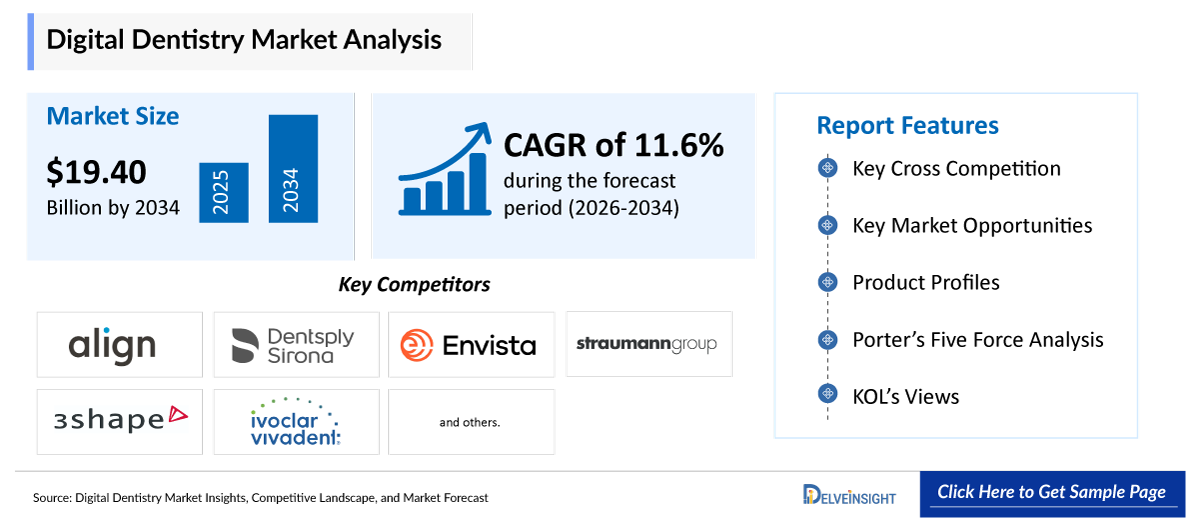
- The global digital dentistry market size was valued at USD 7.20 billion in 2025 and is projected to reach USD 19.40 billion by 2034.
- The market is expected to expand at a CAGR of 11.6% during the forecast period 2026-2034, supported by the rising adoption of intraoral scanners and digital impressions, the growth of chairside computer-aided design and manufacturing and same-day dentistry, the expansion of dental three-dimensional printing, and the integration of artificial intelligence across the digital workflow.
- By product, the computer-aided design and manufacturing systems segment dominated the digital dentistry market with a 32% share in 2025.
- By technology, the chairside segment dominated the digital dentistry market with a 52% share in 2025.
- By application, the prosthodontics and restorative segment dominated the digital dentistry market with a 34% share in 2025.
- By end-user, the dental clinics segment dominated the digital dentistry market with a 58% share in 2025.
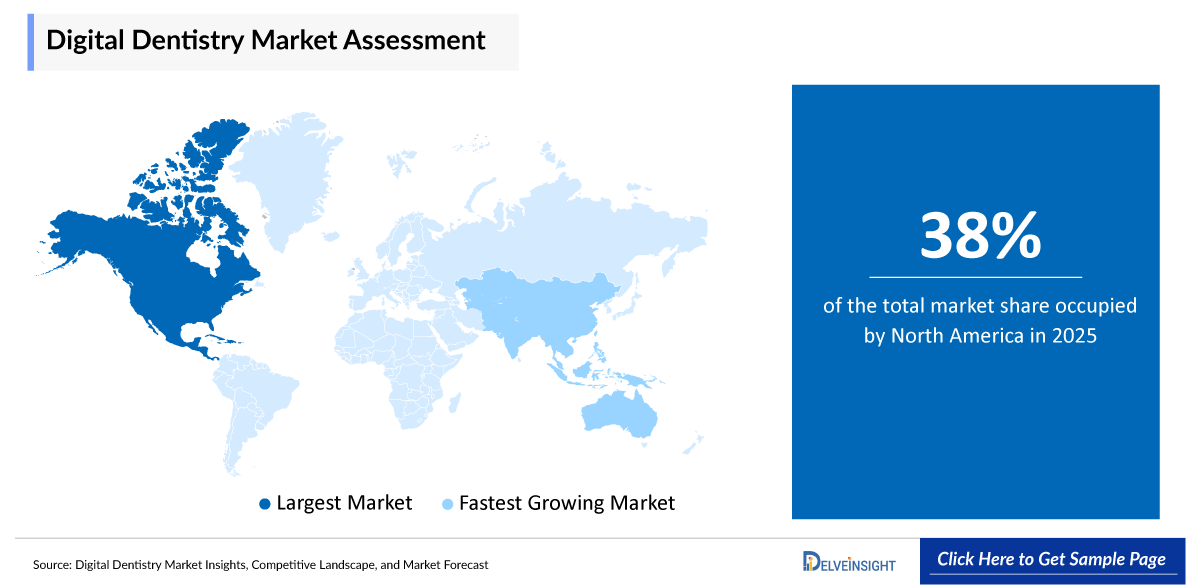
- North America accounted for the largest share of the digital dentistry market at 38% in 2025, while Asia-Pacific is anticipated to register the fastest growth through 2034.
Digital dentistry is the use of digital and computer-aided technologies across the dental workflow to capture, design, manufacture, and manage dental restorations, appliances, and treatment, replacing analog methods such as conventional impressions and manual fabrication. The scope encompasses intraoral scanners that capture digital impressions, computer-aided design and manufacturing systems that design and mill or print restorations, dental three-dimensional printers, dental imaging systems including cone beam computed tomography, and the software that connects the workflow, together with dental milling machines and materials.
Leading vendors provide comprehensive digital ecosystems, and Dentsply Sirona offers the CEREC chairside computer-aided design and manufacturing system, Primescan intraoral scanners, Primeprint three-dimensional printing, and the DS Core cloud platform across restorative, implantology, and orthodontic workflows, while Align Technology provides the iTero intraoral scanners, the Invisalign clear aligner system, and exocad computer-aided design and manufacturing software, and 3Shape provides the TRIOS intraoral scanners and Dental System software. The workflow proceeds from digital scanning through design to chairside or laboratory manufacturing, connected by cloud platforms and increasingly enhanced by artificial intelligence. The contemporary market is defined by the adoption of intraoral scanning, the growth of chairside and three-dimensional printing, and the integration of artificial intelligence.
Digital Dentistry Market Key Growth Drivers
- Rising adoption of intraoral scanners and digital impressions that replace conventional impressions, with leading systems including the Dentsply Sirona Primescan, the Align Technology iTero, the 3Shape TRIOS, and the Medit intraoral scanners.
- The growth of chairside computer-aided design and manufacturing and same-day dentistry, with the CEREC system enabling the design and manufacture of restorations in a single visit.
- The expansion of dental three-dimensional printing for models, splints, dentures, and restorations, with systems such as the Dentsply Sirona Primeprint and the integration of printing into scanner workflows.
- Integration of artificial intelligence across the digital workflow, with vendors embedding artificial intelligence for caries detection, design automation, and workflow efficiency.
- Growth of clear aligner therapy and digital orthodontics that rely on intraoral scanning and digital treatment planning.
- Rising demand for aesthetic and restorative dentistry and the adoption of cloud connectivity that links scanning, design, and manufacturing.
- Rising dental disease burden, the aging population, and the growth of access to dental care that increase demand for dental treatment.
Key Companies in Digital Dentistry Market
The leading participants in the digital dentistry market include the following:
- Align Technology, Inc.
- Dentsply Sirona Inc.
- Envista Holdings Corporation
- Institut Straumann AG
- 3Shape A/S
- Planmeca Oy
- Ivoclar Vivadent AG
- Carestream Dental LLC
- 3D Systems Corporation
- Medit Corp., and others
For illustrative purposes, only the top 10 companies are listed in the Table of Contents. The report may include analysis and references to additional companies relevant to the market assessment.
Digital Dentistry Market Size
The following table summarizes the headline market metrics for the global digital dentistry market across the base year and the forecast horizon.
|
Report Metrics |
Details |
|
2025 Market Size |
USD 7.20 billion |
|
2034 Projected Market Size |
USD 19.40 billion |
|
Growth Rate (2026-2034) |
11.6% CAGR |
|
Largest Market |
North America (38% share in 2025) |
|
Fastest Growing Market |
Asia-Pacific |
|
Market Structure |
Moderately Consolidated |
All market values are expressed in USD and represent DelveInsight estimates synthesized from primary and secondary research.
Factors Contributing to the Growth of the Digital Dentistry Market
Digital Dentistry Market Drivers
- Rising Adoption of Intraoral Scanners and Digital Impressions: The foundational driver of the digital dentistry market is the rising adoption of intraoral scanners and digital impressions, which replace conventional impressions and serve as the entry point to the digital workflow. Intraoral scanners capture a precise three-dimensional model of the teeth and soft tissue, sparing patients the discomfort of conventional impression materials and providing accurate digital data that flows directly into design and manufacturing. The leading scanners, including the Dentsply Sirona Primescan, the Align Technology iTero, the 3Shape TRIOS, the Planmeca Emerald, and the Medit intraoral scanners, deliver fast, accurate, and comfortable scanning, and the Primescan processes a large volume of three-dimensional points each second to produce clear and rapid scans. Digital impressions improve accuracy, reduce remakes, enable the direct transmission of cases to laboratories and manufacturing, and provide the foundation for restorative, orthodontic, and implant workflows. As scanners become faster, more accurate, more affordable, and more comfortable, and as the clinical and workflow advantages of digital impressions become established, adoption accelerates among general dentists and specialists. The scanner is the gateway to digital dentistry, and its adoption drives the adoption of the design, manufacturing, and software that complete the workflow. The rising adoption of intraoral scanning and digital impressions sustains steady demand across the digital dentistry market and anchors the growth of the digital workflow.
- Growth of Chairside Computer-Aided Design and Manufacturing and Same-Day Dentistry: The growth of chairside computer-aided design and manufacturing and same-day dentistry is a major driver that expands the adoption of in-office digital workflows. Chairside computer-aided design and manufacturing enables a dentist to scan, design, and manufacture a restoration in a single visit, eliminating the need for conventional impressions, temporary restorations, and multiple appointments, and the CEREC system enables the design and manufacture of restorations chairside, spanning restorative, implantology, and orthodontic workflows. Same-day dentistry improves the patient experience, increases practice efficiency and revenue, and allows the dentist to control the entire workflow in-office. The integration of the intraoral scanner with in-office milling and printing, connected by cloud platforms, allows the immediate production of restorations, and the ability to expand a scanner into a full chairside system provides a path to adoption. As dentists adopt chairside computer-aided design and manufacturing to offer same-day restorations, improve efficiency, and control the workflow, demand for chairside systems grows. The growth of chairside computer-aided design and manufacturing and same-day dentistry expands the market, concentrates demand in the chairside technology segment and the dental clinic end-user, and drives the adoption of the scanners, mills, printers, and software that enable the in-office workflow across the forecast period.
- Expansion of Dental Three-Dimensional Printing: The expansion of dental three-dimensional printing is a powerful driver that broadens the applications of digital dentistry and enables the in-office and laboratory production of a growing range of dental products. Dental three-dimensional printing produces models, surgical guides, splints and nightguards, dentures, and, increasingly, restorations, using resins and other materials, and it is becoming a mainstream chairside and laboratory solution. The Dentsply Sirona Primeprint and other dental printers, together with resins such as materials for three-dimensional printed dentures, enable the production of dental products, and scanner vendors have integrated design for in-practice three-dimensional printing of models, splints, and restorations into their workflows. Three-dimensional printing lowers the cost and time of producing dental products, enables customization, and expands the range of products that can be manufactured in-office or in the laboratory. The growth of printable materials, the improvement of printer speed and accuracy, and the integration of printing into scanner and design workflows accelerate adoption, and consortia and partnerships advance digital denture and other workflows. As three-dimensional printing becomes faster, more capable, and more integrated, and as the range of printable products expands, demand for dental three-dimensional printers and materials grows. The expansion of dental three-dimensional printing broadens the digital dentistry market and sustains demand across chairside and laboratory settings throughout the forecast period.
- Integration of Artificial Intelligence Across the Digital Workflow: The integration of artificial intelligence across the digital workflow is transforming digital dentistry and driving investment in intelligent systems. Artificial intelligence is being woven throughout the digital workflow, from scanning through design to manufacturing, to automate tasks, improve accuracy, and enhance diagnosis. Vendors have embedded artificial intelligence for caries detection using near-infrared and fluorescence technologies, for the automated design of restorations, for margin detection and full-contour design, and for workflow automation and connectivity, and the leading vendors have advanced artificial intelligence across their platforms. Artificial intelligence accelerates the design of restorations, reduces the manual effort of the digital workflow, supports diagnosis and treatment planning, and improves the consistency and quality of outcomes. The application of artificial intelligence to intraoral scanning, computer-aided design, and imaging shifts competition toward the intelligence of the platform and expands the value delivered to the practice. As vendors embed artificial intelligence across scanning, design, diagnosis, and manufacturing, and as practices adopt these capabilities to improve efficiency and quality, demand concentrates in artificial intelligence-enabled digital dentistry systems. This modernization cycle drives the upgrade and replacement of systems and expands the value delivered per deployment, sustaining growth in the digital dentistry market across the forecast period.
- Growth of Clear Aligner Therapy and Digital Orthodontics: The growth of clear aligner therapy and digital orthodontics is a major driver that relies on and reinforces digital dentistry. Clear aligner therapy uses intraoral scanning, digital treatment planning, and manufacturing to produce a series of custom aligners that move teeth, and it has grown rapidly as a preferred alternative to conventional braces for many patients. Align Technology provides the Invisalign clear aligner system alongside the iTero intraoral scanners and exocad software for digital orthodontics and restorative dentistry, and other companies provide clear aligner systems, all of which depend on intraoral scanning and digital planning. Clear aligner therapy drives the adoption of intraoral scanners in general and orthodontic practices, since the scanner is required to capture the digital impression that initiates treatment, and it links orthodontics to the broader digital workflow. The growth of aesthetic orthodontics, patient demand for discreet treatment, and the expansion of clear aligner therapy to more cases and providers enlarge the demand for the scanning, planning, and manufacturing that digital orthodontics requires. As clear aligner therapy and digital orthodontics grow, they drive the adoption of intraoral scanning and digital workflows across dental practices. The growth of clear aligner therapy and digital orthodontics sustains demand for digital dentistry and reinforces the adoption of intraoral scanning across the forecast period.
- Rising Demand for Aesthetic and Restorative Dentistry and Cloud Connectivity: The rising demand for aesthetic and restorative dentistry, together with the adoption of cloud connectivity, drives the growth of digital dentistry. Patient demand for aesthetic and restorative treatment, including crowns, veneers, bridges, and implant restorations, drives the use of digital workflows that design and manufacture these restorations with precision and natural aesthetics, and digital design and manufacturing enable customized, high-quality restorations. Cloud connectivity has become central to digital dentistry, linking the scanner, design software, laboratory, and manufacturing, and enabling the transmission of cases, the sharing of designs, and cloud-based processing, with platforms such as DS Core connecting the workflow and cloud-native scanning moving processing from local hardware to the cloud. Cloud connectivity streamlines the workflow, enables collaboration between the practice and the laboratory, supports patient communication through simulations, and provides the foundation for artificial intelligence and analytics. The combination of demand for aesthetic and restorative dentistry and the connectivity that links the digital workflow drives the adoption of digital dentistry across practices and laboratories. As patients seek aesthetic and restorative treatment and as cloud connectivity links the workflow, demand for the scanning, design, manufacturing, and software of digital dentistry grows, sustaining the growth of the market across the forecast period.
- Rising Dental Disease Burden, Aging Population, and Access to Care: The rising burden of dental disease, the aging of the population, and the growth of access to dental care increase the demand for dental treatment and the digital dentistry that delivers it. Dental caries, periodontal disease, and tooth loss affect a large and growing population, and the aging of the population increases the need for restorative, prosthetic, and implant treatment, all of which are delivered increasingly through digital workflows. The growth of the middle class and the expansion of access to dental care in emerging markets enlarge the population seeking dental treatment, and the demand for restorative, aesthetic, and orthodontic treatment rises with awareness and disposable income. Digital dentistry delivers this treatment more efficiently, accurately, and comfortably than analog methods, and its adoption grows with the volume of dental treatment. The rising prevalence of dental conditions, the aging population requiring prosthetic and implant care, and the expansion of access to dental treatment increase the volume of dental procedures and the demand for the digital workflows that deliver them. As the burden of dental disease and the demand for dental treatment grow, and as digital dentistry becomes the standard of care, demand for digital dentistry systems, materials, and software grows. The rising dental disease burden, aging population, and growth of access to care sustain demand for digital dentistry across the forecast period.
Digital Dentistry Market Restraints
The digital dentistry market faces several interrelated restraints that temper its growth. The foremost is the high cost of digital dentistry systems, since intraoral scanners, milling machines, three-dimensional printers, and imaging systems require substantial capital investment, and a complete chairside system including the scanner, computer, and cart represents a high barrier to entry, particularly for small and independent practices. The learning curve and the training required to adopt digital workflows are significant, since dentists and staff must learn to scan, design, and manufacture, and the disruption to established workflows and the time to proficiency can deter adoption. Interoperability and the tension between open and closed ecosystems create complexity, since scanners, software, and manufacturing systems from different vendors do not always integrate seamlessly, and closed ecosystems can lock practices into a single vendor while open workflows require integration effort. The regulatory clearance of digital dentistry devices, including scanners, aligners, and three-dimensional printers, under the United States Food and Drug Administration and the European Union Medical Device Regulation adds time and cost to the introduction of products. Reimbursement for dental treatment is limited and varies, and the cost of digital systems is not always offset by reimbursement, which can constrain the financial return for some practices. Resistance among dentists accustomed to analog methods, concerns about the accuracy and durability of some digital products, and the cost and complexity of materials further constrain adoption. The consolidation of the market among large vendors and the pace of technological change, which can render systems obsolete, add risk to investment. Together, these factors moderate the pace and scope of adoption and require vendors to demonstrate clinical value, efficiency, return on investment, and ease of use to sustain growth.
Digital Dentistry Market Segment Analysis
The global digital dentistry market is segmented by product (computer-aided design and manufacturing systems, intraoral scanners, dental three-dimensional printers, dental imaging systems, dental software, and others), by technology (chairside and dental laboratory), by application (prosthodontics and restorative, orthodontics, implantology, endodonics, and others), by end-users (dental clinics, denal labs, academics and reseach institutes, and others)and by geography (North America, Europe, Asia-Pacific, and the Rest of the World).
By Product
Dominant Subsegment: Computer-Aided Design and Manufacturing Systems.
The computer-aided design and manufacturing systems category is expected to dominate the market. The computer-aided design and manufacturing systems segment accounted for a 32% share of the digital dentistry market in 2025. Computer-aided design and manufacturing systems, which encompass the design software and the milling and manufacturing that produce dental restorations from digital scans, are the core of the digital dentistry workflow and the largest product category by value. The dominance of the segment reflects the central role of computer-aided design and manufacturing in producing the restorations that are the primary output of digital dentistry, the value of the design software and milling systems, and the breadth of restorative, implant, and orthodontic applications. The CEREC system enables the chairside design and manufacture of restorations, laboratory systems produce restorations at scale, and design software connects the scanner to manufacturing. Computer-aided design and manufacturing spans chairside and laboratory workflows and restorative, implant, and orthodontic applications, and it is the technology through which digital scans become physical restorations. The integration of computer-aided design and manufacturing with intraoral scanning, three-dimensional printing, and cloud platforms, and the addition of artificial intelligence to design, reinforce the centrality of the segment. As digital dentistry grows and as restorations are increasingly designed and manufactured digitally, demand for computer-aided design and manufacturing systems grows. The centrality of computer-aided design and manufacturing to the production of restorations and its breadth across applications sustain the leadership of the segment across the forecast period.
By Technology
Dominant Subsegment: Chairside.
The chairside category is expected to dominate the market. The chairside segment accounted for a 52% share of the digital dentistry market in 2025. Chairside digital dentistry, in which scanning, design, and manufacturing occur in the dental practice, has become the dominant technology as dentists adopt in-office digital workflows to offer same-day restorations, improve efficiency, and control the workflow. The dominance of the segment reflects the large and growing number of dental practices adopting intraoral scanners and chairside computer-aided design and manufacturing, the value of same-day dentistry to practices and patients, and the expansion of chairside three-dimensional printing. Chairside systems enable the dentist to scan, design, and manufacture a restoration in a single visit, and the integration of the scanner with in-office milling and printing, connected by cloud platforms, allows the immediate production of restorations and appliances. The ability to expand a scanner into a full chairside system provides a path to adoption, and the growth of chairside three-dimensional printing broadens the products that can be made in-office. While laboratory technology remains essential for complex and high-volume manufacturing, the adoption of chairside digital workflows by the large number of dental practices sustains the leadership of the chairside segment. The value of same-day dentistry, the adoption of in-office scanning and manufacturing, and the growth of chairside printing sustain the leadership of the chairside segment across the forecast period.
By Application
Dominant Subsegment: Prosthodontics and Restorative.
The prosthodontics and restorative category is expected to dominate the market. The prosthodontics and restorative segment accounted for a 34% share of the digital dentistry market in 2025. Prosthodontics and restorative dentistry, which encompasses crowns, bridges, veneers, inlays, onlays, dentures, and implant restorations, is the leading application of digital dentistry because these restorations are the primary output of the digital workflow and the most common use of intraoral scanning and computer-aided design and manufacturing. The dominance of the segment reflects the high volume of restorative treatment, the suitability of restorations for digital design and manufacturing, and the central role of restorative workflows in chairside and laboratory digital dentistry. Digital workflows design and manufacture restorations with precision and natural aesthetics, and the CEREC and other systems enable restorative workflows chairside and in the laboratory. The demand for aesthetic and restorative treatment, the aging population requiring prosthetic and implant care, and the efficiency and quality of digital restorative workflows drive the application. The integration of intraoral scanning, computer-aided design and manufacturing, and three-dimensional printing supports the full range of restorative and prosthetic treatment. As restorative and prosthetic treatment grows and as it is increasingly delivered digitally, demand for the digital dentistry that supports it grows. The high volume of restorative treatment and its suitability for digital workflows sustain the leadership of the prosthodontics and restorative segment across the forecast period.
By End-User
Dominant Subsegment: Dental Clinics.
The dental clinics category is expected to dominate the market. The dental clinics segment accounted for a 58% share of the digital dentistry market in 2025. Dental clinics and practices, including general and specialist practices, are the principal adopters of digital dentistry because they perform the large majority of dental treatment, adopt intraoral scanners and chairside systems, and are the point of care at which the digital workflow begins, which concentrates market value in this segment. The dominance of the segment reflects the number of dental practices, the adoption of intraoral scanning and chairside computer-aided design and manufacturing by clinics, and the growth of in-office digital workflows and same-day dentistry. Dental clinics adopt intraoral scanners as the entry point to digital dentistry, expand into chairside computer-aided design and manufacturing and three-dimensional printing, and use cloud platforms to connect with laboratories, and the growth of chairside and in-office workflows concentrates demand in clinics. While dental laboratories are essential end-users that adopt digital design and manufacturing at scale, and academic and research institutes drive education and innovation, the number of dental clinics, their adoption of scanning and chairside systems, and the growth of in-office digital workflows sustain the leadership of the dental clinics segment across the forecast period, and it shapes the direction of the market.
Digital Dentistry Market Region Analysis
Dominant Region: North America
North America accounted for a 38% share of the global digital dentistry market in 2025, representing the highest regional market share globally. The leadership of the region reflects the advanced adoption of digital dentistry, the high level of dental spending, the concentration of leading vendors, and the strong demand for aesthetic and restorative dentistry. The United States is the largest national market, supported by the scale of its dental sector, the high adoption of intraoral scanners, chairside computer-aided design and manufacturing, and clear aligner therapy, the strong demand for aesthetic and orthodontic treatment, and the presence of leading vendors including Align Technology and the North American operations of the major dental companies. The United States Food and Drug Administration regulates digital dentistry devices, and the high level of dental spending and the demand for aesthetic and restorative treatment support the adoption of digital workflows. The concentration of dental practices adopting digital technology, the growth of dental service organizations that deploy digital dentistry at scale, and the strong culture of aesthetic dentistry reinforce the leadership of the region. The advanced adoption of digital dentistry, the high level of dental spending, the concentration of vendors, and the demand for aesthetic and restorative treatment sustain the position of North America as the largest regional market across the forecast period.
Fastest Growing Region: Asia-Pacific
Asia-Pacific is projected to register the fastest compound annual growth rate through 2034. The region is expanding access to dental care, growing its middle class, and adopting digital dentistry, which drives the growth of the market. China, Japan, India, and South Korea are the principal national markets, supported by growing dental care access, rising disposable income, the demand for aesthetic and orthodontic treatment, and the presence of scanner and technology vendors, with South Korea in particular home to intraoral scanner companies. The growth of the middle class, the rising demand for aesthetic and restorative dentistry, the expansion of dental practices, and the adoption of intraoral scanning and digital workflows enlarge the demand for digital dentistry. As access to dental care expands, as disposable income rises, and as practices adopt digital technology, the region increases its adoption of digital dentistry from a growing base. The combination of care access expansion, rising income, aesthetic demand, and the adoption of digital workflows positions Asia-Pacific as the fastest-growing regional market, and it attracts investment and commercial focus from the leading global vendors seeking presence in high-growth national markets.
Digital Dentistry Market Regional Commentary
North America
North America leads the market, supported by the advanced adoption of digital dentistry, the high level of dental spending, the concentration of leading vendors, and the strong demand for aesthetic and restorative dentistry. The United States dominates the region through the scale of its dental sector, the high adoption of intraoral scanning, chairside computer-aided design and manufacturing, and clear aligner therapy, and the presence of leading vendors. The demand for aesthetic and orthodontic treatment and the growth of dental service organizations sustain the adoption of digital workflows.
Europe
Europe is a substantial and advanced market shaped by the strong presence of dental technology vendors, including Dentsply Sirona, Institut Straumann, 3Shape, Ivoclar Vivadent, and Planmeca, the high standard of dental care, and the demand for aesthetic and restorative treatment. Germany, the United Kingdom, France, Italy, and Spain are the principal national markets, supported by advanced dental practices, the adoption of digital workflows, and the conformity requirements of the European Union Medical Device Regulation. Demand is sustained by the adoption of intraoral scanning, computer-aided design and manufacturing, and three-dimensional printing.
Asia-Pacific
Asia-Pacific is the fastest-growing region, driven by the expansion of dental care access, the growth of the middle class, and the adoption of digital dentistry across China, Japan, India, and South Korea. Rising disposable income, the demand for aesthetic and orthodontic treatment, and the presence of scanner vendors, particularly in South Korea, sustain demand, and the region attracts commercial focus from the leading global vendors.
Rest of World
The Rest of World, spanning Latin America, the Middle East, and Africa, represents an emerging opportunity as access to dental care expands and as the demand for aesthetic and restorative treatment grows. Growth is supported by the expansion of dental practices, the adoption of intraoral scanning and digital workflows, and rising disposable income, though adoption varies by market. Vendors pursue these markets through scanners and digital workflows suited to expanding dental care.
Digital Dentistry Market Competitive Landscape
The global digital dentistry market is classified as Moderately Consolidated. A group of large companies offering comprehensive digital dentistry ecosystems holds a substantial share of the market, while specialist scanner, imaging, three-dimensional printing, and software vendors compete across the product categories. Competition centers on the breadth and integration of the digital ecosystem, the performance of intraoral scanners, the capabilities of computer-aided design and manufacturing and three-dimensional printing, artificial intelligence, cloud connectivity, and the openness or integration of the workflow, and product launches, artificial intelligence introductions, and acquisitions intensify the contest.
The competitive landscape is evaluated across the following dimensions:
- Market concentration: Moderately consolidated, with a group of large companies offering comprehensive digital dentistry ecosystems holding a substantial share, alongside specialist scanner, imaging, three-dimensional printing, and software vendors.
- Leading players: Align Technology, with iTero scanners and the Invisalign system, and Dentsply Sirona, with CEREC, Primescan, and Primeprint, lead alongside Envista, Institut Straumann, and 3Shape, while Planmeca, Ivoclar Vivadent, Carestream Dental, 3D Systems, and Medit contest defined product categories.
- Geographic reach: The leading vendors operate global commercial and service organizations, and scanner and technology vendors, including companies based in Europe, North America, and Asia, compete across regions.
- Product portfolio strength: Competitive advantage rests on the breadth and integration of the ecosystem across intraoral scanning, computer-aided design and manufacturing, three-dimensional printing, imaging, and software, and on the performance of the intraoral scanner as the entry point to the workflow.
- Pipeline strength: Development is concentrated in intraoral scanner performance and cloud-native scanning, artificial intelligence across the workflow, three-dimensional printing, and the integration and connectivity of the digital ecosystem.
- Strategic partnerships: Collaboration spans integration between scanners, design software, and manufacturing, partnerships and consortia for digital denture and other workflows, and alliances that connect the ecosystem across vendors.
- M&A activity: Consolidation has shaped the field, exemplified by the acquisition of scanner technology to enter the intraoral scanner market, including the acquisition of Alliedstar by Institut Straumann, alongside continued consolidation of digital dentistry technology.
- Innovation focus: Innovation is shifting toward cloud-native scanning, artificial intelligence across scanning, design, and diagnosis, chairside three-dimensional printing, and the integration of the digital ecosystem.
- Regulatory standing: Clearance of scanners, aligners, and three-dimensional printers by the United States Food and Drug Administration, conformity under the European Union Medical Device Regulation, and support for imaging and data standards are decisive competitive credentials and a principal axis of competition among the leaders.
Digital Dentistry Market Recent Developmental Activities
- In January 2024, Align Technology, Inc. launched the iTero Lumina intraoral scanner, featuring a field of capture three times wider in a wand fifty percent smaller and forty-five percent lighter, delivering faster scanning, higher accuracy, and superior visualization. Strategic significance: the launch advanced the performance of intraoral scanning and strengthened the position of a leading scanner and clear aligner company.
- In September 2024, Align Technology, Inc. announced the Align Oral Health Suite on the iTero Element Plus Series and Lumina scanners, including the Invisalign Outcome Simulator Pro and the iTero Design Suite for in-practice three-dimensional printing of models, splints, and restorations. Strategic significance: the suite advanced patient communication and in-practice three-dimensional printing and integrated design into the scanner workflow.
- In 2024, Dentsply Sirona Inc. launched the Primescan 2, a cloud-native intraoral scanner that moves processing from local hardware to the cloud, and enhanced it in 2025 with file compression that reduces bandwidth requirements by fifty percent and integrated caries detection using near-infrared and fluorescence technologies. Strategic significance: the scanner advanced cloud-native scanning and artificial intelligence-supported diagnosis within a connected dentistry ecosystem.
- In 2024, Institut Straumann AG acquired Alliedstar and launched the SIRIOS intraoral scanner, entering the intraoral scanner market. Strategic significance: the acquisition and launch marked the entry of a major dental company into intraoral scanning and signaled a shift in the competitive landscape.
- In 2025, Align Technology, Inc. introduced restorative capabilities for the iTero Lumina scanner, including full-contour design integration and margin detection, and integration with the iTero Design Suite and third-party three-dimensional printing. Strategic significance: the update expanded the scanner from orthodontic to restorative workflows and strengthened its position as a comprehensive digital dentistry platform.
- In 2024, 3Shape A/S advanced its platforms with artificial intelligence and intelligent automation and connectivity across scanning and design. Strategic significance: the developments reinforced the role of artificial intelligence and connectivity in a leading scanner and software vendor.
- In 2024 and 2025, Dentsply Sirona Inc. advanced its DS Core cloud platform and the integration of Primescan and third-party scanners with in-office milling and printing, connecting the workflow across scanning, design, and manufacturing. Strategic significance: the developments reinforced cloud connectivity and the integration of the chairside and laboratory workflow.
- In 2024 and 2025, dental three-dimensional printing advanced with new resins, including materials for three-dimensional printed dentures and splints, and post-curing devices, and consortia advanced digital denture workflows. Strategic significance: the developments expanded the applications and adoption of dental three-dimensional printing across chairside and laboratory settings.
- In 2024 and 2025, artificial intelligence was integrated across the digital dentistry workflow, from scanning through design to diagnosis, with caries detection, design automation, and workflow automation. Strategic significance: the integration of artificial intelligence became a defining axis of competition and advanced the automation and intelligence of the digital workflow.
- In 2024 and 2025, Medit Corp. and Shining 3D advanced their intraoral scanners with improved performance and premium features, competing across the scanner market. Strategic significance: the developments intensified competition in the intraoral scanner market and expanded access to digital scanning.
- In 2024 and 2025, Envista Holdings Corporation and Carestream Dental LLC advanced their imaging and scanning solutions and the integration of scanners with imaging platforms. Strategic significance: the developments reinforced the integration of imaging and scanning within the digital dentistry workflow.
- In 2024 and 2025, the leading vendors advanced intraoral scanning, cloud connectivity, artificial intelligence, and three-dimensional printing across comprehensive digital dentistry ecosystems. Strategic significance: the convergence of the leaders on scanning, cloud, artificial intelligence, and printing confirmed these as the defining axes of competition and signaled a market maturing into integrated, intelligent, and connected digital dentistry ecosystems.
Digital Dentistry Market Segmentation
- Digital Dentistry Market Assessment by Product
- Computer-Aided Design and Manufacturing Systems
- Intraoral Scanners
- Dental Three-Dimensional Printers
- Dental Imaging Systems
- Dental Software
- Others
- Digital Dentistry Market Assessment by Technology
- Chairside
- Dental Laboratory
- Digital Dentistry Market Assessment by Application
- Prosthodontics and Restorative
- Orthodontics
- Implantology
- Endodontics
- Others
- Digital Dentistry Market Assessment by End-User
- Dental Clinics
- Dental Laboratories
- Academic and Research Institutes
- Others
Digital Dentistry Market Assessment by Geography
- North America Digital Dentistry Market Assessment
- United States Digital Dentistry Market Size in USD million (2023-2034)
- Canada Digital Dentistry Market Size in USD million (2023-2034)
- Mexico Digital Dentistry Market Size in USD million (2023-2034)
- Europe Digital Dentistry Market Assessment
- Germany Digital Dentistry Market Size in USD million (2023-2034)
- United Kingdom Digital Dentistry Market Size in USD million (2023-2034)
- France Digital Dentistry Market Size in USD million (2023-2034)
- Italy Digital Dentistry Market Size in USD million (2023-2034)
- Spain Digital Dentistry Market Size in USD million (2023-2034)
- Rest of Europe Digital Dentistry Market Size in USD million (2023-2034)
- Asia-Pacific Digital Dentistry Market Assessment
- China Digital Dentistry Market Size in USD million (2023-2034)
- Japan Digital Dentistry Market Size in USD million (2023-2034)
- India Digital Dentistry Market Size in USD million (2023-2034)
- Australia Digital Dentistry Market Size in USD million (2023-2034)
- South Korea Digital Dentistry Market Size in USD million (2023-2034)
- Rest of Asia-Pacific Digital Dentistry Market Size in USD million (2023-2034)
- Rest of the World Digital Dentistry Market Assessment
- Middle East Digital Dentistry Market Size in USD million (2023-2034)
- Africa Digital Dentistry Market Size in USD million (2023-2034)
- South America Digital Dentistry Market Size in USD million (2023-2034)
Digital Dentistry Market Recent Industry Trends and Milestones (2023-2026):
|
Category |
Key Developments |
|
Digital Dentistry Market Product Approval |
The period was defined by the launch of advanced intraoral scanners and integrated digital ecosystems. Align Technology launched the iTero Lumina scanner and later added restorative capabilities, Dentsply Sirona launched the cloud-native Primescan 2 with artificial intelligence-supported caries detection, and Institut Straumann acquired scanner technology and launched the SIRIOS scanner. Medit and Shining 3D advanced their scanners, and vendors advanced computer-aided design and manufacturing and three-dimensional printing. Together, these launches concentrated competition in high-performance, cloud-native, and artificial intelligence-enabled scanning and integrated digital ecosystems. |
|
Digital Dentistry Market Product Expansion |
Product expansion advanced along three axes. The first is intraoral scanning and cloud-native processing, as vendors advanced scanner performance, moved processing to the cloud, and integrated artificial intelligence for diagnosis. The second is three-dimensional printing, as vendors expanded printable materials and integrated design for in-practice printing of models, splints, and restorations. The third is ecosystem integration, as vendors connected scanning, design, and manufacturing through cloud platforms such as DS Core and integrated scanners with imaging and manufacturing. Vendors also expanded artificial intelligence across scanning, design, and diagnosis. |
|
Digital Dentistry Market Investment |
Investment was shaped by competition in intraoral scanning, artificial intelligence, and three-dimensional printing. Vendors invested in scanner performance, cloud-native scanning, and artificial intelligence, and major dental companies acquired scanner technology to enter or strengthen their position in intraoral scanning, exemplified by the acquisition of Alliedstar by Institut Straumann. Investment also flowed into three-dimensional printing materials and workflows, into cloud platforms connecting the workflow, and into the clearance and conformity required to introduce digital dentistry products. Vendors and dental service organizations invested in deploying digital dentistry at scale. |
|
Company Strategy |
The unifying strategic theme is the building of comprehensive, integrated, and intelligent digital dentistry ecosystems anchored by the intraoral scanner. Align Technology is advancing the iTero scanners, Invisalign, and exocad software; Dentsply Sirona is advancing CEREC, Primescan, Primeprint, and DS Core; and Institut Straumann is entering intraoral scanning while advancing implant and orthodontic workflows. 3Shape is advancing scanners and software with artificial intelligence, and Medit, Planmeca, Envista, Carestream Dental, and 3D Systems are competing across scanning, imaging, and manufacturing. Across the field, strategy centers on scanning, cloud, artificial intelligence, three-dimensional printing, and ecosystem integration. |
|
Emerging Technologies |
The defining emerging technologies are cloud-native intraoral scanning that moves processing from local hardware to the cloud; artificial intelligence across the workflow for caries detection, design automation, and diagnosis; dental three-dimensional printing that becomes a mainstream chairside and laboratory solution for models, splints, dentures, and restorations; and integrated digital ecosystems connected by cloud platforms that link scanning, design, and manufacturing. Supporting these are near-infrared and fluorescence imaging for diagnosis, improved materials for three-dimensional printing, and integration between scanners, imaging, and manufacturing. Across these, the trajectory is toward digital dentistry that is cloud-connected, intelligent, and integrated, improving the efficiency, accuracy, and accessibility of dental treatment across restorative, orthodontic, and implant care. |
Digital Dentistry Market Startup Funding and Investment Trends
Investment in the digital dentistry field has concentrated on technologies that advance scanning, artificial intelligence, three-dimensional printing, and the integration of the digital workflow, namely intraoral scanners, artificial intelligence for diagnosis and design, dental three-dimensional printing, and cloud platforms and software. Because the core market is moderately consolidated among large companies offering comprehensive ecosystems, innovators pursue differentiated scanning, artificial intelligence, printing, or software technologies that serve defined needs or that a larger company can absorb. The table below summarizes representative companies advancing the next generation of digital dentistry.
|
Company |
Total Funding |
Funding Stage |
Main Product/Offering |
Core Technology |
|
Medit Corp. |
Privately held |
Commercial stage |
Medit intraoral scanners |
Intraoral scanning and design software |
|
SprintRay Inc. |
Venture-backed |
Commercial stage |
Dental three-dimensional printers |
Chairside three-dimensional printing |
|
Request for unlocking the report of the @ Digital Dentistry Market Insights | ||||
Capital formation in this field is shaped by the presence of large companies offering comprehensive ecosystems, so investors have favored companies that introduce differentiated intraoral scanning, artificial intelligence for diagnosis and design, chairside three-dimensional printing, or software that integrates with or complements the leading ecosystems. Intraoral scanning is a clear thesis, seeking to deliver high-performance and affordable scanners as the entry point to digital dentistry. Artificial intelligence for radiographic and diagnostic analysis and for design automation constitutes a second thesis, and dental three-dimensional printing a third, bringing chairside and laboratory manufacturing to a growing range of products. The archetypal outcome is acquisition by a major dental company seeking scanning, artificial intelligence, or printing capability, exemplified by the acquisition of scanner technology to enter the intraoral scanner market, which provides a defined exit that sustains earlier-stage investment. The principal risks are the comprehensive ecosystems and installed bases of the large vendors, the high cost and learning curve of digital dentistry, the regulatory clearance required for dental devices, and the pace of technological change.
Key Takeaways from the Digital Dentistry Market Report Study
- Market size analysis for the current digital dentistry market size (2025), and market forecast for 9 years (2026 to 2034).
- Top key product and technology developments, mergers, acquisitions, partnerships, and joint ventures that happened over the last 3 years.
- Key companies dominating the global digital dentistry market.
- Various opportunities available for competitors in the digital dentistry market space.
- What are the top-performing segments in 2025? How will these segments perform in 2034?
- Which are the top-performing regions and countries in the current digital dentistry market scenario?
- Which are the regions and countries where companies should concentrate their opportunities for digital dentistry market growth in the future?
Target audience who can benefit from this digital dentistry market report study
- Digital dentistry system, device, and software providers
- Research organizations and consulting companies
- Digital dentistry-related organizations, associations, forums, and other alliances
- Government and corporate offices
- Start-up companies, venture capitalists, and private equity firms
- Distributors and traders dealing in digital dentistry
- Various end-users who want to know more about the digital dentistry market and the latest technological developments in the digital dentistry market.

