
Digital Diabetes Management Market Summary
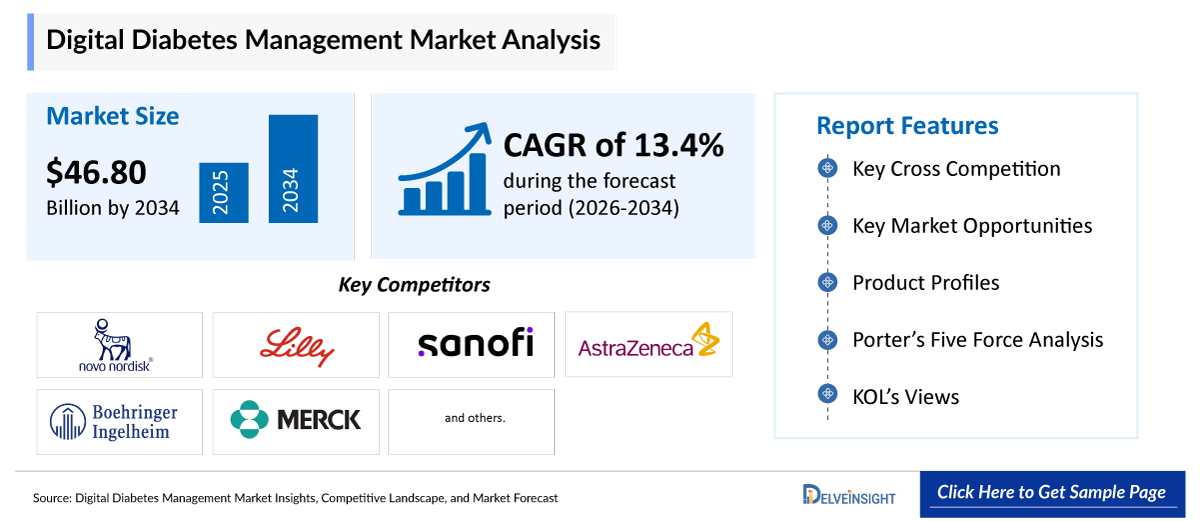
- The Digital Diabetes Management market size is estimated at USD 15.20 billion in 2025 and is projected to reach USD 46.80 billion by 2034. Growth is anchored in the rapid adoption of continuous glucose monitoring, the shift of connected insulin delivery and CGM systems into over-the-counter and non-insulin populations, and expanding integration of AI-driven software and remote patient-monitoring platforms.
- The global digital diabetes management market is growing at a CAGR of 13.4% during the forecast period from 2026 to 2034.
- By product type, the devices segment dominated the Digital Diabetes Management market with a 58% share in 2025, led within devices by continuous glucose monitoring systems.
- By diabetes type, the Type 2 Diabetes segment dominated the Digital Diabetes Management market with a 61% share in 2025.
- By end-user, the hospitals segment dominated the Digital Diabetes Management market with a 44% share in 2025.
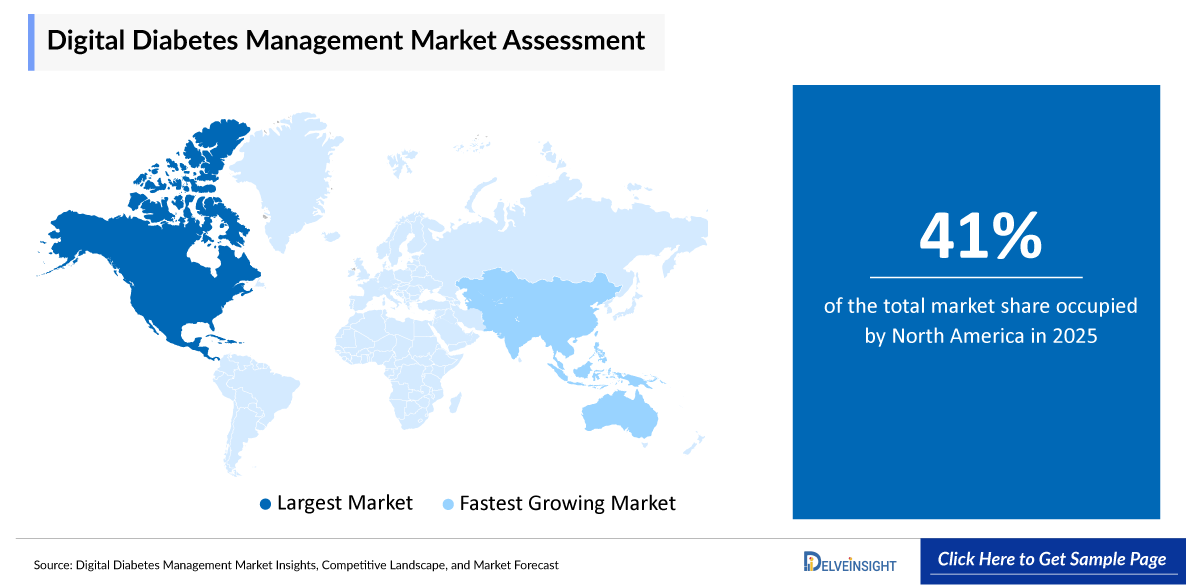
- North America dominated the global digital diabetes management market revenue with a 41% share in 2025, representing the highest regional market share globally.
Digital diabetes management refers to the ecosystem of connected devices, software platforms, and services that help individuals with diabetes monitor glucose levels, manage insulin delivery, and coordinate care in real time. The category spans continuous glucose monitoring (CGM) systems, smart glucose meters, smart insulin pens and pumps, and companion software applications, alongside remote patient-monitoring and data-management services that connect patients, caregivers, and clinicians.
Rising global diabetes prevalence, growing reimbursement for CGM among both insulin-dependent and non-insulin Type 2 patients, and the convergence of glucose sensing with automated insulin delivery (AID) algorithms are reshaping diabetes care from periodic clinical visits toward continuous, data-driven management. The market is organized by product type across software, devices, and services; by diabetes type across Type 1, Type 2, gestational, and other diabetes types; and by end-user across hospitals, ambulatory surgical centers, diabetes and endocrinology centers, and others. Driven by the launch of over-the-counter CGM sensors, deepening device interoperability, and rising investment in AI-based glucose analytics, digital diabetes management has become a central pillar of connected chronic-disease care.
Digital Diabetes Management Market Key Growth Drivers
- The rising global burden of diabetes is expanding the addressable patient population, with the International Diabetes Federation estimating approximately 589 million adults living with diabetes in 2024, a figure projected to reach 853 million by 2050.
- The launch of over-the-counter continuous glucose monitors, including Dexcom's Stelo and Abbott's Lingo and Libre Rio, is extending CGM adoption beyond insulin users to the broader Type 2 and pre-diabetes population.
- Deepening interoperability between CGM sensors and automated insulin delivery systems, exemplified by the global partnership between Abbott and Medtronic, is accelerating adoption of connected, closed-loop diabetes management.
- Expanding payer coverage, including Dexcom's push for Medicare coverage of CGM in non-insulin Type 2 patients, is broadening reimbursed access to digital monitoring tools.
- Growing investment in AI-powered glucose analytics, cloud-based data platforms, and telehealth-enabled remote patient monitoring is improving personalization of diabetes care and clinician workflow efficiency.
- Rising smartphone penetration and consumer familiarity with connected health applications are lowering adoption barriers for diabetes management software and companion apps.
- The convergence of device interoperability, expanding reimbursement, and AI-enabled analytics is expected to sustain strong double-digit growth in the market through 2034.
Key Companies in Digital Diabetes Management Market
The competitive landscape is led by the following active manufacturers:
- Abbott Laboratories
- Dexcom Inc.
- Medtronic plc
- F. Hoffmann-La Roche Ltd.
- Insulet Corporation
- Tandem Diabetes Care Inc.
- Ascensia Diabetes Care Holdings AG
- LifeScan Inc.
- B. Braun Melsungen AG
- Glooko Inc., and others
For illustrative purposes, only the top 10 companies are listed in the Table of Contents. The report may include analysis and references to additional companies relevant to the market assessment.
Digital Diabetes Management Market Size
The following snapshot summarizes the principal report metrics for the Digital Diabetes Management market.
|
Report Metrics |
Details |
|
2025 Market Size |
USD 15.20 billion |
|
2034 Projected Market Size |
USD 46.80 billion |
|
Growth Rate (2026-2034) |
13.4% CAGR |
|
Largest Market |
North America |
|
Fastest Growing Market |
Asia-Pacific |
|
Market Structure |
Moderately Concentrated |
All market values are expressed in USD and represent DelveInsight estimates synthesized from primary and secondary research.
Factors Contributing to the Growth of the Digital Diabetes Management Market
Digital Diabetes Management Market Drivers
- Rising Global Diabetes Prevalence: The single most powerful driver of the Digital Diabetes Management market is the accelerating global prevalence of diabetes. The International Diabetes Federation's Diabetes Atlas estimates roughly 589 million adults aged 20-79 were living with diabetes in 2024, close to 1 in 9 adults worldwide, with the figure projected to rise to 853 million by 2050, a 46% increase. Diabetes caused an estimated 3.4 million deaths globally in 2024, and diabetes-related health expenditure exceeded USD 1 trillion. As the patient population expands and health systems face growing strain, connected monitoring and management tools that reduce clinical burden while improving glycemic outcomes become essential infrastructure, anchoring sustained demand for digital diabetes management solutions through 2034.
- Expansion of Over-the-Counter and Non-Insulin CGM Adoption: A structural shift toward over-the-counter continuous glucose monitoring is broadening the addressable market well beyond the traditional insulin-dependent population. Dexcom's Stelo and Abbott's Lingo and Libre Rio sensors, cleared for people who do not take insulin, use established CGM hardware but target an estimated 25 million additional U.S. users who manage Type 2 diabetes or general metabolic health without insulin therapy. This consumerization of glucose sensing is normalizing continuous monitoring as an everyday wellness tool rather than a prescription-only device, expanding sensor volumes, and pulling adjacent software and coaching services into the same purchase decision. As awareness grows and pricing becomes more accessible, non-insulin CGM adoption is expected to be one of the fastest-growing demand pools across the forecast period.
- Convergence of CGM and Automated Insulin Delivery Systems: The deepening integration between glucose sensors and insulin delivery systems is a central growth engine for the market. Abbott and Medtronic announced a global partnership pairing Abbott's FreeStyle Libre-based CGM sensors with Medtronic's automated insulin delivery and smart insulin pen systems, enabling automatic insulin-dose adjustments based on real-time glucose data. Insulet is similarly extending Omnipod 5 compatibility with Abbott's FreeStyle Libre 3 Plus sensor and has outlined plans for an adaptive-learning Omnipod 6 system and a fully automated, meal-announcement-free Type 2 diabetes system targeted for 2028. As hybrid closed-loop and fully closed-loop systems proliferate, hardware-software interoperability becomes a decisive purchase driver, increasing the value and stickiness of connected diabetes management ecosystems.
- Expanding Payer Coverage and Reimbursement: Broadening reimbursement is unlocking demand among previously underserved patient segments. Dexcom is actively pursuing expanded Medicare coverage of CGM for Type 2 diabetes patients who do not use insulin, supported by real-world evidence and a planned 300-person randomized controlled trial comparing CGM to standard-of-care monitoring. Private payers have already begun moving toward broader coverage, and policymakers are testing alternative payment and coverage pathways for connected diabetes devices. As reimbursement expands across both public and private payers, the pool of patients able to access digital monitoring and management tools without prohibitive out-of-pocket cost grows correspondingly, directly enlarging the addressable market.
- Growth of AI-Enabled Analytics and Data-Management Platforms: Rising investment in artificial intelligence-driven glucose analytics and cloud-based diabetes data platforms is improving personalization of care and expanding the software and services component of the market. Glooko has extended cloud connectivity across Abbott, Dexcom, Insulet, and now Tandem devices, allowing the majority of people using advanced CGM and insulin-delivery therapy to have their data flow automatically into clinician workflows without manual uploads. This growing interoperability layer, combined with predictive analytics and remote patient-monitoring capabilities, is transforming diabetes management software from a passive data repository into an active clinical decision-support tool, sustaining demand for platform subscriptions and data-management services across the forecast period.
- Strong Investor and Strategic Interest in Diabetes Technology: Sustained investor and strategic interest is accelerating the build-out of digital diabetes management capacity. Tandem Diabetes Care announced a USD 200 million convertible-notes offering in February 2026 to fund continued platform investment, Medtronic's diabetes business, MiniMed, became a newly independent company in 2026 with plans spanning a next-generation patch pump and a meal-announcement-free algorithm, and Dexcom disclosed a corporate acquisition alongside continued CGM platform expansion. This continued inflow of capital, together with strategic partnerships and platform consolidation among device makers and software providers, validates the sector's long-term growth trajectory and channels sustained investment toward providers with connected, interoperable ecosystems across the forecast period.
Digital Diabetes Management Market Restraints
Despite strong momentum, the Digital Diabetes Management market faces material constraints. The high cost of advanced CGM systems, smart insulin pumps, and connected pens remains a barrier to adoption in price-sensitive and emerging markets, where out-of-pocket spending and uneven reimbursement limit uptake despite rising diabetes prevalence. Data privacy and cybersecurity concerns surrounding continuous transmission of sensitive glucose and insulin-dosing data create hesitancy among patients and regulatory scrutiny for manufacturers. Sensor accuracy, calibration requirements, and skin-related adverse events with wearable CGM devices can affect patient adherence and satisfaction. Complex and varying regulatory pathways across the United States, Europe, and Asia-Pacific lengthen product-approval timelines and increase compliance costs, while limited digital literacy and inconsistent connectivity infrastructure constrain adoption in rural and lower-income regions. The entry of lower-cost over-the-counter sensors is also intensifying price competition, pressuring margins for established prescription-based device makers. Together, these cost, privacy, technical, regulatory, and infrastructure barriers temper the pace of growth, even as the underlying drivers of rising diabetes prevalence, device interoperability, and reimbursement expansion remain firmly intact.
Digital Diabetes Management Market Segment Analysis
The digital diabetes management market by product type (software, devices {continuous glucose monitoring (cgm) systems, smart glucose meters, smart insulin pens and pumps, others}, services), diabetes type (type 1 diabetes, type 2 diabetes, gestational diabetes, other diabetes types), end-users (hospitals, ambulatory surgical centers, diabetes & endocrinology centers, others), and geography (North America, Europe, Asia-Pacific, and Rest of World).
By Product Type
Dominant Subsegment: Continuous Glucose Monitoring (CGM) Systems.
The Continuous Glucose Monitoring (CGM) Systems segment accounted for 39% of the Digital Diabetes Management market in 2025. Continuous Glucose Monitoring (CGM) Systems are boosting the overall Digital Diabetes Management market by providing real-time, continuous glucose data that enables patients and healthcare providers to make faster and more informed decisions regarding insulin dosing, diet, exercise, and disease management. Integration of CGM data with smartphone applications, digital therapeutics, telehealth platforms, and AI-based analytics is further enabling personalized and remote diabetes care. The growing adoption of connected CGM devices, increasing demand for minimally invasive glucose monitoring, and rising use of automated alerts and predictive glucose insights are accelerating the shift from episodic glucose testing toward continuous, data-driven diabetes management, thereby expanding the digital diabetes ecosystem.
By Diabetes Type
Dominant Subsegment: Type 2 Diabetes.
The Type 2 Diabetes segment accounted for 61% of the Digital Diabetes Management market in 2025. Type 2 diabetes is the leading diabetes type because it represents the overwhelming majority of the global diabetic population, and because the recent expansion of CGM and digital coaching tools into non-insulin Type 2 users, through devices such as Stelo, Lingo, and Libre Rio, has opened a large previously underserved segment to digital monitoring. The scale of the Type 2 population, combined with growing payer interest in CGM as a tool for lifestyle and medication management rather than solely insulin titration, sustains great and dependable demand for digital diabetes management devices and software. Type 1 diabetes remains a high-intensity segment with the deepest penetration of automated insulin delivery systems, and gestational diabetes is a smaller but clinically important segment benefiting from short-term, high-adherence monitoring programs. Nonetheless, the sheer size and expanding digital engagement of the Type 2 population secure its clear leadership across the forecast period.
By End-Users
Dominant Subsegment: Hospitals.
The hospitals segment accounted for 44% of the Digital Diabetes Management market in 2025. Hospitals lead the end-user category because they manage the highest volume of newly diagnosed and complex diabetes patients, coordinate initial device prescriptions and training, and possess the infrastructure to integrate CGM and insulin-delivery data into broader electronic health record and inpatient monitoring systems. Hospitals also serve as the primary site for managing acute diabetes complications, where continuous, connected monitoring materially improves care coordination. Diabetes and endocrinology centers are the fastest-growing end-user category as specialized clinics increasingly serve as long-term hubs for device titration, remote monitoring review, and AID system management, while ambulatory surgical centers and other outpatient settings account for a smaller but steadily growing share as diabetes screening and device support extend into outpatient care pathways. The breadth of patient volume and infrastructure integration keep hospitals the dominant end-user category across the forecast period.
Digital Diabetes Management Market Region Analysis
Dominant Region: North America
North America accounted for 41% of the global digital diabetes management market revenue in 2025, representing the highest regional market share globally. The region's dominance reflects a mature diabetes-technology ecosystem, high CGM and automated insulin delivery penetration, strong private and public payer coverage, and the concentration of leading manufacturers, including Abbott, Dexcom, Medtronic, Insulet, and Tandem, within the United States. Over 37 million Americans are diagnosed with diabetes, according to the Centers for Disease Control and Prevention, representing roughly 11% of the population, underscoring a large addressable base. The 2024 launches of over-the-counter CGM devices, growing Medicare and private-payer coverage discussions for non-insulin Type 2 users, and rapid rollout of next-generation automated insulin delivery systems are reinforcing regional leadership. Strong reimbursement infrastructure, regulatory clarity from the FDA, and proximity to the region's dominant device manufacturers anchor North America's continued leadership across the forecast period.
Fastest Growing Region: Asia-Pacific
Asia-Pacific is the fastest-growing region in the Digital Diabetes Management market. The region's elevated CAGR is driven by a rapidly rising diabetic population, expanding healthcare infrastructure investment, and growing affordability of connected devices across China, Japan, India, South Korea, and Australia. China is expanding domestic CGM and insulin-pump manufacturing and distribution, Japan is integrating digital diabetes tools into its advanced healthcare system, India is seeing rapid growth in low-cost glucose-monitoring apps and smart meters supported by rising smartphone penetration, and South Korea and Australia are advancing reimbursement frameworks for connected diabetes devices. Government healthcare digitization initiatives, an expanding urban middle class, and growing awareness of continuous monitoring benefits are accelerating adoption, while regional manufacturers and global players scale local partnerships and distribution. The combination of high disease burden, rising affordability, and healthcare-infrastructure build-out positions Asia-Pacific as the principal source of incremental growth over the forecast period.
Digital Diabetes Management Market Regional Commentary
North America
North America accounted for 41% of the global digital diabetes management market revenue in 2025. The United States dominates on the strength of its dense concentration of leading manufacturers, mature reimbursement infrastructure, and rapid uptake of over-the-counter and AID-integrated devices, while Canada and Mexico contribute a smaller but growing share supported by expanding public and private coverage.
Europe
Europe is a large and advanced regional market, supported by strong national health-system adoption of CGM, established EMA and national regulatory frameworks, and growing automated insulin delivery penetration. Partnerships and platform interoperability initiatives across Germany, the United Kingdom, France, Italy, and Spain reinforce the region's role in both device and software adoption for Type 1 and Type 2 diabetes management.
Asia-Pacific
Asia-Pacific is the fastest-growing region, propelled by rising diabetes incidence, rapid healthcare-infrastructure build-out, and growing digital-health investment across China, Japan, India, South Korea, and Australia. Expanding local manufacturing, rising smartphone-based app adoption, and government digital-health initiatives are accelerating regional growth and clinical adoption.
Rest of World
The Rest of World region, spanning Latin America, the Middle East, and Africa, is an emerging growth frontier. Expanding healthcare infrastructure, rising diabetes prevalence, and growing government focus on chronic-disease digitization are gradually broadening access, while international partnerships and mobile-first health platforms support the build-out of regional adoption.
Digital Diabetes Management Market Competitive Landscape
The Digital Diabetes Management market is classified as Moderately Concentrated. A group of integrated device and diagnostics leaders with broad CGM, insulin-delivery, and software portfolios, including Abbott, Dexcom, Medtronic, and Roche, anchor the top tier through scale, brand recognition, and device interoperability partnerships, while specialized and fast-scaling providers such as Insulet, Tandem Diabetes Care, Ascensia, LifeScan, B. Braun, and Glooko compete through focused device innovation, software interoperability, and regional distribution strength, increasing competition in the fastest-growing software and non-insulin CGM segments.
The competitive landscape can be evaluated across the following dimensions:
- Market concentration: Moderately concentrated, with diversified device and diagnostics leaders anchoring the top tier and a fast-growing field of specialized insulin-delivery and software providers.
- Leading players: Abbott, Dexcom, Medtronic, and Roche anchor the top tier through broad CGM, insulin-delivery, and diagnostics portfolios.
- Geographic reach: Leaders operate global, multi-country distribution networks; Insulet's Omnipod platform continues to expand into new international markets, including Spain.
- Product portfolio strength: Top players offer end-to-end CGM, smart insulin pens and pumps, companion software, and cloud-based data-management platforms.
- Device interoperability: Cross-manufacturer CGM-to-AID connectivity, including the Abbott-Medtronic partnership and Insulet's multi-CGM compatibility, is a decisive competitive advantage.
- Strategic partnerships: Platform interoperability agreements, such as Glooko's cloud connectivity across Abbott, Dexcom, Insulet, and Tandem devices, extend software reach across competing hardware ecosystems.
- M&A and corporate activity: Active portfolio realignment, including Medtronic's 2026 spin-off of its MiniMed diabetes business and Dexcom's disclosed 2026 acquisition, is reshaping competitive positioning.
- Manufacturing and R&D capabilities: Sensor miniaturization, adaptive-learning algorithms, and multi-day wear CGM technology are key competitive moats.
- Innovation focus: Over-the-counter CGM expansion, fully closed-loop automated insulin delivery, AI-driven glucose analytics, and dual glucose-ketone sensing.
Digital Diabetes Management Market Recent Developmental Activities
- In Aug 2026, FibroBiologics was granted a U.S. patent covering the specialized use of modified fibroblasts. The patented technology enhances the survival, durability, and functional performance of transplanted insulin-producing pancreatic islet cells, advancing potential cell-based therapies for diabetes management.
- In 2026, Dexcom Inc. announced a corporate acquisition alongside continued expansion of its continuous glucose monitoring platform, including the rollout of its 15-day wear sensor and pursuit of expanded Medicare coverage for non-insulin Type 2 patients. Strategic significance: Broadens Dexcom's platform capabilities and addressable non-insulin patient population.
- In 2026, Medtronic plc completed the spin-off of its MiniMed diabetes business into a newly independent company, which outlined plans for a next-generation patch pump and a fully automated insulin-delivery algorithm that removes meal-announcement requirements. Strategic significance: Sharpens strategic focus and accelerates next-generation automated insulin delivery development.
- In June 2026, Medtronic's MiniMed expanded its partnership with Abbott to add a dual glucose-ketone sensor to its automated insulin delivery ecosystem. Strategic significance: Extends the Abbott-Medtronic CGM alliance and broadens clinical monitoring capability for diabetic ketoacidosis risk.
- In June 2026, Glooko Inc. added cloud connectivity with Tandem insulin pumps to its data-management platform, extending automatic data synchronization across Abbott, Dexcom, Insulet, and Tandem devices. Strategic significance: Strengthens Glooko's position as the leading cross-manufacturer diabetes data-interoperability platform.
- In 2026, Ascensia Diabetes Care Holdings AG began transitioning U.S. sales, marketing, and commercialization of the Eversense implantable CGM to Senseonics, its long-standing distribution partner, effective January 2026. Strategic significance: Realigns Ascensia's commercial focus toward its core blood-glucose-monitoring business while supporting continued Eversense market growth.
- In February 2026, Tandem Diabetes Care Inc. announced an offering of USD 200 million in aggregate principal amount of convertible notes to support continued platform investment. Strategic significance: Strengthens Tandem's balance sheet to fund ongoing insulin-delivery and software innovation.
- In 2025 and 2026, Insulet Corporation advanced integration of its Omnipod 5 system with Abbott's FreeStyle Libre 3 Plus sensor, outlined plans for the adaptive-learning Omnipod 6 automated insulin delivery system, and disclosed plans for a fully automated Type 2 diabetes system targeted for 2028. Strategic significance: Extends Insulet's automated insulin delivery leadership and broadens applicability beyond Type 1 diabetes.
- In August 2024, Abbott Laboratories entered a global partnership with Medtronic to connect an Abbott FreeStyle Libre-based continuous glucose monitor with Medtronic's automated insulin delivery and smart insulin pen systems. Strategic significance: Pairs two of the industry's leading glucose-sensing and insulin-delivery platforms, expanding installed-base reach for both companies.
- In 2024, Dexcom Inc. and Abbott Laboratories each received FDA clearance for over-the-counter continuous glucose monitors, Stelo and Lingo/Libre Rio, respectively, extending CGM access to non-insulin users. Strategic significance: Opens the CGM category to a significantly larger consumer and Type 2 non-insulin population.
- In 2024, F. Hoffmann-La Roche Ltd. and B. Braun Melsungen AG continued to expand their diabetes-care device and digital-solutions portfolios across European and global markets. Strategic significance: Reinforces both companies' presence in blood-glucose monitoring and connected insulin-delivery infrastructure.
Digital Diabetes Management Market Segmentation
- Digital Diabetes Management Market by Product Type
- Software
- Devices
- Continuous Glucose Monitoring (CGM) Systems
- Smart Glucose Meters
- Smart Insulin Pens and Pumps
- Others
- Services
- Digital Diabetes Management Market by DIabetes Type
- Type 1 Diabetes
- Type 2 Diabetes
- Gestational Diabetes
- Other Diabetes Types
- Digital Diabetes Management Market by End-Users
- Hospitals
- Ambulatory Surgical Centers
- Diabetes & Endocrinology Centers
- Others
Digital Diabetes Management Market by Geography
- North America Digital Diabetes Management Market
- United States Digital Diabetes Management Market Size in USD million (2023-2034)
- Canada Digital Diabetes Management Market Size in USD million (2023-2034)
- Mexico Digital Diabetes Management Market Size in USD million (2023-2034)
- Europe Digital Diabetes Management Market
- Germany Digital Diabetes Management Market Size in USD million (2023-2034)
- United Kingdom Digital Diabetes Management Market Size in USD million (2023-2034)
- France Digital Diabetes Management Market Size in USD million (2023-2034)
- Italy Digital Diabetes Management Market Size in USD million (2023-2034)
- Spain Digital Diabetes Management Market Size in USD million (2023-2034)
- Rest of Europe Digital Diabetes Management Market Size in USD million (2023-2034)
- Asia-Pacific Digital Diabetes Management Market
- China Digital Diabetes Management Market Size in USD million (2023-2034)
- Japan Digital Diabetes Management Market Size in USD million (2023-2034)
- India Digital Diabetes Management Market Size in USD million (2023-2034)
- Australia Digital Diabetes Management Market Size in USD million (2023-2034)
- South Korea Digital Diabetes Management Market Size in USD million (2023-2034)
- Rest of Asia-Pacific Digital Diabetes Management Market Size in USD million (2023-2034)
- Rest of the World (RoW) Digital Diabetes Management Market
- Middle East Digital Diabetes Management Market Size in USD million (2023-2034)
- Africa Digital Diabetes Management Market Size in USD million (2023-2034)
- South America Digital Diabetes Management Market Size in USD million (2023-2034)
Digital Diabetes Management Market Recent Industry Trends and Milestones (2023-2026):
|
Category |
Key Developments |
|
Digital Diabetes Management Market Product Approval |
Regulatory momentum is expanding the addressable market. The FDA cleared Dexcom's Stelo (March 2024) and Abbott's Lingo and Libre Rio (2024) as the first over-the-counter continuous glucose monitors, opening access to an estimated 25 million additional non-insulin users. Insulet advanced Omnipod 5 compatibility with Abbott's Libre 3 Plus sensor, and Medtronic's MiniMed 780G received a Type 2 label expansion in Europe. Each approval creates durable demand for connected devices and companion software, the large majority of which is delivered through digital, cloud-connected platforms. |
|
Digital Diabetes Management Market Expansion |
Manufacturers broadened platform interoperability and geographic reach. Glooko extended cloud connectivity across Abbott, Dexcom, Insulet, and Tandem devices, enabling automatic data sync for the majority of advanced device users. Insulet's Omnipod platform continued expanding into new international markets, including Spain, while Dexcom launched its 15-day wear sensor through durable medical equipment channels. Telehealth-enabled remote patient monitoring and AI-driven glucose analytics expanded across hospital and endocrinology-center settings. |
|
Digital Diabetes Management Market Investment |
Capital activity accelerated across the sector. Tandem Diabetes Care announced a USD 200 million convertible-notes offering in February 2026, Medtronic completed the spin-off of its MiniMed diabetes business into a standalone company in 2026, and Dexcom disclosed a corporate acquisition to broaden its platform. Ascensia began transitioning its Eversense CGM business to Senseonics, and continued strategic partnerships, including the Abbott-Medtronic CGM-AID alliance, underscored sustained investor and corporate interest in connected diabetes technology. |
|
Company Strategy |
Abbott Laboratories: Platform leadership through FreeStyle Libre, Lingo, and Libre Rio, reinforced by the Medtronic AID partnership. Dexcom Inc.: CGM platform expansion through Stelo, the 15-day sensor, and Medicare coverage advocacy. Medtronic plc: Automated insulin delivery leadership through MiniMed, now operating as an independent company. F. Hoffmann-La Roche Ltd.: Diabetes-care device and diagnostics portfolio depth. Insulet Corporation: Tubeless pump innovation and multi-CGM compatibility. Tandem Diabetes Care Inc.: Balance-sheet strengthening to fund continued insulin-delivery innovation. Ascensia Diabetes Care Holdings AG, LifeScan Inc., B. Braun Melsungen AG, and Glooko Inc.: Focused blood-glucose monitoring, regional distribution strength, and cross-platform data interoperability. |
|
Emerging Technologies |
Fully closed-loop automated insulin delivery is the leading edge of innovation, with Insulet, Tandem, and MiniMed all developing systems that remove meal-announcement requirements. Over-the-counter CGM adoption, dual glucose-ketone sensing, and AI-driven predictive glucose analytics are expanding rapidly, while cross-manufacturer data interoperability platforms and telehealth-enabled remote monitoring are accelerating earlier, more personalized clinical intervention. |
Digital Diabetes Management Market Startup Funding and Investment Trends
Investment in the Digital Diabetes Management ecosystem has concentrated on non-insulin CGM expansion, automated insulin delivery, and AI-driven data-management platforms. The following companies illustrate recent funding and investment activity and technology focus.
|
Company |
Total Funding |
Funding Stage |
Main Offering |
Core Technology |
|
Senseonics Holdings, Inc. |
Public (NYSE American) |
Commercial-stage; expanding Eversense distribution (2026) |
Long-term implantable CGM |
365-day implantable glucose sensing |
|
Request for unlocking the report of the @ Digital Diabetes Management Market Insights | ||||
Capital continues to flow toward providers that extend CGM access to non-insulin populations and deliver connected, interoperable data platforms. Established manufacturers such as Tandem Diabetes Care and Dexcom raised capital and pursued acquisitions to fund continued platform development, while Medtronic's spin-off of MiniMed into a standalone diabetes company signals continued conviction in dedicated, focused diabetes-technology investment. Emerging providers such as Senseonics, with its long-term implantable Eversense CGM, and DarioHealth, with its AI-powered coaching platform, are scaling alongside established device makers. Collectively, these investments signal conviction that device interoperability, over-the-counter CGM expansion, and AI-enabled analytics will define the next phase of competitive advantage in the global digital diabetes management market.
Key Takeaways from the Digital Diabetes Management Market Report Study
- Market size analysis for the current digital diabetes management market size (2025), and market forecast for 9 years (2026 to 2034).
- Top key product/technology developments, mergers, acquisitions, partnerships, and joint ventures that happened over the last 3 years.
- Key companies dominating the global digital diabetes management market.
- Various opportunities available for competitors in the digital diabetes management market space.
- What are the top-performing segments in 2025? How will these segments perform in 2034?
- Which are the top-performing regions and countries in the current digital diabetes management market scenario?
- Which are the regions and countries where companies should concentrate their opportunities for digital diabetes management market growth in the future?
Target audience who can benefit from this digital diabetes management market report study
- Digital diabetes management product providers
- Research organizations and consulting companies
- Neurodegenerative disease therapeutics-related organizations, associations, forums, and other alliances
- Government and corporate offices
- Start-up companies, venture capitalists, and private equity firms
- Distributors and traders dealing in Digital diabetes management
- Various end-users who want to know more about the Digital Diabetes Management market and the latest technological developments in the global digital diabetes management market.

