
Digital Migraine Treatment Devices Market Summary
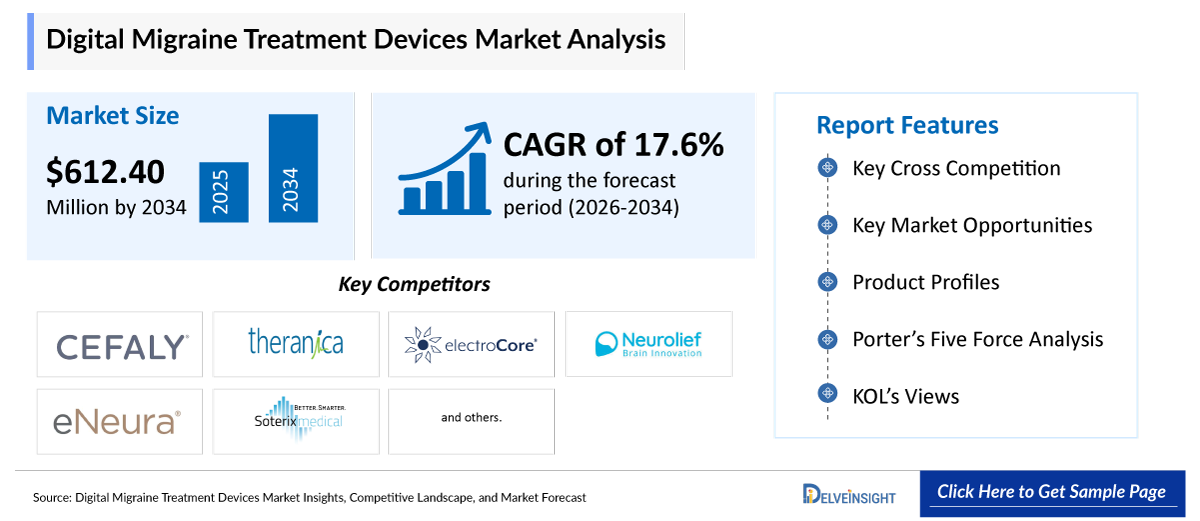
- The Digital Migraine Treatment Devices Market Size is estimated at USD 142.50 million in 2025 and is projected to reach USD 612.40 million by 2034. Growth is anchored in the rapid clinical adoption of non-invasive neuromodulation as a drug-free alternative to pharmacological migraine care, expanding FDA clearances and label extensions, and growing integration of connected, app-controlled therapy into everyday migraine management.
- The Global Digital Migraine Treatment Devices Market Size is growing at a CAGR of 17.6% during the forecast period from 2026 to 2034.
Digital Migraine Treatment Devices Market Trends & Insights
- By product type, the wearable digital migraine treatment devices segment dominated the Digital Migraine Treatment Devices market with a 64% share in 2025.
- By technology, the supraorbital stimulation digital migraine devices segment dominated the Digital Migraine Treatment Devices market with a 31% share in 2025.
- By connectivity, the Bluetooth-enabled devices segment dominated the Digital Migraine Treatment Devices market with a 42% share in 2025.
- By application, the chronic migraine segment dominated the Digital Migraine Treatment Devices market with a 53% share in 2025.
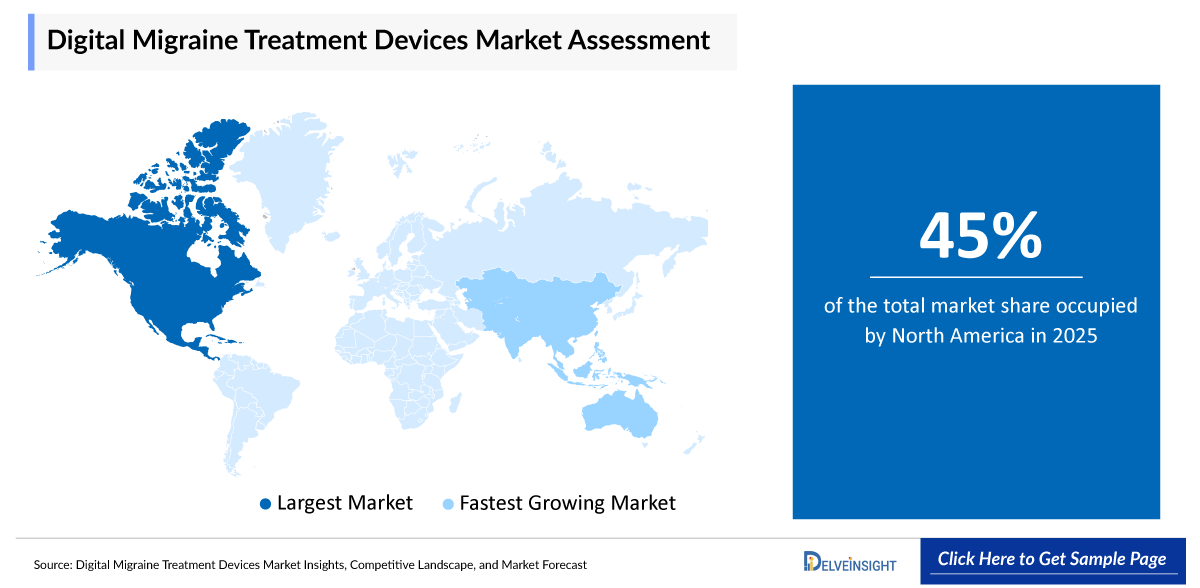
- North America dominated the global Digital Migraine Treatment Devices market revenue with a 45% share in 2025, representing the highest regional market share globally.
Request to unlock the Sample Page of "Digital Migraine Treatment Devices Market"
Digital Migraine Treatment Devices Market Size
The following snapshot summarizes the principal report metrics for the Digital Migraine Treatment Devices market.
|
Report Metrics |
Details |
|
2025 Market Size | |
|
2034 Projected Market Size | |
|
Growth Rate (2026-2034) | |
|
Largest Market |
North America |
|
Fastest Growing Market |
Asia-Pacific |
|
Market Structure |
Fragmented |
All market values are expressed in USD and represent DelveInsight estimates synthesized from primary and secondary research.
Factors Contributing to the Growth of the Digital Migraine Treatment Devices Market
Digital Migraine Treatment Devices Market Drivers
-
Rapid Clinical and Commercial Expansion of Non-Invasive Neuromodulation
The most powerful driver of the Digital Migraine Treatment Devices market is the accelerating clinical and commercial adoption of non-invasive neuromodulation as a mainstream migraine therapy. CEFALY Technology's supraorbital stimulation device became the most frequently prescribed neuromodulation device for migraine among U.S. veterans in 2025, while Theranica's Nerivio remote electrical neuromodulation wearable has expanded its FDA clearance to include dual-use acute and preventive treatment in patients as young as eight years old. As clinical evidence accumulates and device manufacturers broaden approved indications across age groups and migraine subtypes, adoption is extending from specialty headache clinics into primary care and direct-to-consumer channels, anchoring sustained market growth through 2034.
-
Rising Global Migraine Burden
The growing global burden of migraine is expanding demand for non-pharmacological treatment alternatives. Global Burden of Disease 2021 analyses estimate more than 1.1 billion prevalent migraine cases and over 43 million migraine-related disability-adjusted life years worldwide, while the World Health Organization reports that headache disorders affected roughly 3.1 billion people in 2021, with migraine ranking among the leading causes of neurological disease burden. As awareness of migraine's disabling impact on work, education, and quality of life increases, both patients and clinicians are turning to digital neuromodulation devices to reduce attack frequency and severity, directly enlarging the addressable patient population for the market.
-
Growing Preference for Drug-Free, Non-Invasive Treatment Options
A structural shift toward non-pharmacological pain management is a central growth engine for the market. Many migraine patients experience inadequate relief, intolerable side effects, or medication-overuse headache from acute and preventive pharmacotherapy, and pregnant patients and adolescents in particular face limited safe drug options. Digital migraine treatment devices such as CEFALY's supraorbital stimulator and electroCore's gammaCore non-invasive vagus nerve stimulator address this gap by delivering clinically validated relief without systemic side effects or drug interactions. As patient demand for safe, self-administered, drug-free options grows, particularly among reproductive-age women and pediatric populations, adoption of digital neuromodulation devices continues to expand.
-
Accelerating Regulatory Clearances and Expanded Indications
A growing wave of FDA clearances and label expansions is broadening the eligible patient population and increasing commercial adoption. CEFALY Technology received clearance for devices that can both stop a migraine in progress and prevent future episodes, extending beyond its original preventive-only indication, while Neurolief's Relivion MG combined occipital and trigeminal neurostimulation system secured FDA clearance for acute migraine treatment. Theranica's Nerivio has progressively expanded from acute-only use to dual-use acute and preventive treatment and from adult to pediatric populations as young as eight. Each clearance and label expansion creates durable, recurring demand for compliant, evidence-backed devices and reinforces manufacturer investment in expanding indications.
-
Integration of Smartphone Connectivity and Companion Applications
The integration of Bluetooth connectivity, smartphone-controlled dosing, and companion mobile applications is improving treatment adherence and expanding the value proposition of digital migraine treatment devices. CEFALY Connected syncs with the CeCe Migraine Management app to let users track treatment sessions and log migraine attacks, while Theranica's Nerivio is controlled entirely through a smartphone app that also serves as a migraine diary shareable with healthcare providers. This connectivity enables remote monitoring, personalized treatment adjustment, and the accumulation of real-world usage data that manufacturers use to support regulatory submissions and payer engagement, reinforcing adoption across the forecast period.
-
Expanding Payer Coverage and Institutional Adoption
Broadening reimbursement pathways and institutional adoption are increasing patient access to digital migraine treatment devices. In the United States, the Veterans Health Administration prescribed more than 21,000 neuromodulation devices for migraine in 2024, with CEFALY accounting for the majority of orders, while in the United Kingdom, electroCore's gammaCore has secured extended listing in the NHS Supply Chain Catalogue and positive National Institute for Health and Care Excellence guidance. As government health systems, national insurers, and private payers increasingly recognize digital neuromodulation as a covered, evidence-based therapy, affordability barriers ease and adoption broadens across both institutional and home-use settings.
-
Strong Investor and Medtech Interest in Migraine Neuromodulation
Sustained investor interest is accelerating innovation and commercial expansion across the sector. Theranica has raised over USD 45 million in growth financing led by New Rhein Healthcare Investors to fund U.S. commercial expansion of its Nerivio wearable, and additional device makers, including Neurolief, Ybrain, and Nu Eyne, continue to attract venture funding to advance next-generation neuromodulation platforms spanning transcranial and combined stimulation modalities. This continued influx of capital is expanding manufacturing capacity, funding new clinical trials, and validating the long-term commercial potential of digital migraine treatment devices, channeling sustained investment toward the sector through the forecast period.
Digital Migraine Treatment Devices Overview
A digital migraine treatment device is a regulated, technology-enabled medical device that uses neuromodulation, most commonly electrical or magnetic stimulation, to prevent or acutely treat migraine attacks without pharmaceutical intervention. Because migraine is a highly prevalent and often under-treated neurological disorder, and because many patients seek to avoid the side effects, contraindications, or overuse risk associated with acute and preventive medications, digital migraine treatment devices have emerged as a clinically validated, drug-free adjunct or alternative within the broader migraine care pathway.
These devices provide end-to-end functionality spanning nerve stimulation delivery, smartphone app control and treatment logging, cloud-based symptom and usage tracking, and, increasingly, connected data sharing with treating physicians. The market is organized by product type across wearable and handheld form factors; by technology, including supraorbital stimulation, vagus nerve stimulation (VNS), single-pulse transcranial magnetic stimulation (sTMS), and occipital nerve stimulation (ONS); by connectivity across Bluetooth-enabled, Wi-Fi-enabled, smartphone-connected, and standalone devices; by application across migraine with and without aura and chronic and episodic migraine; and by end-user, led by hospitals and clinics.
Driven by the clinical validation and FDA clearance of new neuromodulation modalities, rising migraine prevalence, growing patient and physician preference for non-pharmacological options, and the expansion of connected, app-enabled care ecosystems, digital migraine treatment devices have become an increasingly mainstream component of the global migraine management landscape.
Digital Migraine Treatment Devices Market Key Growth Drivers
- The rapid clinical and commercial expansion of non-invasive neuromodulation therapies is driving demand, with CEFALY becoming the most frequently prescribed neuromodulation device for migraine among U.S. veterans in 2025 and Theranica's Nerivio expanding into pediatric and dual-use acute-and-preventive indications.
- The rising global migraine burden is expanding demand for non-pharmacological treatment options, with Global Burden of Disease analyses estimating more than 1.1 billion prevalent migraine cases worldwide and the World Health Organization ranking migraine among the leading causes of neurological disease burden.
- Growing patient and physician preference for drug-free, non-invasive treatment options is expanding adoption, as digital neuromodulation devices avoid the side effects, medication-overuse headache risk, and contraindications associated with acute and preventive pharmacotherapy.
- Accelerating regulatory clearances and expanded indications, including FDA clearance of dual-use acute-and-preventive devices and expansion into adolescent and pediatric populations, are broadening the eligible patient base and increasing commercial adoption.
- Increasing integration of smartphone connectivity, Bluetooth-enabled hardware, and companion apps is improving treatment adherence, enabling remote monitoring, and supporting personalized, data-driven migraine management.
- Expanding payer coverage and institutional adoption, including inclusion in government and veteran health system formularies and national health service supply catalogues, is broadening patient access and reimbursement pathways.
- The convergence of rising migraine prevalence, non-pharmacological treatment preference, regulatory momentum, and connected-device innovation is expected to sustain strong double-digit growth in the market through 2034.
Major Digital Migraine Treatment Devices Companies
The Digital Migraine Treatment Devices Competitive Landscape is led by the following active manufacturers:
- CEFALY Technology
- Theranica Bio-Electronics
- electroCore, Inc.
- Neurolief Ltd.
- eNeura, Inc.
- WAT Medical Technology
- Soterix Medical, Inc.
- Nu Eyne Co., Ltd.
- Ybrain, Inc.
- Shenzhen Dongdixin Technology Co., Ltd.
For illustrative purposes, only the top 10 companies are listed in the Table of Contents. The report may include analysis and references to additional companies relevant to the market assessment.
Digital Migraine Treatment Devices Market Restraints
Despite strong momentum, the Digital Migraine Treatment Devices market faces material constraints. High device and treatment costs relative to generic pharmacological alternatives limit affordability for uninsured and out-of-pocket patients, particularly in price-sensitive emerging markets. Inconsistent and evolving reimbursement policies across geographies create uncertainty for both manufacturers and patients, and many national health systems have yet to establish clear coverage pathways for neuromodulation devices.
Clinical evidence, while growing, remains more limited than the decades of data supporting pharmacological migraine therapies, and some devices have faced questions regarding real-world effectiveness relative to sham-controlled trial results. Device-related risks, including skin irritation, discomfort, and treatment discontinuation due to inconvenience or perceived limited efficacy, can constrain sustained adherence. Regulatory pathways for novel neuromodulation modalities can be lengthy and costly, and past market exits, including the 2020 bankruptcy of an early single-pulse transcranial magnetic stimulation device maker, illustrate the commercial fragility that can accompany a still-maturing device category.
Limited awareness of digital migraine treatment options among primary care physicians and patients outside specialty headache centers further constrains market penetration, while competition from pharmacological innovations, including newer classes of preventive medications, continues to compete for the same patient population. Together, these cost, reimbursement, evidentiary, and awareness barriers temper the pace of growth, even as the underlying drivers of rising migraine burden, non-pharmacological preference, and regulatory momentum remain firmly intact.
Digital Migraine Treatment Devices Market Segment Analysis
The digital migraine treatment devices market by product type (wearable digital migraine treatment devices, handheld digital migraine treatment devices, others), technology (supraorbital stimulation digital migraine devices, vagus nerve stimulation (vns) digital migraine devices, single-pulse transcranial magnetic stimulation digital migraine devices, occipital nerve stimulation (ons) digital migraine devices, others), connectivity (bluetooth-enabled devices, wi-fi-enabled devices, smartphone-connected devices, standalone devices), application (migraine without aura, migraine with aura, chronic migraine, episodic migraine, others), end-users (hospitals and clinics, specialty neurology centers, others), and geography (North America, Europe, Asia-Pacific, and Rest of World).
-
Digital Migraine Treatment Devices Market Segmentation By Product Type
Dominant Subsegment: Wearable Digital Migraine Treatment Devices.
The wearable digital migraine treatment devices segment accounted for 64% of the Digital Migraine Treatment Devices market in 2025. Wearable devices, including forehead headbands, upper-arm bands, and combined head-worn systems, are the leading product type because they enable both preventive daily use and acute on-demand treatment while allowing patients to continue normal activity during a session. Devices such as CEFALY's supraorbital headband, Theranica's Nerivio upper-arm wearable, and Neurolief's Relivion MG head-worn system have secured broad FDA clearances spanning acute and preventive indications and pediatric use, driving adoption across specialty headache clinics, primary care, and direct-to-consumer channels. The convenience, discretion, and connected-app integration of wearable form factors, combined with growing physician familiarity and payer recognition, sustain the segment's leadership. Handheld devices, led by electroCore's gammaCore vagus nerve stimulator, remain an important complementary category for acute, on-demand treatment, but the recurring daily-use pattern and dual-use clinical positioning of wearables secure their leadership across the forecast period.
-
Digital Migraine Treatment Devices Market Segmentation By Technology
Dominant Subsegment: Supraorbital Stimulation Digital Migraine Devices.
The supraorbital stimulation digital migraine devices segment accounted for 31% of the Digital Migraine Treatment Devices market in 2025. Supraorbital stimulation, delivered via external trigeminal nerve stimulation (e-TNS), is the leading technology because it was the first neuromodulation modality to receive FDA approval for migraine and has since expanded from prevention-only to dual acute-and-preventive use, giving it the longest clinical track record, deepest physician familiarity, and broadest installed base of any modality. CEFALY Technology's device has been recognized as the most frequently prescribed neuromodulation device for migraine within the U.S. Veterans Health Administration system, reinforcing the segment's institutional credibility. Vagus nerve stimulation (VNS) devices, led by electroCore's gammaCore, hold a substantial share on the strength of dual migraine and cluster headache indications, while remote electrical neuromodulation and combined occipital-trigeminal stimulation platforms are expanding quickly on strong pediatric and dual-use clinical data. Single-pulse transcranial magnetic stimulation, the first FDA-cleared device category, remains a smaller niche following commercial disruption among early entrants. Despite rapid growth in newer modalities, the scale and evidentiary depth of supraorbital stimulation secure its leadership across the forecast period.
-
Digital Migraine Treatment Devices Market Segmentation By Connectivity
Dominant Subsegment: Bluetooth-Enabled Devices.
The Bluetooth-enabled devices segment accounted for 42% of the Digital Migraine Treatment Devices market in 2025. Bluetooth-enabled devices are the leading connectivity category because they allow real-time pairing with companion smartphone applications for dosing control, adherence tracking, and migraine diary functionality without requiring continuous internet access. CEFALY Connected, the Bluetooth-enabled evolution of the original CEFALY device, syncs with the CeCe Migraine Management app to let patients track sessions and log attacks, illustrating how connectivity enhances both patient engagement and the real-world evidence base manufacturers use to support regulatory and payer submissions. Smartphone-connected devices, including Theranica's app-controlled Nerivio, represent a closely related and fast-growing category, while standalone devices, favored for their simplicity and lower cost, continue to serve price-sensitive and less tech-oriented patient segments. Wi-Fi-enabled devices remain a smaller niche. The reliability, low power consumption, and broad smartphone compatibility of Bluetooth connectivity secure its leadership across the forecast period.
-
Digital Migraine Treatment Devices Market Segmentation By Application
Dominant Subsegment: Chronic Migraine.
The chronic migraine segment accounted for 53% of the Digital Migraine Treatment Devices market in 2025. Chronic migraine is the leading application because patients experiencing 15 or more headache days per month represent the most severely affected, treatment-resistant, and clinically underserved population, generating sustained demand for effective preventive and abortive options beyond pharmacotherapy. Device manufacturers have prioritized chronic migraine in clinical trials and label expansions, and expanded indications, such as Theranica's chronic-migraine clearance for Nerivio, have broadened the eligible patient base. Episodic migraine represents a large and growing application as devices increasingly target earlier-stage disease to prevent progression to chronic status, while migraine with and without aura applications benefit from technology-specific positioning, including single-pulse transcranial magnetic stimulation's specific aura-related indication. The severity, treatment resistance, and high per-patient device utilization associated with chronic migraine secure the segment's leadership across the forecast period.
-
Digital Migraine Treatment Devices Market Segmentation By End-Users
Dominant Subsegment: Hospitals and Clinics.
The hospitals and clinics segment accounted for 47% of the Digital Migraine Treatment Devices market in 2025. Hospitals and clinics are the leading end-user category because most digital migraine treatment devices remain prescription-based or are initially recommended through physician engagement, and headache specialists and neurologists play a central role in patient education, device selection, and monitoring outcomes. Institutional channels such as the U.S. Veterans Health Administration and the UK's National Health Service have formally incorporated neuromodulation devices into their supply and treatment pathways, reinforcing clinical-channel dominance. Specialty neurology centers represent a fast-growing end-user category as dedicated headache and migraine clinics expand and increasingly serve as centers of excellence for device-based care, while home-care and direct-to-consumer use, captured within the others category, is expanding as over-the-counter clearances broaden patient self-selection. The central role of clinical validation and physician guidance in device adoption secures the leadership of hospitals and clinics across the forecast period.
Digital Migraine Treatment Devices Market Region Analysis
- Dominant Region: North America
North America accounted for 45% of the global Digital Migraine Treatment Devices market revenue in 2025, representing the highest regional market share globally. The region's dominance reflects a high diagnosed migraine prevalence, a mature specialty headache-care infrastructure, clear FDA regulatory pathways, and expanding institutional and payer adoption, particularly in the United States. North America hosts the largest concentration of clinically validated device manufacturers and the deepest base of FDA-cleared products, and patients benefit from established reimbursement channels including Veterans Health Administration formulary inclusion. The commercial momentum of devices such as CEFALY and Nerivio, combined with growing physician familiarity and direct-to-consumer marketing, drives substantial adoption. Continued FDA clearances for expanded indications and pediatric populations, alongside major pharmaceutical and medtech companies monitoring the neuromodulation space, reinforce the region's continued leadership across the forecast period.
- Fastest Growing Region: Asia-Pacific
Asia-Pacific is the fastest-growing region in the Digital Migraine Treatment Devices market. The region's elevated CAGR is driven by rising diagnosed migraine prevalence, expanding neurology and headache-care infrastructure, and growing healthcare investment across China, Japan, India, South Korea, and Australia. South Korean manufacturers including Ybrain and Nu Eyne are advancing next-generation neuromodulation platforms domestically, China's Shenzhen Dongdixin Technology is scaling regional device manufacturing, and Japan and Australia are expanding specialty headache-clinic networks. Government healthcare investment, growing awareness of non-pharmacological pain management, and rising disposable income supporting out-of-pocket device purchases are accelerating adoption, while regional manufacturers increasingly pursue international regulatory clearances to compete globally. The combination of high unmet need, domestic device innovation, and healthcare infrastructure build-out positions Asia-Pacific as the principal source of incremental growth over the forecast period.
Digital Migraine Treatment Devices Regional Commentary
- North America
North America accounted for 45% of the global Digital Migraine Treatment Devices market revenue in 2025. The United States dominates on the strength of its specialty headache-care infrastructure, FDA regulatory clarity, and institutional adoption through channels including the Veterans Health Administration, while continued label expansions and direct-to-consumer marketing reinforce its leadership.
- Europe
Europe is a large and advanced regional market, supported by CE mark regulatory pathways, positive national health technology assessments such as the UK National Institute for Health and Care Excellence guidance on vagus nerve stimulation, and established specialty headache-clinic networks across Germany, France, the United Kingdom, Italy, and Spain. Belgium-based CEFALY Technology's home-market presence and expanding NHS Supply Chain listings reinforce the region's role in both device innovation and clinical adoption.
- Asia-Pacific
Asia-Pacific is the fastest-growing region, propelled by rising migraine diagnosis rates, expanding neurology infrastructure, and growing healthcare investment across China, Japan, India, South Korea, and Australia. Domestic device innovation from South Korean and Chinese manufacturers, combined with international clearance pursuits, is accelerating regional market development.
- Rest of World
The Rest of World region, spanning Latin America, the Middle East, and Africa, is an emerging growth frontier. Expanding neurology and headache-care infrastructure, rising awareness of non-pharmacological migraine treatment options, and gradual regulatory alignment with FDA and CE mark standards are broadening access, while international distribution partnerships support the build-out of regional demand.
Digital Migraine Treatment Devices Market Competitive Landscape
The Digital Migraine Treatment Devices Market is classified as Fragmented. A group of clinically established, first-mover players with broad regulatory clearances and deep real-world evidence, including CEFALY Technology, Theranica Bio-Electronics, and electroCore, anchor the top tier, while specialized and fast-scaling providers such as Neurolief, eNeura, WAT Medical Technology, Soterix Medical, Nu Eyne, Ybrain, and Shenzhen Dongdixin Technology compete through differentiated neuromodulation modalities, regional manufacturing strength, and emerging clinical indications, increasing competition across product categories.
The Digital Migraine Treatment Devices Competitive Landscape can be evaluated across the following dimensions:
- Market concentration: Fragmented, with clinically established first movers leading and a growing field of specialized regional and technology-differentiated device makers.
- Leading players: CEFALY Technology, Theranica Bio-Electronics, and electroCore anchor the top tier through first-mover regulatory clearances and the deepest real-world clinical evidence base.
- Geographic reach: Leading players operate across North America, Europe, and expanding Asia-Pacific channels; CEFALY Technology, headquartered in Belgium with U.S. operations, exemplifies the transatlantic reach required for global distribution.
- Product portfolio strength: Top players offer multiple device generations spanning acute, preventive, and dual-use indications, connected companion applications, and expanding pediatric and adolescent clearances.
- Regulatory clearances: Breadth and recency of FDA clearances and CE marks, including expanded age range and dual-use acute-and-preventive indications, is a decisive competitive advantage.
- Strategic partnerships: Institutional tie-ups, such as CEFALY's inclusion in Veterans Health Administration prescribing channels and electroCore's NHS Supply Chain listing, extend payer and provider reach.
- Funding activity: Active venture financing, including Theranica's Series C round led by New Rhein Healthcare Investors, supports continued commercial expansion and pipeline development.
- Manufacturing capabilities: Precision electrode and stimulation-hardware manufacturing, companion mobile application development, and cloud data infrastructure are key competitive moats.
- Innovation focus: Expansion into pediatric and adolescent populations, dual-use acute-and-preventive indications, combined multi-nerve stimulation platforms, and AI-enabled personalized treatment algorithms.
Digital Migraine Treatment Devices Market Recent Developmental Activities
- In 2026, CEFALY Technology unveiled a new brand identity alongside the CEFALY Migraine Relief app, giving users expanded tools to manage their migraine treatment and prevention routine. Strategic significance: Strengthens the connected-device ecosystem and reinforces CEFALY's leadership in supraorbital stimulation.
- In November 2025, CEFALY Technology announced that CEFALY Connected became the most frequently prescribed neuromodulation device for migraine within the U.S. Veterans Health Administration, accounting for 53 percent of neuromodulation device orders in 2024. Strategic significance: Validates clinical adoption within a major institutional health system and reinforces CEFALY's leading market position.
- In October 2025, Theranica Bio-Electronics presented new real-world evidence on its Nerivio remote electrical neuromodulation wearable at the Child Neurology Society Annual Meeting, reinforcing its pediatric migraine positioning. Strategic significance: Strengthens clinical evidence supporting Nerivio's expanded pediatric indication and supports continued adoption in younger patient populations.
- In 2025, electroCore, Inc., highlighted a growth outlook for its gammaCore non-invasive vagus nerve stimulation platform, citing expansion opportunities across federal healthcare, commercial insurance, and consumer wellness channels. Strategic significance: Signals continued institutional and payer-channel expansion for vagus nerve stimulation technology.
- In 2025, CEFALY Technology participated in the American College of Obstetricians and Gynecologists Annual Clinical and Scientific Meeting to showcase its device as a non-drug option for migraine relief during pregnancy. Strategic significance: Expands clinical positioning into a historically underserved patient population with limited safe pharmacological options.
- In 2023, electroCore, Inc., secured a two-year extension of gammaCore's listing in the NHS Supply Chain Catalogue in the United Kingdom. Strategic significance: Reinforces institutional reimbursement access and continuity of supply within a major national health system.
- In 2023, Theranica Bio-Electronics received expanded FDA clearance for Nerivio as a dual-use acute and preventive treatment for migraine with or without aura in patients 12 years of age and older. Strategic significance: Broadens the eligible patient population and strengthens Nerivio's clinical positioning against single-indication competitors.
Digital Migraine Treatment Devices Market Segmentation
Digital Migraine Treatment Devices Market by Product Type
- Wearable Digital Migraine Treatment Devices
- Handheld Digital Migraine Treatment Devices
- Others
Digital Migraine Treatment Devices Market by Technology
- Supraorbital Stimulation Digital Migraine Devices
- Vagus Nerve Stimulation (VNS) Digital Migraine Devices
- Single-Pulse Transcranial Magnetic Stimulation Digital Migraine Devices
- Occipital Nerve Stimulation (ONS) Digital Migraine Devices
- Others
Digital Migraine Treatment Devices Market by Connectivity
- Bluetooth-Enabled Devices
- Wi-Fi-Enabled Devices
- Smartphone-Connected Devices
- Standalone Devices
Digital Migraine Treatment Devices Market by Application
- Migraine Without Aura
- Migraine With Aura
- Chronic Migraine
- Episodic Migraine
- Others
Digital Migraine Treatment Devices Market by End-User
- Hospitals and Clinics
- Specialty Neurology Centers
- Others
Digital Migraine Treatment Devices Market by Geography
-
North America Digital Migraine Treatment Devices Market
- United States Digital Migraine Treatment Devices Market Size in USD million (2023-2034)
- Canada Digital Migraine Treatment Devices Market Size in USD million (2023-2034)
- Mexico Digital Migraine Treatment Devices Market Size in USD million (2023-2034)
-
Europe Digital Migraine Treatment Devices Market
- Germany Digital Migraine Treatment Devices Market Size in USD million (2023-2034)
- United Kingdom Digital Migraine Treatment Devices Market Size in USD million (2023-2034)
- France Digital Migraine Treatment Devices Market Size in USD million (2023-2034)
- Italy Digital Migraine Treatment Devices Market Size in USD million (2023-2034)
- Spain Digital Migraine Treatment Devices Market Size in USD million (2023-2034)
- Rest of Europe Digital Migraine Treatment Devices Market Size in USD million (2023-2034)
-
Asia-Pacific Digital Migraine Treatment Devices Market
- China Digital Migraine Treatment Devices Market Size in USD million (2023-2034)
- Japan Digital Migraine Treatment Devices Market Size in USD million (2023-2034)
- India Digital Migraine Treatment Devices Market Size in USD million (2023-2034)
- Australia Digital Migraine Treatment Devices Market Size in USD million (2023-2034)
- South Korea Digital Migraine Treatment Devices Market Size in USD million (2023-2034)
- Rest of Asia-Pacific Digital Migraine Treatment Devices Market Size in USD million (2023-2034)
-
Rest of the World (RoW) Digital Migraine Treatment Devices Market
- Middle East Digital Migraine Treatment Devices Market Size in USD million (2023-2034)
- Africa Digital Migraine Treatment Devices Market Size in USD million (2023-2034)
- South America Digital Migraine Treatment Devices Market Size in USD million (2023-2034)
Digital Migraine Treatment Devices Market Recent Industry Trends and Milestones (2023-2026)
|
Category |
Key Developments |
|
Digital Migraine Treatment Devices Market Product Approval |
Regulatory momentum is broadening commercial adoption. Theranica's Nerivio expanded from an acute-only indication to dual-use acute and preventive treatment for migraine with or without aura in patients 12 and older, and later to patients as young as eight. Neurolief's Relivion MG secured FDA clearance for acute migraine treatment via combined occipital and trigeminal stimulation, and CEFALY Technology added clearances enabling its device to both stop an in-progress migraine and prevent future episodes. Each clearance and label expansion creates durable demand for evidence-backed, connected neuromodulation devices. |
|
Digital Migraine Treatment Devices Market Expansion |
Manufacturers broadened connected-device ecosystems and institutional reach. CEFALY Technology unveiled a new brand identity and the CEFALY Migraine Relief app, electroCore secured extended NHS Supply Chain Catalogue listing in the United Kingdom, and CEFALY became the most-prescribed neuromodulation device for migraine within the U.S. Veterans Health Administration. Companion mobile applications, including the CeCe Migraine Management app and Nerivio's smartphone control, expanded across the sector to improve adherence tracking and remote monitoring. |
|
Digital Migraine Treatment Devices Market Investment |
Capital continued flowing toward clinically validated neuromodulation platforms. Theranica closed a USD 45 million Series C round led by New Rhein Healthcare Investors to fund U.S. commercial expansion, while South Korean and Chinese manufacturers, including Ybrain, Nu Eyne, and Shenzhen Dongdixin Technology, advanced regional manufacturing and next-generation device development. Industry-wide interest in non-pharmacological pain management continued to support venture financing across the competitive set. |
|
Company Strategy |
CEFALY Technology: Institutional and payer-channel expansion through Veterans Health Administration adoption and app-enabled connected devices. Theranica Bio-Electronics: Pediatric and dual-use indication expansion supported by venture financing. electroCore, Inc.: Federal healthcare, commercial insurance, and consumer wellness channel expansion for gammaCore. Neurolief Ltd.: Differentiated combined multi-nerve stimulation technology. eNeura, Inc., WAT Medical Technology, Soterix Medical, Inc., Nu Eyne Co., Ltd., Ybrain, Inc., and Shenzhen Dongdixin Technology Co., Ltd.: Specialized neuromodulation technology development and regional manufacturing scale-up. |
|
Emerging Technologies |
Combined multi-nerve stimulation platforms, such as Neurolief's occipital-trigeminal system, represent a leading edge of innovation, alongside expanding pediatric and adolescent indications and dual-use acute-and-preventive clearances. Bluetooth and smartphone connectivity, companion migraine-diary applications, and cloud-based usage analytics are becoming standard, while AI-driven personalization of stimulation parameters and predictive attack forecasting are emerging areas of development. Collaborations between device manufacturers, academic headache centers, and health systems are accelerating clinical validation of new modalities. |
Digital Migraine Treatment Devices Market Startup Funding and Investment Trends
Investment in the Digital Migraine Treatment Devices ecosystem has concentrated on expanding clinical evidence, broadening regulatory clearances, and scaling connected-device manufacturing. The following companies illustrate recent funding and investment activity and technology focus.
|
Company |
Total Funding |
Funding Stage |
Main Offering |
Core Technology |
|
Theranica Bio-Electronics |
USD 45 million+ (Series C) |
Growth / Late-Stage Venture |
Wearable REN migraine device |
Remote electrical neuromodulation |
|
Request for unlocking the report of the @ Digital Migraine Treatment Devices Market | ||||
Capital continues to flow toward manufacturers that demonstrate strong clinical evidence and expand regulatory indications. Theranica's USD 45 million Series C round, led by New Rhein Healthcare Investors with participation from aMoon, Lightspeed Venture Partners, LionBird, Takoa Invest, and Corundum Open Innovation, underscores investor conviction in wearable neuromodulation for migraine.
Emerging providers such as Nu Eyne and Ybrain are scaling next-generation neuromodulation platforms in South Korea, while Shenzhen Dongdixin Technology and WAT Medical Technology expand regional manufacturing capacity in China. Collectively, these investments signal conviction that expanded clinical indications, connected-device functionality, and regional manufacturing scale-up will define the next phase of competitive advantage in the global Digital Migraine Treatment Devices market.
Key Takeaways from the Digital Migraine Treatment Devices Market Report Study
- Market size analysis for the current digital migraine treatment devices market size (2025), and market forecast for 9 years (2026 to 2034).
- Top key product/technology developments, mergers, acquisitions, partnerships, and joint ventures that happened over the last 3 years.
- Key companies dominating the global digital migraine treatment devices market.
- Various opportunities available for competitors in the digital migraine treatment devices market space.
- What are the top-performing segments in 2025? How will these segments perform in 2034?
- Which are the top-performing regions and countries in the current digital migraine treatment devices market scenario?
- Which are the regions and countries where companies should concentrate their opportunities for digital migraine treatment devices market growth in the future?
Target audience who can benefit from this Digital Migraine Treatment Devices market report study
- Digital migraine treatment devices product providers
- Research organizations and consulting companies
- Neurodegenerative disease therapeutics-related organizations, associations, forums, and other alliances
- Government and corporate offices
- Start-up companies, venture capitalists, and private equity firms
- Distributors and traders dealing in digital migraine treatment devices
- Various end-users who want to know more about the digital migraine treatment devices market and the latest technological developments in the digital migraine treatment devices market.
Stay updated with us for Recent Articles @ New DelveInsight Blogs

