
DNA and Gene Cloning Services Market Summary
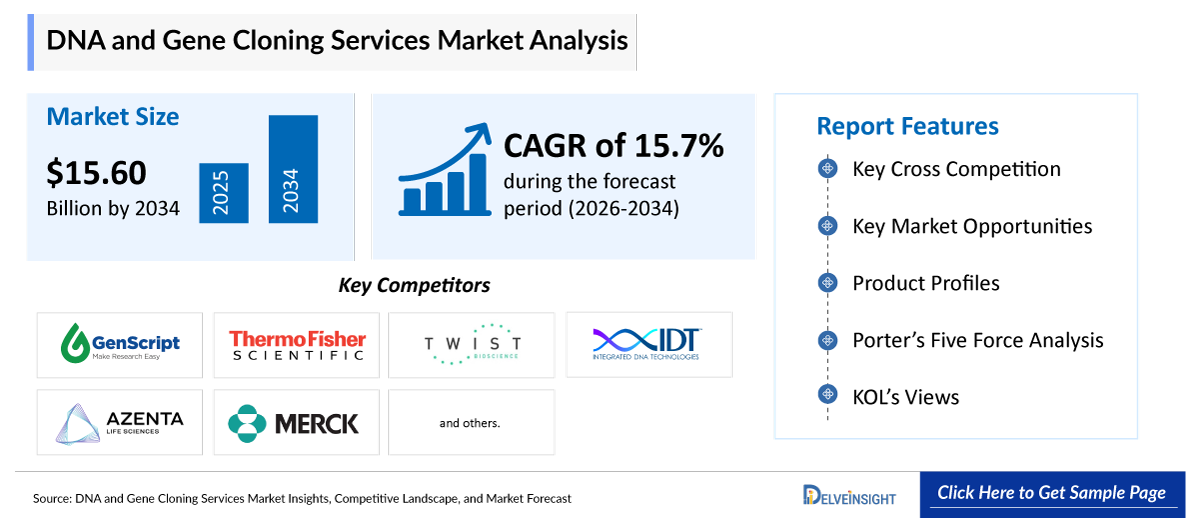
- The global DNA and gene cloning services market size was valued at USD 4.20 billion in 2025 and is projected to reach USD 15.60 billion by 2034.
- The market is expected to expand at a CAGR of 15.7% during the forecast period 2026-2034, supported by the growth of biologics and gene-based therapeutics, the expansion of synthetic biology and cell and gene therapy, the advancement of gene synthesis and cloning technology, and the outsourcing of molecular biology to specialized service providers.
- By service type, the gene synthesis segment dominated the DNA and gene cloning services market with a 38% share in 2025.
- By application, the drug discovery and development segment dominated the DNA and gene cloning services market with a 36% share in 2025.
- By end-user, the pharmaceutical and biotechnology companies segment dominated the DNA and gene cloning services market with a 44% share in 2025.
- By grade, the research-use segment dominated the DNA and gene cloning services market with a 68% share in 2025.
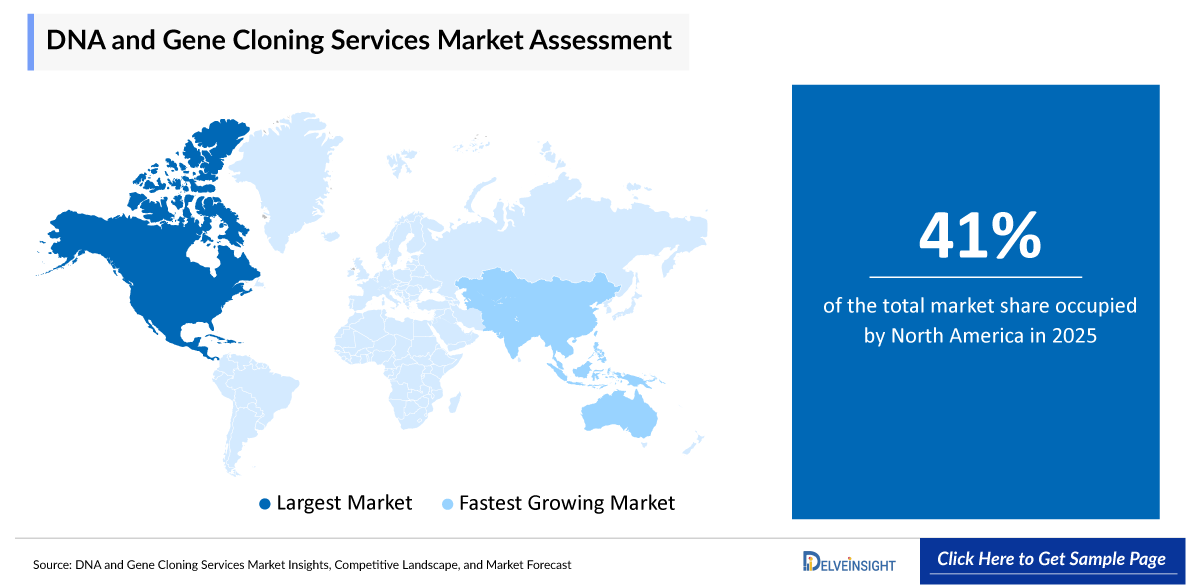
- North America accounted for the largest share of the DNA and gene cloning services market at 41% in 2025, while Asia-Pacific is anticipated to register the fastest growth through 2034.
DNA and gene cloning services are the outsourced molecular biology services that design, synthesize, clone, and construct genes, vectors, and DNA constructs for research, therapeutic, and industrial applications. The scope encompasses gene synthesis, in which custom DNA sequences are synthesized de novo; molecular cloning and subcloning, in which genes are inserted into vectors; vector construction and mutagenesis; plasmid preparation, codon optimization, and library construction.
Leading providers include GenScript, which offers gene synthesis and cloning and subcloning into a large selection of vectors; Thermo Fisher Scientific, which offers GeneArt gene synthesis and Gateway cloning; Twist Bioscience, which offers silicon-chip DNA synthesis; Integrated DNA Technologies, which offers gene fragments; and Azenta through GENEWIZ, together with ATUM, Eurofins, Takara Bio, and other providers. The services free researchers from the labor of molecular biology and provide the building blocks of recombinant protein production, genome editing, vaccine development, and cell and gene therapy, and the contemporary market is defined by the growth of therapeutics and synthetic biology, the advance of synthesis technology, and the expansion of quality tiers from research-use to good manufacturing practice.
DNA and Gene Cloning Services Market Key Growth Drivers
- Growth of biologics and gene-based therapeutics, including monoclonal antibodies, messenger RNA vaccines, and gene therapies that begin with the cloning and expression of target sequences.
- Expansion of synthetic biology and cell and gene therapy, which depend on gene synthesis, cloning, and vector construction.
- Advances in gene synthesis and cloning technology, including silicon-chip synthesis, error correction, and automation that increase throughput and reduce cost.
- Outsourcing of molecular biology to specialized service providers with the expertise, capacity, and turnaround that researchers require.
- Growth of good manufacturing practice cloning and plasmid production for the clinical development of cell and gene therapy and vaccines.
- Growth of research funding and the demand for gene synthesis and cloning across academic and industrial research.
- Adoption of artificial intelligence and automated design platforms that optimize sequence design and cloning success.
Key Companies in DNA and Gene Cloning Services Market
The leading participants in the DNA and gene cloning services market include the following:
- GenScript Biotech Corporation
- Thermo Fisher Scientific Inc.
- Twist Bioscience Corporation
- Integrated DNA Technologies, Inc.
- Azenta, Inc.
- ATUM
- Eurofins Scientific SE
- Takara Bio Inc.
- Merck KGaA
- Macrogen, Inc., and others
For illustrative purposes, only the top 10 companies are listed in the Table of Contents. The report may include analysis and references to additional companies relevant to the market assessment.
DNA and Gene Cloning Services Market Size
The following table summarizes the headline market metrics for the global DNA and gene cloning services market across the base year and the forecast horizon.
|
Report Metrics |
Details |
|
2025 Market Size |
USD 4.20 billion |
|
2034 Projected Market Size |
USD 15.60 billion |
|
Growth Rate (2026-2034) |
15.7% CAGR |
|
Largest Market |
North America (41% share in 2025) |
|
Fastest Growing Market |
Asia-Pacific |
|
Market Structure |
Fragmented |
All market values are expressed in USD and represent DelveInsight estimates synthesized from primary and secondary research.
Factors Contributing to the Growth of the DNA and Gene Cloning Services Market
DNA and Gene Cloning Services Market Drivers
- Growth of Biologics and Gene-Based Therapeutics: The foundational driver of the DNA and gene cloning services market is the growth of biologics and gene-based therapeutics, which begin with the cloning and expression of target sequences. Biologic and gene-based therapeutics, including monoclonal antibodies, recombinant proteins, messenger RNA vaccines, and gene therapies, have become a central and fast-growing part of the pharmaceutical pipeline, and these products begin with the cloning and expression of target genes in microbial or mammalian systems. The development of a biologic or gene-based therapeutic requires the synthesis and cloning of the target sequence, the construction of expression vectors, and the production of plasmid DNA, and DNA and gene cloning services provide these foundational steps. The growth of the biologics pipeline, the expansion of antibody, protein, and vaccine development, and the rise of gene and cell therapies increase the demand for gene synthesis, cloning, and vector construction that begin their development. Service providers offer gene synthesis, cloning, and expression solutions that accelerate the discovery and development of biologics and gene-based therapeutics, and the growth of these therapeutics drives the demand for the services. As biologics and gene-based therapeutics grow and as their pipelines expand, the demand for gene synthesis and cloning that begin their development grows in step. The growth of biologics and gene-based therapeutics anchors the growth of the DNA and gene cloning services market across the forecast period.
- Expansion of Synthetic Biology and Cell and Gene Therapy: The expansion of synthetic biology and cell and gene therapy is a defining driver that depends on gene synthesis, cloning, and vector construction. Synthetic biology, which engineers biological systems for research, industrial, and therapeutic applications, depends on the synthesis and assembly of genes, pathways, and constructs, and cell and gene therapy depends on the synthesis and cloning of therapeutic genes, the construction of viral and non-viral vectors, and the production of plasmid DNA. The growth of synthetic biology, including metabolic engineering, protein and antibody engineering, and the construction of gene circuits and libraries, drives the demand for gene fragments, gene synthesis, and cloning, and gene fragments are used to develop metabolic pathways, build variant libraries, and assemble genome editing constructs. Cell and gene therapy, one of the fastest-growing areas of medicine, requires the synthesis and cloning of therapeutic sequences, the construction of vectors, and the production of clinical-grade plasmid DNA, and providers support the development of these therapies from research through clinical stages. The expansion of synthetic biology and cell and gene therapy, and their dependence on gene synthesis and cloning, drive the demand for services. As synthetic biology and cell and gene therapy expand, the demand for the gene synthesis, cloning, and vector construction they require grows. The expansion of synthetic biology and cell and gene therapy sustains demand for DNA and gene cloning services across the forecast period.
- Advance of Gene Synthesis and Cloning Technology: The advance of gene synthesis and cloning technology, including silicon-chip synthesis, error correction, and automation, increases throughput and reduces cost and drives the growth of the market. Gene synthesis technology has advanced from column-based synthesis to silicon-chip and semiconductor-based synthesis, dramatically increasing throughput and reducing cost, and the silicon-chip synthesis platform transforms DNA synthesis from a laboratory process into an industrialized process. Error correction and sequence verification technologies, including machine-learning error correction and sequencing verification, improve the accuracy and reliability of synthesized DNA, enabling the synthesis of longer and more complex sequences, and automation and high-throughput workflows increase capacity and reduce turnaround. The advance of synthesis technology enables the synthesis of longer genes, larger libraries, and more complex constructs at lower cost and faster turnaround, expanding the applications and accessibility of gene synthesis and cloning. Providers invest in synthesis technology, error correction, and automation to increase throughput, reduce cost, and improve quality, and the advance of technology expands the market. As gene synthesis and cloning technology advances and as it reduces cost and increases throughput and quality, the applications and demand for the services grow. The advance of gene synthesis and cloning technology sustains the growth and modernization of the DNA and gene cloning services market across the forecast period.
- Outsourcing of Molecular Biology to Specialized Providers: The outsourcing of molecular biology to specialized service providers is a powerful driver that concentrates demand in the services market. Gene synthesis, cloning, and vector construction are labor-intensive, specialized, and time-consuming, and researchers increasingly outsource these tasks to specialized providers with the expertise, capacity, technology, and turnaround to perform them efficiently, freeing researchers to focus on their experiments and applications. Service providers offer gene synthesis, cloning and subcloning into a large selection of vectors, vector construction, mutagenesis, and plasmid preparation, delivering sequence-verified constructs ready for use, and they provide the expertise, throughput, and turnaround that internal laboratories cannot match. The outsourcing of molecular biology is driven by the efficiency, quality, and speed of specialized providers, the complexity and labor of the tasks, and the focus of researchers on their core work; providers offer online ordering, design tools, and rapid turnaround that make outsourcing convenient. The growth of the biologics and research pipelines, the complexity of molecular biology, and the value of specialized providers drive the outsourcing of gene synthesis and cloning. As researchers outsource molecular biology to specialized providers for efficiency, quality, and speed, demand for the services grows. The outsourcing of molecular biology to specialized providers sustains demand for DNA and gene cloning services across the forecast period.
- Growth of Good Manufacturing Practice Cloning and Plasmid Production: The growth of good manufacturing practice cloning and plasmid production for clinical development drives the expansion of the market into high-value clinical-grade services. The clinical development of cell and gene therapy and vaccines requires good manufacturing practice-grade plasmid DNA, cloning, and DNA production, and providers have expanded their services to offer preclinical and clinical-grade cloning and plasmid production that support the development of these therapies to investigational new drug filing and clinical trials. Good manufacturing practice services, including good manufacturing practice plasmid DNA, single-stranded and double-stranded DNA, and clinical-grade cloning, enable the development of gene and cell therapies and vaccines, and the growth of these therapies drives the demand for good manufacturing practice services. Good manufacturing practice-grade services command higher value than research-use services and represent a growing and high-value segment of the market, and providers invest in good manufacturing practice capacity to serve the clinical development of therapeutics. The growth of cell and gene therapy and vaccine development, the requirement for good manufacturing practice-grade DNA, and the higher value of clinical-grade services drive the expansion into good manufacturing practice cloning and plasmid production. As cell and gene therapy and vaccine development grow and as they require good manufacturing practice-grade services, demand for good manufacturing practice cloning and plasmid production grows. The growth of good manufacturing practice cloning and plasmid production sustains demand for DNA and gene cloning services across the forecast period.
- Growth of Research Funding and Molecular Biology Research: The growth of research funding and molecular biology research across academic and industrial settings drives the demand for gene synthesis and cloning services. Academic institutions, research organizations, and industrial laboratories conduct extensive molecular biology research, driven by government and private funding for genomics, synthetic biology, and biomedical research, and this research depends on gene synthesis, cloning, and vector construction. The growth of research funding, the expansion of genomics and synthetic biology research, and the demand for specialized molecular biology drive the adoption of gene synthesis and cloning services across research settings, and academic and research institutes represent a large source of demand. Research organizations collaborate with service providers to accelerate their research, outsourcing the synthesis and cloning of gene fragments and constructs, and the growth of research and the outsourcing of molecular biology drive the demand for services. The breadth of applications, including recombinant protein production, gene function analysis, genome editing, and vaccine development, sustains broad demand across research. As research funding and molecular biology research grow and as researchers outsource gene synthesis and cloning, demand for the services grows. The growth of research funding and molecular biology research sustains demand for DNA and gene cloning services across the forecast period.
- Adoption of Artificial Intelligence and Automated Design Platforms: The adoption of artificial intelligence and automated design platforms optimizes sequence design and cloning and drives the modernization of the market. Artificial intelligence and machine learning are applied to the design of genes, vectors, and constructs, optimizing sequence design, codon optimization, and cloning strategy to improve expression, success, and turnaround, and providers have introduced artificial intelligence-powered design and vector platforms. Automated and cloud-based ordering and design platforms enable researchers to design, order, and track projects online, and artificial intelligence optimizes the design of sequences and constructs to improve success and reduce timelines. The application of artificial intelligence to sequence and vector design improves the yield, expression, and success of gene synthesis and cloning, and it reduces the timelines of complex projects, enhancing the value and efficiency of the services. Providers invest in artificial intelligence design tools, cloud ordering platforms, and automated workflows to improve success, reduce timelines, and differentiate their services. As artificial intelligence and automated design platforms advance and as providers adopt them to optimize design and cloning, the value and efficiency of the services grow. The adoption of artificial intelligence and automated design platforms sustains the modernization and growth of the DNA and gene cloning services market across the forecast period.
DNA and Gene Cloning Services Market Restraints
The DNA and gene cloning services market faces several interrelated restraints that temper its growth. The foremost is the complexity and cost of high-value and clinical-grade services, since the synthesis of long, complex, and difficult sequences and the production of good manufacturing practice-grade DNA are technically challenging and costly, and the complexity and cost of these services can limit access and require substantial capability and investment. The requirement for biosecurity screening and export control adds obligation and complexity, since providers must screen synthetic gene sequences and customers for sequences of concern under the harmonized screening protocol of the International Gene Synthesis Consortium and the framework for nucleic acid synthesis screening, and the screening and compliance add cost and process. The technical challenges of synthesizing difficult sequences, including sequences with high complexity, repeats, or secondary structure, and the challenges of large-scale plasmid and vector production, limit the reliability and turnaround of some projects. The competitive and commoditizing nature of standard gene synthesis and cloning, following the advances and spread of technology, exerts price pressure, particularly for standard research-use services. The reliance on skilled molecular biology expertise and the shortage of skilled professionals constrain capacity. The variability of turnaround and quality across providers and projects, and the dependence of downstream research on the accuracy of the constructs, require quality assurance and verification. Intellectual property and the licensing of cloning technologies and vectors add complexity, and the requirement for research-use restrictions on some vectors and technologies constrains commercial use. The concentration of high-value therapeutic and good manufacturing practice services among providers with the capability and capacity limits the participation of smaller providers in the highest-value segments. Together, these factors moderate the pace and scope of growth and require providers to demonstrate quality, capability, compliance, and value to sustain growth.
DNA and Gene Cloning Services Market Segment Analysis
The global DNA and gene cloning services market is segmented by service type (gene synthesis, molecular cloning and sub cloning, vector construction and mutagenesis, and plasmid preparation and others), by application (drug discovery and development, synthetic biology, academic and basic research, and others), by grade (research-use, good manufacturing practice and clinical grade), and by end-users (pharmaceutical and biotechnology companies, academics and research institutes, contract research and manufacturing organizations, and others) by geography (North America, Europe, Asia-Pacific, and the Rest of the World).
By Service Type
Dominant Subsegment: Gene Synthesis.
The gene synthesis category is expected to dominate the market. The gene synthesis segment accounted for a 38% share of the DNA and gene cloning services market in 2025. Gene synthesis, in which custom DNA sequences are synthesized de novo without a physical template, is the leading service type because it is the foundational service on which cloning, vector construction, and downstream applications depend, and it has grown with the advance of synthesis technology and the expansion of applications. The dominance of the segment reflects the foundational role of gene synthesis in providing custom DNA, the advance of synthesis technology that has expanded throughput and reduced cost, and the breadth of applications that begin with synthesized genes. Providers synthesize custom genes with sequence optimization and error correction, delivering synthesized DNA cloned into vectors and ready for expression, and gene synthesis is integrated with cloning, codon optimization, and vector construction. The advances in silicon-chip and high-throughput synthesis, the reduction of cost, and the expansion of applications in research, synthetic biology, and therapeutics drive the gene synthesis segment. While molecular cloning and subcloning, vector construction and mutagenesis, and plasmid preparation are essential and integrated services, the foundational role, technological advance, and breadth of application of gene synthesis sustain the leadership of the gene synthesis segment across the forecast period.
By Application
Dominant Subsegment: Drug Discovery and Development.
The drug discovery and development category is expected to dominate the market. The drug discovery and development segment accounted for a 36% share of the DNA and gene cloning services market in 2025. Drug discovery and development, encompassing the discovery and development of biologics, gene-based therapeutics, and small molecules, is the leading application because it is the largest and highest-value use of gene synthesis and cloning, beginning the development of the antibodies, proteins, vaccines, and gene and cell therapies that dominate the pipeline. The dominance of the segment reflects the centrality of gene synthesis and cloning to the discovery and development of biologics and gene-based therapeutics, the growth of the therapeutic pipeline, and the value of pharmaceutical and biotechnology demand. The development of biologics and gene-based therapeutics begins with the synthesis and cloning of target sequences, the construction of expression vectors, and the production of plasmid DNA, and providers support drug discovery and development from research through clinical stages. The growth of the biologics and gene therapy pipeline, the value of therapeutic development, and the dependence of drug discovery on gene synthesis and cloning drive the segment. While synthetic biology, academic research, diagnostics, and industrial applications are significant, the scale, value, and growth of drug discovery and development sustain the leadership of the drug discovery and development segment across the forecast period.
By End-User
Dominant Subsegment: Pharmaceutical and Biotechnology Companies.
The pharmaceutical and biotechnology companies category is expected to dominate the market. The pharmaceutical and biotechnology companies segment accounted for a 44% share of the DNA and gene cloning services market in 2025. Pharmaceutical and biotechnology companies, which develop biologics, gene-based therapeutics, and vaccines, are the leading end-user because they represent the largest and highest-value source of demand, outsourcing extensive gene synthesis, cloning, and vector construction for their discovery and development programs. The dominance of the segment reflects the scale of pharmaceutical and biotechnology research and development, the value of therapeutic development, and the extensive outsourcing of molecular biology by these companies. Pharmaceutical and biotechnology companies outsource gene synthesis, cloning, vector construction, and good manufacturing practice plasmid production for their discovery and development of antibodies, proteins, vaccines, and gene and cell therapies, and they represent a large and high-value source of demand. The scale of research and development, the value of therapeutics, and the extensive outsourcing of molecular biology by pharmaceutical and biotechnology companies concentrate demand in this segment. While academic and research institutes are a large source of demand, and contract research and manufacturing organizations are a fast-growing end-user, the scale, value, and outsourcing of pharmaceutical and biotechnology companies sustain the leadership of the pharmaceutical and biotechnology companies segment across the forecast period, and it shapes the direction of the market.
By Grade
Dominant Subsegment: Research-Use.
The research-use category is expected to dominate the market. The research-use segment accounted for a 68% share of the DNA and gene cloning services market in 2025. Research-use services, which deliver gene synthesis, cloning, and constructs for research and discovery applications, are the leading segment because they represent the large majority of gene synthesis and cloning volume, serving the extensive research and discovery activity of academic, industrial, and pharmaceutical laboratories. The dominance of the segment reflects the large volume of research and discovery applications, the breadth of research-use gene synthesis and cloning, and the foundational role of research-use services in research and early development. Research-use gene synthesis, cloning, and constructs support the extensive molecular biology research, drug discovery, and synthetic biology of laboratories, and they represent the large majority of the volume of services, serving research and discovery before clinical development. The scale of research and discovery, the breadth of research-use applications, and the foundational role of research-use services drive the segment. While good manufacturing practice and clinical-grade services are a fast-growing and high-value segment, serving the clinical development of cell and gene therapy and vaccines, the large volume and breadth of research-use services sustain the leadership of the research-use segment across the forecast period, even as good manufacturing practice services grow in value and importance.
DNA and Gene Cloning Services Market Region Analysis
Dominant Region: North America
North America accounted for a 41% share of the global DNA and gene cloning services market in 2025, representing the highest regional market share globally. The leadership of the region reflects the advanced biotechnology and pharmaceutical industry, the concentration of gene synthesis and cloning providers, the strength of research funding, and the growth of cell and gene therapy. The United States is the largest national market, supported by the concentration of biotechnology and pharmaceutical companies, the extensive research funding for genomics and biomedical research, the presence and capacity of the leading gene synthesis and cloning providers, and the growth of cell and gene therapy and biologics development. The advanced healthcare and research infrastructure, the strong presence of biotechnology firms, the significant funding for recombinant DNA research, and the demand for gene synthesis and cloning from the therapeutic pipeline drive the adoption of services, and the leading providers operate extensive capacity in the region. The advanced industry, the concentration of providers, the research funding, and the growth of therapeutics reinforce the leadership of the region. The combination of industry strength, provider capacity, research funding, and therapeutic growth sustains the position of North America as the largest regional market across the forecast period.
Fastest Growing Region: Asia-Pacific
Asia-Pacific is projected to register the fastest compound annual growth rate through 2034. The region combines the rapid growth of its biotechnology and pharmaceutical industry, the expansion of research and manufacturing capacity, the presence of gene synthesis and cloning providers, and the growth of research funding, which drives the fast growth of the market. China, India, Japan, and South Korea are the principal national markets, supported by the rapid growth of biotechnology and pharmaceutical research and development, the expansion of contract research and manufacturing, the presence and growth of gene synthesis and cloning providers, and the increase in research funding and biomedical research. The growth of the biotechnology industry, the expansion of research and therapeutic development, and the growth of gene synthesis and cloning capacity enlarge the demand for services. As the biotechnology and pharmaceutical industry grows, as research and manufacturing expand, and as gene synthesis and cloning capacity grows, the region increases its demand and provision of services from a growing base, and the scale of the industry and research expansion creates substantial long-term demand. The combination of industry growth, research expansion, provider presence, and funding growth positions Asia-Pacific as the fastest-growing regional market, and it attracts investment and the expansion of global and regional providers.
DNA and Gene Cloning Services Market Regional Commentary
North America
North America leads the market, supported by the advanced biotechnology and pharmaceutical industry, the concentration of gene synthesis and cloning providers, the strength of research funding, and the growth of cell and gene therapy. The United States dominates the region through its concentration of biotechnology and pharmaceutical companies, extensive research funding, and the capacity of the leading providers. The growth of biologics and gene therapy development sustains demand.
Europe
Europe is a substantial market shaped by a strong biotechnology and pharmaceutical industry, the presence of providers including Eurofins and Merck, and the growth of research and therapeutic development. Germany, the United Kingdom, France, Italy, and Spain are the principal national markets, supported by the biotechnology and pharmaceutical industry, research funding, and the growth of biologics and gene therapy. Demand is sustained by therapeutic development, research, and the outsourcing of molecular biology.
Asia-Pacific
Asia-Pacific is the fastest-growing region, driven by the rapid growth of biotechnology and pharmaceutical research, the expansion of research and manufacturing capacity, and the growth of gene synthesis and cloning providers across China, India, Japan, and South Korea. Industry growth, research expansion, and provider growth sustain rapid growth, and the region attracts investment and the expansion of global and regional providers.
Rest of World
The Rest of World, spanning Latin America, the Middle East, and Africa, represents an emerging opportunity as biotechnology research and healthcare investment grow. Growth is supported by the growth of research, the expansion of biotechnology, and the increasing use of gene synthesis and cloning services, though research capacity and access vary by market. Providers pursue these markets through gene synthesis and cloning services and global logistics suited to growing research activity.
DNA and Gene Cloning Services Market Competitive Landscape
The global DNA and gene cloning services market is classified as Fragmented. A group of gene synthesis and molecular biology service providers holds a substantial share of the market, while DNA synthesis technology companies, specialty cloning providers, and regional providers compete on technology, quality, price, and turnaround. Competition centers on the throughput and cost of synthesis, the accuracy and quality of constructs, the breadth of services from synthesis to good manufacturing practice production, the selection of vectors and technologies, turnaround, and biosecurity and compliance; technology advances, capacity investment, and consolidation intensify the contest.
The competitive landscape is evaluated across the following dimensions:
- Market concentration: Fragmented, with a group of gene synthesis and molecular biology service providers holding a substantial share, alongside DNA synthesis technology companies, specialty cloning providers, and regional providers.
- Leading players: GenScript, Thermo Fisher Scientific, Twist Bioscience, and Integrated DNA Technologies lead in gene synthesis and cloning; Azenta through GENEWIZ and Eurofins lead in molecular biology services, and ATUM, Takara Bio, Merck, and Macrogen contest synthesis, cloning, and regional services.
- Geographic reach: The leading providers operate global synthesis, cloning, and logistics capacity, with concentration in North America and expanding presence in Europe and Asia-Pacific.
- Product portfolio strength: Competitive advantage rests on the breadth from gene synthesis and cloning to vector construction and good manufacturing practice plasmid production, the selection of vectors and technologies, and the throughput, accuracy, and turnaround of the services.
- Pipeline strength: Development is concentrated in synthesis technology and throughput, error correction and accuracy, artificial intelligence design, good manufacturing practice capacity, and biosecurity compliance.
- Strategic partnerships: Collaboration spans partnerships between synthesis technology and service companies, alliances with pharmaceutical and synthetic biology companies, and licensing of DNA technologies.
- M&A activity: Consolidation has shaped the field, with larger players acquiring synthesis, cloning, and technology companies to enhance capability and capacity, and the field includes large diversified companies alongside specialist providers.
- Innovation focus: Innovation is shifting toward higher-throughput and lower-cost synthesis, error correction and accuracy, artificial intelligence and automated design, good manufacturing practice and clinical-grade services, and biosecurity.
- Regulatory standing: Compliance with biosecurity screening under the harmonized screening protocol of the International Gene Synthesis Consortium and the framework for nucleic acid synthesis screening, good manufacturing practice for clinical-grade services, and export control are decisive competitive credentials and a principal axis of competition and responsibility among the leaders.
DNA and Gene Cloning Services Market Recent Developmental Activities
- In April 2024, the White House Office of Science and Technology Policy issued the framework for nucleic acid synthesis screening, establishing expectations for the screening of synthetic nucleic acid sequences and customers to prevent misuse. Strategic significance: the framework reinforced the biosecurity obligations of gene synthesis providers and shaped the screening and compliance of the industry.
- In May 2024, Twist Bioscience Corporation launched multiplexed gene fragments, enabling the pooled synthesis of DNA fragments and supporting high-throughput screening. Strategic significance: the launch advanced high-throughput gene synthesis and supported synthetic biology and screening applications.
- In June 2024, GenScript Biotech Corporation launched the FLASH gene synthesis service, reducing the time from sequence to plasmid construct and accelerating research in antibody drugs, vaccines, and cell and gene therapy. Strategic significance: the launch advanced the speed of gene synthesis and cloning and supported the acceleration of therapeutic research.
- In July 2024, GenScript Biotech Corporation launched an artificial intelligence-powered vector design platform, incorporating machine learning to optimize cloning success and reduce project timelines for complex genetic constructs. Strategic significance: the launch advanced artificial intelligence in vector design and cloning and reinforced the modernization of the services.
- In September 2024, Thermo Fisher Scientific Inc. invested in automated gene synthesis manufacturing capacity, enhancing global capacity for complex cloning projects and reducing delivery times. Strategic significance: the investment expanded synthesis and cloning capacity and reinforced the position of a leading provider in high-throughput and complex services.
- In January 2025, Azenta, Inc., through GENEWIZ, introduced a high-efficiency site-directed mutagenesis service for oncology and virology research, enabling rapid variant library creation. Strategic significance: the launch advanced mutagenesis and variant library services and supported therapeutic and research applications.
- In February 2025, Thermo Fisher Scientific Inc. expanded its gene synthesis and cloning portfolio to support good manufacturing practice-grade plasmid production for cell and gene therapy developers. Strategic significance: the expansion advanced good manufacturing practice cloning and plasmid production and reinforced the growth of clinical-grade services.
- In May 2025, Twist Bioscience Corporation revised its collaboration with a synthetic biology company, acquiring long DNA technology licenses and enhancing its DNA synthesis portfolio. Strategic significance: the development advanced long DNA synthesis capability and supported the growth of the synthesis and cloning portfolio.
- In 2024 and 2025, GENEWIZ from Azenta Life Sciences maintained membership in the International Gene Synthesis Consortium and followed its harmonized screening protocol, screening gene sequences and customers for sequences of concern. Strategic significance: the practice reinforced the biosecurity and responsible provision of gene synthesis services.
- In 2024 and 2025, Integrated DNA Technologies, Inc. advanced its gene fragment and gBlocks synthesis and its role in genome editing and synthetic biology applications. Strategic significance: the developments reinforced the position of a leading gene fragment provider in genome editing and synthetic biology.
- In 2024 and 2025, providers advanced good manufacturing practice-grade single-stranded and double-stranded DNA and plasmid services for non-viral cell and gene therapy development. Strategic significance: the advancement of good manufacturing practice non-viral DNA services supported the development of next-generation cell and gene therapies.
- In 2024 and 2025, the leading providers advanced synthesis throughput and cost, error correction and accuracy, artificial intelligence design, good manufacturing practice capacity, and biosecurity across DNA and gene cloning services. Strategic significance: the convergence of the leaders on throughput, accuracy, artificial intelligence, good manufacturing practice, and biosecurity confirmed these as the defining axes of competition and signaled a market advancing toward faster, more accurate, clinical-grade, and responsible gene synthesis and cloning.
DNA and Gene Cloning Services Market Segmentation
- DNA and Gene Cloning Services Market Assessment by Service Type
- Gene Synthesis
- Molecular Cloning and Subcloning
- Vector Construction and Mutagenesis
- Plasmid Preparation and Others
- DNA and Gene Cloning Services Market Assessment by Application
- Drug Discovery and Development
- Synthetic Biology
- Academic and Basic Research
- Others
- DNA and Gene Cloning Services Market Assessment by End-User
- Pharmaceutical and Biotechnology Companies
- Academic and Research Institutes
- Contract Research and Manufacturing Organizations
- Others
- DNA and Gene Cloning Services Market Assessment by Grade
- Research-Use
- Good Manufacturing Practice and Clinical-Grade
DNA and Gene Cloning Services Market Assessment by Geography
- North America DNA and Gene Cloning Services Market Assessment
- United States DNA and Gene Cloning Services Market Size in USD million (2023-2034)
- Canada DNA and Gene Cloning Services Market Size in USD million (2023-2034)
- Mexico DNA and Gene Cloning Services Market Size in USD million (2023-2034)
- Europe DNA and Gene Cloning Services Market Assessment
- Germany DNA and Gene Cloning Services Market Size in USD million (2023-2034)
- United Kingdom DNA and Gene Cloning Services Market Size in USD million (2023-2034)
- France DNA and Gene Cloning Services Market Size in USD million (2023-2034)
- Italy DNA and Gene Cloning Services Market Size in USD million (2023-2034)
- Spain DNA and Gene Cloning Services Market Size in USD million (2023-2034)
- Rest of Europe DNA and Gene Cloning Services Market Size in USD million (2023-2034)
- Asia-Pacific DNA and Gene Cloning Services Market Assessment
-
- China DNA and Gene Cloning Services Market Size in USD million (2023-2034)
- Japan DNA and Gene Cloning Services Market Size in USD million (2023-2034)
- India DNA and Gene Cloning Services Market Size in USD million (2023-2034)
- Australia DNA and Gene Cloning Services Market Size in USD million (2023-2034)
- South Korea DNA and Gene Cloning Services Market Size in USD million (2023-2034)
- Rest of Asia-Pacific DNA and Gene Cloning Services Market Size in USD million (2023-2034)
- Rest of the World DNA and Gene Cloning Services Market Assessment
- Middle East DNA and Gene Cloning Services Market Size in USD million (2023-2034)
- Africa DNA and Gene Cloning Services Market Size in USD million (2023-2034)
- South America DNA and Gene Cloning Services Market Size in USD million (2023-2034)
DNA and Gene Cloning Services Market Recent Industry Trends and Milestones (2023-2026):
|
Category |
Key Developments |
|
DNA and Gene Cloning Services Market Service Advancement |
The period was defined by the advancement of synthesis throughput, artificial intelligence design, and clinical-grade services. GenScript launched the FLASH gene synthesis service and an artificial intelligence vector design platform, Twist Bioscience launched multiplexed gene fragments and advanced long DNA, Thermo Fisher expanded capacity and good manufacturing practice plasmid production, and Azenta advanced mutagenesis and variant library services. Providers advanced error correction, automation, and biosecurity. Together, these advances concentrated competition in fast, accurate, clinical-grade, and responsible gene synthesis and cloning. |
|
DNA and Gene Cloning Services Market Service Expansion |
Service expansion advanced along three axes. The first is synthesis throughput and technology, as providers advanced silicon-chip and high-throughput synthesis, multiplexed fragments, and long DNA. The second is artificial intelligence and automation, as providers advanced artificial intelligence design, automated ordering, and error correction. The third is good manufacturing practice and clinical-grade services, as providers expanded good manufacturing practice plasmid and DNA production for cell and gene therapy. Providers also expanded vector selection, mutagenesis, and biosecurity screening. |
|
DNA and Gene Cloning Services Market Investment |
Investment was shaped by capacity expansion, technology, and clinical-grade services. Thermo Fisher invested in automated manufacturing capacity, Twist Bioscience acquired long DNA technology licenses, and providers invested in synthesis technology, artificial intelligence design, and good manufacturing practice capacity. Investment flowed into throughput and cost reduction, accuracy and error correction, good manufacturing practice and clinical-grade services, and biosecurity compliance, and the growth of cell and gene therapy drove investment in clinical-grade cloning and plasmid production. |
|
Company Strategy |
The unifying strategic theme is the delivery of fast, accurate, scalable, clinical-grade, and responsible gene synthesis and cloning. GenScript, Thermo Fisher, Twist Bioscience, and Integrated DNA Technologies are advancing synthesis throughput, technology, and good manufacturing practice; Azenta and Eurofins are advancing molecular biology services, and ATUM, Takara Bio, Merck, and Macrogen are advancing synthesis, cloning, and regional services. Across the field, strategy centers on throughput, accuracy, artificial intelligence, good manufacturing practice, and biosecurity. |
|
Emerging Technologies |
The defining emerging technologies are silicon-chip and high-throughput synthesis that industrialize DNA synthesis and reduce cost; error correction and sequence verification that enable long and complex DNA; artificial intelligence and automated design that optimize sequence and vector design; good manufacturing practice and clinical-grade cloning and plasmid production that support cell and gene therapy; and biosecurity screening that ensures responsible provision. Supporting these are enzymatic synthesis, cloud-based ordering, and long DNA and library construction. Across these, the trajectory is toward gene synthesis and cloning that is faster, more accurate, more scalable, clinical-grade, and responsible, accelerating research, drug discovery, synthetic biology, and cell and gene therapy. |
DNA and Gene Cloning Services Market Startup Funding and Investment Trends
Investment in the DNA and gene cloning field has concentrated on technologies that make DNA synthesis and cloning faster, cheaper, more scalable, and more capable, namely high-throughput and enzymatic synthesis, artificial intelligence design, long DNA and complex constructs, and good manufacturing practice and clinical-grade services. Because the market is fragmented across large diversified providers and specialist and technology companies, innovators pursue differentiated synthesis technologies, design platforms, or clinical-grade capabilities that serve defined needs or that a larger company can absorb. The table below summarizes representative companies advancing the next generation of DNA synthesis and cloning.
|
Company |
Total Funding |
Funding Stage |
Main Product/Offering |
Core Technology |
|
Twist Bioscience Corporation |
Publicly listed |
Commercial stage |
Silicon-chip DNA synthesis |
Chip-based high-throughput synthesis |
|
ATUM |
Privately held |
Commercial stage |
Gene synthesis and design |
Enzymatic and optimized synthesis |
|
Request for unlocking the report of the @ DNA and Gene Cloning Services Market Insights | ||||
Capital formation in this field is shaped by the presence of large diversified gene synthesis and molecular biology providers, so investors and acquirers have favored companies that introduce differentiated synthesis technologies, notably enzymatic and long DNA synthesis, artificial intelligence design, or clinical-grade capabilities that serve defined needs or that a larger company can absorb. High-throughput and enzymatic synthesis is a clear thesis, reducing the cost and expanding the capability of DNA synthesis. Long DNA and complex constructs constitute a second thesis, enabling the synthesis of genes and pathways, and good manufacturing practice and clinical-grade services a third, supporting cell and gene therapy. The archetypal outcome is acquisition by a large gene synthesis, molecular biology, or life science company seeking to add technology and capacity, exemplified by the consolidation of synthesis and technology companies, or growth into a synthesis and services provider. The principal risks are the capacity and technology of the large providers, the commoditization and price pressure of standard synthesis, the technical challenge of long and complex DNA, and the biosecurity and compliance obligations of the field.
Key Takeaways from the DNA and Gene Cloning Services Market Report Study
- Market size analysis for the current DNA and gene cloning services market size (2025), and market forecast for 9 years (2026 to 2034).
- Top key service and technology developments, launches, partnerships, and investments that happened over the last 3 years.
- Key companies dominating the global DNA and gene cloning services market.
- Various opportunities available for competitors in the DNA and gene cloning services market space.
- What are the top-performing segments in 2025? How will these segments perform in 2034?
- Which are the top-performing regions and countries in the current DNA and gene cloning services market scenario?
- Which are the regions and countries where companies should concentrate their opportunities for DNA and gene cloning services market growth in the future?
Target audience who can benefit from this DNA and gene cloning services market report study
- Gene synthesis, molecular biology, and DNA cloning service providers
- Research organizations and consulting companies
- Gene synthesis and synthetic biology-related organizations, associations, forums, and other alliances
- Government and corporate offices
- Start-up companies, venture capitalists, and private equity firms
- Pharmaceutical, biotechnology, and research organizations dealing in gene synthesis and cloning
- Various end-users who want to know more about the DNA and gene cloning services market and the latest technological developments in the DNA and gene cloning services market.

