
DYSPORT Market Sales
Key Factors Driving DYSPORT Growth
1. Expansion of the Global Neuromodulator / Aesthetic Injectable Market
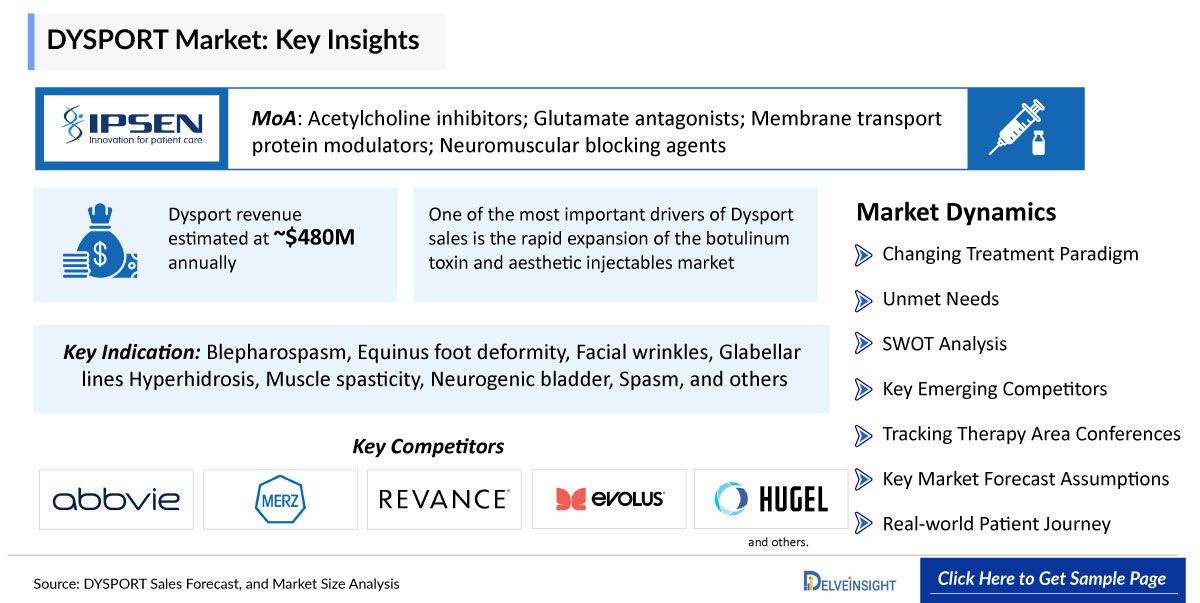
One of the most important drivers of Dysport sales is the rapid expansion of the botulinum toxin and aesthetic injectables market.
- Botulinum toxin products are among the most commonly performed minimally invasive cosmetic procedures worldwide.
- Rising demand for non-surgical facial rejuvenation is driving strong market growth.
- The medical cosmetology botulinum toxin market is projected to grow to ~$11.3B by 2028 with ~8% CAGR.
Growth drivers include:
- Increasing acceptance of minimally invasive procedures
- Rising aging population
- Growing disposable income in emerging markets
- Increased use of neuromodulators in preventive aesthetics
2. Strong Sales Growth Within Galderma’s Injectable Aesthetics Portfolio
Dysport continues to deliver strong commercial performance for Galderma.
- Neuromodulator sales reached $1.47B in 2025, growing 14.3% year-over-year, with Dysport contributing significantly to the segment’s growth.
- In 2024, Galderma’s neuromodulator category generated $1.29B in revenue, representing ~11.8% growth year-over-year.
Dysport is a core contributor to this segment, which includes neuromodulators used in aesthetic dermatology.
This strong performance reflects:
- Increasing physician demand
- Expanded patient base
- Market share gains in key countries.
3. Competitive Pricing and Physician Preference
Dysport has positioned itself as a cost-effective alternative to Botox in many markets.
Estimated market positioning:
- Botox: ~72% global market share
- Dysport: ~12% market share
- Dysport revenue estimated at ~$480M annually.
Advantages that drive adoption include:
- Competitive pricing per unit compared with Botox
- Rapid onset of action reported by clinicians
- Strong clinical efficacy in both aesthetic and therapeutic indications.
This positioning allows Dysport to capture price-sensitive segments and expand its global footprint.
4. Broad Indication Portfolio in Therapeutic Neurology
Dysport’s growth is supported by its use in multiple neurological disorders.
Key therapeutic indications include:
- Cervical dystonia
- Upper and lower limb spasticity
- Blepharospasm
- Pediatric spasticity
Therapeutic indications provide:
- Reimbursed treatment revenue
- Higher dosing requirements than aesthetic treatments
- Long-term treatment cycles
These medical applications significantly increase the total addressable market beyond cosmetic use.
5. Geographic Expansion and Market Penetration
Dysport is now approved in dozens of global markets, with strong growth in regions outside the United States.
Key geographic drivers include:
- Expansion in Europe, Latin America, and Asia-Pacific
- Increasing penetration in under-served aesthetic markets
International markets have been a major growth engine for Galderma, delivering double-digit sales growth across injectable aesthetics categories.
Emerging markets are particularly attractive due to:
- Rapid expansion of medical aesthetics clinics
- Growing middle-class spending on cosmetic procedures.
DYSPORT Recent Developments
- In January 2026, Ipsen announced the presentation of 14 across multiple neurological conditions at the TOXINS 2026 conference (14-17 January) in Madrid, Spain. Data presented highlighted the depth and diversity of evidence across multiple movement disorders including post stroke spasticity, cervical dystonia and blepharospasm, adding to the available evidence of DYSPORT (abobotulinumtoxinA) in patient care – alongside new indications under evaluation.
“DYSPORT Sales Forecast, and Market Size Analysis – 2034” report provides comprehensive insights of DYSPORT for approved indication like Blepharospasm, Equinus foot deformity, Facial wrinkles, Glabellar lines Hyperhidrosis, Muscle spasticity, Neurogenic bladder, Spasm, Torticollis; as well as potential indication like Migraine, Musculoskeletal disorders, and Urinary incontinence in the 7MM. A detailed picture of DYSPORT’s existing usage in approved and anticipated entry and performance in potential indications in the 7MM, i.e., the United States, EU4 (Germany, France, Italy, and Spain) and the United Kingdom, and Japan for the study period 2020 –2034 is provided in this report along with a detailed description of the DYSPORT for approved and potential indications. The DYSPORT market report provides insights about DYSPORT’s sales forecast, mechanism of action (MoA), dosage and administration, as well as research and development including regulatory milestones, along with other developmental activities. Further, it also consists of historical and current DYSPORT performance, future market assessments inclusive of the DYSPORT market forecast analysis for approved and potential indications in the 7MM, SWOT, analysts’ views, comprehensive overview of market competitors, and brief about other emerging therapies in respective indications. It also provides analysis of DYSPORT sales forecasts, along with factors driving its market.
DYSPORT Drug Summary
DYSPORT is a botulinum toxin type A formulation from Ipsen, supplied as lyophilized powder in 300- or 500-unit vials for intramuscular or subcutaneous reconstitution with preservative-free saline, indicated for treating adults with cervical dystonia to reduce neck pain and abnormal head position; temporary improvement of moderate to severe glabellar lines; upper limb spasticity in adults; and lower limb spasticity in pediatric patients aged 2 years and older, by inhibiting acetylcholine release at neuromuscular junctions via SNAP-25 cleavage, leading to temporary muscle paralysis and reduced spasticity. It offers a wider diffusion profile compared to other botulinum toxins, enabling broader muscle coverage per injection, with dosing tailored by units/kg for spasticity (up to 15 units/kg unilateral lower limb or 30 units/kg bilateral, not exceeding 1000 units per session) and effects lasting 12-16 weeks before retreatment. DYSPORT carries a boxed warning for distant spread of toxin effects causing symptoms like muscle weakness, dysphagia, respiratory issues, or death, particularly in vulnerable patients, and is contraindicated in those with hypersensitivity to botulinum toxin or cow's milk protein. The report provides DYSPORT’s sales, growth barriers and drivers, post usage and approvals in multiple indications.
Scope of the DYSPORT Market Report
The report provides insights into:
- A comprehensive product overview including the DYSPORT MoA, description, dosage and administration, research and development activities in approved indications like Blepharospasm, Equinus foot deformity, Facial wrinkles, Glabellar lines Hyperhidrosis, Muscle spasticity, Neurogenic bladder, Spasm, Torticollis; as well as potential indication like Migraine, Musculoskeletal disorders, and Urinary incontinence.
- Elaborated details on DYSPORT regulatory milestones and other development activities have been provided in DYSPORT market report.
- The report also highlights DYSPORT‘s cost estimates and regional variations, reported and estimated sales performance, research and development activities in approved and potential indications across the United States, Europe, and Japan.
- The DYSPORT market report also covers the patents information, generic entry and impact on cost cut.
- The DYSPORT market report contains current and forecasted DYSPORT sales for approved and potential indications till 2034.
- Comprehensive coverage of the late-stage emerging therapies for respective indications.
- The DYSPORT market report also features the SWOT analysis with analyst views for DYSPORT in approved and potential indications.
Methodology
The DYSPORT market report is built using data and information sourced primarily from internal databases, primary and secondary research and in-house analysis by DelveInsight’s team of industry experts. Information and data from the secondary sources have been obtained from various printable and nonprintable sources like search engines, news websites, global regulatory authorities websites, trade journals, white papers, magazines, books, trade associations, industry associations, industry portals and access to available databases.
DYSPORT Analytical Perspective by DelveInsight
In-depth DYSPORT Market Assessment
This DYSPORT sales market forecast report provides a detailed market assessment of DYSPORT for approved indication like Blepharospasm, Equinus foot deformity, Facial wrinkles, Glabellar lines Hyperhidrosis, Muscle spasticity, Neurogenic bladder, Spasm, Torticollis; as well as potential indication like Migraine, Musculoskeletal disorders, and Urinary incontinence in the seven major markets, i.e., the United States, EU4 (Germany, France, Italy, and Spain) and the United Kingdom, and Japan. This segment of the report provides current and forecasted DYSPORT sales data uptil 2034.
DYSPORT Clinical Assessment
The DYSPORT market report provides the clinical trials information of DYSPORT for approved and potential indications covering trial interventions, trial conditions, trial status, start and completion dates.
DYSPORT Competitive Landscape
The report provides Insights on competitors and marketed products within the domain, along with a summary of emerging products and their respective launch dates, posing significant competition in the market.
DYSPORT Market Potential & Revenue Forecast
- Projected market size for the DYSPORT and its key indications
- Estimated DYSPORT sales potential (DYSPORT peak sales forecasts)
- DYSPORT Pricing strategies and reimbursement landscape
DYSPORT Competitive Intelligence
- Number of competing drugs in development (pipeline analysis)
- DYSPORT Market positioning compared to existing treatments
- DYSPORT Strengths & weaknesses relative to competitors
DYSPORT Regulatory & Commercial Milestones
- DYSPORT Key regulatory approvals & expected launch timelines
- Commercial partnerships, licensing deals, and M&A activity
DYSPORT Clinical Differentiation
- DYSPORT Efficacy & safety advantages over existing drugs
- DYSPORT Unique selling points
DYSPORT Market Report Highlights
- In the coming years, the DYSPORT market scenario is set to change due to strong adoption, increased prescriptions and broader uptake in multiple immunological indications; which would expand the size of the market.
- The DYSPORT companies are developing therapies that focus on novel approaches to treat/improve the disease condition, assess challenges, and seek opportunities that could influence DYSPORT’s dominance.
- Other emerging products for Blepharospasm, Equinus foot deformity, Facial wrinkles, Glabellar lines Hyperhidrosis, Muscle spasticity, Neurogenic bladder, Spasm, Torticollis; as well as potential indication like Migraine, Musculoskeletal disorders, and Urinary incontinence are expected to give tough market competition to DYSPORT and launch of late-stage emerging therapies in the near future will significantly impact the market.
- A detailed description of regulatory milestones, and developmental activities, provide the current development scenario of DYSPORT in approved and potential indications.
- Analyse DYSPORT cost, pricing trends and market positioning to support strategic decision-making in the immunology landscape.
- Our in-depth analysis of the forecasted DYSPORT sales data uptil 2034 will support the clients in decision-making process regarding their therapeutic portfolio by identifying the overall scenario of DYSPORT in approved and potential indications.
Key Questions Answered In The DYSPORT Market Report
- What is the class of therapy, route of administration and mechanism of action of DYSPORT? How strong is DYSPORT’s clinical and commercial performance?
- What is DYSPORT’s clinical trial status in each individual indications such as Blepharospasm, Equinus foot deformity, Facial wrinkles, Glabellar lines Hyperhidrosis, Muscle spasticity, Neurogenic bladder, Spasm, Torticollis; as well as potential indication like Migraine, Musculoskeletal disorders, and Urinary incontinence and study completion date?
- What are the key collaborations, mergers and acquisitions, licensing and other activities related to the DYSPORT Manufacturers?
- What are the key designations that have been granted to DYSPORT for approved and potential indications? How are they going to impact DYSPORT’s penetration in various geographies?
- What is the current and forecasted DYSPORT market scenario for approved and potential indications? What are the key assumptions behind the forecast?
- What are the current and forecasted sales of DYSPORT in the seven major countries, including the United States, Europe (Germany, France, Italy, Spain) and the United Kingdom, and Japan?
- What are the other emerging products available and how are these giving competition to DYSPORT for approved and potential indications?
- Which are the late-stage emerging therapies under development for the treatment of approved and potential indications?
- How cost-effective is DYSPORT? What is the duration of therapy and what are the geographical variations in cost per patient?