
Elamipretide Market Sales
Key Factors Driving Elamipretide Growth
1. First-in-class therapy for Barth Syndrome (major unmet need)
The biggest driver of growth is that elamipretide became the first approved treatment for Barth syndrome, a rare mitochondrial disorder with previously no disease-modifying therapy.
- In September 2025, the U.S. Food and Drug Administration granted accelerated approval for elamipretide (Forzinity) for patients with Barth syndrome weighing ≥30 kg.
- Barth syndrome is extremely rare, affecting ~150 patients in the United States and fewer than ~300 globally.
- The therapy demonstrated improvements in mitochondrial function, muscle strength (~45%), and heart function (~40%) in clinical studies.
- cause the disease previously had no approved treatments, adoption among diagnosed patients is expected to be very high.
- mmercial impact
- spite the small patient population, ultra-orphan pricing significantly increases revenue potential.
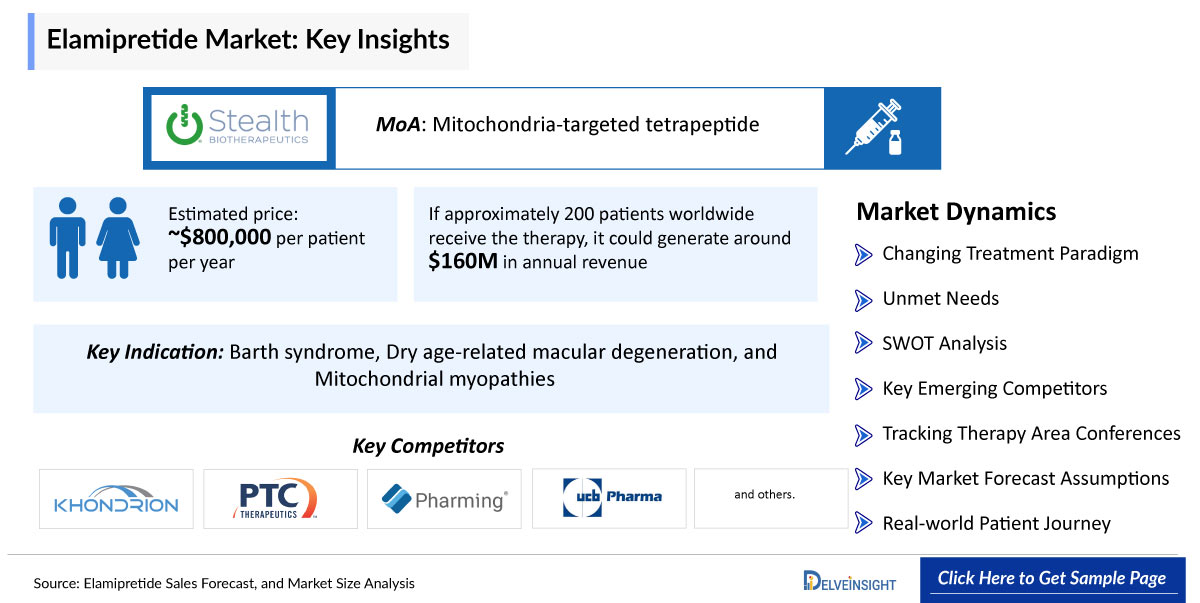
- Estimated price: ~$800,000 per patient per year.
Estimated revenue potential
- If ~200 global patients receive therapy → ~$160M annual revenue
- With broader diagnosis and expanded access → $200M+ potential peak sales
2. Ultra-orphan drug pricing and reimbursement dynamics
Rare disease drugs often command premium pricing due to:
- extremely small patient populations
- lack of alternative therapies
- strong advocacy and payer support
Elamipretide fits the ultra-orphan model, similar to other rare disease therapies priced between $500k–$2M annually.
The high price point means even small patient uptake generates meaningful revenue, supporting commercialization despite limited patient numbers.
3. Potential label expansion into larger mitochondrial diseases
Growth will increasingly depend on expansion beyond Barth syndrome.
Elamipretide is being investigated for additional mitochondrial disorders, including:
- Primary mitochondrial myopathy (PMM)
- Dry age-related macular degeneration (AMD)
- For example:
- The Phase 3 ReNEW trial is evaluating elamipretide in dry AMD, with 360 patients enrolled globally.
- Results from the trial are expected around 2026.
Commercial implication
If approved for dry AMD, the drug would move from a hundreds-of-patients market to potentially millions, dramatically increasing revenue potential.
Estimated peak sales scenarios often cited in analyst models:
- Barth syndrome only: ~$150M–$250M
- Barth syndrome + mitochondrial myopathy: ~$400M–$700M
- With AMD approval: potentially >$1B peak sales
4. Unique mechanism targeting mitochondrial dysfunction
Elamipretide works by targeting cardiolipin in the mitochondrial inner membrane, stabilizing mitochondrial energy production.
This mitochondria-targeted peptide mechanism is relatively novel and applicable to many diseases involving mitochondrial dysfunction.
Therapeutic areas where this mechanism could be relevant include:
- neuromuscular diseases
- cardiovascular disorders
- metabolic disorders
- ophthalmology
Because mitochondrial dysfunction is implicated in numerous conditions, the platform has pipeline-expansion potential, increasing long-term commercial value.
5. Strong patient advocacy and regulatory support
Another growth driver is strong advocacy from the rare-disease community, which influenced regulatory decisions.
Patient groups and clinicians actively supported approval due to:
- severe disease burden
- lack of alternatives
- anecdotal clinical improvements in expanded access programs
Regulators also accepted surrogate endpoints (e.g., muscle strength improvement) to support accelerated approval, enabling faster market entry.
Elamipretide Recent Developments
- In September 2025, Stealth BioTherapeutics announced that the US Food and Drug Administration (FDA) granted accelerated approval to FORZINITY (elamipretide) injection to improve muscle strength in adult and pediatric patients with Barth syndrome weighing at least 30 kilograms (kg) (approximately 66 pounds). Barth syndrome is a life-limiting pediatric mitochondrial cardioskeletal disease that affects approximately 150 individuals in the United States.
“Elamipretide Sales Forecast, and Market Size Analysis – 2034” report provides comprehensive insights of Elamipretide for approved indication like Barth syndrome; as well as potential indications like Dry age-related macular degeneration and Mitochondrial myopathies in the 7MM. A detailed picture of Elamipretide’s existing usage in approved and anticipated entry and performance in potential indications in the 7MM, i.e., the United States, EU4 (Germany, France, Italy, and Spain) and the United Kingdom, and Japan for the study period 2020 –2034 is provided in this report along with a detailed description of the Elamipretide for approved and potential indications. The Elamipretide market report provides insights about Elamipretide’s sales forecast, mechanism of action (MoA), dosage and administration, as well as research and development including regulatory milestones, along with other developmental activities. Further, it also consists of historical and current Elamipretide performance, future market assessments inclusive of the Elamipretide market forecast analysis for approved and potential indications in the 7MM, SWOT, analysts’ views, comprehensive overview of market competitors, and brief about other emerging therapies in respective indications. It also provides analysis of Elamipretide sales forecasts, along with factors driving its market.
Elamipretide Drug Summary
Elamipretide is a first-in-class mitochondria-targeting tetrapeptide developed by Stealth BioTherapeutics, administered via subcutaneous injection (typically 40 mg daily), indicated for improving muscle strength in patients weighing at least 30 kg with Barth syndrome, a rare X-linked genetic disorder primarily affecting males that impairs mitochondrial cardiolipin, leading to cardiomyopathy, skeletal myopathy, fatigue, exercise intolerance, and increased infection risk. It selectively binds to cardiolipin on the inner mitochondrial membrane via its D-Arg-Dmt-Lys-Phe structure, stabilizing cristae architecture, enhancing electron transport chain efficiency, reducing reactive oxygen species (ROS) production, inhibiting mitochondrial permeability transition pore opening, and boosting ATP synthesis to restore bioenergetics in dysfunctional mitochondria. FDA-approved under accelerated approval in September 2025 based on muscle strength improvements, it exhibits mild-to-moderate injection site reactions as the primary side effect, with ongoing confirmatory trials required for continued approval. The report provides Elamipretide’s sales, growth barriers and drivers, post usage and approvals in multiple indications.
Scope of the Elamipretide Market Report
The report provides insights into:
- A comprehensive product overview including the Elamipretide MoA, description, dosage and administration, research and development activities in approved indications like Barth syndrome; as well as potential indications like Dry age-related macular degeneration and Mitochondrial myopathies.
- Elaborated details on Elamipretide regulatory milestones and other development activities have been provided in Elamipretide market report.
- The report also highlights Elamipretide‘s cost estimates and regional variations, reported and estimated sales performance, research and development activities in approved and potential indications across the United States, Europe, and Japan.
- The Elamipretide market report also covers the patents information, generic entry and impact on cost cut.
- The Elamipretide market report contains current and forecasted Elamipretide sales for approved and potential indications till 2034.
- Comprehensive coverage of the late-stage emerging therapies for respective indications.
- The Elamipretide market report also features the SWOT analysis with analyst views for Elamipretide in approved and potential indications.
Methodology
The Elamipretide market report is built using data and information sourced primarily from internal databases, primary and secondary research and in-house analysis by DelveInsight’s team of industry experts. Information and data from the secondary sources have been obtained from various printable and nonprintable sources like search engines, news websites, global regulatory authorities websites, trade journals, white papers, magazines, books, trade associations, industry associations, industry portals and access to available databases.
Elamipretide Analytical Perspective by DelveInsight
In-depth Elamipretide Market Assessment
This Elamipretide sales market forecast report provides a detailed market assessment of Elamipretide for approved indication like Barth syndrome; as well as potential indications like Dry age-related macular degeneration and Mitochondrial myopathies in the seven major markets, i.e., the United States, EU4 (Germany, France, Italy, and Spain) and the United Kingdom, and Japan. This segment of the report provides current and forecasted Elamipretide sales data uptil 2034.
Elamipretide Clinical Assessment
The Elamipretide market report provides the clinical trials information of Elamipretide for approved and potential indications covering trial interventions, trial conditions, trial status, start and completion dates.
Elamipretide Competitive Landscape
The report provides Insights on competitors and marketed products within the domain, along with a summary of emerging products and their respective launch dates, posing significant competition in the market.
Elamipretide Market Potential & Revenue Forecast
- Projected market size for the Elamipretide and its key indications
- Estimated Elamipretide sales potential (Elamipretide peak sales forecasts)
- Elamipretide Pricing strategies and reimbursement landscape
Elamipretide Competitive Intelligence
- Number of competing drugs in development (pipeline analysis)
- Elamipretide Market positioning compared to existing treatments
- Elamipretide Strengths & weaknesses relative to competitors
Elamipretide Regulatory & Commercial Milestones
- Elamipretide Key regulatory approvals & expected launch timelines
- Commercial partnerships, licensing deals, and M&A activity
Elamipretide Clinical Differentiation
- Elamipretide Efficacy & safety advantages over existing drugs
- Elamipretide Unique selling points
Elamipretide Market Report Highlights
- In the coming years, the Elamipretide market scenario is set to change due to strong adoption, increased prescriptions and broader uptake in multiple immunological indications; which would expand the size of the market.
- The Elamipretide companies are developing therapies that focus on novel approaches to treat/improve the disease condition, assess challenges, and seek opportunities that could influence Elamipretide’s dominance.
- Other emerging products for Barth syndrome; as well as potential indications like Dry age-related macular degeneration and Mitochondrial myopathies are expected to give tough market competition to Elamipretide and launch of late-stage emerging therapies in the near future will significantly impact the market.
- A detailed description of regulatory milestones, and developmental activities, provide the current development scenario of Elamipretide in approved and potential indications.
- Analyse Elamipretide cost, pricing trends and market positioning to support strategic decision-making in the immunology landscape.
- Our in-depth analysis of the forecasted Elamipretide sales data uptil 2034 will support the clients in decision-making process regarding their therapeutic portfolio by identifying the overall scenario of Elamipretide in approved and potential indications.
Key Questions Answered In The Elamipretide Market Report
- What is the class of therapy, route of administration and mechanism of action of Elamipretide? How strong is Elamipretide’s clinical and commercial performance?
- What is Elamipretide’s clinical trial status in each individual indications such as Barth syndrome; as well as potential indications like Dry age-related macular degeneration and Mitochondrial myopathies and study completion date?
- What are the key collaborations, mergers and acquisitions, licensing and other activities related to the Elamipretide Manufacturers?
- What are the key designations that have been granted to Elamipretide for approved and potential indications? How are they going to impact Elamipretide’s penetration in various geographies?
- What is the current and forecasted Elamipretide market scenario for approved and potential indications? What are the key assumptions behind the forecast?
- What are the current and forecasted sales of Elamipretide in the seven major countries, including the United States, Europe (Germany, France, Italy, Spain) and the United Kingdom, and Japan?
- What are the other emerging products available and how are these giving competition to Elamipretide for approved and potential indications?
- Which are the late-stage emerging therapies under development for the treatment of approved and potential indications?
- How cost-effective is Elamipretide? What is the duration of therapy and what are the geographical variations in cost per patient?

