
Electroceutical Devices Market Summary
● The Electroceutical Devices Market is estimated at USD 19.85 billion in 2025 and is projected to reach USD 34.60 billion by 2034. Growth is anchored in the rapid clinical adoption of neuromodulation and bioelectronic stimulation therapies, rising prevalence of chronic neurological, cardiovascular, and pain-related disorders, and the accelerating shift toward drug-free, device-based treatment alternatives.
● The global Electroceutical Devices Market is growing at a CAGR of 6.4% during the forecast period from 2026 to 2034.
● By product type, the implantable Electroceutical devices segment dominated the Electroceutical Devices Market with a 67% share in 2025.
● By technology, the neuromodulation segment dominated the Electroceutical Devices Market with a 29% share in 2025.
● By therapeutic application, the neurological disorders segment dominated the Electroceutical Devices Market with a 38% share in 2025.
● By end-user, the hospitals segment dominated the Electroceutical Devices Market with a 46% share in 2025.
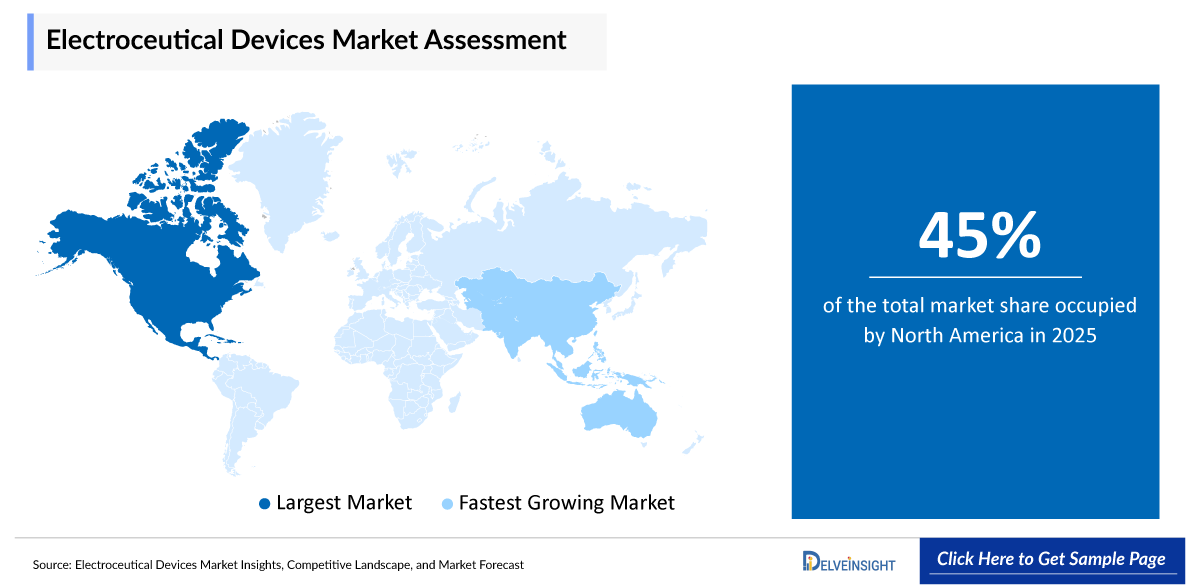
● North America dominated the global Electroceutical Devices Market revenue with a 45% share in 2025, representing the highest regional market share globally.
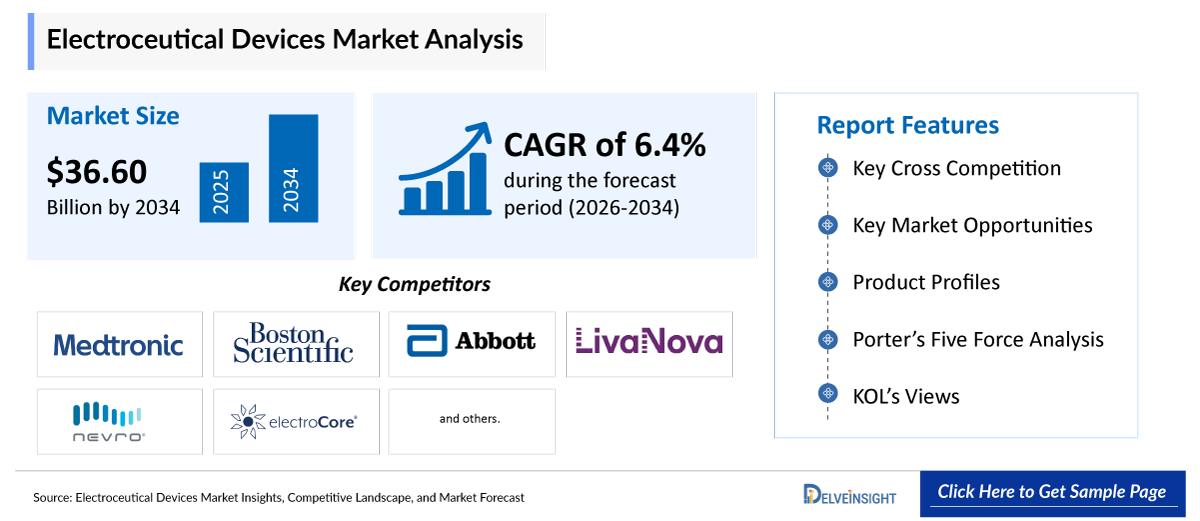
An electroceutical device is a therapeutic technology that uses targeted electrical stimulation of nerves, muscles, or neural circuits to diagnose, manage, or treat disease, offering a drug-free alternative or complement to pharmacological therapy. Electroceutical devices range from implantable systems such as spinal cord stimulators, vagus nerve stimulators, sacral neuromodulation systems, and hypoglossal nerve stimulators to non-invasive and external systems such as transcranial electrical stimulators, wearable peripheral nerve stimulators, and portable bioelectronic devices for headache and tremor management. The market is organized by product type across implantable and non-invasive/external devices; by technology, spanning electrical stimulation, neuromodulation, bioelectronic stimulation, transcranial electrical stimulation, peripheral nerve stimulation, spinal cord stimulation, vagus nerve stimulation, and other modalities; and by therapeutic application, led by neurological disorders alongside cardiovascular disorders, chronic pain management, gastrointestinal disorders, and respiratory disorders. Driven by an aging population, the rising global burden of chronic pain and neurological disease, growing clinical evidence for bioelectronic and neuroimmune modulation therapies, and continued miniaturization and battery-life improvements in implantable systems, electroceutical devices have become an increasingly central pillar of modern, minimally invasive patient care.
Electroceutical Devices Market Key Growth Drivers
• The rapid clinical and commercial expansion of neuromodulation therapies is driving demand, with sacral neuromodulation, spinal cord stimulation, and vagus nerve stimulation platforms gaining broader reimbursement coverage and indication expansions.
• The rising global burden of chronic pain, obstructive sleep apnea, overactive bladder, and neurological disorders is expanding candidate populations for device-based intervention.
• Regulatory milestones such as the August 2025 FDA approval of SetPoint Medical's SetPoint System, the first implantable neuroimmune-modulation therapy for rheumatoid arthritis, are opening new therapeutic categories for bioelectronic medicine.
• Continued consolidation among device majors, including Boston Scientific's completed acquisition of sacral neuromodulation leader Axonics and Globus Medical's 2025 acquisition of spinal cord stimulation pioneer Nevro, is expanding scale, R&D investment, and commercial reach across the sector.
• Growing adoption of non-invasive and wearable neuromodulation devices, including transcranial electrical stimulation and peripheral nerve stimulation systems, is broadening access beyond surgical candidates.
• Advances in miniaturization, rechargeable battery technology, MRI-conditional labeling, and closed-loop, sensing-enabled stimulation platforms are improving patient outcomes and adoption.
• The convergence of clinical evidence generation, regulatory support, and strategic M&A is expected to sustain steady, above-GDP growth in the market through 2034.
Key Companies in Electroceutical Devices Market
The competitive landscape is led by the following active manufacturers:
• Medtronic
• Boston Scientific
• Abbott
• LivaNova
• Nevro Corp.
• electroCore
• BioElectronics Corporation
• Axonics
• Inspire Medical Systems
• SetPoint Medical
• Cala Health
• SPR Therapeutics
• Soterix Medical
• Parasym Ltd.
Factors Contributing to the Growth of the Electroceutical Devices Market
Market Drivers
Rapid Expansion of Neuromodulation and Bioelectronic Stimulation Therapies
The most powerful driver of the Electroceutical Devices Market is the rapid clinical and commercial rise of neuromodulation and bioelectronic stimulation therapies. Spinal cord stimulation, sacral neuromodulation, and vagus nerve stimulation platforms are increasingly used to manage chronic pain, overactive bladder, and inflammatory and neurological conditions that were historically managed with medication alone. Commercial momentum is substantial: Boston Scientific completed its roughly USD 3.7 billion acquisition of sacral neuromodulation leader Axonics in November 2024, and Globus Medical agreed in February 2025 to acquire spinal cord stimulation pioneer Nevro for approximately USD 250 million, both moves underscoring the strategic value of neuromodulation platforms. As these therapies move into earlier treatment lines and new indications, demand for electroceutical devices expands directly, anchoring market growth through 2034.
Rising Global Burden of Chronic Pain and Neurological Disorders
The growing global burden of chronic pain, neurodegenerative disease, and sleep-disordered breathing is expanding the addressable patient population for electroceutical intervention. Conditions such as chronic back and limb pain, diabetic peripheral neuropathy, Parkinson's disease, epilepsy, and obstructive sleep apnea are rising in prevalence alongside an aging global population. Electroceutical devices are increasingly positioned as first-line or adjunctive therapy for these conditions, supported by growing clinical evidence such as Inspire Medical Systems' long-term hypoglossal nerve stimulation outcomes data presented through 2025 and 2026. As disease prevalence increases and device-based therapies gain broader clinical acceptance, the volume and diversity of electroceutical device utilization rise in step, translating directly into sustained demand across the forecast period.
Market Restraints
Despite strong momentum, the Electroceutical Devices Market faces material constraints. The high cost of implantable systems and associated surgical procedures is a significant barrier, particularly in price-sensitive and emerging markets where reimbursement coverage remains inconsistent or absent. Complex and lengthy regulatory pathways for implantable devices, including PMA requirements in the United States, lengthen time to market and raise development costs. Surgical risks associated with implantation, including infection, lead migration, and device-related complications, temper adoption among risk-averse patients and physicians. Reimbursement uncertainty and variability across geographies constrain market penetration, particularly for newer indications such as neuroimmune modulation and non-traditional pain applications. A shortage of physicians trained in implantation and programming of advanced neuromodulation systems constrains scale-up in underserved regions. Battery replacement requirements for non-rechargeable implants add long-term cost and necessitate repeat procedures, while data security and connectivity concerns around increasingly networked, sensor-enabled devices raise cybersecurity considerations. Together, these cost, regulatory, clinical, reimbursement, and workforce barriers temper the pace of growth, even as the underlying drivers of neuromodulation expansion, chronic disease burden, and non-invasive adoption remain firmly intact.
Electroceutical Devices Market Segment Analysis
The electroceutical devices market by product type (implantable electroceutical devices, non-invasive/external electroceutical devices), by technology (electrical stimulation, neuromodulation, bioelectronic stimulation, transcranial electrical stimulation, peripheral nerve stimulation, spinal cord stimulation, vagus nerve stimulation, others), by therapeutic application (neurological disorders, cardiovascular disorders, chronic pain management, gastrointestinal disorders, respiratory disorders, others), by end-users (hospitals, specialty clinics, ambulatory surgical centers, others), and by geography (North America, Europe, Asia-Pacific, and Rest of World).
By Product Type
Dominant Subsegment: Implantable Electroceutical Devices.
The implantable electroceutical devices segment accounted for 67% of the Electroceutical Devices Market in 2025. Implantable devices, including spinal cord stimulators, sacral neuromodulation systems, vagus nerve stimulators, and hypoglossal nerve stimulators, are the leading product type because they deliver continuous, targeted stimulation directly to the nerve or tissue of interest, producing durable clinical outcomes for chronic and severe conditions that non-invasive alternatives cannot fully replicate. Established reimbursement pathways, decades of clinical evidence, and strong physician familiarity with implantable neuromodulation reinforce the segment's scale, while recent consolidation, including Boston Scientific's acquisition of Axonics and Globus Medical's acquisition of Nevro, further validates implantable platforms as core strategic assets. While non-invasive and external electroceutical devices are the fastest-growing product type, propelled by wearable and portable bioelectronic systems, the durability, clinical depth, and reimbursement maturity of implantable platforms secure this segment's leadership across the forecast period.
By Technology
Dominant Subsegment: Neuromodulation.
The neuromodulation segment accounted for 29% of the Electroceutical Devices Market in 2025. Neuromodulation, encompassing spinal cord stimulation, sacral neuromodulation, deep brain stimulation, and related technologies, is the leading technology category because it addresses a broad and well-established set of indications, including chronic pain, overactive bladder, and movement disorders, with strong long-term clinical evidence and reimbursement support. The segment benefits from continuous platform innovation, including rechargeable, MRI-conditional, and closed-loop sensing systems from Medtronic, Boston Scientific, and Abbott. Vagus nerve stimulation and peripheral nerve stimulation are among the fastest-growing technology categories, driven by expanding indications in neuroimmune modulation and tremor management, but the breadth of established indications and clinical depth of neuromodulation secure its leadership across the forecast period.
Electroceutical Devices Market Region Analysis
Dominant Region: North America
North America accounted for 45% of the global Electroceutical Devices Market revenue in 2025, representing the highest regional market share globally. The region's dominance reflects a mature neuromodulation ecosystem, deep clinical-research infrastructure, favorable reimbursement from CMS and private payers, and the concentrated presence of leading manufacturers including Medtronic, Boston Scientific, Abbott, Nevro, and Inspire Medical Systems. The United States hosts the largest concentration of implanting physicians, clinical trial activity, and commercial neuromodulation programs, and recent consolidation, including Boston Scientific's acquisition of Axonics and Globus Medical's acquisition of Nevro, reinforces the region's manufacturing and commercial base. Strong reimbursement, regulatory clarity from the FDA, and continued clinical evidence generation, including SetPoint Medical's 2025 approval for rheumatoid arthritis, anchor the region's continued leadership across the forecast period.
Fastest Growing Region: Asia-Pacific
Asia-Pacific is the fastest-growing region in the Electroceutical Devices Market. The region's elevated CAGR is driven by rising prevalence of chronic pain, neurological disease, and sleep-disordered breathing, expanding healthcare infrastructure, and growing healthcare investment across China, Japan, India, South Korea, and Australia. China is expanding domestic neuromodulation manufacturing and hospital adoption, Japan is advancing reimbursement pathways for implantable stimulation therapies, India is emerging as a lower-cost manufacturing and clinical-trial hub, and Australia benefits from established reimbursement for chronic pain and sleep-apnea device therapies. Government healthcare investment, an aging population, and growing physician training in implantation techniques are accelerating adoption, while regional manufacturers scale production and align with global regulatory standards. This combination of rising disease burden, infrastructure build-out, and clinical training positions Asia-Pacific as the principal source of incremental growth over the forecast period.
Regional Commentary
North America
North America accounted for 45% of the global Electroceutical Devices Market revenue in 2025. The United States dominates on the strength of its neuromodulation infrastructure, clinical-research base, favorable reimbursement, and concentration of leading manufacturers, while ongoing consolidation and new indication approvals, including SetPoint Medical's neuroimmune modulation therapy, reinforce its leadership.
Europe
Europe is a large and advanced regional market, supported by established CE marking and national reimbursement frameworks, a strong clinical-research base, and growing adoption of non-invasive neuromodulation devices from manufacturers such as Parasym Ltd. and Soterix Medical. Growing use of vagus nerve stimulation and transcranial stimulation across Germany, France, the United Kingdom, Italy, and Spain reinforces the region's role in both implantable and non-invasive electroceutical adoption.
Asia-Pacific
Asia-Pacific is the fastest-growing region, propelled by rising chronic disease prevalence, expanding hospital infrastructure, and growing healthcare investment across China, Japan, India, South Korea, and Australia. Expanding local manufacturing, improving reimbursement pathways, and growing physician training in implantation techniques are accelerating regional adoption of both implantable and non-invasive electroceutical devices.
Rest of World
The Rest of World region, spanning Latin America, the Middle East, and Africa, is an emerging growth frontier. Expanding healthcare infrastructure, rising awareness of device-based alternatives to chronic pain medication, and gradual improvements in reimbursement and regulatory alignment with global standards are broadening access, while international partnerships and physician training programs support the build-out of regional implantation capacity.
Electroceutical Devices Market Competitive Landscape
The Electroceutical Devices Market is classified as Moderately Concentrated. A group of diversified device majors with broad neuromodulation portfolios and global commercial reach, including Medtronic, Boston Scientific, Abbott, and LivaNova, anchor the top tier, while specialized and fast-scaling providers such as Nevro Corp., electroCore, Axonics, Inspire Medical Systems, SetPoint Medical, Cala Health, SPR Therapeutics, Soterix Medical, Parasym Ltd., and BioElectronics Corporation compete through focused clinical indications, non-invasive platforms, and dedicated therapeutic-area expertise, increasing competition in the fastest-growing non-invasive and neuroimmune modulation segments.
The competitive landscape can be evaluated across the following dimensions:
• Market concentration: Moderately concentrated, with diversified device majors leading and a fast-growing field of specialized neuromodulation and non-invasive stimulation providers.
• Leading players: Medtronic, Boston Scientific, Abbott, and LivaNova anchor the top tier through broad neuromodulation portfolios and global commercial networks.
• Geographic reach: Leaders operate global, multi-country commercial and manufacturing networks essential for implantable device distribution and physician training.
• Portfolio strength: Top players offer end-to-end implantable and non-invasive stimulation platforms spanning pain management, neurology, urology, and cardiology applications.
• Clinical evidence and regulatory access: Ownership of long-term clinical outcomes data and first-in-class regulatory approvals, including SetPoint Medical's neuroimmune modulation clearance, is a decisive advantage.
• Strategic partnerships and M&A: Active consolidation, including Boston Scientific's acquisition of Axonics and Globus Medical's acquisition of Nevro, extends scale and technology depth.
• Manufacturing capabilities: Miniaturized implant design, rechargeable and MRI-conditional battery systems, and closed-loop sensing platforms are key competitive moats.
• Innovation focus: Closed-loop neuromodulation, non-invasive wearable stimulation, neuroimmune modulation, and AI-assisted programming are shaping the next phase of competition.
Electroceutical Devices Market Recent Developmental Activities
2026, Medtronic, continued expansion of its closed-loop spinal cord stimulation and deep brain stimulation platforms to broaden indications across chronic pain and movement disorders. Strategic significance: Reinforces Medtronic's position as an integrated, diversified neuromodulation leader.
2025-2026, Boston Scientific, advanced integration of Axonics' sacral neuromodulation portfolio following the November 2024 acquisition close, expanding its urology and pelvic health franchise. Strategic significance: Strengthens Boston Scientific's position in high-growth sacral neuromodulation adjacencies.
Electroceutical Devices Market Segmentation
Electroceutical Devices Market by Product Type
• Implantable Electroceutical Devices
• Non-Invasive/External Electroceutical Devices
Electroceutical Devices Market by Technology
• Electrical Stimulation
• Neuromodulation
• Bioelectronic Stimulation
• Transcranial Electrical Stimulation
• Peripheral Nerve Stimulation
• Spinal Cord Stimulation
• Vagus Nerve Stimulation
• Others
Electroceutical Devices Market by Therapeutic Application
• Neurological Disorders
• Cardiovascular Disorders
• Chronic Pain Management
• Gastrointestinal Disorders
• Respiratory Disorders
• Others
Electroceutical Devices Market by End-Users
• Hospitals
• Specialty Clinics
• Ambulatory Surgical Centers
• Others
Electroceutical Devices Market by Geography
• North America Electroceutical Devices Market
▪ United States Electroceutical Devices Market Size in USD million (2023-2034)
▪ Canada Electroceutical Devices Market Size in USD million (2023-2034)
▪ Mexico Electroceutical Devices Market Size in USD million (2023-2034)
• Europe Electroceutical Devices Market
▪ Germany Electroceutical Devices Market Size in USD million (2023-2034)
▪ United Kingdom Electroceutical Devices Market Size in USD million (2023-2034)
▪ France Electroceutical Devices Market Size in USD million (2023-2034)
▪ Italy Electroceutical Devices Market Size in USD million (2023-2034)
▪ Spain Electroceutical Devices Market Size in USD million (2023-2034)
▪ Rest of Europe Electroceutical Devices Market Size in USD million (2023-2034)
• Asia-Pacific Electroceutical Devices Market
▪ China Electroceutical Devices Market Size in USD million (2023-2034)
▪ Japan Electroceutical Devices Market Size in USD million (2023-2034)
▪ India Electroceutical Devices Market Size in USD million (2023-2034)
▪ Australia Electroceutical Devices Market Size in USD million (2023-2034)
▪ South Korea Electroceutical Devices Market Size in USD million (2023-2034)
▪ Rest of Asia-Pacific Electroceutical Devices Market Size in USD million (2023-2034)
• Rest of the World (RoW) Electroceutical Devices Market
▪ Middle East Electroceutical Devices Market Size in USD million (2023-2034)
▪ Africa Electroceutical Devices Market Size in USD million (2023-2034)
▪ South America Electroceutical Devices Market Size in USD million (2023-2034)
Key Takeaways from the Electroceutical Devices Market Report Study
• Market size analysis for the current Electroceutical Devices Market size (2025), and market forecast for 9 years (2026 to 2034).
• Top key product/technology developments, mergers, acquisitions, partnerships, and joint ventures that happened over the last 3 years.
• Key companies dominating the global Electroceutical Devices Market.
• Various opportunities available for competitors in the Electroceutical Devices Market space.
• What are the top-performing segments in 2025? How will these segments perform in 2034?
• Which are the top-performing regions and countries in the current Electroceutical Devices Market scenario?
• Which are the regions and countries where companies should concentrate their opportunities for Electroceutical Devices Market growth in the future?
Target audience who can benefit from this Electroceutical Devices Market report study
• Electroceutical Devices product providers
• Research organizations and consulting companies
• Neurodegenerative disease therapeutics-related organizations, associations, forums, and other alliances
• Government and corporate offices
• Start-up companies, venture capitalists, and private equity firms
• Distributors and traders dealing in Electroceutical Devices
• Various end-users who want to know more about the Electroceutical Devices Market and the latest technological developments in the Electroceutical Devices Market.

