
Electronic Health Record Market Summary
- The Electronic Health Records market size is estimated at USD 32.44 billion in 2025 and is projected to reach USD 52.60 billion by 2034. Growth is anchored in the rising global emphasis on interoperability and health information exchange, the integration of EHRs with AI-enabled clinical decision support and analytics tools, and the increasing number of national digital health initiatives promoting EHR adoption.
- The global Electronic Health Records market is growing at a CAGR of 5.61% during the forecast period from 2026 to 2034.
- By Product & Services, the software segment dominated the Electronic Health Records market with a 64% share in 2025.
- By Deployment, the cloud segment dominated the Electronic Health Records market with a 55% share in 2025.
- By Type, the Acute EHR segment dominated the Electronic Health Records market with a 46% share in 2025.
- By End-Users, the Hospitals & Clinics segment dominated the Electronic Health Records market with a 52% share in 2025.
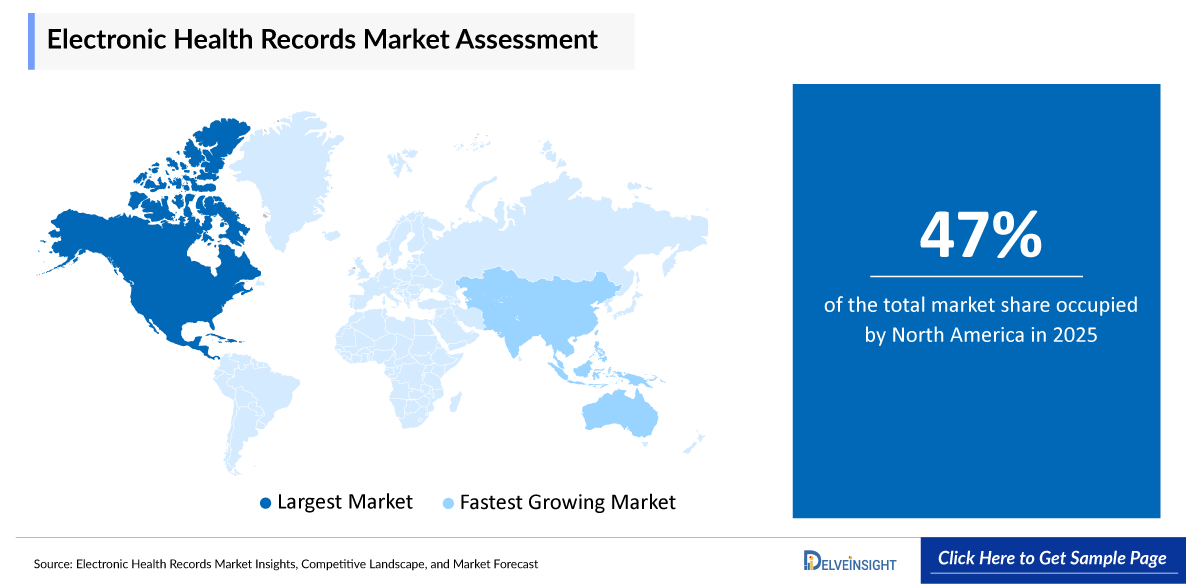
- North America dominated the global Electronic Health Records market revenue with a 47% share in 2025, representing the highest regional market share globally.
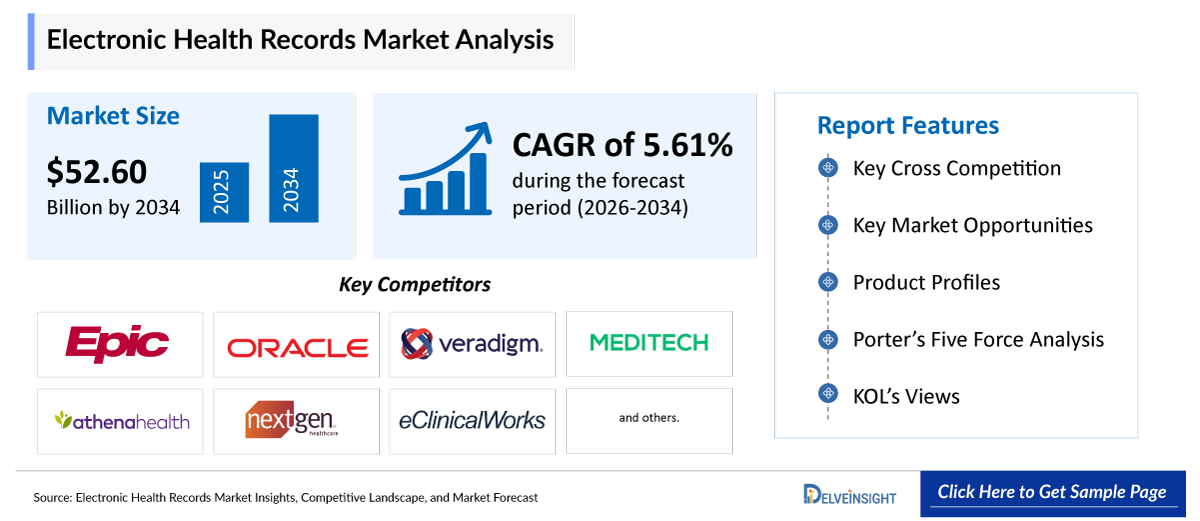
An electronic health record (EHR) is a digital, longitudinal system of a patient's medical history that is created, maintained, and shared across authorized healthcare providers, capturing diagnoses, medications, laboratory and imaging results, treatment plans, immunizations, and allergies in a structured, interoperable format. Because modern care delivery spans hospitals, ambulatory practices, diagnostic centers, and post-acute facilities, healthcare organizations rely on EHR vendors to provide software platforms, implementation and integration services, and, to a lesser extent, supporting hardware that together digitize clinical, financial, and operational workflows.
The market is organized by product & services across hardware, software, and services; by deployment across on-premise, cloud, and hybrid models; by type across acute, ambulatory, and post-acute care EHR; by application across clinical decision making, administrative support, patient management, and others; and by end-users, led by hospitals and clinics. Driven by regulatory mandates for interoperability, the rapid embedding of ambient AI documentation and clinical decision support, accelerating cloud migration, and continued private-equity-led consolidation among vendors, EHR platforms have become essential digital infrastructure underpinning modern, data-driven healthcare delivery.
Electronic Health Records Market Key Growth Drivers
- The growing emphasis on interoperability and health information exchange, reinforced by frameworks such as TEFCA and the USCDI data set, is driving demand for modern, connected EHR platforms.
- The rapid integration of AI-enabled clinical decision support, ambient listening, and automated documentation tools is reducing clinician burnout and accelerating platform upgrades and replacements.
- Regulatory mandates, including the 21st Century Cures Act and ongoing HIPAA and quality-reporting requirements, continue to reinforce digital documentation and data-sharing obligations across care settings.
- The accelerating shift toward cloud-based and web-based EHR deployment is lowering infrastructure costs and easing adoption among small and mid-sized practices and ambulatory surgical centers.
- Rising chronic disease prevalence and the shift toward value-based, coordinated care are increasing demand for EHR platforms that unify acute, ambulatory, and post-acute records.
- Private-equity-backed consolidation, exemplified by Thoma Bravo's acquisition of NextGen Healthcare and Vista Equity Partners' backing of Greenway Health, is reshaping vendor scale and accelerating platform investment.
- The convergence of interoperability mandates, AI adoption, cloud migration, and vendor consolidation is expected to sustain steady, mid-single-digit growth in the market through 2034.
Key Companies in Electronic Health Records Market
The competitive landscape is led by the following active players:
- Epic Systems Corporation
- Oracle
- Veradigm LLC
- Medical Information Technology, Inc. (MEDITECH)
- athenahealth
- NXGN Management, LLC (NextGen Healthcare)
- eClinicalWorks
- Greenway Health, LLC
- Practice Fusion, Inc.
- Particle Health, and others
For illustrative purposes, only the top 10 companies are listed in the Table of Contents. The report may include analysis and references to additional companies relevant to the market assessment.
Electronic Health Records Market Size
The following snapshot summarizes the principal report metrics for the Electronic Health Records market.
|
Report Metrics |
Details |
|
2025 Market Size |
USD 32.44 billion |
|
2034 Projected Market Size |
USD 52.60 billion |
|
Growth Rate (2026-2034) |
5.61% CAGR |
|
Largest Market |
North America |
|
Fastest Growing Market |
Asia-Pacific |
|
Market Structure |
Moderately Fragmented |
All market values are expressed in USD and represent DelveInsight estimates synthesized from primary and secondary research.
Factors Contributing to the Growth of the Electronic Health Records Market
Electronic Health Records Market Drivers
- Growing Emphasis on Interoperability and Health Information Exchange: The most consistent driver of the Electronic Health Records market is the growing emphasis on interoperability and health information exchange across the care continuum. National frameworks such as the Trusted Exchange Framework and Common Agreement (TEFCA) and the United States Core Data for Interoperability (USCDI) are pushing vendors to standardize FHIR-based data exchange, enabling patient records to move seamlessly between hospitals, ambulatory practices, and health information networks. Health systems are replacing siloed legacy platforms with unified, interoperable records to improve care coordination, reduce duplicate testing, and meet federal compliance requirements. As data-sharing obligations tighten and health information exchanges mature, demand for EHR platforms capable of standards-based interoperability continues to expand, anchoring market growth through 2034.
- Integration of AI-Enabled Clinical Decision Support and Ambient Documentation: The rapid embedding of artificial intelligence within EHR platforms is reshaping vendor competition and accelerating upgrade cycles. Ambient AI documentation and scribing tools, clinical decision support engines, and automated coding assistants are being built directly into leading platforms, with athenahealth partnering with Abridge, MEDITECH partnering with Avo, and Epic advancing a collaborative AI roadmap. Oracle Health has gone furthest, building a new AI-native EHR on Oracle Cloud Infrastructure for what it terms the agentic AI era, launched for ambulatory settings in 2025 with acute care capability planned for 2026. As AI-native features embedded directly in the record reduce reliance on third-party scribes and increase vendor lock-in, they are becoming a decisive purchasing criterion and a primary driver of platform investment.
- Regulatory Mandates and Quality-Reporting Requirements: Regulatory mandates continue to reinforce digital documentation across healthcare settings. The 21st Century Cures Act's information-blocking provisions, ongoing HIPAA obligations, and quality-reporting programs require healthcare organizations to maintain certified, interoperable EHR systems and to make patient data accessible without undue restriction. These requirements sustain baseline demand for certified EHR platforms across hospitals, ambulatory practices, and post-acute facilities, and they compel providers still operating on legacy or unsupported systems to modernize. As certification criteria evolve and regulators continue to prioritize patient data access, compliance-driven replacement and upgrade cycles remain a steady contributor to market growth.
- Accelerating Cloud Migration and Lower-Cost Deployment Models: The shift toward cloud-based and web-based EHR deployment is broadening the addressable market, particularly among small and mid-sized practices. Cloud and web-based systems eliminate the need for in-house servers, reduce upfront hardware investment, and offer subscription-based pricing that is attractive to smaller providers, while also simplifying maintenance, security patching, and interoperability. Vendors are increasingly launching new cloud-native offerings and migrating legacy on-premise customers to hosted platforms, and this transition is proceeding fastest among ambulatory practices and outpatient clinics. As cloud infrastructure matures and cybersecurity capabilities improve, this lower-friction deployment model continues to expand the market's reach into previously underserved provider segments.
- Rising Chronic Disease Burden and the Shift to Value-Based Care: The rising global burden of chronic and cardiovascular disease is expanding demand for EHR platforms capable of longitudinal, coordinated care management. Cardiology-focused EHR functionality, which integrates data from electrocardiograms, echocardiograms, and cardiac catheterization directly into the patient record, has emerged as a particularly high-growth clinical area, while neurological disease, which the World Health Organization estimates causes more than 11 million deaths annually, is also driving specialty EHR adoption. As payer models shift toward value-based reimbursement that rewards preventive and chronic-disease management, providers require platforms that unify records across acute, ambulatory, and post-acute settings, sustaining demand for comprehensive, interoperable EHR systems.
- Private-Equity-Led Consolidation Reshaping the Vendor Landscape: Active consolidation among EHR vendors is reshaping competitive dynamics and channeling capital toward platform modernization. Thoma Bravo's acquisition of NextGen Healthcare, Bain Capital and Hellman & Friedman's ownership of athenahealth, Francisco Partners' acquisition of AdvancedMD, and Vista Equity Partners' backing of Greenway Health illustrate a market bifurcating between platform winners investing heavily in AI and interoperability and smaller vendors operating in maintenance mode under financial ownership. This consolidation is increasing the scale and R&D capacity of surviving platforms while narrowing the field of viable vendors, a dynamic that is expected to continue reshaping the competitive landscape through the forecast period.
Electronic Health Records Market Restraints
Despite steady momentum, the Electronic Health Records market faces material constraints. High implementation and switching costs remain a significant barrier, as large-scale EHR deployments require substantial upfront capital, lengthy implementation timelines, and extensive staff training, discouraging smaller providers and slowing replacement of legacy systems. Interoperability gaps persist despite regulatory mandates, as differing data standards, information-blocking practices, and inconsistent FHIR implementation across vendors continue to complicate seamless data exchange. Clinician burnout and documentation burden associated with complex EHR interfaces remain a persistent concern, and dissatisfaction with legacy platforms, such as the customer attrition reported around Oracle Health's Millennium platform, illustrates how implementation and usability shortfalls can directly affect vendor market share. Cybersecurity and patient-data-privacy risks are intensifying as records move to cloud infrastructure and are exchanged more broadly across networks, raising compliance costs and liability exposure. Reimbursement and government-incentive structures vary significantly across geographies, slowing adoption in lower-income and emerging markets, while a shortage of skilled health-IT implementation professionals constrains large-scale rollouts. Together, these cost, interoperability, usability, security, and workforce barriers temper the pace of growth, even as the underlying drivers of AI adoption, cloud migration, and interoperability mandates remain firmly intact.
Electronic Health Records Market Segment Analysis
The Electronic Health Records by Product & Services (Hardware, Software, Services), Deployment (On-premise, Cloud, Hybrid), Type (Acute EHR, Ambulatory EHR, Post-Acute Care EHR), Application (Clinical Decision Making, Administrative Support, Patient Management, Others), End-Users (Hospitals & Clinics, Ambulatory Surgical Centers, Others), and Geography (North America, Europe, Asia-Pacific, and Rest of World).
By Product & Services
Dominant Subsegment: Software. The software category is expected to dominate the market.
Dominant: Volumetric Pumps ~ 64%
The software segment accounted for 64% of the Electronic Health Records market in 2025. Software is the leading product category because it delivers the core clinical, financial, and administrative functionality that defines an EHR platform, integrating documentation, order entry, e-prescribing, and analytics within a single licensed or subscription-based system. Continuous feature upgrades, expanding AI-enabled clinical decision support, and the shift toward cloud-native architectures keep software spending recurring and central to vendor revenue. Hardware, comprising servers, workstations, and networking infrastructure, represents a comparatively small and declining share as cloud deployment reduces on-premise infrastructure needs. Services, spanning implementation, integration, training, data migration, and ongoing technical support, are the fastest-growing category as providers increasingly rely on managed services and subscription-based support to reduce operational burden and ensure system performance and security. Nonetheless, the scale and recurring nature of software licensing and subscriptions secure its leadership across the forecast period.
By Deployment
Dominant Subsegment: Cloud. The cloud category is expected to dominate the market.
Dominant: Cloud ~ 55%
The cloud segment accounted for 55% of the Electronic Health Records market in 2025. Cloud deployment leads the market because it eliminates the need for in-house servers, lowers upfront hardware and IT costs, and offers the scalability, remote accessibility, and simplified maintenance that healthcare providers of all sizes increasingly demand. Web and cloud-based EHRs are particularly attractive to small and mid-sized practices, ambulatory surgical centers, and specialty clinics that lack dedicated IT infrastructure, and major vendors, including athenahealth, eClinicalWorks, and Oracle Health, are actively migrating customers toward cloud-native platforms. On-premise deployment retains a meaningful base among large academic medical centers and health systems with legacy investments and strict data-residency requirements, but its share is steadily eroding. Hybrid deployment, which combines cloud accessibility with on-premise control over sensitive workloads, is growing as large health systems phase their cloud transitions. The scalability, cost efficiency, and accelerating vendor migration toward cloud architectures secure the segment's leadership through the forecast period.
By Type
Dominant Subsegment: Acute EHR. The acute EHR category is expected to dominate the market.
Dominant: Acute EHR ~ 46%
The Acute EHR segment accounted for 46% of the Electronic Health Records market in 2025. Acute EHR systems lead the market because hospital inpatient environments generate the highest data volumes and require comprehensive platforms capable of managing complex, regulated workflows spanning emergency care, intensive care, surgery, pharmacy, laboratory, and billing within a single centralized system. Government incentive programs and stringent inpatient regulatory-reporting requirements have driven near-universal EHR adoption among hospitals, sustaining a large, mature installed base that continues to generate upgrade and replacement demand, illustrated by ongoing platform competition between Epic, Oracle Health, and MEDITECH. Ambulatory EHR is the fastest-growing type as reimbursement increasingly rewards outpatient and preventive care, driving adoption among clinics and physician offices, while Post-Acute Care EHR is expanding steadily as rehabilitation, skilled-nursing, and long-term-care facilities digitize records to support care-transition coordination. Nonetheless, the scale, complexity, and regulatory weight of inpatient hospital environments keep Acute EHR the dominant type across the forecast period.
By Application
Dominant Subsegment: Administrative Support. The administrative support category is expected to dominate the market.
Dominant: Administrative Support ~ 41%
The administrative support segment accounted for 41% of the Electronic Health Records market in 2025. Administrative support, encompassing scheduling, registration, billing, coding, and revenue-cycle functions, leads the market because these workflows touch every patient encounter and directly affect provider reimbursement, making them a foundational and continuously used component of every EHR deployment. Patient management functionality, including care coordination, patient portals, and population-health tools, represents a large and steadily growing share as providers prioritize engagement and chronic-disease management. Clinical decision making, which includes AI-enabled alerts, diagnostic support, and evidence-based guidance embedded at the point of care, is the fastest-growing application, expanding as vendors race to embed ambient documentation and clinical AI directly into their platforms. While clinical decision support is capturing the majority of new vendor investment and innovation, the breadth, frequency, and revenue-critical nature of administrative and billing workflows secure administrative support's leadership across the forecast period.
By End-Users
Dominant Subsegment: Hospitals & Clinics. The hospitals & clinics category is expected to dominate the market.
Dominant: Hospitals & Clinics ~ 52%
The Hospitals & Clinics segment accounted for 52% of the Electronic Health Records market in 2025. Hospitals and clinics lead the end-user market because they generate the largest and most complex volume of patient data, requiring comprehensive platforms that manage inpatient, outpatient, emergency, pharmacy, laboratory, radiology, and billing functions within a single centralized system. High patient inflows, complex clinical workflows, and stringent federal compliance requirements have driven near-universal EHR adoption among hospitals and hospital-affiliated clinics, and continued investment in AI-enabled documentation and interoperability sustains upgrade demand within this base. Ambulatory Surgical Centers represent the fastest-growing end-user category as outpatient procedure volumes rise and reimbursement incentives favor lower-cost surgical settings, requiring lightweight yet interoperable EHR systems. Other end-users, including long-term care facilities, specialty practices, and pharmacies, are also expanding adoption as care coordination requirements broaden across the continuum. Nonetheless, the scale and complexity of hospital and clinic data management keep this segment dominant through the forecast period.
Electronic Health Records Market Region Analysis
Dominant Region: North America
Dominant: North America ~ 47% (Largest)
North America accounted for 47% of the global Electronic Health Records market revenue in 2025, representing the highest regional market share globally. The region's dominance reflects a mature health-IT ecosystem, near-universal EHR adoption among hospitals driven by federal meaningful-use and interoperability incentives, and the concentration of the industry's leading platform vendors, including Epic, Oracle Health, athenahealth, and MEDITECH, within the United States. North America hosts the largest installed base of acute-care and ambulatory EHR deployments, and ongoing platform competition, illustrated by Epic's continued share gains and Oracle Health's rollout of a new AI-native platform, is sustaining substantial replacement and upgrade spending. Regulatory clarity under the 21st Century Cures Act, deep private-equity investment in vendor consolidation, and rapid embedding of ambient AI documentation across leading platforms anchor the region's continued leadership across the forecast period.
Fastest Growing Region: Asia-Pacific
Asia-Pacific is the fastest-growing region in the Electronic Health Records market. The region's elevated CAGR is driven by expanding government digital-health initiatives, rising healthcare infrastructure investment, and growing hospital construction across China, Japan, India, South Korea, and Australia. China is accelerating national health-information platform rollouts, Japan is investing in interoperable hospital digitization, India is expanding EHR adoption through both domestic and international vendors serving its large and fragmented hospital sector, and South Korea and Australia are advancing national digital-health strategies with strong government backing. Rising chronic disease burden, expanding private-hospital networks, and growing willingness among regional vendors to adopt cloud-based, lower-cost EHR platforms are accelerating adoption. The combination of policy support, infrastructure build-out, and a large underpenetrated hospital and clinic base positions Asia-Pacific as the principal source of incremental growth over the forecast period.
Electronic Health Records Regional Commentary
North America
North America accounted for 47% of the global Electronic Health Records market revenue in 2025. The United States dominates on the strength of near-universal hospital EHR adoption, a concentrated base of leading platform vendors, and regulatory clarity under the 21st Century Cures Act, while intensifying platform competition between Epic, Oracle Health, and MEDITECH, alongside rapid AI-feature rollout, reinforces the region's leadership.
Europe
Europe is a large and advanced regional market, supported by national digital-health strategies, established interoperability frameworks, and growing investment in hospital and primary-care digitization across Germany, France, the United Kingdom, Italy, and Spain. Government-led health-information-exchange initiatives and expanding vendor partnerships are reinforcing the region's role in both hospital and ambulatory EHR adoption.
Asia-Pacific
Asia-Pacific is the fastest-growing region, propelled by expanding government digital-health programs, rising hospital construction, and growing healthcare investment across China, Japan, India, South Korea, and Australia. National health-information platform rollouts, hospital digitization initiatives, and the entry of both global and domestic EHR vendors are accelerating regional adoption and clinical-data-exchange activity.
Rest of World
The Rest of World region, spanning Latin America, the Middle East, and Africa, is an emerging growth frontier. Expanding hospital infrastructure, rising government investment in digital-health initiatives, and efforts to align regulatory frameworks with international interoperability standards are gradually broadening EHR access, while growing partnerships with global vendors support the build-out of regional health-IT capacity.
Electronic Health Records Market Competitive Landscape
The Electronic Health Records market is classified as Moderately Fragmented. A group of scaled platform leaders with deep installed bases and strong AI roadmaps, including Epic Systems Corporation, Oracle, and Medical Information Technology, Inc. (MEDITECH), anchor the hospital and acute-care tier, while athenahealth and eClinicalWorks lead the ambulatory and outpatient tier. A broader field of specialized and private-equity-backed providers, including Veradigm, NXGN Management (NextGen Healthcare), Greenway Health, Practice Fusion, and interoperability platforms such as Particle Health, compete through specialty focus, pricing flexibility, and data-exchange capability, sustaining active competition across the mid-tier and small-practice segments.
The competitive landscape can be evaluated across the following dimensions:
- Market concentration: Moderately fragmented, with a small number of scaled leaders dominating hospital deployments and a fragmented field of ambulatory and specialty vendors.
- Leading players: Epic Systems Corporation, Oracle, and Medical Information Technology, Inc. (MEDITECH) anchor the hospital and acute-care tier through installed base and platform depth.
- Geographic reach: Leading vendors operate large, multi-country installed bases; Epic and Oracle Health together account for a majority of United States acute-care hospital beds.
- Service portfolio strength: Top players offer end-to-end clinical documentation, order entry, revenue-cycle management, interoperability APIs, and increasingly, embedded AI documentation and decision support.
- AI and interoperability capability: Ownership of AI-native platforms and FHIR-based interoperability, including Oracle Health's new AI-enabled EHR and Epic's collaborative AI roadmap, is a decisive competitive advantage.
- Strategic partnerships: Tie-ups between platform vendors and AI companies, such as athenahealth's partnership with Abridge and MEDITECH's collaboration with Avo, extend clinical AI capability.
- M&A and PE activity: Active consolidation, including Thoma Bravo's acquisition of NextGen Healthcare and Vista Equity Partners' backing of Greenway Health, is reshaping vendor scale.
- Platform capabilities: Cloud-native architecture, ambient AI documentation, and standards-based interoperability are key competitive moats.
- Innovation focus: AI-native platform rebuilds, ambient clinical documentation, agentic AI workflows, and expanding FHIR-based data-exchange infrastructure.
Electronic Health Records Market Recent Developmental Activities
- In 2026, Oracle Health advanced the rollout of its new AI-native Electronic Health Records platform, built on Oracle Cloud Infrastructure, with acute-care capability planned following its 2025 ambulatory launch. Strategic significance: Positions Oracle Health's completely rebuilt EHR as a decisive proofpoint for restoring customer confidence and competing with Epic in the hospital tier.
- In 2026, eClinicalWorks announced a partnership with the National Association of Community Health Centers (NACHC) to drive AI adoption and healthcare IT modernization across community health centers. Strategic significance: Expands eClinicalWorks' reach into underserved ambulatory and safety-net care settings and reinforces its AI product roadmap.
- In 2026, Greenway Health, LLC, launched an Agentic AI Factory in collaboration with Amazon Web Services as part of its Automated Healthcare Practice strategy, focused on ambient documentation and automated administrative workflows. Strategic significance: Strengthens Greenway's ambulatory AI capability and reinforces its position under Vista Equity Partners' ownership.
- In 2026, Epic Systems Corporation extended its Community Connect offering into smaller standalone hospitals, adding hospitals switching from competing platforms according to KLAS Research's 2026 U.S. Acute Care EHR Market Share report. Strategic significance: Reinforces Epic's leadership in the acute-care hospital tier and demonstrates continued share gains against Oracle Health.
- In February 2025, athenahealth partnered with Abridge to integrate AI-powered ambient listening and clinical scribing tools into its athenaOne platform for outpatient documentation. Strategic significance: Strengthens athenahealth's cloud-native ambulatory platform with embedded clinical AI, reducing clinician documentation burden.
- In 2025, Medical Information Technology, Inc. (MEDITECH), advanced its collaboration with Avo to embed AI-enabled clinical workflow tools within its Expanse platform, supporting continued retention among its legacy hospital customer base. Strategic significance: Reinforces MEDITECH's position as the third-largest acute-care EHR vendor by hospital customer base in the United States.
- In 2025, Veradigm LLC continued expansion of its ambulatory EHR and clinical-network offerings, reporting expected annual revenue in the range of USD 583 to 588 million. Strategic significance: Sustains Veradigm's position as a scaled ambulatory and clinical-data platform provider amid active market consolidation.
- In 2025, NXGN Management, LLC (NextGen Healthcare) continued integration and platform investment under Thoma Bravo ownership following its USD 1.8 billion acquisition, expanding its ambulatory and specialty EHR offerings. Strategic significance: Reflects continued private-equity-driven consolidation and platform reinvestment in the mid-tier ambulatory EHR segment.
- In 2025, Particle Health continued to scale its healthcare data-exchange API platform, aggregating and unifying medical records from more than 270 million patients across thousands of data sources for payer, provider, and technology customers. Strategic significance: Strengthens third-party interoperability infrastructure that connects disparate EHR platforms, supporting the broader push toward standards-based data exchange.
- In 2025, Oracle reported that nearly a third of sampled Oracle Health customers indicated the vendor was no longer part of their long-term plans, according to KLAS Research, prompting continued investment in its new AI-enabled EHR platform. Strategic significance: Highlights the competitive pressure driving Oracle Health's platform rebuild and underscores the stakes of its 2026 acute-care rollout.
Electronic Health Records Market Segmentation
Electronic Health Records Market by Product & Services
Hardware
Software
Services
Electronic Health Records (EHR) Market by Deployment
On-premise
Cloud
Hybrid
Electronic Health Records (EHR) Market by Type
Acute EHR
Ambulatory EHR
Post-Acute Care EHR
Electronic Health Records (EHR) Market by Application
Clinical Decision Making
Administrative Support
Patient Management
Others
Electronic Health Records (EHR) Market by End-Users
Hospitals & Clinics
Ambulatory Surgical Centers
Others
Electronic Health Records Market by Geography
North America Electronic Health Records Market
United States Electronic Health Records Market Size in USD million (2023-2034)
Canada Electronic Health Records Market Size in USD million (2023-2034)
Mexico Electronic Health Records Market Size in USD million (2023-2034)
Europe Electronic Health Records Market
Germany Electronic Health Records Market Size in USD million (2023-2034)
United Kingdom Electronic Health Records Market Size in USD million (2023-2034)
France Electronic Health Records Market Size in USD million (2023-2034)
Italy Electronic Health Records Market Size in USD million (2023-2034)
Spain Electronic Health Records Market Size in USD million (2023-2034)
Rest of Europe Electronic Health Records Market Size in USD million (2023-2034)
Asia-Pacific Electronic Health Records Market
China Electronic Health Records Market Size in USD million (2023-2034)
Japan Electronic Health Records Market Size in USD million (2023-2034)
India Electronic Health Records Market Size in USD million (2023-2034)
Australia Electronic Health Records Market Size in USD million (2023-2034)
South Korea Electronic Health Records Market Size in USD million (2023-2034)
Rest of Asia-Pacific Electronic Health Records Market Size in USD million (2023-2034)
Rest of the World (RoW) Electronic Health Records Market
Middle East Electronic Health Records Market Size in USD million (2023-2034)
Africa Electronic Health Records Market Size in USD million (2023-2034)
South America Electronic Health Records Market Size in USD million (2023-2034)
Electronic Health Records Market Recent Industry Trends and Milestones (2023-2026):
|
Category |
Key Developments |
|
Electronic Health Records Market Product Approval |
Regulatory momentum continues to reinforce digital documentation and interoperability requirements. The 21st Century Cures Act's information-blocking provisions and evolving ONC certification criteria under USCDI v3 require certified EHR platforms to support standards-based data exchange. Certification updates and TEFCA participation requirements are driving vendors, including Epic, Oracle Health, athenahealth, and eClinicalWorks, to continuously update certified modules, creating durable demand for compliant, interoperable platform upgrades across hospital and ambulatory settings. |
|
Electronic Health Records Market Expansion |
Vendors broadened capacity and capability across the value chain. Epic expanded its Community Connect offering into smaller standalone hospitals, athenahealth and MEDITECH embedded AI-powered ambient documentation through partnerships with Abridge and Avo, and Oracle Health launched a rebuilt, cloud-native AI EHR for ambulatory settings ahead of its planned 2026 acute-care release. Cloud migration accelerated across small and mid-sized practices, while services such as implementation, data migration, and managed support scaled to meet growing demand for subscription-based deployment. |
|
Electronic Health Records Market Investment |
Consolidation and capital investment accelerated. Thoma Bravo completed its USD 1.8 billion acquisition of NextGen Healthcare, Bain Capital and Hellman & Friedman continued their ownership of athenahealth, Francisco Partners backed AdvancedMD, and Vista Equity Partners continued its investment in Greenway Health. Particle Health raised growth capital to scale its interoperability API platform, while Oracle committed substantial capital, reported in the tens of billions of dollars, to rebuild its EHR platform on Oracle Cloud Infrastructure. |
|
Company Strategy |
Epic Systems Corporation: Continued hospital share gains and Community Connect expansion into smaller systems. Oracle: Full platform rebuild on Oracle Cloud Infrastructure targeting the agentic AI era. Medical Information Technology, Inc. (MEDITECH): Legacy customer retention and AI partnership with Avo. athenahealth: Cloud-native ambulatory leadership reinforced by the Abridge AI partnership. Veradigm LLC and NXGN Management, LLC: Platform reinvestment under continued ownership and consolidation. eClinicalWorks: Ambulatory network expansion, including the NACHC community health center partnership. Greenway Health, LLC: AI-first strategy through its AWS-backed Agentic AI Factory. Practice Fusion, Inc. and Particle Health: Specialty ambulatory platform and interoperability API scale-up. |
|
Emerging Technologies |
AI-enabled clinical decision support and ambient documentation are the leading edge of innovation, with vendors racing to embed scribing, coding automation, and diagnostic decision support directly into certified EHR platforms. Cloud-native, FHIR-based architectures are replacing legacy on-premise systems, while agentic AI workflows, exemplified by Oracle Health's platform rebuild, aim to automate multi-step clinical and administrative tasks. Expanding interoperability infrastructure, including TEFCA-aligned data exchange and third-party aggregation platforms such as Particle Health, is enabling more seamless data flow across disparate EHR systems, and growing collaboration between vendors, health systems, and AI companies is accelerating the pace of platform innovation. |
Electronic Health Records Market Startup Funding and Investment Trends
Investment in the Electronic Health Records ecosystem has concentrated on AI-native platform development, interoperability infrastructure, and ambulatory and specialty EHR expansion. The following companies illustrate recent funding and investment activity and technology focus.
|
Company |
Total Funding |
Funding Stage |
Main Offering |
Core Technology |
|
Particle Health |
USD 39.3 million+ raised |
Growth venture |
Healthcare data-exchange API platform |
FHIR-based patient-data aggregation |
|
NXGN Management, LLC (NextGen Healthcare) |
USD 1.8 billion acquisition |
Acquired by Thoma Bravo (2023) |
Ambulatory and specialty EHR platform |
Cloud-based practice management and clinical records |
|
Request for unlocking the report of the @ Electronic Health Records Market Insights | ||||
Capital continues to flow toward vendors that combine AI-native platform capability with standards-based interoperability. Oracle's multibillion-dollar investment in rebuilding its EHR platform on Oracle Cloud Infrastructure underscores the scale of capital required to compete in the agentic AI era, while private-equity sponsors, including Thoma Bravo, Bain Capital, Hellman & Friedman, Francisco Partners, and Vista Equity Partners, continue to fund consolidation and platform modernization across the ambulatory tier. Emerging interoperability providers such as Particle Health are scaling API-based data-exchange infrastructure that connects disparate EHR platforms, while established vendors deepen AI partnerships to embed ambient documentation and clinical decision support. Collectively, these investments signal conviction that AI-native architecture, standards-based interoperability, and platform consolidation will define the next phase of competitive advantage in the global Electronic Health Records market.
Key Takeaways from the Electronic Health Records Market Report Study
- Market size analysis for the current electronic health records market size (2025), and market forecast for 9 years (2026 to 2034).
- Top key product/technology developments, mergers, acquisitions, partnerships, and joint ventures that happened over the last 3 years.
- Key companies dominating the global electronic health records market.
- Various opportunities available for competitors in the electronic health records market space.
- What are the top-performing segments in 2025? How will these segments perform in 2034?
- Which are the top-performing regions and countries in the current electronic health records market scenario?
- Which are the regions and countries where companies should concentrate their opportunities for electronic health records market growth in the future?
Target audience who can benefit from this Electronic Health Records market report study
- Electronic health records product providers
- Research organizations and consulting companies
- Electronic health records-related organizations, associations, forums, and other alliances
- Government and corporate offices
- Start-up companies, venture capitalists, and private equity firms
- Distributors and traders dealing in electronic health records
- Various end-users who want to know more about the electronic health records market and the latest technological developments in the electronic health records market.
Frequently Asked Questions
Q1. What is the growth rate of the electronic health records market?
The electronic health records market is projected to expand at a CAGR of 5.61% during the forecast period from 2026-2034.
Q2. What is the market size of the electronic health records market?
The electronic health records market size is estimated at USD 32.44 billion in 2025 and is projected to reach USD 52.60 billion by 2034.
Q3. Which region dominates the electronic health records market?
North America dominated the Electronic Health Records (EHR) market with a 47% share of global revenue in 2025, supported by a mature health-IT ecosystem, near-universal hospital EHR adoption, a concentrated base of leading platform vendors, and regulatory clarity under the 21st Century Cures Act. Asia-Pacific is the fastest-growing region over the forecast period.
Q4. What are the key drivers of the electronic health records market?
The principal drivers are the growing emphasis on interoperability and health information exchange, reinforced by frameworks such as TEFCA and USCDI; the rapid integration of AI-enabled clinical decision support and ambient documentation tools; regulatory mandates under the 21st Century Cures Act and HIPAA; accelerating cloud migration lowering deployment costs for smaller practices; and private-equity-led consolidation reshaping vendor scale and investment capacity.
Q5. Who are the major players in the electronic health records market?
The leading Electronic Health Records companies in the market - include Epic Systems Corporation, Oracle, Veradigm LLC, Medical Information Technology, Inc. (MEDITECH), athenahealth, NXGN Management, LLC (NextGen Healthcare), eClinicalWorks, Greenway Health, LLC, Practice Fusion, Inc., and Particle Health, among others.

