
Elezanumab Market Summary
Key Factors Driving Elezanumab Growth
1. First-in-class RGMa inhibition (novel neuro-regenerative mechanism)
Elezanumab targets RGMa (Repulsive Guidance Molecule A), a protein that:
- Inhibits axonal growth
- Suppresses neuronal repair after CNS injury
By blocking RGMa, elezanumab aims to:
- Promote axonal regrowth
- Enhance remyelination
- Improve functional recovery in CNS disorders
➡️ Growth driver: disease-modifying neuroregeneration, not just symptom control
2. Strong biological rationale in multiple sclerosis (MS)
In MS:
- Axonal damage is a major cause of permanent disability progression
- Current therapies mainly reduce inflammation but do not repair neurons
Preclinical and translational studies (AbbVie disclosures + neuroscience publications) show:
- RGMa is upregulated in CNS injury and MS lesions
- Blocking RGMa improves axonal regeneration in animal models
➡️ Growth driver: fills major unmet need in neurorepair beyond immunosuppression
3. Early clinical signals in MS and spinal cord injury programs
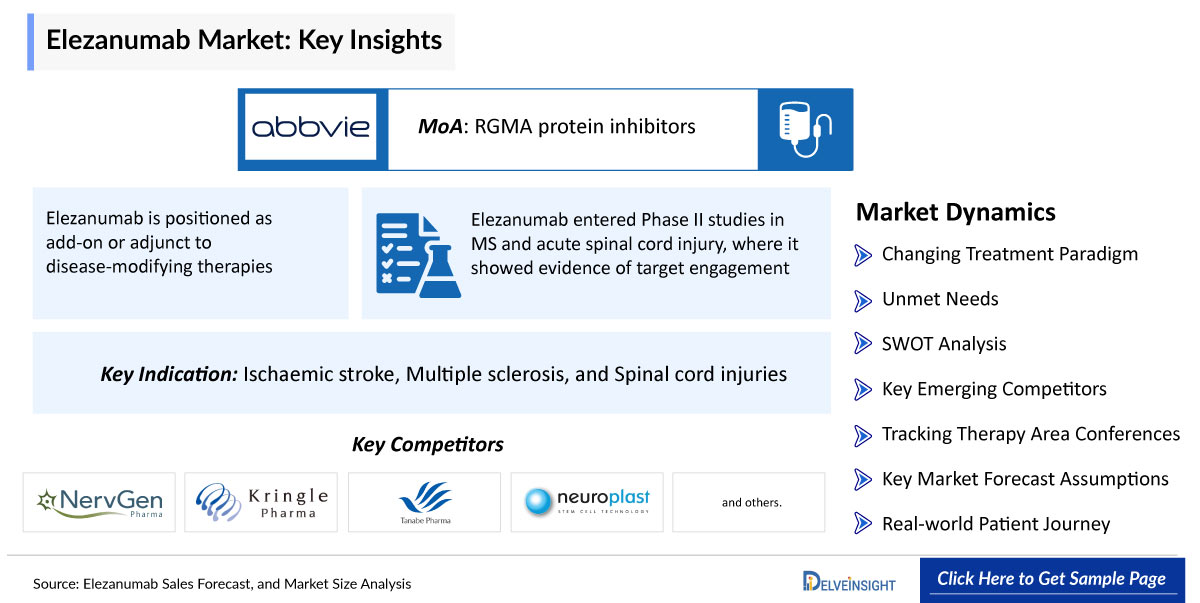
Elezanumab entered Phase II studies in MS and acute spinal cord injury, where it showed:
- Evidence of target engagement
- Some signals of functional improvement trends (e.g., motor recovery measures in SCI exploratory cohorts)
- Generally acceptable safety profile in early studies (no major dose-limiting toxicity reported in early-phase programs per AbbVie disclosures)
4. Large addressable neurological disease burden
The commercial rationale is driven by:
- Multiple sclerosis affects ~2.8 million people globally (WHO estimates)
- High unmet need in progressive MS, where disability accumulation continues despite therapy
- Spinal cord injury affects hundreds of thousands of patients annually worldwide
➡️ Growth driver: large chronic disability markets with long-term treatment potential
5. Complementary positioning vs existing MS therapies
Current MS treatments:
- Strong in relapsing-remitting MS (RRMS)
- Weak in repairing existing axonal damage
Elezanumab is positioned as:
- Add-on or adjunct to disease-modifying therapies
- Potential first neurorestorative biologic
Elezanumab Recent Developments
In September 2020, AbbVie announced that the US Food and Drug Administration (FDA) granted Orphan Drug and Fast Track designations for elezanumab (ABT-555), an investigational treatment for patients following spinal cord injury.
“Elezanumab Sales Forecast, and Market Size Analysis – 2034” report provides comprehensive insights of Elezanumab for potential indication like Ischaemic stroke, Multiple sclerosis, and Spinal cord injuries in the 7MM. A detailed picture of Elezanumab’s existing usage in anticipated entry and performance in potential indications in the 7MM, i.e., the United States, EU4 (Germany, France, Italy, and Spain) and the United Kingdom, and Japan for the study period 2020 –2034 is provided in this report along with a detailed description of the Elezanumab for potential indications. The Elezanumab market report provides insights about Elezanumab’s sales forecast, mechanism of action (MoA), dosage and administration, as well as research and development including regulatory milestones, along with other developmental activities. Further, it also consists of historical and current Elezanumab performance, future market assessments inclusive of the Elezanumab market forecast analysis for potential indications in the 7MM, SWOT, analysts’ views, comprehensive overview of market competitors, and brief about other emerging therapies in respective indications. It also provides analysis of Elezanumab sales forecasts, along with factors driving its market.
Elezanumab Drug Summary
Elezanumab is an investigational human monoclonal antibody designed to bind and neutralize repulsive guidance molecule A (RGMa), a key inhibitor of axonal growth and neuronal regeneration in the central nervous system. By blocking RGMa signaling, Elezanumab aims to promote axonal repair, enhance neuronal plasticity, and improve functional recovery following neurological injury or disease. It has been explored primarily in conditions such as spinal cord injury and multiple sclerosis, where inhibition of endogenous regeneration pathways contributes to disability progression. Administered via intravenous infusion in clinical studies, it is being evaluated for its ability to improve neurological function, reduce disability progression, and support remyelination or neuroregeneration-related processes. Elezanumab remains an investigational therapy without regulatory approval, and its clinical development has focused on establishing safety, tolerability, pharmacokinetics, and preliminary efficacy signals in neurodegenerative and neurotrauma settings. The report provides Elezanumab’s sales, growth barriers and drivers, post usage and approvals in multiple indications.
Scope of the Elezanumab Market Report
The report provides insights into:
- A comprehensive product overview including the Elezanumab MoA, description, dosage and administration, research and development activities in potential indication like Ischaemic stroke, Multiple sclerosis, and Spinal cord injuries.
- Elaborated details on Elezanumab regulatory milestones and other development activities have been provided in Elezanumab market report.
- The report also highlights Elezanumab‘s cost estimates and regional variations, reported and estimated sales performance, research and development activities in potential indications across the United States, Europe, and Japan.
- The Elezanumab market report also covers the patents information, generic entry and impact on cost cut.
- The Elezanumab market report contains current and forecasted Elezanumab sales for potential indications till 2034.
- Comprehensive coverage of the late-stage emerging therapies for respective indications.
- The Elezanumab market report also features the SWOT analysis with analyst views for Elezanumab in potential indications.
Methodology
The Elezanumab market report is built using data and information sourced primarily from internal databases, primary and secondary research and in-house analysis by DelveInsight’s team of industry experts. Information and data from the secondary sources have been obtained from various printable and nonprintable sources like search engines, news websites, global regulatory authorities websites, trade journals, white papers, magazines, books, trade associations, industry associations, industry portals and access to available databases.
Elezanumab Analytical Perspective by DelveInsight
- In-depth Elezanumab Market Assessment
This Elezanumab sales market forecast report provides a detailed market assessment of Elezanumab for potential indication like Ischaemic stroke, Multiple sclerosis, and Spinal cord injuries in the seven major markets, i.e., the United States, EU4 (Germany, France, Italy, and Spain) and the United Kingdom, and Japan. This segment of the report provides current and forecasted Elezanumab sales data uptil 2034.
- Elezanumab Clinical Assessment
The Elezanumab market report provides the clinical trials information of Elezanumab for potential indications covering trial interventions, trial conditions, trial status, start and completion dates.
Elezanumab Competitive Landscape
The report provides Insights on competitors and marketed products within the domain, along with a summary of emerging products and their respective launch dates, posing significant competition in the market.
Elezanumab Market Potential & Revenue Forecast
- Projected market size for the Elezanumab and its key indications
- Estimated Elezanumab sales potential (Elezanumab peak sales forecasts)
- Elezanumab Pricing strategies and reimbursement landscape
Elezanumab Competitive Intelligence
- Number of competing drugs in development (pipeline analysis)
- Elezanumab Market positioning compared to existing treatments
- Elezanumab Strengths & weaknesses relative to competitors
Elezanumab Regulatory & Commercial Milestones
- Elezanumab Key regulatory approvals & expected launch timelines
- Commercial partnerships, licensing deals, and M&A activity
Elezanumab Clinical Differentiation
- Elezanumab Efficacy & safety advantages over existing drugs
- Elezanumab Unique selling points
Elezanumab Market Report Highlights
- In the coming years, the Elezanumab market scenario is set to change due to strong adoption, increased prescriptions and broader uptake in multiple immunological indications; which would expand the size of the market.
- The Elezanumab companies are developing therapies that focus on novel approaches to treat/improve the disease condition, assess challenges, and seek opportunities that could influence Elezanumab’s dominance.
- Other emerging products for Ischaemic stroke, Multiple sclerosis, and Spinal cord injuries are expected to give tough market competition to Elezanumab and launch of late-stage emerging therapies in the near future will significantly impact the market.
- A detailed description of regulatory milestones, and developmental activities, provide the current development scenario of Elezanumab in potential indications.
- Analyse Elezanumab cost, pricing trends and market positioning to support strategic decision-making in the immunology landscape.
- Our in-depth analysis of the forecasted Elezanumab sales data uptil 2034 will support the clients in decision-making process regarding their therapeutic portfolio by identifying the overall scenario of Elezanumab in potential indications.
Key Questions
- What is the class of therapy, route of administration and mechanism of action of Elezanumab? How strong is Elezanumab’s clinical and commercial performance?
- What is Elezanumab’s clinical trial status in each individual indications such as Ischaemic stroke, Multiple sclerosis, and Spinal cord injuries and study completion date?
- What are the key collaborations, mergers and acquisitions, licensing and other activities related to the Elezanumab Manufacturers?
- What are the key designations that have been granted to Elezanumab for potential indications? How are they going to impact Elezanumab’s penetration in various geographies?
- What is the current and forecasted Elezanumab market scenario for potential indications? What are the key assumptions behind the forecast?
- What are the current and forecasted sales of Elezanumab in the seven major countries, including the United States, Europe (Germany, France, Italy, Spain) and the United Kingdom, and Japan?
- What are the other emerging products available and how are these giving competition to Elezanumab for potential indications?
- Which are the late-stage emerging therapies under development for the treatment of potential indications?
- How cost-effective is Elezanumab? What is the duration of therapy and what are the geographical variations in cost per patient?

