
Emergency Department Information System Market Summary
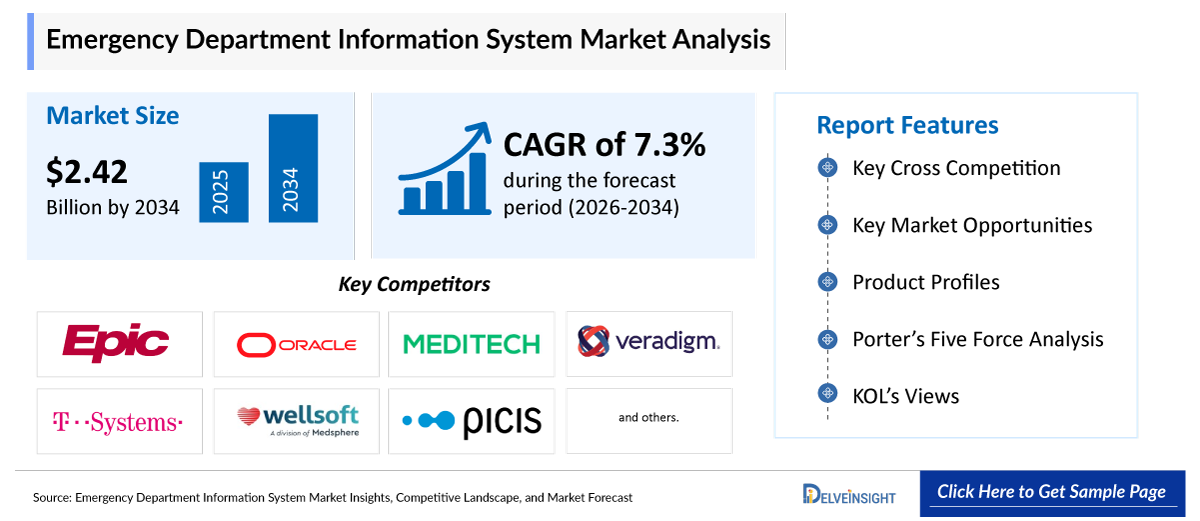
- The global emergency department information system market size was valued at USD 1.28 billion in 2025 and is projected to reach USD 2.42 billion by 2034.
- The market is expected to expand at a CAGR of 7.3% during the forecast period 2026-2034, supported by the high and rising volume of emergency department visits, the emergency department crowding and boarding crisis, regulatory compliance and interoperability requirements, and the adoption of artificial intelligence and analytics in emergency care.
- By type, the integrated solutions segment dominated the emergency department information system market with a 64% share in 2025.
- By delivery mode, the on-premise segment dominated the emergency department information system market with a 46% share in 2025.
- By component, the software segment dominated the emergency department information system market with a 62% share in 2025.
- By end-user, the hospital-based emergency departments segment dominated the emergency department information system market with a 78% share in 2025.
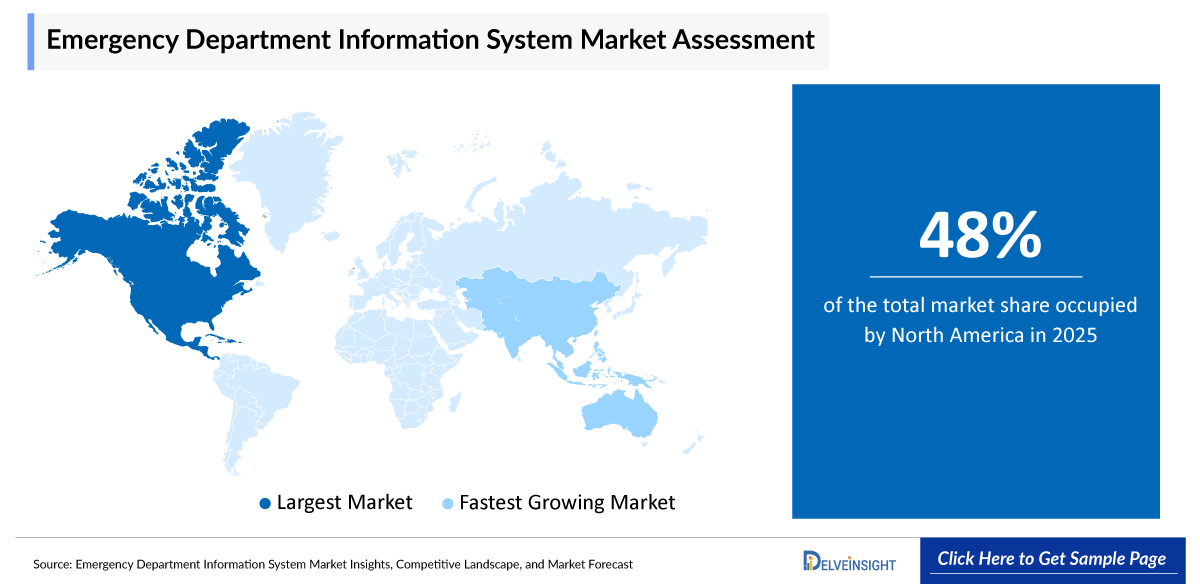
- North America accounted for the largest share of the emergency department information system market at 48% in 2025, while Asia-Pacific is anticipated to register the fastest growth through 2034.
An emergency department information system is a specialized health information technology solution that manages the clinical and operational workflows of the emergency department, including patient registration and tracking, triage and acuity scoring, clinical documentation, computerized order entry, results review, disposition and discharge, and reporting and analytics. The system provides a real-time tracking board that displays patient status, room and bed availability, and orders, and it enforces time-stamped documentation, critical condition alerts, and evidence-based order sets suited to the high-acuity, high-throughput environment of emergency care.
Emergency department information systems are delivered either as modules integrated within an enterprise electronic health record, such as Epic ASAP, Oracle Health FirstNet, MEDITECH Expanse Emergency Department, and Veradigm Sunrise Emergency Care, or as standalone best-of-breed systems, such as MEDHOST, T-System, Wellsoft, and Picis, that interface with the hospital information system. The workflow proceeds from arrival and triage through assessment, orders, treatment, and disposition, with the system coordinating care, capturing documentation and charges, and measuring throughput. The contemporary market is defined by the migration from best-of-breed toward integrated enterprise systems and by the integration of artificial intelligence, ambient documentation, and analytics into emergency care.
Emergency Department Information System Market Key Growth Drivers
- High and rising volume of emergency department visits, with the Centers for Disease Control and Prevention estimating 140 million emergency department visits in the United States each year, of which 40 million are injury related and 18 million result in hospital admission.
- The emergency department crowding and boarding crisis, which has drawn national attention and prompted forty-four members of Congress to request a federal task force on emergency department boarding in May 2023.
- Regulatory compliance requirements, including the Emergency Medical Treatment and Labor Act enforced by the Centers for Medicare and Medicaid Services and the health information technology certification administered by the Office of the National Coordinator for Health Information Technology.
- Interoperability requirements and the digitization of emergency care that drive the adoption and modernization of emergency department information systems.
- The migration from standalone best-of-breed systems toward integrated enterprise electronic health record emergency department modules such as Epic ASAP and Oracle Health FirstNet.
- Adoption of artificial intelligence, ambient documentation, and analytics that reduce clinician burden and improve throughput and patient safety.
- The imperative to improve patient flow, reduce errors, and enhance patient safety in the high-acuity emergency care environment.
Key Companies in Emergency Department Information System Market
The leading participants in the emergency department information system market include the following:
- Epic Systems Corporation
- Oracle Corporation
- Medical Information Technology, Inc.
- Veradigm Inc.
- MEDHOST, Inc.
- T-System, Inc.
- Wellsoft Corporation
- Picis Clinical Solutions, Inc.
- athenahealth, Inc.
- InterSystems Corporation, and others
For illustrative purposes, only the top 10 companies are listed in the Table of Contents. The report may include analysis and references to additional companies relevant to the market assessment.
Emergency Department Information System Market Size
The following table summarizes the headline market metrics for the global emergency department information system market across the base year and the forecast horizon.
|
Report Metrics |
Details |
|
2025 Market Size |
USD 1.28 billion |
|
2034 Projected Market Size |
USD 2.42 billion |
|
Growth Rate (2026-2034) |
7.3% CAGR |
|
Largest Market |
North America (48% share in 2025) |
|
Fastest Growing Market |
Asia-Pacific |
|
Market Structure |
Consolidated |
All market values are expressed in USD and represent DelveInsight estimates synthesized from primary and secondary research.
Factors Contributing to the Growth of the Emergency Department Information System Market
Emergency Department Information System Market Drivers
- High and Rising Volume of Emergency Department Visits: The foundational driver of the emergency department information system market is the high and rising volume of emergency department visits, which creates a continuous, high-acuity workload that specialized information systems are required to manage. The Centers for Disease Control and Prevention estimates 140 million emergency department visits in the United States each year, of which 40 million are injury related and 18 million result in admission to the hospital, a scale of demand that places overwhelming pressure on emergency departments. Each visit generates a sequence of registration, triage, assessment, orders, treatment, documentation, and disposition that must be coordinated rapidly and accurately under time pressure, and the volume and acuity of this workload cannot be managed efficiently with paper or with general-purpose systems. Emergency department information systems provide the real-time tracking boards, triage and acuity scoring, time-stamped documentation, order entry, and throughput measurement that emergency departments require to manage this volume safely. The persistence of high visit volumes, the aging of the population, and the role of the emergency department as a safety net for acute and unscheduled care sustain the demand for specialized information systems. As visit volumes remain high and the complexity of emergency care grows, the requirement for systems that manage the emergency workflow, coordinate care, and measure performance sustains steady demand for emergency department information systems across hospitals and freestanding emergency facilities.
- Emergency Department Crowding and Boarding Crisis: The emergency department crowding and boarding crisis is a powerful driver of demand for the throughput and patient flow technology that emergency department information systems provide. Crowding occurs when the demand for emergency services exceeds the capacity to provide care, and boarding occurs when admitted patients are held in the emergency department while awaiting an inpatient bed, and both degrade care, safety, and patient experience. The crisis has drawn national attention, and forty-four members of Congress wrote to the Secretary of Health and Human Services in May 2023 requesting a task force to identify solutions to emergency department boarding, while the American College of Emergency Physicians, the Emergency Nurses Association, and the Agency for Healthcare Research and Quality have published research and position statements on the problem. Emergency department information systems address crowding and boarding by providing real-time visibility into patient status and capacity, measuring throughput intervals such as door-to-provider and length of stay, identifying bottlenecks, and coordinating patient flow, and advanced systems apply analytics and prediction to anticipate surges and optimize staffing and bed allocation. As hospitals and health systems seek to manage crowding, reduce boarding, and improve throughput to protect patients and meet performance measures, they invest in the tracking, measurement, and analytics that emergency department information systems provide. The persistence and severity of the crowding and boarding crisis sustain demand for emergency department information systems and for the throughput and analytics capabilities they deliver.
- Regulatory Compliance and Interoperability Requirements: Regulatory compliance and interoperability requirements drive the adoption and modernization of emergency department information systems. The Emergency Medical Treatment and Labor Act, enforced by the Centers for Medicare and Medicaid Services, requires emergency departments to provide a medical screening examination and stabilizing treatment to all patients regardless of ability to pay, and compliance requires accurate, time-stamped documentation of screening, treatment, and transfer that emergency department information systems capture. The Office of the National Coordinator for Health Information Technology administers the health information technology certification program that defines the capabilities certified electronic health record systems must provide, and the Centers for Medicare and Medicaid Services promoting interoperability programs and quality measures, including emergency department throughput measures, create requirements that emergency department systems must support. The interoperability provisions of the 21st Century Cures Act and the requirement to exchange health information across settings drive the adoption of systems that connect the emergency department to the enterprise electronic health record and to external data. Compliance with these requirements demands documentation, measurement, and interoperability capabilities that certified, integrated emergency department information systems provide, and it favors systems that are certified and continuously updated for regulatory change. The breadth of the compliance and interoperability framework sustains demand for modern, certified emergency department information systems and reinforces the migration toward integrated enterprise systems.
- Migration from Best-of-Breed to Integrated Enterprise Systems: The migration from standalone best-of-breed systems toward integrated enterprise electronic health record emergency department modules is a defining driver that concentrates demand in integrated solutions. Historically, many emergency departments deployed dedicated best-of-breed emergency department information systems chosen for their emergency-specific workflows, but as hospitals standardized on enterprise electronic health records, they increasingly replaced standalone systems with the emergency department modules of their enterprise vendor to achieve a single patient record, seamless data flow, and unified support. Enterprise modules such as Epic ASAP and Oracle Health FirstNet provide emergency-specific tracking, triage, documentation, and order entry within the enterprise record, so that emergency department data is instantly available if a patient is admitted, and they eliminate the interfaces and data reconciliation that best-of-breed systems require. This migration, observed across the industry as hospitals consolidate on enterprise platforms, concentrates demand in integrated solutions while sustaining a role for best-of-breed systems in facilities that prioritize emergency-specific functionality or operate outside a single enterprise platform. The value of a unified patient record, seamless transitions from emergency to inpatient care, and unified support drives the preference for integrated modules. This structural migration sustains demand for integrated enterprise emergency department information systems and shapes the competitive structure of the market.
- Adoption of Artificial Intelligence, Ambient Documentation, and Analytics: The adoption of artificial intelligence, ambient documentation, and analytics is transforming emergency department information systems and driving investment in modern platforms. Vendors have embedded artificial intelligence and analytics to reduce clinician documentation burden, support decision-making, and optimize throughput, and ambient documentation tools that capture the clinician-patient conversation and generate notes reduce the time clinicians spend on documentation in the high-pressure emergency environment. Predictive analytics anticipate patient surges, estimate length of stay, and identify patients at risk of deterioration or of leaving without being seen, and acuity auto-scoring and critical condition alerts support rapid triage and prioritization. Enterprise vendors have integrated artificial intelligence assistants and ambient documentation into their emergency department modules, and analytics dashboards provide real-time visibility into throughput and performance. These capabilities address the central challenges of emergency care, which are the pressure on clinician time, the need for rapid and accurate decisions, and the management of throughput under crowding, and they shift competition toward the intelligence and usability of the platform. As emergency departments adopt artificial intelligence and analytics to reduce burden, improve safety, and manage flow, demand concentrates in modern, intelligent emergency department information systems. This modernization cycle drives replacement and upgrade of systems and expands the value delivered per deployment, sustaining growth in the market.
- Rising Electronic Health Record Adoption and Digitization of Emergency Care: The rising adoption of electronic health records and the broader digitization of emergency care sustain demand for emergency department information systems across hospitals and freestanding facilities. The adoption of electronic health records in hospitals, advanced by federal incentive and promoting interoperability programs, has established the digital foundation on which emergency department information systems operate, and the transition from paper and manual records to electronic documentation and tracking is now standard in developed health systems. The digitization of emergency care extends beyond documentation to encompass computerized order entry, results review, decision support, charge capture, and analytics, all of which require an emergency department information system to coordinate. The growth of freestanding emergency departments and urgent care facilities, which require emergency documentation and management systems suited to their settings, adds to the demand, and vendors offer systems for hospitals, freestanding emergency centers, and urgent care. In emerging markets, the digitization of healthcare and the modernization of emergency services drive the initial adoption of emergency department information systems. As electronic health record adoption deepens and as emergency care digitizes across settings and regions, the requirement for systems that manage the emergency workflow electronically sustains demand. The ongoing digitization of emergency care and the extension of electronic systems across facilities and regions sustain steady demand for emergency department information systems.
- Imperative to Reduce Clinician Burden, Errors, and Improve Patient Safety: The imperative to reduce clinician burden, prevent errors, and improve patient safety in the high-acuity emergency environment drives the adoption of emergency department information systems and their advanced capabilities. The emergency department is among the highest-risk clinical settings, where rapid decisions, high patient volumes, frequent interruptions, and incomplete information create risk of diagnostic and treatment error, and where clinician burnout is a serious concern. Emergency department information systems reduce risk by providing time-stamped documentation, order sets and decision support, critical condition alerts, and complete, accessible patient information, and they reduce clinician burden by streamlining documentation, automating tracking, and, increasingly, applying ambient documentation and artificial intelligence. Accurate documentation and coding also support compliance and appropriate reimbursement and reduce medical-legal risk in a setting with significant liability exposure. The reduction of transcription and manual tracking, the provision of decision support, and the alerting of critical conditions improve safety and efficiency, and vendors design systems by emergency clinicians to ensure intuitive, fast workflows suited to the environment. As emergency departments seek to protect patients, support clinicians, and manage risk under pressure, they adopt information systems that improve safety, reduce burden, and support compliance. This imperative sustains demand for emergency department information systems and for the decision support, documentation, and artificial intelligence capabilities that address the risks of emergency care.
Emergency Department Information System Market Restraints
- The emergency department information system market faces several interrelated restraints that temper its growth. The foremost is the high cost and complexity of implementation and integration, since deploying an emergency department information system, particularly an enterprise module, requires substantial investment, configuration to emergency workflows, integration with the hospital information system and ancillary systems, and training, and the cost and disruption can be prohibitive for smaller and rural facilities. Clinician burden and usability concerns are a significant restraint, since poorly designed systems, excessive alerts, and burdensome documentation can slow clinicians, contribute to burnout, and generate resistance in a setting where speed is critical, and the addition of the documentation load to the emergency workflow is a persistent challenge. Integration and interoperability challenges persist, since emergency departments must exchange data with the enterprise record, ancillary systems, and external sources, and incomplete interoperability creates gaps and manual reconciliation. Data security and privacy obligations add compliance burden and risk, since emergency systems process sensitive information and must protect it under regulation. The high-availability requirement of emergency care makes downtime and system failure especially consequential, which raises the stakes of deployment and can create caution. The consolidation of the market toward enterprise vendors limits the addressable market for best-of-breed systems and can reduce choice and flexibility for facilities. Budget constraints, particularly in smaller, rural, and safety-net facilities, and the shortage of health information technology and emergency staff to implement and operate systems, further constrain adoption. Together these factors moderate the pace of adoption and modernization and require vendors to demonstrate usability, reliability, integration, and clear value to sustain growth.
Emergency Department Information System Market Segment Analysis
The global emergency department information system market is segmented by type (integrated solutions and standalone solutions), by delivery mode (on premise, cloud-based, and web-based), by component (software and services), by end-user (hospital-based emergency departments, freestanding emergency departments, and others), and by geography (North America, Europe, Asia-Pacific, and the Rest of the World).
By Type
Dominant Subsegment: Integrated Solutions.
The integrated solutions category is expected to dominate the market. The integrated solutions segment accounted for a 64% share of the emergency department information system market in 2025. Integrated solutions are emergency department modules embedded within an enterprise electronic health record, and they have become the dominant type as hospitals standardize on enterprise platforms and replace standalone systems with the emergency department module of their enterprise vendor. The dominance of the segment reflects the value of a single patient record, seamless data flow between the emergency department and inpatient and ambulatory settings, and unified support and maintenance, which integrated modules provide and which standalone systems cannot match without interfaces and data reconciliation. Enterprise modules such as Epic ASAP, Oracle Health FirstNet, MEDITECH Expanse Emergency Department, and Veradigm Sunrise Emergency Care deliver emergency-specific tracking, triage, documentation, and order entry within the enterprise record, so that emergency data is instantly available across the continuum of care. The migration from best-of-breed toward enterprise modules, observed across the industry, concentrates demand in integrated solutions, and the integration of artificial intelligence and analytics within enterprise platforms reinforces the trend. While standalone best-of-breed systems retain a role in facilities that prioritize emergency-specific functionality or operate outside a single enterprise platform, the value of unification and the standardization of hospitals on enterprise electronic health records sustain the leadership of the integrated solutions segment across the forecast period.
By Delivery Mode
Dominant Subsegment: On-Premise.
The on-premise category is expected to dominate the market. The on-premise segment accounted for a 46% share of the emergency department information system market in 2025. On-premise deployment, in which the emergency department information system and the enterprise electronic health record are hosted within the hospital's own data center or a dedicated environment, has been the predominant model for hospital systems because of the requirement for high availability, control, and integration in a critical care setting. The dominance of the segment reflects the deployment preferences of large hospitals and health systems, which have historically hosted their enterprise electronic health records on-premise or in dedicated hosted environments to ensure control, performance, and continuity, and the emergency department module is deployed as part of that enterprise system. The high-availability requirement of emergency care, where downtime is especially consequential, and the sensitivity of the data reinforce the preference for controlled deployment. While cloud and web-based delivery is growing, particularly through web-based enterprise systems such as MEDITECH Expanse and cloud-based systems for smaller facilities and freestanding emergency departments, and while enterprise vendors increasingly offer hosted and cloud options, the installed base and continued deployment of on-premise and dedicated hosted enterprise systems sustain the leadership of the on-premise segment. The deployment preferences of large hospitals, the high-availability requirement of emergency care, and the installed base of enterprise systems sustain the leadership of the on-premise segment across the forecast period, even as cloud and web-based delivery grows.
By Component
Dominant Subsegment: Software.
The software category is expected to dominate the market. The software segment accounted for a 62% share of the emergency department information system market in 2025. Software comprises the emergency department information system application, including the tracking board, triage and acuity scoring, clinical documentation, order entry, results review, disposition, and analytics that constitute the system, and it is the core deliverable that hospitals and emergency facilities license and deploy. The dominance of the segment reflects the central role of the software application in managing the emergency workflow and the recurring nature of software licensing and subscription revenue. The leading vendors deliver emergency department functionality as software, whether as a module within an enterprise electronic health record or as a standalone application, and the software embodies the tracking, documentation, decision support, and analytics that define the system. While implementation, integration, training, and support services are essential complements that hospitals require to deploy and maintain their systems, and while these services represent a substantial and growing part of the market, the software application is the foundation on which those services are delivered and the primary object of the investment. The addition of artificial intelligence, ambient documentation, and analytics to the software, and the shift toward subscription licensing, reinforce the leadership of the software component. Its centrality to the emergency department deployment and the recurring nature of software revenue sustain its leadership across the forecast period.
By End-User
Dominant Subsegment: Hospital-Based Emergency Departments.
The hospital-based emergency department category is expected to dominate the market. The hospital-based emergency departments segment accounted for a 78% share of the emergency department information system market in 2025. Hospital-based emergency departments, which are attached to acute care hospitals and provide the full range of emergency services, represent the large majority of emergency departments and emergency visits, and they are the principal deployers of emergency department information systems, which concentrates demand in this segment. The dominance of the segment reflects the number and scale of hospital emergency departments, the volume and acuity of the visits they manage, and their integration within enterprise hospital electronic health records that include emergency department modules. Hospital emergency departments handle the large majority of the emergency visits estimated by the Centers for Disease Control and Prevention, including the high-acuity cases that result in admission, and they require comprehensive emergency department information systems integrated with the enterprise record to coordinate care across the emergency and inpatient settings. The migration toward integrated enterprise modules is concentrated in hospital emergency departments that standardize on enterprise electronic health records. While freestanding emergency departments and urgent care facilities represent a growing segment that requires emergency documentation and management systems, the number, scale, and acuity of hospital emergency departments sustain the leadership of the hospital-based segment across the forecast period, and it shapes the direction of the market.
Emergency Department Information System Market Region Analysis
Dominant Region: North America
North America accounted for a 48% share of the global emergency department information system market in 2025, representing the highest regional market share globally. The leadership of the region reflects the high volume of emergency department visits, the advanced adoption of electronic health records, the concentration of the leading vendors, and a rigorous regulatory framework. The United States is the largest national market, supported by the scale of its emergency care system, the estimate by the Centers for Disease Control and Prevention of 140 million emergency department visits each year, the severity of the crowding and boarding crisis, and the advanced adoption of enterprise electronic health records with emergency department modules. The Emergency Medical Treatment and Labor Act, enforced by the Centers for Medicare and Medicaid Services, requires screening and stabilizing treatment and the documentation to demonstrate it, the Office of the National Coordinator for Health Information Technology administers health information technology certification, and the Centers for Medicare and Medicaid Services promoting interoperability programs and emergency department throughput measures create requirements that drive adoption. The leading vendors, including Epic Systems, Oracle Health, MEDITECH, and the specialist best-of-breed vendors, are headquartered and operate in the region, and the migration toward integrated enterprise modules is most advanced there. The scale of emergency care, the maturity of electronic health record adoption, the regulatory framework, and the concentration of vendors reinforce the leadership of the region. The combination of visit volume, electronic health record maturity, regulatory rigor, and vendor presence sustains the position of North America as the largest regional market across the forecast period.
Fastest Growing Region: Asia-Pacific
Asia-Pacific is projected to register the fastest compound annual growth rate through 2034. The region is expanding its hospital infrastructure, modernizing emergency services, and digitizing healthcare, which drives the initial adoption and modernization of emergency department information systems. China, Japan, and India are the principal national markets, supported by growing healthcare investment, the construction and modernization of hospitals, the rising volume of emergency visits driven by large populations and aging, and government initiatives to digitize healthcare and adopt electronic health records. The transition from paper and manual processes toward electronic documentation and tracking in emergency departments, the growth of hospital electronic health record adoption, and the modernization of emergency services enlarge the demand for emergency department information systems. As health systems build and modernize emergency departments and adopt electronic systems, the region increases its adoption of emergency department information systems, and the large and rising volume of emergency care creates substantial long-term demand. The combination of infrastructure expansion, healthcare digitization, rising emergency volumes, and electronic health record adoption positions Asia-Pacific as the fastest-growing regional market, and it attracts investment and commercial focus from the leading global vendors seeking presence in high-growth national markets.
Emergency Department Information System Market Regional Commentary
North America
North America leads the market, supported by the high volume of emergency department visits, the advanced adoption of enterprise electronic health records, the concentration of the leading vendors, and a rigorous regulatory framework. The United States dominates the region through the scale of its emergency care system, the severity of the crowding and boarding crisis, and the maturity of electronic health record adoption. The Emergency Medical Treatment and Labor Act, health information technology certification, and promoting interoperability and throughput requirements sustain demand for modern, integrated emergency department information systems.
Europe
Europe is a substantial market shaped by universal and statutory health systems, the digitization of hospital care, and national programs to modernize emergency and hospital information systems. Germany, the United Kingdom, France, Italy, and Spain are the principal national markets, supported by large hospital systems, the adoption of electronic health records, and the modernization of emergency services. Demand is sustained by the digitization of emergency care and by the pressure of emergency department crowding on health systems.
Asia-Pacific
Asia-Pacific is the fastest-growing region, driven by the expansion and modernization of hospital infrastructure, the digitization of healthcare, and the rising volume of emergency visits across China, Japan, and India. The transition to electronic documentation and tracking, the growth of hospital electronic health record adoption, and government digitization initiatives sustain demand, and the region attracts commercial focus from the leading global vendors.
Rest of World
The Rest of World, spanning Latin America, the Middle East, and Africa, represents an emerging opportunity as hospital infrastructure expands and as healthcare digitizes. Growth is supported by the construction and modernization of hospitals, the adoption of electronic health records, and the modernization of emergency services, though adoption varies by market. Vendors pursue these markets through systems suited to developing infrastructure and to hospitals adopting electronic emergency care for the first time.
Emergency Department Information System Market Competitive Landscape
The global emergency department information system market is classified as Consolidated. A small group of enterprise electronic health record vendors holds a large share of the market through emergency department modules integrated within their platforms, supported by strong installed bases among hospitals and health systems, while specialist best-of-breed vendors compete on emergency-specific functionality, usability, and flexibility. Competition centers on integration with the enterprise record, emergency-specific workflow and usability, throughput and analytics, artificial intelligence and ambient documentation, and regulatory certification, and product launches, artificial intelligence introductions, and the migration from best-of-breed to enterprise systems intensify the contest.
The competitive landscape is evaluated across the following dimensions:
- Market concentration: Consolidated, with a small group of enterprise electronic health record vendors holding a large share through integrated emergency department modules, alongside a tier of specialist best-of-breed emergency department information system vendors.
- Leading players: Epic Systems, with the ASAP module, and Oracle Health, with FirstNet, lead through integrated enterprise modules, MEDITECH and Veradigm compete with enterprise emergency department solutions, and MEDHOST, T-System, Wellsoft, and Picis compete as specialist best-of-breed vendors, while athenahealth and InterSystems contest defined segments.
- Geographic reach: The leading enterprise vendors maintain large installed bases in North America and operate internationally, while best-of-breed and regional vendors serve defined markets and facility types.
- Product portfolio strength: Competitive advantage rests on emergency-specific tracking, triage, documentation, order entry, disposition, and analytics, delivered either integrated within an enterprise record or as a best-of-breed system, with integration and unified data increasingly decisive.
- Pipeline strength: Development is concentrated in artificial intelligence and ambient documentation, throughput and predictive analytics, usability and clinician burden reduction, and interoperability within the enterprise record and across settings.
- Strategic partnerships: Collaboration spans integration with enterprise electronic health records, ambient documentation and artificial intelligence partnerships, and alliances that connect emergency department systems to ancillary and external data.
- M&A activity: Consolidation has shaped the field, exemplified by the acquisition of Cerner by Oracle and its integration into Oracle Health, and by the acquisition and integration of best-of-breed emergency department systems, alongside the ongoing migration from best-of-breed to enterprise platforms.
- Innovation focus: Innovation is shifting toward embedded artificial intelligence and ambient documentation, throughput and predictive analytics, usability, and interoperability within integrated enterprise platforms.
- Regulatory standing: Health information technology certification administered by the Office of the National Coordinator for Health Information Technology, conformance to Emergency Medical Treatment and Labor Act documentation requirements, and support for promoting interoperability and throughput measures are decisive competitive credentials and a principal axis of competition among the leaders.
Emergency Department Information System Market Recent Developmental Activities
- In 2024 and 2025, Oracle Corporation advanced its Oracle Health clinical portfolio, including the FirstNet emergency department solution, and introduced a next-generation electronic health record with an embedded artificial intelligence clinical assistant following its acquisition and integration of Cerner. Strategic significance: the modernization of a leading enterprise platform advanced artificial intelligence and usability within the emergency department module and the broader electronic health record.
- In 2024 and 2025, Epic Systems Corporation advanced its ASAP emergency department module with artificial intelligence, ambient documentation, and analytics capabilities, including acuity auto-scoring, tracking boards, and integration with ambient documentation tools. Strategic significance: the developments reinforced the position of the leading enterprise vendor and advanced artificial intelligence and throughput capabilities in the emergency department.
- In May 2023, forty-four members of the United States Congress wrote to the Secretary of Health and Human Services requesting a task force to identify solutions to the emergency department boarding crisis. Strategic significance: the national attention to crowding and boarding reinforced the demand for the throughput, tracking, and analytics capabilities that emergency department information systems provide.
- In 2024 and 2025, MEDITECH advanced its Expanse Emergency Department solution, a web-based emergency department module with triage, bedside documentation, and analytics, and integrated ambient artificial intelligence documentation into its platform. Strategic significance: the developments strengthened the position of a leading enterprise vendor serving community hospitals and advanced web-based and artificial intelligence-enabled emergency care.
- In 2024 and 2025, the leading vendors integrated ambient artificial intelligence documentation tools that capture the clinician-patient conversation and generate clinical notes into their emergency department workflows. Strategic significance: the adoption of ambient documentation addressed clinician burden in the high-pressure emergency environment and became a defining axis of competition.
- In 2024 and 2025, MEDHOST, Inc. advanced its emergency department information system with dynamic patient tracking, electrocardiogram integration, and throughput analytics for busy emergency departments. Strategic significance: the developments reinforced the position of a leading best-of-breed vendor competing on emergency-specific functionality.
- In 2024 and 2025, T-System, Inc. advanced its emergency department documentation and coding solutions, including electronic health record-agnostic documentation and evaluation and management coding tools. Strategic significance: the developments strengthened the position of a specialist vendor focused on emergency documentation and compliant coding.
- In 2024 and 2025, Veradigm Inc. advanced its Sunrise Emergency Care solution with emergency documentation, charge capture, and integration with the broader electronic health record. Strategic significance: the developments reinforced the position of an enterprise vendor offering an integrated emergency department solution.
- In 2024 and 2025, athenahealth, Inc. advanced its cloud-based electronic health record with emergency department capabilities, revenue cycle management, and patient flow optimization. Strategic significance: the developments extended cloud-based emergency care capabilities suited to community and freestanding facilities.
- In 2022, the National Center for Health Statistics concluded the National Hospital Ambulatory Medical Care Survey and signaled a transition toward electronic health record-based surveillance of emergency care. Strategic significance: the shift toward electronic data underscored the role of emergency department information systems as the source of emergency care data and performance measurement.
- In 2024 and 2025, InterSystems Corporation advanced its TrakCare unified health information system, including emergency department capabilities, for international health systems. Strategic significance: the developments reinforced the position of a vendor serving international markets with an integrated emergency department solution.
- In 2024 and 2025, the leading vendors embedded artificial intelligence, ambient documentation, and predictive analytics across emergency department tracking, triage, documentation, and throughput. Strategic significance: the convergence of the leaders on artificial intelligence, ambient documentation, and analytics confirmed these as the defining axes of competition and signaled a market shifting toward intelligent, integrated, and usable emergency department information systems.
Emergency Department Information System Market Segmentation
- Emergency Department Information System Market Assessment by Type
- Integrated Solutions
- Standalone Solutions
- Emergency Department Information System Market Assessment by Delivery Mode
- On-Premise
- Cloud-Based
- Web-Based
- Emergency Department Information System Market Assessment by Component
- Software
- Services
- Emergency Department Information System Market Assessment by End-User
- Hospital-Based Emergency Departments
- Freestanding Emergency Departments
- Others
Emergency Department Information System Market Assessment by Geography
- North America Emergency Department Information System Market Assessment
- United States Emergency Department Information System Market Size in USD million (2023-2034)
- Canada Emergency Department Information System Market Size in USD million (2023-2034)
- Mexico Emergency Department Information System Market Size in USD million (2023-2034)
- Europe Emergency Department Information System Market Assessment
- Germany Emergency Department Information System Market Size in USD million (2023-2034)
- United Kingdom Emergency Department Information System Market Size in USD million (2023-2034)
- France Emergency Department Information System Market Size in USD million (2023-2034)
- Italy Emergency Department Information System Market Size in USD million (2023-2034)
- Spain Emergency Department Information System Market Size in USD million (2023-2034)
- Rest of Europe Emergency Department Information System Market Size in USD million (2023-2034)
- Asia-Pacific Emergency Department Information System Market Assessment
- China Emergency Department Information System Market Size in USD million (2023-2034)
- Japan Emergency Department Information System Market Size in USD million (2023-2034)
- India Emergency Department Information System Market Size in USD million (2023-2034)
- Australia Emergency Department Information System Market Size in USD million (2023-2034)
- South Korea Emergency Department Information System Market Size in USD million (2023-2034)
- Rest of Asia-Pacific Emergency Department Information System Market Size in USD million (2023-2034)
- Rest of the World Emergency Department Information System Market Assessment
- Middle East Emergency Department Information System Market Size in USD million (2023-2034)
- Africa Emergency Department Information System Market Size in USD million (2023-2034)
- South America Emergency Department Information System Market Size in USD million (2023-2034)
Emergency Department Information System Market Recent Industry Trends and Milestones (2023-2026):
|
Category |
Key Developments |
|
Emergency Department Information System Market Product Advancement |
The period was defined by the advancement of integrated, artificial intelligence-enabled emergency department modules. Oracle advanced Oracle Health FirstNet and a next-generation electronic health record with an embedded artificial intelligence clinical assistant, Epic advanced its ASAP module with acuity auto-scoring, tracking boards, and ambient documentation, and MEDITECH advanced its web-based Expanse Emergency Department solution. Best-of-breed vendors including MEDHOST, T-System, Wellsoft, and Picis advanced emergency-specific tracking, documentation, and coding. Vendors aligned their systems to health information technology certification and to Emergency Medical Treatment and Labor Act documentation and throughput requirements, concentrating competition in integrated, certified, and intelligent emergency department systems. |
|
Emergency Department Information System Market Product Expansion |
Product expansion advanced along three axes. The first is artificial intelligence and ambient documentation, as vendors embedded ambient documentation tools and artificial intelligence assistants to reduce clinician burden and support decision-making. The second is throughput and analytics, as vendors added predictive analytics, real-time tracking, and dashboards to manage crowding and boarding. The third is integration and interoperability, as enterprise vendors unified the emergency department module with the enterprise record and best-of-breed vendors strengthened interfaces to hospital information systems. Vendors also extended systems to freestanding emergency departments and urgent care facilities and to web-based and cloud delivery. |
|
Emergency Department Information System Market Investment |
Investment was shaped by consolidation and by the migration to integrated enterprise systems. Oracle integrated Cerner into Oracle Health and invested in a next-generation electronic health record, and hospitals invested in replacing best-of-breed systems with enterprise emergency department modules. Vendors invested in artificial intelligence, ambient documentation, and analytics, and in the throughput and interoperability capabilities that crowding and regulation require. Investment also flowed into the systems required to meet health information technology certification and promoting interoperability requirements, and vendors extended emergency department capabilities to freestanding and international facilities. |
|
Company Strategy |
The unifying strategic theme is the integration of the emergency department module within an intelligent enterprise electronic health record. Epic is advancing ASAP within its enterprise platform, Oracle is advancing FirstNet within Oracle Health and its next-generation electronic health record, and MEDITECH is advancing Expanse Emergency Department for community hospitals. Veradigm and InterSystems are competing with integrated enterprise emergency solutions, and MEDHOST, T-System, Wellsoft, and Picis are competing as best-of-breed specialists on emergency-specific functionality and usability. Across the field, strategy centers on integration, artificial intelligence, ambient documentation, throughput analytics, and usability. |
|
Emerging Technologies |
The defining emerging technologies are ambient artificial intelligence documentation that captures the clinician-patient conversation and generates notes; predictive analytics that anticipate patient surges, estimate length of stay, and identify patients at risk; acuity auto-scoring and critical condition alerts that support rapid triage; real-time tracking boards and throughput dashboards that manage crowding and boarding; and interoperability within the enterprise record and across settings. Supporting these are electronic health record-agnostic documentation and coding tools, web-based and cloud delivery, and integration with ancillary and external data. Across these, the trajectory is toward emergency department information systems that are integrated, intelligent, and usable, reducing clinician burden, improving throughput, and enhancing patient safety in the high-acuity emergency environment. |
Emergency Department Information System Market Startup Funding and Investment Trends
Investment in the emergency department information system field has concentrated on technologies that reduce clinician burden, improve throughput, and enhance decision-making, namely ambient artificial intelligence documentation, predictive analytics for patient flow and acuity, and clinical decision support for emergency care. Because the core market is consolidated among enterprise electronic health record vendors with entrenched installed bases and best-of-breed specialists, most innovators pursue a differentiated technology, such as ambient documentation or predictive analytics, that integrates with the enterprise record or that a larger vendor can absorb. The table below summarizes representative companies advancing the next generation of emergency department and acute care technology.
|
Company |
Total Funding |
Funding Stage |
Main Product/Offering |
Core Technology |
|
Abridge |
Venture-backed |
Commercial stage |
Ambient clinical documentation |
Generative artificial intelligence documentation |
|
Ambience Healthcare |
Venture-backed |
Commercial stage |
Ambient documentation and coding |
Artificial intelligence clinical documentation |
|
Request for unlocking the report of the @ Emergency Department Information System Market Insights | ||||
Capital formation in this field is shaped by the difficulty of competing against the enterprise electronic health record vendors, whose integrated modules and installed bases create high barriers, so investors have favored companies that introduce differentiated technology, such as ambient documentation, predictive patient flow, or acute care decision support, that integrates with the enterprise record rather than replacing it. Ambient artificial intelligence documentation is the clearest technology thesis, seeking to reduce the documentation burden that contributes to clinician burnout in the emergency environment. Predictive analytics for patient flow, capacity, and acuity constitutes a second thesis, addressing the crowding and boarding crisis, and clinical decision support and imaging triage for acute care a third. The archetypal outcome is acquisition by or partnership with an enterprise electronic health record vendor seeking to add a differentiated capability, or integration into enterprise workflows, which provides a defined path that sustains earlier-stage investment. The principal risks are the entrenched integrated modules and installed bases of the enterprise vendors, the high-availability and safety expectations of emergency care, the validation and regulatory requirements of clinical software, and the difficulty of integrating with enterprise records. Source: company disclosures.
Key Takeaways from the Emergency Department Information System Market Report Study
- Market size analysis for the current emergency department information system market size (2025), and market forecast for 9 years (2026 to 2034).
- Top key product and technology developments, mergers, acquisitions, partnerships, and joint ventures that happened over the last 3 years.
- Key companies dominating the global emergency department information system market.
- Various opportunities available for competitors in the emergency department information system market space.
- What are the top-performing segments in 2025? How will these segments perform in 2034?
- Which are the top-performing regions and countries in the current emergency department information system market scenario?
- Which are the regions and countries where companies should concentrate their opportunities for emergency department information system market growth in the future?
Target audience who can benefit from this emergency department information system market report study
- Emergency department information system software and service providers
- Research organizations and consulting companies
- Emergency department information system-related organizations, associations, forums, and other alliances
- Government and corporate offices
- Start-up companies, venture capitalists, and private equity firms
- Distributors and traders dealing in emergency department information systems
- Various end-users who want to know more about the emergency department information system market and the latest technological developments in the emergency department information system market.

