
EOHILIA Sales Forecast Summary
Key Factors Driving EOHILIA Growth
Regulatory Milestone: First FDA-Approved Oral EoE Therapy
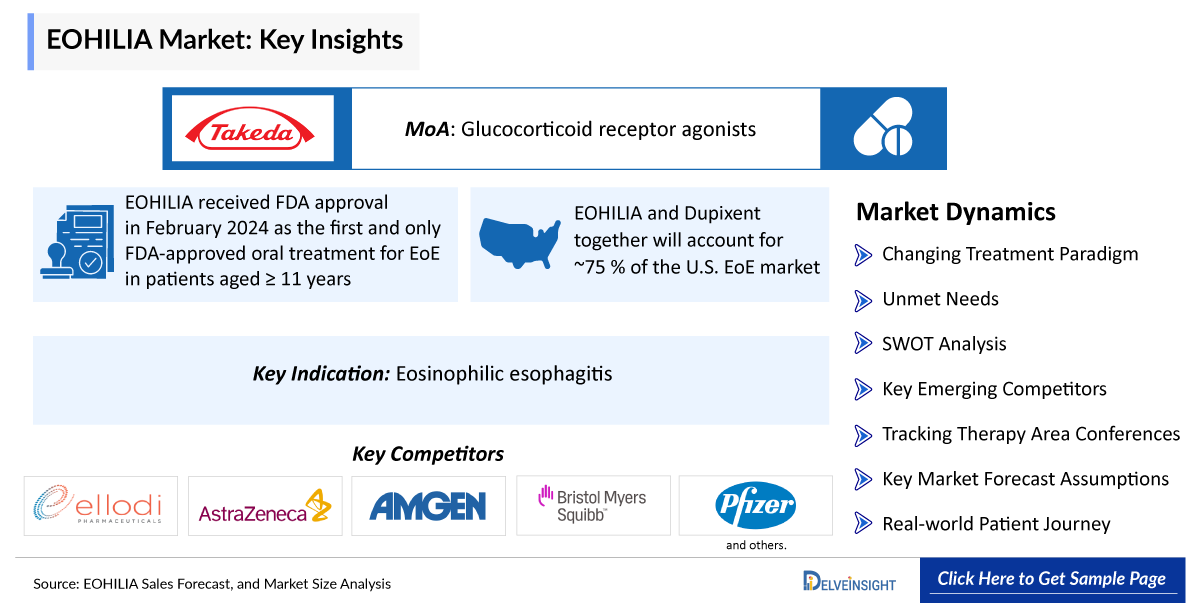
- EOHILIA received FDA approval on February 2024 as the first and only FDA-approved oral treatment for eosinophilic esophagitis (EoE) in patients aged ≥ 11 years, delivering a targeted budesonide oral suspension designed to reduce esophageal inflammation and dysphagia symptoms.
- The approval was based on two 12-week randomized clinical trials showing significant reductions in eosinophil counts and improvement in swallowing difficulty compared with placebo. In one study, 53 % of patients achieved a reduction in eosinophil count with EOHILIA vs ~1 % with placebo; in another, ~38 % showed similar gains.
Clinical Performance and Patient-Friendly Formulation
- EOHILIA’s thixotropic budesonide oral suspension is formulated to improve local retention in the esophagus versus generic off-label steroid slurries, and is dosed twice daily for up to 12 weeks in approved use.
- Clinical study data show measurable reductions in difficulty swallowing (DSQ score) — e.g., patients treated with EOHILIA showed a >10-point DSQ improvement versus ~6.5 in placebo — indicating real symptomatic benefit.
- The established safety profile and tolerability help mitigate treatment hesitation among both patients and prescribers.
Expanded Addressable Market Within a Growing Disease Category
- Eosinophilic esophagitis (EoE) incidence and diagnosis rates are rising, with significant unmet need for approved therapies that improve adherence and outcomes.
- In the U.S., the EoE drug market is projected to grow from about $202 million in 2020 to ~$1.19 billion by 2030 (CAGR ~ 19.4%) as patients transition from off-label treatments to FDA-approved therapies including EOHILIA and biologics.
- Analysts forecast that by 2030, EOHILIA and Dupixent together will account for ~75 % of the U.S. EoE market, illustrating substantial room for uptake.
Competitive & Treatment Landscape Shifts
- The EoE treatment landscape is undergoing a paradigm shift from off-label steroids and proton pump inhibitors toward targeted, approved therapies. EOHILIA’s approval, along with biologics like Dupixent (dupilumab) and other pipeline agents, has broadened therapeutic options.
- EOHILIA’s ease of use compared to compounding and inhaler-based approaches is cited as a factor driving uptake among clinicians and patients.
- Survey data indicate that, early after launch, EoE specialists are initiating EOHILIA in newly diagnosed or mild cases, and in some practices, it is used ahead of biologics or to delay biologic initiation when appropriate.
Pediatric Usage and Expanded Treatment Reach
- EOHILIA’s approval covers patients aged 11 years and older, marking a broader pediatric indication vs many prior treatments.
- Given EoE’s prevalence in children and adolescents, pediatric use significantly increases the addressable population for therapy adoption.
Economic & Forecast Context (Broader Market Growth)
- Industry data project the global EoE drug market to grow significantly through the next decade: e.g., one model forecasts growth from ~USD 1,088 million in 2024 to over ~USD 9,244 million by 2035 (7-major markets combined) at ~21.5 % CAGR, driven by rising prevalence, better diagnosis, and new therapy adoption.
- Analysts expect corticosteroid-based therapies — including oral suspensions like EOHILIA — to maintain significant share alongside biologics as EoE becomes more routinely treated with approved agents.
EOHILIA Recent Developments
- EOHILIA’s approval and adoption represent a major therapeutic milestone in accessible oral treatment for EoE. The combination of clinical efficacy, expanded patient access, and broader market expansion trends suggests growing utilization in the coming years, especially as clinicians seek alternatives to biologics and off-label regimens.
“EOHILIA Sales Forecast, and Market Size Analysis – 2034” report provides comprehensive insights of EOHILIA for potential indication like Eosinophilic oesophagitis in the 7MM. A detailed picture of EOHILIA’s existing usage in anticipated entry and performance in potential indications in the 7MM, i.e., the United States, EU4 (Germany, France, Italy, and Spain) and the United Kingdom, and Japan for the study period 2020 –2034 is provided in this report along with a detailed description of the EOHILIA for potential indications. The EOHILIA market report provides insights about EOHILIA’s sales forecast, mechanism of action (MoA), dosage and administration, as well as research and development including regulatory milestones, along with other developmental activities. Further, it also consists of historical and current EOHILIA performance, future market assessments inclusive of the EOHILIA market forecast analysis for potential indications in the 7MM, SWOT, analysts’ views, comprehensive overview of market competitors, and brief about other emerging therapies in respective indications. It also provides analysis of EOHILIA sales forecasts, along with factors driving its market.
EOHILIA Drug Summary
EOHILIA (budesonide oral suspension) is a novel thixotropic formulation of budesonide, a synthetic corticosteroid, specifically developed by Takeda for the 12-week treatment of eosinophilic esophagitis (EoE) in adult and pediatric patients aged 11 years and older, featuring a unique viscosity that becomes more fluid upon shaking for easier swallowing before reverting to a viscous state to coat and adhere to the esophageal mucosa, delivering targeted anti-inflammatory effects with reduced systemic exposure. Indicated solely for short-term induction therapy (not demonstrated safe/effective beyond 12 weeks), the white-to-yellow 2 mg/10 mL suspension in unit-dose packets (shaken and swallowed twice daily) reduces esophageal eosinophil counts (histologic remission ≤6 eos/hpf in up to 54-62% vs. 1-2% placebo across two Phase III trials), improves dysphagia symptoms, and targets inflammatory cells like eosinophils, based on double-blind, placebo-controlled studies in patients aged 11-56. Administered orally without food, it contains inactive ingredients such as acesulfame potassium, ascorbic acid, and Avicel; common side effects include esophageal candidiasis (up to 20%), headache, throat irritation, and hyperhidrosis, with warnings for immunosuppression, adrenal axis effects, growth retardation in pediatrics, and unmasking of allergies upon switching from systemic steroids; FDA-approved in 2024 as the first oral therapy for EoE. The report provides EOHILIA’s sales, growth barriers and drivers, post usage and approvals in multiple indications.
Scope of the EOHILIA Market Report
The report provides insights into:
- A comprehensive product overview including the EOHILIA MoA, description, dosage and administration, research and development activities in potential indication like Eosinophilic oesophagitis.
- Elaborated details on EOHILIA regulatory milestones and other development activities have been provided in EOHILIA market report.
- The report also highlights EOHILIA‘s cost estimates and regional variations, reported and estimated sales performance, research and development activities in potential indications across the United States, Europe, and Japan.
- The EOHILIA market report also covers the patents information, generic entry and impact on cost cut.
- The EOHILIA market report contains current and forecasted EOHILIA sales for potential indications till 2034.
- Comprehensive coverage of the late-stage emerging therapies for respective indications.
- The EOHILIA market report also features the SWOT analysis with analyst views for EOHILIA in potential indications.
Methodology
The EOHILIA market report is built using data and information sourced primarily from internal databases, primary and secondary research and in-house analysis by DelveInsight’s team of industry experts. Information and data from the secondary sources have been obtained from various printable and nonprintable sources like search engines, news websites, global regulatory authorities websites, trade journals, white papers, magazines, books, trade associations, industry associations, industry portals and access to available databases.
EOHILIA Analytical Perspective by DelveInsight
- In-depth EOHILIA Market Assessment
This EOHILIA sales market forecast report provides a detailed market assessment of EOHILIA for potential indication like Eosinophilic oesophagitis in the seven major markets, i.e., the United States, EU4 (Germany, France, Italy, and Spain) and the United Kingdom, and Japan. This segment of the report provides current and forecasted EOHILIA sales data uptil 2034.
- EOHILIA Clinical Assessment
The EOHILIA market report provides the clinical trials information of EOHILIA for potential indications covering trial interventions, trial conditions, trial status, start and completion dates.
EOHILIA Competitive Landscape
The report provides Insights on competitors and marketed products within the domain, along with a summary of emerging products and their respective launch dates, posing significant competition in the market.
EOHILIA Market Potential & Revenue Forecast
- Projected market size for the EOHILIA and its key indications
- Estimated EOHILIA sales potential (EOHILIA peak sales forecasts)
- EOHILIA Pricing strategies and reimbursement landscape
EOHILIA Competitive Intelligence
- Number of competing drugs in development (pipeline analysis)
- EOHILIA Market positioning compared to existing treatments
- EOHILIA Strengths & weaknesses relative to competitors
EOHILIA Regulatory & Commercial Milestones
- EOHILIA Key regulatory approvals & expected launch timelines
- Commercial partnerships, licensing deals, and M&A activity
EOHILIA Clinical Differentiation
- EOHILIA Efficacy & safety advantages over existing drugs
- EOHILIA Unique selling points
EOHILIA Market Report Highlights
- In the coming years, the EOHILIA market scenario is set to change due to strong adoption, increased prescriptions and broader uptake in multiple immunological indications; which would expand the size of the market.
- The EOHILIA companies are developing therapies that focus on novel approaches to treat/improve the disease condition, assess challenges, and seek opportunities that could influence EOHILIA’s dominance.
- Other emerging products for corneal disorders are expected to give tough market competition to EOHILIA and launch of late-stage emerging therapies in the near future will significantly impact the market.
- A detailed description of regulatory milestones, and developmental activities, provide the current development scenario of EOHILIA in potential indications.
- Analyse EOHILIA cost, pricing trends and market positioning to support strategic decision-making in the immunology landscape.
- Our in-depth analysis of the forecasted EOHILIA sales data uptil 2034 will support the clients in decision-making process regarding their therapeutic portfolio by identifying the overall scenario of EOHILIA in potential indications.
Key Questions
- What is the class of therapy, route of administration and mechanism of action of EOHILIA? How strong is EOHILIA’s clinical and commercial performance?
- What is EOHILIA’s clinical trial status in each individual indications such as Eosinophilic oesophagitis and study completion date?
- What are the key collaborations, mergers and acquisitions, licensing and other activities related to the EOHILIA Manufacturers?
- What are the key designations that have been granted to EOHILIA for potential indications? How are they going to impact EOHILIA’s penetration in various geographies?
- What is the current and forecasted EOHILIA market scenario for potential indications? What are the key assumptions behind the forecast?
- What are the current and forecasted sales of EOHILIA in the seven major countries, including the United States, Europe (Germany, France, Italy, Spain) and the United Kingdom, and Japan?
- What are the other emerging products available and how are these giving competition to EOHILIA for potential indications?
- Which are the late-stage emerging therapies under development for the treatment of potential indications?
- How cost-effective is EOHILIA? What is the duration of therapy and what are the geographical variations in cost per patient?

