
ePharmacy Market Summary
- The global e-pharmacy market was size valued at USD 105.00 billion in 2025 and is projected to reach USD 415.00 billion by 2034.
- The market is expected to expand at a CAGR of 16.5% during the forecast period 2026-2034, supported by the convenience of home delivery and rising consumer adoption, the growth of chronic disease and mail-order refill demand, the cost savings and price transparency of online pharmacies, and the penetration of smartphones and mobile applications.
- By drug type, the prescription medications segment dominated the e-pharmacy market with a 60% share in 2025.
- By product category, the vitamins and dietary supplements segment dominated the e-pharmacy market with a 28% share in 2025.
- By platform, the mobile applications segment dominated the e-pharmacy market with a 58% share in 2025.
- By business model, the mail-order and direct pharmacy segment dominated the e-pharmacy market with a 56% share in 2025.
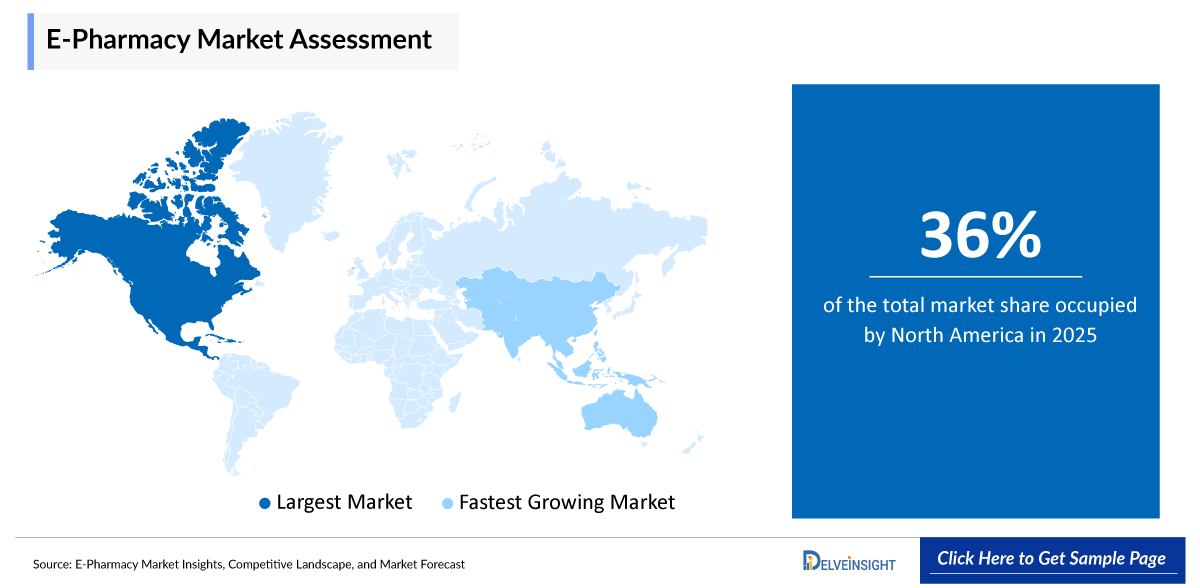
- North America accounted for the largest share of the e-pharmacy market at 36% in 2025, while Asia-Pacific is anticipated to register the fastest growth through 2034.
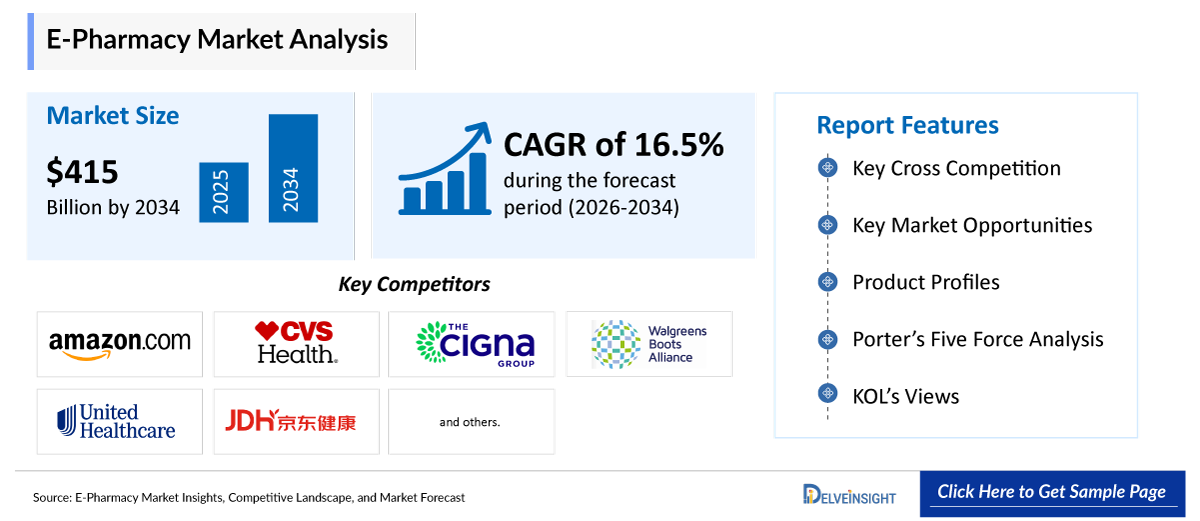
An e-pharmacy is an online pharmacy that sells and delivers prescription and over-the-counter medications, wellness products, vitamins and supplements, and personal care and healthcare products through websites and mobile applications, with home or mail delivery. The scope encompasses mail-order and direct integrated pharmacies that dispense and deliver medications, online pharmacy marketplaces and platforms that aggregate pharmacies and products, and the prescription verification, pharmacist consultation, insurance, and delivery services that support them, and it is increasingly linked to telehealth and electronic prescriptions. Leading participants include large technology and retail companies, pharmacy benefit and integrated pharmacy organizations, and regional online pharmacy platforms, and Amazon operates Amazon Pharmacy following its acquisition of PillPack, CVS Health, Walgreens, and Cigna through Express Scripts and UnitedHealth Group through OptumRx operate integrated and mail-order pharmacy, JD Health and Alibaba Health lead in China, and Apollo, PharmEasy, and Tata 1mg lead in India. The model provides convenience, home delivery, cost savings, and access, and the contemporary market is defined by the entry of large technology and retail players, the integration of telehealth and digital prescriptions, and the evolving regulation of online pharmacy.
E-Pharmacy Market Key Growth Drivers
- Convenience, home delivery, and rising consumer adoption, with a substantial share of patients using online prescription services for convenience, cost savings, and medication management.
- Growth of chronic disease and the demand for mail-order and automatic refill of maintenance medications delivered to the home.
- Cost savings and price transparency, with online pharmacies offering medication cost savings compared with traditional pharmacies and subscription models such as the Amazon RxPass.
- Penetration of smartphones and mobile applications that enable mobile-first online pharmacy, particularly in Asia.
- Integration of e-pharmacy with telehealth and electronic prescriptions that connects the prescription to the fulfillment.
- Entry of large technology and retail players, including Amazon following its acquisition of PillPack, that expand and intensify the market.
- Improved access to medications for rural and underserved populations with limited access to physical pharmacies.
Key Companies in E-Pharmacy Market
The leading participants in the e-pharmacy market include the following:
- Amazon.com, Inc.
- CVS Health Corporation
- The Cigna Group
- Walgreens Boots Alliance, Inc.
- UnitedHealth Group Incorporated
- JD Health International Inc.
- Alibaba Health Information Technology Limited
- Apollo Hospitals Enterprise Limited
- API Holdings Limited
- Redcare Pharmacy N.V., and others
For illustrative purposes, only the top 10 companies are listed in the Table of Contents. The report may include analysis and references to additional companies relevant to the market assessment.
E-Pharmacy Market Size
The following table summarizes the headline market metrics for the global e-pharmacy market across the base year and the forecast horizon.
|
Report Metrics |
Details |
|
2025 Market Size |
USD 105.00 billion |
|
2034 Projected Market Size |
USD 415.00 billion |
|
Growth Rate (2026-2034) |
16.5% CAGR |
|
Largest Market |
North America (36% share in 2025) |
|
Fastest Growing Market |
Asia-Pacific |
|
Market Structure |
Fragmented |
All market values are expressed in USD and represent DelveInsight estimates synthesized from primary and secondary research.
Factors Contributing to the Growth of the E-Pharmacy Market
E-Pharmacy Market Drivers
- Convenience, Home Delivery, and Rising Consumer Adoption: The foundational driver of the e-pharmacy market is the convenience of ordering medications online and receiving them at home, and the rising adoption of online pharmacy by consumers. Online pharmacies offer the same medications and services as physical pharmacies with the added convenience of ordering from home, home delivery, and the avoidance of travel and waiting, and a substantial share of patients now use online prescription services for convenience, cost savings, and improved medication management. Consumers value the ability to order prescriptions and health products from any location, to schedule delivery and refills, to consult pharmacists remotely, and to manage their medications digitally, and the growth of e-commerce and the changed expectations of consumers have accelerated the adoption of online pharmacy. The convenience of home delivery is particularly valuable for patients managing chronic conditions, patients with mobility limitations, and patients in areas with limited pharmacy access, and it became especially valuable during health emergencies. Online pharmacies provide the ordering, delivery, refill, and consultation services that make medication management convenient, and the adoption of these services grows with the broader adoption of e-commerce and digital health. As consumers adopt online pharmacy for its convenience and as the expectation of home delivery becomes established, demand for e-pharmacy grows. The convenience of home delivery and the rising adoption of online pharmacy by consumers anchor the growth of the e-pharmacy market across the forecast period.
- Growth of Chronic Disease and Mail-Order Refill Demand: The growth of chronic disease and the demand for the mail-order and automatic refill of maintenance medications drive the adoption of e-pharmacy. The rising prevalence of chronic conditions such as diabetes, hypertension, and cardiovascular disease, driven by the aging population and lifestyle factors, increases the number of patients requiring regular, ongoing medication, and these maintenance medications are well suited to mail-order and automatic refill delivered to the home. Mail-order and integrated pharmacies deliver maintenance medications in convenient supplies with automatic refills and free shipping, and they manage the ongoing medication of chronic patients, reducing the burden of repeated pharmacy visits and improving adherence. Amazon Pharmacy offers refills in convenient supplies, Express Scripts delivers medications with automatic refills and free shipping, and integrated pharmacies manage the maintenance medications of large populations. The growth of chronic disease enlarges the population of patients requiring ongoing medication, and the convenience and adherence benefits of mail-order and automatic refill drive the adoption of e-pharmacy for maintenance medications. As chronic disease grows and as patients seek the convenience and adherence of mail-order refill, demand for e-pharmacy grows. The growth of chronic disease and the demand for mail-order and automatic refill of maintenance medications sustain demand for e-pharmacy across the forecast period.
- Cost Savings and Price Transparency: The cost savings and price transparency offered by online pharmacies drive consumer adoption and the growth of the market. Online pharmacies offer medication cost savings compared with traditional brick-and-mortar pharmacies, and digital prescription management can deliver savings of 15 to 80 percent on medication costs, driven by lower overhead, price comparison, discount programs, and subscription models. Subscription and discount models, such as the Amazon RxPass subscription that provides eligible medications for a flat monthly fee, discount card programs, and direct-to-consumer pricing, provide transparent and lower prices that attract price-sensitive consumers. The transparency of online pricing enables consumers to compare prices and to find the lowest cost, and the pressure of high and opaque medication prices drives consumers toward the savings and transparency of online pharmacy. Online pharmacies compete on price and transparency, and the savings they offer are a powerful driver of adoption, particularly for uninsured, underinsured, and price-sensitive patients. As consumers seek to reduce medication costs and to access transparent pricing, they adopt online pharmacies that offer savings and transparency. The cost savings and price transparency of online pharmacies drive consumer adoption and sustain demand for e-pharmacy across the forecast period.
- Penetration of Smartphones and Mobile Applications: The penetration of smartphones and the adoption of mobile applications drive the growth of mobile-first e-pharmacy, particularly in Asia and emerging markets. The widespread adoption of smartphones and mobile internet enables consumers to order medications and health products through mobile applications, and mobile applications provide a convenient, accessible interface for ordering, refills, consultation, and delivery. Mobile-first online pharmacy is particularly important in Asia, where high mobile penetration and the adoption of mobile commerce have driven the growth of large online pharmacy platforms, and platforms in China and India reach large populations through mobile applications. Mobile applications integrate ordering, prescription upload, pharmacist consultation, delivery tracking, and payment, and they provide the primary channel through which many consumers access online pharmacy. The growth of smartphone penetration, the adoption of mobile commerce, and the convenience of mobile applications enlarge the reach and adoption of e-pharmacy, particularly in emerging markets with large and growing mobile populations. As smartphone penetration grows and as consumers adopt mobile applications for healthcare, demand for mobile e-pharmacy grows. The penetration of smartphones and the adoption of mobile applications sustain the growth of e-pharmacy and reinforce the leadership of the mobile application platform across the forecast period.
- Integration with Telehealth and Electronic Prescriptions: The integration of e-pharmacy with telehealth and electronic prescriptions connects the prescription to the fulfillment and drives the adoption of online pharmacy. The growth of telehealth and virtual care generates prescriptions that flow directly to online pharmacies for fulfillment and delivery, and the integration of the virtual visit, the electronic prescription, and the online pharmacy creates a seamless digital care and medication experience. Electronic prescribing enables prescriptions to be transmitted directly to online pharmacies, and online pharmacies work with prescribers and telehealth providers to receive and fulfill prescriptions, with online pharmacies coordinating with prescribing providers and insurers. The linkage of telehealth and e-pharmacy is particularly powerful for conditions managed through virtual care, including chronic conditions, behavioral health, and direct-to-consumer treatment, and direct-to-consumer platforms combine virtual consultation, prescription, and pharmacy fulfillment. The integration of telehealth, electronic prescriptions, and online pharmacy creates a seamless digital pathway from consultation to medication, and the growth of telehealth drives the growth of the online pharmacy that fulfills its prescriptions. As telehealth grows and as it integrates with online pharmacy, demand for e-pharmacy grows. The integration of e-pharmacy with telehealth and electronic prescriptions sustains demand for e-pharmacy across the forecast period.
- Entry of Large Technology and Retail Players: The entry of large technology and retail players expands and intensifies the e-pharmacy market and drives its growth. Large technology and retail companies have entered online pharmacy, bringing scale, fulfillment capability, technology, and consumer reach, and Amazon launched Amazon Pharmacy following its acquisition of the online pharmacy PillPack, applying its fulfillment, delivery, and membership capabilities to pharmacy. The entry of these players pressures incumbents to improve delivery, price, and convenience, and it expands the market by bringing online pharmacy to large consumer bases and by investing in fulfillment and technology. Established pharmacy and retail companies, including CVS Health, Walgreens, and Walmart, have expanded their online pharmacy and delivery, integrated pharmacy and pharmacy benefit organizations operate large mail-order pharmacies, and technology and retail platforms in Asia and other regions reach large populations. The competition and investment brought by large technology and retail players accelerate the improvement and adoption of online pharmacy, and their scale and reach expand the market. As large technology and retail players enter and invest in online pharmacy and as competition intensifies, the market expands and matures. The entry of large technology and retail players expands and intensifies the e-pharmacy market and sustains its growth across the forecast period.
- Improved Access for Rural and Underserved Populations: The improvement of access to medications for rural and underserved populations drives the adoption of e-pharmacy and expands its reach. Many rural and underserved communities have limited access to physical pharmacies, with pharmacy deserts and the closure of pharmacies leaving patients without convenient access to medications, and online pharmacy provides access to medications through home delivery regardless of the proximity of a physical pharmacy. Online pharmacies deliver medications to patients in rural and underserved areas, patients with mobility limitations, and patients without convenient access to a pharmacy, expanding access to medications and improving adherence. The value of online pharmacy for access is particularly high in rural areas, in emerging markets with limited pharmacy infrastructure, and for populations with mobility or transportation barriers. The expansion of access to medications for underserved populations is both a driver of adoption and a benefit that supports the growth and the social value of online pharmacy. As online pharmacy expands access to medications for rural and underserved populations, and as the closure of physical pharmacies increases the need for delivery, demand for e-pharmacy grows. The improvement of access to medications for rural and underserved populations sustains demand for e-pharmacy across the forecast period.
E-Pharmacy Market Restraints
The e-pharmacy market faces several interrelated restraints that temper its growth. The foremost is the complexity and uncertainty of the regulatory environment, since online pharmacy is regulated to ensure prescription verification and safety, and the regulations vary and evolve across jurisdictions, with the sale of prescription medications requiring valid prescriptions and, for controlled substances, restrictions on online prescribing, and with some markets, such as India, operating under pending and uncertain e-pharmacy rules that create regulatory risk. The prevalence of illegitimate and rogue online pharmacies is a significant restraint, since a large proportion of online pharmacies operate unlawfully, with one evaluation classifying a substantial share of online pharmacies as rogue and capable of selling prescription medications without authorization, and the distribution of counterfeit, unapproved, and falsified medicines, including counterfeit pills laced with dangerous substances, undermines trust and prompts enforcement, and the challenge of distinguishing safe from hazardous sites requires verification. The requirement for prescription verification and the risk of prescription fraud add complexity and cost, and the restrictions on the online sale of controlled substances constrain certain categories. Data privacy and security obligations add compliance burden and risk, since online pharmacy processes sensitive health and payment data. Logistics and cold chain requirements for certain medications add complexity and cost to delivery. Resistance from traditional pharmacies, concerns about the loss of pharmacist oversight and counseling, and the integration with insurance and pharmacy benefit systems create friction. The cross-border complexity of serialization, licensing, and compliance raises the cost of expansion. Together these factors moderate the pace and scope of adoption and require online pharmacies to demonstrate safety, legitimacy, compliance, and value to sustain growth.
E-Pharmacy Market Segment Analysis
The global e-pharmacy market is segmented by drug type (prescription medications and over the counter products), by product category (skin care, vitamin and dietary supplements, cold and flu, weight management and others), by platform (mobile application and websites), by business model (mail order and direct pharmacy and online pharmacy) and by geography (North America, Europe, Asia-Pacific, and the Rest of the World).
By Drug Type
Dominant Subsegment: Prescription Medications.
The prescription medications category is expected to dominate the market. The prescription medications segment accounted for a 60% share of the e-pharmacy market in 2025. Prescription medications, dispensed against a valid prescription and including the maintenance medications for chronic conditions, represent the largest share of the e-pharmacy market because they account for the majority of pharmacy value and are well suited to mail-order and automatic refill. The dominance of the segment reflects the large value of prescription medications, the suitability of maintenance medications for mail-order delivery, and the central role of prescription fulfillment in the online pharmacy model. Online pharmacies dispense and deliver prescription medications against valid prescriptions, mail-order and integrated pharmacies manage the maintenance medications of chronic patients with automatic refill, and the fulfillment of prescriptions is the core function of most online pharmacies. The growth of chronic disease, the value of prescription medications, and the suitability of maintenance medications for delivery drive the prescription medications segment, and the integration of telehealth and electronic prescriptions reinforces the flow of prescriptions to online pharmacies. While over-the-counter products, wellness, and personal care products are important and high-volume categories, the value and centrality of prescription medications sustain the leadership of the prescription medications segment. The value of prescription medications, their suitability for mail-order, and the growth of chronic disease sustain the leadership of the prescription medications segment across the forecast period.
By Product Category
Dominant Subsegment: Vitamins and Dietary Supplements.
The vitamins and dietary supplements category is expected to dominate the market. The vitamins and dietary supplements segment accounted for a 28% share of the e-pharmacy market within the product categories in 2025. Vitamins and dietary supplements, encompassing vitamins, minerals, supplements, and nutritional products, are the leading product category among the over-the-counter and wellness products sold by online pharmacies because they are high-volume, frequently repurchased, and well suited to online sale and subscription. The dominance of the segment reflects the high demand for vitamins and supplements, the suitability of these products for online purchase and repeat delivery, and the growth of the wellness and preventive health market. Consumers purchase vitamins and supplements online for convenience, selection, and price, and they frequently repurchase them, making them a large and recurring category for online pharmacies. The growth of health and wellness awareness, the preventive use of supplements, and the convenience of online purchase and subscription drive the vitamins and dietary supplements category. Online pharmacies offer a broad selection of vitamins and supplements alongside medications and other health products. While skin care, cold and flu, weight management, and other categories are significant, the high demand, repeat purchase, and suitability for online sale of vitamins and supplements sustain the leadership of the vitamins and dietary supplements segment among product categories across the forecast period.
By Platform
Dominant Subsegment: Mobile Applications.
The mobile applications category is expected to dominate the market. The mobile applications segment accounted for a 58% share of the e-pharmacy market in 2025. Mobile applications, through which consumers order medications and health products on smartphones, have become the leading platform for online pharmacy because of the widespread adoption of smartphones, the convenience of mobile ordering, and the mobile-first nature of online pharmacy in Asia and emerging markets. The dominance of the segment reflects the penetration of smartphones, the convenience and accessibility of mobile applications, and the mobile-first adoption of online pharmacy in the large markets of Asia. Mobile applications integrate ordering, prescription upload, pharmacist consultation, delivery tracking, and payment in a convenient interface, and they provide the primary channel through which many consumers, particularly in Asia and emerging markets, access online pharmacy. The large online pharmacy platforms in China and India reach their large populations primarily through mobile applications, and mobile applications drive the adoption of online pharmacy in markets with high mobile penetration. As smartphone penetration grows and as consumers adopt mobile applications for healthcare and commerce, the mobile application platform leads the market. The penetration of smartphones, the convenience of mobile applications, and the mobile-first adoption of online pharmacy in Asia sustain the leadership of the mobile applications segment across the forecast period.
By Business Model
Dominant Subsegment: Mail-Order and Direct Pharmacy.
The mail-order and direct pharmacy category is expected to dominate the market. The mail-order and direct pharmacy segment accounted for a 56% share of the e-pharmacy market in 2025. Mail-order and direct pharmacy, in which an integrated online pharmacy dispenses and delivers medications directly to the patient, represents the largest business model because it includes the large mail-order pharmacies of integrated pharmacy and pharmacy benefit organizations and the direct pharmacy operations of large technology and retail companies. The dominance of the segment reflects the scale of mail-order pharmacy in the delivery of maintenance medications, the operation of large direct pharmacies by integrated organizations and technology and retail companies, and the control and integration that the direct model provides. Integrated pharmacy and pharmacy benefit organizations operate large mail-order pharmacies that deliver maintenance medications to large populations, and technology and retail companies operate direct online pharmacies that dispense and deliver medications, controlling the fulfillment and the customer relationship. The mail-order and direct model provides the scale, control, and integration to manage prescriptions, insurance, and delivery, and it dominates the value of prescription fulfillment. While the online pharmacy marketplace model, in which platforms aggregate pharmacies and products, is significant and dominant in some markets, the scale of mail-order and direct pharmacy in the delivery of prescription medications sustains the leadership of the mail-order and direct pharmacy segment across the forecast period.
E-Pharmacy Market Region Analysis
Dominant Region: North America
North America accounted for a 36% share of the global e-pharmacy market in 2025, representing the highest regional market share globally. The leadership of the region reflects the large value of its pharmacy market, the scale of mail-order and integrated pharmacy, the entry of large technology and retail players, and the advanced adoption of online pharmacy. The United States is the largest national market, supported by the large value of its prescription drug market, the scale of mail-order pharmacy operated by pharmacy benefit and integrated pharmacy organizations, the entry and expansion of Amazon Pharmacy and the online operations of the large pharmacy and retail chains, and the advanced adoption of online prescription services by consumers. The regulation of online pharmacy under the Ryan Haight Act and the Federal Food, Drug, and Cosmetic Act, the accreditation of legitimate online pharmacies by the National Association of Boards of Pharmacy, and the integration of online pharmacy with insurance and telehealth shape the market. The leading participants, including Amazon, CVS Health, Walgreens, Cigna through Express Scripts, and UnitedHealth Group through OptumRx, operate in the region, and the adoption of mail-order, direct, and online pharmacy is advanced. The value of the pharmacy market, the scale of mail-order and integrated pharmacy, the entry of technology and retail players, and the adoption of online pharmacy reinforce the leadership of the region. The combination of market value, mail-order scale, competitive entry, and adoption sustains the position of North America as the largest regional market across the forecast period.
Fastest Growing Region: Asia-Pacific
Asia-Pacific is projected to register the fastest compound annual growth rate through 2034. The region combines large populations, high smartphone penetration, the rapid growth of large online pharmacy platforms, and the expansion of access to medications, which drives the fast growth of the e-pharmacy market. China, India, and Japan are the principal national markets, supported by the large online pharmacy platforms of China, including JD Health and Alibaba Health, the large and growing online pharmacy platforms of India, including Apollo, PharmEasy, and Tata 1mg, the high penetration of smartphones and mobile commerce, and the expansion of access to medications for large and dispersed populations. The mobile-first adoption of online pharmacy, the growth of the middle class, the rising demand for convenient access to medications, and the investment in online pharmacy platforms drive the rapid growth of the region. The large populations, the high mobile penetration, and the growth of online pharmacy platforms create substantial and fast-growing demand, though the regulatory environment, particularly in India, is evolving. The combination of population scale, mobile penetration, platform growth, and access expansion positions Asia-Pacific as the fastest-growing regional market, and it is a central focus of the global and regional players.
E-Pharmacy Market Regional Commentary
North America
North America leads the market, supported by the large value of its pharmacy market, the scale of mail-order and integrated pharmacy, the entry of large technology and retail players, and the advanced adoption of online pharmacy. The United States dominates the region through the value of its prescription drug market, the scale of mail-order pharmacy, and the entry and expansion of Amazon Pharmacy and the large chains. The regulation of online pharmacy under the Ryan Haight Act and by the Food and Drug Administration, and the accreditation of legitimate pharmacies, shape the market.
Europe
Europe is a substantial market shaped by the growth of online pharmacy, the regulation of online sale under the European Union Falsified Medicines Directive and the common logo for legal online pharmacies, and the presence of large online pharmacies including Redcare Pharmacy and DocMorris. Germany, the United Kingdom, France, Italy, and Spain are the principal national markets, supported by the growth of online pharmacy, the liberalization of online prescription sale in some markets, and the adoption of home delivery. Demand is sustained by convenience, cost, and the growth of online pharmacy platforms.
Asia-Pacific
Asia-Pacific is the fastest-growing region, driven by large populations, high smartphone penetration, the growth of large online pharmacy platforms, and the expansion of access across China, India, and Japan. The large platforms of China and India, mobile-first adoption, and the growth of the middle class sustain rapid growth, though the regulatory environment, particularly the pending e-pharmacy rules in India, is evolving. The region is a central focus of global and regional players.
Rest of World
The Rest of World, spanning Latin America, the Middle East, and Africa, represents an emerging opportunity as online pharmacy expands and as access to medications grows. Growth is supported by the growth of e-commerce and smartphones, the expansion of access to medications, and the entry of online pharmacy platforms, though adoption and regulation vary by market. Global and regional players pursue these markets through online pharmacy platforms suited to expanding e-commerce and access.
E-Pharmacy Market Competitive Landscape
The global e-pharmacy market is classified as Fragmented. A large number of participants competes across regions and models, including large technology and retail companies, integrated pharmacy and pharmacy benefit organizations, and regional online pharmacy platforms and marketplaces, and no single participant holds a dominant share of the global market, which is divided across regional markets with distinct leaders. Competition centers on the breadth of products and medications, the speed and reach of delivery, price and cost savings, the integration of telehealth and prescriptions, the convenience of the platform, and safety and legitimacy, and the entry of large players, acquisitions, and platform investment intensify the contest.
The competitive landscape is evaluated across the following dimensions:
- Market concentration: Fragmented, with large technology and retail companies, integrated pharmacy and pharmacy benefit organizations, and regional online pharmacy platforms and marketplaces, and no single participant holding a dominant global share, with distinct leaders across regional markets.
- Leading players: Amazon, CVS Health, Walgreens, Cigna through Express Scripts, and UnitedHealth Group through OptumRx lead in North America, JD Health and Alibaba Health lead in China, Apollo, PharmEasy, and Tata 1mg lead in India, and Redcare Pharmacy and DocMorris lead in Europe.
- Geographic reach: The market is divided across regional markets with distinct leaders, and large technology and retail companies expand across markets while regional platforms lead their home markets.
- Product portfolio strength: Competitive advantage rests on the breadth of medications and products, the speed and reach of delivery and fulfillment, the integration of prescriptions and telehealth, and the convenience and trust of the platform.
- Pipeline strength: Development is concentrated in delivery speed and fulfillment, mobile and platform experience, integration with telehealth and prescriptions, subscription and pricing models, and safety and verification.
- Strategic partnerships: Collaboration spans partnerships with prescribers, telehealth providers, insurers, and pharmacy benefit organizations, and alliances that extend delivery, fulfillment, and reach.
- M&A activity: Consolidation has shaped the field, exemplified by the acquisition of the online pharmacy PillPack by Amazon and the acquisition of care navigation and diagnostics companies by integrated pharmacy organizations, alongside consolidation of regional platforms.
- Innovation focus: Innovation is shifting toward faster delivery and fulfillment, mobile and platform experience, integration with telehealth, subscription and transparent pricing, and safety and verification.
- Regulatory standing: Compliance with the regulation of online pharmacy, including prescription verification, the restrictions on controlled substances under the Ryan Haight Act, the enforcement of the Food and Drug Administration, and accreditation by the National Association of Boards of Pharmacy, and legitimacy and safety, are decisive competitive credentials and a principal axis of competition among the leaders.
E-Pharmacy Market Recent Developmental Activities
- In 2020, Amazon.com, Inc. launched Amazon Pharmacy, an online and mobile prescription medication ordering and fulfillment service, following its acquisition of the online pharmacy PillPack, and it later added the RxPass subscription and faster delivery. Strategic significance: the launch brought a large technology and fulfillment company into online pharmacy and intensified competition on delivery, price, and convenience.
- In 2023, CVS Health Corporation acquired the home health and care navigation company Signify Health, integrating home diagnostics and care navigation into its pharmacy and insurance ecosystem. Strategic significance: the acquisition extended an integrated pharmacy and insurance organization into home-based care and reflected the convergence of pharmacy, care, and delivery.
- In 2023, the Drug Enforcement Administration proposed rules under the Ryan Haight Act on the prescribing of controlled substances via telemedicine, generating 38,000 public comments, and the flexibilities were extended while the rules were developed. Strategic significance: the proposed rules and their extension shaped the online prescribing of controlled substances and the integration of telehealth and online pharmacy.
- In 2023 and 2024, the Delhi High Court directed the Government of India to frame a policy for the online sale of medicines, noting that the draft e-pharmacy rules had been pending for several years. Strategic significance: the direction reflected the evolving and uncertain regulation of e-pharmacy in India, a large and fast-growing market.
- In 2024, the United States Drug Enforcement Administration and the Department of Justice charged defendants in a scheme that distributed counterfeit pharmaceuticals through fake online pharmacies, and the Drug Enforcement Administration reinforced the recommendation to verify online pharmacies through the National Association of Boards of Pharmacy. Strategic significance: the enforcement and the emphasis on verification underscored the importance of legitimacy and safety in online pharmacy.
- In 2024 and 2025, JD Health International Inc. and Alibaba Health Information Technology Limited advanced their online pharmacy and healthcare platforms in China, delivering medications and health products to large populations through mobile platforms. Strategic significance: the developments reinforced the leadership of the large online pharmacy platforms in the large and fast-growing Chinese market.
- In 2024 and 2025, Apollo Hospitals Enterprise Limited, API Holdings Limited, and Tata 1mg advanced their online pharmacy platforms in India, delivering medications, health products, and diagnostic services through mobile applications. Strategic significance: the developments reinforced the growth of online pharmacy in India despite the evolving regulatory environment.
- In 2024 and 2025, Amazon.com, Inc. expanded the delivery, pricing, and reach of Amazon Pharmacy, including faster and same-day delivery in select markets and the RxPass subscription for eligible medications. Strategic significance: the expansion intensified competition on delivery speed and price and advanced the convenience of online pharmacy.
- In 2024 and 2025, Redcare Pharmacy N.V. and DocMorris advanced their online pharmacy platforms in Europe, expanding the online sale and delivery of medications and health products. Strategic significance: the developments reinforced the growth of online pharmacy in Europe under the evolving regulation of online prescription sale.
- In 2024 and 2025, integrated pharmacy and pharmacy benefit organizations advanced their mail-order and direct pharmacy, delivering maintenance medications with automatic refill and integrating pharmacy with insurance and care. Strategic significance: the developments reinforced the scale and role of mail-order and integrated pharmacy in the delivery of prescription medications.
- In 2024 and 2025, direct-to-consumer platforms integrated telehealth consultation, prescription, and online pharmacy fulfillment for conditions including chronic care, behavioral health, and wellness. Strategic significance: the integration of telehealth and online pharmacy created seamless digital care and medication pathways and expanded the direct-to-consumer model.
- In 2024 and 2025, the leading participants advanced delivery, mobile platforms, telehealth integration, subscription pricing, and safety and verification across online pharmacy. Strategic significance: the convergence of the leaders on delivery, mobile, telehealth, pricing, and safety confirmed these as the defining axes of competition and signaled a market maturing into convenient, integrated, and trusted online pharmacy.
E-Pharmacy Market Segmentation
- E-Pharmacy Market Assessment by Drug Type
- Prescription Medications
- Over-the-Counter Products
- E-Pharmacy Market Assessment by Product Category
- Skin Care
- Vitamins and Dietary Supplements
- Cold and Flu
- Weight Management
- Others
- E-Pharmacy Market Assessment by Platform
- Mobile Applications
- Websites
- E-Pharmacy Market Assessment by Business Model
- Mail-Order and Direct Pharmacy
- Online Pharmacy
E-Pharmacy Market Assessment by Geography
- North America E-Pharmacy Market Assessment
- United States E-Pharmacy Market Size in USD million (2023-2034)
- Canada E-Pharmacy Market Size in USD million (2023-2034)
- Mexico E-Pharmacy Market Size in USD million (2023-2034)
- Europe E-Pharmacy Market Assessment
- Germany E-Pharmacy Market Size in USD million (2023-2034)
- United Kingdom E-Pharmacy Market Size in USD million (2023-2034)
- France E-Pharmacy Market Size in USD million (2023-2034)
- Italy E-Pharmacy Market Size in USD million (2023-2034)
- Spain E-Pharmacy Market Size in USD million (2023-2034)
- Rest of Europe E-Pharmacy Market Size in USD million (2023-2034)
- Asia-Pacific E-Pharmacy Market Assessment
- China E-Pharmacy Market Size in USD million (2023-2034)
- Japan E-Pharmacy Market Size in USD million (2023-2034)
- India E-Pharmacy Market Size in USD million (2023-2034)
- Australia E-Pharmacy Market Size in USD million (2023-2034)
- South Korea E-Pharmacy Market Size in USD million (2023-2034)
- Rest of Asia-Pacific E-Pharmacy Market Size in USD million (2023-2034)
- Rest of the World E-Pharmacy Market Assessment
- Middle East E-Pharmacy Market Size in USD million (2023-2034)
- Africa E-Pharmacy Market Size in USD million (2023-2034)
- South America E-Pharmacy Market Size in USD million (2023-2034)
E-Pharmacy Market Recent Industry Trends and Milestones (2023-2026):
|
Category |
Key Developments |
|
E-Pharmacy Market Platform Advancement |
The period was defined by the advancement of delivery, mobile platforms, and the integration of telehealth. Amazon expanded Amazon Pharmacy with faster delivery and the RxPass subscription, JD Health and Alibaba Health advanced their platforms in China, and Apollo, PharmEasy, and Tata 1mg advanced their platforms in India. Integrated pharmacy organizations advanced mail-order and direct pharmacy, and direct-to-consumer platforms integrated telehealth and pharmacy. Together these advances concentrated competition in fast, mobile, integrated, and trusted online pharmacy. |
|
E-Pharmacy Market Service Expansion |
Service expansion advanced along three axes. The first is delivery and fulfillment, as participants expanded faster and same-day delivery and fulfillment reach. The second is telehealth and prescription integration, as participants connected virtual consultation, electronic prescriptions, and pharmacy fulfillment. The third is pricing and subscription, as participants introduced subscription and transparent pricing models such as the Amazon RxPass. Participants also expanded product breadth across medications, wellness, vitamins, and personal care, and enhanced mobile platforms and safety and verification. |
|
E-Pharmacy Market Investment |
Investment was shaped by the entry of large players and the growth of regional platforms. Amazon entered and expanded online pharmacy following its acquisition of PillPack, integrated pharmacy organizations acquired care and diagnostics companies, and regional platforms in China, India, and Europe invested in delivery, mobile, and reach. Investment flowed into delivery and fulfillment, mobile platforms, telehealth integration, and safety and verification, and participants navigated the evolving regulation of online pharmacy across markets. |
|
Company Strategy |
The unifying strategic theme is the delivery of convenient, integrated, and trusted online pharmacy at scale. Amazon is advancing fulfillment, delivery, and subscription, CVS Health, Walgreens, Cigna, and UnitedHealth Group are advancing integrated and mail-order pharmacy, JD Health and Alibaba Health are advancing platforms in China, and Apollo, PharmEasy, and Tata 1mg are advancing platforms in India. Redcare Pharmacy and DocMorris are advancing platforms in Europe. Across the field, strategy centers on delivery, mobile, telehealth integration, pricing, and safety. |
|
Emerging Technologies |
The defining emerging technologies are mobile platforms that integrate ordering, prescription upload, consultation, and delivery; the integration of telehealth and electronic prescriptions that connects consultation to fulfillment; faster and same-day delivery and fulfillment; subscription and transparent pricing models; and verification and safety technologies that authenticate legitimate pharmacies and medications. Supporting these are artificial intelligence for personalization and adherence, integration with insurance and pharmacy benefit systems, and cold chain and logistics for specialty medications. Across these, the trajectory is toward online pharmacy that is convenient, fast, mobile, integrated with telehealth, and trusted, improving access, adherence, and affordability of medications. |
E-Pharmacy Market Startup Funding and Investment Trends
Investment in the e-pharmacy field has concentrated on models and technologies that make the access to medications more convenient, more integrated, and more affordable, namely online pharmacy platforms and marketplaces, direct-to-consumer telehealth and pharmacy, delivery and fulfillment, and adherence and medication management. Because the market is fragmented and divided across regions with large technology, retail, and integrated pharmacy leaders and regional platforms, innovators pursue differentiated platforms, direct-to-consumer models, or technologies that serve defined markets or that a larger participant can absorb. The table below summarizes representative companies advancing the next generation of online pharmacy.
|
Company |
Total Funding |
Funding Stage |
Main Product/Offering |
Core Technology |
|
API Holdings Limited |
Venture-backed |
Commercial stage |
PharmEasy online pharmacy |
Online pharmacy and diagnostics platform |
|
Hims & Hers Health, Inc. |
Publicly listed |
Commercial stage |
Direct-to-consumer care and pharmacy |
Telehealth and pharmacy fulfillment |
|
Request for unlocking the report of the @ E-Pharmacy Market Insights | ||||
Capital formation in this field is shaped by the presence of large technology, retail, and integrated pharmacy leaders and regional platforms, so investors have favored companies that introduce differentiated online pharmacy platforms, direct-to-consumer telehealth and pharmacy models, or fulfillment and delivery technologies that serve defined markets or complement the leaders. Online pharmacy platforms and marketplaces are a clear thesis, providing convenient access to medications and health products, particularly in emerging markets. Direct-to-consumer telehealth and pharmacy constitutes a second thesis, integrating consultation, prescription, and fulfillment, and pharmacy fulfillment and delivery a third, providing the infrastructure for online pharmacy. The archetypal outcome is acquisition by a large technology, retail, or integrated pharmacy company, or growth into a regional leader, exemplified by the acquisition of PillPack by Amazon, which provides a path that sustains investment. The principal risks are the scale and reach of the large participants, the complexity and uncertainty of online pharmacy regulation, the prevalence of illegitimate pharmacies and the importance of trust, and the logistics and compliance of medication delivery.
Key Takeaways from the E-Pharmacy Market Report Study
- Market size analysis for the current e-pharmacy market size (2025), and market forecast for 9 years (2026 to 2034).
- Top key platform, technology, and service developments, mergers, acquisitions, partnerships, and joint ventures that happened over the last 3 years.
- Key companies dominating the global e-pharmacy market.
- Various opportunities available for competitors in the e-pharmacy market space.
- What are the top-performing segments in 2025? How will these segments perform in 2034?
- Which are the top-performing regions and countries in the current e-pharmacy market scenario?
- Which are the regions and countries where companies should concentrate their opportunities for e-pharmacy market growth in the future?
Target audience who can benefit from this e-pharmacy market report study
- E-pharmacy, online pharmacy, and digital health providers
- Research organizations and consulting companies
- E-pharmacy-related organizations, associations, forums, and other alliances
- Government and corporate offices
- Start-up companies, venture capitalists, and private equity firms
- Distributors and traders dealing in e-pharmacy and pharmaceuticals
- Various end-users who want to know more about the e-pharmacy market and the latest technological developments in the e-pharmacy market.

