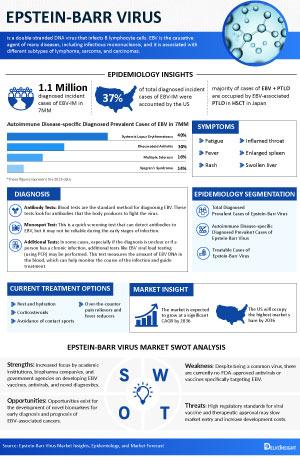
Epstein–Barr Virus Market Summary
Epstein-Barr Virus (EBV) Insights and Trends
- Epstein-Barr Virus (EBV) is also known to cause infectious mononucleosis, a self-limited flu-like illness, in adolescents. EBV is often reactivated, and it employs several mechanisms of evading the host immune system. It has also been implicated in inducing host immune dysfunction, potentially resulting in exacerbation or triggering of inflammatory processes.
- EBV has therefore been linked to several autoimmune diseases, including systemic lupus erythematosus, multiple sclerosis, rheumatoid arthritis, and Sjögren’s syndrome.
- Most people worldwide are infected with the EBV at some point in their lives. It generally causes mild or no symptoms, so many individuals remain unaware of the infection. However, in some cases, it can lead to a more serious condition known as infectious mononucleosis, commonly referred to as “mono” or the “kissing disease.”
- EBV infects around 90% of adults worldwide, with primary infection usually occurring in childhood.
- The age of infection varies by geography, race/ethnicity, and socioeconomic factors, which are important considerations for developing effective EBV vaccination programs.
- According to the Centers for Disease Control and Prevention (CDC), about 9 out of 10 people have been infected with EBV. It is a type of herpes virus that spreads easily through saliva (spit) and other bodily fluids. Most people get EBV as children.
- There is currently no curative treatment for EBV, and management is mainly supportive. Treatment focuses on relieving symptoms such as fever, sore throat, and fatigue through rest, hydration, and pain relievers, while corticosteroids may be used in severe cases.
- Tabelecleucel (EBVALLO) is the first and currently the only allogeneic (donor-derived) T-cell immunotherapy approved by the European Medicines Agency (EMA) for the treatment of patients with relapsed or refractory Epstein–Barr Virus–positive post-transplant lymphoproliferative disease (EBV+ PTLD). However, in January 2026, the US FDA issued a Complete Response Letter (CRL), declining approval on the basis of manufacturing deficiencies rather than concerns related to safety or efficacy.
- The EBV pipeline is limited and scarce, with few key candidates like vidofludimus calcium (IMU-838), mRNA 1189, mRNA-1195, and others focusing on targeted immunotherapy and immune modulation. These therapies aim to address underlying disease mechanisms, highlighting ongoing efforts to move beyond supportive care and fill major unmet needs.
- EBV remains an area of significant unmet need, due to the lack of a preventive vaccine, absence of curative therapies, and limited treatment options for associated complications such as EBV-driven malignancies.
Epstein-Barr Virus (EBV) Market Size and Forecast in the 7MM
- 2025 Epstein-Barr Virus (EBV) Market Size: ~USD XXX million
- 2036 Projected Epstein-Barr Virus (EBV) Market Size: ~USD XXX million
- Epstein-Barr Virus (EBV) Growth Rate (2026–2036): XX% CAGR
-Market-Key-Insights.png)
DelveInsight's ‘Epstein-Barr Virus (EBV) – Market Insights, Epidemiology and Market Forecast – 2036’ report delivers an in-depth understanding of the EBV, historical and forecasted epidemiology, as well as the EBV market trends in the United States, EU4 (Germany, Spain, Italy, and France) and the United Kingdom, and Japan.
The Epstein-Barr Virus (EBV) market report delivers a comprehensive analysis of the current treatment landscape, including standards of care, clinical practices, and evolving therapeutic algorithms. It evaluates EBV patient burden trends, revenue & market share dynamics, peak patient share & therapy uptake analysis, and provides an in-depth market size assessment, and growth rate projections (Historical & Forecast 2022–2036) across global regions. The report highlights key unmet medical needs in Epstein-Barr Virus (EBV) and maps the competitive and clinical landscape to uncover high‑value opportunities, providing a clear outlook on future market growth potential.
Scope of the Epstein-Barr Virus Market Report | |
|
Study Period |
2022–2036 |
|
Historical Year |
2022–2025 |
|
Forecast Period |
2026–2036 |
|
Base Year |
2026 |
|
Geographies Covered |
|
|
EBV Market CAGR (Study period/Forecast period) |
XX% (2026 ̶ 2036) |
|
EBV Epidemiology Segmentation Analysis |
Patient Burden Assessment
|
|
EBV Companies |
|
|
EBV Therapies |
|
|
EBV Market |
Segmented by
|
|
Analysis |
|
Key Factors Driving the Epstein-Barr Virus (EBV) Market
Rising EBV Prevalence
The high and widespread prevalence of EBV, coupled with an aging population and increased immunosuppression-related risk factors (e.g., transplants, cancer therapies), is expected to drive market growth. In the US, a substantial infected population base exists, which is anticipated to increase further by 2036, contributing to a growing clinical and economic burden.
Rising Opportunities in the EBV Market
The EBV market is shifting toward targeted immunotherapies, antiviral agents, and vaccine development, focusing on controlling viral latency and EBV-driven diseases. T-cell therapies and emerging preventive vaccines represent key growth areas. Increasing evidence linking EBV to cancers and autoimmune diseases is further expanding opportunities for immune-modulating and disease-modifying treatments, making EBV a high-potential innovation space.
Emerging EBV Competitive Landscape
Emerging EBV therapies such as Vidofludimus calcium, Ebvax, and others are driving market growth by addressing a high unmet medical need with no established curative treatments. These candidates are shifting the landscape from supportive care to targeted immunotherapy and vaccine-based approaches, expanding treatment options across PTLD, autoimmune diseases, and EBV-associated conditions. This is increasing R&D investment, pipeline activity, and market expansion potential, making EBV a key emerging therapeutic area.
Epstein-Barr Virus (EBV) Understanding and Treatment Algorithm
Epstein-Barr Virus (EBV) Overview and Diagnosis
EBV is a highly prevalent herpesvirus that infects nearly 90% of the global adult population. It is primarily transmitted through saliva and often causes asymptomatic or mild infection, especially in childhood. In adolescents and adults, EBV can lead to infectious mononucleosis (“mono”). The virus establishes lifelong latency in the body and can reactivate under certain conditions. EBV is also associated with several malignancies and lymphoproliferative disorders, particularly in immunocompromised individuals.
Epstein-Barr Virus (EBV) Diagnosis
Diagnosis of EBV is based on a combination of clinical presentation and laboratory testing. Common tests include heterophile antibody tests (Monospot) for rapid screening and EBV-specific serology (e.g., VCA-IgM, VCA-IgG, EBNA) to determine the stage of infection. In certain cases, especially in immunocompromised patients, PCR-based assays are used to detect and quantify EBV DNA. Additional findings, such as atypical lymphocytosis and elevated liver enzymes, may support the diagnosis.
Further details are provided in the report.
Epstein-Barr Virus (EBV) Treatment
There is no curative treatment for EBV, and management is primarily supportive. Care focuses on rest, hydration, and symptomatic relief for fever, sore throat, and fatigue. Analgesics and antipyretics are commonly used to manage discomfort. In severe cases, such as airway obstruction or significant inflammation, corticosteroids may be prescribed. Antiviral therapies have limited clinical benefit and are not routinely recommended. For serious EBV-associated conditions like PTLD, advanced therapies, including immunotherapy, may be utilized.
Further details related to country-based variations are provided in the report.
Epstein-Barr Virus (EBV) Unmet Needs
The section “unmet needs of Epstein-Barr Virus (EBV)” outlines the critical gaps between the current state of patient care, diagnosis, and the ideal & effective management of the disease. It highlights the obstacles experienced by patients, clinicians, and researchers and identifies potential solutions for future progress.
- High global prevalence (~90% adults), but limited prevention strategies and no vaccine to reduce transmission
- Delayed or complex diagnosis due to variable symptoms and need for specialized testing (serology/PCR)
- Lack of curative therapies, with current care mainly supportive and limited targeted treatment options, and others…..
Comprehensive unmet needs insights in Epstein-Barr Virus (EBV) and their strategic implications are provided in the full report.
Epstein-Barr Virus (EBV) Epidemiology
Key Findings from Epstein-Barr Virus (EBV) Epidemiological Analysis and Forecast
- According to secondary analysis, the overall seroprevalence of EBV for children aged 6–19 in the United States was 66.5%. This ranged from 54.1% among 6–8-year-olds to 82.9% among 18–19-year-olds. Males were slightly less likely to be infected than females (64.2% vs. 68.9%).
- EBV infects up to 95% of adults globally. The prevalence of EBV varies by type of EBV and geographic region. EBV type 1 is the most common and is found worldwide, with a higher prevalence in Europe, Asia, North America, and South America.
- EBV resides silently in 19 out of 20 Americans and can cause a small group of immune cells to become abnormal, triggering a widespread immune response against the body’s tissues.
- As per studies, more than 99% of patients with multiple sclerosis have been infected with EBV, which is notably higher than the 90–95% seroprevalence observed in the general population. With improved assay sensitivity and stricter diagnostic criteria, EBV seropositivity in individuals with multiple sclerosis is considered to be nearly 100%.
- As per studies, in lupus patients, the fraction of EBV-infected B cells rises to about 1 in 400 — a 25-fold difference.
- In a comprehensive study, it is reported that EBV infection is a pivotal contributor to multiple sclerosis. The research analyzed data from a large cohort of over 10 million young adults in the US military, among whom 955 individuals were diagnosed with sclerosis during their active duty.
- According to secondary analysis. The study evaluated individuals with rheumatoid arthritis undergoing treatment, comparing clinical and laboratory characteristics based on anti-EBV EA-DR IgG antibody status. A notable proportion (43.9%) tested positive, indicating a significant presence of EBV-related antibodies within this population.
Epstein-Barr Virus (EBV) Drug Chapters & Competitive Analysis
The EBV drug chapter provides a detailed, market-focused review of approved therapies and the emerging pipeline across Phase I–III clinical trials. It covers the mechanism of action, clinical trial data, regulatory approvals, patents, collaborations, and strategic partnerships for each therapy, along with their advantages, limitations, and recent developments. This section offers critical insights into the EBV treatment landscape, supporting market assessment, competitive analysis, and growth forecasting for the EBV therapeutics market.
Approved Therapies for Epstein-Barr Virus (EBV)
Tabelecleucel (EBVALLO): Atara Biotherapeutics and Pierre Fabre Laboratories
Atara Biotherapeutics is recognized as a leader in T-cell immunotherapy, leveraging its allogeneic EBV-specific T-cell platform to develop therapies for cancer and autoimmune diseases. Its lead candidate, tabelecleucel (tab-cel), has received marketing authorization under the brand EBVALLO in the European Economic Area, the United Kingdom, and Switzerland. The company is advancing off-the-shelf T-cell therapies targeting EBV-driven diseases, with tab-cel positioned as its most advanced program for EBV-positive post-transplant lymphoproliferative disease (EBV+ PTLD), particularly in patients who have failed prior therapies such as rituximab-based treatment. The FDA issued a second CRL on January 9, 2026, rejecting the Biologics License Application (BLA) for adult and pediatric patients with Epstein-Barr virus-positive post-transplant lymphoproliferative disease (EBV+ PTLD) after prior therapy.
Note: Detailed marketed therapies assessment of therapies will be provided in the final report.
Epstein-Barr Virus (EBV) Pipeline Analysis
Vidofludimus calcium (IMU-838): Immunic Therapeutics
Vidofludimus calcium is a small molecule investigational drug in development as an oral next-generation treatment option for patients with multiple sclerosis and other chronic inflammatory and autoimmune diseases. It is a broad-spectrum anti-viral effect, which may support lowering the rate of viral infections and reactivations, including EBV reactivation, potentially resulting in slowing potential EBV-related neurodegenerative processes.
Vidofludimus calcium is being tested in several ongoing multiple sclerosis trials, including the twin Phase III ENSURE trials in relapsing multiple sclerosis and the supportive Phase II CALLIPER trial in progressive multiple sclerosis.
Ebvax: Grid Biosciences
Grid’s lead vaccine candidate, Ebvax, is built on the Ferritin Vehicle platform and is being developed to protect against EBV and its associated complications. Ferritin, a naturally occurring protein, self-assembles into spherical nanoparticles, enabling efficient antigen presentation. Ebvax incorporates EBV components fused to ferritin, which is designed to elicit a stronger and more durable immune response compared to conventional vaccine approaches. The Ferritin Vehicleᵀᴹ platform also has broader applicability, allowing incorporation of antigens from other pathogens, such as the COVID-19 spike protein or influenza hemagglutinin.
Ebvax aims to protect against EBV infection, which is often asymptomatic but can lead to conditions such as infectious mononucleosis, EBV-associated cancers, and certain autoimmune diseases later in life. Positioned as a single vaccine approach targeting EBV and its related disease burden, Ebvax is currently in development and has not yet received regulatory approval or biologics licensing.
Comparison of Emerging Epstein-Barr Virus Drugs Under Development | |||||||
|
Drug Name |
Company |
Highest Phase |
Indication |
RoA |
MoA |
Molecule Type |
Anticipated Launch in the US |
|
Vidofludimus calcium (IMU-838) |
Immunic Therapeutics |
III |
Multiple sclerosis |
Oral |
Nuclear receptor-related 1 (Nurr1) activator |
Small molecule |
Information is available in the full report |
|
Ebvax |
Grid Biosciences |
NA |
Prophylactic and therapeutic protection against EBV and related diseases |
NA |
Fused to ferritin and produces a strong and long-lasting immune response |
Vaccine |
Information is available in the full report |
|
RBI-5000 |
Replicate Bioscience |
Preclinical |
Infectious mononucleosis |
NA |
Multiple antigens of the EBV |
srRNA vaccine |
Information is available in the full report |
|
Note: Launch insights are provisional and may change with future report updates or the occurrence of major key catalysts. | |||||||
Note: A detailed emerging therapies assessment will be provided in the final report
Epstein-Barr Virus (EBV) Key Players, Market Leaders and Emerging Companies
- Atara Biotherapeutics
- Pierre Fabre Laboratories
- Immunic Therapeutics
- Grid Biosciences
- Replicate Bioscience, and others
Epstein-Barr Virus (EBV) Drug Updates
- In March 2026, Atara Biotherapeutics announced that a Type A meeting with the US Food and Drug Administration (FDA) had been scheduled to discuss the Complete Response Letter (CRL) to the Biologics License Application (BLA) for tabelecleucel (tab-cel) held by partner Pierre Fabre Pharmaceuticals.
- In March 2026, Immunic announced that the European Patent Office (EPO) had granted a key European patent, EP3713554, directed to label-relevant dosing regimens of lead asset vidofludimus calcium. The patent is expected to protect vidofludimus calcium in Europe until 2038, and may be eligible for a Supplementary Protection Certificate (SPC), which could extend market exclusivity potentially into 2043. This patent was previously granted by the United States Patent and Trademark Office (USPTO) in 2023.
- In February 2026, Immunic announced the presentation of additional data from its Phase II CALLIPER trial evaluating vidofludimus calcium in patients with progressive multiple sclerosis (PMS) at the Americas Committee for Treatment and Research in Multiple Sclerosis (ACTRIMS).
- In November 2025, Atara transferred the BLA to Pierre Fabre Pharmaceuticals, the US pharmaceutical subsidiary of Pierre Fabre Laboratories. As a first step towards resolution, PFP intends to request a Type A meeting and expects it to be granted within 45 days.
Epstein-Barr Virus (EBV) Market Outlook
The EBV market is largely underdeveloped, with current treatment mainly limited to symptomatic and disease-specific care rather than virus-targeted therapies. In infectious mononucleosis, management is mainly supportive, including rest and antipyretics, as it is typically self-limiting. In chronic active EBV (CAEBV), treatment includes immunosuppressants and hematopoietic stem cell transplantation, which is the only curative option but carries a high risk. For EBV-associated malignancies such as Hodgkin lymphoma, nasopharyngeal carcinoma, gastric cancer, and PTLD, therapy relies on chemotherapy, radiation, and immunotherapy (rituximab), targeting the cancer rather than the virus. Tabelecleucel has received approval in Europe for EBV-positive PTLD, marking progress in cell therapy, though availability remains limited globally. Despite strong links between EBV and autoimmune diseases like multiple sclerosis and lupus, there are still no EBV-specific treatments.
The future EBV market is expected to expand with targeted therapies, including EBV-specific T-cell therapy, monoclonal antibodies, and antivirals aimed at viral replication and latency control. Vaccine development is a major transformative opportunity, with candidates such as nanoparticle-based vaccines in early clinical trials. However, significant unmet needs remain, including a lack of approved antivirals or vaccines, challenges of viral latency, and limited early diagnosis tools. Therapeutic innovation is further driven by increasing recognition of EBV’s role in cancers and autoimmune diseases, but vaccine success in preventing conditions like MS and lupus may take many years to confirm, positioning EBV as a high-growth but highly unmet medical need market.
Key findings from Epstein-Barr Virus Market Forecast and Analysis
- Overall, the launch of first-in-class therapies, improved diagnostic approaches, and increasing disease awareness are expected to drive steady growth in the 7MM EBV market from 2022 to 2036, with strong commercial implications for both marketed products and emerging pipelines.
- The US holds the largest EBV market share in 2025, driven by high diagnosis rates, advanced healthcare infrastructure, and strong adoption of emerging and novel treatment approaches.
- The market is shifting toward targeted and disease-modifying strategies, including T-cell-based therapies, antivirals, and vaccines, focusing on viral latency and EBV-driven diseases.
Further details will be provided in the report….
Drug Class/Insights into Leading Emerging and Marketed Therapies in Epstein-Barr Virus (EBV) (2022–2036 Forecast)
The EBV market (2022–2036 forecast) is evolving toward targeted, immune-based, and disease-modifying therapies, focusing on viral persistence, immune dysregulation, and EBV-driven complications, rather than traditional symptomatic care.
- T-cell immunotherapies: EBV-specific T-cell approaches represent a major therapeutic class, with companies advancing off-the-shelf cell therapies to target EBV-driven malignancies. A key example is tabelecleucel (tab-cel) by Atara Biotherapeutics, which has received marketing authorization in Europe, the UK, and Switzerland (EBVALLO). It is primarily used for EBV-positive post-transplant lymphoproliferative disease (EBV+ PTLD), especially in patients who fail prior therapies such as rituximab-based treatment, highlighting its role as a leading disease-specific immunotherapy.
- Targeted immunomodulatory therapies: Vidofludimus calcium, developed by Immunic Therapeutics, is an oral small molecule Nurr1 activator in Phase III for multiple sclerosis, reflecting growing interest in immune regulation strategies linked to EBV-associated autoimmune disease pathways.
- Vaccine-based approaches: Emerging candidates such as Ebvax aim to provide prophylactic and therapeutic protection against EBV, using a ferritin-based platform to generate strong and long-lasting immune responses, representing a key preventive strategy in development.
Further details will be provided in the report….
Epstein-Barr Virus (EBV) Drug Uptake
This section focuses on the uptake rate of potential drugs expected to be launched in the market during the forecast period (2026–2036). The analysis covers the EBV market's uptake by drugs, patient uptake by therapy, and sales of each drug.
The uptake of EBV therapies (2026–2036) is expected to vary by modality and clinical evidence strength. T-cell therapies like tabelecleucel are likely to see strong uptake in EBV-positive PTLD due to existing approvals and clear clinical need. Vaccines such as Ebvax and RBI-5000 are expected to show gradual uptake initially, with potential long-term acceleration if preventive efficacy is proven. Immunomodulatory agents like vidofludimus calcium may achieve moderate uptake, especially in EBV-linked autoimmune conditions. Overall, uptake will be driven by unmet need, regulatory approvals, and expansion into oncology and autoimmune indications.
Further detailed analysis of emerging therapies' drug uptake in the report…
Market Access and Reimbursement of EBV
|
The France Reimbursement for EBV Therapies | |
|
Drug |
Access Program |
|
Tabelecleucel (EBVALLO) |
SMR: Important ASMR: IV (minor) |
NICE is unable to make a recommendation on tabelecleucel (Ebvallo) for treating post‑transplant lymphoproliferative disorder caused by the Epstein‑Barr virus. This is because Pierre Fabre Ltd did not provide an evidence submission. We will review this decision if the company decides to make a submission.
Reimbursement is a crucial factor that affects the drug’s access to the market. Often, the decision to reimburse comes down to the price of the drug relative to the benefit it produces in treated patients. To reduce the healthcare burden of these high-cost therapies, many payment models are being considered by payers and other industry insiders.
Further details are provided in the final report….
Epstein-Barr Virus (EBV) Therapies Price Scenario & Trends
Pricing and analogue assessment of EBV therapies highlights evolving price dynamics structures. This section summarizes the cost of approved treatments, the closest and most appropriate analogue selection for emerging therapies, and the understanding of how pricing influences market access, adherence, and long-term uptake.
Further details are provided in the final report….
Industry Experts and Physician Views for Epstein-Barr Virus (EBV)
To keep up with EBV market trends, we take Key Opinion Leaders (KOLs) and Subject Matter Experts (SMEs) opinions working in the domain through primary research to fill the data gaps and validate our secondary research. Industry experts were contacted for insights on the EBV emerging therapies, evolving treatment landscape, patient adherence to conventional therapies, therapy switching trends, drug adoption and uptake, accessibility challenges, and epidemiology and real-world prescription patterns in EBV, including MD, PhD, Instructor, Postdoctoral Researcher, Professor, Researcher, and others.
DelveInsight’s analysts connected with 10+ KOLs to gather insights; however, interviews were conducted with 6+ KOLs in the 7MM. Centers such as the University School of Medicine in Atlanta, the Berlin Institute of Health at Charité, and the University of Washington School of Medicine, etc. were contacted. Their opinion helps understand and validate current and emerging EBV therapies, highlight unmet medical needs, provide epidemiological context, and support strategic decisions for market access, therapy adoption, and pipeline prioritization in EBV.
What are the KOL Views on Epstein-Barr Virus Market? | |
|
Region |
Key Opinion Leaders (KOLs) and Subject Matter Experts (SMEs) |
|
United States |
“Post-transplant lymphoproliferative disorders (PTLD), most of which are EBV-associated lymphomas, are a frequent cause of morbidity and mortality after organ transplantation. Preventing EBV viremia has strong potential to reduce the incidence of PTLD and limit the need to reduce immunosuppression, thereby helping preserve graft function while improving overall patient outcomes. Effective prevention of EBV viremia remains a significant unmet need in transplant medicine.” |
|
Germany |
“EBV is a driver of multiple sclerosis, where there is an ongoing, lifelong immunological response to EBV that continuously causes damage in the central nervous system [CNS]. In theory, if one can eradicate the virus, the destructive immune response could also resolve. Thus, an EBV antiviral treatment could potentially treat and maybe cure multiple sclerosis.” |
Epstein-Barr Virus Qualitative Analysis: SWOT and Conjoint Analysis
We perform qualitative and market Intelligence analysis using various approaches, such as SWOT analysis and conjoint analysis.
In the SWOT analysis of Epstein-Barr Virus (EBV), strengths, weaknesses, opportunities, and threats in terms of disease diagnosis, patient awareness, patient burden, competitive landscape, cost-effectiveness, and geographical accessibility of therapies are provided.
Conjoint analysis analyzes emerging therapies based on relevant attributes such as safety, efficacy, frequency of administration, route of administration, and order of entry. Scoring is given based on these parameters to analyze the effectiveness of therapy.
The team of analysts analyzes promising emerging therapies based on relevant attributes such as safety, efficacy, frequency of administration, route of administration, and order of entry. In efficacy, the trial’s primary and secondary outcome measures are evaluated, whereas the therapies’ safety is evaluated, wherein the acceptability, tolerability, and adverse events are mainly observed. In addition, the scoring is also based on the route of administration, order of entry, probability of success, and the addressable patient pool for each therapy. According to these parameters, the final weightage score and the ranking of the emerging therapies are decided.
Scope of the Epstein-Barr Virus Market Report
- The Epstein-Barr Virus Market report covers a segment of key events, an executive summary, a descriptive overview of Epstein-Barr Virus (EBV), explaining its causes, signs and symptoms, pathogenesis, and currently available treatments.
- Comprehensive insight has been provided into the epidemiology segments and forecasts, the future growth potential of the diagnosis rate, and disease progression along treatment guidelines.
- Additionally, an all-inclusive account of both the current and emerging treatments, along with the elaborate profiles of late-stage and prominent therapies, will have an impact on the current treatment landscape.
- A detailed review of the Epstein-Barr Virus (EBV) market, historical and forecasted market size, market share by therapies, detailed assumptions, and rationale behind our approach is included in the report, covering the 7MM drug outreach.
- The Epstein-Barr Virus Market report provides an edge while developing business strategies by understanding trends through SWOT analysis and expert insights/KOL views, patient journey, and treatment preferences that help in shaping and driving the 7MM Epstein-Barr Virus (EBV) market.
Epstein-Barr Virus Market Report Insights
- Epstein-Barr Virus (EBV) Patient Population Forecast
- Epstein-Barr Virus (EBV) Therapeutics Market Size
- Epstein-Barr Virus (EBV) Pipeline Analysis
- Epstein-Barr Virus (EBV) Market Size and Trends
- Epstein-Barr Virus (EBV) Market Opportunity (Current and forecasted)
Epstein-Barr Virus Market Report Key Strengths
- Epidemiology‑based (Epi‑based) Bottom‑up Forecasting
- Artificial Intelligence (AI)-enabled Market Research Report
- 11-year forecast
- Epstein-Barr Virus (EBV) Market Outlook (North America, Europe, Asia-Pacific)
- Patient Burden Trends (by geography)
- Epstein-Barr Virus (EBV) Treatment Addressable Market (TAM)
- Epstein-Barr Virus (EBV) Competitive Landscape
- Epstein-Barr Virus (EBV) Major Companies Insights
- Epstein-Barr Virus (EBV) Price Trends and Analogue Assessment
- Epstein-Barr Virus (EBV) Therapies Drug Adoption/Uptake
- Epstein-Barr Virus (EBV) Therapies Peak Patient Share Analysis
Epstein-Barr Virus Market Report Assessment
- Epstein-Barr Virus (EBV) Current Treatment Practices
- Epstein-Barr Virus (EBV) Unmet Needs
- Epstein-Barr Virus (EBV) Clinical Development Analysis
- Epstein-Barr Virus (EBV) Emerging Drugs Product Profiles
- Epstein-Barr Virus (EBV) Market Attractiveness
- Epstein-Barr Virus (EBV) Qualitative Analysis (SWOT and Conjoint Analysis)
Frequently Asked Questions from Epstein-Barr Virus Market
Epstein-Barr Virus Market Insights
- What was the Epstein-Barr Virus (EBV) market size, the market size by therapies, market share (%) distribution in 2025, and what would it look like by 2036? What are the contributing factors for this growth?
- What are the anticipated pricing variations among different geographies for the emerging therapies in the future?
- What can be the future treatment paradigm of Epstein-Barr Virus (EBV)?
- What are the disease risks, burdens, and unmet needs of Epstein-Barr Virus (EBV)? What will be the growth opportunities across the 7MM concerning the patient population with Epstein-Barr Virus (EBV)?
- Who is the major future competitor in the market, and how will the competitors affect their market share?
- What are the current options for the treatment of Epstein-Barr Virus (EBV)? What are the current guidelines for treating Epstein-Barr Virus (EBV) in the US, Europe, and Japan?
Reasons to Buy the Epstein-Barr Virus Market Report
- The Epstein-Barr Virus Market report will help in developing business strategies by understanding the latest trends and changing treatment dynamics driving the Epstein-Barr Virus (EBV) market.
- Bottom‑up forecasting builds from the affected population to product forecasts, delivering a robust, data‑driven approach ideal for new therapies and novel classes.
- Insights on patient burden/disease incidence, evolution in diagnosis, and factors contributing to the change in the epidemiology of the disease during the forecast years.
- Understand the existing market opportunities in varying geographies and the growth potential over the coming years.
- Identifying strong upcoming Epstein-Barr Virus companies in the Epstein-Barr Virus Market will help devise strategies to help get ahead of competitors.
- Detailed analysis and ranking of class-wise potential current and emerging therapies under the conjoint analysis section to provide visibility around leading classes.
- To understand KOLs’ perspectives on the accessibility, acceptability, and compliance-related challenges of existing treatment to overcome barriers in the future.
- Detailed insights into the unmet needs of the existing market so that the upcoming Epstein-Barr Virus companies can strengthen their development and launch strategy.
- This Artificial Intelligence (AI)‑enabled report summarizes and simplifies complex datasets within the report into clear, actionable insights for stakeholders, investors, and healthcare providers, enabling faster, data‑driven decisions.
-pipeline.png&w=256&q=75)