
Essential Thrombocythemia Market Summary
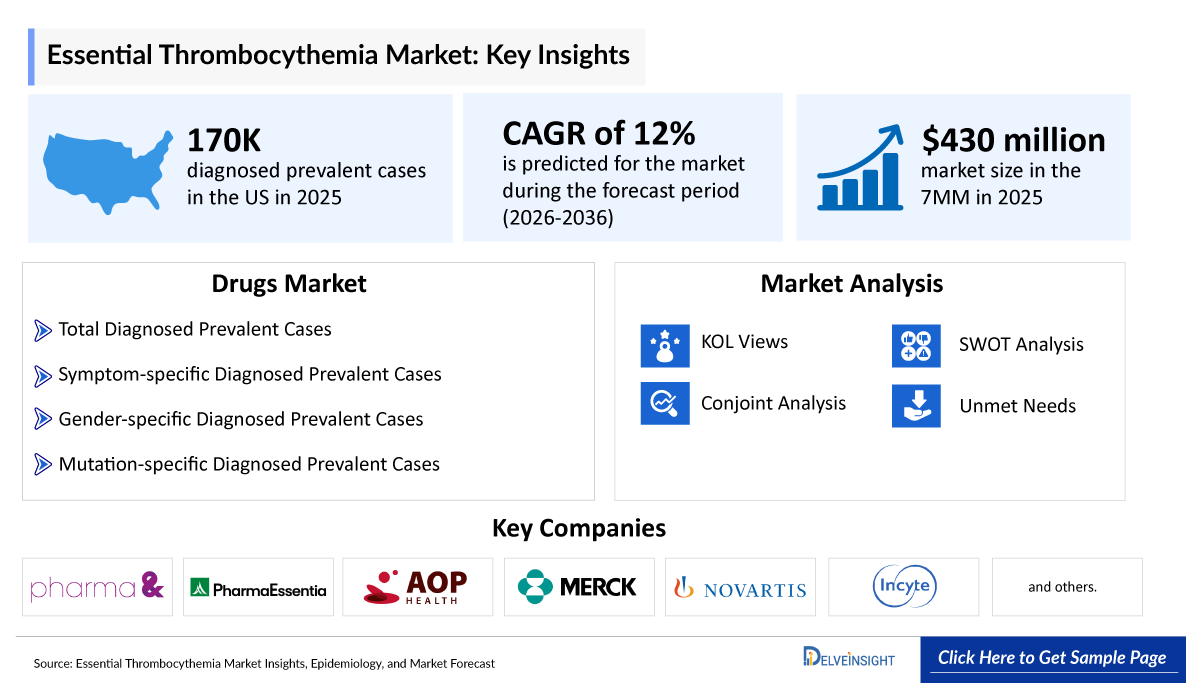
- According to DelveInsight’s analysis, the Essential Thrombocythemia Market Size was found to be ~USD 430 million in the leading markets (the United States, the EU4 (Germany, France, Italy, and Spain), the United Kingdom, and Japan) in 2025.
- The leading Essential Thrombocythemia Companies such as PharmaEssentia, Merck Sharp and Dohme, MorphoSys, Step Pharma, AOP Orphan Pharmaceuticals AG, Incyte Corporation, Janssen Research & Development, and others.
Essential Thrombocythemia Market Insights and Trends
- Essential thrombocythemia is a chronic myeloproliferative neoplasm characterized by an increased number of platelets in the blood. Most commonly diagnosed in women over the age of 50.
- The primary cause of essential thrombocythemia is the overproduction of hematopoietic cells due to the mutations of the JAK2, CALR, or MPL genes. These genes are known as ’driver mutations‘ due to their role in developing a myeloproliferative neoplasm. Though 90% of adults have JAK2, CALR, or MPL mutations, it is not unusual to find children with a molecular triple wildtype status.
- The median estimate of survival among essential thrombocythemia patients is 20 years. However, depending on the age of presentation, this varies, and as a result, the median survival of patients younger than 60 years of age approaches 33 years.
- The most common cause of morbidity and mortality is thrombosis, which occurs among 20% of essential thrombocythemia patients, compared to bleeding complications in 10% of this population.
- The risk of complications of essential thrombocythemia by thrombosis in Japanese patients is lower as compared to Western populations, suggesting that genetic background, such as race, may influence the clinical features.”
- Over time, a minority of individuals with essential thrombocythemia (approximately 10%) may progress to a related condition known as post- essential thrombocythemia myelofibrosis. This transformation is characterized by the development of fibrotic (scar) tissue in the bone marrow, which can lead to anemia, persistent fatigue, and splenomegaly.
- Current treatment of high-risk essential thrombocythemia primarily involves Hydroxyurea as first-line cytoreduction, with Anagrelide or Busulfan used in selected or second-line settings, alongside low-dose Aspirin to reduce thrombotic risk.
- There is only one drug, peginterferon alfa-2a (PEGASYS), approved specifically for the treatment of essential thrombocythemia, and it is authorized exclusively in Europe. In contrast, no therapies have received FDA approval for the treatment of essential thrombocythemia in the US.
- The 2026 NCCN Clinician Guidelines now recognize ropeginterferon alfa-2b-njft (BESREMi) as a Category 1 preferred treatment option for patients with high-risk essential thrombocythemia who have shown inadequate response or loss of response to prior cytoreductive therapy. While ropeginterferon is still under review by the US FDA for essential thrombocythemia, its inclusion in the guidelines is significant and is likely to influence both clinical decision-making and payer coverage.
Essential Thrombocythemia Market Size and Forecast in the 7MM
- 2025 Essential Thrombocythemia Market Size: ~USD 430 million
- 2036 Projected Essential Thrombocythemia Market Size: ~USD XXX million
- Essential Thrombocythemia Growth Rate (2026–2036): ~12% CAGR
Request for Unlocking the Sample Page of the "Essential Thrombocythemia Treatment Market"
Key Factors Driving the Growth of Essential Thrombocythemia Market
-
Rising Essential Thrombocythemia Prevalence
The prevalence of essential thrombocythemia is steadily increasing, serving as a key driver of market growth. In the United States, there were approximately ~170,000 diagnosed prevalent cases in 2025, with numbers expected to rise further by 2036. This growth is primarily driven by improved diagnostic capabilities, heightened disease awareness, and advancements in molecular and genetic testing.
-
Rising Opportunities in Targeted Therapies in Essential Thrombocythemia
Emerging therapies in essential thrombocythemia are increasingly focused on precision-driven and mechanism-based approaches, aiming to improve hematologic response, reduce thrombotic risk, and enhance long-term disease control. Novel agents targeting key disease pathways—such as JAK-STAT signaling, interferon-mediated immune modulation, and epigenetic regulation—are gaining traction. The growing body of clinical evidence supporting next-generation interferons, LSD1 inhibitors, and BET inhibitors highlights significant opportunities for drug developers to address underlying disease biology rather than merely controlling platelet counts. This shift toward disease-modifying therapies is expected to reshape the essential thrombocythemia treatment paradigm, reduce treatment burden, and drive future innovation and market growth.
-
Emerging Essential Thrombocythemia Competitive Landscape
The entry of novel targeted therapies such as ropeginterferon alfa-2b, bomedemstat, pelabresib, and INCA033989 is expected to significantly reshape the essential thrombocythemia market landscape. Their adoption is anticipated to drive market expansion through premium pricing and longer treatment duration, while accelerating the shift from conventional cytoreductive therapies to targeted, disease-modifying approaches.
DelveInsight's ‘Essential Thrombocythemia Market Insights, Epidemiology and Market Forecast – 2036’ report delivers an in-depth understanding of essential thrombocythemia, historical and forecasted epidemiology, as well as the essential thrombocythemia market trends in the United States, EU4 (Germany, Spain, Italy, and France), the United Kingdom, and Japan.
The Essential Thrombocythemia Treatment Market Report delivers a comprehensive analysis of the current treatment landscape, including standards of care, clinical practices, and evolving therapeutic algorithms. It evaluates essential erythromelalgia patient burden trends, revenue & market share dynamics, peak patient share & therapy uptake analysis, and provides an in-depth market size assessment, and growth rate projections (Historical & Forecast 2022–2036) across global regions. The report highlights key unmet medical needs in essential thrombocythemia and maps the competitive and clinical landscape to uncover high‑value opportunities, providing a clear outlook on future market growth potential.
Scope of the Essential Thrombocythemia Market Report | |
|
Study Period |
2022–2036 |
|
Historical Year |
2022–2025 |
|
Forecast Period |
2026–2036 |
|
Base Year |
2026 |
|
Geographies Covered |
|
|
Essential Thrombocythemia CAGR | |
|
Essential Thrombocythemia Epidemiology Segmentation Analysis |
Patient Burden Assessment
|
|
Essential Thrombocythemia Companies |
|
|
Essential Thrombocythemia Therapies |
|
|
Essential Thrombocythemia Market |
Segmented by
|
|
Analysis |
|
Essential Thrombocythemia Understanding
Essential Thrombocythemia Overview
Essential thrombocythemia is a rare, chronic blood disorder characterized by the overproduction of platelets due to abnormal bone marrow activity. It belongs to the group of myeloproliferative neoplasms and is commonly associated with mutations such as JAK2, CALR, or MPL. Patients may be asymptomatic or present with symptoms related to thrombosis, bleeding, headaches, or microvascular disturbances. The condition carries an increased risk of blood clots and, less commonly, progression to myelofibrosis or acute leukemia. Management is risk-adapted, focusing on reducing thrombotic risk through cytoreductive therapy and antiplatelet agents. With appropriate treatment, many patients maintain a near-normal life expectancy.
Essential Thrombocythemia Diagnosis
Diagnosis of essential thrombocythemia is based on a combination of clinical evaluation, laboratory findings, and molecular testing. It typically begins with a complete blood count (CBC) showing persistently elevated platelet levels (≥450 × 10⁹/L). A bone marrow biopsy is performed to confirm increased megakaryocytes with characteristic morphology and to exclude other myeloproliferative disorders. Molecular testing plays a key role, with identification of driver mutations such as JAK2, CALR, or MPL supporting the diagnosis. Secondary causes of thrombocytosis (e.g., infection, inflammation, and iron deficiency) must be ruled out. Diagnosis is ultimately established using standardized criteria such as those from the World Health Organization.
Essential Thrombocythemia Treatment
Essential Thrombocythemia treatment is risk-adapted and primarily aimed at preventing thrombotic complications. Low-risk patients are often managed with observation and low-dose Aspirin for vascular risk reduction. High-risk patients typically require cytoreductive therapy, with Hydroxyurea as the most commonly used first-line agent. Alternatives include Anagrelide and interferon-based therapies (e.g., Peginterferon alfa-2a), particularly in younger patients or those intolerant to hydroxyurea. Treatment choice depends on factors such as age, history of thrombosis, mutation status, and tolerability, with the overall goal of controlling platelet counts and minimizing long-term complications.
Essential Thrombocythemia Unmet Needs
The section “unmet needs of Essential Thrombocythemia” outlines the critical gaps between the current state of patient care, diagnosis, and the ideal & effective management of the disease. It highlights the obstacles experienced by patients, clinicians, and researchers and identifies potential solutions for future progress.
- Challenges in accurate diagnosis and differentiation from similar conditions
- Underdiagnosis due to asymptomatic presentation
- Lack of curative therapies and disease-modifying treatment options
- Resistance or intolerance to first-line treatments like Hydroxyurea
- Persistent thrombotic risk despite therapies such as Aspirin
- Risk of progression to advanced diseases, and others…..
Essential Thrombocythemia Epidemiology
Key Findings from Essential Thrombocythemia Epidemiological Analysis and Forecast
- The United States accounted for ~170,000 Essential Thrombocythemia Diagnosed Prevalent Cases in 2025. These cases are anticipated to increase by 2036.
- In 2025, symptom-specific cases of essential thrombocythemia in the United States were ~68,000 and ~102,000 for asymptomatic and symptomatic, respectively.
- In the United States, essential thrombocythemia shows a clear female predominance, with approximately 65% of cases occurring in females compared to 35% in males, indicating a higher disease burden among women.
- In 2025, among mutation-specific cases of essential thrombocythemia in the US, JAK2 mutations accounted for the highest number of cases (~92,000), significantly exceeding CALR, MPL, and triple-negative subtypes.
- In the United States, essential thrombocythemia shows a risk distribution across very-low-risk, low-risk, intermediate-risk, and high-risk groups, with the highest proportion observed in the high-risk category (~38%) and the lowest in the intermediate-risk group (~15%).
- In essential thrombocythemia, age-specific distribution shows that patients aged >60 years account for the highest proportion of cases, followed by those aged 40–60 years, while individuals aged <40 years represent the lowest share, primarily due to the age-related accumulation of somatic mutations and increased diagnostic detection in older populations.
Numbers are subject to change with report updation, clinical information updates, etc.
Essential Thrombocythemia Epidemiological Segmentation in the 7MM
- Total Essential Thrombocythemia Diagnosed Prevalent Cases
- Essential Thrombocythemia Symptom-specific Diagnosed Prevalent Cases
- Essential Thrombocythemia Gender-specific Diagnosed Prevalent Cases
- Essential Thrombocythemia Mutation-specific Diagnosed Prevalent Cases
- Essential Thrombocythemia Risk-specific Diagnosed Prevalent Cases
- Essential Thrombocythemia Age-specific Diagnosed Prevalent Cases
- Total Essential Thrombocythemia Treated Cases
Essential Thrombocythemia Drug Analysis& Competitive Analysis
The essential thrombocythemia drug chapter provides a detailed, market-focused review of approved therapies and the emerging pipeline across Phase I–III Essential Thrombocythemia Clinical Trials. It covers the mechanism of action, clinical trial data, regulatory approvals, patents, collaborations, and strategic partnerships for each therapy, along with their advantages, limitations, and recent developments. This section offers critical insights into the essential thrombocythemia treatment landscape, supporting market assessment, competitive analysis, and growth forecasting for the essential thrombocythemia therapeutics market.
Essential Thrombocythemia Approved Therapies
-
Peginterferon alfa-2a (PEGASYS): Pharma&
PEGASYS is a Type I interferon; it is made when interferon alfa-2a undergoes the process of pegylation, in which one or more chains of PEG are attached to another molecule. In PEGASYS, a large, branched, mobile PEG is bound to the interferon alfa-2a molecule and provides a selectively protective barrier. There are ongoing shortages of Pegasys (peginterferon alfa-2a) pre-filled syringes in the 135 micrograms/0.5 mL and 180 micrograms/0.5 mL strengths. These shortages are attributed to manufacturing site transitions and broader global supply constraints, and are expected to persist until June 2026.
-
- In August 2024, pharmaand GmbH (pharma&) announced that the EC had granted marketing authorization for a Type II variation for PEGASYS (peginterferon alfa-2a) as a monotherapy treatment for adults with essential thrombocythemia.
- In July 2025, pharmaand GmbH (pharma&) announced today that the MHRA has granted marketing authorization for PEGASYS as a monotherapy treatment for adults with polycythemia vera or essential thrombocythemia.
Note: Detailed marketed therapies assessment of therapies will be provided in the final report.
Essential Thrombocythemia Pipeline Analysis
-
Ropeginterferon alfa-2b (BESREMi): PharmaEssentia and AOP Orphan Pharmaceuticals
Ropeginterferon alfa-2b is a novel, site-specific, monopegylated, stable IFN-α analog. The unique single isoform differentiates ropeginterferon alfa-2b from earlier generation polypegylated IFN, which utilized random pegylation methods and, therefore, contains many isoforms, with each Polyethylene Glycol (PEG) conjugate having its own activity and stability properties. PharmaEssentia is developing ropeginterferon alfa-2b (P1101) for the treatment of essential thrombocythemia with an injection duration every two weeks and making a great effort to achieve much better tolerated and compliance, leading to improved response rates. As per the company’s pipeline, a global Phase III clinical trial evaluating ropeginterferon alfa-2b for essential thrombocythemia is currently underway.
Key milestones for ropeginterferon alfa-2b-njft for the treatment of adult patients with essential thrombocythemia include the SURPASS data readout on January 6, 2025, inclusion in the NCCN Guidelines (Version 1.2026), and regulatory submissions across Japan in 2025.
-
Bomedemstat: Merck
Bomedemstat (MK-3543) is an investigational small molecule, irreversible LSD1 inhibitor being developed by Merck. LSD1 regulates the proliferation of hematopoietic stem cells, playing an essential role in cell differentiation and maturation. Bomedemstat is being evaluated in a wide range of MPNs, including essential thrombocythemia. Bomedemstat has US FDA, Orphan Drug Designation (ODD), and Fast Track Designation (FTD) for the treatment of essential thrombocythemia.
Comparison of Emerging Drugs Under Development | |||||||
|
Drug Name |
Company |
Highest Phase |
Indication |
RoA |
MoA |
Molecule Type |
Anticipated Launch in the US |
|
Ropeginterferon alfa-2b (BESREMi) |
PharmaEssentia and AOP Orphan Pharmaceuticals |
III |
Essential thrombocythemia |
SC |
Binds to IFN-αR |
Recombinant IFN-α2b protein |
2026 |
|
Bomedemstat (MK-3543/IMG-7289) |
Merck |
III |
Essential thrombocythemia |
Oral |
Lysine-specific Demethylase-1 (LSD1) inhibitor |
Small molecule |
2027 |
|
Pelabresib (CPI-0610) |
Novartis |
I/II |
Adults with essential thrombocythemia (Arm 4) |
Oral |
BET inhibitor |
Small molecule |
Information is available in the full report |
|
INCA033989 |
Incyte |
I |
Essential thrombocythemia |
Oral |
Calreticulin inhibitors |
Monoclonal antibody |
Information is available in the full report |
|
Note: Launch insights are provisional and may change with future report updates or the occurrence of major key catalysts. | |||||||
Essential Thrombocythemia Companies, Market Leaders, and Emerging Companies
- Pharma&
- PharmaEssentia
- AOP Orphan Pharmaceuticals
- Merck
- Novartis
- Incyte, and others
Essential Thrombocythemia Drug Updates
- As per the Q4 financial presentation of Merck, the approval of bomedemstat for the treatment of essential thrombocythemia is anticipated in 2027.
- In January 2026, PharmaEssentia announced positive topline results from its Phase IIb EXCEED-essential thrombocythemia clinical trial of ropeginterferon alfa-2b-njft in patients with essential thrombocythemia.
- In January 2026, PharmaEssentia announced that the US Food and Drug Administration (FDA) had accepted the Company’s supplemental Biologics License Application (sBLA) for ropeginterferon alfa-2b-njft for the treatment of adult patients with essential thrombocythemia. The user fee target date is August 30, 2026.
Essential Thrombocythemia Market Outlook
The Essential Thrombocythemia Market Outlook is progressively expanding, driven by high unmet medical needs and continuous therapeutic advancements. Essential thrombocythemia is a rare hematologic disorder characterized by excessive platelet production, increasing the risk of thrombosis and serious complications such as stroke or myocardial infarction. Current treatment focuses on risk-adapted management to reduce clotting risk and control symptoms. Low-dose Aspirin is widely used as a first-line therapy to prevent platelet aggregation and reduce thrombotic events.
Cytoreductive therapy is central for high-risk patients, especially those with platelet counts >1 million/μL, with Hydroxyurea as the first-line agent. Alternatives include Anagrelide and interferon-based therapies such as Peginterferon alfa-2a, which are important for younger patients or those with treatment intolerance. Busulfan is used in select cases due to safety concerns. Clinical evidence highlights the importance of achieving a complete hematologic response as it reduces thrombotic risk and disease progression. Combination approaches with Aspirin and cytoreductive therapy further improve outcomes. Interferons demonstrate strong clinical response and potential disease-modifying effects.
Despite progress, there remain key gaps, including a lack of curative therapies, treatment resistance, and long-term safety concerns. Emerging therapies such as ropeginterferon alfa-2b and bomedemstat are being developed to deliver targeted treatment and durable disease control with a shift toward personalized medicine. Overall, the launch of first-in-class therapies, improved diagnostic approaches, and increasing disease awareness are expected to drive steady growth in the 7MM essential thrombocythemia market from 2022–2036, with strong commercial implications for both marketed products and emerging pipelines.
- According to the estimates, the largest Essential Thrombocythemia Market Size was captured by the United States, i.e., ~USD 265 million in 2025.
- In 2025, anagrelide led the US Essential Thrombocythemia Market, capturing approximately 35% of the therapy-wise share, followed by another therapy at ~27%.
- Regional Essential Thrombocythemia Market Dynamics show the United States leading in revenue, while Japan and Europe demonstrate steady growth, driven by rising prevalence, improved diagnostics, and increasing adoption of advanced therapies.
- The entry of mid- to late-stage candidates such as ropeginterferon alfa-2b and bomedemstat is expected to intensify competition in the essential thrombocythemia treatment landscape during the forecast period.
Essential Thrombocythemia Drug Class/Insights into Leading Emerging and Marketed Therapies (2022–2036 Forecast)
The Essential Thrombocythemia Treatment Landscape is evolving toward mechanism-based and disease-modifying therapies, moving beyond traditional cytoreduction to targeted and long-acting approaches.
- Interferon-based therapies (disease-modifying biologics): Agents such as Ropeginterferon alfa-2b (BESREMi) and Peginterferon alfa-2a act via IFN-α receptor binding, offering durable hematologic and molecular responses. These therapies are gaining traction as preferred long-term options, supported by regulatory approvals in Europe and the UK. However, Pegasys currently faces supply constraints through mid-2026, which may impact short-term adoption.
- Epigenetic and targeted small molecules: Bomedemstat (Merck) represents a novel LSD1 inhibitor targeting abnormal megakaryopoiesis, with potential disease-modifying effects in late-stage development.
- Mutation-directed and novel biologics: Early-stage therapies like INCA033989 (Incyte) focus on CALR-mutated disease, representing a shift toward precision medicine by directly targeting disease-driving mutations.
- Established cytoreductive backbone: Conventional therapies such as Hydroxyurea and Anagrelide continue to dominate current management, particularly for rapid platelet control, though they lack disease-modifying potential.
Overall, the Essential Thrombocythemia Market is transitioning toward targeted therapies and interferon-based approaches that offer long-term disease control and potential modification, while novel epigenetic and mutation-specific agents are expected to drive the next wave of innovation in essential thrombocythemia.
Essential Thrombocythemia Drug Uptake
This section focuses on the uptake rate of potential Essential Thrombocythemia drugs expected to be launched in the market during the forecast period (2026–2036). The analysis covers the essential thrombocythemia market's uptake by drugs, patient uptake by therapy, and sales of each drug. The uptake is anticipated to vary across interferon-based biologics, targeted small molecules, and conventional cytoreductive therapies.
Recently emerging agents such as Ropeginterferon alfa-2b and approved Peginterferon alfa-2a are expected to witness moderate to strong uptake, supported by their disease-modifying potential, durable responses, and increasing physician preference for long-acting therapies. Additionally, late-stage pipeline candidates like Bomedemstat are projected to gain traction due to their novel mechanisms targeting disease biology.
The shift toward these newer therapies is primarily driven by the limitations of traditional treatments such as Hydroxyurea and Anagrelide, which mainly provide cytoreduction without altering disease progression. Increasing emphasis on long-term disease control, molecular response, and improved safety profiles is accelerating the adoption of targeted approaches.
Essential Thrombocythemia Market Access and Reimbursement
- France
The France Reimbursement for Essential Thrombocythemia Therapies | |
|
Drug |
Access Program |
|
Peginterferon alfa-2a (PEGASYS) |
SMR: Important |
Reimbursement is a crucial factor that affects the drug’s access to the market. Often, the decision to reimburse comes down to the price of the drug relative to the benefit it produces in treated patients. To reduce the healthcare burden of these high-cost therapies, many payment models are being considered by payers and other industry insiders.
Essential Thrombocythemia Therapies Price Scenario & Trends
Pricing and analogue assessment of essential thrombocythemia therapies highlights evolving price dynamics structures. This section summarizes the cost of approved treatments, the closest and most appropriate analogue selection for emerging therapies, and the understanding of how pricing influences market access, adherence, and long-term uptake.
Further details are provided in the final report….
Essential Thrombocythemia Industry Experts and Physician Views
To keep up with Essential Thrombocythemia Market Trends, we take Key Opinion Leaders (KOLs) and Subject Matter Experts (SMEs) opinions working in the domain through primary research to fill the data gaps and validate our secondary research. Industry experts were contacted for insights on the essential thrombocythemia emerging therapies, evolving treatment landscape, patient adherence to conventional therapies, therapy switching trends, drug adoption and uptake, accessibility challenges, and epidemiology and real-world prescription patterns in essential thrombocythemia, including MD, PhD, Instructor, Postdoctoral Researcher, Professor, Researcher, and others.
DelveInsight’s analysts connected with 10+ KOLs to gather insights; however, interviews were conducted with 6+ KOLs in the 7MM. Centers such as the University of North Carolina at Chapel Hill, the University of Tokyo Hospital, and King’s College London, etc. were contacted. Their opinion helps understand and validate current and emerging essential thrombocythemia therapies, highlight unmet medical needs, provide epidemiological context, and support strategic decisions for market access, therapy adoption, and pipeline prioritization in essential thrombocythemia.
Region |
Key Opinion Leaders (KOLs) and Subject Matter Experts (SMEs) |
|
United States |
“Our goals in essential thrombocythemia are particularly around the prevention of thrombosis and bleeding and the improvement of symptoms when we can. There has been an evidence-driven, stepwise approach to how we treat [patients with] essential thrombocythemia. First, low-dose aspirin: I think there is a fair amount of agreement in our guidelines that JAK2 mutated patients have a slightly higher risk of thrombosis in those settings and might benefit from an aspirin even in lower-risk settings…higher-risk patients being older or having had prior vascular events, perhaps leukocytosis, perhaps difficult symptoms.” |
|
Germany |
“Prevention and mitigation of cardiovascular events, such as thrombohemorrhagic complications, have been the main goal of treatment development for patients with essential thrombocythemia and polycythemia vera. An improved understanding of these myeloproliferative neoplasms, including the identification of driver mutations in JAK2, CALR, and MPL, has opened the door to treatments that enable the natural history of these diseases to be altered.” |
Essential Thrombocythemia Qualitative Analysis: SWOT and Conjoint Analysis
We perform qualitative and Essential Thrombocythemia Drugs Market Intelligence analysis using various approaches, such as SWOT analysis and conjoint analysis. In the SWOT analysis of essential thrombocythemia, strengths, weaknesses, opportunities, and threats in terms of disease diagnosis, patient awareness, patient burden, competitive landscape, cost-effectiveness, and geographical accessibility of therapies are provided. Conjoint analysis analyzes emerging therapies based on relevant attributes such as safety, efficacy, frequency of administration, route of administration, and order of entry. Scoring is given based on these parameters to analyze the effectiveness of therapy.
The team of analysts analyzes promising emerging therapies based on relevant attributes such as safety, efficacy, frequency of administration, route of administration, and order of entry. In efficacy, the trial’s primary and secondary outcome measures are evaluated, whereas the therapies’ safety is evaluated, wherein the acceptability, tolerability, and adverse events are mainly observed. In addition, the scoring is also based on the route of administration, order of entry, probability of success, and the addressable patient pool for each therapy. According to these parameters, the final weightage score and the ranking of the emerging therapies are decided.
Scope of the Essential Thrombocythemia Market Report
- The Essential Thrombocythemia Therapeutics Market Report covers a segment of key events, an executive summary, a descriptive overview, explaining its causes, signs and symptoms, pathogenesis, and currently available treatments.
- Comprehensive insight has been provided into the Essential Thrombocythemia Epidemiology segments and forecasts, the future growth potential of the diagnosis rate, and disease progression along treatment guidelines.
- Additionally, an all-inclusive account of both the current and emerging treatments, along with the elaborate profiles of late-stage and prominent therapies, will have an impact on the current Essential Thrombocythemia Treatment landscape.
- A detailed review of the Essential Thrombocythemia Therapeutics Market, historical and forecasted Essential Thrombocythemia Market Size, Essential Thrombocythemia Drugs Market Share by therapies, detailed assumptions, and rationale behind our approach is included in the report, covering the 7MM drug outreach.
- The Essential Thrombocythemia Therapeutics Market Report provides an edge while developing business strategies by understanding trends through SWOT analysis and expert insights/KOL views, patient journey, and treatment preferences that help in shaping and driving the 7MM Essential Thrombocythemia Drugs Market.
Essential Thrombocythemia Market Report Insights
- Essential Thrombocythemia Patient Population Forecast
- Essential Thrombocythemia Therapeutics Market Size
- Essential Thrombocythemia Pipeline Analysis
- Essential Thrombocythemia Market Size and Trends
- Essential Thrombocythemia Market Opportunity (Current and forecasted)
Essential Thrombocythemia Market Report Key Strengths
- Epidemiology‑based (Epi‑based) Bottom‑up Forecasting
- Artificial Intelligence (AI)-enabled Market Research Report
- 11-year forecast
- Essential Thrombocythemia Market Outlook (North America, Europe, Asia-Pacific)
- Patient Burden Trends (by geography)
- Essential Thrombocythemia Treatment Addressable Market (TAM)
- Essential Thrombocythemia Competitive Landscape
- Essential Thrombocythemia Major Companies Insights
- Essential Thrombocythemia Price Trends and Analogue Assessment
- Essential Thrombocythemia Therapies Drug Adoption/Uptake
- Essential Thrombocythemia Therapies Peak Patient Share Analysis
Essential Thrombocythemia Market Report Assessment
- Essential Thrombocythemia Current Treatment Practices
- Essential Thrombocythemia Unmet Needs
- Essential Thrombocythemia Clinical Development Analysis
- Essential Thrombocythemia Emerging Drugs Product Profiles
- Essential Thrombocythemia Market Attractiveness
- Essential Thrombocythemia Qualitative Analysis (SWOT and Conjoint Analysis)
Key Questions Answered in the Essential Thrombocythemia Market Report
Essential Thrombocythemia Market Insights
- What was the essential thrombocythemia market size, the Essential Thrombocythemia treatment market size by therapies, market share (%), distribution in 2025, and what would it look like by 2036? What are the contributing factors for this growth?
- What are the anticipated pricing variations among different geographies for the emerging therapies in the future?
- What can be the future treatment paradigm of essential thrombocythemia?
- What are the disease risks, burdens, and Essential Thrombocythemia unmet needs? What will be the growth opportunities across the 7MM concerning the patient population with essential thrombocythemia?
- Who is the major future competitor in the market, and how will the competitors affect their market share?
- What are the current options for the treatment of essential thrombocythemia? What are the current guidelines for treating essential thrombocythemia in the US, Europe, and Japan?
Reasons to Buy the Essential Thrombocythemia Market Report
- The Essential Thrombocythemia Therapeutics Market Report will help in developing business strategies by understanding the latest trends and changing treatment dynamics driving the essential thrombocythemia drugs market.
- Bottom-up forecasting builds from the affected population to product forecasts, delivering a robust, data-driven approach ideal for new therapies and novel classes.
- Insights on patient burden/disease Essential Thrombocythemia Incidence, evolution in diagnosis, and factors contributing to the change in the epidemiology of the disease during the forecast years.
- Understand the existing market opportunities in varying geographies and the growth potential over the coming years.
- Identifying strong upcoming players in the Essential Thrombocythemia Drugs Market will help devise strategies to help get ahead of competitors.
- Detailed analysis and ranking of class-wise potential current and emerging therapies under the conjoint analysis section to provide visibility around leading classes.
- To understand KOLs’ perspectives on the accessibility, acceptability, and compliance-related challenges of existing treatment to overcome barriers in the future.
- Detailed insights into the unmet needs of the existing market so that the upcoming players can strengthen their development and launch strategy.
- This Artificial Intelligence (AI)-enabled report summarizes and simplifies complex datasets within the report into clear, actionable insights for stakeholders, investors, and healthcare providers, enabling faster, data-driven decisions.
Stay updated with us for Recent Articles



