Ewing Sarcoma Market Summary
Ewing Sarcoma Insights and Trends
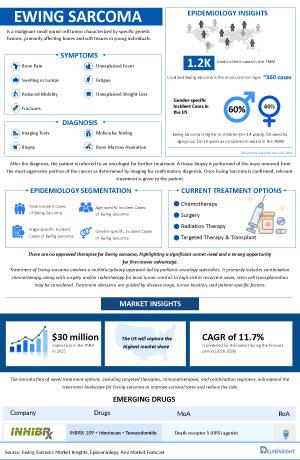
- Ewing sarcoma is a malignant small round cell tumor characterized by specific genetic fusions, primarily affecting bones and soft tissues in young individuals.
- Ewing sarcoma typically originates in the diaphysis and diaphyseal metaphyseal regions of long bones, as well as in the pelvis and ribs, though it can develop in virtually any bone. Extraskeletal forms of Ewing sarcoma account for approximately 12% of cases and can arise across a broad range of anatomical sites.
- Ewing sarcoma is the second most common malignant bone tumor in children and young adults, following osteosarcoma. Around 80% of cases occur in patients younger than 20 years.
- In Ewing sarcoma, occurrence in patients older than 30 years is relatively uncommon, and when it does occur, the tumors are more likely to arise in soft tissues rather than bone.
- Ewing sarcoma shows a male predominance, with a male-to-female ratio of approximately 1.4:1.
- According to DelveInsight’s analysis, Ewing sarcoma market size was found to be ~USD 30 million in the leading markets (the United States, the EU4 (Germany, France, Italy, and Spain), the United Kingdom, and Japan) in 2025.
- The highest number of incident cases of Ewing sarcoma were observed in the United States. On the other hand, among EU4 countries, the highest number of Ewing sarcoma cases were observed in Germany, whereas Japan accounted for the lowest number of cases in the 7MM in 2025.The prognosis for Ewing sarcoma has improved over the years due to advances in treatment. The 5-year survival rate for localized Ewing sarcoma is around 70–80%, while the survival rate for metastatic disease is lower, around 30–40%. However, it is important to note that survival rates can vary depending on individual factors and the response to treatment.
- There are no approved therapies for Ewing sarcoma, highlighting a significant unmet need and a strong opportunity for first-mover advantage.
- Treatment of Ewing sarcoma involves a multidisciplinary approach led by pediatric oncology specialists. It primarily includes combination chemotherapy, along with surgery and/or radiotherapy for local tumor control. In high-risk or recurrent cases, stem cell transplantation may be considered. Treatment decisions are guided by disease stage, tumor location, and patient-specific factors.
- First-line therapy for metastatic Ewing Sarcoma is similar to that for localized disease and utilizes the same chemotherapy backbone with adequate local control of both primary and metastatic sites.
- Prominent Ewing sarcoma companies, including Inhibrx, SEED therapeutics, Jazz Pharmaceuticals, and others, primarily undertake the development of therapies for Ewing sarcoma. These key companies focus on developing treatments specifically for patients in the second line and above of treatment.
Ewing Sarcoma Market Size and Forecast in the 7MM
- 2025 Ewing sarcoma Market Size: ~USD 30 million
- 2036 Projected Ewing sarcoma Market Size: ~USD 90 million
- Ewing sarcoma Growth Rate (2026–2036): 11.7% CAGR
DelveInsight's ‘Ewing Sarcoma – Market Insights, Epidemiology and Market Forecast – 2036’ report delivers an in-depth understanding of the Ewing sarcoma, historical and forecasted epidemiology, as well as the Ewing sarcoma market trends in the United States, EU4 (Germany, Spain, Italy, and France) and the United Kingdom, and Japan.
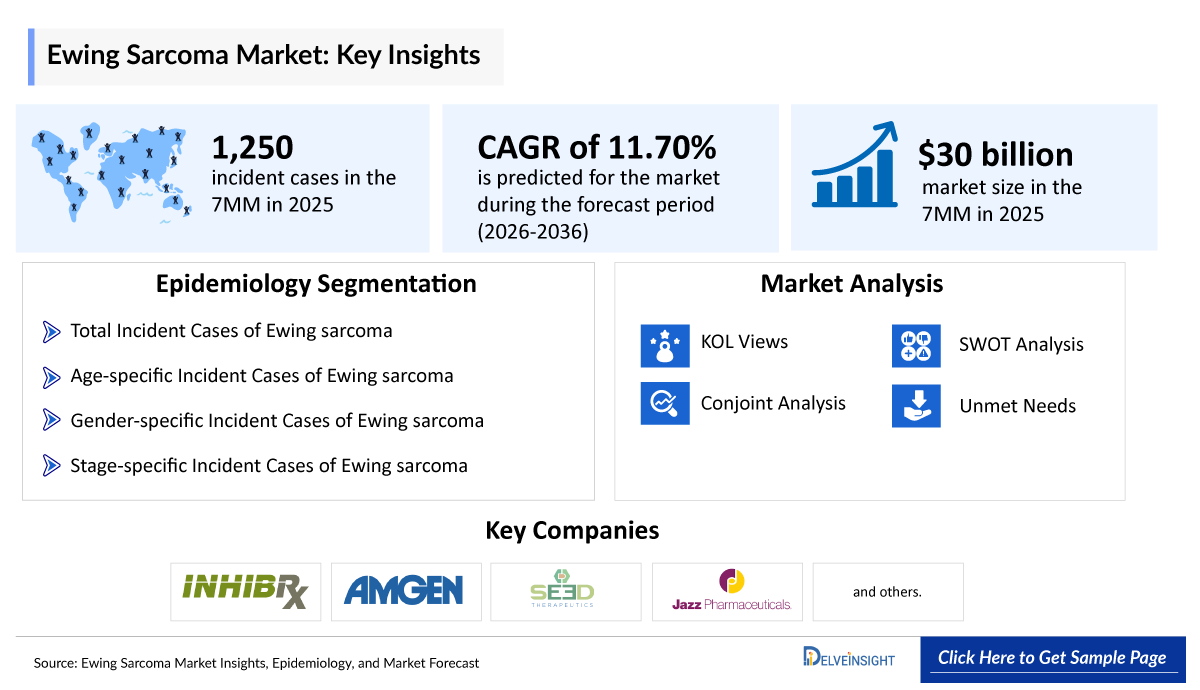
The Ewing Sarcoma market report delivers a comprehensive analysis of the current treatment landscape, including standards of care, clinical practices, and evolving therapeutic algorithms. It evaluates Ewing sarcoma patient burden trends, revenue & market share dynamics, peak patient share & therapy uptake analysis, and provides an in-depth market size assessment and growth rate projections (Historical & Forecast 2022–2036) across global regions. The report highlights key unmet medical needs in Ewing sarcoma and maps the competitive and clinical landscape to uncover high‑value opportunities, providing a clear outlook on future market growth potential.
| Scope of the Ewing Sarcoma Market Report | |
|
Study Period |
2022–2036 |
|
Historical Year |
2022–2025 |
|
Forecast Period |
2026–2036 |
|
Base Year |
2026 |
|
Geographies Covered |
|
|
Ewing Sarcoma Market CAGR (Study period/Forecast period) |
11.7% (2026 ̶ 2036) |
|
Ewing Sarcoma Epidemiology Segmentation Analysis |
Patient Burden Assessment
|
|
Ewing Sarcoma Companies |
|
|
Ewing sarcoma Therapies |
|
|
Ewing sarcoma Market |
Segmented by
|
|
Analysis |
|
Key Factors Driving the Ewing Sarcoma Market
Rising Ewing Sarcoma Diagnosis
Although Ewing sarcoma is a rare malignancy, improving diagnostic techniques and increasing awareness are contributing to a steady rise in diagnosed cases, particularly among children and adolescents. Enhanced use of molecular diagnostics and imaging has enabled earlier and more accurate detection, thereby expanding the treatable patient pool and driving market growth.
Rising Opportunities in Ewing Sarcoma
The Ewing sarcoma treatment landscape is witnessing growing innovation, with increasing focus on targeted therapies, immunotherapies, and novel agents addressing fusion-driven oncogenesis. The lack of effective options in relapsed and metastatic settings presents a significant opportunity for emerging therapies to capture market share. Additionally, supportive regulatory frameworks such as orphan drug designations, increasing clinical trial activity, and improving access to specialized oncology care are expected to enhance treatment uptake and drive market expansion over the forecast period.
Emerging Ewing Sarcoma Competitive Landscape
Some of the Ewing sarcoma drugs in clinical trials include Lurbinectedin, Ozekibart (INBRX-109), Xaluritamig, ST-01156, and others
Ewing Sarcoma Understanding and Treatment Algorithm
Ewing Sarcoma Overview
Ewing sarcoma (also known as Ewing sarcoma) is a cancerous tumor that usually begins growing in a bone. It occurs primarily in children and young adults, often appearing during the teen years. Although Ewing sarcoma can develop in any bone, it usually affects the long bones, such as the thighbone (femur), shinbone (tibia), and upper arm bone (humerus). The bones of the pelvis are also often affected. Occasionally, the tumor begins in the muscles and soft tissues. The most common symptoms are stiffness, pain, swelling, or tenderness in the bone or the tissue surrounding the bone.
Ewing Sarcoma Diagnosis
The patient’s journey begins with symptoms such as persistent bone pain even at rest, swelling, and a large palpable mass on the affected bone. Followed by a visit to the orthopedics, where the patient is suggested diagnostic tests such as MRI, CT scan, and plain radiography. After the diagnosis patient is referred to an oncologist for further treatment. A tissue biopsy is performed of the mass removed from the most aggressive portion of cancer as determined by imaging for confirmatory diagnosis. Once Ewing Sarcoma is confirmed, relevant treatment is given to the patient.
Further details are provided in the report.
Ewing Sarcoma Treatment
The treatment of Ewing sarcoma involves a multidisciplinary approach integrating systemic chemotherapy, surgery, and/or radiation therapy. Multi-agent chemotherapy remains the backbone of treatment due to the high risk of micro metastatic disease. For newly diagnosed localized and metastatic patients, standard first-line regimens include VDC/IE (vincristine, doxorubicin, and cyclophosphamide alternating with ifosfamide and etoposide), which continues to be the preferred standard of care, along with other intensive combinations such as VIDE and VAIA in select settings. These regimens are typically administered in a neoadjuvant and adjuvant setting combined with local control measures such as surgery and/or radiotherapy.
In the relapsed or refractory setting, treatment options remain limited and are primarily chemotherapy-based. Commonly used and guideline-supported regimens include cyclophosphamide plus topotecan and irinotecan plus temozolomide (with or without vincristine), along with other options such as high-dose ifosfamide and gemcitabine-based combinations. Participation in clinical trials evaluating emerging targeted therapies and novel combinations is strongly recommended due to the high unmet need and lack of curative options in advanced disease.
Further details related to country-based variations are provided in the report.
Ewing Sarcoma Unmet Needs
The section “unmet needs of Ewing sarcoma” outlines the critical gaps between the current state of patient care, diagnosis, and the ideal & effective management of the disease. It highlights the obstacles experienced by patients, clinicians, and researchers and identifies potential solutions for future progress.
- Need for novel therapies
- Limited access to experienced sarcoma pathologists
- Delays in early diagnosis and timely treatment
- Lack of reliable biomarkers for prognosis and treatment response, and others…..
Comprehensive unmet needs insights in Ewing sarcoma and their strategic implications are provided in the full report.
Ewing Sarcoma Epidemiology
Key Findings from Ewing Sarcoma Epidemiological Analysis and Forecast
- According to DelveInsight’s estimates, the total incident cases of Ewing sarcoma in the 7MM were approximately 1,250 in 2025.
- It has been observed that the incident of Ewing sarcoma is higher in children (10–14 years) followed by age group 15–19 years as compared to adults in the 7MM.
- In 2025, among Ewing sarcoma by stage in the US, localized Ewing sarcoma is the most incident type (~360 cases), followed by metastatic Ewing sarcoma accounting for ~160 cases.
- In 2025, the number of cases of Ewing sarcoma is higher in males than in females.
Ewing Sarcoma Drug Chapters & Competitive Analysis
The drug chapter segment of the Ewing sarcoma report encloses a detailed analysis of the late-stage (Phase II) and early stage (Phase I/II) pipeline drug such, lurbinectedin, Ozekibart (INBRX-109), Xaluritamig, ST-01156, and others. There are currently no approved therapies for Ewing Sarcoma. It also helps understand the clinical trial details, expressive pharmacological action, agreements and collaborations, approval and patent details, advantages and disadvantages of each included drug, and the latest news and press releases.
Ewing Sarcoma Pipeline Analysis
Lurbinectedin (ZEPZELCA): Jazz Pharmaceuticals and PharmaMar
Lurbinectedin (PM1183) is a synthetic transcription inhibitor that selectively targets oncogenic transcription programs critical for tumor cell survival. In addition to its direct cytotoxic effects on cancer cells, lurbinectedin modulates the tumor microenvironment by inhibiting transcription in tumor-associated macrophages, leading to reduced production of pro-tumorigenic cytokines. This dual mechanism supports its development in tumors characterized by transcriptional addiction, where limited actionable targets are available.
Jazz Pharmaceuticals is actively investigating lurbinectedin in a Phase I/II clinical trial in pediatric populations
|
Comparison of Emerging Drugs Under Development | |||||||
|
Drug Name |
Company |
Highest Phase |
Indication |
RoA |
MoA |
Molecule Type |
Anticipated Launch in the US |
|
INBRX-109 + Irinotecan + Temozolomide |
Inhibrx |
I |
Locally advanced or metastatic, non-resectable, Ewing sarcoma |
IV infusion |
Death receptor 5 (DR5) agonist |
Tetravalent monoclonal antibody |
Information is available in the full report |
|
Note: Launch insights are provisional and may change with future report updates or the occurrence of major key catalysts. | |||||||
Ewing Sarcoma Key Players and Emerging Companies
- Inhibrx
- Amgen
- SEED Therapeutics
- Jazz Pharmaceuticals, and others
Ewing Sarcoma Drug Updates
- In March 2026, Inhibrx new data presented at the ESMO Sarcoma and Rare Cancers Congress highlighted that INBRX-109 (ozekibart) in combination with irinotecan and temozolomide demonstrated strong clinical activity in relapsed/refractory Ewing sarcoma, achieving an objective response rate of ~64.5% and disease control rate of ~87%, indicating promising potential for this novel DR5 agonist-based therapy.
- In January 2026, the global INTER-EWING-1 clinical trial was initiated to evaluate improved frontline treatment strategies in patients with Ewing sarcoma, aiming to reduce high relapse rates (30–40%) and improve survival outcomes through optimized multimodal therapy approaches.
- In October 2025, emerging research highlighted that anti-angiogenic therapy (e.g., pazopanib) developed by Novartis showed promising outcomes in pediatric patients with metastatic Ewing sarcoma, with improved progression-free outcomes and survival signals in early clinical evaluations.
Ewing Sarcoma Drug Class Insights
Ewing Sarcoma Market Outlook
While advancements in the treatment of Ewing sarcoma, including multi-agent chemotherapy, surgery, and radiation therapy, have improved survival outcomes in patients with localized disease, progress remains limited in high-risk, metastatic, and relapsed settings. The management of these patients continues to be challenging due to an incomplete understanding of the underlying tumor biology, particularly the heterogeneity associated with EWS-FLI1-driven oncogenesis, as well as the rarity of the disease, which limits large-scale clinical trial feasibility.
Currently, there is no universally accepted standard second-line therapy for relapsed or refractory Ewing sarcoma. Commonly used salvage regimens include combinations such as cyclophosphamide plus topotecan and irinotecan plus temozolomide, along with other chemotherapy-based approaches. High-dose chemotherapy followed by autologous stem cell transplantation remains an area of clinical investigation and selective use, with mixed evidence and no clear consensus on its routine adoption.
Recent years have seen increasing focus on novel therapeutic strategies, including targeted therapies, epigenetic modulators, and immunotherapy approaches aimed at disrupting EWS-FLI1-driven pathways. Despite these advances, most emerging therapies remain in early to mid-stage clinical development, and participation in clinical trials is strongly encouraged, particularly for patients with relapsed disease.
The overall treatment landscape continues to reflect a significant unmet need, with limited effective options beyond first-line therapy. Ongoing research, improved clinical trial designs, and growing awareness are expected to facilitate the development of more effective and targeted treatment options. However, as a rare (orphan) disease, Ewing sarcoma continues to face challenges in drug development, underscoring the need for sustained research efforts and increased clinical trial participation.
- The total market size of Ewing Sarcoma in the 7MM is approximately USD 30 million in 2023 and is projected to increase during the forecast period (2024–2034).
- Among EU4 countries, Germany accounts for the maximum market size i.e. ~25% of the total EU4 and the UK market share.
- The introduction of novel treatment options, including targeted therapies, immunotherapies, and combination regimens, will expand the treatment landscape for Ewing sarcoma to improve survival rates and reduce the side effects associated with traditional treatments like chemotherapy and radiation therapy.
Further details will be provided in the report….
Ewing Sarcoma Drug Insights into Leading Emerging and Marketed Therapies in Ewing sarcoma (2022–2036 Forecast)
Cytotoxic chemotherapy (standard of care): Multi-agent chemotherapy regimens such as VDC/IE (vincristine, doxorubicin, cyclophosphamide alternating with ifosfamide and etoposide) remain the backbone of treatment across localized and metastatic settings. These regimens provide high initial response rates and are typically combined with surgery and/or radiotherapy for local control; however, outcomes remain poor in relapsed or high-risk patients, highlighting a significant unmet need.
Apoptosis-inducing agents (DR5 agonists): INBRX-109 (ozekibart) is a DR5 agonist monoclonal antibody that induces tumor cell apoptosis and has demonstrated encouraging response rates in combination with chemotherapy in relapsed Ewing sarcoma. This class is emerging as one of the most promising novel approaches in the current pipeline.
Overall, the Ewing sarcoma landscape is transitioning from reliance on non-specific cytotoxic chemotherapy toward precision-based combination strategies, with targeted therapies and novel biologically driven approaches expected to shape future treatment paradigms, particularly in relapsed and refractory settings where unmet need remains high.
Further details will be provided in the report….
Ewing Sarcoma Drug Uptake
This section focuses on the uptake rate of potential drugs expected to be launched in the market during the forecast period (2026–2036). The analysis covers the Ewing sarcoma market's uptake by drugs, patient uptake by therapy, and sales of each drug.
The uptake of therapies in Ewing sarcoma remains largely dominated by multi-agent cytotoxic chemotherapy regimens such as VDC/IE, which continue to demonstrate strong and consistent use across both localized and metastatic settings. Their sustained uptake is driven by established clinical efficacy, lack of approved targeted alternatives, and the aggressive nature of the disease requiring intensive systemic treatment. In the relapsed or refractory setting, commonly used salvage regimens such as irinotecan plus temozolomide and cyclophosphamide plus topotecan also maintain steady utilization despite limited long-term outcomes.
In contrast, emerging targeted and combination therapies, including INBRX-109 (ozekibart) combinations, are expected to show gradual uptake, particularly in patients with relapsed disease. Additional agents such as Lurbinectedin and Xaluritamig are also gaining attention in clinical trials and may see incremental adoption as evidence matures. Overall, while chemotherapy will continue to dominate in the near term, the uptake of targeted and novel therapies is expected to increase progressively, driven by unmet need and advancements in precision-based treatment approaches.
Further detailed analysis of emerging therapies' drug uptake in the report…
Market Access and Reimbursement of Ewing Sarcoma
The United States
In the US healthcare system, both Public and Private health insurance coverage are included. Also, Medicare and Medicaid are the largest government-funded programs in the US. The major healthcare programs, including Medicare, Medicaid, the Children’s Health Insurance Program (CHIP), and the state and federal health insurance marketplaces, are overseen by the Centers for Medicare & Medicaid Services (CMS). Other than these, Pharmacy Benefit Managers (PBMs), third-party organizations that provide services, and educational programs to aid patients are also present.
Reimbursement is a crucial factor that affects the drug’s access to the market. Often, the decision to reimburse comes down to the price of the drug relative to the benefit it produces in treated patients. To reduce the healthcare burden of these high-cost therapies, many payment models are being considered by payers and other industry insiders.
Further details are provided in the final report….
Ewing Sarcoma Therapies Price Scenario & Trends
Pricing and analogue assessment of Ewing sarcoma therapies highlights evolving price dynamics structures. This section summarizes the cost of approved treatments, closest and most appropriate analogue selection for emerging therapies, and understanding of how pricing influences market access, adherence, and long-term uptake.
Further details are provided in the final report….
Industry Experts and Physician Views for Ewing sarcoma
To keep up with Ewing sarcoma market trends, we take Key Opinion Leaders (KOLs) and Subject Matter Experts (SMEs) opinions working in the domain through primary research to fill the data gaps and validate our secondary research. Industry experts were contacted for insights on the Ewing sarcoma emerging therapies, evolving treatment landscape, patient adherence to conventional therapies, therapy switching trends, drug adoption and uptake, accessibility challenges, and epidemiology and real-world prescription patterns in Ewing sarcoma, including MD, PhD, Instructor, Postdoctoral Researcher, Professor, Researcher, and others.
DelveInsight’s analysts connected with 10+ KOLs to gather insights; however, interviews were conducted with 6+ KOLs in the 7MM. Centers such as the University of North Carolina at Chapel Hill, Berlin Institute of Health at Charité, and the University of Nottingham, etc. were contacted. Their opinion helps understand and validate current and emerging Ewing sarcoma therapies, highlight unmet medical needs, provide epidemiological context, and support strategic decisions for market access, therapy adoption, and pipeline prioritization in Ewing sarcoma.
|
Region |
Key Opinion Leaders (KOLs) and Subject Matter Experts (SMEs) |
|
United States |
“Ewing sarcoma is an aggressive disease afflicting children primarily through young adults under 20 years of age, so it is a particular unmet medical need in this regard with no established treatment for relapsed disease. Phase II study has shown encouraging activity with a manageable safety profile in this setting. Lurbinectedin could represent a valuable addition to therapies for Ewing sarcoma.” |
|
United Kingdom |
“Dose-intensive chemotherapy with vincristine, doxorubicin, cyclophosphamide, ifosfamide, and etoposide is more effective, less toxic, and shorter in duration for all stages of newly diagnosed Ewing sarcoma than vincristine, ifosfamide, doxorubicin, and etoposide induction and should be the standard of care for Ewing sarcoma.” |
Qualitative Analysis: SWOT and Conjoint Analysis
We perform qualitative and market Intelligence analysis using various approaches, such as SWOT analysis and conjoint analysis.
In the SWOT analysis of Ewing sarcoma, strengths, weaknesses, opportunities, and threats in terms of disease diagnosis, patient awareness, patient burden, competitive landscape, cost-effectiveness, and geographical accessibility of therapies are provided.
Conjoint analysis analyzes emerging therapies based on relevant attributes such as safety, efficacy, frequency of administration, route of administration, and order of entry. Scoring is given based on these parameters to analyze the effectiveness of therapy.
The team of analysts analyzes promising emerging therapies based on relevant attributes such as safety, efficacy, frequency of administration, route of administration, and order of entry. In efficacy, the trial’s primary and secondary outcome measures are evaluated, whereas the therapies’ safety is evaluated, wherein the acceptability, tolerability, and adverse events are majorly observed. In addition, the scoring is also based on the route of administration, order of entry, probability of success, and the addressable patient pool for each therapy. According to these parameters, the final weightage score and the ranking of the emerging therapies are decided.
Scope of the Ewing Sarcoma Market Report
- The report covers a segment of key events, an executive summary, a descriptive overview of Ewing sarcoma, explaining its causes, signs and symptoms, pathogenesis, and currently available treatments.
- Comprehensive insight has been provided into the epidemiology segments and forecasts, the future growth potential of the diagnosis rate, and disease progression along treatment guidelines.
- Additionally, an all-inclusive account of both the current and emerging treatments, along with the elaborative profiles of late-stage and prominent therapies, will have an impact on the current treatment landscape.
- A detailed review of the Ewing sarcoma market, historical and forecasted market size, market share by therapies, detailed assumptions, and rationale behind our approach is included in the report, covering the 7MM drug outreach.
- The report provides an edge while developing business strategies by understanding trends through SWOT analysis and expert insights/KOL views, patient journey, and treatment preferences that help in shaping and driving the 7MM Ewing sarcoma market.
Ewing Sarcoma Market Report Insights
- Ewing Sarcoma Patient Population Forecast
- Ewing Sarcoma Therapeutics Market Size
- Ewing Sarcoma Pipeline Analysis
- Ewing Sarcoma Market Size and Trends
- Ewing Sarcoma Market Opportunity (Current and forecasted)
Ewing Sarcoma Market Report Key Strengths
- Epidemiology‑based (Epi‑based) Bottom‑up Forecasting
- Artificial Intelligence (AI)-enabled Market Research Report
- 11-year forecast
- Ewing Sarcoma Market Outlook (North America, Europe, Asia-Pacific)
- Patient Burden Trends (by geography)
- Ewing Sarcoma Treatment Addressable Market (TAM)
- Ewing Sarcoma Competitive Landscape
- Ewing Sarcoma Major Companies Insights
- Ewing Sarcoma Price Trends and Analogue Assessment
- Ewing Sarcoma Therapies Drug Adoption/Uptake
- Ewing Sarcoma Therapies Peak Patient Share analysis
Ewing Sarcoma Market Report Assessment
- Ewing Sarcoma Current Treatment Practices
- Ewing Sarcoma Unmet Needs
- Ewing Sarcoma Clinical Development Analysis
- Ewing Sarcoma Emerging Drugs Product Profiles
- Ewing Sarcoma Market Attractiveness
- Ewing Sarcoma Qualitative Analysis (SWOT and Conjoint Analysis)
Key Questions Answered in the Ewing Sarcoma Market Report
- What was the Ewing sarcoma market size, the market size by therapies, market share (%) distribution in 2025, and what would it look like by 2036? What are the contributing factors for this growth?
- What are the anticipated pricing variations among different geographies for the emerging therapies in the future?
- What can be the future treatment paradigm of Ewing sarcoma?
- What are the disease risks, burdens, and unmet needs of Ewing sarcoma? What will be the growth opportunities across the 7MM concerning the patient population with Ewing sarcoma?
- Who is the major future competitor in the market, and how will the competitors affect their market share?
- What are the current options for the treatment of Ewing sarcoma? What are the current guidelines for treating Ewing sarcoma in the US, Europe, and Japan?
Reasons to Ewing Sarcoma Report Buy
- The report will help in developing business strategies by understanding the latest trends and changing treatment dynamics driving the Ewing sarcoma market.
- Bottom up forecasting builds from the affected population to product forecasts, delivering a robust, data driven approach ideal for new therapies and novel classes.
- Insights on patient burden/disease incidence, evolution in diagnosis, and factors contributing to the change in the epidemiology of the disease during the forecast years.
- Understand the existing market opportunities in varying geographies and the growth potential over the coming years.
- Identifying strong upcoming players in the market will help devise strategies to help get ahead of competitors.
- Detailed analysis and ranking of class-wise potential current and emerging therapies under the conjoint analysis section to provide visibility around leading classes.
- To understand KOLs’ perspectives on the accessibility, acceptability, and compliance-related challenges of existing treatment to overcome barriers in the future.
- Detailed insights on the unmet needs of the existing market so that the upcoming players can strengthen their development and launch strategy.
- This Artificial Intelligence (AI) enabled report summarize and simplify complex datasets within the report into clear, actionable insights for stakeholders, investors, and healthcare providers, enabling faster, data driven decisions.