
Familial Adenomatous Polyposis Epidemiology
Familial Adenomatous Polyposis (FAP) Trends
- According to the National Organization for Rare Disorders (NORD), FAP is a rare inherited disorder affecting approximately 1 in 5,000 to 1 in 10,000 individuals worldwide. The condition is caused by germline mutations in the APC gene and accounts for less than 1% of all colorectal cancer cases.
- As reported by the National Comprehensive Cancer Network (NCCN) and multiple hereditary colorectal cancer studies, nearly 100% of untreated classic FAP patients develop colorectal cancer by 40–50 years of age, highlighting the importance of early diagnosis and preventive intervention.
- FAP is typically diagnosed during adolescence or early adulthood, with colorectal adenomas often developing between 10 and 20 years of age. Increased utilization of genetic testing and family-based screening programs has contributed to earlier identification of affected individuals and at-risk relatives.
- Approximately 70–80% of FAP cases are inherited from an affected parent, while 20–30% arise from de novo APC mutations, emphasizing the need for both family history assessment and genetic evaluation in newly diagnosed patients.
- Beyond colorectal manifestations, FAP is associated with a variety of extracolonic features, including duodenal adenomas, desmoid tumors, osteomas, congenital hypertrophy of the retinal pigment epithelium (CHRPE), thyroid cancer, and other gastrointestinal neoplasms, contributing significantly to disease burden and long-term morbidity.
- Epidemiological studies suggest that the reported prevalence of FAP is gradually increasing due to greater awareness of hereditary cancer syndromes, broader adoption of APC mutation testing, improved surveillance registries, and enhanced screening among family members of affected individuals.
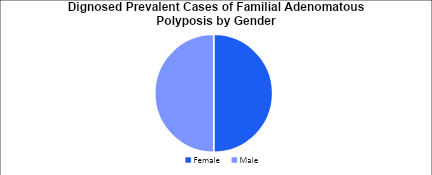
- FAP affects males and females equally, as the disorder follows an autosomal dominant inheritance pattern. However, disease severity, polyp burden, and the occurrence of extracolonic manifestations may vary considerably among patients, even within the same family.
Familial Adenomatous Polyposis (FAP) Epidemiology Forecast in the United States
- 2025 Diagnosed Prevalent Cases of FAP: ~XXXX
- 2036 Projected Diagnosed Prevalent Cases of FAP: ~XXXX
- FAP Growth Rate (2026–2036): XX% CAGR
DelveInsight's ‘Familial Adenomatous Polyposis (FAP) – Epidemiology Forecast – 2036’ report delivers an in-depth understanding of the FAP, historical and forecasted epidemiology in the United States, EU4 (Germany, Spain, Italy, and France), and the United Kingdom, and Japan.
|
Study Period |
2022–2036 |
|
Historical Year |
2022–2025 |
|
Forecast Period |
2026–2036 |
|
Base Year |
2026 |
|
Geographies Covered |
|
|
FAP Epidemiology CAGR (Forecast period) |
XX% (2026-2036) |
|
FAP Epidemiology Segmentation Analysis |
Patient Burden Assessment
|
Familial Adenomatous Polyposis (FAP) Understanding and Diagnosis Algorithm
Familial Adenomatous Polyposis (FAP) Overview
FAP is a rare, inherited autosomal dominant colorectal cancer predisposition syndrome caused primarily by pathogenic mutations in the APC (adenomatous polyposis coli) gene. The condition is characterized by the development of hundreds to thousands of adenomatous polyps throughout the colon and rectum, typically beginning during adolescence or early adulthood. If left untreated, individuals with classic FAP face an almost 100% lifetime risk of developing colorectal cancer, often before the age of 40–50 years. In addition to colorectal manifestations, patients may develop extracolonic features, including duodenal and gastric polyps, desmoid tumors, osteomas, congenital hypertrophy of the retinal pigment epithelium (CHRPE), thyroid cancer, hepatoblastoma, and other benign or malignant tumors. The disease imposes a substantial lifelong clinical burden, requiring intensive surveillance, preventive interventions, and multidisciplinary management.
Familial Adenomatous Polyposis (FAP) Diagnosis
Diagnosis of FAP relies on a combination of clinical evaluation, family history assessment, endoscopic findings, and genetic testing. Colonoscopy remains the cornerstone of diagnosis and typically reveals numerous adenomatous polyps in the colon and rectum. Confirmation is generally achieved through identification of a pathogenic APC gene mutation using molecular genetic testing. Additional diagnostic evaluations may include upper gastrointestinal endoscopy to assess duodenal and gastric polyps, imaging studies for desmoid tumors, and screening for extracolonic manifestations. Early diagnosis is critical because timely surveillance and prophylactic surgical interventions can substantially reduce colorectal cancer risk and improve long-term outcomes for affected individuals and at-risk family members.
Further details are provided in the report.
Familial Adenomatous Polyposis (FAP) Epidemiology
Key Findings from Familial Adenomatous Polyposis (FAP) Epidemiological Analysis and Forecast
- As per Kindie et al. (2024), FAP occurs in approximately 1/10,000 to 1/30,000 live births and accounts for less than 1% of all colorectal cancers in the US.
- According to Chung et al. (2024), FAP has an estimated prevalence of 1 in 8000 to 1 in 18,000 and accounts for less than 1 percent of all colorectal cancers in the US. It affects males and females equally and has a worldwide distribution.
- According to Menon and Kasi (2024), approximately 20% to 30% of individuals diagnosed with FAP lack a documented family history and instead display de novo Adenomatous Polyposis Coli (APC) gene mutations.
- In a Japanese cohort study of FAP by Yamaguchi et al. (2016), 265 cases were identified as classical FAP (≥100 adenomas) and 38 cases were classified as AFAP (<100 adenomas) out of a total of 303 patients.
- The estimated prevalence of FAP is around 3 people per 100,000 in England, as per NICE (2020).
- As per Sasaki et al. (2024), FAP prevalence ranges between 1:20,000 and 1:10,000 in Western countries and 1:17,400 in Japan.
- As per the National Organization for Rare Disorders (NORD) (2014), FAP affects males and females in equal numbers. It occurs in approximately one in 5,000 to 10,000 individuals in the US and accounts for about 0.5% of all cases of colorectal cancer.
Scope of the Report
- The report covers a segment of an executive summary, a descriptive overview of FAP, explaining its causes, signs and symptoms, and pathogenesis.
- Comprehensive insight has been provided into the epidemiology segments and forecasts, the future growth potential of the diagnosis rate, and disease progression.
Report Insights
FAP Patient Population Forecast
Report Key Strengths
- Epidemiology‑based (epi‑based) Bottom‑up Forecasting
- 11-year Forecast
- Patient Burden Trends (by geography)
FAQs
- What are the disease risks, burdens, and unmet needs of FAP? What will be the growth opportunities across the 7MM concerning the patient population with FAP?
- What is the historical and forecasted FAP patient pool in the US, EU4 (Germany, France, Italy, and Spain), the UK, and Japan?
Reasons to Buy
- Insights on patient burden/disease prevalence, evolution in diagnosis, and factors contributing to the change in the epidemiology of the disease during the forecast years.
- To understand key opinion leaders’ perspectives on the diagnostic challenges to overcome barriers in the future.
- Detailed insights into various factors hampering disease diagnosis and other existing diagnostic challenges.