-market.png&w=256&q=75)
Familial Chylomicronemia Syndrome Market Summary
- The Familial Chylomicronemia Syndrome Market Size is anticipated to grow with a significant CAGR during the study period (2022-2026).
- The leading Familial Chylomicronemia Syndrome companies developing therapies in the treatment market include -
Key Familial Chylomicronemia Syndrome Market & Epidemiolofy Insights
- FCS is a rare autosomal recessive disorder characterized by extremely elevated triglyceride levels, typically exceeding 1000 mg/dL, due to defective lipoprotein lipase (LPL) activity or related genetic mutations. Early onset is common, with symptoms often appearing in childhood, including recurrent abdominal pain, pancreatitis, eruptive xanthomas, and lipemia retinalis.
- According to DelveInsight's analysis, the 7MM reported approximately 2,100 diagnosed prevalent cases of FCS in 2025.
- The clinical burden of FCS increases with age, reflecting cumulative exposure to high triglyceride levels and repeated pancreatitis episodes. Patients often require lifelong management, and dietary fat restriction remains the cornerstone of therapy to reduce triglyceride levels and prevent acute pancreatitis.
- Current approved systemic therapies include Volanesorsen (WAYLIVRA), Olezarsen (TRYNGOLZA), and Plozasiran (REDEMPLO), which target apoC-III to enhance triglyceride clearance. Plozasiran, as an siRNA therapy, offers infrequent dosing and robust triglyceride reduction.
- TRYNGOLZA (olezarsen) is the first-ever treatment approved in US for adults living with FCS as an adjunct to diet.
- Despite these advances, residual risk of pancreatitis and other complications persists, highlighting the importance of ongoing monitoring, patient education, and adherence to both pharmacologic and dietary interventions.
- The approved FCS therapies are commercially available through companies including Arrowhead Pharmaceuticals, and Ionis Pharmaceuticals reflecting a targeted, mechanism-driven approach that has transformed management of this previously underserved patient population.
DelveInsight's ‘Familial Chylomicronemia Syndrome Market Insights, Epidemiology and Market Forecast – 2036’ report delivers an in-depth understanding of the FCS, historical and forecasted epidemiology, as well as the Familial Chylomicronemia Syndrome therapeutics market trends in the United States, EU4 (Germany, Spain, Italy, and France) and the United Kingdom, and Japan.
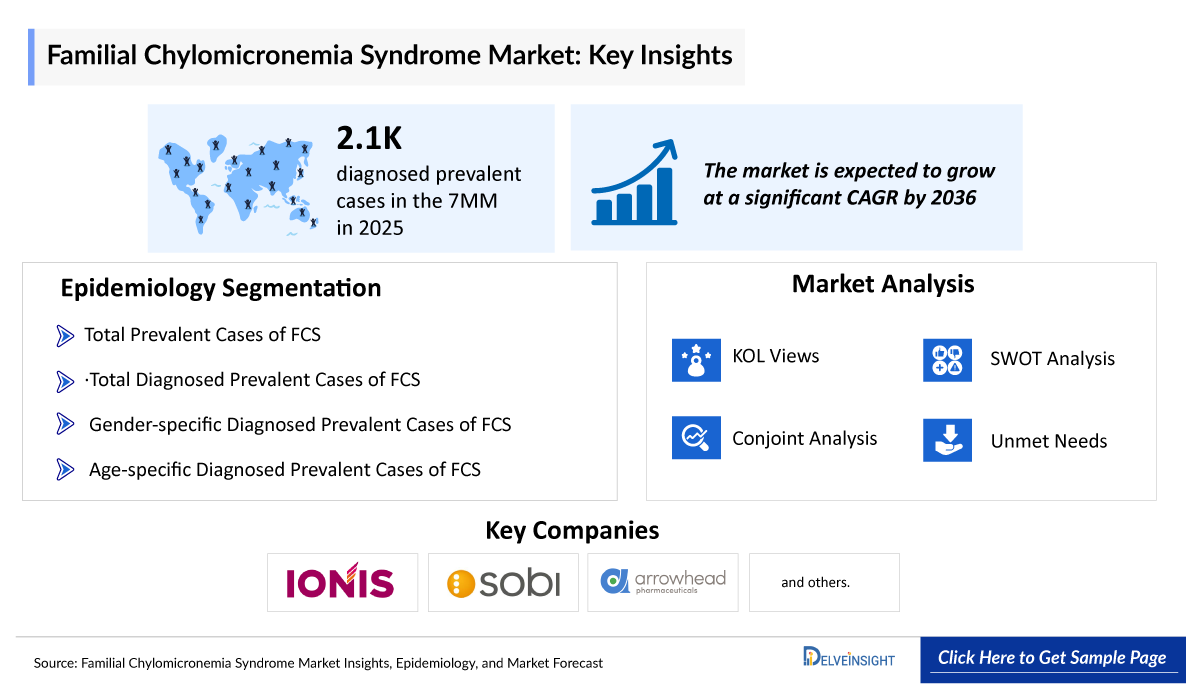
The Familial Chylomicronemia Syndrome market report delivers a comprehensive analysis of the current treatment landscape, including standards of care, clinical practices, and evolving therapeutic algorithms. It evaluates, FCS patient burden trends, revenue & market share dynamics, peak patient share & therapy uptake analysis, and provides an in-depth market size assessment, and growth rate projections (Historical & Forecast 2022–2036) across global regions. The report highlights key unmet medical needs in FCS and maps the competitive and clinical landscape to uncover high value opportunities, providing a clear outlook on future market growth potential.
Key Factors Driving the Familial Chylomicronemia Syndrome Market
- Development of Targeted Therapies: The market is witnessing a shift from strict dietary management to the development of advanced, targeted therapies, including antisense oligonucleotide, siRNA therapies that manage triglyceride levels. Recent FDA approvals like Polazasiran validate the therapeutic landscape and accelerate market growth.
- High Unmet Clinical Need: The severe, recurring risk of acute pancreatitis creates a high demand for therapies, pushing the development of novel solutions to improve patient outcomes.
- Favorable Regulatory Support: Governments and regulators offer, Orphan drug designations and Fast-track approvals for rare diseases. These policies reduce development barriers and accelerate commercialization.
Scope of the Familial Chylomicronemia Syndrome Market Report | |
|
Study Period |
2022–2036 |
|
Historical Year |
2022–2025 |
|
Forecast Period |
2026–2036 |
|
Base Year |
2026 |
|
Geographies Covered |
ü North America : The US; ü Europe: Germany, France, Italy, and Spain and the UK; ü Asia-Pacific: Japan |
|
FCS Epidemiology Segmentation Analysis |
Patient Burden Assessment · Total Prevalent Cases of FCS · Total Diagnosed Prevalent Cases of FCS · Gender-specific Diagnosed Prevalent Cases of FCS · Age-specific Diagnosed Prevalent Cases of FCS · Total Treated Cases of FCS |
|
FCS Companies |
· Ionis Pharmaceuticals · Swedish Orphan Biovitrum · Arrowhead Pharmaceuticals |
|
FCS Therapies |
· Plozasiran (REDEMPLO) - Recently Approved · Olezarsen (TRYNGOLZA) · Volanesorsen (WAYLIVRA), and others |
|
FCS Market |
Segmented by · Region/Geographies · Drugs/Therapies |
|
Analysis |
· Addressable Patient Population · Market Drivers and Market barriers · Cost Assumptions and Pricing Analogues · KOL Views · SWOT Analysis · Reimbursement · Conjoint Analysis · Unmet Need |
|
|
|
Familial Chylomicronemia Syndrome Disease Understanding
Familial Chylomicronemia Syndrome Overview and Diagnosis
FCS is most commonly known as Lipoprotein Lipase (LPL) deficiency. It is also frequently referred to as Fredrickson Type 1 Hyperlipoproteinemia or Type 1 Hyperlipidemia. It is a rare genetic lipid disorder characterized by elevated triglyceride (TG) levels due to mutations in the LPL gene. Variants in five other genes, including APOA5, APOC2, GPD1, GPIHPB1, and LMF1, can also lead to FCS. It is present in childhood to early adulthood as severe hypertriglyceridemia (HTG), with fasting plasma triglyceride (TG) levels >10 mmol/L. Clinical signs and symptoms of FCS include failure to thrive, nausea, vomiting, abdominal pain, lipemia retinalis, eruptive xanthomas on the trunk and limbs, and hepatosplenomegaly. The most severe clinical outcome in FCS is acute pancreatitis which can be life-threatening.
The diagnosis of FCS is primarily based on clinical presentation, laboratory findings, and genetic testing. Blood samples from individuals with FCS often appear creamy due to the extremely high levels of triglycerides, typically exceeding 10 mmol/liter. Diagnosis involves ruling out secondary causes of hypertriglyceridemia such as uncontrolled diabetes, alcohol use, or certain medications. Confirmation is achieved through genetic testing, which identifies mutations in genes involved in lipoprotein metabolism, most commonly the lipoprotein lipase gene (LPL) gene. Early and accurate diagnosis is important to prevent complications, particularly recurrent acute pancreatitis, and to guide appropriate management strategies.
Further details are provided in the report....
Current Familial Chylomicronemia Syndrome Treatment Landscape
Treatment of FCS focuses on reducing triglyceride levels to prevent recurrent pancreatitis, primarily through strict dietary and pharmacologic approaches. The cornerstone of management includes following a very low-fat diet, along with avoidance of alcohol and secondary triggers. The current treatment landscape includes targeted therapies that inhibit apolipoprotein C-III (APOC3), a key regulator of triglyceride metabolism. Olezarsen (TRYNGOLZA) is a next-generation antisense oligonucleotide, Volanesorsen (WAYLIVRA) is an earlier APOC3 inhibitor, Plozasiran (REDEMPLO) is a small interfering RNA (siRNA) therapy targeting APOC3, has shown promising efficacy with potentially less frequent dosing and a favorable safety profile among other therapies.
Further details related to country-based variations are provided in the report...
Familial Chylomicronemia Syndrome Unmet Needs
The section “unmet needs of Familial Chylomicronemia Syndrome” outlines the critical gaps between the current state of patient care, diagnosis, and the ideal & effective management of the disease. It highlights the obstacles experienced by patients, clinicians, and researchers and identifies potential solutions for future progress.
1. Residual risk of acute pancreatitis despite treatment
2. Incomplete triglyceride control in some patients
3. Accessibility and high cost of novel therapies
4. Delayed diagnosis and lack of disease awareness, and others…..
Note: Comprehensive unmet needs insights in FCS and their strategic implications are provided in the full report....
Familial Chylomicronemia Syndrome Epidemiology
The Familial Chylomicronemia Syndrome epidemiology section provides insights about the historical and current Familial Chylomicronemia Syndrome patient pool and forecasted trends for individual seven major countries. It helps to recognize the causes of current and forecasted trends by exploring numerous studies and views of key opinion leaders. This part of the Familial Chylomicronemia Syndrome market report also provides the diagnosed patient pool and their trends along with assumptions undertaken.
Key Findings from FCS Epidemiological Analysis and Forecast
- In 2025, the US accounted for the highest diagnosed prevalent cases of FCS with more then 1,300 cases. These cases are anticipated to increase during the forecast period.
- Approximately 70% of individuals diagnosed with FCS are male, with a median age of diagnosis around 9 years, highlighting its early onset and male predominance.
- Japan recorded more diagnosed cases of FCS than UK.
- In 2025, the diagnosed burden of FCS in the US was higher in the 0–17 years age group compared to individuals aged 18 years and above, indicating a greater concentration of cases in the pediatric and adolescent population.
- Most patients (>90%) found managing fat intake to be difficult, and 53% experienced symptoms despite adherence to their diets.
Familial Chylomicronemia Syndrome Drug Analysis & Competitive Landscape
The FCS drug chapter provides a detailed, market-focused review of approved therapies. It covers mechanism of action, clinical trial data, regulatory approvals, patents, collaborations, strategic partnerships upcoming Key catalyst for each therapy, along with their advantages, limitations, and recent developments. This section offers critical insights into the Familial Chylomicronemia Syndrome treatment landscape, supporting market assessment, competitive analysis, and growth forecasting for the FCS therapeutics market.
Approved Therapies for Familial Chylomicronemia Syndrome
Olezarsen (TRYNGOLZA): Ionis Pharmaceuticals and Swedish Orphan Biovitrum
Olezarsen, approved since 2024 is the first therapy proven to significantly reduce triglyceride levels in adults with FCS when used as an adjunct to diet. TRYNGOLZA is an RNA-targeted medicine designed to lower the body's production of apolipoprotein C-III (apoC-III), a protein produced in the liver that is a key regulator of triglyceride metabolism. Clinical trials showed it significantly reduced triglycerides and pancreatitis events, offering a much-needed treatment beyond strict dietary control. TRYNGOLZA has been approved in the European Union (EU) as an adjunct to diet in adult patients for the treatment of genetically confirmed FCS.
Volanesorsen (WAYLIVRA): Ionis Pharmaceuticals
WAYLIVRA, developed by Ionis and co-developed by Akcea, is an antisense oligonucleotide that reduces apoC-III production, a key regulator of plasma triglyceride levels. Administered via self-injection, it promotes triglyceride breakdown, potentially lowering fat accumulation and the risk of pancreatitis, a serious complication of FCS. WAYLIVRA has obtained conditional marketing authorization in 2019 in the European Union for FCS treatment and has been designated as an Orphan Drug by the European Medicines Agency. Its approval represents a significant milestone for the global FCS community.
Familial Chylomicronemia Syndrome (FCS) Marketed/Approved Therapies | ||||||
|
Drug/Therapy |
Company |
Indication |
Molecule Type |
MoA |
RoA |
Marketed Region |
|
Plozasiran (REDEMPLO) |
Arrowhead Pharmaceuticals |
FCS |
siRNA |
ApoC-III Inhibitor |
SC |
US:2025 |
|
Olezarsen (TRYNGOLZA) |
Ionis Pharmaceuticals and Swedish Orphan Biovitrum |
FCS |
Antisense oligonucleotide |
ApoC-III Inhibitor |
SC |
US: 2024 |
|
Volanesorsen (WAYLIVRA) |
Ionis Pharmaceuticals |
FCS |
Antisense oligonucleotide |
ApoC-III Inhibitor |
SC |
EU: 2019 |
Note: Detailed marketed therapies assessment will be provided in the final report...
Familial Chylomicronemia Syndrome Key Players and Market Leaders
- Ionis Pharmaceuticals
- Arrowhead Pharmaceuticals, and others
Familial Chylomicronemia Syndrome Drug Updates
- In January 2026, Ionis Pharmaceuticals announced TRYNGOLZA outperformed expectations as the first US FDA approved treatment for FCS, generating USD 105 million in preliminary US net product sales in 2025.
- In September 2025, Ionis Pharmaceuticals announced that TRYNGOLZA has been approved in the European Union (EU) as an adjunct to diet in adult patients for the treatment of genetically confirmed FCS. The approval is based on positive data from the Phase III Balance study, in which TRYNGOLZA 80 mg significantly reduced fasting triglycerides at 6 months, with effects sustained to 12 months, lowered acute pancreatitis events, and showed good safety and tolerability.
- In November 2025, Arrowhead Pharmaceuticals announced that US FDA has approved REDEMPLO (plozasiran), a small interfering RNA (siRNA) medicine, as an adjunct to diet to reduce triglycerides in adults with Familial Chylomicronemia Syndrome. REDEMPLO is the first and only FDA-approved medicine to be studied in patients with genetically confirmed and clinically diagnosed FCS.
- In December 2024, the US FDA approved TRYNGOLZA as an adjunct to diet for triglyceride reduction in adults with FCS. The approval was based on the Phase III Balance trial, which demonstrated significant triglyceride reductions and fewer pancreatitis events.
Familial Chylomicronemia Syndrome Market Outlook
The treatment landscape for FCS has begun to evolve after years of dependence on strict dietary fat restriction and limited pharmacologic options with modest efficacy. Historically, management focused on preventing acute pancreatitis through lifestyle interventions and off-label lipid-lowering agents, but recent advances in RNA-targeted therapies have significantly altered the therapeutic outlook. Antisense oligonucleotides therapies such as Volanesorsen marked an early breakthrough by targeting apoC-III, a key regulator of triglyceride metabolism, thereby reducing triglyceride levels in patients with genetically confirmed FCS. Building on this mechanism, newer agents like Olezarsen and Plozasiran are advancing with improved safety profiles and dosing convenience, reflecting a shift toward more precise and patient-friendly therapies.
Among currently available therapies for FCS, next-generation apoC-III–targeting agents such as Olezarsen is expected to account for a significant share of total revenue, driven by improved safety, tolerability, and broader patient adoption compared to earlier therapies.
Established treatments like Volanesorsen are anticipated to retain a role in select patient populations, while newer approved options such as Plozasiran are likely to strengthen market competition and contribute to a more diversified and competitive FCS treatment landscape over the forecast period.
- In May 2026, Ionis Pharmaceuticals lowered the price of Tryngolza, from USD 595,000 to USD 40,000 which is 93% reduction ahead of anticipated label expansion.
- In May 2019, Akcea Therapeutics announced today volanesorsen (WAYLIVRA) has received conditional marketing authorization from the European Commission (EC) as an adjunct to diet in adult patients with genetically confirmed FCS.
Further details will be provided in the report...
Drug Class/Insights into Marketed Therapies in FCS (2022–2036 Forecast)
The FCS market comprises antisense oligonucleotides, and siRNA, each targeting different aspects of FCS.
- Antisense oligonucleotides: Therapies such as Volanesorsen and Olezarsen inhibit the production of apoC-III, a key regulator of triglyceride metabolism. By reducing apoC-III levels, these agents enhance lipoprotein lipase activity and promote the clearance of triglyceride-rich lipoproteins, thereby significantly lowering plasma triglyceride levels in patients with FCS.
- siRNA: Plozasiran is a siRNA therapy that works by selectively silencing hepatic production of apoC-III. This approach enables durable triglyceride lowering with less frequent dosing and a favorable safety profile.
RNA-based therapies define the core innovation landscape in FCS, with approved antisense oligonucleotide and siRNA therapies commercially validated.
Familial Chylomicronemia Syndrome Drug Uptake
This section focuses on the uptake rate of potential Familial Chylomicronemia Syndrome drugs in the market during the forecast period (2026–2036). The analysis covers the FCS drug’s uptake, performance at peak, factors affecting performance during prime years of growth, patient uptake by therapy, and anticipated sales generated by each drug.
The uptake of therapies in FCS is expected to vary based on clinical positioning, mechanism of action, and stage of development. Plozasiran (REDEMPLO), as the first approved siRNA therapy, is projected to achieve rapid adoption due to its potent triglyceride-lowering effect, infrequent dosing, and favorable tolerability, positioning it as a preferred option for most patients with genetically confirmed FCS. Olezarsen (TRYNGOLZA) is also expected to show strong uptake, driven by its improved safety profile and more convenient administration compared with earlier antisense oligonucleotides.
Detailed insights of emerging therapies' drug uptake is included in the report...
Market Access and Reimbursement of Approved therapies in Familial Chylomicronemia Syndrome
The report further provides detailed insights on the country-wise accessibility and reimbursement scenarios, cost-effectiveness scenario of approved therapies, programs making accessibility easier and out-of-pocket costs more affordable, insights on patients insured under federal or state government prescription drug programs, etc.
- The United States
US Reimbursement of Therapies Approved for FCS | |
|
Drug/Therapy |
Access Program |
|
REDEMPLO |
Rely On Redemplo Patient Support Program |
Reimbursement is a crucial factor that affects the drug’s access to the market. Often, the decision to reimburse comes down to the price of the drug relative to the benefit it produces in treated patients. To reduce the healthcare burden of these high-cost therapies, many payment models are being considered by payers and other industry insiders. Patients may pay as little as USD 0 out-of-pocket for Redemplo 25 mg. Eligible commercially insured patients may qualify for copay support with the Rely On Redemplo Copay Card Program.
NOTE: Further Details are provided in the final report...
Familial Chylomicronemia Syndrome Therapies Price Scenario & Trends
Pricing and analogue assessment of FCS therapies highlights evolving price dynamics structures. This section summarizes the cost of approved treatments, closest and most appropriate analogue selection for emerging therapies, and understanding of how pricing influences market access, adherence, and long-term uptake.
REDEMPLO is launched with USD 60,000 wholesale acquisition cost (WAC) price and is intended to maintain price throughout the long lifecycle of the product.
Industry Experts and Physician Views for Familial Chylomicronemia Syndrome
To keep up with FCS market trends, we take Key Opinion Leaders (KOLs) and Subject Matter Experts (SMEs) opinions working in the domain through primary research to fill the data gaps and validate our secondary research. Industry experts were contacted for insights on the FCS emerging therapies, evolving treatment landscape, patient adherence to conventional therapies, therapy switching trends, drug adoption and uptake, accessibility challenges, and epidemiology and real-world prescription patterns in FCS, including MD, PhD, Instructor, Postdoctoral Researcher, Professor, Researcher, and others.
DelveInsight’s analysts connected with 15+ KOLs to gather insights at country level. Centers such as the Southern Illinois University School of Medicine, and Sapienza University of Rome, etc. were contacted.Their opinion helps understand and validate current and emerging FCS therapies, highlight unmet medical needs, provide epidemiological context, and support strategic decisions for market access, therapy adoption, and pipeline prioritization in FCS.
|
Region | Key Opinion Leaders (KOLs) and Subject Matter Experts (SMEs) |
|
United States |
“The exact prevalence of FCS is unknown, making it an indication with little information; even physicians do not know enough about it. There is no defined standard of care or list of suggested practices for managing FCS.” |
|
Germany |
“Acute or recurrent pancreatitis is the primary complication associated with Familial Chylomicronemia Syndrome. Patients with triglyceride levels exceeding 1,500 mg/dL are at a significantly elevated risk for developing pancreatitis. Additionally, the risk of cardiovascular disease (CVD) becomes more pronounced IN FCS, requiring a tailored approach to manage both lipid levels and overall cardiovascular health.” |
Qualitative Analysis: SWOT and Conjoint Analysis
We perform qualitative and market Intelligence analysis using various approaches, such as SWOT analysis and conjoint analysis.
In the SWOT analysis of FCS, strengths, weaknesses, opportunities, and threats in terms of disease diagnosis, patient awareness, patient burden, competitive landscape, cost-effectiveness, and geographical accessibility of therapies are provided.
Conjoint analysis analyzes emerging therapies based on relevant attributes such as safety, efficacy, frequency of administration, route of administration, and order of entry. Scoring is given based on these parameters to analyze the effectiveness of therapy.
The team of analysts analyzes promising emerging therapies based on relevant attributes such as safety, efficacy, frequency of administration, route of administration, and order of entry. In efficacy, the trial’s primary and secondary outcome measures are evaluated, whereas the therapies’ safety is evaluated, wherein the acceptability, tolerability, and adverse events are majorly observed. In addition, the scoring is also based on the route of administration, order of entry, probability of success, and the addressable patient pool for each therapy. According to these parameters, the final weightage score and the ranking of the emerging therapies are decided.
Scope of the Familial Chylomicronemia Syndrome Market Report
- The report covers a segment of key events, an executive summary, a descriptive overview of FCS, explaining their causes, signs and symptoms, pathogenesis, and currently available treatments.
- Comprehensive insight has been provided into the epidemiology segments and forecasts, the future growth potential of the diagnosis rate, and disease progression along treatment guidelines.
- Additionally, an all-inclusive account of both the current and emerging treatments, along with the elaborative profiles of late-stage and prominent therapies, will have an impact on the current treatment landscape.
- A detailed review of the FCS market, historical and forecasted market size, market share by therapies, detailed assumptions, and rationale behind our approach is included in the report, covering the 7MM drug outreach.
- The report provides an edge while developing business strategies by understanding trends through SWOT analysis and expert insights/KOL views, patient journey, and treatment preferences that help in shaping and driving the 7MM FCS market.
Familial Chylomicronemia Syndrome Market Report Insights
- Familial Chylomicronemia Syndrome Patient Population Forecast
- Familial Chylomicronemia Syndrome Therapeutics Market Size
- Familial Chylomicronemia Syndrome Pipeline Analysis
- Familial Chylomicronemia Syndrome Market Size and Trends
- Familial Chylomicronemia Syndrome Market Opportunity (Current and forecasted)
Familial Chylomicronemia Syndrome Market Report Key Strengths
- Epidemiology based (Epi based) Bottom up Forecasting
- Artificial Intelligence (AI)-Enabled Market Research Report
- 11-Year Forecast
- Familial Chylomicronemia Syndrome Market Outlook (North America, Europe, Asia-Pacific)
- Patient Burden Trends (By Geography)
- Familial Chylomicronemia Syndrome Treatment Addressable Market (TAM)
- Familial Chylomicronemia Syndrome Competitve Landscape
- Familial Chylomicronemia Syndrome) Major Companies Insights
- Familial Chylomicronemia Syndrome Price Trends and Analogue Assessment
- Familial Chylomicronemia Syndrome Therapies Drug Adoption/Uptake
- Familial Chylomicronemia Syndrome Therapies Peak Patient Share Analysis
Familial Chylomicronemia Syndrome Market Report Assessment
- Familial Chylomicronemia Syndrome Current Treatment Practices
- Familial Chylomicronemia Syndrome Unmet Needs
- Familial Chylomicronemia Syndrome Clinical Development Analysis
- Familial Chylomicronemia Syndrome Emerging Drugs Product Profiles
- Familial Chylomicronemia Syndrome Market attractiveness
- Familial Chylomicronemia Syndrome Qualitative Analysis (SWOT and conjoint analysis)
- Familial Chylomicronemia Syndrome Market Drivers
- Familial Chylomicronemia Syndrome Market Barriers
FAQs Reakted to Familial Chylomicronemia Syndrome Market Report:
Familial Chylomicronemia Syndrome Market Insights
- What was the FCS market size, the market size by therapies, market share (%) distribution in 2025, and what would it look like by 2036? What are the contributing factors for this growth?
- What are the anticipated pricing variations among different geographies for the emerging therapies in the future?
- What can be the future treatment paradigm of FCS?
- What are the disease risks, burdens, and unmet needs of FCS? What will be the growth opportunities across the 7MM concerning the patient population with FCS?
- Who is the major future competitor in the market, and how will the competitors affect their market share?
- What are the current options for the treatment of FCS? What are the current guidelines for treating FCS in the US, Europe, and Japan?
Reasons to Buy Familial Chylomicronemia Syndrome Market Forecast Report
- The report will help in developing business strategies by understanding the latest trends and changing treatment dynamics driving the FCS market.
- Bottom up forecasting builds from the affected population to product forecasts, delivering a robust, data driven approach ideal for new therapies and novel classes.
- Insights on patient burden/disease incidence, evolution in diagnosis, and factors contributing to the change in the epidemiology of the disease during the forecast years.
- Understand the existing market opportunities in varying geographies and the growth potential over the coming years.
- Identifying strong upcoming players in the market will help devise strategies to help get ahead of competitors.
- Detailed analysis and ranking of class-wise potential current and emerging therapies under the conjoint analysis section to provide visibility around leading classes.
- To understand KOLs’ perspectives on the accessibility, acceptability, and compliance-related challenges of existing treatment to overcome barriers in the future.
- Detailed insights on the unmet needs of the existing market so that the upcoming players can strengthen their development and launch strategy.
- This Artificial Intelligence (AI) enabled report summarize and simplify complex datasets with in the report into clear, actionable insights for stakeholders, investors, and healthcare providers, enabling faster, data driven decisions.