Female Infertility Pipeline
DelveInsight’s, “Female Infertility Pipeline Insight 2026” report provides comprehensive insights about 8+ companies and 10+ pipeline drugs in Female Infertility pipeline landscape. It covers the pipeline drug profiles, including clinical and nonclinical stage products. It also covers the therapeutics assessment by product type, stage, route of administration, and molecule type. It further highlights the inactive pipeline products in this space.
Geography Covered
- Global coverage
Female Infertility Understanding
Female Infertility Overview
Female infertility is the inability of a woman to conceive after 12 months of regular, unprotected intercourse. It can result from problems with ovulation, fallopian tubes, uterus, or hormonal imbalances. Common causes include conditions like Polycystic Ovary Syndrome, Endometriosis, blocked fallopian tubes, or age-related decline in fertility.
Diagnosis typically involves medical history, hormonal tests, and imaging studies. Treatment depends on the cause and may include medications, lifestyle changes, surgery, or assisted reproductive techniques such as In Vitro Fertilization. Early diagnosis and appropriate management can significantly improve the chances of conception. Maintaining a healthy lifestyle, balanced diet, and regular medical check-ups also play an important role in supporting reproductive health.
Common signs and symptoms includes Irregular or absent menstrual periods, which may indicate ovulation problems. Painful or heavy periods, sometimes associated with conditions like Endometriosis. Hormonal changes, including acne, excessive facial or body hair, or hair thinning, often linked with Polycystic Ovary Syndrome. Pain during intercourse, which may suggest underlying reproductive issues. Difficulty conceiving after 12 months of regular unprotected intercourse. Pelvic pain or discomfort, possibly related to infections or reproductive organ problems.
Female infertility pathophysiology involves disruptions in the normal reproductive processes required for conception. It may occur due to ovulatory dysfunction, where hormonal imbalance prevents the release of a mature egg, commonly seen in Polycystic Ovary Syndrome. Structural abnormalities such as blocked fallopian tubes can prevent the sperm and egg from meeting, while uterine conditions like Endometriosis may impair implantation. Additionally, hormonal disturbances involving the hypothalamus–pituitary–ovarian axis can disrupt follicle development and ovulation, leading to reduced fertility.
Diagnosis of female infertility involves a comprehensive evaluation to identify the underlying cause. It typically begins with a detailed medical history, menstrual history, and physical examination. Doctors may perform hormonal blood tests to assess ovulation and evaluate the Hypothalamic–pituitary–ovarian axis. Imaging tests such as pelvic ultrasound and procedures like Hysterosalpingography are used to check the uterus and fallopian tubes for abnormalities or blockages.
Treatment of female infertility depends on the underlying cause and the patient’s overall health. It may include ovulation-inducing medications to regulate hormone levels and stimulate egg release. Surgical procedures may be used to correct structural problems such as blocked fallopian tubes or conditions like Endometriosis. Assisted reproductive technologies, including In Vitro Fertilization, may be recommended when other treatments are unsuccessful. Lifestyle changes such as maintaining a healthy weight and reducing stress can also improve fertility outcomes.
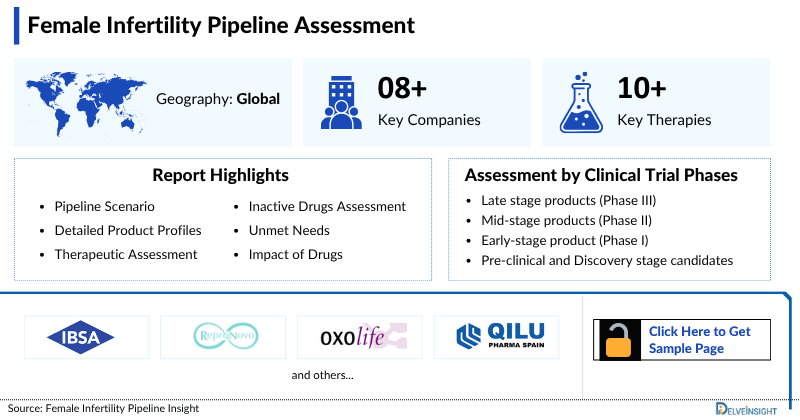
"Female Infertility Pipeline Insight 2026" report by DelveInsight outlays comprehensive insights of present scenario and growth prospects across the indication. A detailed picture of the Female Infertility pipeline landscape is provided which includes the disease overview and Female Infertility treatment guidelines. The assessment part of the report embraces, in depth Female Infertility commercial assessment and clinical assessment of the pipeline products under development. In the report, detailed description of the drug is given which includes mechanism of action of the drug, clinical studies, NDA approvals (if any), and product development activities comprising the technology, Female Infertility collaborations, licensing, mergers and acquisition, funding, designations and other product related details.
Discover the latest Female Infertility pipeline insights, emerging therapies, and clinical advancements shaping the future of treatment in 2026.
Female Infertility Pipeline Report Highlights
- The Female Infertility companies and academics are working to assess challenges and seek opportunities that could influence Female Infertility R&D. The therapies under development are focused on novel approaches to treat/improve Female Infertility.
Female Infertility Emerging Drugs Analysis
This segment of the Female Infertility report encloses its detailed analysis of various drugs in different stages of clinical development, including Phase III, II, I, Preclinical and Discovery. It also helps to understand clinical trial details, expressive pharmacological action, agreements and collaborations, and the latest news and press releases.
Female Infertility Emerging Drugs
Progesterone-IBSA Injectable Solution: IBSA Institut Biochimique SA
Progesterone-IBSA Injectable Solution is a subcutaneous progesterone formulation developed by IBSA Institut Biochimique SA for use in female infertility treatments. It is designed to provide luteal phase support during assisted reproductive technologies (ART), helping to prepare and maintain the uterine lining for successful implantation. The formulation uses a water-soluble cyclodextrin-based delivery system, allowing easier and more patient-friendly administration compared to traditional intramuscular injections. It is being evaluated in clinical studies for its safety, efficacy, and ability to support pregnancy outcomes in women undergoing fertility treatments.
OXO-001: Oxolife
OXO-001, a first-in-class, non-hormonal oral pill targeting the endometrium to enhance embryo implantation in IVF/ICSI and treat PCOS-related infertility. OXO-001 acts directly on the endometrium to enhance and improve the embryo implantation process, a breakthrough innovation in reproductive medicine. It has demonstrated its effectiveness in increasing embryo implantation, pregnancy, and live birth rates among infertile women who are undergoing in vitro fertilization (IVF) or intracytoplasmic sperm injection (ICSI). The development of OXO-001, a single-to-take oral pill, responds to the most relevant unmet medical need in infertility which affects millions of women undergoing assisted reproduction worldwide, since there is no alternative on the market to improve the embryo implantation process. As per the company pipeline, the drug is in Phase II stage of its clinical trial for the treatment of Female Infertility.
QL1012D: Qilu Pharmaceutical Co., Ltd.
QL1012D is an investigational recombinant human follicle-stimulating hormone (FSH) injection developed by Qilu Pharmaceutical Co., Ltd. for the treatment of female infertility. It functions as an FSH receptor agonist, promoting ovarian follicle growth and supporting ovulation in women undergoing assisted reproductive technologies. The drug is being developed as a biosimilar to existing FSH therapies, aiming to provide comparable efficacy and safety. QL1012D is currently in early-phase clinical development, with studies evaluating its pharmacokinetics and tolerability.
Further product details are provided in the report……..
Female Infertility: Therapeutic Assessment
This Female Infertility segment of the report provides insights about the different Female Infertility drugs segregated based on following parameters that define the scope of the report, such as:
Major Players in Female Infertility
- There are approx. 8+ key companies which are developing the therapies for Female Infertility. The companies which have their Female Infertility drug candidates in the most advanced stage, i.e. Phase III include, IBSA Institut Biochimique SA
Phases
DelveInsight’s report covers around 10+ products under different phases of clinical development like
- Late stage products (Phase III)
- Mid-stage products (Phase II)
- Early-stage product (Phase I) along with the details of
- Pre-clinical and Discovery stage candidates
- Discontinued & Inactive candidates
Female Infertility Route of Administration
Female Infertility pipeline report provides the therapeutic assessment of the pipeline drugs by the Route of Administration. Products have been categorized under various ROAs such as
- Oral
- Intravenous
- Subcutaneous
- Parenteral
- Topical
Female Infertility Molecule Type
Female Infertility Products have been categorized under various Molecule types such as
- Recombinant fusion proteins
- Small molecule
- Monoclonal antibody
- Peptide
- Polymer
- Gene therapy
Female Infertility Product Type
Female Infertility Drugs have been categorized under various product types like Mono, Combination and Mono/Combination.
Female Infertility Clinical Trials Activities
The Female Infertility Pipeline report provides insights into Female Infertility Clinical Trials in Phase III, II, I, preclinical and discovery stage. It also analyses Female Infertility therapeutic drugs key players involved in developing key drugs.
Female Infertility Pipeline Development Activities
The Female Infertility Clinical Trials analysis report covers the detailed information of collaborations, acquisition and merger, licensing along with a thorough therapeutic assessment of emerging Female Infertility drugs.
Female Infertility Pipeline Report Insights
- Female Infertility Pipeline Analysis
- Female Infertility Therapeutic Assessment
- Female Infertility Market Unmet Needs
- Impact of Female Infertility Drugs
Female Infertility Report Assessment
- Female Infertility Pipeline Product Profiles
- Female Infertility Therapeutic Assessment
- Female Infertility Pipeline Assessment
- Inactive Female Infertility drugs assessment
- Female Infertility Market Unmet Needs
Discover actionable insights into the Female Infertility market trends, epidemiology trends, and forecast through 2036 to stay ahead in emerging therapies.
Key Questions Answered in the Female Infertility Pipeline Report
Current Treatment Scenario and Emerging Therapies:
- How many companies are developing Female Infertility drugs?
- How many Female Infertility drugs are developed by each company?
- How many emerging drugs are in mid-stage, and late-stage of development for the treatment of Female Infertility?
- What are the key collaborations (Industry–Industry, Industry–Academia), Mergers and acquisitions, licensing activities related to the Female Infertility therapeutics?
- What are the recent trends, drug types and novel technologies developed to overcome the limitation of existing therapies?
- What are the clinical studies going on for Female Infertility and their status?
- What are the key designations that have been granted to the emerging drugs?
Female Infertility Key Players
- IBSA Institut Biochimique SA
- ReproNovo
- Oxolife
- Qilu Pharmaceutical Co., Ltd.
- Creative Medical Technology Holdings, Inc
- U Ploid
Female Infertility Key Products
- Progesterone-IBSA Injectable Solution
- RPN-002 (nolasiban)
- OXO-001
- QL1012D
- Alova
- Women age-related infertility therapeutic
Explore comprehensive insights into Female Infertility epidemiology trends, patient population forecasts, and growth opportunities through 2034 for strategic decision-making.