
Gel Documentation System Market Summary
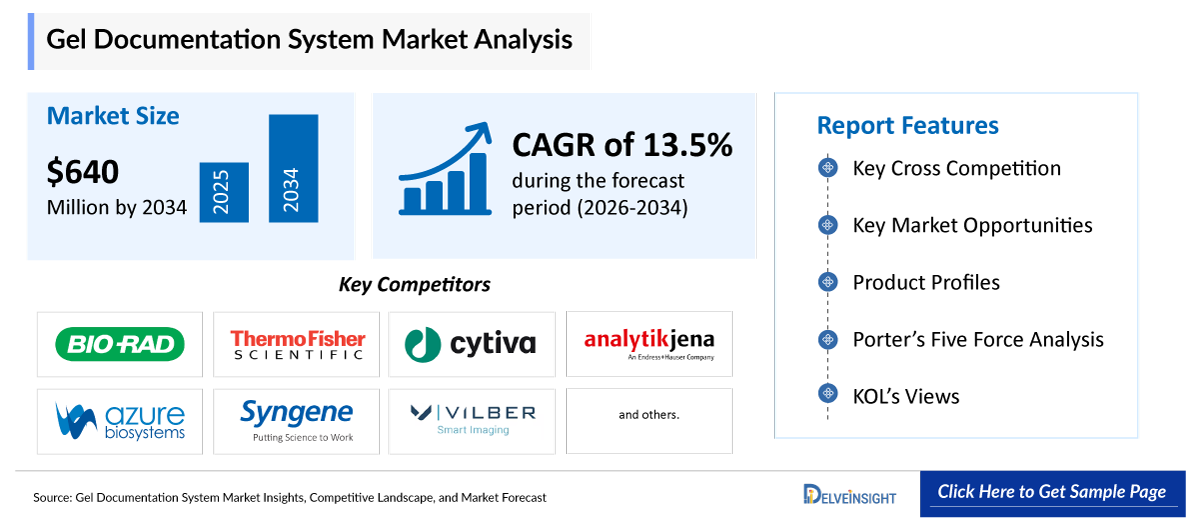
- The Gel Documentation System Market Size is estimated at USD 385 million in 2025 and is projected to reach USD 640 million by 2034. Growth is anchored in the enduring ubiquity of electrophoresis in molecular biology, the replacement of film and charge-coupled device imaging with scientific CMOS sensors, and tightening requirements for quantitative, reproducible, and auditable image data.
- The Global Gel Documentation System Market Size is growing at a CAGR of 5.8% during the forecast period from 2026 to 2034.
Gel Documentation System Market Trends & Insights
- By product, the instruments segment dominated the Gel Documentation System market with a 72% share in 2025.
- By light source, the ultraviolet segment dominated the Gel Documentation System market with a 46% share in 2025.
- By detection technique, the fluorescence segment dominated the Gel Documentation System market with a 42% share in 2025.
- By application, the nucleic acid quantification segment dominated the Gel Documentation System market with a 44% share in 2025.
- By end user, the academic and research institutes segment dominated the Gel Documentation System market with a 46% share in 2025.
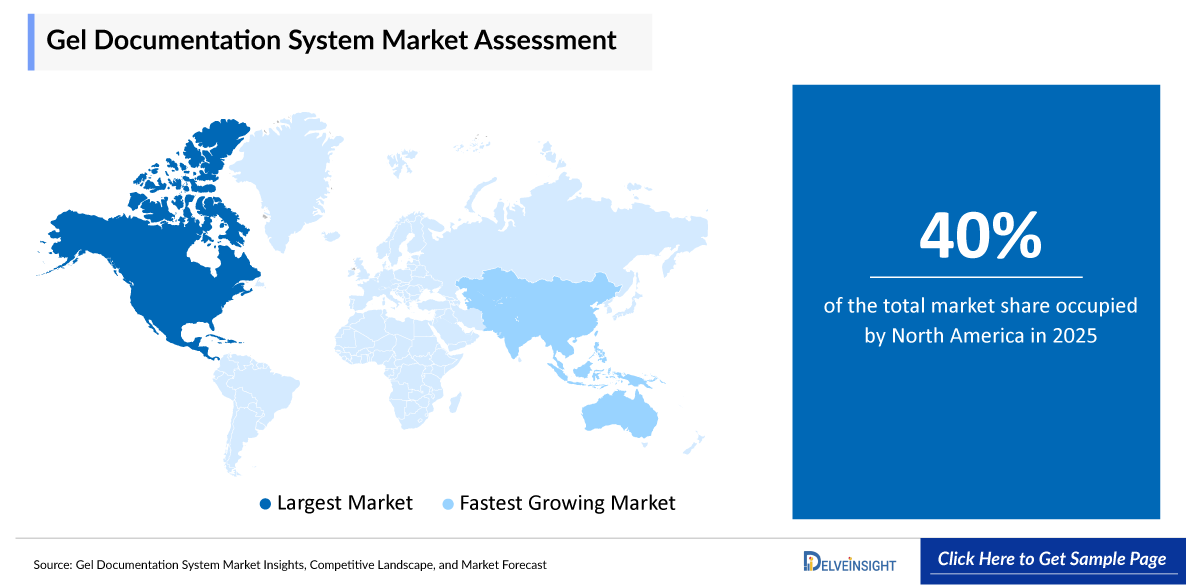
- North America dominated the global Gel Documentation System market revenue with a 40% share in 2025, representing the highest regional market share globally.
Request for Unlocking the Sample Page of the "Gel Documentation System Market"
Factors Contributing to the Growth of the Gel Documentation System Market
Gel Documentation System Market Drivers
-
Enduring Ubiquity of Electrophoresis across Molecular Biology Workflows
The foundational driver of the gel documentation system market is that electrophoresis remains embedded in essentially every molecular biology workflow, and every separation must be visualised, recorded, and often quantified. Agarose gel electrophoresis verifies polymerase chain reaction products, restriction digests, plasmid preparations, cloning constructs, and RNA integrity, while polyacrylamide gel electrophoresis and western blotting remain the reference methods for protein separation, identification, and semi-quantitative expression analysis.
Two-dimensional gel electrophoresis continues to serve comparative proteomics by resolving proteins first by isoelectric point and then by molecular mass. Because the imaging step is obligatory rather than optional, the instrument sits on the critical path of experiments performed daily in university departments, core facilities, biotechnology companies, contract research organisations, and quality control laboratories worldwide.
Newer techniques including quantitative polymerase chain reaction, digital polymerase chain reaction, and next-generation sequencing have displaced gels for some endpoints, yet they generate their own requirement for gel-based quality checks of libraries and amplicons. The breadth and permanence of this installed workflow base underpins a replacement and expansion cycle that anchors market growth through 2034.
-
Transition from Film and Charge-Coupled Devices to Scientific CMOS Imaging
The technology substrate of the category has changed decisively, and that change is driving a replacement cycle across the installed base. Photographic film, once standard for chemiluminescent western blots, captured a single arbitrary time point and offered no linear dynamic range, making quantitation unreliable.
Cooled charge-coupled device cameras replaced film and enabled signal accumulation mode, in which chemiluminescence is collected over time, and the optimal exposure is selected computationally. Scientific complementary metal oxide semiconductor sensors have now displaced charge-coupled devices in turn.
Bio-Rad launched the ChemiDoc Go Imaging System on 1 July 2024, describing it as the first benchtop imager to leverage advanced CMOS digital imaging, and reporting that its cooled 20.4 megapixel CMOS camera delivers the same high sensitivity as, and greater pixel density than, charge-coupled device detection while offering better power efficiency and enhanced reliability.
The practical consequence is that benchtop instruments now match the sensitivity of larger shared systems, expanding the addressable market from core facilities into individual laboratories. Sensor migration therefore drives both replacement demand and unit expansion across the forecast period.
Gel Documentation System Market Restraints
Despite a durable installed workflow base, the gel documentation system market faces constraints that have already suppressed reported demand. The most immediate is the research funding environment. Bio-Rad reported full-year 2025 Life Science segment net sales of USD 1,021.1 million, a decrease of 1.3% on a currency-neutral basis, stating that the decline was driven primarily by the constrained academic research and biotech funding environment, with fourth-quarter Life Science sales falling 4.0% on the same basis; management attributed reduced demand for instruments specifically to those constraints and characterised 2025 as a challenging year of geopolitical uncertainty and continued pressure on academic research funding. Because gel imagers are discretionary capital equipment purchased from grant and departmental budgets, they are among the first line items deferred when funding tightens.
Replacement cycles compound the problem: a well-maintained instrument operates for a decade or longer, so unit demand depends on laboratory formation and obsolescence rather than consumption, and the category generates little recurring revenue relative to reagent-driven platforms. Substitution pressure is real and growing, as capillary and automated western systems, microchip electrophoresis, quantitative and digital polymerase chain reaction, and next-generation sequencing displace gel-based endpoints, while smartphone-coupled and open-source imagers erode the low end.
Price compression from Chinese, Taiwanese, and Indian entrants narrows margins in academic channels. Core-facility consolidation reduces the number of instruments purchased per unit of research activity.
Tariff and supply chain exposure has required manufacturers to redistribute manufacturing and sourcing and to implement restructuring to lower cost bases. Regulatory pressure on ethidium bromide and ultraviolet exposure obliges stain and illumination transitions that impose validation cost on users. Together these factors cap growth at mid-single digits despite the technique’s ubiquity.
A gel documentation system, commonly called a gel doc or gel imager, is a benchtop instrument used in molecular biology laboratories to visualise, capture, and quantify nucleic acids and proteins separated within agarose or polyacrylamide gels and transferred onto membranes. A complete system integrates four elements: an enclosed darkroom that excludes ambient light; an illumination source, historically an ultraviolet transilluminator and increasingly light-emitting diode arrays or lasers, selected to excite the stain or fluorophore in use; a cooled digital sensor, formerly a charge-coupled device and now predominantly a scientific complementary metal oxide semiconductor camera capable of long exposures without thermal noise; and acquisition and analysis software that performs densitometry, lane and band detection, molecular weight estimation, and quantitation.
Detection modes span colorimetric imaging of Coomassie and silver stains, ultraviolet or blue-light fluorescence of nucleic acid dyes, near-infrared and visible fluorescence for multiplexed western blots, chemiluminescence for enzyme-linked antibody detection, and stain-free imaging that visualises tryptophan residues through a trihalo compound reaction.
Applications span nucleic acid quantification, protein quantification and western blotting, and quality control across academic, pharmaceutical, contract research, and clinical laboratories. The category has evolved from photographic film and Polaroid capture into a networked, quantitative, and regulated imaging platform judged on sensitivity, linear dynamic range, reproducibility, and data integrity.
Gel Documentation System Market Key Growth Drivers
- Gel electrophoresis remains a foundational technique across molecular biology, genomics, and proteomics, and every separation requires imaging and documentation, sustaining a broad and durable installed base.
- Scientific CMOS sensors have displaced charge-coupled devices, with Bio-Rad describing the ChemiDoc Go launched in July 2024 as the first benchtop imager to use advanced CMOS digital imaging, delivering equal sensitivity with greater pixel density and improved power efficiency.
- Journals and regulators increasingly require quantitative rather than illustrative blots, shifting demand toward stain-free total protein normalisation and multiplexed fluorescence that eliminate housekeeping-protein probing and stripping.
- All-light-emitting-diode illumination is replacing ultraviolet tubes, improving instrument durability, reducing maintenance, lowering energy consumption, and permitting safer nucleic acid stains and gel excision workflows.
- Data integrity expectations in regulated laboratories drive adoption of software modules supporting 21 CFR Part 11, user account management, audit trails, and installation and operational qualification tooling.
- Cloud connectivity and algorithmic analysis, exemplified by Bio-Rad’s BR.io platform for image upload, storage, and access, are converting a standalone instrument into a networked data-capture endpoint.
- Expanding research infrastructure across Asia-Pacific, coupled with cost-optimised entrants from China, Taiwan, and India, is broadening the addressable installed base at lower average selling prices.
Major Documentation System Companies
- Bio-Rad Laboratories, Inc.
- Thermo Fisher Scientific Inc.
- Cytiva (Danaher Corporation)
- Analytik Jena GmbH+Co. KG
- Azure Biosystems, Inc.
- Syngene (Synoptics Ltd.)
- Vilber Lourmat SAS
- LI-COR Biosciences
- Bio-Techne Corporation
- Merck KGaA
Gel Documentation System Market Segment Analysis
The Gel Documentation System Market by Product (Instruments, Software, Accessories and Consumables), Light Source (Ultraviolet, Light-Emitting Diode, Laser, Others), Detection Technique (Fluorescence, Chemiluminescence, Colorimetric and Densitometry, Radioisotopic), Application (Nucleic Acid Quantification, Protein Quantification and Western Blotting, Others), End User (Academic and Research Institutes, Pharmaceutical and Biotechnology Companies, Contract Research Organizations, Hospitals and Diagnostic Laboratories, Others), and Geography (North America, Europe, Asia-Pacific, Rest of World).
-
Gel Documentation System Market Segmentation By Product
Dominant Subsegment: Instruments. The instruments category is expected to dominate the market.
Dominant: Instruments ~ 72%
The instruments segment accounted for a 72% share of the Gel Documentation System market in 2025. Instruments dominate because the imaging hardware is the indivisible, capital-budgeted purchase on which everything else depends. A gel documentation system integrates a light-excluding darkroom, an illumination assembly, a cooled scientific sensor, and optics into a single validated unit, and no laboratory can substitute software or accessories for that hardware.
Value is concentrated in sensor performance and illumination architecture, the two attributes that determine chemiluminescence sensitivity, linear dynamic range, and multiplexing capability, and these are precisely where manufacturers compete. The transition to scientific complementary metal oxide semiconductor detection, exemplified by the Bio-Rad ChemiDoc Go with its cooled 20.4 megapixel sensor, is driving the replacement of charge-coupled device platforms and sustaining instrument revenue even where laboratory counts are static.
Software is the fastest-growing product category, monetised through analysis packages, cloud platforms such as BR.io, and compliance modules addressing 21 CFR Part 11, and it creates the switching cost that defends instrument margin. Accessories and consumables, comprising trays, filters, ultraviolet shields, and stain-free chemistries, provide a modest recurring stream. Instruments retain clear leadership across the forecast period on capital intensity and technical differentiation.
-
Gel Documentation System Market Segmentation By Light Source
Dominant Subsegment: Ultraviolet. The ultraviolet category is expected to dominate the market.
Dominant: Ultraviolet ~ 46%
The ultraviolet segment accounted for a 46% share of the Gel Documentation System market in 2025. Ultraviolet illumination retains the largest share because it remains the excitation source for the nucleic acid stains that dominate the global installed base. Ethidium bromide and comparable intercalating dyes absorb in the ultraviolet, and decades of published protocols, teaching curricula, and validated methods are written for ultraviolet transillumination.
Ultraviolet activation is also the mechanism of stain-free imaging, in which tryptophan residues interact with trihalo compounds to produce a fluorescent signal enabling total protein normalisation, so the source persists even in the most advanced protein workflows. Light-emitting diode illumination is nevertheless the fastest-growing source and the specification of choice on new platforms, offering uniform illumination, energy savings, bulb longevity, materially improved durability, and minimal maintenance, while enabling safer blue-light-excited stains and on-instrument gel excision.
Bio-Rad describes the ChemiDoc Go as using all-light-emitting-diode epi- and transillumination with blue, amber, and ultraviolet arrays, illustrating that ultraviolet survives as one diode channel among several rather than as a tube. Laser sources serve near-infrared fluorescence scanners where background suppression is paramount. Ultraviolet retains leadership on legacy stain compatibility.
Gel Documentation System Market Region Analysis
- Dominant Region: North America
- Dominant: North America ~ 40% (Largest)
North America accounted for a 40% share of the global Gel Documentation System market revenue in 2025, representing the highest regional market share globally. Dominance rests on the density of federally funded academic research, the concentration of pharmaceutical and biotechnology laboratories, and a purchasing mix weighted toward premium multi-mode instruments rather than entry-level transilluminators.
The region hosts the category leader, Bio-Rad Laboratories, which develops and manufactures the ChemiDoc family alongside Image Lab software and the BR.io cloud platform, together with Azure Biosystems, LI-COR Biosciences, Thermo Fisher Scientific, Bio-Techne, and the Cytiva imaging business within Danaher. Regulated end users operating under 21 CFR Part 11 concentrate here, and compliance-capable software commands a premium that other regions pay less frequently.
The region is also where the category’s cyclicality is most visible: Bio-Rad reported currency-neutral Life Science sales declines in the Americas during 2025 attributable to constrained academic research and biotech funding, and responded by redistributing manufacturing and sourcing to mitigate tariff exposure and by restructuring to lower its cost base. Premium mix, regulatory rigour, and vendor concentration sustain regional leadership across the forecast period. Source: Bio-Rad Laboratories financial disclosures, 2025-2026.
- Fastest Growing Region: Asia-Pacific
Asia-Pacific is the fastest-growing region in the Gel Documentation System market. Growth is driven by rapid laboratory formation against a low installed base, sustained government investment in genomics, proteomics, agricultural biotechnology, and biomanufacturing across China, India, Japan, South Korea, and Southeast Asia, and the expansion of contract research capacity serving global sponsors.
The region has also become a manufacturing centre in its own right: affordable systems from Chinese manufacturers including Clinx Science Instruments and Tanon Science and Technology, from MaestroGen in Taiwan, and from Indian manufacturers including iGene Labserve and Biozen Labs have entered the market and are winning share in price-sensitive academic and teaching laboratories that previously relied on shared core-facility instruments or photographic capture.
Nippon Genetics supplies blue-light illumination and safer stains suited to the regional shift away from ethidium bromide. The commercial consequence is strong unit growth accompanied by average selling price compression, with imported premium platforms retaining the regulated pharmaceutical, biotechnology, and contract research segments. Asia-Pacific remains the principal source of incremental installed base through 2034.
Gel Documentation System Regional Commentary
- North America
North America accounted for a 40% share of the global Gel Documentation System market revenue in 2025. The United States leads through federally funded academic research density, a concentration of regulated pharmaceutical and biotechnology end users, and the presence of Bio-Rad, Azure Biosystems, LI-COR, Thermo Fisher Scientific, and Cytiva, while remaining the region most sensitive to research funding cycles and tariff exposure.
- Europe
Europe is the second-largest regional market and a centre of imaging engineering, home to Analytik Jena within the Endress+Hauser Group, Vilber Lourmat in France, Merck KGaA in Germany, and Syngene, Cleaver Scientific, UVItec, and Scientific Digital Imaging in the United Kingdom. Public research funding, stringent laboratory safety rules accelerating the retreat from ethidium bromide and ultraviolet exposure, and a strong contract research base underpin steady demand.
- Asia-Pacific
Asia-Pacific is the fastest-growing region, propelled by laboratory formation, government research investment, and expanding contract research capacity, alongside domestic manufacturing from Clinx, Tanon, MaestroGen, iGene Labserve, and Biozen Labs. Unit growth is strong, and average selling prices are compressing, with imported premium platforms retaining regulated segments.
- Rest of World
The Rest of World region, spanning the Middle East, Africa, and South America, is characterised by import dependence, constrained capital budgets, and demand concentrated in national universities, agricultural research institutes, and public health laboratories. Sovereign investment in genomics capability and the falling entry price of digital imagers are gradually widening the installed base from a low starting point.
Gel Documentation System Market Competitive Landscape
The Gel Documentation System market is classified as Moderately Concentrated. Bio-Rad Laboratories holds a clear leadership position through the ChemiDoc and Gel Doc families, Image Lab software, stain-free chemistry, StarBright fluorescent antibodies, and the BR.io cloud platform, an integrated stack that competitors match only in parts.
A second tier comprising Cytiva, Thermo Fisher Scientific, Analytik Jena, Azure Biosystems, Syngene, Vilber Lourmat, LI-COR Biosciences, and Bio-Techne competes on sensitivity, price, and specialist detection modes. A third tier of cost-optimised entrants from China, Taiwan, and India is expanding the installed base while compressing prices in academic channels. Barriers to entry are moderate in hardware and high in software, validation, and consumable ecosystem lock-in.
The Gel Documentation System Competitive Landscape can be evaluated across the following dimensions:
- Market concentration: Moderately concentrated, with a clear leader in the premium multi-mode tier and fragmentation across entry-level transilluminator and benchtop systems.
- Leading players: Bio-Rad Laboratories anchors the market; Cytiva, Thermo Fisher Scientific, Analytik Jena, Azure Biosystems, Syngene, Vilber Lourmat, LI-COR Biosciences, and Bio-Techne form the second tier.
- Geographic reach: Incumbents operate global direct and distributor channels; Azure Biosystems emphasises direct selling with immediate technical support; regional entrants concentrate on domestic academic markets.
- Product portfolio strength: Leaders span entry-level nucleic acid imagers through chemiluminescence-sensitive multi-mode platforms, with Bio-Rad uniquely coupling instruments to stain-free gels, fluorescent antibodies, and cloud software.
- Technology position: Scientific CMOS detection, all-light-emitting-diode illumination, near-infrared laser fluorescence, signal accumulation mode, and stain-free total protein normalisation define the performance frontier.
- Software and compliance: Modules satisfying 21 CFR Part 11, user account management, audit trails, and installation and operational qualification tooling are decisive in regulated accounts and are the principal defence against low-cost entrants.
- Consumable and ecosystem lock-in: Stain-free chemistries, proprietary fluorescent dyes, application-specific trays, and cloud data platforms create switching cost that defends instrument margin.
- Portfolio and capital actions: Bio-Rad integrated the digital polymerase chain reaction developer Stilla Technologies during 2025 and refined capital allocation toward research prioritisation and acquisitions.
- Innovation focus: Algorithmic exposure selection and band calling, cloud-native data management, safer blue-light stains, multiplexed fluorescence, and compact benchtop platforms with shared-instrument sensitivity.
Gel Documentation System Market Recent Breakthroughs and Developments
- In February 2026, Bio-Rad Laboratories, Inc. reported full-year 2025 net sales of USD 2,583.2 million, an increase of 0.7% as reported and essentially flat on a currency-neutral basis, with Life Science segment sales of USD 1,021.1 million, down 1.3% currency-neutral, attributed primarily to the constrained academic research and biotech funding environment; fourth-quarter Life Science sales fell 4.0% currency-neutral. Strategic significance: Quantifies the funding-driven contraction in discretionary research instrument demand that defines the category’s near-term trajectory.
- In 2025, Bio-Rad Laboratories, Inc. mitigated tariff exposure by redistributing manufacturing and sourcing, implemented restructuring actions to lower its cost base, and refined capital allocation with particular focus on research prioritisation and acquisitions. Strategic significance: Demonstrates that geopolitical and trade exposure now shapes manufacturing footprint decisions for laboratory instrument vendors.
Gel Documentation System Market Segmentation
Gel Documentation System Market by Product
- Instruments
- Software
- Accessories and Consumables
Gel Documentation System Market by Light Source
- Ultraviolet
- Light-Emitting Diode
- Laser
- Others
Gel Documentation System Market by Detection Technique
- Fluorescence
- Chemiluminescence
- Colorimetric and Densitometry
- Radioisotopic
Gel Documentation System Market by Application
- Nucleic Acid Quantification
- Protein Quantification and Western Blotting
- Others
Gel Documentation System Market by End User
- Academic and Research Institutes
- Pharmaceutical and Biotechnology Companies
- Contract Research Organizations
- Hospitals and Diagnostic Laboratories
- Others
Gel Documentation System Market by Geography
North America Gel Documentation System Market
- United States Gel Documentation System Market Size in USD million (2023-2034)
- Canada Gel Documentation System Market Size in USD million (2023-2034)
- Mexico Gel Documentation System Market Size in USD million (2023-2034)
Europe Gel Documentation System Market
- Germany Gel Documentation System Market Size in USD million (2023-2034)
- United Kingdom Gel Documentation System Market Size in USD million (2023-2034)
- France Gel Documentation System Market Size in USD million (2023-2034)
- Italy Gel Documentation System Market Size in USD million (2023-2034)
- Spain Gel Documentation System Market Size in USD million (2023-2034)
- Rest of Europe Gel Documentation System Market Size in USD million (2023-2034)
Asia-Pacific Gel Documentation System Market
- China Gel Documentation System Market Size in USD million (2023-2034)
- Japan Gel Documentation System Market Size in USD million (2023-2034)
- India Gel Documentation System Market Size in USD million (2023-2034)
- Australia Gel Documentation System Market Size in USD million (2023-2034)
- South Korea Gel Documentation System Market Size in USD million (2023-2034)
- Rest of Asia-Pacific Gel Documentation System Market Size in USD million (2023-2034)
Rest of the World (RoW) Gel Documentation System Market
- Middle East Gel Documentation System Market Size in USD million (2023-2034)
- Africa Gel Documentation System Market Size in USD million (2023-2034)
- South America Gel Documentation System Market Size in USD million (2023-2034)
Key Takeaways from the Gel Documentation System Market Report Study
- Market size analysis for the current gel documentation system market size (2025), and market forecast for 9 years (2026 to 2034).
- Top key product/technology developments, mergers, acquisitions, partnerships, and joint ventures that happened over the last 3 years.
- Key companies dominating the global gel documentation system market.
- Various opportunities available for competitors in the gel documentation system market space.
- What are the top-performing segments in 2025? How will these segments perform in 2034?
- Which are the top-performing regions and countries in the current gel documentation system market scenario?
- Which are the regions and countries where companies should concentrate their opportunities for gel documentation system market growth in the future?
Target audience who can benefit from this gel documentation system market report study
- Gel Documentation System product providers
- Research organizations and consulting companies
- Gel Documentation System-related organizations, associations, forums, and other alliances
- Government and corporate offices
- Start-up companies, venture capitalists, and private equity firms
- Distributors and traders dealing in gel documentation system
- Various end-users who want to know more about the gel documentation system market and the latest technological developments in the gel documentation system market.
Stay updated with us for Recent Articles @ New DelveInsight Blogs

