
Gene Therapy in Ophthalmology Market
- As per DelveInsight, in 2020, the Gene Therapy in Ophthalmology market size was highest in the US among the 7MM, accounting for approximately USD 35 million, which is further expected to increase by 2034.
- Currently, there is only one approved gene therapy in ophthalmology, that is LUXTURNA, which was approved by the US FDA in December 2017, and by the EU in November 2018.
- Among the total prevalent cases of selected indications across the 7MM, the highest number of cases comprised of Diabetic Retinopathy, followed by Wet-AMD, and the lowest number of cases comprised of Leber Hereditary Optic Neuropathy in 2020.
- Among the indication-wise treated cases across the 7MM, the lowest number of cases comprised of Achromatopsia in 2020.
- In December 2023, the US FDA granted the RMAT designation, and in October 2023, the EMA granted PRIME designation to 4D-150 for intravitreal treatment of wet AMD.
- 4D Molecular Therapeutics is anticipating a Phase II dose expansion interim landmark data analysis of the PRISM study of 4D-150 in wet AMD at the Angiogenesis, Exudation, and Degeneration 2024 Conference and an update on the US FDA feedback on Phase III pivotal trial plan in February 2024.
- In December 2023, Ocugen announced that the US FDA had granted RMAT designation to OCU400 for the treatment of retinitis pigmentosa associated with RHO mutations.
- Gene therapy in ophthalmology companies - Johnson & Johnson Innovative Medicine, Meiragtx, Beacon Therapeutics, Nanoscope Therapeutics, Gensight Biologics, 4d Molecular Therapeutics, Coave Therapeutics, Bionic Sight, Gensight Biologics, Neurophth Therapeutics, Adverum Biotechnologies, Eyevensys, and others are revolutionizing vision care by developing innovative treatments for inherited retinal diseases and other eye disorders.

Download the Sample PDF to Get More Insight @ Gene Therapy in Ophthalmology Market
DelveInsight's "Gene Therapy in Ophthalmology Market Insights, Epidemiology and Market Forecast–2034” report delivers an in-depth understanding of the Gene Therapy in Ophthalmology, historical and forecasted epidemiology as well as the Gene Therapy in Ophthalmology therapeutics market trends in the United States, EU4 (Germany, France, Italy, and Spain), and the United Kingdom, and Japan.
Gene Therapy in Ophthalmology market report provides current treatment practices, emerging drugs, and market share of the individual therapies, current and forecasted 7MM Gene Therapy in Ophthalmology market size from 2020 to 2034. The report also covers current Gene Therapy in Ophthalmology treatment practices/algorithms, and unmet medical needs to curate the best of the opportunities and assesses the underlying potential of the market.
|
Study Period |
2020 to 2034 |
|
Forecast Period |
2024-2034 |
|
Geographies Covered |
|
|
Gene therapy in Ophthalmology Market |
|
|
Gene therapy in Ophthalmologys Market Size | |
|
Gene therapy in Ophthalmology Companies |
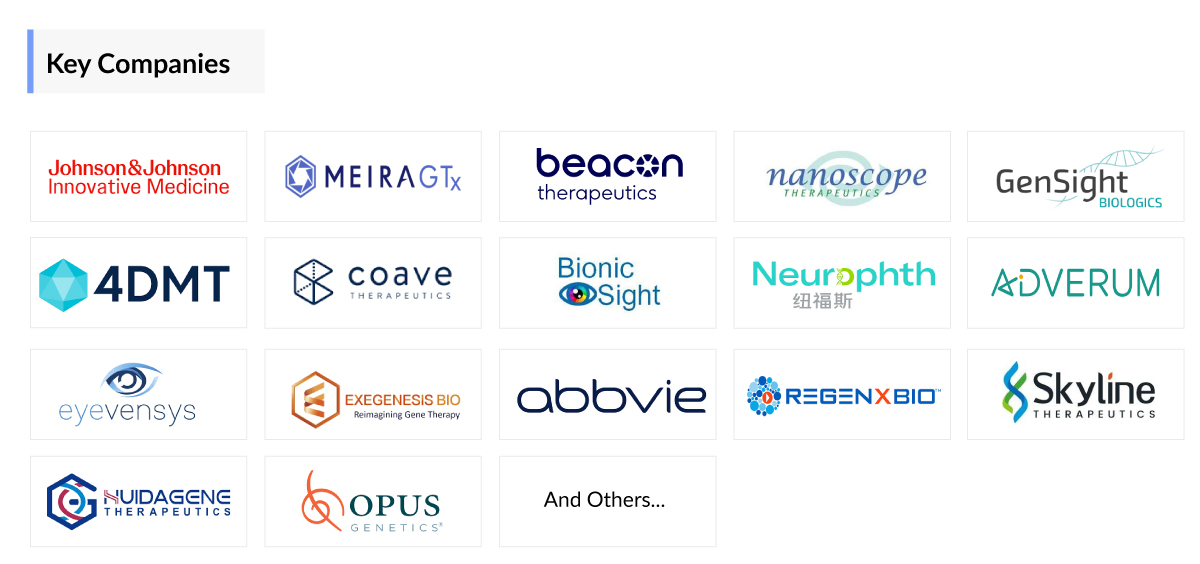
Johnson & Johnson Innovative Medicine, Meiragtx, Beacon Therapeutics, Nanoscope Therapeutics, Gensight Biologics, 4d Molecular Therapeutics, Coave Therapeutics, Bionic Sight, Gensight Biologics, Neurophth Therapeutics, Adverum Biotechnologies, Eyevensys, 4d Molecular Therapeutics, Exegenesis Bio, Meiragtx, Johnson & Johnson Innovative Medicine, Neurophth Therapeutics, 4d Molecular Therapeutics, Atsena Therapeutics, Ocugen, Abbvie, Regenxbio, Skyline Therapeutics, Huidagene Therapeutics, Opus Genetics, and others. |
|
Gene therapy in Ophthalmology Epidemiology Segmentation |
|
Key Factors Driving the Gene Therapy in Ophthalmology Market
Rising Prevalence of Genetic Ocular Disorders
Inherited retinal diseases (IRDs) such as retinitis pigmentosa and Leber congenital amaurosis are leading causes of blindness worldwide. With over 200,000 individuals affected globally, there is a substantial demand for innovative treatments. Gene therapies offer the potential for long-term solutions with a single administration, reducing the treatment burden
Spark Therapeutics’ LUXTURNA Approval
The approval of LUXTURNA has led to a paradigm shift in the therapeutic approach to monogenic retinal diseases, paving the way for pharmaceutical innovation in the advanced therapy medicinal products (ATMP) space.
Advancements in Gene Editing Technologies
Technological innovations, particularly in gene editing tools like CRISPR, have enhanced the development of novel therapies. These advancements allow for precise modifications at the genetic level, providing a more targeted approach to treating genetic eye diseases
Gene Therapy in Ophthalmology Competitive Landscape
Some of the drugs in the pipeline include LUMEVOQ (GenSight Biologics), Botaretigene sparoparvovec (Johnson & Johnson Innovative Medicine/MeiraGTx), JNJ-8120188 (Johnson & Johnson Innovative Medicine), OCU400 (Ocugen), 4D-150 (4D Molecular Therapeutics), ASTSN-101 (Astena Therapeutics), and others.
Gene Therapy in Ophthalmology Treatment Market
Gene Therapy in Ophthalmology Overview
Gene therapy aims to address the underlying cause of disease, such as changes in genes. Gene therapy is the use of genetic material to treat or prevent disease. The genetic material that is delivered, DNA or RNA, has instructions to change how a protein—or group of proteins—is produced by the cell. For some diseases, this means making changes to account for too much, insufficient, or incorrect essential proteins produced within cells. Gene therapy is being investigated in ophthalmology for a number of diseases, including dry age-related macular degeneration, wet age-related macular degeneration, Stargardt disease, retinitis pigmentosa, Leber's Congenital Amaurosis (LCA), and others. Gene therapy in ophthalmology clinical trials is revolutionizing treatment approaches, offering promising outcomes for inherited retinal diseases and vision restoration.
Further details are provided in the report…
Gene Therapy in Ophthalmology Epidemiology
The epidemiology covered in the report provides historical as well as forecasted Gene Therapy in Ophthalmology epidemiology segmented by Total Diagnosed Prevalent Cases of Selected Indications for Gene Therapies in Ophthalmology in the 7MM, Indication-wise Eligible Cases in the 7MM, and Indication-wise Treated Cases in the 7MM, covering the United States, EU4 (Germany, France, Italy, and Spain), and the United Kingdom, and Japan from 2020 to 2034.
- Among all the diagnosed prevalent cases of selected indications for gene therapies in ophthalmology, the highest cases comprised of Diabetic Retinopathy, with approximately 9,200,000 cases in the 7MM in 2020.
- In the US, the highest number of diagnosed prevalent cases comprised of Diabetic Retinopathy with approximately 4,800,000, while the lowest cases comprised Leber Hereditary Optic Neuropathy in 2020.
- In EU4 and the UK, Germany accounted for the highest number of Retinitis Pigmentosa-treated cases with approximately 24,000 in 2020.
- In Japan, the total number of wet-AMD-eligible cases was approximately 800,000 in 2020.
.jpg)
Gene Therapy in Ophthalmology Drug Chapters
The drug chapter segment of the gene therapy in ophthalmology report encloses a detailed analysis of gene therapy in ophthalmology emerging pipeline drugs (Phase-III and Phase II and Phase I/II) . It also helps to understand gene therapy in ophthalmology clinical trial details, expressive pharmacological action, agreements and collaborations, approval and patent details, advantages and disadvantages of each included drug, and the latest news and press releases. The Gene Therapy in Ophthalmology drugs market is rapidly advancing, offering innovative treatments for various inherited and acquired eye disorders.
Gene Therapy in Ophthalmology Marketed Drugs
LUXTURNA is an AAV vector-based gene therapy indicated for the treatment of patients with confirmed biallelic RPE65 mutation-associated retinal dystrophy. Patients must have viable retinal cells, as determined by the treating physician. Mutations in the RPE65 (retinal pigment epithelial 65 kDa protein) gene lead to reduced or absent levels of RPE65 isomerohydrolase activity, blocking the visual cycle and resulting in impairment of vision. Injection of LUXTURNA into the subretinal space results in the transduction of some retinal pigment epithelial cells with a cDNA encoding normal human RPE65 protein, thus providing the potential to restore the visual cycle. It was approved by the US FDA in December 2017, and by the European Commission in November 2018.
Gene Therapy in Ophthalmology Emerging Drugs
RGX-314: REGENXBIO
RGX-314 is a one-time subretinal treatment that includes the NAV AAV8 vector containing a gene encoding for a monoclonal antibody fragment. The expressed protein is designed to neutralize vascular endothelial growth factor (VEGF) activity, modifying the pathway for the formation of new leaky blood vessels and retinal fluid accumulation. RGX-314 is being developed as a potentially one-time treatment for wet AMD, diabetic retinopathy, and other additional chronic retinal conditions treated with anti-VEGF. ATMOSPHERE, the first of two planned pivotal trials for the evaluation of subretinal delivery of RGX-314 in patients with wet AMD, is active and enrolling patients. In May 2023 the company announced the transfer of the IND applications to AbbVie for all ongoing gene therapy in ophthalmology clinical trials and the expansion of the ATMOSPHERE and ASCENT pivotal trials of RGX-314 delivered subretinally for the treatment of patients with wet AMD to support new global registration plans. The new global site plans and expanded enrollment targets are expected to support regulatory submissions of ABBV-RGX-314 with the US FDA and the EMA in late 2025 through the first half of 2026.
GS010: GenSight Biologics
GS010 targets Leber Hereditary Optic Neuropathy (LHON) by leveraging a mitochondrial targeting sequence (MTS) proprietary technology platform, which allows the platform to specifically address defects inside the mitochondria using an AAV vector. The gene of interest is transferred into the cell to be expressed and produces the functional protein, which will then be shuttled to the mitochondria through specific nucleotidic sequences in order to restore the missing or deficient mitochondrial function. Currently, the drug is in the Phase III stage of its development for the treatment of LHON.
NFS-01: Neurophth Therapeutics
NFS-01 (NR082, rAAV2-ND4), a novel recombinant adeno-associated viral vector, serotype 2, containing a mitochondria codon-optimized NADH-dehydrogenase subunit 4 (ND4) gene under the control of the cytomegalovirus promoter and enhancer, is a novel gene therapy product that is being developed for the treatment of LHON associated with mtND4 mutations. NR082 can deliver the correct genes to the patient's damaged optic ganglion cells through intravitreal injection, thus repairing the mitochondrial biological respiratory chain, and restoring the vitality and visual function of optic ganglion cells. Currently, the drug is in the Phase II/III stage of its development for the treatment of Leber's hereditary optic atrophy.
Note: Detailed therapies assessment will be provided in the final report.
Gene Therapy in Ophthalmology Market Outlook
The gene therapy field experienced ups and downs between 1989 and 2012. After two decades of dashed expectations, the first gene therapy was approved in the EU in 2012. This likely boosted this field, and the development of gene therapies increased prominently. Gene therapies are considered very promising to treat many chronic and disabling previously untreatable diseases. Manufacturers are investing more in this field, and an increasing number of products are under clinical development, mostly in the early stages.
In December 2017, Spark Therapeutics announced that their drug candidate LUXTURNA received US FDA approval for the treatment of patients with confirmed biallelic RPE65 mutation-associated retinal dystrophy. LUXTURNA is the first FDA-approved gene therapy for a genetic disease, the first and only pharmacologic treatment for an inherited retinal disease, and the first AAV vector gene therapy approved in the United States. After the approval era of LUXTURNA, many Gene Therapy in Ophthalmology companies entered into the market space targeting many genes that cause many diseases such as Retinitis Pigmentosa, LCA, LHON, Achromatopsia, Choroideremia, AMD (wet-AMD and dry-AMD), Diabetic Retinopathy, DME, and others.
In the Retinitis Pigmentosa pipeline among the emerging candidates, Beacon’s AGTC-501 aims to restore RPGR gene function in patients with X-linked retinitis pigmentosa. In December 2023, Beacon presented unmasked three-month data from its randomized, controlled, multicenter Phase II SKYLINE trial of AGTC-501 in patients with X-linked retinitis pigmentosa at the FLORetina ICOOR 2023. The landscape for Diabetic Retinopathy and DME therapeutic development is currently limited, with only a few noteworthy players such as AbbVie/REGENXBIO's ABBV-RGX-314 and 4D Molecular Therapeutics (4D-150).
- Overall, gene therapy in the ophthalmology market is further expected to increase in the forecast period (2024–2034).
- The total Gene Therapy in Ophthalmology market size in the 7MM was nearly USD 50 million in 2020 and is projected to grow during the forecast period (2024-2034).
- According to the estimates, the highest market size of gene therapy in ophthalmology is from the United States, that is around USD 35 million, in 2020 and is anticipated to grow significantly by 2034.
- Among EU4 and the UK, Germany had the maximum revenue share in 2020, that is around USD 6 million, and is expected to grow significantly by 2034.
.jpg)
Gene Therapy in Ophthalmology Drugs Uptake
This section focuses on the rate of uptake of the potential drugs expected to be launched in the market during the study period 2020-2034. The analysis covers Gene Therapy in Ophthalmology market uptake by drugs; patient uptake by therapies; and sales of each drug.
Gene Therapy in Ophthalmology Pipeline Development Activities
The report provides insights into Gene Therapy in Ophthalmology clinical trials within Phase III, Phase II, and Phase I/II stage. It also analyzes key players involved in developing targeted therapeutics.
Pipeline Development Activities
The report covers detailed information on collaborations, acquisition and merger, licensing, and patent details for Gene Therapy in Ophthalmology emerging therapies.
KOL- Views on Gene Therapy in Ophthalmology Market
To keep up with current market trends, we take KOLs and ’SME’s opinions working in the domain through primary research to fill the data gaps and validate our secondary research. Industry Experts were contacted for insights on gene therapy in ophthalmology's evolving treatment landscape, patient reliance on conventional therapies, patient therapy switching acceptability, and drug uptake along with challenges related to accessibility.
DelveInsight’s analysts connected with 50+ KOLs to gather insights; however, interviews were conducted with 15+ KOLs in the 7MM. Centers such as Pharmaceutical Research and Manufacturers of America and other organizations. Their opinion helps understand and validate current and emerging therapies or market trends in gene therapy in ophthalmology. This will support the clients in potential upcoming novel treatments by identifying the overall scenario of the market and the unmet needs.
Qualitative Analysis
We perform Qualitative and market Intelligence analysis using various approaches, such as SWOT analysis and Analyst views. In the SWOT analysis, strengths, weaknesses, opportunities, and threats in terms of disease diagnosis, patient awareness, patient burden, competitive landscape, cost-effectiveness, and geographical accessibility of therapies are provided. These pointers are based on the Analyst’s discretion and assessment of the patient burden, cost analysis, and existing and evolving treatment landscape.
The analyst analyzes multiple emerging therapies based on relevant attributes such as safety, efficacy, frequency of administration, route of administration, and order of entry.
In efficacy, the trial’s primary and secondary outcome measures are evaluated.
Further, the therapies’ safety is evaluated wherein the acceptability, tolerability, and adverse events are majorly observed, and it sets a clear understanding of the side effects posed by the drug in the trials.
Market Access and Reimbursement
The reimbursement landscape for gene therapies in ophthalmology, exemplified by treatments like LUXTURNA for inherited retinal dystrophies, is characterized by intricacies and variations across different countries. With high initial costs associated with the development and manufacturing of gene therapies, reimbursement models often adopt a value-based approach, considering the long-term benefits and potential cost savings compared to traditional treatments. Health Technology Assessments (HTAs) are commonly employed to evaluate clinical effectiveness, cost-effectiveness, and overall value, taking into account factors like disease severity and the availability of alternative treatments. The American healthcare system is highly fragmented, with various public and private health insurers. This makes for a more complex environment than in European countries, where there tends to be a single, national health insurance system that undertakes HTAs and decides how reimbursement and patient access are managed. Thus, in the US, various organizations decide which treatments to provide health insurance coverage for and under what conditions. In January 2018, Spark Therapeutics announced three new payer programs: an outcomes-based rebate arrangement with a long-term durability measure, an innovative contracting model, and a proposal to CMS under which payments for LUXTURNA would be made over time.
Note: Detailed assessment will be provided in the final report.
Scope of the Gene Therapy in Ophthalmology Market Report
- The report covers a descriptive overview of gene therapy in ophthalmology, explaining its causes, signs and symptoms, pathogenesis, and currently available therapies.
- Comprehensive insight has been provided into gene therapy in ophthalmology epidemiology and treatment.
- Additionally, an all-inclusive account of both the current and emerging therapies for gene therapy in ophthalmology is provided, along with the assessment of new therapies, which will have an impact on the current treatment landscape.
- A detailed review of the gene therapy in ophthalmology market; historical and forecasted is included in the report, covering the 7MM drug outreach.
- The report provides an edge while developing business strategies, by understanding trends shaping and driving the 7MM gene therapy in ophthalmology market.
Gene Therapy in Ophthalmology Market Report Insights
- Gene Therapy in Ophthalmology Market Report Insights
- Gene Therapy in Ophthalmology Patient Population
- Gene Therapy in Ophthalmology Therapeutic Approaches
- Gene Therapy in Ophthalmology Pipeline Analysis
- Gene Therapy in Ophthalmology Market Size and Trends
- Gene Therapy in Ophthalmology Market Opportunities
- Impact of Upcoming Gene Therapy in Ophthalmology Therapies
- Gene Therapy in Ophthalmology Drugs Market
Gene Therapy in Ophthalmology Market Report Key Strengths
- Eleven Years Forecast
- 7MM Coverage
- Gene Therapy in Ophthalmology Epidemiology Segmentation
- Key Cross Competition
- Highly Analyzed Market
- Gene Therapy in Ophthalmology Drugs Uptake
Gene Therapy in Ophthalmology Market Report Assessment
- Gene Therapy in Ophthalmology Unmet Needs
- Gene Therapy in Ophthalmology Pipeline Product Profiles
- Gene Therapy in Ophthalmology Market Attractiveness
- Qualitative Analysis (SWOT and Conjoint Analysis)
- Gene Therapy in Ophthalmology Market Drivers
- Gene Therapy in Ophthalmology Market Barriers
FAQs
- What was the gene therapy in ophthalmology market share (%) distribution in 2020 and what it would look like in 2034?
- What would be the gene therapy in ophthalmology total market size as well as market size by therapies across the 7MM during the study period (2020–2034)?
- What are the key findings about the market across the 7MM and which country will have the largest gene therapy in ophthalmology market size during the study period (2020–2034)?
- At what CAGR, the gene therapy in the ophthalmology market is expected to grow at the 7MM level during the study period (2020–2034)?
- What would be the gene therapy in the ophthalmology market outlook across the 7MM during the study period (2020–2034)?
- What would be the gene therapy in ophthalmology market growth till 2034 and what will be the resultant market size in the year 2034?
- What are the disease risk, burden, and unmet needs of gene therapy in ophthalmology?
- What is the historical gene therapy in the ophthalmology patient pool in the United States, EU4 (Germany, France, Italy, and Spain), the UK, and Japan?
- What would be the forecasted patient pool of gene therapy in ophthalmology at the 7MM level?
- What will be the growth opportunities across the 7MM concerning the patient population about gene therapy in ophthalmology?
- At what CAGR the population is expected to grow across the 7MM during the study period (2020–2034)?
- How many Gene Therapy in Ophthalmology companies are developing therapies for treatment of gene therapy in ophthalmology ?
- How many emerging therapies are in the mid-stage and late stage of development for gene therapy in ophthalmology?
- What are the key collaborations (Industry–Industry, Industry–Academia), Mergers and acquisitions, and licensing activities related to the gene therapy in ophthalmology?
- What are the recent novel therapies, targets, mechanisms of action, and technologies developed to overcome the limitations of existing therapies?
- What are the clinical studies going on for gene therapy in ophthalmology and their status?
- What are the key designations that have been granted for gene therapies in ophthalmology?
- What are the 7MM historical and forecasted market of gene therapy in ophthalmology?
Reasons to buy Gene Therapy in Ophthalmology Market Forecast
- The report will help in developing business strategies by understanding trends shaping and driving the gene therapy in ophthalmology.
- To understand the future market competition in the gene therapy in ophthalmology market and an Insightful review of the SWOT analysis of gene therapy in ophthalmology.
- Organize sales and marketing efforts by identifying the best opportunities for gene therapy in ophthalmology in the US, EU4 (Germany, France, Italy, and Spain), the United Kingdom, and Japan.
- Identification of strong upcoming players in the market will help in devising strategies that will help in getting ahead of competitors.
- Organize sales and marketing efforts by identifying the best opportunities for the gene therapy in ophthalmology market.
- To understand the future market competition in the gene therapy in ophthalmology market.
Explore key insights with our Gene Therapy in Ophthalmology Market Infographics now!