
GIMOTI Sales Forecast
Key Factors Driving GIMOTI Growth
Growing Prevalence of Gastroparesis, Especially in Diabetic Patients
One of the major drivers for GIMOTI is the increasing prevalence of gastroparesis, particularly among diabetic populations. Gastroparesis is a chronic condition in which delayed gastric emptying leads to nausea, vomiting, and abdominal pain.
- Approximately 9.3% of individuals with diabetes develop gastroparesis, creating a large treatment population.
- Globally, diabetes affects over 537 million adults, expanding the potential patient pool requiring therapy.
Diabetic gastroparesis accounts for about 44.6% of the total gastroparesis treatment market, highlighting the substantial commercial opportunity for therapies targeting this condition.
As diabetes prevalence continues to rise worldwide, demand for treatments such as GIMOTI is expected to grow.
Differentiated Nasal Delivery Addressing Limitations of Oral Therapies
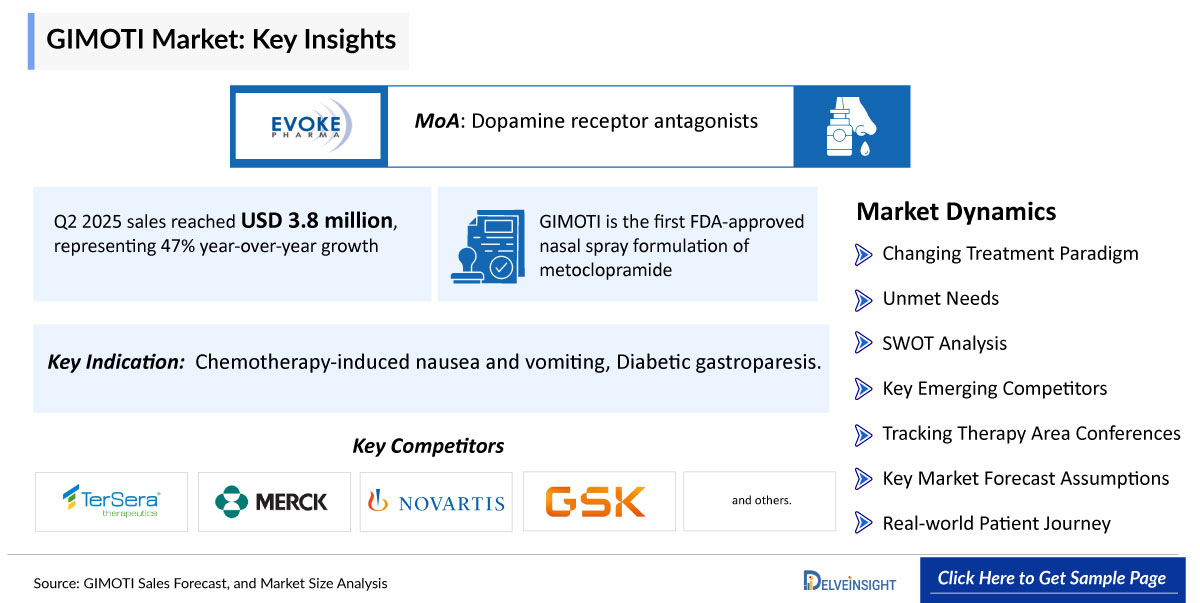
GIMOTI is the first FDA-approved nasal spray formulation of metoclopramide, providing a key advantage over oral formulations.
Patients with gastroparesis often experience impaired gastric emptying, which can make oral medications unreliable. The intranasal route:
- Bypasses the gastrointestinal tract, allowing more consistent drug absorption.
- Provides faster therapeutic onset compared with oral therapy.
- Offers an alternative for patients who experience frequent vomiting.
Physicians have highlighted the unpredictable absorption of oral metoclopramide in gastroparesis patients, which makes nasal delivery an attractive option for improved symptom control.
This differentiated delivery technology is a major factor supporting physician adoption.
Strong Commercial Growth Since Launch
GIMOTI has demonstrated strong year-over-year revenue growth since commercialization.
Key sales milestones include:
- USD 2.5 million in net sales in 2022, representing a 179% increase versus 2021.
- USD 5.2 million in sales in 2023, a 107% year-over-year increase.
- USD 10.2 million in revenue in 2024, representing ~98% annual growth.
Quarterly data also demonstrate continued momentum:
- Q2 2025 sales reached USD 3.8 million, representing 47% year-over-year growth.
This rapid growth reflects increasing physician awareness, improved pharmacy distribution, and expanding patient access.
Expanding Prescriber Base and Improved Patient Access
Another major growth driver is the expansion of physician adoption and pharmacy access.
Commercial metrics show strong momentum:
- The prescriber base increased 46% in 2024, reaching 2,553 cumulative prescribers.
- Prescription fill rates increased 72% year-over-year.
- Patient enrollments increased 22% year-over-year.
Additionally, Evoke Pharma transitioned distribution to ASPN specialty pharmacies, improving prescription fulfillment rates and patient access.
These improvements in commercial infrastructure are expected to support continued prescription growth.
Favorable Real-World Evidence Supporting Clinical and Economic Benefits
Real-world healthcare utilization data has shown meaningful benefits associated with GIMOTI therapy.
Studies presented at major gastroenterology conferences demonstrated:
- Reduced emergency room visits and hospitalizations compared with oral metoclopramide
- Healthcare cost savings of more than USD 15,000 per patient within six months of treatment
Such evidence strengthens the value proposition of GIMOTI for both physicians and healthcare payers.
Patent Protection Extending Commercial Exclusivity
Intellectual property protection also supports long-term growth.
A newly issued US patent extends GIMOTI’s market exclusivity until November 2038, nearly two years longer than the previous projection.
GIMOTI Recent Developments
- In August 2025, Evoke Pharma announced the official issuance of a new US patent related to its product GIMOTI. The patent, US Patent No. 12,377,064, covers the use of intranasal metoclopramide in patients with moderate to severe symptoms of gastroparesis, and has now been issued by the United States Patent and Trademark Office (USPTO).
“GIMOTI Sales Forecast, and Market Size Analysis – 2034” report provides comprehensive insights of GIMOTI for approved indication like Chemotherapy-induced nausea and vomiting, Diabetic gastroparesis in the 7MM. A detailed picture of GIMOTI’s existing usage in anticipated entry and performance in approved indications in the 7MM, i.e., the United States, EU4 (Germany, France, Italy, and Spain) and the United Kingdom, and Japan for the study period 2020 –2034 is provided in this report along with a detailed description of the GIMOTI for approved indications. The GIMOTI market report provides insights about GIMOTI’s sales forecast, mechanism of action (MoA), dosage and administration, as well as research and development including regulatory milestones, along with other developmental activities. Further, it also consists of historical and current GIMOTI performance, future market assessments inclusive of the GIMOTI market forecast analysis for approved indications in the 7MM, SWOT, analysts’ views, comprehensive overview of market competitors, and brief about other emerging therapies in respective indications. It also provides analysis of GIMOTI sales forecasts, along with factors driving its market.
GIMOTI Drug Summary
GIMOTI (metoclopramide nasal spray) is an FDA-approved dopamine-2 (D2) receptor antagonist formulated as a 15 mg per actuation intranasal spray (70 microliters per spray, 9.8 mL bottle yielding ~56 doses), indicated for the relief of symptoms in adults with acute and recurrent diabetic gastroparesis, such as nausea, vomiting, heartburn, early satiety, and bloating. By antagonizing central and peripheral D2 receptors, it enhances gastric motility, accelerates stomach emptying, and increases lower esophageal sphincter tone without stimulating gastric, biliary, or pancreatic secretions, offering a needle-free alternative to oral or injectable metoclopramide for patients with absorption issues. Administered as one spray (15 mg) in alternating nostrils 30 minutes before meals (up to 3 times daily) and at bedtime (maximum 4 times/day for 2-8 weeks), treatment should not exceed 12 weeks total across all metoclopramide forms due to risks of tardive dyskinesia (TD), with contraindications in pediatrics, moderate/severe hepatic/renal impairment, or strong CYP2D6 inhibitor use. The report provides GIMOTI’s sales, growth barriers and drivers, post usage and approvals in multiple indications.
Scope of the GIMOTI Market Report
The report provides insights into:
- A comprehensive product overview including the GIMOTI MoA, description, dosage and administration, research and development activities in approved indication like Chemotherapy-induced nausea and vomiting, Diabetic gastroparesis.
- Elaborated details on GIMOTI regulatory milestones and other development activities have been provided in GIMOTI market report.
- The report also highlights GIMOTI‘s cost estimates and regional variations, reported and estimated sales performance, research and development activities in approved indications across the United States, Europe, and Japan.
- The GIMOTI market report also covers the patents information, generic entry and impact on cost cut.
- The GIMOTI market report contains current and forecasted GIMOTI sales for approved indications till 2034.
- Comprehensive coverage of the late-stage emerging therapies for respective indications.
- The GIMOTI market report also features the SWOT analysis with analyst views for GIMOTI in approved indications.
Methodology
The GIMOTI market report is built using data and information sourced primarily from internal databases, primary and secondary research and in-house analysis by DelveInsight’s team of industry experts. Information and data from the secondary sources have been obtained from various printable and nonprintable sources like search engines, news websites, global regulatory authorities websites, trade journals, white papers, magazines, books, trade associations, industry associations, industry portals and access to available databases.
GIMOTI Analytical Perspective by DelveInsight
In-depth GIMOTI Market Assessment
This GIMOTI sales market forecast report provides a detailed market assessment of GIMOTI for approved indication like Chemotherapy-induced nausea and vomiting, Diabetic gastroparesis in the seven major markets, i.e., the United States, EU4 (Germany, France, Italy, and Spain) and the United Kingdom, and Japan. This segment of the report provides current and forecasted GIMOTI sales data uptil 2034.
GIMOTI Clinical Assessment
The GIMOTI market report provides the clinical trials information of GIMOTI for approved indications covering trial interventions, trial conditions, trial status, start and completion dates.
GIMOTI Competitive Landscape
The report provides Insights on competitors and marketed products within the domain, along with a summary of emerging products and their respective launch dates, posing significant competition in the market.
GIMOTI Market Potential & Revenue Forecast
- Projected market size for the GIMOTI and its key indications
- Estimated GIMOTI sales potential (GIMOTI peak sales forecasts)
- GIMOTI Pricing strategies and reimbursement landscape
GIMOTI Competitive Intelligence
- Number of competing drugs in development (pipeline analysis)
- GIMOTI Market positioning compared to existing treatments
- GIMOTI Strengths & weaknesses relative to competitors
GIMOTI Regulatory & Commercial Milestones
- GIMOTI Key regulatory approvals & expected launch timelines
- Commercial partnerships, licensing deals, and M&A activity
GIMOTI Clinical Differentiation
- GIMOTI Efficacy & safety advantages over existing drugs
- GIMOTI Unique selling points
GIMOTI Market Report Highlights
- In the coming years, the GIMOTI market scenario is set to change due to strong adoption, increased prescriptions and broader uptake in multiple immunological indications; which would expand the size of the market.
- The GIMOTI companies are developing therapies that focus on novel approaches to treat/improve the disease condition, assess challenges, and seek opportunities that could influence GIMOTI’s dominance.
- Other emerging products for Chemotherapy-induced nausea and vomiting, Diabetic gastroparesis are expected to give tough market competition to GIMOTI and launch of late-stage emerging therapies in the near future will significantly impact the market.
- A detailed description of regulatory milestones, and developmental activities, provide the current development scenario of GIMOTI in approved indications.
- Analyse GIMOTI cost, pricing trends and market positioning to support strategic decision-making in the immunology landscape.
- Our in-depth analysis of the forecasted GIMOTI sales data uptil 2034 will support the clients in decision-making process regarding their therapeutic portfolio by identifying the overall scenario of GIMOTI in approved indications.
Key Questions
- What is the class of therapy, route of administration and mechanism of action of GIMOTI? How strong is GIMOTI’s clinical and commercial performance?
- What is GIMOTI’s clinical trial status in each individual indications such as Chemotherapy-induced nausea and vomiting, Diabetic gastroparesis and study completion date?
- What are the key collaborations, mergers and acquisitions, licensing and other activities related to the GIMOTI Manufacturers?
- What are the key designations that have been granted to GIMOTI for approved indications? How are they going to impact GIMOTI’s penetration in various geographies?
- What is the current and forecasted GIMOTI market scenario for approved indications? What are the key assumptions behind the forecast?
- What are the current and forecasted sales of GIMOTI in the seven major countries, including the United States, Europe (Germany, France, Italy, Spain) and the United Kingdom, and Japan?
- What are the other emerging products available and how are these giving competition to GIMOTI for approved indications?
- Which are the late-stage emerging therapies under development for the treatment of approved indications?How cost-effective is GIMOTI? What is the duration of therapy and what are the geographical variations in cost per patient?

