.png&w=256&q=75)
Gout Market
Key Highlights
- The Gout market is expected to grow significantly by 2036.
- Historical clinical-development sources have estimated approximately 160,000 U.S. patients with chronic gout refractory to conventional therapies, although this figure is older and should not be interpreted as a current prevalence estimate.
- Key companies active in the market include Amgen, Crystalys Therapeutics, Arthrosi Therapeutics, LG Chem, Olatec Therapeutics, XORTX Therapeutics, Sobi, Selecta Biosciences, Takeda, Horizon Therapeutics, AstraZeneca, Jiangsu Hengrui Medicine
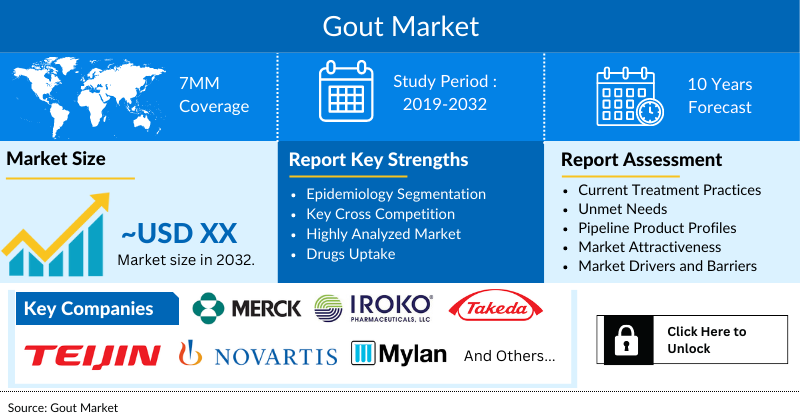
DelveInsight’s “Gout Market Insights, Epidemiology, and Market Forecast – 2036” report delivers an in-depth understanding of the Gout, historical and forecasted epidemiology as well as the Gout market trends in the United States, EU4 (Germany, France, Italy, Spain), and the United Kingdom, and Japan.
The Gout market report provides current treatment practices, emerging drugs, Gout market share of the individual therapies, and current and forecasted Gout market size from 2022 to 2036, segmented by seven major markets. The report also covers current Gout treatment practices/algorithms and unmet medical needs to curate the best of the opportunities and assess the underlying potential of the market.
Geography Covered
- The United States
- EU4 (Germany, France, Italy, Spain), and the United Kingdom
- Japan
Study period: 2022–2036
Key Factors Driving the Gout Market Growth
- Large and Persistent Patient Population: Gout affects approximately 9.2 million U.S. adults, based on NHANES 2015–2016 data, equivalent to about 3.9% of U.S. adults. The large chronic patient pool creates sustained demand for acute-flare therapies and long-term urate-lowering treatment.
- Increasing Burden of Metabolic Comorbidities: Obesity, hypertension, diabetes, insulin resistance, cardiovascular disease and impaired kidney function are associated with increased gout risk. The growing prevalence of these conditions supports continued demand for gout diagnosis and management.
- High Unmet Need in Difficult-to-Treat Gout: A subset of patients remains inadequately controlled despite conventional urate-lowering therapy, creating opportunities for next-generation URAT1 inhibitors, uricases and combination approaches. Refractory patients are also particularly relevant for specialty and biologic therapies.
- Limitations of Existing Urate-Lowering Therapy: Treatment adherence, inadequate serum-urate control, renal considerations, tolerability and flare risk during initiation remain important challenges. These limitations are encouraging development of therapies with alternative mechanisms and potentially improved dosing profiles.
Gout Treatment Algorithm and Disease Understanding
Gout Overview
Gout is a chronic inflammatory arthritis caused by the accumulation of monosodium urate (MSU) crystals in joints and other tissues when serum uric acid levels remain elevated. It commonly presents as sudden, severe episodes of joint pain, swelling, redness and warmth, frequently affecting the first metatarsophalangeal joint of the big toe, although ankles, knees, wrists and other joints can also be involved. Recurrent uncontrolled disease can progress to chronic arthritis and tophi, which are deposits of urate crystals that can damage joints and surrounding tissues. Risk is associated with factors including male sex, advancing age, obesity, hypertension, diabetes, kidney dysfunction, diuretic use and diets or beverages that increase uric-acid production.
Gout Diagnosis
Gout diagnosis combines clinical presentation, medical history, serum urate testing and, where necessary, direct identification of MSU crystals. Synovial-fluid aspiration and polarized microscopy demonstrating negatively birefringent MSU crystals remains the definitive diagnostic approach when confirmation is required. Serum uric acid testing can support diagnosis and treatment monitoring but does not independently establish gout because hyperuricemia can occur without clinical gout. Imaging techniques such as ultrasound and dual-energy CT can also identify urate deposition, particularly when joint aspiration is difficult or the presentation is atypical. X-rays are more useful for assessing chronic structural damage than for confirming early disease.
Gout Treatment
Gout management has two major objectives: rapidly controlling acute inflammation during flares and reducing serum urate over the long term to prevent future flares and crystal accumulation. Acute attacks are generally treated with NSAIDs, colchicine or corticosteroids, selected according to comorbidities and contraindications. Long-term urate-lowering therapy includes xanthine oxidase inhibitors such as allopurinol and febuxostat, while uricosuric therapy can be used in appropriate patients. Pegloticase is an intravenous uricase option for adults with chronic gout refractory to conventional treatment. Current management increasingly follows a treat-to-target approach, with serum urate generally maintained below 6 mg/dL in patients receiving urate-lowering therapy. Lifestyle measures—including weight management, physical activity and limiting alcohol, sugary beverages and high-purine foods—can complement pharmacological treatment.
Gout Epidemiology
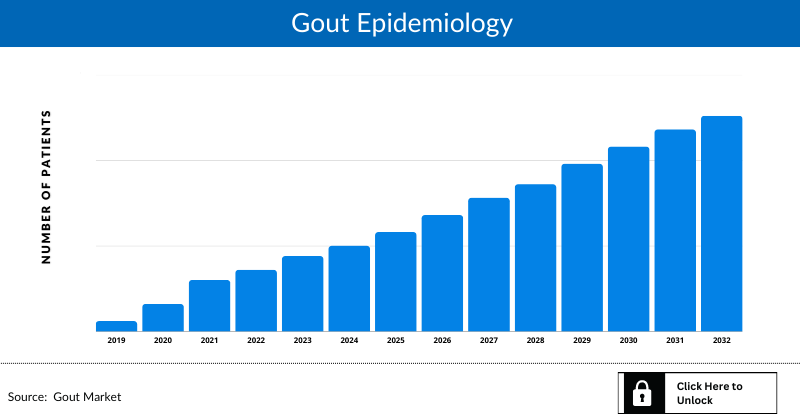
The Gout epidemiology section provides insights into historical and current Gout patient pool and forecasted trends for seven individual major countries. It helps recognize the causes of current and forecasted trends by exploring numerous studies and views of key opinion leaders. This part of the Gout report also provides the diagnosed patient pool, their trends and assumptions undertaken.
Key findings
The study conducted by Dehlin et al. (2020), the reported prevalence of gout in the USA was fairly high, with 3–4% of adults affected in 2007– 2008. Consistent with this estimate, in the 2015– 2016 National Health and Nutrition Examination Survey (NHANES), a stratified, multistage sample representative of the US adult population, the prevalence of self- reported, health professional-diagnosed gout was 3.9%.
Dehlin et al. (2020) also quoted that Gout is common in Europe, with studies in France, Germany, Greece, Italy, the Netherlands, Spain and the UK finding a gout prevalence ranging from 1% to 4% for the period 2003–2014, which has been confirmed in subsequent studies from other European countries.
The Gout epidemiology covered in the report provides historical as well as forecasted Gout epidemiology [segmented as Total Prevalence of Gout, Gender-specific Prevalence of Gout, Age-specific Prevalence of Gout, and Diagnosed and Treatable Cases of Gout] in the 7MM covering the United States, EU4 (Germany, France, Italy, Spain), and the United Kingdom, and Japan from 2022 to 2036.
Gout Drug Chapters
The drug chapter segment of the Gout report encloses the detailed analysis of Gout marketed drugs and late-stage (Phase III and Phase II) Gout pipeline drugs. It also helps understand the Gout clinical trial details, expressive pharmacological action, agreements and collaborations, approval and patent details, advantages and disadvantages of each included drug, and the latest news and press releases.
Gout Marketed Drugs
lesinurad (Zurampic)
Lesinurad (Zurampic) is used to treat patients with gout. In gout, high levels of uric acid cause excess urate crystals to deposit in the joint, creating a hot, swollen, painful joint; the primary manifestation of gout. Lesinurad decreases uric acid by increasing the amount excreted in the urine.
Note: Detailed Current therapies assessment will be provided in the full report...
Gout Emerging Gout drugs
Dotinurad: Crystalys Therapeutics
Dotinurad is an oral, once-daily URAT1 inhibitor designed to increase urinary uric-acid excretion. Unlike xanthine oxidase inhibitors, which reduce uric-acid production, dotinurad works primarily by inhibiting renal urate reabsorption. The drug is already approved in several Asian markets but is not approved in the U.S. Crystalys is developing it through the Phase 3 RUBY and TOPAZ studies and the Phase 2 AMETHYST study, including patients with difficult-to-treat gout. The U.S. development program includes trials comparing dotinurad with allopurinol, including a Phase 3 study in tophaceous gout.
AR882: Arthrosi Therapeutics
AR882 is an investigational oral URAT1 inhibitor being developed for serum-urate reduction in patients with gout. The Phase 3 AR882-301 study evaluates two doses of AR882 against placebo over 12 months and is being conducted under U.S. FDA-regulated development. The program is designed to address the continuing need for more effective urate-lowering options, particularly for patients who do not achieve adequate control with existing therapies.
Note: Detailed emerging therapies assessment will be provided in the full report...
Recent Developments in the Gout Market
- In September 2026, XORTX announced initiation of clinical and commercial manufacturing of XORLO and drug substance/tablets intended to support the XRX-OXY-102 gout study and potential future U.S. FDA marketing application.
- In July 2026, Crystalys raised $130 million in Series B financing to advance global Phase 3 development and commercialization preparation for dotinurad.
- In May 2026, Crystalys Therapeutics announced first-patient dosing in the Phase 2 AMETHYST study of dotinurad in difficult-to-treat gout, including patients intolerant of xanthine oxidase inhibitors or who have failed uricase treatment.
- In March 2026, the Phase 2/3 study of dapansutrile in acute gout flares remained recruiting, evaluating the oral NLRP3 inhibitor against placebo.
Gout Market Outlook
Treatment of pain and inflammation can be achieved with NSAIDs, colchicine, or corticosteroids (systemic or intra-articular). The choice of which treatment is the right one for a particular patient should be made on the basis of the patient’s co-morbid medical conditions, other medications, and side effect profile.
NSAIDS: Commonly used NSAIDs during an acute gout attack include ibuprofen 800 mg three to four times daily or indomethacin 25 to 50 mg four times daily. Treatment should be discontinued when symptoms resolve
Colchicine: Intravenous colchicine is associated with serious toxicities and side effects, so it should be used as an oral formulation only. High dose oral colchicine is generally poorly tolerated because of GI side effects. Lower doses are much better received and may be used in combination with NSAIDs.
Corticosteroids: In patients with contraindications to NSAID use, corticosteroids are the next choice. Corticosteroids can be administered as an injection into the effected joint (intra-articular steroids) or given systemically (orally, such as prednisone or medrol). Intra-articular steriods are useful if only one or two joints are affected and the treating physician is proficient in injecting those joints.
Medicines to prevent recurrences of gout either block the production of uric acid or improve its removal. Examples include: allopurinol, febuxostat, pegloticase, probenecid.
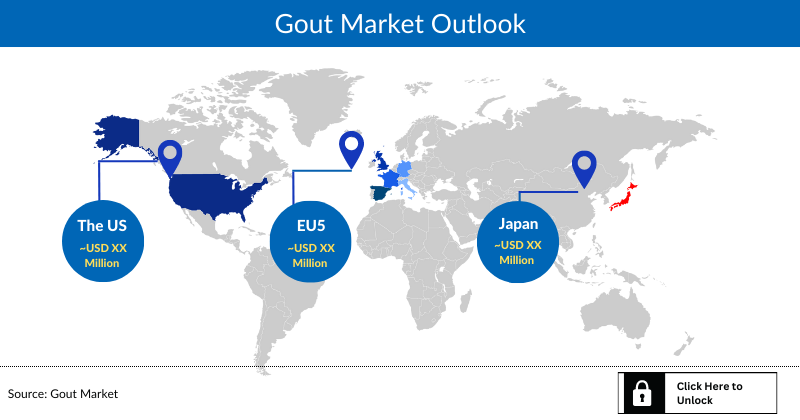
According to DelveInsight, the Gout market in 7MM is expected to witness a major change in the study period 2022–2036.
Gout Drug Uptake
This section focuses on the rate of uptake of the potential drugs recently launched in the Gout market or expected to get launched in the market during the study period 2022–2036. The analysis covers Gout market uptake by drugs, patient uptake by therapies, and sales of each drug.
This will help in understanding the Gout drugs with the most rapid uptake and the reasons behind the maximal use of new drugs and allows the comparison of the drugs based on market share and size, which again will be useful in investigating factors important in the market uptake and in making financial and regulatory decisions.
Gout Pipeline Development Activities
The Gout report provides insights into Gout Clinical Trails within Phase II, and Phase III stages. It also analyses Gout’s key players involved in developing targeted therapeutics.
Gout market clinical trial development activities
The report covers detailed information on collaborations, acquisitions, and mergers, licensing patent details, and other information for Gout emerging therapies.
Gout Reimbursement Scenario
Approaching reimbursement proactively can have a positive impact both during the late stages of product development and well after product launch. In a report, we consider reimbursement to identify economically attractive indications and market opportunities. When working with finite resources, the ability to select the markets with the fewest reimbursement barriers can be a critical business and price strategy.
KOL Views
To keep up with current epidemiology and market trends, we take KOLs and SMEs' opinions working in the Gout domain through primary research to fill the data gaps and validate our secondary research. Their opinion helps to understand and validate current and emerging therapies and treatment patterns along with Gout market trends. This will support the clients in potential upcoming novel treatments by identifying the overall scenario of the market and the unmet needs.
Competitive Intelligence Analysis
We perform competitive and market intelligence analysis of the Gout market by using various competitive intelligence tools that include – SWOT analysis, PESTLE analysis, Porter's five forces, BCG Matrix, Market entry strategies, etc. The inclusion of the analysis entirely depends upon the data availability.
|
Report Metrics |
Details |
|
Study Period |
2022 to 2036 |
|
Forecast Period |
2026 to 2036 |
|
CAGR | |
|
Gout Market Size |
USD XX Million by 2036 |
|
Key Gout Companies |
Mylan N.V., MERCK & Co. Inc., Iroko Pharmaceutical LLC, Hikma Pharmaceuticals plc, Takeda Pharmaceutical Company Limited, Teijin Pharma Limited, Novartis AG, Horizon Therapeutics plc, Teva Pharmaceutical Industries Ltd., and Many Others. |
Scope of the Gout Market Report
- The Gout Therapeutics Market Report covers a segment of key events, an executive summary, a descriptive overview, explaining their causes, signs and symptoms, pathogenesis, and currently available treatments.
- Comprehensive insight has been provided into the epidemiology segments and forecasts, the future growth potential of the diagnosis rate, and disease progression along Gout Treatment guidelines.
- Additionally, an all-inclusive account of both the current and emerging treatments, along with the elaborative profiles of late-stage and prominent therapies, will have an impact on the current Gout Treatment landscape.
- A detailed review of the Gout Therapeutics Market, historical and forecasted Gout Treatment Market Size, Gout Drugs Market Share by therapies, detailed assumptions, and rationale behind our approach is included in the report, covering the 7MM drug outreach.
- The Gout Therapeutics Market Report provides an edge while developing business strategies by understanding trends through SWOT analysis and expert insights/KOL views, patient journey, and treatment preferences that help in shaping and driving the 7MM Gout Drugs Market.
Gout Market Report Insights
- Gout Patient Population Forecast
- Gout Therapeutics Market Size
- Gout Pipeline Drugs Analysis
- Gout Market Size and Trends
- Gout Therapeutics Market Opportunity (Current and Forecasted)
Gout Market Report Key Strengths
- Epidemiology-based (Epi-based) Bottom-up Forecasting
- Artificial Intelligence (AI) - enabled Market Research Report
- 11-year forecast
- Gout Market Outlook (North America, Europe, Asia-Pacific)
- Patient Burden Trends (by geography)
- Gout Treatment Addressable Market (TAM)
- Gout Competitive Landscape
- Gout Major Companies Insights
- Gout Price Trends and Analogue Assessment
- Gout Therapies Drug Adoption/Uptake
- Gout Therapies Peak Patient Share Analysis
Gout Market Report Assessment
- Gout Current Treatment Practices
- Gout Unmet Needs
- Gout Clinical Development Analysis
- Gout Emerging Drugs Product Profiles
- Gout Market Attractiveness
- Gout Qualitative Analysis (SWOT and Attribute analysis)
Key Questions Answered in the Gout Treatment Market Report
Gout Therapeutics Market Insights
- What was the Gout Treatment Market Size, the Gout Market Size by therapies, Gout Drugs Market Share (%) distribution in 2025, and what would it look like by 2036? What are the contributing factors for this growth?
- What are the anticipated pricing variations among different geographies for the emerging therapies in the future?
- What can be the future treatment paradigm of Gout?
- What are the disease risks, burdens, and unmet needs of Gout?
- What will be the growth opportunities across the 7MM concerning the patient population with Gout?
- Who is the major future competitor in the market, and how will the competitors affect their market share?
- What are the current options for the treatment of Gout? What are the current guidelines for treating Gout in the US, Europe, and Japan?
Reasons to Buy the Gout Therapeutics Market Report
- The Gout Therapeutics Market Report will help in developing business strategies by understanding the latest trends and changing treatment dynamics driving the Gout Drugs Market.
- Bottom up forecasting builds from the affected population to product forecasts, delivering a robust, data driven approach ideal for new therapies and novel classes.
- Insights on patient burden/disease Gout Prevalence, evolution in diagnosis, and factors contributing to the change in the epidemiology of the disease during the forecast years.
- Understand the existing Gout Drugs Market opportunities in varying geographies and the growth potential over the coming years.
- Identifying strong upcoming players in the Gout Drugs Market will help devise strategies to help get ahead of competitors.
- Detailed analysis, ranking of class-wise potential current, and emerging therapies under the attribute analysis section to provide visibility around leading classes.
- To understand KOLs’ perspectives on the accessibility, acceptability, and compliance-related challenges of existing treatment to overcome barriers in the future.
- Detailed insights on the unmet needs of the existing Gout Drugs Market so that the upcoming players can strengthen their development and launch strategy.
- This Artificial Intelligence (AI) enabled report summarize and simplify complex datasets with in the report into clear, actionable insights for stakeholders, investors, and healthcare providers, enabling faster, data driven decisions.