-market.png&w=256&q=75)
Guillain-Barre Syndrome (GBS) Market Summary
- The Guillain-Barré Syndrome Market Size is anticipated to grow with a significant CAGR during the study period (2020-2034).
- The leading Guillain-Barré Syndrome companies developing therapies include - Annexon, Hansa Biopharma, Grifols, CSL Behring, Octapharma, Takeda, Kedrion Biopharma, and others.
Guillain-Barré Syndrome Market and Epidemiology Analysis
- The current market is predominantly occupied by treatment options like immune-modulating agents and plasma exchange aids. However, there is currently no FDA-approved drug for Guillain-Barré Syndrome.
- The unmet needs in this disease area include limited availability of effective treatments, limited understanding of the causes, and lack of awareness. However, with the robust emerging pipeline, the market will be driven by both approved and emerging therapies during the forecast period (2024–2034).
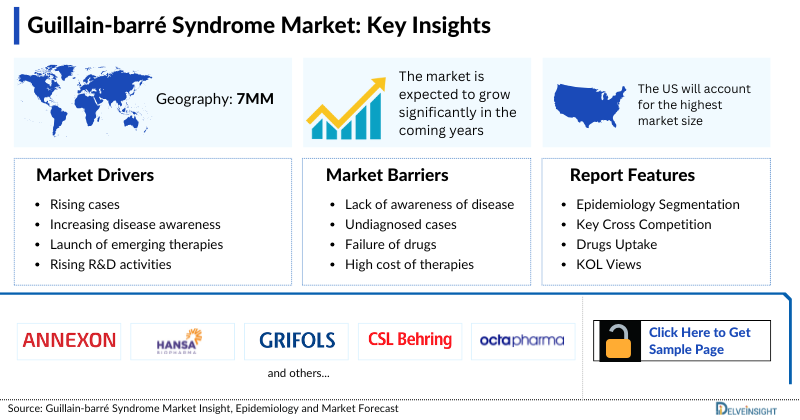
- The Guillain-Barré Syndrome market is expected to experience significant growth during the forecast period (2024–2034). This is a direct consequence of various market-driving factors such as the rising incidence of Guillain-Barré Syndrome, increasing awareness of the disease, the development of innovative treatment options, and increased investment by pharmaceutical companies for research and development.
- To propel the market in the coming years, several companies like Annexon, and Hansa Biopharma, among others developing their assets like ANX005, imlifidase, etc. for Guillain-Barré Syndrome. Due to the anticipated approval of some of the emerging therapies that are under development in the coming years, the overall Guillain-Barré Syndrome therapeutics market is expected to grow at a significant CAGR over the forecast period [2024–2034].
Request for unlocking the Sample Page of the "Guillain-Barré Syndrome Market Insights"
Key Factors Driving the Guillain-Barré Syndrome Market
- Rising Incidence and Improved Diagnosis: Increased awareness among clinicians and advancements in diagnostic techniques have led to earlier and more accurate identification of Guillain-Barré Syndrome, expanding the treated patient population.
- Strong Dependence on IVIG and Plasma Exchange Therapies: The widespread use of intravenous immunoglobulin (IVIG) and plasma exchange as standard-of-care treatments continues to drive market demand, supported by consistent clinical efficacy in reducing disease severity and recovery time.
- Expansion of Healthcare Infrastructure and Access to Care: Growth in critical care facilities, especially in emerging markets, and improved access to neurology specialists are enabling broader adoption of GBS treatments worldwide.
- Emerging Pipeline and R&D Investments: Increasing research focus on novel immunomodulatory therapies, including complement inhibitors and FcRn antagonists, is strengthening the future market outlook and attracting investment from pharmaceutical and biotech companies.
- Supportive Regulatory and Reimbursement Environment: Orphan drug designations, favorable reimbursement policies for IVIG in developed regions, and government support for rare disease management are facilitating market growth and encouraging continued innovation.
DelveInsight’s comprehensive report titled “Guillain-Barré Syndrome Market Insights, Epidemiology, and Market Forecast – 2034” offers a detailed analysis of Guillain-Barré Syndrome. The report presents historical and projected epidemiological data covering total incident cases of Guillain-Barré Syndrome, gender-specific cases of Guillain-Barré Syndrome, age-specific cases of Guillain-Barré Syndrome, and treated cases of Guillain-Barré Syndrome. In addition to epidemiology, the market report encompasses various aspects related to the patient population. These aspects include the diagnosis process, prescription patterns, physician perspectives, market accessibility, treatment options, and prospective developments in the market across seven major markets: the United States, EU4 (Germany, France, Italy, and Spain), the United Kingdom, and Japan, spanning from 2020 to 2034.
The report analyzes the existing treatment practices and unmet medical requirements in Guillain-Barré Syndrome. It evaluates the market potential and identifies potential business prospects for enhancing therapies or interventions. This valuable information enables stakeholders to make well-informed decisions regarding product development and strategic planning for the market.
Scope of the Guillain-Barré Syndrome Market | |
|
Study Period |
2020 to 2034 |
|
Forecast Period |
2024-2034 |
|
Geographies Covered |
|
|
Chemotherapy-Induced Neutropenia Market |
|
|
Chemotherapy-Induced Neutropenia Market Size | |
|
Chemotherapy-Induced Neutropenia Companies |
Annexon, Hansa Biopharma, Grifols, CSL Behring, Octapharma, Kedrion Biopharma, and others |
|
Chemotherapy-Induced Neutropenia Epidemiology Segmentation |
|
Guillain-Barré Syndrome Disease Understanding
Guillain-Barré Syndrome Overview
Guillain-Barré Syndrome can be described as a collection of clinical syndromes that manifests as acute inflammatory polyradiculoneuropathy with resultant weakness and diminished reflexes. With poliomyelitis under control in developed countries, GBS is now the most important cause of acute flaccid paralysis. The etiology of GBS is not entirely understood but is believed to be due to autoimmune causes, where the majority of cases are triggered by infection-stimulating anti-ganglioside antibody production.
Unexplained sensations often occur first, such as tingling in the feet or hands or even pain (especially in children), starting in the legs or back. Children will also show symptoms of difficulty in walking and may refuse to walk. These sensations tend to disappear before the major, longer-term symptoms appear. Most people reach the greatest stage of weakness within the first two weeks after symptoms appear; by the third week, 90% of affected individuals are at their weakest.
There are three different forms of GBS Acute inflammatory demyelinating polyradiculoneuropathy (AIDP). It predominantly affects the myelin and is the most common form in America and Europe. Acute motor axonal neuropathy (AMAN) affects the axons of the nerves going to the muscles and is the most common form in some Asian countries. Acute motor and sensory axonal neuropathy (AMSAN) affects the axons of the motor and sensory nerves. muscle aches, vision changes or signs of an eye infection headaches, and neurological deficits.
Guillain-Barré Syndrome Diagnosis
The diagnosis of Guillain-Barré Syndrome is mainly based on checking clinical symptoms and findings by neurological examination, including diminished or loss of deep tendon reflexes. A lumbar puncture or electromyography (EMG) may also be done for supportive information, though should not delay treatment. The clinical diagnosis of Guillain-Barré Syndrome can be confirmed by cerebrospinal fluid analysis and nerve conduction studies.
Guillain-Barré Syndrome Treatment Landscape
Treatment of Guillain-Barré Syndrome is subdivided into the management of severely paralyzed patients with intensive care and ventilatory support and specific immunomodulating treatments that shorten the progressive course of Guillain-Barré Syndrome, presumably by limiting nerve damage. High-dose intravenous immunoglobulin (IVIG) therapy and plasma exchange aid in more rapid resolution of the disease. The predominant mechanisms by which IVIG therapy exerts its action appear to be a combined effect of complement inactivation, neutralization of idiotypic antibodies, cytokine inhibition, and saturation of Fc receptors on macrophages. Corticosteroids alone do not alter the outcome of Guillain-Barré Syndrome, caspofungin, micafungin, or anidulafungin are given through the vein (intravenous or IV). Fluconazole, amphotericin B, and other antifungal medications may also be appropriate in certain situations.
Guillain-Barré Syndrome Epidemiology
The Guillain-Barré Syndrome epidemiology section of the market report offers information on the patient populations, including historical and projected trends for each of the seven major markets. Examining key opinion leader views from physicians or clinical experts can assist in identifying the reasons behind historical and projected trends. The patient pool, their trends, and the underlying assumptions are all included in this section of the report.
This section also presents the data with relevant tables and graphs, offering a clear and concise view of the occurrence of Guillain-Barré Syndrome. Additionally, the report discloses the assumptions made during the analysis, ensuring data interpretation and presentation transparency. This epidemiological data is valuable for understanding the disease burden and its impact on the patient population across various regions.
Key Findings from Guillain-Barré Syndrome Epidemiological Analyses and Forecast
- As per analysis, Guillain-Barré Syndrome affects about one or two people each year in every 100 thousand population. Its exact cause is unknown. Based on our analysis people of all ages can be affected by Guillain-Barré Syndrome, but it is more common in adults and males.
- As per analysis among the European countries, Guillain-Barré Syndrome occurs throughout the world with a median annual incidence of 1 case per hundred thousand population, with men being more frequently affected than women.
- Our analysis suggests the overall annual incidence of Guillain-Barré Syndrome varies between 1 per ninety thousand and 1 per fifty-five thousand. In Europe and North America, AIDP is the most frequent form of Guillain-Barré Syndrome accounting for around 90% of cases.
Guillain-Barré Syndrome Epidemiology Segmentation
- Total incident cases of Guillain-Barré Syndrome
- Gender-specific cases of Guillain-Barré Syndrome
- Age-specific cases of Guillain-Barré Syndrome
- Treated cases of Guillain-Barré Syndrome
Guillain-Barré Syndrome Drug Analysis
The drug chapter segment of the Guillain-Barré Syndrome drugs market report encloses the detailed analysis of Guillain-Barré Syndrome marketed drugs and late-stage (Phase-III and Phase-II) Guillain-Barré Syndrome pipeline drugs. It also helps to understand the Guillain-Barré Syndrome clinical trial details, expressive pharmacological action, agreements and collaborations, approval and patent details, advantages and disadvantages of each included drug, and the latest news and press releases.
Emerging Guillain-Barré Syndrome Drugs
The pipeline of Guillain-Barré Syndrome is quite robust with several products available in the developmental stage. There are several key players involved in the development of promising products such as Annexon, Hansa Biopharma, Alexion Pharmaceuticals, and others.
ANX005: Annexon
ANX005 (Annexon) is a clinical-stage investigational monoclonal antibody intended to treat patients with antibody-mediated autoimmune and complement-mediated neurodegenerative disorders. This novel therapy is formulated for IV administration and is designed to inhibit C1q and the entire classical complement pathway. Annexon is expected to deliver Phase III data for ANX005 in the second half of 2024. ANX005 has received both fast-track and orphan drug designations from the US FDA for the treatment of Guillain-Barré Syndrome.
Imlifidase: Hansa Biopharma
Imlifidase (Hansa Biopharma) is an antibody-cleaving enzyme originating from Streptococcus pyogenes that specifically targets IgG and inhibits IgG-mediated immune response mlifidase has completed Phase II trials for the treatment of Guillain-Barré Syndrome, including the 15-HMedIdeS-09 trial, which demonstrated positive safety, tolerability, and early efficacy outcomes. The company will do further analysis of efficacy data in 2024. The drug has also been granted orphan drug designation by the US FDA.
Note: Detailed emerging therapies assessment will be provided in the final report...
Guillain-Barré Syndrome Market Outlook
Two treatments accelerate recovery from Guillain-Barré Syndrome, plasma exchange (PE, also called plasmapheresis) and intravenous immune globulin (IVIg). PE connects one vein via a thin plastic tube to a machine that separates the plasma (the liquid portion of the blood) from the red blood cells and returns the red blood cells with a plasma substitute via another vein. It removes harmful substances, especially the antibodies that cause Guillain-Barré Syndrome. IVIg consists of giving high doses of immune globulin (the antibodies in the blood) into a vein. The immune globulin comes from highly purified pooled plasma from thousands of healthy people. It probably works by blocking the effects of the harmful antibodies that cause Guillain-Barré Syndrome. IVIg is more convenient and more widely available than PE, but both are equally helpful.
Combining the two does not help more. Early treatment within the first 2 weeks after the onset of Guillain-Barré Syndrome symptoms is preferable. No other treatments hasten recovery. Against expectations, steroids have not been effective in clinical trials.
The majority of people recover completely or nearly completely. However, some have mild residual effects such as foot drop or abnormal feeling in the feet and hands for 2 years or more. Persistent fatigue and pain may be problematic. Fewer than 15% have a substantial long-term disability severe enough to need a cane, walker, or wheelchair. Death from Guillain-Barré Syndrome does occur but in fewer than 5% of patients and is rare in countries with intensive care facilities. Also, recurrence is rare. Early recognition and treatment of Guillain-Barré Syndrome also may be important in the long-term prognosis, especially in patients with poor clinical prognostic signs, such as older age, a rapidly progressing course, and antecedent diarrhea.
Immunomodulatory treatment has been used to hasten recovery. Intravenous immunoglobulin (IVIG) and plasma exchange have proved equally effective. Corticosteroids (oral and intravenous) have not been found to have a clinical benefit in Guillain-Barré Syndrome. Consequently, this class of drugs is not currently employed in the treatment of the syndrome. A few studies have investigated other medications to treat Guillain-Barré Syndrome; however, the trials have been small and the evidence weak, highlighting the need to investigate potential treatment options further. Scientists are concentrating on finding new treatments and refining existing ones.
With ongoing research and continued dedication, the future holds hope for even more effective treatments and, ultimately, a cure for this challenging condition. According to DelveInsight, the Guillain-Barré Syndrome market in the 7MM is expected to change significantly during the study period 2020–2034.
Guillain-Barré Syndrome Competitive Landscape
The competitive landscape of Guillain-Barré Syndrome (GBS) is characterized by a limited number of established therapies and ongoing research aimed at improving outcomes. Current treatment is dominated by intravenous immunoglobulin (IVIG) and plasma exchange, with major players such as CSL Behring, Grifols, Takeda, Octapharma, and Kedrion supplying immunoglobulin products. Emerging competition is driven by companies exploring complement inhibitors, FcRn antagonists, and immunomodulatory therapies to reduce disease severity and speed recovery. Academic collaborations and orphan-drug designations are shaping development strategies, while high treatment costs, supply constraints for IVIG, and lack of disease-specific approved drugs continue to influence market dynamics.
Key Guillain-Barré Syndrome Companies
The Key Guillain-Barré Syndrome companies actively involved in the Guillain-Barré Syndrome treatment landscape include -
- Annexon
- Hansa Biopharma
- Grifols
- CSL Behring
- Octapharma
- Takeda
- Kedrion Biopharma, and others
Guillain-Barré Syndrome Market Segmentation
DelveInsight’s ‘Guillain-Barré Syndrome Market Insights, Epidemiology, and Market Forecast – 2034’ report provides a detailed outlook of the current and future Guillain-Barré Syndrome market, segmented within countries, by therapies, and by classes. Further, the market of each region is then segmented by each therapy to provide a detailed view of the current and future market share of all therapies.
Guillain-Barré Syndrome Market Size by Countries
The Guillain-Barré Syndrome market size is assessed separately for various countries, including the United States, EU4 (Germany, France, Italy, and Spain), the UK, and Japan. In 2022, the United States held a significant share of the overall 7MM (Seven Major Markets) Guillain-Barré Syndrome market, primarily attributed to the country's higher occurrence of the condition and the elevated cost of the available treatments. This dominance is projected to persist, especially with the potential early introduction of new products.
Guillain-Barré Syndrome Market Size by Therapies
Guillain-Barré Syndrome Market Size by Therapies is categorized into current and emerging markets for the study period 2020–2034. One of the emerging drugs anticipated to launch during the forecast period is ANX005 by Annexon.
Note: Detailed market segment assessment will be provided in the final report....
Guillain-Barré Syndrome Drugs Uptake
This section focuses on the sales uptake of potential Guillain-Barré Syndrome drugs that have recently been launched or are anticipated to be launched in the Guillain-Barré Syndrome market between 2020 and 2034. It estimates the market penetration of Guillain-Barré Syndrome drugs for a given country, examining their impact within and across classes and segments. It also touches upon the financial and regulatory decisions contributing to the probability of success (PoS) of the drugs in the Guillain-Barré Syndrome market.
The emerging Guillain-Barré Syndrome therapies are analyzed based on various attributes such as safety and efficacy in randomized clinical trials, order of entry and other market dynamics, and the unmet need they fulfill in the GBS market.
Guillain-Barré Syndrome Clinical Trial Activities
The Guillain-Barré Syndrome pipeline report offers an analysis of Guillain-Barré Syndrome clinical trials within Phase II and III stages and examines companies involved in developing targeted therapeutics for Guillain-Barré Syndrome. It provides valuable insights into the advancements and progress of potential treatments in clinical development for this condition.
Guillain-Barré Syndrome Pipeline Development Activities
The Guillain-Barré Syndrome clinical trials analysis report covers information on collaborations, acquisitions and mergers, licensing, patent details, and other information for emerging Guillain-Barré Syndrome therapies.
Note: Detailed assessment of drug uptake and attribute analysis will be provided in the full report on Guillain-Barré Syndrome...
Guillain-Barré Syndrome Market Access and Reimbursement
DelveInsight’s ‘Guillain-Barré Syndrome Market Insights, Epidemiology, and Market Forecast – 2034’ report provides a descriptive overview of the market access and reimbursement scenario of Guillain-Barré Syndrome.
This section includes a detailed analysis of the country-wise healthcare system for each therapy, enlightening the market access, reimbursement policies, and health technology assessments.
Latest KOL Views on Guillain-Barré Syndrome Market Report
To keep up with current Guillain-Barré Syndrome market trends and fill gaps in secondary findings, we interview KOLs and SMEs working in the Guillain-Barré Syndrome domain. Their opinion helps understand and validate current and emerging therapies and treatment patterns or Guillain-Barré Syndrome market trends. This will support the clients in potential upcoming novel treatments by identifying the overall scenario of the market and the Guillain-Barré Syndrome's unmet needs.
Guillain-Barré Syndrome Report KOL Insights
DelveInsight’s analysts connected with 50+ KOLs to gather insights; however, interviews were conducted with 15+ KOLs in the 7MM. These KOLs were from organizations, institutes, and hospitals, such as University Hospitals Cleveland Medical Center, and Washington University School of Medicine among others.
“Even though management of patients happens by off-label therapies, novel drug development is an ongoing opportunity for patients of this disease group.”
“The predominant treatment for patients suffering from Guillain-Barré Syndrome is Intravenous immunoglobulin (IVIG) and plasma exchange (PE) therapy”.
Note: Detailed assessment of KOL Views will be provided in the full report on Guillain-Barré Syndrome...
Guillain-Barré Syndrome Competitive Intelligence Analysis
We conduct a Competitive and Market Intelligence analysis of the Guillain-Barré Syndrome Market, utilizing various Competitive Intelligence tools such as SWOT analysis and Market entry strategies. The inclusion of these analyses is contingent upon data availability, ensuring a comprehensive and well-informed assessment of the market landscape and competitive dynamics.
Scope of the Guillain-Barré Syndrome Market Report
- The Guillain-Barré Syndrome treatment market report covers the descriptive overview of Guillain-Barré Syndrome, explaining its causes, signs and symptoms, pathophysiology, diagnosis and currently available Guillain-Barré Syndrome therapies
- Comprehensive insight has been provided into the Guillain-Barré Syndrome epidemiology and treatment in the 7MM
- Additionally, an all-inclusive account of both the current and emerging therapies for Guillain-Barré Syndrome is provided, along with the assessment of new therapies, which will have an impact on the current treatment landscape
- A detailed review of the Guillain-Barré Syndrome treatment market; historical and forecasted is included in the report, covering drug outreach in the 7MM
- The Guillain-Barré Syndrome treatment market report provides an edge while developing business strategies, by understanding trends shaping and driving the global Guillain-Barré Syndrome market
Guillain-Barré Syndrome Market Report Insights
- Guillain-Barré Syndrome Patient Population
- Guillain-Barré Syndrome Therapeutic Approaches
- Guillain-Barré Syndrome Pipeline Analysis
- Guillain-Barré Syndrome Market Size and Trends
- Guillain-Barré Syndrome Market Opportunities
- Impact of Upcoming Therapies
Guillain-Barré Syndrome Market Report Key Strengths
- 11 Years Forecast
- The 7MM Coverage
- Guillain-Barré Syndrome Epidemiology Segmentation
- Key Cross Competition
- Highly Analyzed Guillain-Barré Syndrome Market
- Guillain-Barré Syndrome Drugs Uptake
Guillain-Barré Syndrome Market Report Assessment
- Guillain-Barré Syndrome Current Treatment Practices
- Guillain-Barré Syndrome Unmet Needs
- Guillain-Barré Syndrome Pipeline Product Profiles
- Guillain-Barré Syndrome Market Attractiveness
- Guillain-Barré Syndrome Market Drivers
- Guillain-Barré Syndrome Market Barriers
Key Questions Answered In The Guillain-Barré Syndrome Market Report:
- How common is Guillain-Barré Syndrome?
- What are the key findings of Guillain-Barré Syndrome epidemiology across the 7MM, and which country will have the highest number of patients during the study period (2020–2034)?
- What are the currently available treatments for Guillain-Barré Syndrome?
- What are the disease risks, burdens, and unmet needs of Guillain-Barré Syndrome?
- At what CAGR is the Guillain-Barré Syndrome market and its epidemiology is expected to grow in the 7MM during the forecast period (2024–2034)?
- How would the unmet needs impact the Guillain-Barré Syndrome market dynamics and subsequently influence the analysis of the related trends?
- What would be the forecasted patient pool of Guillain-Barré Syndrome in the 7MM covering the United States, EU4 (Germany, France, Italy, and Spain), the UK, and Japan?
- Among EU4 and the UK, which country will have the highest number of patients during the forecast period (2024–2034)?
- How many companies are currently developing therapies for the treatment of Guillain-Barré Syndrome?
Reasons to buy Guillain-Barré Syndrome Market Report
- The Guillain-Barré Syndrome treatment market report will help in developing business strategies by understanding trends shaping and driving the Guillain-Barré Syndrome market
- To understand the future market competition in the Guillain-Barré Syndrome market and Insightful review of the key market drivers and barriers
- Organize sales and marketing efforts by identifying the best opportunities for Guillain-Barré Syndrome in the US, Europe (Germany, Spain, Italy, France, and the United Kingdom) and Japan
- Identification of strong upcoming Guillain-Barré Syndrome companies in the Guillain-Barré Syndrome drugs market will help in devising strategies that will help in getting ahead of competitors
- Organize sales and marketing efforts by identifying the best opportunities for Guillain-Barré Syndrome market
- To understand the future market competition in the Guillain-Barré Syndrome market