
Hand Foot Syndrome Market
Key Highlights
- The Hand-foot Syndrome market is expected to strengthen as awareness of the disease increases and more effective interventions are being developed.
- The leading Hand-foot Syndrome Companies working in the market include Quanta Medical, Pfizer, Hoffmann-La Roche, Merck Sharp & Dohme LLC, Ortho Biotech Inc, Nordic Pharma SAS, and others
Request for unlocking the CAGR of the Hand-foot Syndrome Market
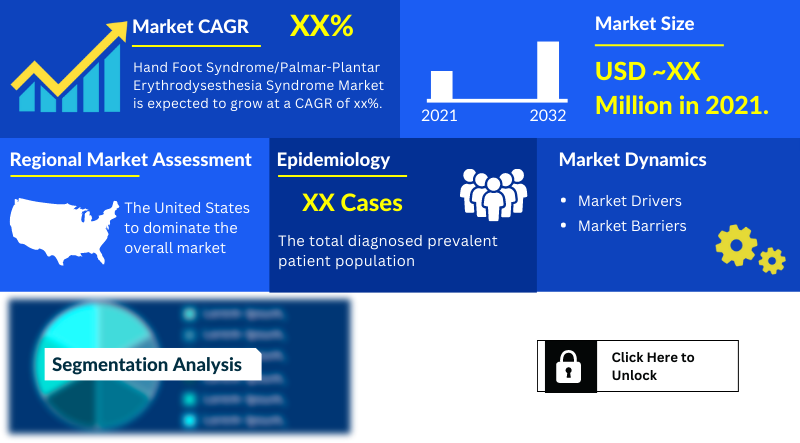
DelveInsight’s “Hand-foot Syndrome– Market Insights, Epidemiology, and Market Forecast – 2032” report delivers an in-depth understanding of the hand-foot syndrome, historical and forecasted epidemiology as well as the Hand-foot Syndrome market trends in the United States, EU4 (Germany, Spain, Italy, France), and the United Kingdom, and Japan.
The hand-foot syndrome market report provides current treatment practices, emerging drugs Hand-foot syndrome market share of the individual therapies, and current and forecasted hand-foot syndrome market size from 2019 to 2032, segmented by seven major markets. The report also covers current hand-foot syndrome treatment practices/algorithms and Hand-foot Syndrome unmet needs to curate the best of the opportunities and assess the underlying potential of the market.
|
Report Metrics |
Details |
|
Study Period |
2019 to 2032 |
|
Geography Covered |
The United States, EU5 (Germany, France, Italy, Spain, and the United Kingdom), and Japan |
|
Forecast Period |
2023 to 2032 |
|
Hand Foot Syndrome CAGR | |
|
Hand Foot Syndrome Market Size | Request Market Size To Know |
|
Hand Foot Syndrome Companies | Quanta Medical, Hoffmann-La-Roche, and others. |
Hand-foot Syndrome Treatment Market
The DelveInsight’s Hand-foot Syndrome treatment market report gives a thorough understanding of hand-foot syndrome by including details such as disease definition, symptoms, causes, pathophysiology, and treatment.
Hand-foot syndrome, also known as palmar-plantar erythrodysesthesia, is a skin reaction that can occur as a side effect of some types of chemotherapy. It can cause redness, swelling, and blistering on the palms of the hands and soles of the feet. In severe cases, it can also cause thick, yellowish skin in places like the joints, soles, and palms. Symptoms of Hand-foot Syndrome include cracked, flaking, or peeling skin, blisters, ulcers, or sores on the skin, severe pain, and difficulty walking or using the hands. Hand-foot Syndrome can be managed with lifestyle changes, such as using corticosteroid creams to reduce inflammation, moisturizing the skin, and avoiding tight-fitting clothing
Hand-foot Syndrome Diagnosis
The hand-foot syndrome usually first appears within days of commencing chemotherapy, although it may take several months and a number of chemotherapy cycles. The palms are always involved and less consistently the soles, fingers, toes, tops of feet, and backs of hands. The diagnosis is usually made clinically. A skin biopsy may show a variable degree of scattered individual skin cell death, inflammation at the junction of the epidermis and dermis, and opening up of blood vessels.
Hand-foot Syndrome Treatment
Hand-foot syndrome treatment is largely based on symptom control. If there’s swelling or inflammation, topical steroid creams may be prescribed or cancer treatment may be postponed until symptoms improve. Sometimes the dose of chemotherapy is also adjusted to manage this side effect. Moisturizers are recommended for dryness. Sometimes medicated creams, like urea cream, can help get rid of rough skin. Celebrex can sometimes be used for pain, but it is not routinely prescribed.
Systemic treatment options for hand-foot syndrome include COX-2 inhibitors, vitamin E, steroids (oral dexamethasone), and analgesics. Preventative measures such as avoiding mechanical stress or trauma, exposure to high temperatures, and tight footwear can also help manage the symptoms of hand-foot syndrome.
Hand-foot Syndrome Epidemiology
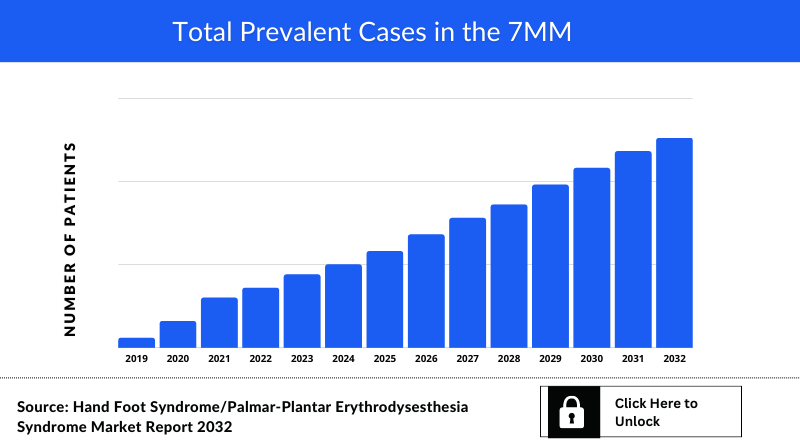
The hand-foot syndrome epidemiology section provides insights into the historical and current hand-foot syndrome patient pool and forecasted trends for seven individual major countries. It helps recognize the causes of current and forecasted trends by exploring numerous studies and views of key opinion leaders. This part of the hand-foot syndrome report also provides the diagnosed patient pool, their trends, and assumptions undertaken.
Key findings
- According to the CDC (2022), in 2019, the incidence rates of Breast cancer was 133.9 per 100,000 in females. For esophageal, the incidence is 7.3 per 100,000 in males and 1.8 per 100,000 in females.
- According to the ACS (2019), in females with breast cancer, 16% patients were treated with Mastectomy and chemotherapy, and 1% were treated with either radiotherapy (RT) or chemo in Stage Iⅈ in Stage III, 56% patients were treated wit the mastectomy and chemo combination regimen, while 6% were treated with either RT or chemo. In Stage IV, 10% patients were treated with the Mastectomy and chemo combination regimen, while 56% were treated with either RT or chemo.
- The hand-foot syndrome epidemiology covered in the report provides historical as well as forecasted hand-foot syndrome epidemiology [segmented as Incidence of Selected Cancers, Total Treated Patients by Respective Chemotherapies and Targeted Therapies, Incidence of Hand-foot Syndrome, Grade-specific cases of Hand-foot Syndrome, Total Treated Cases of Hand-foot Syndrome] in the 7MM covering the United States, EU4 (Germany, France, Italy, Spain), and the United Kingdom, and Japan from 2019 to 2032.
Country-wise Hand-foot Syndrome Epidemiology
The epidemiology segment also provides the hand-foot syndrome epidemiology data and findings across the United States, EU4 (Germany, France, Italy, Spain), and the United Kingdom, and Japan.
Hand-foot Syndrome Market Outlook
Since hand-foot syndrome is a side effect of certain chemotherapeutic drugs, its occurrence is dose-related and a higher cumulative dose is associated with a higher likelihood of developing hand-foot syndrome. With no specific therapy being available for its treatment, the current treatment scenario focuses on the management of its symptoms. Currently, hand-foot syndrome management is a combination of prevention, patient education, symptom amelioration, and dose intensity management.
Prior to treatment with chemotherapeutic agents, patients are assessed for pre-existing skin conditions of the hand and feet are assessed and treated. Patient education about preventive measures to reduce stress on corresponding skin areas is also necessary. These measures of prevention consist mostly of lifestyle changes like reduction of skin friction by wearing loose clothes, avoiding heat, using of emollients and creams. Regional cooling using ice packs and similar methods are also used at times during treatment administration. Symptomatic treatment choice depends upon the severity of symptoms and impacts on patient’s QoL.
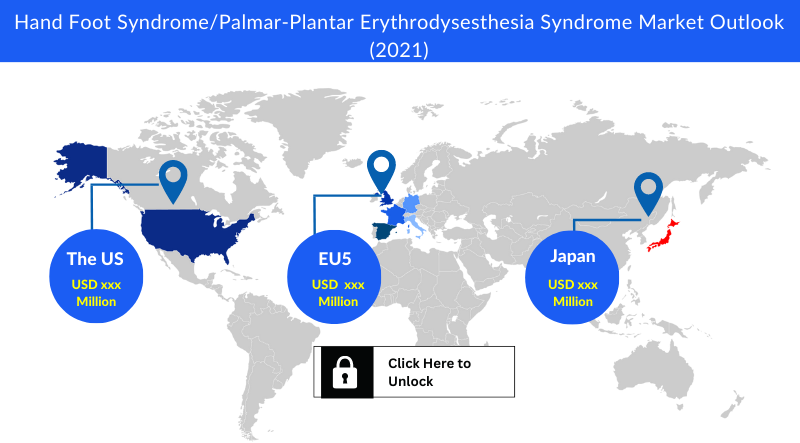
According to DelveInsight, the Hand-foot Syndrome market in 7MM is expected to witness a change in the study period 2019–2032 with factors such as the increasing incidence of chemotherapy drugs usage, the growing geriatric population and demand for novel treatment.
Key findings
This section includes a glimpse of the Hand-foot Syndrome market in 7MM.
The United States: Hand-foot Syndrome Market Outlook
This section provides the total Hand-foot Syndrome market size and market size by therapies in the United States.
EU4 and the UK Countries: Hand-foot Syndrome Market Outlook
The total Hand-foot Syndrome market size and market size by therapies in Germany, France, Italy, Spain, and the United Kingdom are provided in this section.
Japan: Hand-foot Syndrome Market Outlook
The total Hand-foot Syndrome market size and market size by therapies in Japan are also mentioned.
KOL Views
To keep up with current epidemiology and market trends, we take KOLs and SMEs' opinions working in the Hand-foot Syndrome domain through primary research to fill the data gaps and validate our secondary research. Their opinion helps to understand and validate current and emerging therapies and treatment patterns along with Hand-foot Syndrome market trends. This will support the clients in potential upcoming novel treatments by identifying the overall scenario of the market and the Hand-foot Syndrome unmet needs.
Competitive Intelligence Analysis
We perform competitive and market intelligence analysis of the Hand-foot Syndrome market by using various competitive intelligence tools that include – SWOT analysis, PESTLE analysis, Porter's five forces, BCG Matrix, Market entry strategies, etc. The inclusion of the analysis entirely depends upon the data availability.
Hand-foot Syndrome Market Report Scope
- Descriptive overview of Hand-foot Syndrome, disease overview, patient journeys, treatment algorithms, diagnosis, and currently available therapies
- Comprehensive insight into the Hand-foot Syndrome epidemiology and forecasts in the 7MM
- Exhaustive analysis of the Hand-foot Syndrome market; historical and forecasted covering drug outreach in the 7MM
- Detailed patient-based Hand-foot Syndrome market forecasting determines the trends shaping and driving the global Hand-foot Syndrome market
Hand-foot Syndrome Market Report Highlights
- In the coming years, the hand-foot syndrome market is set to change due to the rising patients using chemotherapy drugs and incremental healthcare spending across the world; which would expand the size of the market to enable the drug manufacturers to penetrate more into the market
- The Hand-foot Syndrome companies and academics are working to assess challenges and seek opportunities that could influence hand-foot syndrome R&D
- A better understanding of hand-foot syndrome will also contribute to the development of novel therapeutics for hand-foot syndrome
Hand-foot Syndrome Report Insights
- Patient-Based Hand-foot Syndrome Market Forecasting
- Therapeutic approaches
- Hand-foot syndrome market size and trends
- Hand-foot syndrome market opportunities
Hand-foot Syndrome Report Key Strengths
- 10 years Hand-foot Syndrome Market forecast
- 7MM Coverage
- Hand-foot syndrome epidemiology segmentation
- KOL views
Hand-foot Syndrome Report Assessment
- Current Hand-foot Syndrome treatment market practices
- Hand-foot Syndrome Unmet needs
- Hand-foot syndrome market attractiveness
Key Questions
Hand-foot Syndrome treatment market insights:
- What would be the Hand-foot syndrome market growth till 2032, and what will be the resultant market size in 2032?
- What was the Hand-foot syndrome drug class share (in percentage) distribution in 2019, and how would it look in 2032?
- What would be the total Hand-foot syndrome market size and market size by therapies across the 7MM during the forecast period (2023–2032)?
- What are the key findings of the market across 7MM, and which country will have the largest Hand-foot syndrome market size during the forecast period (2023–2032)
- How would the unmet needs affect the Hand-foot syndrome market dynamics and subsequent analysis of the associated trends?
Hand-foot Syndrome Epidemiology Insights:
- What are the disease risk, burden, and regional/ethnic differences of hand-foot syndrome?
- What is the historical and forecasted hand-foot syndrome patient pool in 7MM, and where can one observe the highest patient population and growth opportunities?
- What are the key factors driving the epidemiology trends for seven major markets covering the United States, EU4 (Germany, Spain, France, Italy), and the UK, and Japan?
Current Hand-foot Syndrome Treatment Market Scenario, Marketed Drugs, and Emerging Therapies
- What are the current treatment guidelines and treatment options for hand-foot syndrome in the US, Europe, and Japan?
- What are the key collaborations (Industry–Industry, Industry-Academia), mergers and acquisitions, and licensing activities related to hand-foot syndrome therapies?
Reasons to Buy
- The patient-based Hand-foot Syndrome market forecast analysis will help in developing business strategies by understanding trends shaping and driving the Hand-foot Syndrome market
- Organize sales and marketing efforts by identifying the best opportunities for Hand-foot Syndrome in the US, EU4 (Germany, Spain, Italy, France), and the United Kingdom, and Japan
- Identification of strong upcoming players in the market that will help devise strategies that will help in getting ahead of competitors.