
Healthcare Healthcare Claims Management Market Summary
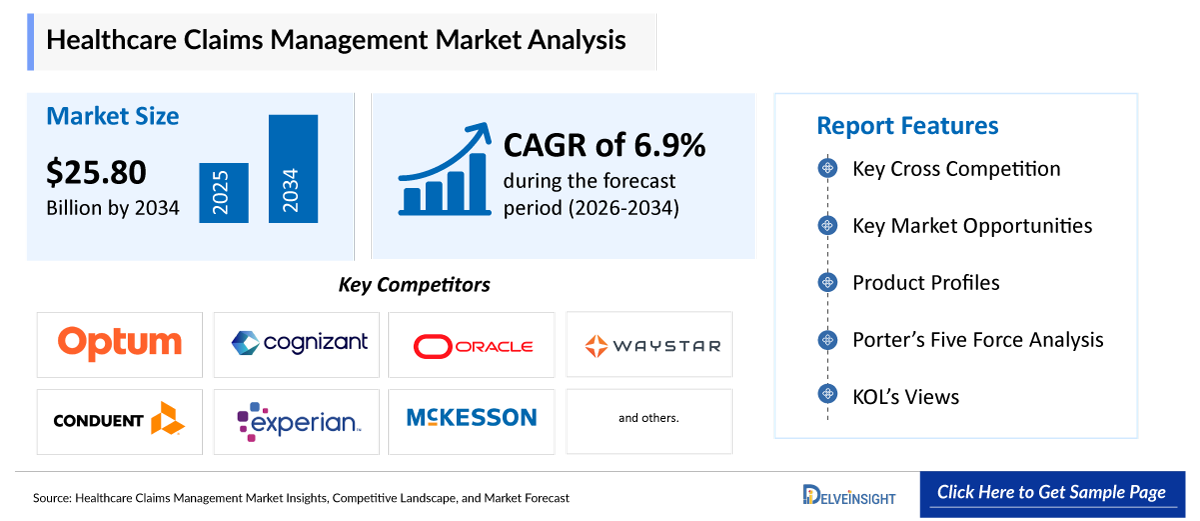
- The global healthcare claims management market size was valued at USD 14.20 billion in 2025 and is projected to reach USD 25.80 billion by 2034.
- The market is expected to expand at a CAGR of 6.9% during the forecast period 2026-2034, supported by the rising volume and complexity of healthcare claims, regulatory mandates for electronic transactions and interoperability, the growing focus on payment integrity and denial prevention, and the adoption of artificial intelligence, automation, and cloud in claims processing.
- By component, the services segment dominated the healthcare claims management market with a 58% share in 2025.
- By solution type, the integrated solutions segment dominated the healthcare claims management market with a 62% share in 2025.
- By delivery mode, the cloud-based segment dominated the healthcare claims management market with a 46% share in 2025.
- By end-user, the healthcare payers segment dominated the healthcare claims management market with a 52% share in 2025.
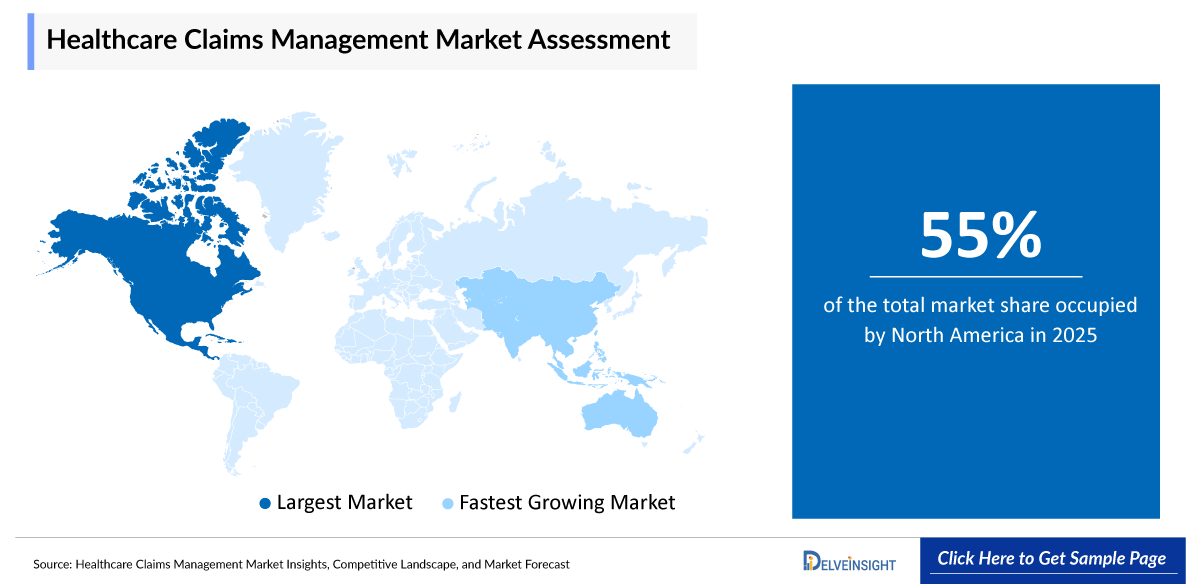
- North America accounted for the largest share of the healthcare claims management market at 55% in 2025, while Asia-Pacific is anticipated to register the fastest growth through 2034.
Healthcare claims management is the set of software and services used to create, submit, route, adjudicate, price, review, and reconcile healthcare insurance claims between providers, clearinghouses, and payers across the claim lifecycle. The scope spans provider-side revenue cycle activities, including claim scrubbing, submission, and denial management, clearinghouse and electronic data interchange services that route claims and remittances, and payer-side core administrative processing, including auto-adjudication, benefit and pricing determination, payment integrity, and fraud, waste, and abuse detection.
The work is conducted through the standardized transactions mandated under the Health Insurance Portability and Accountability Act, including the X12 837 claim, the 835 remittance, the 270 and 271 eligibility, the 276 and 277 status, and the 278 prior authorization transactions. Leading vendors deliver these capabilities across payer and provider markets, and Optum through Change Healthcare operates clearinghouse, payment integrity, and adjudication solutions, Cognizant through TriZetto Facets and QNXT provides core payer administration and auto-adjudication, and Waystar, Availity, and Experian Health provide provider-side clearinghouse and claims management. The contemporary market is defined by the transition to cloud and application programming interfaces, the mandate for electronic prior authorization, and the integration of artificial intelligence into adjudication and payment integrity.
Healthcare Claims Management Market Key Growth Drivers
- Rising volume and complexity of healthcare claims, with the Cognizant TriZetto clearinghouse alone processing 4.4 billion payer-provider transactions each year across 875,000 healthcare providers and 8,000 payer connections.
- Regulatory mandates for electronic transactions, with the Health Insurance Portability and Accountability Act requiring standardized X12 transactions for claims, remittances, eligibility, status, and prior authorization.
- The advancement of interoperability requirements, with the Centers for Medicare and Medicaid Services releasing the Interoperability and Prior Authorization Final Rule on January 17, 2024, requiring impacted payers to implement Fast Healthcare Interoperability Resources application programming interfaces and to meet prior authorization decision timeframes of 72 hours for urgent and seven calendar days for standard requests.
- Growing focus on payment integrity and denial prevention, with payers layering pre-adjudication, mid-adjudication, and post-adjudication review to reduce improper payments.
- Adoption of artificial intelligence, automation, and cloud that increases auto-adjudication rates and accelerates claim processing across payer and provider operations.
- Rising healthcare costs and administrative burden that drive the automation and outsourcing of claims processing.
- The shift toward value-based care and electronic prior authorization that expands the requirements placed on claims and administrative systems.
Key Companies in Healthcare Claims Management Market
The leading participants in the healthcare claims management market include the following:
- Optum, Inc.
- Cognizant Technology Solutions Corporation
- Oracle Corporation
- Waystar Holding Corp.
- Conduent Incorporated
- Experian plc
- McKesson Corporation
- Availity, LLC
- HealthEdge Software, Inc.
- Cotiviti, Inc., and others
For illustrative purposes, only the top 10 companies are listed in the Table of Contents. The report may include analysis and references to additional companies relevant to the market assessment.
Healthcare Claims Management Market Size
The following table summarizes the headline market metrics for the global healthcare claims management market across the base year and the forecast horizon.
|
Report Metrics |
Details |
|
2025 Market Size |
USD 14.20 billion |
|
2034 Projected Market Size |
USD 25.80 billion |
|
Growth Rate (2026-2034) |
6.9% CAGR |
|
Largest Market |
North America (55% share in 2025) |
|
Fastest Growing Market |
Asia-Pacific |
|
Market Structure |
Moderately Consolidated |
All market values are expressed in USD and represent DelveInsight estimates synthesized from primary and secondary research.
Factors Contributing to the Growth of the Healthcare Claims Management Market
Healthcare Claims Management Market Drivers
- Rising Volume and Complexity of Healthcare Claims: The foundational driver of the healthcare claims management market is the sheer volume and complexity of healthcare claims that must be created, submitted, routed, adjudicated, and reconciled across the reimbursement system. Billions of claims and administrative transactions flow between providers, clearinghouses, and payers each year, and the Cognizant TriZetto clearinghouse alone processes 4.4 billion payer-provider transactions annually across 875,000 healthcare providers, 8,000 payer connections, and 650 electronic health record interfaces. Each claim must be coded correctly with the current diagnosis and procedure code sets, matched to the correct benefits and pricing, checked against millions of government regulations, industry standards, and payer policies, and adjudicated within regulatory timeframes, a task that Optum describes as complex because of the millions of rules that must be considered during claim processing. The growth of medical, dental, and pharmacy claims, the proliferation of payer policies and state and federal requirements, and the expansion of coverage all increase the volume and complexity of the workload. Manual processing cannot scale to this volume within the accuracy and timeliness that the system requires, which compels payers and providers to adopt claims management software and services that automate scrubbing, submission, routing, adjudication, and reconciliation. The relentless growth in the volume and complexity of claims sustains steady demand for claims management solutions across payer and provider markets and anchors the growth of the market.
- Regulatory Mandates for Electronic Transactions and Standards: Regulatory mandates for electronic transactions and standardized formats are a central driver of the claims management market, since compliance requires validated systems that generate and process standardized transactions. The Health Insurance Portability and Accountability Act Administrative Simplification provisions mandate the use of standardized X12 transactions for healthcare administration, including the 837 claim, the 835 remittance advice, the 270 and 271 eligibility inquiry and response, the 276 and 277 claim status, the 278 prior authorization, and the 834 enrollment transactions, and covered entities must exchange these transactions in the prescribed formats. The Committee on Operating Rules for Information Exchange of the Council for Affordable Quality Healthcare publishes operating rules that add infrastructure and data content requirements to these transactions, including the Health Care Claims Data Content Rule, to reduce the inconsistency and misalignment that arise across implementations. Clearinghouses and payer systems must maintain conformance to these standards and operating rules and update continuously as they evolve, and vendors offer certified, compliant clearinghouse and adjudication solutions to meet the requirements. Because the standards are mandatory, detailed, and continuously updated, they favor solutions that are certified and continuously maintained for conformance, and they require the technology and expertise that specialist vendors provide. The breadth and permanence of the electronic transaction mandate sustains durable demand for compliant claims management software and clearinghouse services across the market.
- The Advancement of Interoperability and Prior Authorization Requirements: The advancement of interoperability and electronic prior authorization requirements is intensifying demand for modern claims and administrative systems. The Centers for Medicare and Medicaid Services released the Interoperability and Prior Authorization Final Rule, known as CMS-0057-F, on January 17, 2024, requiring impacted payers, including Medicare Advantage organizations, state Medicaid and Children's Health Insurance Program programs and managed care plans, and Qualified Health Plan issuers, to implement Fast Healthcare Interoperability Resources application programming interfaces for patient access, provider access, payer-to-payer exchange, and prior authorization. The rule requires prior authorization decisions within 72 hours for urgent requests and seven calendar days for standard requests, with operational provisions generally beginning January 1, 2026, and application programming interface requirements generally by January 1, 2027. The rule addresses the low adoption of the electronic X12 278 prior authorization transaction, which covered a minority of medical prior authorization requests as of 2024, and it moves the industry toward application programming interface-based exchange, with the standards bodies publishing a crosswalk between the X12 278 transaction and the Fast Healthcare Interoperability Resources prior authorization support transaction. These requirements compel payers to modernize their claims, prior authorization, and administrative systems and to adopt application programming interfaces alongside traditional electronic data interchange, and they drive investment in the platforms and services that claims management vendors provide. The regulatory push toward interoperability and electronic prior authorization sustains demand for modern claims management solutions.
- Growing Focus on Payment Integrity and Denial Prevention: The growing focus on payment integrity and denial prevention is a major driver of demand for claims management software and services, as payers seek to pay claims accurately and to reduce improper payments. Payment integrity refers to the processes, technologies, and controls that verify claims are paid accurately, appropriately, and in compliance with regulatory and contractual requirements, and it spans pre-submission, pre-payment, and post-payment activities, including verifying eligibility, confirming correct coding and billing, applying the right benefits and pricing, and detecting and preventing fraud, waste, and abuse. Payers layer pre-adjudication edits, mid-adjudication checks, and post-adjudication reviews with current regulatory guidance, payer policies, and contract terms, and mature programs use advanced analytics and artificial intelligence to identify errors early, reduce overpayments and underpayments, and streamline review. Optum reports that its payment integrity suite can help health plans achieve medical cost savings of 10 percent annually, and its claim editing, claim review, and claim pricing solutions integrate with existing adjudication processes. On the provider side, denial management and claim scrubbing reduce rejections and accelerate payment, and vendors report high first-pass acceptance rates through robust edits and automation. As medical costs rise and payers seek savings without amplifying provider abrasion, the demand for payment integrity, claim editing, and denial prevention solutions grows, sustaining demand for the software and services that claims management vendors provide across the claim lifecycle.
- Adoption of Artificial Intelligence, Automation, and Cloud: The adoption of artificial intelligence, automation, and cloud is transforming claims processing and driving investment in modern claims management platforms. Payers and providers seek to raise auto-adjudication rates, reduce manual intervention, and accelerate the claim lifecycle, and vendors have embedded artificial intelligence and automation across claim editing, adjudication, denial management, and payment integrity. Configurable automation and bots handle tasks from claims intake through data validation to improve auto-adjudication and scale operations, artificial intelligence-powered claim editing identifies and corrects errors before submission or adjudication, and advanced analytics and machine learning sharpen the precision of payment integrity over time. Cloud and application programming interface delivery is increasingly central, and vendors offer clearinghouse and administrative transactions through modern interfaces that support real-time, near real-time, and batch processing and that connect to payers and practice management systems without legacy infrastructure. The transition to cloud lowers the cost of maintaining high-availability systems, enables scalability, and provides the foundation for analytics and artificial intelligence. As payers and providers modernize legacy systems to gain automation, accuracy, and speed, demand concentrates in cloud, application programming interface, and artificial intelligence-enabled claims management platforms. This modernization cycle drives replacement of legacy systems and expands the value delivered per deployment, sustaining growth in advanced claims management solutions.
- Rising Healthcare Costs and Administrative Burden: Rising healthcare costs and the administrative burden of the reimbursement system drive the automation and outsourcing of claims management. Administrative costs represent a substantial share of healthcare spending, and the complexity of coding, billing, eligibility, prior authorization, adjudication, and reconciliation imposes a heavy burden on payers and providers that manual processes cannot manage efficiently. Payers face pressure to control medical and administrative costs, and providers face pressure to reduce the cost to collect and to accelerate cash flow, and both turn to claims management software and services to automate transactions, reduce errors and rework, and improve efficiency. The reduction of administrative waste is a shared priority, and solutions that prevent errors before money moves, reduce appeals and recoveries, and lower the administrative burden of paper workflows deliver measurable value. Many payers and providers outsource claims processing and revenue cycle functions to specialist service providers to convert fixed cost into variable cost and to access scale, expertise, and technology. As healthcare costs rise and as the administrative burden grows with the complexity of the system, the imperative to automate and outsource claims management strengthens. This cost and efficiency pressure sustains demand for both claims management software and the outsourced services that automate and manage the claim lifecycle across payer and provider markets.
- Shift Toward Value-Based Care and Coverage Expansion: The shift toward value-based care and the expansion of health insurance coverage broaden the requirements placed on claims and administrative systems and enlarge the volume of claims to be managed. Value-based contracts, attributed patient rosters, and alternative payment models add complexity to claims processing beyond traditional fee-for-service, requiring systems that can administer capitation, bundled payments, quality measures, and value-based reimbursement alongside standard claims. The operating rules for attributed patient rosters and value-based arrangements add data content and infrastructure requirements that claims systems must support. At the same time, the expansion of health insurance coverage through public and private programs increases the number of insured lives and the volume of claims that payers and providers must process. The growth of Medicare Advantage, Medicaid managed care, and commercial coverage enlarges the population of claims subject to adjudication, payment integrity, and reporting, and it raises the demand for scalable claims management systems. Providers and payers require platforms that can administer both traditional and value-based reimbursement and that can scale with rising claim volumes. The combination of value-based care complexity and coverage expansion sustains demand for flexible, scalable claims management solutions that can administer diverse reimbursement models across a growing volume of claims, reinforcing the growth of the market.
Healthcare Claims Management Market Restraints
The healthcare claims management market faces several interrelated restraints that temper its growth. The foremost is the risk to data security and privacy, since claims systems process large volumes of protected health information and financial data and are attractive targets for cyberattacks, and major incidents, including the cyberattack on Change Healthcare in 2024 that disrupted claims processing across the industry, have exposed the concentration and continuity risk of the claims infrastructure and heightened scrutiny of security and resilience. The dependence of the industry on a small number of large clearinghouses and platforms concentrates risk, and the disruption of a single major processor can affect claims and cash flow across many payers and providers, which raises concern and can slow reliance on single vendors. Integration with entrenched legacy payer administration systems is technically demanding, and the replacement or modernization of core adjudication platforms is costly, complex, and disruptive, which lengthens sales cycles and slows modernization. The persistence of inconsistent implementations and the low adoption of certain electronic transactions, such as the electronic prior authorization transaction, create fragmentation that increases the burden of reconciliation on vendors and revenue cycle teams. The cost of implementing and maintaining compliant claims systems and of adapting to continuously evolving regulations and operating rules is substantial, particularly for smaller payers and providers. Data privacy and security regulation adds compliance burden and constrains the movement of sensitive data, and cloud adoption in payer environments has been cautious because of the sensitivity and volume of the data. The shortage of experienced claims, revenue cycle, and health information technology professionals limits the capacity to implement and operate advanced systems. Together these factors moderate the pace of adoption and modernization and require vendors to demonstrate security, resilience, compliance, and clear value to sustain growth.
Healthcare Claims Management Market Segment Analysis
The global healthcare claims management market is segmented by component (software and services), by solution type (integrated solutions and standalone solutions), by delivery mode (on premise, cloud-based, and web-based), by end-user (healthcare payers, healthcare providers, and others), and by geography (North America, Europe, Asia-Pacific, and the Rest of the World).
By Component
Dominant Subsegment: Services.
The services category is expected to dominate the market. The services segment accounted for a 58% share of the healthcare claims management market in 2025. Services encompass the outsourced processing of claims, revenue cycle management, clearinghouse operations, payment integrity review, denial management, and the implementation, integration, and support of claims management software, and they represent the larger share of market value because of the labor intensity of claims operations and the widespread outsourcing of these functions. The dominance of the segment reflects the preference of many payers and providers to outsource claims processing and revenue cycle functions to specialist providers that offer scale, expertise, and technology, and the substantial implementation, integration, and support services required to deploy and maintain claims platforms. Vendors deliver payment integrity, claim review, and clearinghouse operations as services alongside software, and business process providers process claims on behalf of payers and providers to reduce cost and improve efficiency. The complexity of coding, adjudication, payment integrity, and reconciliation, and the shortage of skilled staff, reinforce the reliance on outsourced services, and the recurring nature of processing and support services provides a durable revenue base. As payers and providers seek to convert fixed cost into variable cost, access expertise, and manage rising claim volumes, the demand for outsourced and support services grows. The labor intensity of claims operations, the prevalence of outsourcing, and the recurring nature of processing and support services sustain the leadership of the services segment across the forecast period.
By Solution Type
Dominant Subsegment: Integrated Solutions.
The integrated solutions category is expected to dominate the market. The integrated solutions segment accounted for a 62% share of the healthcare claims management market in 2025. Integrated solutions combine the functions of the claim lifecycle, including submission, clearinghouse routing, adjudication, editing, pricing, denial management, payment integrity, and reporting, into a unified platform or ecosystem, and they represent the larger share of the market because payers and providers increasingly prefer end-to-end systems that reduce fragmentation and streamline workflows. The dominance of the segment reflects the value of unifying the claim lifecycle on a single platform, which improves data flow, reduces manual steps, and provides visibility across the process, and the strategy of the leading vendors to offer comprehensive, integrated platforms. Payer platforms such as TriZetto Facets integrate claims auto-adjudication, enrollment, benefit administration, and provider management, and provider revenue cycle platforms integrate claim scrubbing, submission, remittance, denial management, and analytics into a unified engine. Integrated solutions enable the closed-loop coordination of editing, adjudication, and review that payment integrity requires, and they support the automation and analytics that raise auto-adjudication rates and reduce denials. As payers and providers seek to consolidate fragmented workflows, improve efficiency, and gain end-to-end visibility, they favor integrated platforms over standalone point solutions. The value of unification, the strategy of the leading vendors, and the efficiency of end-to-end platforms sustain the leadership of the integrated solutions segment across the forecast period.
By Delivery Mode
Dominant Subsegment: Cloud-Based.
The cloud-based category is expected to dominate the market. The cloud-based segment accounted for a 46% share of the healthcare claims management market in 2025. Cloud and application programming interface delivery has become the leading deployment model because it lowers the cost of maintaining high-availability systems, enables scalability, supports real-time and batch transactions, and provides the foundation for analytics and artificial intelligence. The dominance of the segment reflects the migration of payers and providers from legacy on-premise systems toward cloud and application programming interface platforms and the preference of new adopters for scalable, low-infrastructure deployment. Vendors offer clearinghouse and administrative transactions through cloud application programming interfaces that support real-time, near real-time, and batch processing and that connect to payers and practice management systems without legacy infrastructure, and claim pricing and editing solutions can be deployed onsite or via the cloud. Cloud delivery is particularly important for connecting the many providers and payers in the claims network and for enabling the interoperability and application programming interface exchange that regulation now requires. Although payer environments have adopted cloud cautiously because of the sensitivity and volume of the data, the shift toward cloud, application programming interfaces, and software-as-a-service is well established and accelerating. As payers and providers modernize to gain scalability, connectivity, and analytics, the cloud-based segment leads the market and drives replacement demand, and its alignment with the interoperability and artificial intelligence modernization cycle sustains its leadership across the forecast period.
By End-User
Dominant Subsegment: Healthcare Payers.
The healthcare payers category is expected to dominate the market. The healthcare payers segment accounted for a 52% share of the healthcare claims management market in 2025. Healthcare payers, including commercial insurers, Medicare Advantage organizations, Medicaid managed care plans, and third-party administrators, operate the core administrative processing that adjudicates claims, and they carry the largest and most complex claims management operations, which concentrates market value in this group. The dominance of the segment reflects the scale and complexity of payer adjudication, the investment payers make in core administrative platforms, payment integrity, and fraud, waste, and abuse detection, and the regulatory requirements that fall on payers for electronic transactions, interoperability, and prior authorization. Payers deploy core administrative platforms such as TriZetto Facets and QNXT and HealthRules Payer to auto-adjudicate claims, administer benefits and pricing, and manage provider networks, and they invest heavily in payment integrity to pay claims accurately and reduce improper payments. The interoperability and prior authorization requirements of the Centers for Medicare and Medicaid Services fall directly on payers, driving investment in modern application programming interface-based systems. The scale and complexity of payer adjudication, the depth of payer investment in administrative and payment integrity systems, and the regulatory requirements on payers sustain the leadership of the healthcare payers segment across the forecast period, even as healthcare providers increase their investment in revenue cycle and claims management, and it shapes the direction of the market.
Healthcare Claims Management Market Region Analysis
Dominant Region: North America
North America accounted for a 55% share of the global healthcare claims management market in 2025, representing the highest regional market share globally. The leadership of the region reflects the scale and complexity of the United States healthcare reimbursement system, the concentration of the leading vendors, the rigor of the regulatory framework, and the maturity of electronic claims processing. The United States is the largest national market, supported by a multi-payer system of commercial insurers, Medicare, Medicaid, and third-party administrators, the high volume and complexity of claims generated by the system, and the substantial administrative cost that drives automation and outsourcing. The Health Insurance Portability and Accountability Act mandates standardized electronic transactions, the Council for Affordable Quality Healthcare operating rules add infrastructure and data content requirements, and the Centers for Medicare and Medicaid Services released the Interoperability and Prior Authorization Final Rule in January 2024 requiring payers to implement application programming interfaces and to meet prior authorization decision timeframes. The leading vendors, including Optum with Change Healthcare, Cognizant with TriZetto, Waystar, Availity, and Experian Health, are headquartered and operate in the region, and the maturity of electronic claims and remittance processing is high. The scale of the reimbursement system, the regulatory framework, the concentration of vendors, and the maturity of electronic processing reinforce the leadership of the region. The combination of system scale, regulatory rigor, vendor presence, and processing maturity sustains the position of North America as the largest regional market across the forecast period.
Fastest Growing Region: Asia-Pacific
Asia-Pacific is projected to register the fastest compound annual growth rate through 2034. The region is expanding health insurance coverage, digitizing healthcare administration, and building the claims processing infrastructure required to support growing insured populations, which drives demand for claims management software and services. China, Japan, and India are the principal national markets, supported by the expansion of public and private health insurance, the digitization of claims and payments, and government initiatives to modernize healthcare administration. The growth of insured lives, the rising volume of claims, and the shift from manual and paper processes toward electronic and digital claims processing enlarge the demand for claims management systems and services. As health systems and insurers adopt electronic claims, payment integrity, and analytics, and as outsourcing of claims processing grows, the region increases its adoption of modern claims management solutions. The combination of coverage expansion, digitization, infrastructure development, and outsourcing growth positions Asia-Pacific as the fastest-growing regional market, and it attracts investment and commercial focus from the leading global vendors and service providers seeking presence in high-growth national markets.
Healthcare Claims Management Market Regional Commentary
North America
North America leads the market, supported by the scale and complexity of the United States reimbursement system, the concentration of the leading vendors, and a rigorous regulatory framework. The United States dominates the region through its multi-payer system, the high volume and complexity of claims, and the administrative cost that drives automation and outsourcing. The Health Insurance Portability and Accountability Act electronic transaction mandate, the Council for Affordable Quality Healthcare operating rules, and the Centers for Medicare and Medicaid Services interoperability and prior authorization requirements sustain demand for compliant, modern claims management solutions.
Europe
Europe is a substantial market shaped by statutory and private health insurance systems and by the digitization of healthcare administration. Germany, the United Kingdom, France, Italy, and Spain are the principal national markets, supported by large insured populations, the digitization of claims and reimbursement, and the modernization of administrative systems. Demand is sustained by the automation of claims processing and by the growth of private insurance and outsourced administration alongside statutory systems.
Asia-Pacific
Asia-Pacific is the fastest-growing region, driven by the expansion of health insurance coverage, the digitization of healthcare administration, and the development of claims processing infrastructure across China, Japan, and India. The growth of insured lives, the shift from manual to electronic processing, and the growth of outsourcing sustain demand, and the region attracts commercial focus from the leading global vendors and service providers.
Rest of World
The Rest of World, spanning Latin America, the Middle East, and Africa, represents an emerging opportunity as health insurance coverage expands and as healthcare administration digitizes. Growth is supported by the expansion of public and private insurance, the adoption of electronic claims processing, and the modernization of administrative systems, though adoption varies by market. Vendors and service providers pursue these markets through digital platforms and outsourced services suited to developing infrastructure.
Healthcare Claims Management Market Competitive Landscape
The global healthcare claims management market is classified as Moderately Consolidated. A small group of large payer and provider technology and services companies holds a substantial share through comprehensive platforms and services that span the claim lifecycle, while specialist payer platform, clearinghouse, payment integrity, and revenue cycle vendors compete on defined segments and differentiated technology. Competition centers on the breadth of the platform, connectivity and network reach, auto-adjudication and automation, payment integrity, regulatory conformity, and security and resilience, and acquisitions, product launches, and technology investment intensify the contest.
The competitive landscape is evaluated across the following dimensions:
- Market concentration: Moderately consolidated, with a small group of large payer and provider technology and services companies holding a substantial share, alongside a tier of specialist payer platform, clearinghouse, payment integrity, and revenue cycle vendors.
- Leading players: Optum, through Change Healthcare, leads in clearinghouse, payment integrity, and adjudication, Cognizant, through TriZetto Facets and QNXT, leads in core payer administration, and Waystar, Availity, and Experian Health lead in provider clearinghouse and revenue cycle, while HealthEdge, Cotiviti, Conduent, Oracle, and McKesson contest defined segments.
- Geographic reach: The leading vendors operate large networks and delivery organizations concentrated in the United States, with the Cognizant TriZetto clearinghouse connecting 875,000 providers and 8,000 payers and Waystar serving a network of one million providers, while service providers deliver globally.
- Product portfolio strength: Competitive advantage rests on breadth across submission, clearinghouse, adjudication, editing, pricing, denial management, payment integrity, and analytics, since payers and providers increasingly prefer integrated platforms that unify the claim lifecycle.
- Pipeline strength: Development is concentrated in artificial intelligence and automation for editing, adjudication, and payment integrity, in cloud and application programming interface delivery, and in interoperability and electronic prior authorization aligned to the requirements of the Centers for Medicare and Medicaid Services.
- Strategic partnerships: Collaboration spans payer-provider connectivity, integration with practice management and core administrative systems, and alliances that extend network reach and interoperability.
- M&A activity: Consolidation has shaped the field, exemplified by the acquisition of Change Healthcare by UnitedHealth Group and its integration into Optum, alongside continued consolidation of clearinghouse, revenue cycle, and payment integrity assets.
- Innovation focus: Innovation is shifting toward artificial intelligence and automation across the claim lifecycle, cloud and application programming interface delivery, electronic prior authorization and interoperability, and payment integrity analytics.
- Regulatory standing: Conformance to the Health Insurance Portability and Accountability Act electronic transaction standards, the Council for Affordable Quality Healthcare operating rules, and the Centers for Medicare and Medicaid Services interoperability and prior authorization requirements, together with security certifications, is a decisive competitive credential and a principal axis of competition among the leaders.
Healthcare Claims Management Market Recent Developmental Activities
- In February 2024, Change Healthcare, part of Optum and UnitedHealth Group, experienced a major cyberattack that disrupted claims processing, payments, and eligibility transactions across the United States healthcare system, prompting the Centers for Medicare and Medicaid Services to convene a payer and provider roundtable. Strategic significance: the event exposed the concentration and continuity risk of the claims infrastructure and intensified industry focus on the security, resilience, and redundancy of claims management systems.
- In January 2024, the Centers for Medicare and Medicaid Services released the Interoperability and Prior Authorization Final Rule, known as CMS-0057-F, requiring impacted payers to implement Fast Healthcare Interoperability Resources application programming interfaces and to meet prior authorization decision timeframes of 72 hours for urgent and seven calendar days for standard requests. Strategic significance: the rule drives payer investment in modern, application programming interface-based claims, prior authorization, and administrative systems.
- In March 2024, the Council for Affordable Quality Healthcare published the Health Care Claims Data Content Rule for the X12 837 transaction through its Committee on Operating Rules for Information Exchange. Strategic significance: the rule advanced the standardization and consistency of claims data content and reinforced the requirement for conformant clearinghouse and adjudication systems.
- In 2024, Waystar Holding Corp. completed its initial public offering and listed on the public market, operating a revenue cycle and claims management platform serving a network of one million providers and processing USD 2.4 trillion in claims annually. Strategic significance: the listing strengthened the position and visibility of a leading provider-side claims management and revenue cycle vendor.
- In 2024 and 2025, Optum, Inc. advanced its payment integrity, claim editing, and claim pricing solutions, including artificial intelligence-enabled denial prevention and provider education, integrated with existing adjudication processes. Strategic significance: the developments reinforced the position of a leading vendor in payment integrity and denial prevention across the claim lifecycle.
- In 2024 and 2025, Cognizant Technology Solutions Corporation advanced its TriZetto Facets and QNXT core administration platforms with claims auto-adjudication, prior authorization automation, and configurable automation bots for health plans. Strategic significance: the developments strengthened the position of a leading core payer administration vendor and advanced automation in claims adjudication.
- In 2022, the standards bodies X12 and Health Level Seven published a crosswalk mapping the X12 278 prior authorization transaction to the Fast Healthcare Interoperability Resources prior authorization support transaction. Strategic significance: the crosswalk aligned the traditional electronic data interchange standard with the application programming interface standard and supported the transition to electronic prior authorization.
- In 2024 and 2025, HealthEdge Software, Inc. advanced its HealthRules Payer core administration platform with cloud-native, rules-driven claims adjudication for payer operations. Strategic significance: the developments reinforced the position of a modern, cloud-native core administration vendor competing with established payer platforms.
- In 2024 and 2025, Cotiviti, Inc. advanced its payment accuracy and payment integrity solutions for health plans, applying analytics to reduce improper payments across the claim lifecycle. Strategic significance: the developments strengthened the position of a leading payment integrity vendor in a market focused on payment accuracy.
- In 2024 and 2025, Availity, LLC and Experian Health advanced their clearinghouse and claims management networks with real-time eligibility, claim status, and application programming interface connectivity for providers and payers. Strategic significance: the developments reinforced the role of provider-side clearinghouse and claims management networks in the claim lifecycle.
- In 2026 and 2027, impacted payers are required to implement the operational and application programming interface provisions of the Centers for Medicare and Medicaid Services Interoperability and Prior Authorization Final Rule, with operational provisions generally beginning January 1, 2026, and application programming interface requirements generally by January 1, 2027. Strategic significance: the phased compliance timeline sustains payer investment in modern claims and prior authorization systems across the forecast period.
- In 2024 and 2025, the leading vendors embedded artificial intelligence, automation, and cloud application programming interfaces across claim editing, adjudication, denial management, and payment integrity. Strategic significance: the convergence of the leaders on artificial intelligence, automation, and cloud confirmed these as the defining axes of competition and signaled a market shifting from legacy systems toward intelligent, connected, and automated claims management.
Healthcare Claims Management Market Segmentation
- Healthcare Claims Management Market Assessment by Component
- Software
- Services
- Healthcare Claims Management Market Assessment by Solution Type
- Integrated Solutions
- Standalone Solutions
- Healthcare Claims Management Market Assessment by Delivery Mode
- On-Premise
- Cloud-Based
- Web-Based
- Healthcare Claims Management Market Assessment by End-User
- Healthcare Payers
- Healthcare Providers
- Others
Healthcare Claims Management Market Assessment by Geography
- North America Healthcare Claims Management Market Assessment
- United States Healthcare Claims Management Market Size in USD million (2023-2034)
- Canada Healthcare Claims Management Market Size in USD million (2023-2034)
- Mexico Healthcare Claims Management Market Size in USD million (2023-2034)
- Europe Healthcare Claims Management Market Assessment
- Germany Healthcare Claims Management Market Size in USD million (2023-2034)
- United Kingdom Healthcare Claims Management Market Size in USD million (2023-2034)
- France Healthcare Claims Management Market Size in USD million (2023-2034)
- Italy Healthcare Claims Management Market Size in USD million (2023-2034)
- Spain Healthcare Claims Management Market Size in USD million (2023-2034)
- Rest of Europe Healthcare Claims Management Market Size in USD million (2023-2034)
- Asia-Pacific Healthcare Claims Management Market Assessment
- China Healthcare Claims Management Market Size in USD million (2023-2034)
- Japan Healthcare Claims Management Market Size in USD million (2023-2034)
- India Healthcare Claims Management Market Size in USD million (2023-2034)
- Australia Healthcare Claims Management Market Size in USD million (2023-2034)
- South Korea Healthcare Claims Management Market Size in USD million (2023-2034)
- Rest of Asia-Pacific Healthcare Claims Management Market Size in USD million (2023-2034)
- Rest of the World Healthcare Claims Management Market Assessment
- Middle East Healthcare Claims Management Market Size in USD million (2023-2034)
- Africa Healthcare Claims Management Market Size in USD million (2023-2034)
- South America Healthcare Claims Management Market Size in USD million (2023-2034)
Healthcare Claims Management Market Recent Industry Trends and Milestones (2023-2026):
|
Category |
Key Developments |
|
Healthcare Claims Management Market Product Advancement |
The period was defined by the advancement of automated, cloud, and application programming interface-based claims platforms. Cognizant advanced TriZetto Facets and QNXT with claims auto-adjudication and prior authorization automation, HealthEdge advanced its cloud-native HealthRules Payer adjudication engine, and Optum advanced payment integrity, claim editing, and claim pricing with artificial intelligence. Vendors aligned their platforms to the Health Insurance Portability and Accountability Act electronic transaction standards, the Council for Affordable Quality Healthcare operating rules, and the Centers for Medicare and Medicaid Services interoperability and prior authorization requirements. Together these advances concentrated competition in automated, integrated, and compliant claims platforms. |
|
Healthcare Claims Management Market Product Expansion |
Product expansion advanced along three axes. The first is artificial intelligence and automation, as vendors embedded automation and analytics across claim editing, adjudication, denial management, and payment integrity to raise auto-adjudication rates and reduce improper payments. The second is cloud and application programming interface delivery, as vendors offered clearinghouse and administrative transactions through modern interfaces supporting real-time and batch processing without legacy infrastructure. The third is interoperability and electronic prior authorization, as vendors built Fast Healthcare Interoperability Resources application programming interfaces to meet the requirements of the Centers for Medicare and Medicaid Services. Vendors also expanded payment integrity, denial prevention, and network connectivity across payer and provider markets. |
|
Healthcare Claims Management Market Investment |
Investment was shaped by consolidation, modernization, and the response to security risk. UnitedHealth Group integrated Change Healthcare into Optum, and Waystar completed its initial public offering, while vendors and payers invested in artificial intelligence, cloud, application programming interfaces, and payment integrity. The cyberattack on Change Healthcare in 2024 drove investment in the security, resilience, and redundancy of claims infrastructure. Investment also flowed into the systems required to meet the interoperability and prior authorization requirements of the Centers for Medicare and Medicaid Services, and service providers expanded outsourced claims and revenue cycle capacity to serve payers and providers. |
|
Company Strategy |
The unifying strategic theme is the combination of an integrated claims platform with artificial intelligence, automation, and cloud delivery. Optum is advancing clearinghouse, payment integrity, and adjudication through Change Healthcare, Cognizant is advancing TriZetto Facets and QNXT core administration, and Waystar, Availity, and Experian Health are advancing provider clearinghouse and revenue cycle networks. HealthEdge and Cotiviti are competing in cloud-native adjudication and payment integrity, and Oracle, McKesson, and Conduent are competing across administrative technology and services. Across the field, strategy centers on automation, integration, interoperability, payment integrity, and security. |
|
Emerging Technologies |
The defining emerging technologies are artificial intelligence and automation that raise auto-adjudication rates, identify and correct claim errors before submission, and sharpen payment integrity; cloud and application programming interface platforms that support real-time and batch transactions and connect payers and providers without legacy infrastructure; Fast Healthcare Interoperability Resources application programming interfaces that enable interoperability and electronic prior authorization; and advanced analytics and machine learning for fraud, waste, and abuse detection and denial prevention. Supporting these are configurable automation bots, real-time eligibility and claim status, and secure, resilient infrastructure. Across these, the trajectory is toward claims management that is automated, connected, interoperable, and intelligent, improving accuracy, speed, and compliance across the claim lifecycle for payers and providers. |
Healthcare Claims Management Market Startup Funding and Investment Trends
Investment in the healthcare claims management field has concentrated on technologies that make the claim lifecycle more automated, more connected, and more intelligent, namely artificial intelligence for claim editing, adjudication, and denial prevention, cloud and application programming interface platforms that modernize legacy processing, and analytics for payment integrity and fraud, waste, and abuse detection. Because the core market is served by large payer and provider technology and services companies with entrenched platforms and networks, most innovators pursue a differentiated technology or a modern platform that a larger vendor can absorb or that serves a defined segment of payers or providers. The table below summarizes representative companies advancing the next generation of claims management technology.
|
Company |
Total Funding |
Funding Stage |
Main Product/Offering |
Core Technology |
|
HealthEdge Software, Inc. |
Private equity backed |
Commercial stage |
HealthRules Payer |
Cloud-native rules-driven claims adjudication |
|
Cohere Health, Inc. |
Venture-backed |
Commercial stage |
Prior authorization platform |
Artificial intelligence prior authorization automation |
|
Request for unlocking the report of the @ Healthcare Claims Management Market Insights | ||||
Capital formation in this field is shaped by the difficulty of competing against the large payer and provider technology and services companies, whose integrated platforms, networks, and scale create high barriers, so investors have favored companies that introduce artificial intelligence, automation, or modern cloud platforms for defined segments of the claim lifecycle rather than those contesting the core platforms. Artificial intelligence and automation for claim editing, adjudication, prior authorization, and denial prevention is the clearest technology thesis, seeking to raise auto-adjudication rates and reduce administrative cost and improper payments. Cloud-native modernization of legacy core administration and revenue cycle systems constitutes a second thesis, and analytics for payment integrity and fraud, waste, and abuse detection a third. The archetypal outcome is acquisition by one of the leading payer or provider technology companies seeking to add a differentiated capability, which provides a defined exit that sustains earlier-stage investment. The principal risks are the security and privacy expectations of a field that processes protected health information, the entrenched platforms and networks of the incumbents, the concentration of the claims infrastructure, and the regulatory complexity of electronic transactions and interoperability. Source: company disclosures.
Key Takeaways from the Healthcare Claims Management Market Report Study
- Market size analysis for the current healthcare claims management market size (2025), and market forecast for 9 years (2026 to 2034).
- Top key product and technology developments, mergers, acquisitions, partnerships, and joint ventures that happened over the last 3 years.
- Key companies dominating the global healthcare claims management market.
- Various opportunities available for competitors in the healthcare claims management market space.
- What are the top-performing segments in 2025? How will these segments perform in 2034?
- Which are the top-performing regions and countries in the current healthcare claims management market scenario?
- Which are the regions and countries where companies should concentrate their opportunities for healthcare claims management market growth in the future?
Target audience who can benefit from this healthcare claims management market report study
- Healthcare claims management software and service providers
- Research organizations and consulting companies
- Healthcare claims management-related organizations, associations, forums, and other alliances
- Government and corporate offices
- Start-up companies, venture capitalists, and private equity firms
- Distributors and traders dealing in healthcare claims management
- Various end-users who want to know more about the healthcare claims management market and the latest technological developments in the healthcare claims management market.

