
Healthcare Supply Chain Management Market Summary
- The global healthcare supply chain management market was valued at USD 3.20 billion in 2025 and is projected to reach USD 8.60 billion by 2034.
- The market is expected to expand at a CAGR of 11.6% during the forecast period 2026-2034, supported by the imperative to control supply costs and improve efficiency, the focus on supply chain resilience and visibility following disruption, the mandates for traceability and serialization, and the integration of artificial intelligence and cloud technology.
- By component, the software segment dominated the healthcare supply chain management market with a 58% share in 2025.
- By function, the procurement and sourcing segment dominated the healthcare supply chain management market with a 32% share in 2025.
- By delivery mode, the cloud-based segment dominated the healthcare supply chain management market with a 56% share in 2025.
- By end-user, the providers segment dominated the healthcare supply chain management market with a 62% share in 2025.
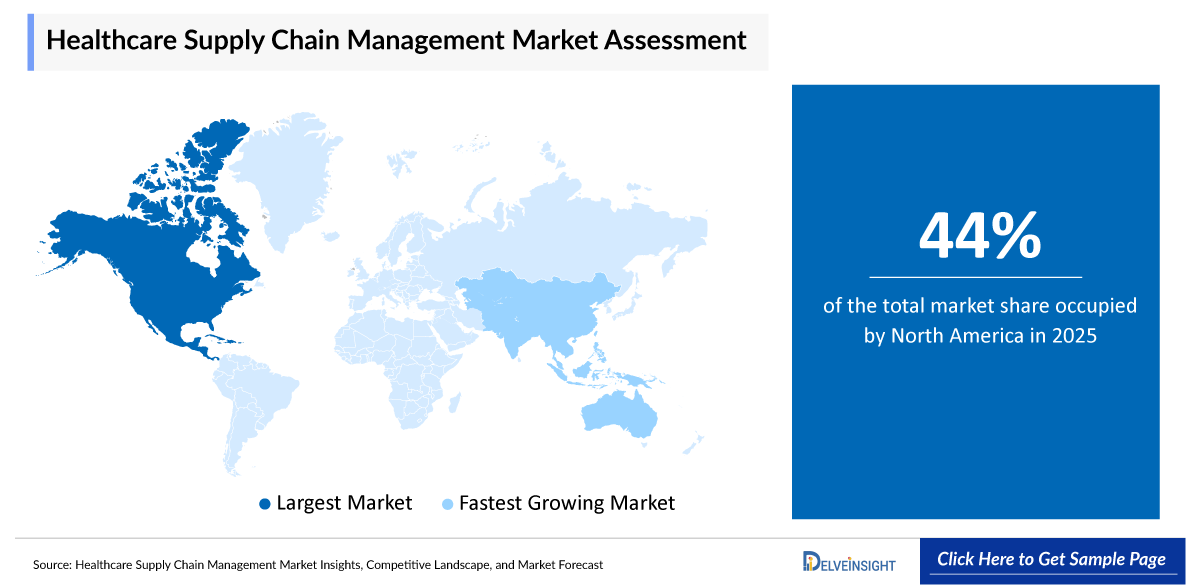
- North America accounted for the largest share of the healthcare supply chain management market at 44% in 2025, while Asia-Pacific is anticipated to register the fastest growth through 2034.
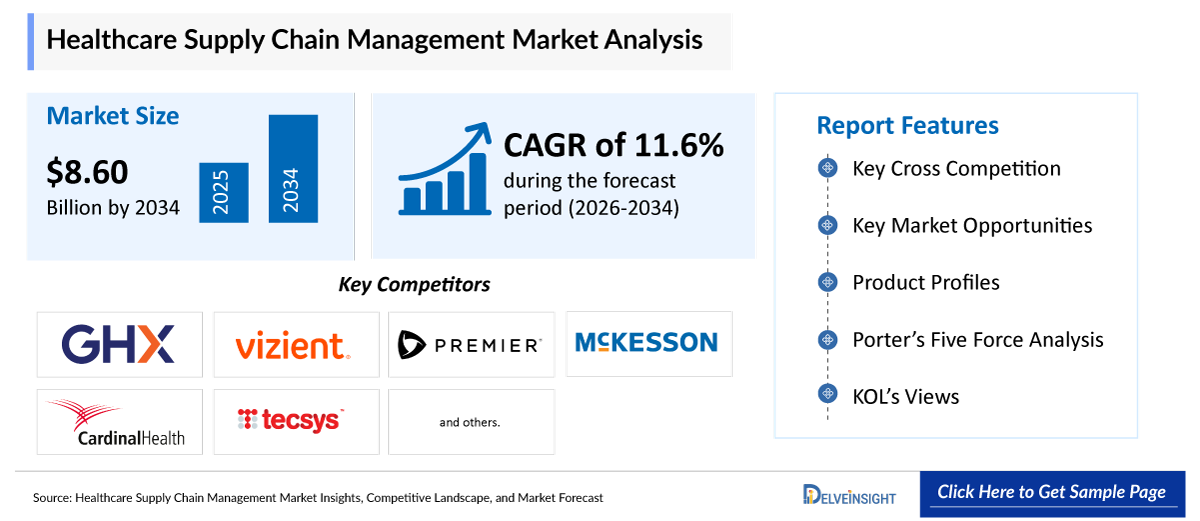
Healthcare supply chain management is the software, platforms, and services that manage the sourcing, procurement, inventory, distribution, and tracking of medical supplies, devices, and pharmaceuticals across healthcare providers, distributors, and manufacturers. The scope encompasses procurement and sourcing, inventory and materials management, order and contract management, demand planning and analytics, and traceability and logistics, delivered through software, exchange platforms, and services. Leading solutions include the Global Healthcare Exchange cloud platform connecting providers and suppliers, the group purchasing and analytics platforms of Vizient and Premier, the distribution and supply management of McKesson and Cardinal Health, the supply chain software of Tecsys and symplr, and the supply chain solutions of enterprise vendors such as Oracle, SAP, and Workday. The solutions automate purchasing, manage inventory and contracts, provide spend and utilization analytics, and support traceability and resilience, and the contemporary market is defined by the imperative to control cost, the focus on resilience and visibility, the mandates for traceability, and the integration of artificial intelligence and cloud.
Healthcare Supply Chain Management Market Key Growth Drivers
- Imperative to control supply costs and improve operational efficiency, with supply cost among the largest expenses of healthcare providers.
- Focus on supply chain resilience and visibility following the disruption of recent years, with the industry shifting toward resiliency as a core design principle.
- Mandates for traceability and serialization, with the Drug Supply Chain Security Act requiring serialization and the Food and Drug Administration Unique Device Identification rule requiring device identification.
- Integration of artificial intelligence and analytics for demand forecasting, inventory optimization, and spend management.
- Adoption of cloud-based supply chain platforms that provide scalability, connectivity, and analytics.
- Connection of the supply chain to clinical processes and the electronic health record for a clinically integrated supply chain.
- Growth of group purchasing, spend analytics, and value analysis that optimize sourcing and cost.
Key Companies in Healthcare Supply Chain Management Market
The leading participants in the healthcare supply chain management market include the following:
- Global Healthcare Exchange, LLC
- Vizient, Inc.
- Premier, Inc.
- McKesson Corporation
- Cardinal Health, Inc.
- Tecsys Inc.
- symplr Software LLC
- Oracle Corporation
- SAP SE
- Omnicell, Inc.
For illustrative purposes, only the top 10 companies are listed in the Table of Contents. The report may include analysis and references to additional companies relevant to the market assessment.
Healthcare Supply Chain Management Market Size
The following table summarizes the headline market metrics for the global healthcare supply chain management market across the base year and the forecast horizon.
|
Report Metrics |
Details |
|
2025 Market Size |
USD 3.20 billion |
|
2034 Projected Market Size |
USD 8.60 billion |
|
Growth Rate (2026-2034) |
11.6% CAGR |
|
Largest Market |
North America (44% share in 2025) |
|
Fastest Growing Market |
Asia-Pacific |
|
Market Structure |
Moderately Consolidated |
All market values are expressed in USD and represent DelveInsight estimates synthesized from primary and secondary research.
Factors Contributing to the Growth of the Healthcare Supply Chain Management Market
Market Drivers
Imperative to Control Supply Costs and Improve Efficiency
The foundational driver of the healthcare supply chain management market is the imperative to control supply costs and improve operational efficiency, since supply cost is among the largest expenses of healthcare providers. The supply chain, encompassing the procurement, inventory, and distribution of medical supplies, devices, and pharmaceuticals, represents a large share of healthcare costs, and the pressure on healthcare margins drives providers to control supply costs and improve the efficiency of the supply chain. Healthcare supply chain management software and solutions automate purchasing, optimize inventory, manage contracts and compliance, and provide spend and utilization analytics, enabling providers to reduce cost, eliminate waste, and improve efficiency. The management of the supply chain enables providers to negotiate and comply with contracts, standardize purchasing, reduce excess and expired inventory, and identify opportunities for savings, and the visibility and analytics of supply chain solutions reveal the cost and utilization of supplies. The pressure on healthcare margins, the magnitude of supply cost, and the inefficiency of manual and fragmented supply chain processes drive the adoption of supply chain management solutions. As providers face margin pressure and seek to control supply costs and improve efficiency, they adopt the software and solutions that automate, optimize, and provide visibility into the supply chain. The imperative to control supply costs and improve operational efficiency sustains demand for healthcare supply chain management across the forecast period and anchors the growth of the market.
Focus on Supply Chain Resilience and Visibility
The focus on supply chain resilience and visibility, intensified by the disruption of recent years, is a defining driver that shifts the supply chain from a cost center to a strategic priority. The disruption of the healthcare supply chain during recent global events exposed the fragility of lean and globalized supply chains and the risk of shortages of critical supplies, and the industry has shifted toward supply chain resiliency as a core design principle rather than a reactive concept. Providers and manufacturers seek visibility into their supply chains, the diversification of sourcing, the management of inventory and safety stock, and the ability to anticipate and respond to disruption, and supply chain management solutions provide the visibility, analytics, and planning that resilience requires. Solutions provide real-time inventory visibility, demand forecasting, supplier risk management, and the diversification and regionalization of sourcing, enabling providers to anticipate and respond to shortages and disruption. The experience of shortages, the recognition of supply chain risk, and the geopolitical and trade disruption of supply chains drive the investment in resilience and visibility. As providers and manufacturers prioritize resilience and visibility to prevent shortages and manage risk, they adopt the supply chain management solutions that provide them. The focus on supply chain resilience and visibility sustains demand for healthcare supply chain management across the forecast period.
Mandates for Traceability and Serialization
The mandates for the traceability and serialization of pharmaceuticals and medical devices are a powerful driver that requires the data management and systems that supply chain solutions provide. The Drug Supply Chain Security Act requires the electronic tracking and tracing of prescription drugs at the package level through serialization, with end-to-end serialization requirements, and the Food and Drug Administration Unique Device Identification rule requires that medical devices carry standardized identifiers in human-readable and machine-readable form and be registered in the device identification database. These mandates require manufacturers, distributors, and providers to capture, manage, and share standardized product and traceability data, and the GS1 standards, including the global trade item number and electronic product code information services, form the backbone of compliance. Internationally, the European Union Medical Device Regulation and Falsified Medicines Directive impose device identification and medicine authentication requirements, and countries across Asia-Pacific are aligning their identification systems with global standards. Supply chain management solutions provide the data management, serialization, traceability, and standards support that compliance requires, and traceability supports patient safety, recall management, and authentication. As traceability and serialization mandates require the capture and management of standardized product data, providers and manufacturers adopt the supply chain solutions that enable compliance. The mandates for traceability and serialization sustain demand for healthcare supply chain management across the forecast period.
Integration of Artificial Intelligence and Analytics
The integration of artificial intelligence and analytics is transforming healthcare supply chain management and driving investment in intelligent solutions. Supply chain management generates and depends on large volumes of data on purchasing, inventory, utilization, and cost, and artificial intelligence and analytics turn this data into forecasts, optimization, and insight. Artificial intelligence supports demand forecasting, predicting the need for supplies and enabling proactive replenishment; inventory optimization, reducing excess and stockouts; spend analytics, revealing cost and savings opportunities; and supplier risk management, anticipating disruption. Vendors have embedded artificial intelligence and predictive analytics into their platforms, providing predictive inventory management, clinical value decisioning, and spend visibility, and analytics reveal the cost, utilization, and value of supplies. Artificial intelligence and analytics improve the accuracy of forecasting, the efficiency of inventory, and the optimization of sourcing and cost, and they shift competition toward the intelligence of the platform. The application of artificial intelligence to demand, inventory, spend, and risk enhances the value of supply chain management and enables the proactive and optimized management of the supply chain. As artificial intelligence and analytics advance and as providers adopt them to forecast, optimize, and manage the supply chain, demand concentrates in intelligent supply chain solutions. The integration of artificial intelligence and analytics sustains the modernization and growth of the healthcare supply chain management market across the forecast period.
Adoption of Cloud-Based Supply Chain Platforms
The adoption of cloud-based supply chain platforms drives the modernization of healthcare supply chain management and concentrates demand in cloud solutions. Cloud-based supply chain platforms provide scalability, connectivity, continuous updating, and the analytics and artificial intelligence that modern supply chain management requires, and providers are adopting cloud solutions to replace legacy and on-premise systems. Cloud platforms connect providers, distributors, and suppliers, enabling the exchange of orders, invoices, and data, and they provide real-time inventory visibility, modular and cloud-native architecture, and access across the enterprise, with the Global Healthcare Exchange operating a cloud-based exchange and vendors providing cloud-native supply chain platforms. Cloud delivery lowers the infrastructure burden, provides scalability and continuous innovation, enables connectivity and data exchange across trading partners, and provides the foundation for analytics and artificial intelligence. The connectivity of cloud platforms is particularly valuable for the supply chain, which spans providers, distributors, and manufacturers and requires the exchange of data across trading partners. As providers adopt cloud supply chain platforms for scalability, connectivity, and analytics, demand concentrates in cloud solutions. The adoption of cloud-based supply chain platforms sustains demand and reinforces the leadership of cloud delivery across the forecast period.
Clinically Integrated Supply Chain and Electronic Health Record Connection
The connection of the supply chain to clinical processes and the electronic health record, creating a clinically integrated supply chain, drives the adoption and value of supply chain management. The integration of the supply chain with clinical processes and the electronic health record connects supply consumption to clinical activity and cost, enabling the capture of supply use at the point of care, the connection of supplies to patients and procedures, and the analysis of the cost and value of supplies in clinical context. Supply chain solutions connect to clinical processes and the electronic health record to capture supply use, document the supplies used in procedures, and analyze utilization and cost by service line and procedure, and the connection of supply chain and clinical data supports value analysis and clinically integrated sourcing. The clinically integrated supply chain enables providers to understand the cost and value of supplies in the context of care, to standardize and optimize supplies based on clinical value, and to capture supply use for costing and billing. The value of connecting supply and clinical data, and the emphasis on value analysis and clinically integrated sourcing, drive the adoption of solutions that connect the supply chain to clinical processes. As providers seek to connect supply and clinical data and to manage the supply chain in a clinical context, demand for clinically integrated supply chain solutions grows. The clinically integrated supply chain and electronic health record connection sustains demand for healthcare supply chain management across the forecast period.
Growth of Group Purchasing, Spend Analytics, and Value Analysis
The growth of group purchasing, spend analytics, and value analysis drives the optimization of sourcing and cost and the adoption of the platforms that enable them. Group purchasing organizations aggregate the purchasing of many providers to negotiate lower prices and standardized contracts, and providers use group purchasing, spend analytics, and value analysis to optimize their sourcing, reduce cost, and standardize supplies. Group purchasing and analytics platforms provide contract management, spend and utilization analytics, value analysis, and performance improvement, enabling providers to optimize their sourcing and cost, and the platforms of the leading group purchasing organizations provide spend visibility, clinical value decisioning, and performance improvement. Spend analytics reveal the cost and opportunity in supply spending, value analysis evaluates supplies on cost and clinical value, and group purchasing negotiates and manages the contracts that optimize price. The growth of the sophistication of sourcing, the emphasis on spend management and value analysis, and the use of group purchasing and analytics drive the adoption of the platforms that enable them. As providers seek to optimize sourcing, manage spend, and analyze value, they adopt the group purchasing, spend analytics, and value analysis platforms that support them. The growth of group purchasing, spend analytics, and value analysis sustains demand for healthcare supply chain management across the forecast period.
Market Restraints
The healthcare supply chain management market faces several interrelated restraints that temper its growth. The foremost is the cost and complexity of implementing supply chain management solutions, since the deployment of supply chain software and platforms requires investment, integration with enterprise resource planning, clinical, and financial systems, data standardization, and process change, and the cost and complexity can be substantial, particularly for smaller providers. The fragmentation and quality of supply chain data are significant challenges, since supply chain management depends on accurate and standardized product, contract, and inventory data, and the fragmentation, inconsistency, and poor quality of data across trading partners and systems limit the effectiveness of solutions and require data governance. Integration and interoperability challenges persist, since supply chain solutions must integrate with enterprise resource planning, clinical, financial, and trading partner systems, and incomplete integration and the diversity of systems create effort and cost. The adoption of standards, including GS1 identifiers and traceability, requires investment and coordination across manufacturers, distributors, and providers, and incomplete adoption limits interoperability and traceability. Change management and the alignment of clinical and supply chain stakeholders are critical and challenging, since supply chain optimization requires the engagement of clinicians and the change of established practices. The reliance on trading partner participation and data exchange means that the value of solutions depends on the participation of suppliers and distributors. The variability of supply chain maturity and infrastructure across providers and regions constrains adoption, particularly in lower-resource settings. Together, these factors moderate the pace and scope of adoption and require vendors to demonstrate value, integration, data quality, and return on investment to sustain growth.
Healthcare Supply Chain Management Market Segment Analysis
The global healthcare supply chain management market is segmented by component (software and services), by function (procurement and sourcing, inventory and materials management, order and logistics management, analytics and planning, and others), by delivery mode (cloud-based and on-premise), by end-users (providers, distributors, manufacturers, and others), and by geography (North America, Europe, Asia-Pacific, and the Rest of the World).
By Component
Dominant Subsegment: Software.
The software category is expected to dominate the market. The software segment accounted for a 58% share of the healthcare supply chain management market in 2025. Software, encompassing the procurement, inventory, contract, analytics, and traceability applications and platforms that manage the supply chain, is the leading component because it provides the automation, visibility, and intelligence that supply chain management requires and is the core deliverable that providers and manufacturers license and deploy. The dominance of the segment reflects the central role of software in automating and optimizing the supply chain, the shift toward cloud and platform software, and the recurring nature of software licensing and subscription revenue. Supply chain software automates purchasing, manages inventory and contracts, provides spend and utilization analytics, supports traceability, and connects trading partners, and vendors deliver their supply chain management as software and cloud platforms. The intelligence and automation of supply chain management reside in the software, and the shift toward cloud, platform, and analytics software increases the prominence of software. While services, including implementation, consulting, and managed services, are important and substantial components, the software platform is the foundation on which the supply chain is managed and the primary object of the recurring investment. The centrality of software to supply chain management and the recurring nature of software revenue sustain the leadership of the software segment across the forecast period.
By Function
Dominant Subsegment: Procurement and Sourcing.
The procurement and sourcing category is expected to dominate the market. The procurement and sourcing segment accounted for a 32% share of the healthcare supply chain management market in 2025. Procurement and sourcing, encompassing purchasing, contract management, group purchasing, sourcing, and spend management, is the leading function because it is the core of supply chain management and the primary means by which providers control cost and optimize supplies. The dominance of the segment reflects the centrality of procurement and sourcing to supply chain management, the emphasis on cost control and contract compliance, and the value of group purchasing, spend analytics, and value analysis. Procurement and sourcing solutions automate purchasing, manage contracts and compliance, enable group purchasing and negotiated pricing, and provide spend analytics and value analysis, and they are the function through which providers control supply cost and optimize sourcing. The exchange platforms that connect providers and suppliers, the group purchasing and analytics platforms, and the procurement automation of supply chain solutions concentrate value in procurement and sourcing. The centrality of procurement to cost control, the value of group purchasing and spend management, and the emphasis on sourcing optimization drive the segment. While inventory and materials management, order and logistics, and analytics are essential functions, the centrality and value of procurement and sourcing sustain the leadership of the procurement and sourcing segment across the forecast period.
By Delivery Mode
Dominant Subsegment: Cloud-Based.
The cloud-based category is expected to dominate the market. The cloud-based segment accounted for a 56% share of the healthcare supply chain management market in 2025. Cloud-based delivery, in which supply chain management is delivered as a cloud service, has become the leading delivery mode because it provides the scalability, connectivity, and analytics that modern supply chain management requires and connects the trading partners of the supply chain. The dominance of the segment reflects the migration of supply chain management to the cloud, the connectivity of cloud platforms across providers, distributors, and suppliers, and the advantages of cloud in scalability, innovation, and analytics. Cloud platforms connect trading partners and enable the exchange of orders, invoices, and data, provide real-time inventory visibility and modular architecture, and deliver the analytics and artificial intelligence that supply chain management requires; the Global Healthcare Exchange and cloud-native vendors provide cloud supply chain platforms. Cloud delivery lowers the infrastructure burden, provides scalability and continuous innovation, and enables the connectivity and data exchange essential to the supply chain. The connectivity of cloud platforms across the trading partners of the supply chain is particularly valuable, and the shift toward cloud concentrates demand in cloud delivery. While on-premise and hybrid delivery remain relevant, the connectivity, scalability, and analytics of cloud sustain the leadership of the cloud-based segment across the forecast period.
By End-User
Dominant Subsegment: Providers.
The providers category is expected to dominate the market. The providers segment accounted for a 62% share of the healthcare supply chain management market in 2025. Providers, including hospitals, health systems, and other care organizations, are the leading end-user because they operate the largest and most complex supply chains, purchase and consume the majority of medical supplies, and adopt supply chain management to control cost and optimize the supply chain, which concentrates market value in this segment. The dominance of the segment reflects the scale and complexity of provider supply chains, the magnitude of provider supply spending, and the investment providers make in supply chain management to control cost and improve efficiency. Hospitals and health systems purchase and consume large volumes of supplies, devices, and pharmaceuticals, operate complex supply chains across facilities and departments, and adopt supply chain management to automate purchasing, optimize inventory, manage contracts, and analyze spend and value. The pressure to control supply cost, the complexity of provider supply chains, and the emphasis on clinically integrated supply chain concentrate demand among providers. While distributors, manufacturers, and pharmacies are important end-users that manage their supply chains and participate in the exchange of data, the scale, complexity, and spending of providers sustain the leadership of the providers segment across the forecast period, and it shapes the direction of the market.
Healthcare Supply Chain Management Market Region Analysis
Dominant Region: North America
North America accounted for a 44% share of the global healthcare supply chain management market in 2025, representing the highest regional market share globally. The leadership of the region reflects the advanced adoption of supply chain management, the pressure on healthcare costs, the mandates for traceability, and the concentration of the leading vendors. The United States is the largest national market, supported by the advanced adoption of supply chain software, exchange platforms, and group purchasing, the intense pressure to control healthcare supply costs, the mandates for traceability under the Drug Supply Chain Security Act and the Unique Device Identification rule, and the presence of the leading vendors. The magnitude of healthcare supply spending, the sophistication of group purchasing and analytics, the mandates for serialization and device identification, and the advanced adoption of cloud and clinically integrated supply chain drive the adoption of supply chain management, and the leading exchange, group purchasing, distribution, and software vendors are headquartered and operate in the region. The advanced adoption, the cost pressure, the traceability mandates, and the concentration of vendors reinforce the leadership of the region. The combination of adoption maturity, cost pressure, regulatory mandates, and vendor presence sustains the position of North America as the largest regional market across the forecast period.
Fastest Growing Region: Asia-Pacific
Asia-Pacific is projected to register the fastest compound annual growth rate through 2034. The region is expanding and modernizing its healthcare infrastructure, adopting supply chain management, aligning with global traceability standards, and growing its healthcare spending, which drives the fast growth of the market. China, India, and Japan are the principal national markets, supported by the construction and modernization of hospitals, the growth of healthcare spending, the adoption of supply chain software and standards, and the alignment of device identification and traceability systems with global standards. The modernization of healthcare, the adoption of supply chain management to control cost and improve efficiency, and the alignment with traceability standards enlarge the demand for supply chain management. As healthcare organizations build and modernize, adopt supply chain management, and align with traceability standards, the region increases its adoption from a growing base, and the scale of healthcare expansion creates substantial long-term demand. The combination of infrastructure expansion, healthcare spending growth, supply chain adoption, and standards alignment positions Asia-Pacific as the fastest-growing regional market, and it attracts investment and commercial focus from the leading global vendors seeking presence in high-growth national markets.
Regional Commentary
North America
North America leads the market, supported by the advanced adoption of supply chain management, the pressure on healthcare costs, the mandates for traceability, and the concentration of the leading vendors. The United States dominates the region through the advanced adoption of supply chain software, exchange, and group purchasing, the pressure to control supply costs, and the mandates for serialization and device identification. The magnitude of supply spending and the sophistication of sourcing sustain demand.
Europe
Europe is a substantial market shaped by advanced healthcare systems, the adoption of supply chain management, and the requirements of the European Union Medical Device Regulation and Falsified Medicines Directive for device identification and medicine authentication. Germany, the United Kingdom, France, Italy, and Spain are the principal national markets, supported by the modernization of healthcare supply chains, the adoption of standards and traceability, and the pressure on healthcare costs. Demand is sustained by cost control, traceability, and the adoption of supply chain solutions.
Asia-Pacific
Asia-Pacific is the fastest-growing region, driven by the construction and modernization of hospitals, the growth of healthcare spending, the adoption of supply chain management, and the alignment with global traceability standards across China, India, and Japan. Healthcare expansion, cost pressure, and standards alignment sustain rapid growth, and the region attracts commercial focus from the leading global vendors.
Rest of World
The Rest of World, spanning Latin America, the Middle East, and Africa, represents an emerging opportunity as healthcare infrastructure expands and as supply chain management and standards are adopted. Growth is supported by the modernization of healthcare, the adoption of supply chain solutions, and the alignment with traceability standards, though supply chain maturity and adoption vary by market. Vendors pursue these markets through cloud supply chain solutions suited to modernizing healthcare organizations.
Healthcare Supply Chain Management Market Competitive Landscape
The global healthcare supply chain management market is classified as Moderately Consolidated. A group of supply chain exchange, group purchasing, distribution, and software companies holds a substantial share of the market through comprehensive platforms and networks, while supply chain software specialists and enterprise technology vendors compete on differentiated solutions. Competition centers on the breadth and depth of supply chain functionality, the connectivity of exchange and trading partner networks, the value of group purchasing and analytics, artificial intelligence and cloud, integration with enterprise and clinical systems, traceability and standards, and product launches, artificial intelligence, and the shift to cloud intensify the contest. The competitive landscape is evaluated across the following dimensions:
- Market concentration: Moderately consolidated, with a group of supply chain exchange, group purchasing, distribution, and software companies holding a substantial share, alongside supply chain software specialists and enterprise technology vendors.
- Leading players: The Global Healthcare Exchange leads in the supply chain exchange, Vizient and Premier lead in group purchasing and analytics, McKesson and Cardinal Health lead in distribution and supply management, Tecsys and symplr lead in supply chain software, and Oracle, SAP, and Omnicell contest enterprise and point-of-care supply chain.
- Geographic reach: The leading exchange, group purchasing, and distribution companies are concentrated in North America, and software and enterprise vendors operate across regions, with expanding presence in international markets.
- Product portfolio strength: Competitive advantage rests on the breadth across procurement, inventory, contract, analytics, and traceability, the connectivity of exchange and trading partner networks, and the value of group purchasing, analytics, and clinically integrated supply chain.
- Pipeline strength: Development is concentrated in artificial intelligence and analytics, cloud-native and modular platforms, clinically integrated supply chain, and traceability and resilience.
- Strategic partnerships: Collaboration spans connectivity between providers, distributors, and suppliers, integration with enterprise resource planning and clinical systems, and alliances that extend networks, analytics, and reach.
- M&A activity: Consolidation has shaped the field, with supply chain software and analytics companies consolidating and enterprise and distribution companies acquiring supply chain capabilities, alongside continued consolidation of supply chain technology assets.
- Innovation focus: Innovation is shifting toward artificial intelligence and predictive analytics, cloud-native and modular platforms, real-time inventory visibility, clinically integrated supply chain, and resilience and traceability.
- Regulatory standing: Support for traceability and serialization under the Drug Supply Chain Security Act, device identification under the Unique Device Identification rule, and GS1 standards, and alignment with international traceability requirements, are decisive competitive credentials and a principal axis of competition among the leaders.
Healthcare Supply Chain Management Market Recent Developmental Activities
In 2024, the Drug Supply Chain Security Act serialization and traceability requirements advanced toward the enhanced, item-level electronic tracing of prescription drugs, requiring manufacturers, distributors, and providers to capture and share serialized product data. Strategic significance: the advancement of serialization drove the adoption of the traceability data management that supply chain solutions provide and reinforced the role of standards in the supply chain.
In 2024 and 2025, the Global Healthcare Exchange, LLC advanced its cloud-based exchange platform connecting healthcare providers, suppliers, and distributors for automated procurement, inventory management, contract compliance, and analytics. Strategic significance: the developments reinforced the position of the leading supply chain exchange and advanced the connectivity and automation of the supply chain.
In 2024 and 2025, Premier, Inc. advanced its supply chain technology platform with artificial intelligence, providing predictive inventory management, spend analytics, and clinical value decisioning. Strategic significance: the developments reinforced the position of a leading group purchasing and analytics company and advanced artificial intelligence in the supply chain.
In 2024 and 2025, Vizient, Inc. advanced its supply chain management, group purchasing, spend analytics, and performance improvement, leading across procurement automation, clinical value decisioning, and analytics. Strategic significance: the developments reinforced the position of a leading group purchasing and analytics company across sourcing, spend, and value.
In 2024 and 2025, Tecsys Inc. advanced its cloud-native supply chain platform, leading in modular cloud-native architecture and real-time inventory visibility across care settings. Strategic significance: the developments reinforced the position of a leading supply chain software specialist and advanced cloud-native and real-time supply chain management.
In 2024 and 2025, McKesson Corporation and Cardinal Health, Inc. advanced their supply management and distribution platforms, providing automated ordering, tracking, compliance, supply visibility, and demand forecasting. Strategic significance: the developments reinforced the role of the leading distributors in supply management and the connection of distribution and supply chain technology.
In 2024 and 2025, symplr Software LLC advanced its supply chain management, streamlining sourcing, contracting, and spend management across the healthcare supply chain. Strategic significance: the developments reinforced the position of a supply chain and operations software vendor in sourcing and spend management.
In 2024 and 2025, Oracle Corporation and SAP SE advanced their cloud supply chain management solutions for healthcare, integrating inventory, procurement, and analytics with enterprise systems. Strategic significance: the developments reinforced the role of enterprise technology vendors in healthcare supply chain and the integration of supply chain with enterprise resource planning.
In 2024 and 2025, Omnicell, Inc. advanced its medication supply chain and automated dispensing and point-of-care inventory management, securing point-of-care supply and medication. Strategic significance: the developments reinforced the role of point-of-care and medication supply chain automation in the supply chain.
In 2024 and 2025, the industry advanced supply chain resilience, shifting toward resiliency as a core design principle, with regional sourcing, safety stock, and visibility to anticipate and respond to disruption. Strategic significance: the shift toward resilience reinforced the strategic priority of the supply chain and the adoption of the solutions that provide visibility and planning.
In 2024 and 2025, the industry advanced the adoption of GS1 standards, including the global trade item number and electronic traceability, and the alignment of device identification and serialization across regions. Strategic significance: The adoption of standards advanced the interoperability, traceability, and data quality of the supply chain.
In 2024 and 2025, the leading vendors advanced artificial intelligence, cloud, clinically integrated supply chain, resilience, and traceability across healthcare supply chain management. Strategic significance: the convergence of the leaders on artificial intelligence, cloud, clinical integration, resilience, and traceability confirmed these as the defining axes of competition and signaled a market advancing toward intelligent, connected, resilient, and traceable supply chain management.
Healthcare Supply Chain Management Market Segmentation
Healthcare Supply Chain Management Market Assessment by Component
- Software
- Services
Healthcare Supply Chain Management Market Assessment by Function
- Procurement and Sourcing
- Inventory and Materials Management
- Order and Logistics Management
- Analytics and Planning
- Others
Healthcare Supply Chain Management Market Assessment by Delivery Mode
- Cloud-Based
- On-Premise
Healthcare Supply Chain Management Market Assessment by End-User
- Providers
- Distributors
- Manufacturers
- Others
Healthcare Supply Chain Management Market Assessment by Geography
- North America
- United States Healthcare Supply Chain Management Market Size in USD million (2023-2034)
- Canada Healthcare Supply Chain Management Market Size in USD million (2023-2034)
- Mexico Healthcare Supply Chain Management Market Size in USD million (2023-2034)
- Europe
- Germany Healthcare Supply Chain Management Market Size in USD million (2023-2034)
- United Kingdom Healthcare Supply Chain Management Market Size in USD million (2023-2034)
- France Healthcare Supply Chain Management Market Size in USD million (2023-2034)
- Italy Healthcare Supply Chain Management Market Size in USD million (2023-2034)
- Spain Healthcare Supply Chain Management Market Size in USD million (2023-2034)
- Rest of Europe Healthcare Supply Chain Management Market Size in USD million (2023-2034)
- Asia-Pacific
- China Healthcare Supply Chain Management Market Size in USD million (2023-2034)
- Japan Healthcare Supply Chain Management Market Size in USD million (2023-2034)
- India Healthcare Supply Chain Management Market Size in USD million (2023-2034)
- Australia Healthcare Supply Chain Management Market Size in USD million (2023-2034)
- South Korea Healthcare Supply Chain Management Market Size in USD million (2023-2034)
- Rest of Asia-Pacific Healthcare Supply Chain Management Market Size in USD million (2023-2034)
- Rest of the World
- Middle East Healthcare Supply Chain Management Market Size in USD million (2023-2034)
- Africa Healthcare Supply Chain Management Market Size in USD million (2023-2034)
- South America Healthcare Supply Chain Management Market Size in USD million (2023-2034)
Healthcare Supply Chain Management Market Recent Industry Trends and Milestones (2023-2026)
|
Category |
Key Developments |
|
Healthcare Supply Chain Management Market Product Advancement |
The period was defined by the advancement of intelligent, cloud, and connected supply chain solutions. The Global Healthcare Exchange advanced its exchange platform, Premier and Vizient advanced group purchasing and analytics with artificial intelligence, Tecsys advanced cloud-native supply chain, McKesson and Cardinal Health advanced supply management and distribution, and symplr, Oracle, SAP, and Omnicell advanced sourcing, enterprise, and point-of-care supply chain. Vendors advanced artificial intelligence, cloud, and clinically integrated supply chain. Together, these advances concentrated competition in intelligent, connected, and cloud supply chain management. |
|
Healthcare Supply Chain Management Market Product Expansion |
Product expansion advanced along three axes. The first is artificial intelligence and analytics, as vendors advanced demand forecasting, inventory optimization, spend analytics, and predictive management. The second is cloud and connectivity, as vendors advanced cloud-native platforms and the connectivity of providers, distributors, and suppliers. The third is clinical integration and traceability, as vendors connected the supply chain to clinical processes and advanced serialization and standards. Vendors also advanced resilience, real-time visibility, and point-of-care and medication supply chain. |
|
Healthcare Supply Chain Management Market Investment |
Investment was shaped by the shift to cloud and artificial intelligence and the priority of resilience. Providers invested in supply chain software, cloud platforms, and analytics, and vendors invested in artificial intelligence, cloud-native platforms, clinical integration, and traceability. The disruption of recent years drove investment in resilience and visibility, and the mandates for serialization and device identification drove investment in traceability. Investment also flowed into the integration of supply chain with enterprise resource planning and clinical systems and into the adoption of standards. |
|
Company Strategy |
The unifying strategic theme is the delivery of intelligent, connected, resilient, and traceable supply chain management. The Global Healthcare Exchange is advancing the exchange; Premier and Vizient are advancing group purchasing and analytics, Tecsys and symplr are advancing supply chain software, McKesson and Cardinal Health are advancing distribution and supply management, and Oracle, SAP, and Omnicell are advancing enterprise and point-of-care supply chain. Across the field, strategy centers on artificial intelligence, cloud, clinical integration, resilience, and traceability. |
|
Emerging Technologies |
The defining emerging technologies are artificial intelligence and predictive analytics that forecast demand, optimize inventory, and manage spend and risk; cloud-native and modular platforms that provide scalability, connectivity, and real-time visibility; clinically integrated supply chain that connects supply and clinical data; and traceability and serialization based on GS1 standards that enable authentication, recall, and resilience. Supporting these are radio-frequency identification and real-time location for visibility, the integration with enterprise resource planning and clinical systems, and resilience and regional sourcing. Across these, the trajectory is toward supply chain management that is intelligent, connected, resilient, and traceable, improving the cost, efficiency, safety, and resilience of the healthcare supply chain. |
Healthcare Supply Chain Management Market Startup Funding and Investment Trends
Investment in the healthcare supply chain field has concentrated on technologies that make the supply chain more intelligent, more connected, and more resilient, namely artificial intelligence and analytics, cloud and connectivity platforms, clinically integrated supply chain, and traceability and visibility. Because the market is moderately consolidated among exchange, group purchasing, distribution, and software companies, innovators pursue differentiated analytics, visibility, automation, or traceability technologies that serve defined needs or that a larger company can absorb. The table below summarizes representative companies advancing the next generation of healthcare supply chain management.
|
Company |
Total Funding |
Funding Stage |
Main Product/Offering |
Core Technology |
|
Tecsys Inc. |
Publicly listed |
Commercial stage |
Cloud supply chain platform |
Cloud-native supply chain management |
|
Cohealo |
Venture-backed |
Commercial stage |
Equipment sharing platform |
Asset and equipment utilization |
|
Request for unlocking the report of the @Healthcare Supply Chain Management Market | ||||
Capital formation in this field is shaped by the presence of large exchange, group purchasing, distribution, and software companies, so investors and acquirers have favored companies that introduce differentiated analytics, point-of-use inventory, surgical and procedural supply chain, procurement content, or traceability that serves defined needs or that a larger company can absorb. Artificial intelligence and analytics for demand, inventory, and spend is a clear thesis, optimizing the cost and efficiency of the supply chain. Point-of-use, surgical, and clinically integrated supply chain constitutes a second thesis, connecting supply and clinical data, and procurement content and traceability a third, improving data quality and compliance. The archetypal outcome is acquisition by an exchange, group purchasing, distribution, or software company seeking to add capability, exemplified by the consolidation of point-of-use and analytics companies, which provides a defined exit that sustains earlier-stage investment. The principal risks are the networks and platforms of the leaders, the fragmentation and quality of supply chain data, the integration required with enterprise and clinical systems, and the reliance on trading partner participation.
Key Takeaways from the Healthcare Supply Chain Management Market Report Study
- Market size analysis for the current healthcare supply chain management market size (2025), and market forecast for 9 years (2026 to 2034).
- Top key product and technology developments, mergers, acquisitions, partnerships, and joint ventures that happened over the last 3 years.
- Key companies dominating the global healthcare supply chain management market.
- Various opportunities available for competitors in the healthcare supply chain management market space.
- What are the top-performing segments in 2025? How will these segments perform in 2034?
- Which are the top-performing regions and countries in the current healthcare supply chain management market scenario?
- Which are the regions and countries where companies should concentrate their opportunities for healthcare supply chain management market growth in the future?
Target audience who can benefit from this healthcare supply chain management market report study
- Healthcare supply chain management and healthcare information technology providers
- Research organizations and consulting companies
- Healthcare supply chain-related organizations, associations, forums, and other alliances
- Government and corporate offices
- Start-up companies, venture capitalists, and private equity firms
- Distributors, manufacturers, and providers dealing in healthcare supply chain
- Various end-users who want to know more about the healthcare supply chain management market and the latest technological developments in the healthcare supply chain management market.

