Heavy Metal Poisoning Market Summary
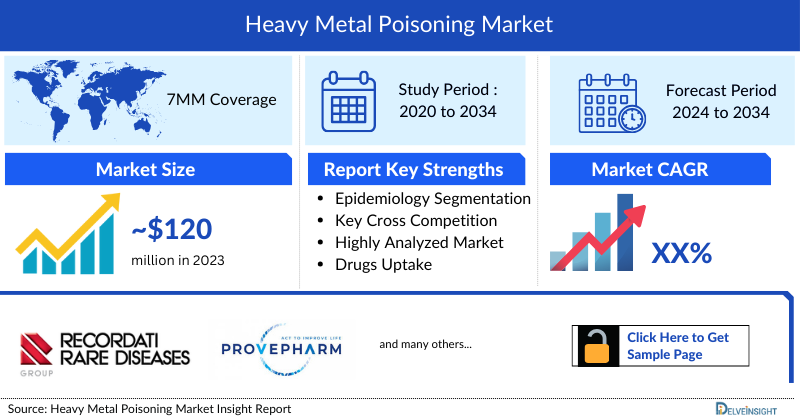
- The heavy metal poisoning market size in the 7MM was nearly ~USD 120 million in 2023 and is expected to grow in the forecasted period.
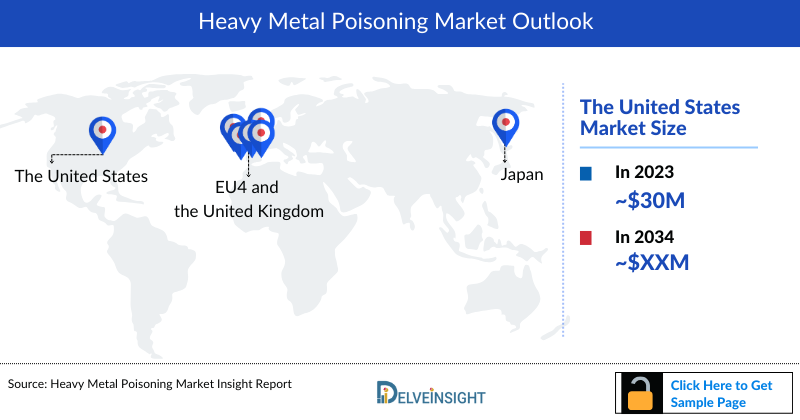
- The US accounts for the highest market size of heavy metal poisoning with ~USD 30 million in 2023.
- Japan has the second highest market size in the 7MM with ~USD 25 million in 2023.
- Among EU4 and the UK, Germany accounted for the highest market size ~USD 20 million in 2023.
Heavy metal poisoning Market Trends & Insights
- Heavy metal poisoning occurs when microscopic molecules of toxic metals like lead, mercury, and arsenic accumulate in the body after exposure. These heavy metals bind to parts of cells, preventing organs from functioning properly and causing potentially life-threatening symptoms.
- The primary treatment for heavy metal poisoning is to cease exposure and use chelating agents to facilitate the excretion of the toxic metal. The most commonly used chelating agents are Dimercaprol (British Anti-Lewisite, BAL), Edetate calcium disodium (CaNa2EDTA), and Penicillamine.
- The highest number of total heavy metal poisoning cases was reported in the US, accounting for approximately 25%, followed by Japan with around 20%, and the EU4 and the UK with about 55% cases.
- The market is anticipated to witness a substantial positive shift owing to better uptake of existing drugs, the expected market launch of therapies, and raised awareness.
- The United States accounts for the largest market size of heavy metal poisoning, in comparison to EU4 (Germany, France, Italy, and Spain) and the United Kingdom, and Japan.
- Japan had the second-largest market size in the 7MM, accounting for approximately 20% of the total in 2023.
- Heavy metal poisoning pipeline is not so robust but possesses a potential drug i.e. Emeramide.
Heavy metal poisoning Market Size and Forecasts
- United States Market Size (2023): USD 30 million
- Japan Market Size (2023): USD 25 million
- Germany Market Size (2023): USD 20 million
- Largest Market: United States
Factors Driving Heavy Metal Poisoning Market Growth
Rising Exposure to Industrial and Environmental Pollutants
Increasing industrialization, mining activities, and improper waste disposal have led to higher exposure to heavy metals such as lead, mercury, arsenic, and cadmium. This growing exposure is a major factor driving the demand for diagnosis and treatment options.
Growing Awareness and Screening Programs
Enhanced public health initiatives and awareness campaigns promoting the early detection of heavy metal toxicity are leading to better diagnosis rates and timely medical interventions, fueling market growth.
Advancements in Chelation Therapy and Novel Treatments
The development of safer and more effective chelating agents, along with research into targeted detoxification therapies, is expanding the treatment landscape for heavy metal poisoning.
Increasing Incidence of Occupational Exposure
Workers in industries such as mining, battery manufacturing, and chemical processing remain at high risk of heavy metal exposure, increasing the patient pool and boosting the market demand for therapeutic solutions.
Supportive Government Regulations and Policies
Stringent environmental and occupational safety regulations, coupled with government funding for toxicity monitoring and remediation programs, are contributing to market expansion.
Advances in Diagnostic Technologies
The introduction of rapid, precise, and non-invasive diagnostic tools for detecting heavy metal levels in biological samples has improved clinical management, encouraging healthcare providers to adopt advanced solutions.
DelveInsight's “Heavy Metal Poisoning Market Insight, Epidemiology and Market Forecast – 2034” report delivers an in-depth understanding of heavy metal poisoning, historical and forecasted epidemiology as well as the heavy metal poisoning market trends in the United States, EU4 (Germany, France, Italy, and Spain) and the United Kingdom, and Japan.
Heavy metal poisoning market report provides real-world prescription pattern analysis, emerging drugs, market share of individual therapies, and historical and forecasted 7MM heavy metal poisoning market size from 2020 to 2034. The report also covers current heavy metal poisoning treatment practices/algorithms and unmet medical needs to curate the best opportunities and assess the market’s underlying potential.
|
Study Period |
2020 to 2034 |
|
Forecast Period |
2024-2034 |
|
Geographies Covered |
|
|
Heavy Metal Poisoning Market |
|
|
Heavy Metal Poisonings Market Size | |
|
Heavy Metal Poisoning Companies |
Recordati Rare Diseases, Provepharm Life Solutions, EmeraMed, Magellan Diagnostics, Bezoloven Inc., and others. |
|
Heavy Metal Poisoning Epidemiology Segmentation |
|
Heavy Metal Poisoning Understanding Market
Heavy Metal Poisoning Overview, Country-Specific Treatment Guidelines and Diagnosis
Heavy metal poisoning occurs when harmful levels of metals such as lead, mercury, cadmium, and arsenic accumulate in the body, often due to environmental exposure, occupational hazards, or contaminated food and water. These metals can interfere with cellular functions, leading to a range of severe health issues. Symptoms may vary based on the specific metal involved and can include abdominal pain, neurological deficits, and organ damage.
Diagnosis of heavy metal poisoning involves a thorough medical history, physical examination, and specific laboratory tests. Clinicians often assess potential exposure sources and symptoms to guide testing. Blood and urine tests are commonly used to measure the levels of various metals in the body. Imaging studies may also be employed to evaluate organ damage. Due to the nonspecific nature of symptoms, diagnosing heavy metal poisoning can be challenging, necessitating a high index of suspicion, especially in individuals with known exposure risks.
Further details related to country-based variations in diagnosis are provided in the report
Heavy Metal Poisoning Treatment
Treatment for heavy metal poisoning primarily focuses on removing the toxic metals from the body, often through chelation therapy. Chelating agents, such as dimercaprol, EDTA, and succimer, bind to heavy metals, facilitating their excretion via urine. The choice of chelating agent depends on the specific metal involved and the severity of the poisoning. Supportive care, including hydration and management of symptoms, is also crucial. In cases of chronic exposure, addressing the source of contamination is essential to prevent further toxicity.
Heavy Metal Poisoning Epidemiology
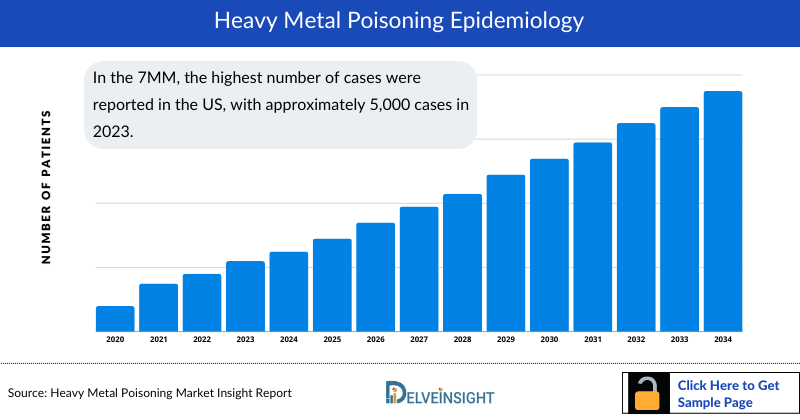
The heavy metal poisoning epidemiology chapter in the report provides historical as well as forecasted in the 7MM covering the United States, EU4 (Germany, France, Italy, and Spain), and the United Kingdom, and Japan from 2020 to 2034. The heavy metal poisoning epidemiology is segmented with detailed insights into total heavy metal poisoning cases, age-specific cases of heavy metal poisoning, and metal type-specific cases of heavy metal poisoning.
- In the 7MM, the highest number of cases were reported in the US, with approximately 5,000 cases in 2023.
- In 2023, the highest cases in the US were in the age group of 20 years or more having nearly 2,300 cases.
- Among EU4 and the UK, Germany accounted for the highest number of heavy metal poisoning cases with approximately 4,000 cases in 2023.
- In 2023, the highest number of heavy metal poisoning cases were due to lead with nearly 2,600 cases and the lowest number of cases was due to cadmium with nearly 120 cases in the US.
Heavy Metal Poisoning Drug Analysis
The drug chapter segment of the heavy metal poisoning report encloses a detailed analysis of heavy metal poisoning marketed drugs and late-stage (Phase III and Phase II) pipeline drugs. It also deep dives into the heavy metal poisoning pivotal clinical trial details, recent and expected market approvals, patent details, the latest news, and recent deals and collaborations.
Heavy Metal Poisoning Marketed Drugs
CHEMET: Recordati Rare Diseases
CHEMET, developed by Recordati Rare Diseases, is a prescription medication indicated for the treatment of lead poisoning, particularly in pediatric patients. It contains succimer, a chelating agent that binds to lead in the body, facilitating its excretion through urine.
CHEMET is designed to reduce blood lead levels effectively while minimizing the risk of adverse effects associated with chelation therapy. The drug is available in capsule form and is intended for use following identification and removal of the lead source to ensure comprehensive management of lead exposure.
Note: Detailed current therapies assessment will be provided in the full report on Heavy Metal Poisoning
Heavy Metal Poisoning Emerging Drugs
Emeramide: EmeraMed
NBMI (N1, N3-Bis-(2-Mercaptoethyl) Isophthalamide) is a new metal chelator drug proposed as an alternative to the current chelators, and it is widely different; compared to the current chelators, consisting of two cysteamine molecules coupled to a single molecule of dicarboxybenzoate. It is used as a chelating agent and has the designation of an orphan drug, in the EU it is used for the treatment of mercury toxicity. It is freely soluble in solutions of dimethylformamide (DMF), dimethyl sulfoxide (DMSO), and sodium hydroxide diluted NaOH, slightly soluble in methanol and acetone, and insoluble in water.
Pre-clinical data indicates low to no toxicity, and that it reduces the toxicity associated with acute exposure to Hg2+. It is currently is in Phase II/III and also going through the EMA and the US FDA drug approval process.
Note: Detailed emerging therapies assessment will be provided in the final report.
Heavy Metal Poisoning Recent Developments
- In March 2025, Zimmer Biomet Holdings, Inc. announced FDA 510(k) clearance for the Persona® Revision SoluTion™ Femur, a revision knee implant component designed for patients with sensitivities to certain metals. Part of the Persona Revision Knee System, it features a proprietary surface-hardening treatment to improve wear performance and provides surgeons with a range of anatomic components, including tibial and femoral cones with various stem options for zonal fixation.
Heavy Metal Poisoning Drug Class Insight
Drugs used to treat heavy metal poisoning primarily belong to the class of chelating agents. Chelating agents work by binding to the heavy metals in the bloodstream, forming stable complexes that are then excreted from the body, typically through urine. Common chelating agents include dimercaprol (BAL), succimer (DMSA), edetate calcium disodium (EDTA), and penicillamine. These drugs are often used depending on the type of heavy metal involved; for example, dimercaprol and succimer are frequently used for lead poisoning, while dimercaprol is also used for arsenic and mercury poisoning. Chelating therapy must be carefully managed, as improper use can lead to redistribution of metals to other tissues or cause renal damage.
Further details will be provided in the final report.
Heavy Metal Poisoning Market Outlook
The primary treatment of heavy metal poisoning is the termination of exposure to the metal. Treatment also consists of the use of various chelating agents that cause the toxic (poison) element to bind with the drug and be excreted in the urine. The three most commonly used drugs for the treatment of metal poisoning are dimercaprol (British anti-Lewisite, BAL), edetate calcium disodium (CaNa2EDTA), and penicillamine. Each of these works by binding actions that permit the metals to be eliminated from the body through the urine. Continuous efforts are thus needed for the development of drugs treating various heavy metal poisoning. Along with that, support from the government and industry support is also necessary. Key players, such as EmeraMed, and others are evaluating their lead candidates in different stages of clinical development, respectively. They aim to investigate their products for the treatment of heavy metal poisoning.
Heavy Metal Poisoning
- The US accounts for the highest market size of heavy metal poisoning with ~USD 30 million in 2023.
- Japan has the second highest market size in the 7MM with ~USD 25 million in 2023.
- Among EU4 and the UK, Germany accounted for the highest market size ~USD 20 million in 2023.
- Among emerging drugs, Emeramide is expected to create a positive shift in market share.
Heavy Metal Poisoning Drugs Uptake
This section focuses on the uptake rate of potential drugs expected to be launched in the market during 2024–2034, which depends on the competitive landscape, safety, and efficacy data along with order of entry. It is important to understand that the key players evaluating their novel therapies in the pivotal and confirmatory trials should remain vigilant when selecting appropriate comparators to stand the greatest chance of a positive opinion from regulatory bodies, leading to approval, smooth launch, and rapid uptake.
Further detailed analysis of emerging therapies drug uptake in the report…
Heavy Metal Poisoning Competitive Landscape
The report provides insights into heavy metal poisoning clinical trials within Phase III and Phase II stages. It also analyzes key players involved in developing targeted therapeutics.
Heavy Metal Poisoning Companies
The report covers information on collaborations, acquisitions and mergers, licensing, and patent details for heavy metal poisoning emerging therapies.
KOL Views on Heavy Metal Poisoning
To keep up with the real-world scenario in current and emerging market trends, we take opinions from Key Industry leaders working in the domain through primary research to fill the data gaps and validate our secondary research. Industry Experts were contacted for insights on the evolving treatment landscape, patient reliance on conventional therapies, patient therapy switching acceptability, and drug uptake along with challenges related to accessibility.
DelveInsight’s analysts connected with 40+ KOLs to gather insights; however, interviews were conducted with 25+ KOLs in the 7MM. Centers such as the Pediatric Environmental Health Center, Center for Diagnostic Nanosystems, Marshall University, Lead Poisoning Prevention and Environmental Health Tracking Branch, etc., were contacted. Their opinion helps understand and validate current and emerging treatment patterns of heavy metal poisoning. This will support the clients in potential upcoming novel treatments by identifying the overall scenario of the market and the unmet needs.
What KOLs are saying on Heavy Metal Poisoning Patient Trends?
|
Region |
KOL Views |
|
United States |
“Arsenic toxicity is a life-threatening condition and mandates aggressive treatment with particular attention to fluid resuscitation, blood pressure support, and cardiac monitoring. Patients requiring hospitalization should be in the ICU for advanced life support monitoring. Chelation therapy has been shown to improve outcomes if started in minutes to hours after arsenic exposure.” |
|
Germany |
“In marine fish and other seafood, the total arsenic content is in general much higher than that in terrestrial food. Furthermore, in seafood organic arsenic compounds are the major arsenicals, including the water-soluble arsenobetaine or arsenosugars as well as the lipid-soluble arsenolipids. In general, the fat fraction of livers and other organs of marine fish is rich in arsenic. Oils from these marine fish generally contain between 1 and 50 mg As kg−1 oil.” |
|
Japan |
“The Morinaga milk poisoning event provides clear-cut evidence for hazard assessment of developmental neurotoxicity. Clinical poisoning with severe neurobehavioral sequelae occurred when infants were exposed to total doses of about 60 mg from milk mixtures during a period of a few weeks. This evidence amply demonstrates the need to consider neurotoxicity as a key concern regarding environmental arsenic exposure.” |
Heavy Metal Poisoning Qualitative Analysis
We perform Qualitative and market Intelligence analysis using various approaches, such as SWOT analysis and Conjoint Analysis. In the SWOT analysis, strengths, weaknesses, opportunities, and threats in terms of gaps in disease diagnosis, patient awareness, physician acceptability, competitive landscape, cost-effectiveness, and geographical accessibility of therapies are provided.
Conjoint Analysis analyzes multiple approved and emerging therapies based on relevant attributes such as safety, efficacy, frequency of administration, route of administration, and order of entry. Scoring is given based on these parameters to analyze the effectiveness of therapy.
Further, the therapies’ safety is evaluated wherein the acceptability, tolerability, and adverse events are majorly observed, and it sets a clear understanding of the side effects posed by the drug in the trials. In addition, the scoring is also based on the probability of success, and the addressable patient pool for each therapy. According to these parameters, the final weightage score and the ranking of the emerging therapies are decided.
Heavy Metal Poisoning Market Access and Reimbursement
The report further provides detailed insights on the country-wise accessibility and reimbursement scenarios, cost-effectiveness scenario of currently used therapies, programs making accessibility easier and out-of-pocket costs more affordable, insights on patients insured under federal or state government prescription drug programs, etc.
Scope of the Heavy Metal Poisoning Market Report
- The report covers a segment of key events, an executive summary, descriptive overview of Heavy Metal Poisoning, explaining its causes, signs and symptoms, pathogenesis, and currently available therapies.
- Comprehensive insight has been provided into the epidemiology segments and forecasts, the future growth potential of diagnosis rate, and disease progression along with country-specific treatment guidelines.
- Additionally, an all-inclusive account of both the current and emerging therapies, along with the elaborative profiles of late-stage and prominent therapies, will have an impact on the current treatment landscape.
- A detailed review of the Heavy Metal Poisoning market, historical and forecasted market size, market share by therapies, detailed assumptions, and rationale behind our approach is included in the report, covering the 7MM drug outreach.
- The report provides an edge while developing business strategies, by understanding trends, through SWOT analysis and expert insights/KOL views, patient journey, and treatment preferences that help in shaping and driving the 7MM Heavy Metal Poisoning market.
Heavy Metal Poisoning Market Report Insights
- Heavy Metal Poisoning Patient Population
- Heavy Metal Poisoning Therapeutic Approaches
- Heavy Metal Poisoning Pipeline Analysis
- Heavy Metal Poisoning Market Size and Trends
- Existing and future Market Opportunity
Heavy Metal Poisoning Market Report Key Strengths
- Eleven Years Forecast
- 7MM Coverage
- Heavy Metal Poisoning Epidemiology Segmentation
- Inclusion of Country-Specific Treatment Guidelines
- Key Cross Competition
- Conjoint Analysis
- Heavy Metal Poisoning Drugs Uptake
- Key Heavy Metal Poisoning Market Forecast Assumptions
Heavy Metal Poisoning Market Report Assessment
- Current Heavy Metal Poisoning Treatment Practices
- Heavy Metal Poisoning Unmet Needs
- Heavy Metal Poisoning Pipeline Product Profiles
- Heavy Metal Poisoning Market Attractiveness
- Qualitative Analysis (SWOT and Conjoint Analysis)
- Heavy Metal Poisoning Market Drivers
- Heavy Metal Poisoning Market Barriers
Key Questions Answered in the Heavy Metal Poisoning Report
- What is the growth rate of the 7MM Heavy Metal Poisoning treatment market?
- What was the Heavy Metal Poisoning total market size, the market size by therapies, market share (%) distribution in 2020, and what would it look like in 2034? What are the contributing factors/key catalysts for this growth?
- Is there any unexplored patient setting that can open the window for growth in the future?
- What are the pricing variations among different geographies for approved and off-label therapies?
- How would the market drivers, barriers, and future opportunities affect the market dynamics and subsequent analysis of the associated trends? Although multiple expert guidelines recommend testing for targetable mutations before therapy initiation, why do barriers to testing remain high?
- What are the current and emerging options for the treatment of Heavy Metal Poisoning?
- How many Heavy Metal Poisoning companies are developing therapies for the treatment of Heavy Metal Poisoning?
- What are the recent novel therapies, targets, mechanisms of action, and technologies developed to overcome the limitations of existing therapies?
- Patient/physician acceptability in terms of preferred treatment options as per real-world scenarios?
- What are the country-specific accessibility issues of expensive, recently approved Heavy Metal Poisoning therapies?
Reasons to buy Heavy Metal Poisoning Market Forecast Report
- The Heavy Metal Poisoning market report will help in developing business strategies by understanding the latest trends and changing treatment dynamics driving the Heavy Metal Poisoning Market.
- Insights on Heavy Metal Poisoning patient burden/disease prevalence, evolution in diagnosis, and factors contributing to the change in the epidemiology of the disease during the forecast years
- Understand the existing market opportunities in varying geographies and the growth potential over the coming years.
- Distribution of historical and current patient share based on real-world prescription data along with reported sales of approved products in the US, EU4 (Germany, France, Italy, and Spain), the United Kingdom, and Japan.
- Identifying strong upcoming Heavy Metal Poisoning companies in the market will help devise strategies to help get ahead of competitors.
- Detailed analysis and ranking of class-wise potential current and emerging therapies under the conjoint analysis section to provide visibility around leading classes.
- Highlights of access and reimbursement policies of approved therapies, barriers to accessibility of expensive off-label therapies, and patient assistance programs.
- To understand Key Opinion Leaders’ perspectives around the accessibility, acceptability, and compliance-related challenges of existing treatment to overcome barriers in the future.
- Detailed insights on the unmet needs of the existing market so that the upcoming players can strengthen their development and launch strategy.