Human Microbiome Market Summary
- The global human microbiome market was valued at USD 1.9 billion in 2025 and is projected to reach USD 8.9 billion by 2034.
- The market is expected to expand at a CAGR of 18.7% during the forecast period 2026-2034, supported by the regulatory validation of live biotherapeutic products following the FDA's approval of Rebyota and Vowst for recurrent Clostridioides difficile infection, the shift from donor-dependent fecal microbiota transplantation toward standardized and precision-engineered bacterial consortia, expanding clinical investigation of microbiome-based therapeutics in inflammatory bowel disease, oncology, and metabolic disorders, and continued advancement in microbiome sequencing and bioinformatics platforms.
- By product type, live biotherapeutic products/therapeutics dominated the human microbiome market in 2025.
- By disease/application, gastrointestinal diseases dominated the human microbiome market in 2025, while infectious diseases represented the fastest-growing application at a CAGR of approximately 35.2%.
- By technology, fecal microbiota transplantation-derived products dominated the human microbiome market in 2025, while standardized/defined bacterial consortia represented the fastest-growing technology.
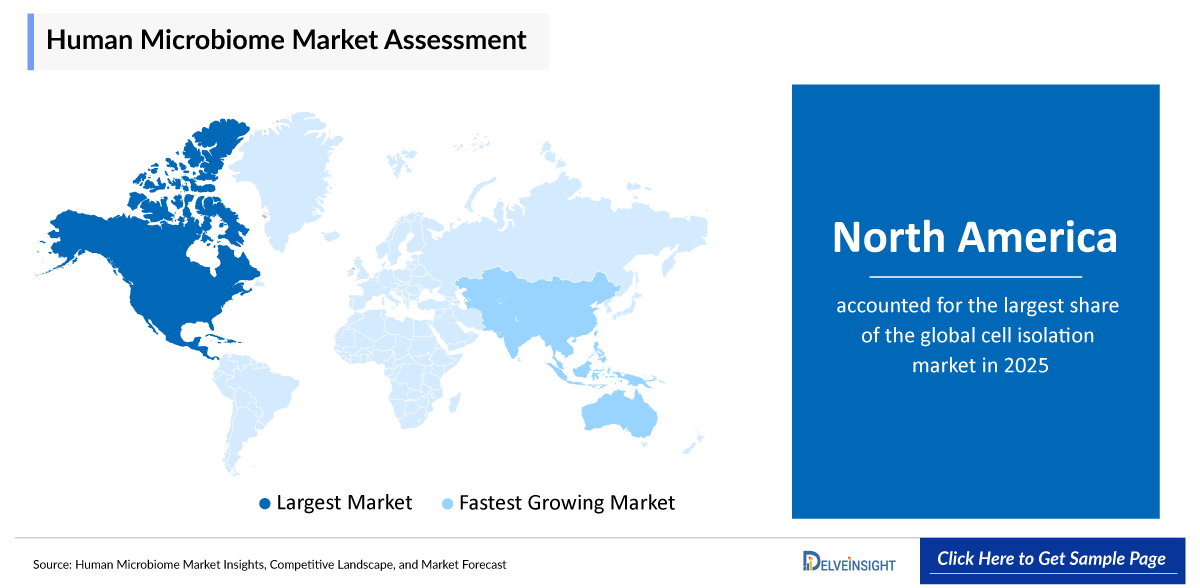
- North America accounted for the largest share of the human microbiome market in 2025, while Asia-Pacific is anticipated to register the fastest growth through 2034.
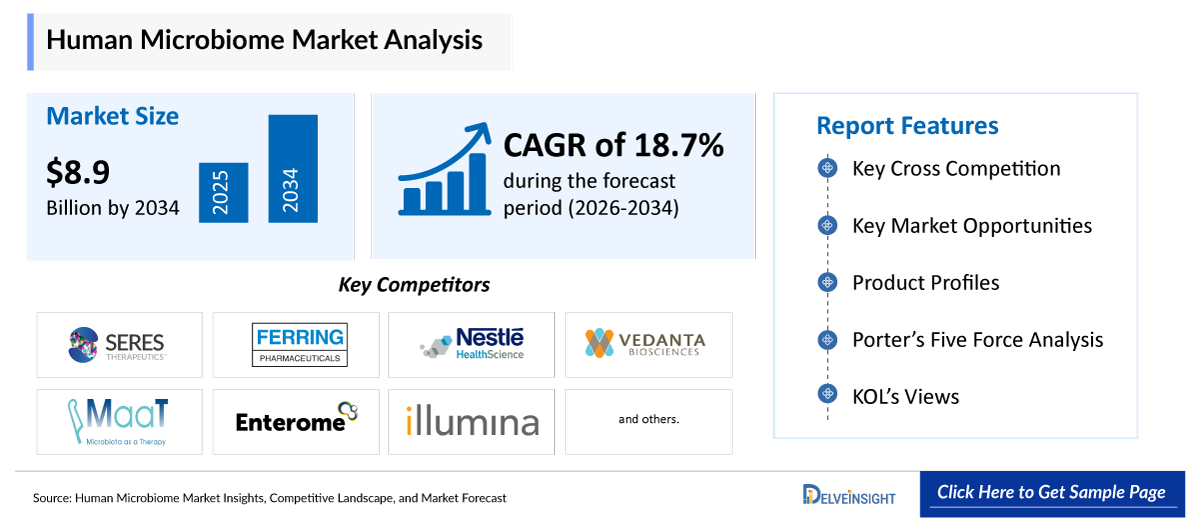
The human microbiome encompasses the collective genetic material of the bacteria, fungi, viruses, and other microorganisms residing within the human body, which play a crucial role in immune function, metabolism, and disease susceptibility. The scope encompasses live biotherapeutic products and therapeutics, including Ferring Pharmaceuticals' Rebyota (fecal microbiota, live-jslm), approved by the FDA in November 2022 as the first human microbiome therapy, and Vowst (fecal microbiota spores, live-brpk), approved in April 2023 as the first oral microbiome therapeutic and now owned by Nestlé Health Science following its June 2024 acquisition of global rights from Seres Therapeutics; standardized and precision-engineered bacterial consortia candidates, including Vedanta Biosciences' VE303; microbiome-based diagnostics and sequencing platforms from Illumina and specialized microbiome analytics providers including Microbiotica and Second Genome; and probiotic and prebiotic products. The market spans gastrointestinal disease, infectious disease, metabolic disorder, oncology, and neurological disorder applications.
Human Microbiome Market Key Growth Drivers
- Regulatory validation of live biotherapeutic products following the FDA's approval of Rebyota in November 2022 and Vowst in April 2023, both indicated for the prevention of recurrent Clostridioides difficile infection, a condition affecting approximately 500,000 patients annually in the United States.
- Strong clinical validation in recurrent C. difficile infection, with fecal microbiota transplantation-based therapies demonstrating cure rates of approximately 70% to 91%, compared with recurrence rates of 25% to 30% following standard antibiotic treatment alone.
- Shift from donor-dependent fecal microbiota transplantation toward standardized and precision-engineered bacterial consortia, exemplified by Vedanta Biosciences' VE303 candidate, reflecting industry-wide focus on manufacturing consistency and reduced donor variability.
- Expanding clinical investigation of microbiome-based therapeutics beyond C. difficile infection into inflammatory bowel disease, oncology, metabolic disorders, and neurological conditions.
- Continued advancement in microbiome sequencing and bioinformatics platforms that improve the resolution and clinical actionability of microbiome profiling for both research and diagnostic applications.
- Growing manufacturing capacity investment by leading commercial-stage companies, exemplified by Ferring Pharmaceuticals' April 2025 expansion of manufacturing capacity for Rebyota to address increasing global demand.
- Sustained government-funded microbiome research initiatives, including European Horizon Europe programs addressing antimicrobial resistance and chronic disease, and national genomics initiatives in China and India supporting microbiome-linked translational research.
Key Companies in Human Microbiome Market
The competitive landscape is led by the following active manufacturers:
- Seres Therapeutics, Inc.
- Ferring Pharmaceuticals (Rebiotix)
- Nestlé Health Science
- Vedanta Biosciences, Inc.
- MaaT Pharma
- Enterome SA
- Illumina, Inc.
- Microbiotica Ltd.
- Second Genome
- Pendulum Therapeutics, Inc.
For illustrative purposes, only the top 10 companies are listed in the Table of Contents. The report may include analysis and references to additional companies relevant to the market assessment.
Human Microbiome Market Size
The following table summarizes the headline market metrics for the global human microbiome market across the base year and the forecast horizon.
|
Report Metrics |
Details |
|
2025 Market Size |
USD 1.9 billion |
|
2034 Projected Market Size |
USD 8.9 billion |
|
Growth Rate (2026-2034) |
18.7% CAGR |
|
Largest Market |
North America |
|
Fastest Growing Market |
Asia-Pacific |
|
Market Structure |
Moderately Consolidated |
All market values are expressed in USD and represent DelveInsight estimates synthesized from primary and secondary research.
Factors Contributing to the Growth of the Human Microbiome Market
Market Drivers
Regulatory Validation of Live Biotherapeutic Products
The foundational driver reshaping the human microbiome market is the regulatory validation of live biotherapeutic products following the FDA's approval of Rebyota in November 2022 and Vowst in April 2023, both indicated for the prevention of recurrent Clostridioides difficile infection. Rebyota, developed by Ferring Pharmaceuticals through its Rebiotix subsidiary, became the first human microbiome therapy to gain FDA approval, while Vowst, developed by Seres Therapeutics, became the first oral microbiome therapeutic approved for this indication. Recurrent C. difficile infection affects approximately 500,000 patients annually in the United States, and these approvals established an important regulatory precedent that has renewed pharmaceutical industry investment in microbiome-based drug development across additional disease areas. As additional microbiome therapeutic candidates advance through clinical development following this regulatory precedent, demand for microbiome discovery, manufacturing, and characterization capability grows across the forecast period.
Strong Clinical Validation in Recurrent C. Difficile Infection
Strong clinical validation in recurrent C. difficile infection underpins continued confidence in microbiome-based therapeutic approaches. Fecal microbiota transplantation-based therapies have demonstrated cure rates of approximately 70% to 91% in recurrent C. difficile infection, compared with recurrence rates of 25% to 30% following standard antibiotic treatment alone, representing a substantial and clinically meaningful improvement over conventional antibiotic-only management. As this clinical evidence base continues to mature and as real-world outcomes data accumulates from the growing population of patients treated with Rebyota and Vowst, with Rebyota alone administered to over 6,200 patients across North America and Europe in 2025, confidence in the broader microbiome therapeutic approach continues to strengthen, supporting continued investment and adoption across the forecast period.
Shift Toward Standardized and Precision-Engineered Bacterial Consortia
The competitive landscape is shifting from donor-dependent fecal microbiota transplantation products toward standardized bacterial consortia and precision-engineered therapies, reflecting the industry's increasing focus on manufacturing consistency and reduced donor variability. Candidates such as Vedanta Biosciences' VE303, a rationally defined consortium of clonal bacterial strains manufactured without reliance on donor fecal material, exemplify this shift toward more scalable, quality-controlled microbiome therapeutic manufacturing. As precision-engineered bacterial consortia continue to advance through clinical development and demonstrate manufacturing and quality advantages over first-generation donor-derived products, this technology category is expected to gain share progressively across the forecast period.
Expanding Clinical Investigation Beyond C. Difficile Infection
Developers are extending microbiome therapeutic clinical programs into inflammatory bowel disease, oncology, metabolic disorders, neurological conditions, and other high-value indications beyond the initial C. difficile infection focus. Seres Therapeutics presented expanded biomarker data in May 2025 from its SER-155 Phase 1b study, supporting the development of microbiome-based therapeutics for broader gut health applications, while additional developers pursue microbiome-modulating approaches across immuno-oncology and metabolic disease. As clinical evidence accumulates supporting microbiome-based intervention across these broader indications, the addressable market for microbiome therapeutics expands substantially beyond its initial gastrointestinal infection focus across the forecast period.
Advancement in Microbiome Sequencing and Bioinformatics Platforms
Continued advancement in microbiome sequencing and bioinformatics platforms improves the resolution and clinical actionability of microbiome profiling for both research and diagnostic applications. Sequencing platforms from Illumina and specialized microbiome analytics capabilities from companies including Microbiotica and Second Genome enable increasingly detailed characterization of microbial community composition and function, supporting both academic research and the biomarker identification programs that underpin microbiome therapeutic development. As sequencing costs continue to decline and as bioinformatics analysis capability continues to improve, demand for microbiome sequencing and analysis platforms grows across both research and emerging diagnostic applications across the forecast period.
Manufacturing Capacity Investment by Commercial-Stage Companies
Growing manufacturing capacity investment by leading commercial-stage companies reflects sustained confidence in near-term demand growth for approved microbiome therapeutics. In April 2025, Ferring Pharmaceuticals announced the expansion of its manufacturing capacity for Rebyota and Adstiladrin to address increasing global demand for its therapeutic portfolio, while Nestlé Health Science reported continued growth in its microbiome product portfolio, including Vowst and probiotics, across Europe and Asia in July 2025. As commercial demand for approved microbiome therapeutics continues to grow, sustained manufacturing capacity investment by leading companies supports continued market expansion across the forecast period.
Sustained Government-Funded Microbiome Research Initiatives
Sustained government-funded microbiome research initiatives provide a stable, long-term funding base supporting continued microbiome research and translational development. European Horizon Europe programs launched in 2025 emphasize microbiome applications in antimicrobial resistance mitigation and chronic disease management, while national genomics initiatives, including China's sequencing research capabilities and India's Genome India Project, increasingly support microbiome-linked translational research within national healthcare systems. As governments across major markets continue to invest in microbiome research infrastructure, demand for microbiome research tools, sequencing platforms, and translational development capability grows across the forecast period.
Market Restraints
The human microbiome market faces several interrelated restraints that temper its growth. The limited number of FDA-approved microbiome therapeutics to date, with Rebyota and Vowst representing the only two approvals despite decades of microbiome research, means that clinical and commercial validation of the broader microbiome therapeutic approach remains earlier-stage relative to more established therapeutic modalities. The complexity and cost of manufacturing living biological products, whether donor-derived or precision-engineered bacterial consortia, under current good manufacturing practice standards adds substantial development and production cost relative to conventional small-molecule or even many biologic therapeutics. Donor-derived fecal microbiota transplantation products face inherent supply chain and donor variability challenges, including donor screening, batch-to-batch consistency, and potential pathogen transmission risk, that standardized bacterial consortia aim to address but have not yet fully displaced. The commercial concentration of the market around a small number of approved or late-stage therapeutic platforms means that competitive entry requires substantial controlled biological material sourcing, clinically attributable outcomes data, and manufacturing records that regulators can review across batches, excluding general laboratory service companies that cannot support controlled product release. Reported exploration of strategic options for Rebyota by Ferring Pharmaceuticals illustrates the ongoing commercial and strategic uncertainty that can affect even approved, commercially available microbiome therapeutic products. Together, these factors moderate the pace of market expansion and require developers to demonstrate manufacturing scalability, clinical differentiation, and commercial execution to sustain growth.
Human Microbiome Market Segment Analysis
The global human microbiome market is segmented by product type (live biotherapeutic products/therapeutics, diagnostics, research tools/sequencing and analysis platforms, and probiotics and prebiotics), by disease/application (gastrointestinal diseases, infectious diseases, metabolic disorders, oncology, neurological disorders, and others), by technology (fecal microbiota transplantation-derived products, standardized/defined bacterial consortia, and sequencing and bioinformatics platforms), by end-user (pharmaceutical and biotechnology companies, hospitals and clinics, academic and research institutes, and diagnostic laboratories), and by geography (North America, Europe, Asia-Pacific, and the Rest of the World).
By Product Type
Dominant Subsegment: Live Biotherapeutic Products/Therapeutics.
The live biotherapeutic products/therapeutics category is expected to dominate the market. Live biotherapeutic products, including Ferring Pharmaceuticals' Rebyota and Nestlé Health Science's Vowst, are the leading product category because they represent the only FDA-approved, commercially available microbiome-based products to date, generating direct commercial revenue at meaningful scale, with Rebyota alone administered to over 6,200 patients across North America and Europe in 2025. The dominance of the segment reflects the regulatory and clinical maturity advantage these approved products hold relative to earlier-stage diagnostic and research tool categories. Diagnostics represented a significant and growing category as microbiome-based diagnostic testing gains clinical adoption, while research tools and sequencing and analysis platforms remain foundational to the discovery and development pipeline underlying future therapeutic candidates, and probiotics and prebiotics constitute a substantial adjacent commercial category.
By Disease/Application
Dominant Subsegment: Gastrointestinal Diseases.
The gastrointestinal diseases category is expected to dominate the market. Gastrointestinal diseases, encompassing recurrent C. difficile infection and inflammatory bowel disease, are the leading application because both FDA-approved microbiome therapeutics, Rebyota and Vowst, are indicated specifically for recurrent C. difficile infection, and because this indication has accumulated the deepest clinical evidence base of any microbiome therapeutic application, with fecal microbiota transplantation-based therapies demonstrating cure rates of approximately 70% to 91%. The dominance of the segment reflects the concentration of regulatory approval and commercial revenue within this single, well-validated clinical application. Infectious diseases represented the fastest-growing application, growing at an estimated CAGR of approximately 35.2%, reflecting expanding clinical investigation of microbiome-based approaches to infectious disease management beyond C. difficile infection specifically, while metabolic disorders, oncology, and neurological disorders remain earlier-stage but increasingly active areas of clinical investigation.
By Technology
Dominant Subsegment: Fecal Microbiota Transplantation-Derived Products.
Fecal microbiota transplantation-derived products accounted for the largest share of the human microbiome market in 2025, reflecting the fact that both FDA-approved microbiome therapeutics, Rebyota and Vowst, originated from donor-derived fecal microbiota material. The dominance of the segment reflects the regulatory and clinical precedent established by these first-generation approved products. Standardized and defined bacterial consortia, exemplified by Vedanta Biosciences' VE303, a rationally defined consortium of clonal bacterial strains manufactured without reliance on donor fecal material, represented the fastest-growing technology category in 2025, reflecting the industry-wide shift toward more scalable, quality-controlled manufacturing approaches that reduce donor dependency and improve batch-to-batch consistency relative to first-generation donor-derived products.
Human Microbiome Market Region Analysis
Dominant Region: North America
North America accounted for the largest share of the global human microbiome market in 2025, representing the highest regional market share globally. The leadership of the region reflects the FDA approvals of Rebyota and Vowst, a mature clinical research ecosystem, access to investment capital, and the presence of leading developers including Seres Therapeutics, Vedanta Biosciences, and Ferring Pharmaceuticals' Rebiotix subsidiary. The United States reports approximately 500,000 C. difficile infections annually, reinforcing sustained demand for effective recurrence-prevention strategies. The concentration of vendors, regulatory approval precedent, and clinical research infrastructure reinforce the position of North America as the largest regional market across the forecast period.
Fastest Growing Region: Asia-Pacific
Asia-Pacific is projected to register the fastest regional growth through 2034. Expansion will be driven by increasing awareness of microbiome health, rising rates of inflammatory bowel disease and metabolic disorders, growing biotechnology investment, and government-supported genomics initiatives, including China's expanding sequencing research capabilities and India's Genome India Project. China, Japan, and India are the principal national markets, supported by expanding academic and biotechnology research capacity and growing regional regulatory engagement with microbiome-based diagnostics and therapeutics. As biomedical research infrastructure continues to expand and as government-supported genomics initiatives mature, Asia-Pacific is positioned as the fastest-growing regional market across the forecast period.
Regional Commentary
North America
North America leads the market, supported by FDA approval precedent, a mature clinical research ecosystem, and the concentration of leading developers. The United States dominates the region through its concentration of companies and the substantial annual burden of C. difficile infection.
Europe
Europe is a substantial market shaped by strong academic microbiome research infrastructure and the presence of leading organizations including MaaT Pharma, Enterome, and Ferring Pharmaceuticals. Germany, the United Kingdom, France, Italy, and Spain are the principal national markets, and the region benefits from Horizon Europe program funding supporting microbiome applications in antimicrobial resistance and chronic disease management.
Asia-Pacific
Asia-Pacific is the fastest-growing region, driven by increasing microbiome health awareness, rising disease burden, and government-supported genomics initiatives including China's sequencing capabilities and India's Genome India Project.
Rest of World
The Rest of World, spanning Latin America, the Middle East, and Africa, represents an emerging opportunity as biomedical research infrastructure expands, though adoption of advanced microbiome diagnostics and therapeutics remains concentrated in leading academic and private research centers.
Human Microbiome Market Competitive Landscape
The global human microbiome market is classified as Moderately Consolidated. Ferring Pharmaceuticals and Nestlé Health Science hold established commercial positions through Rebyota and Vowst, respectively, while Seres Therapeutics retains a live biotherapeutic pipeline following its completed Vowst asset sale, and a broader group of clinical-stage developers, including Vedanta Biosciences, MaaT Pharma, and Enterome, compete in narrower disease-specific applications. Competition centers on clinical evidence depth, manufacturing scalability and consistency, breadth of indication expansion beyond C. difficile infection, and the pace of transition from donor-derived to precision-engineered bacterial consortia. The competitive landscape is evaluated across the following dimensions:
- Market concentration: Moderately consolidated, with Seres Therapeutics, Ferring Pharmaceuticals, Vedanta Biosciences, MaaT Pharma, and Finch Therapeutics collectively accounting for an estimated 90% share of the global market, alongside Nestlé Health Science, Enterome, Illumina, Microbiotica, Second Genome, and Pendulum Therapeutics.
- Leading players: Ferring Pharmaceuticals leads in commercial fecal microbiota transplantation-derived therapy through Rebyota; Nestlé Health Science leads in oral microbiome therapeutics through Vowst, acquired from Seres Therapeutics in June 2024; and Vedanta Biosciences leads in precision-engineered defined bacterial consortia through its VE303 candidate.
- Geographic reach: Ferring Pharmaceuticals, Nestlé Health Science, and Illumina operate global commercial organizations, while specialist developers including MaaT Pharma, Enterome, and Microbiotica maintain more concentrated footprints centered on Europe.
- Product portfolio strength: Competitive advantage rests on the breadth across therapeutic, diagnostic, and research tool categories, and on the depth of clinical evidence supporting expansion beyond the core C. difficile infection indication.
- Pipeline strength: Development is concentrated in precision-engineered bacterial consortia, expanded indications including inflammatory bowel disease, oncology, and metabolic disorders, and administration route innovation, exemplified by Ferring's ongoing CDI-SCOPE study evaluating colonoscopy-based Rebyota administration.
- Strategic partnerships: Collaboration spans precision microbiome engineering partnerships, exemplified by Nexilico's September 2024 collaboration with Siolta Therapeutics targeting necrotizing enterocolitis, and academic research partnerships supporting translational microbiome development.
- M&A activity: Consolidation has shaped the field, exemplified by Nestlé Health Science's June 2024 acquisition of global rights to Vowst from Seres Therapeutics, giving Nestlé complete control over the product's development, commercialization, and manufacturing, and Ferring Pharmaceuticals' reported exploration of strategic options for Rebyota.
- Innovation focus: Innovation is concentrated in standardized and precision-engineered bacterial consortia that reduce donor dependency, expanded therapeutic indications beyond gastrointestinal infection, and improved administration routes and manufacturing scalability.
- Regulatory standing: FDA approval precedent established by Rebyota and Vowst is a decisive competitive credential shaping the regulatory pathway for follow-on microbiome therapeutic candidates across expanded indications.
Human Microbiome Market Recent Developmental Activities
- In June 2024, Nestlé Health Science acquired global rights to Vowst from Seres Therapeutics, giving Nestlé complete control over the further development, commercialization, and manufacturing of Vowst in the United States and worldwide. Strategic significance: the acquisition consolidated commercial control of the first oral microbiome therapeutic under a major global health science company.
- In April 2025, Ferring Pharmaceuticals expanded manufacturing capacity for Rebyota and Adstiladrin to address increasing global demand for its microbiome-based and gene therapy portfolio. Strategic significance: the expansion reinforced Ferring's commercial manufacturing capability to meet growing demand for its approved microbiome therapy.
- In May 2025, Ferring Pharmaceuticals showcased initial findings from the investigational Phase 3b CDI-SCOPE study evaluating the safety and effectiveness of Rebyota when administered by colonoscopy. Strategic significance: the study explored an alternative administration route that could expand Rebyota's clinical utility and patient access.
- In May 2025, Seres Therapeutics presented expanded biomarker data from its SER-155 Phase 1b study, supporting the development of microbiome-based therapeutics for broader gut health applications. Strategic significance: the data expansion supported Seres Therapeutics' continued pipeline development following its Vowst asset sale.
- In September 2024, Nexilico, a pioneer in precision microbiome engineering, collaborated with Siolta Therapeutics, a developer of live biotherapeutic products, to develop targeted biotherapeutics addressing necrotizing enterocolitis in infants. Strategic significance: the collaboration extended precision microbiome engineering into a novel neonatal disease application.
- In July 2025, Nestlé reported continued growth in its microbiome product portfolio, including Vowst and probiotics, across Europe and Asia. Strategic significance: the reported growth validated Nestlé's strategic investment in expanding Vowst's international commercial footprint following its 2024 acquisition.
- Ferring Pharmaceuticals was reported to be exploring strategic options for Rebyota. Strategic significance: the exploration signaled potential further consolidation or restructuring within the commercial microbiome therapeutics landscape.
Human Microbiome Market Segmentation
Human Microbiome Market Assessment by Product Type
- Live Biotherapeutic Products/Therapeutics
- Diagnostics
- Research Tools/Sequencing and Analysis Platforms
- Probiotics and Prebiotics
Human Microbiome Market Assessment by Disease/Application
- Gastrointestinal Diseases
- Infectious Diseases
- Metabolic Disorders
- Oncology
- Neurological Disorders
- Others
Human Microbiome Market Assessment by Technology
- Fecal Microbiota Transplantation-Derived Products
- Standardized/Defined Bacterial Consortia
- Sequencing and Bioinformatics Platforms
Human Microbiome Market Assessment by End-User
- Pharmaceutical and Biotechnology Companies
- Hospitals and Clinics
- Academic and Research Institutes
- Diagnostic Laboratories
Human Microbiome Market Assessment by Geography
- North America
- United States Human Microbiome Market Size in USD million (2023-2034)
- Canada Human Microbiome Market Size in USD million (2023-2034)
- Mexico Human Microbiome Market Size in USD million (2023-2034)
- Europe
- Germany Human Microbiome Market Size in USD million (2023-2034)
- United Kingdom Human Microbiome Market Size in USD million (2023-2034)
- France Human Microbiome Market Size in USD million (2023-2034)
- Italy Human Microbiome Market Size in USD million (2023-2034)
- Spain Human Microbiome Market Size in USD million (2023-2034)
- Rest of Europe Human Microbiome Market Size in USD million (2023-2034)
- Asia-Pacific
- China Human Microbiome Market Size in USD million (2023-2034)
- Japan Human Microbiome Market Size in USD million (2023-2034)
- India Human Microbiome Market Size in USD million (2023-2034)
- Australia Human Microbiome Market Size in USD million (2023-2034)
- South Korea Human Microbiome Market Size in USD million (2023-2034)
- Rest of Asia-Pacific Human Microbiome Market Size in USD million (2023-2034)
- Rest of the World
- Middle East Human Microbiome Market Size in USD million (2023-2034)
- Africa Human Microbiome Market Size in USD million (2023-2034)
- South America Human Microbiome Market Size in USD million (2023-2034)
Human Microbiome Market Recent Industry Trends and Milestones (2023-2026)
|
Category |
Key Developments |
|
Human Microbiome Market Product Advancement |
The period was defined by the commercial consolidation of approved microbiome therapeutics and continued clinical pipeline expansion. Nestlé Health Science acquired Vowst from Seres Therapeutics, Ferring expanded Rebyota manufacturing capacity and explored colonoscopy-based administration, and Seres Therapeutics advanced its SER-155 pipeline candidate. |
|
Human Microbiome Market Product Expansion |
Product expansion advanced along three axes. The first is administration route innovation, exemplified by Ferring's CDI-SCOPE colonoscopy study. The second is precision-engineered bacterial consortia development, exemplified by Vedanta Biosciences' VE303. The third is indication expansion into neonatal, oncology, and metabolic disease applications, exemplified by the Nexilico-Siolta Therapeutics collaboration. |
|
Human Microbiome Market Investment |
Investment was shaped by major commercial consolidation and manufacturing capacity expansion. Nestlé Health Science's acquisition of Vowst and Ferring's manufacturing expansion for Rebyota reflected continued capital commitment to commercial-stage microbiome therapeutics, while government-funded research initiatives in Europe and Asia sustained early-stage pipeline development. |
|
Company Strategy |
The unifying strategic theme is the consolidation of commercial control over approved microbiome therapeutics alongside continued pipeline diversification into precision-engineered consortia and expanded indications. Nestlé Health Science and Ferring Pharmaceuticals are managing commercial-stage Vowst and Rebyota franchises, respectively, while Seres Therapeutics, Vedanta Biosciences, MaaT Pharma, and Enterome compete across earlier-stage precision consortia and disease-specific pipeline development. |
|
Emerging Technology |
The defining emerging technology is the shift from donor-dependent fecal microbiota transplantation toward standardized, precision-engineered bacterial consortia manufactured without reliance on donor fecal material, exemplified by Vedanta Biosciences' VE303. Additional emerging technologies include improved administration routes for existing approved therapies and advanced sequencing and bioinformatics platforms supporting expanded indication development. Across these, the trajectory is toward microbiome therapeutics that are more manufacturable, more broadly indicated, and increasingly validated by real-world commercial outcomes data. |
Human Microbiome Market Startup Funding and Investment Trends
Investment in the human microbiome field has concentrated on technologies that address the manufacturing and scalability limitations of first-generation donor-derived products, namely standardized and precision-engineered bacterial consortia, expanded indication clinical development, and advanced microbiome sequencing and diagnostic platforms. Because the market's only two approved products, Rebyota and Vowst, are now held by Ferring Pharmaceuticals and Nestlé Health Science, respectively, independent developers increasingly pursue differentiated precision consortia technology or disease-specific indication expertise that serves defined clinical needs or that a larger company can acquire or partner with. The table below summarizes representative companies advancing human microbiome innovation.
Capital formation in this field is shaped by the commercial concentration around Rebyota and Vowst and the substantial manufacturing and clinical trial infrastructure required to develop microbiome therapeutics, so investors have favored companies that introduce differentiated precision consortia technology, disease-specific indication expertise, or specialized diagnostic and sequencing capability that serves defined needs or that a larger company can acquire or partner with. Precision-engineered bacterial consortia development is a clear thesis, exemplified by Vedanta Biosciences' VE303. Disease-specific indication expansion beyond C. difficile infection constitutes a second thesis, exemplified by MaaT Pharma and Enterome, and specialized microbiome sequencing and diagnostics a third, exemplified by Microbiotica and Second Genome. The archetypal outcome is acquisition by a diversified health science or pharmaceutical company seeking to add capability, exemplified by Nestlé Health Science's acquisition of Vowst, or continued independent clinical development toward regulatory approval, as with Vedanta Biosciences. The principal risks are the limited number of approved products establishing commercial precedent, the substantial manufacturing complexity and cost of living biological therapeutics, and the dependence on continued clinical evidence generation to support indication expansion beyond C. difficile infection.
|
Company |
Total Funding |
Funding Stage |
Main Product/Offering |
Core Technology |
|
Vedanta Biosciences, Inc. |
Privately held, multiple funding rounds |
Late-stage clinical (Phase 3) |
VE303 |
Rationally defined, clonal bacterial consortium manufactured without donor fecal material. |
|
Request to unlock the report on the @ Human Microbiome Market | ||||
Key Takeaways from the Human Microbiome Market Report Study
- Market size analysis for the current human microbiome market size (2025), and market forecast for 9 years (2026 to 2034).
- Top key product, technology, and regulatory developments, mergers, acquisitions, partnerships, and joint ventures that happened over the last 3 years.
- Key companies dominating the global human microbiome market.
- Various opportunities available for competitors in the human microbiome market space.
- What are the top-performing segments in 2025? How will these segments perform in 2034?
- Which are the top-performing regions and countries in the current human microbiome market scenario?
- Which are the regions and countries where companies should concentrate their opportunities for human microbiome market growth in the future?
Target audience that can benefit from this human microbiome market report study
- Human microbiome therapeutics and diagnostics providers
- Research organizations and consulting companies
- Gastroenterology, infectious disease, and microbiome-related organizations, associations, forums, and other alliances
- Government and corporate offices
- Start-up companies, venture capitalists, and private equity firms
- Distributors and partners dealing in human microbiome products and services
- Various end-users who want to know more about the human microbiome market and the latest research developments in the human microbiome market.

