
Hyperkalemia Insights and Trends
- A significant proportion of the hyperkalemia burden is concentrated among older adults, particularly those with chronic kidney disease, heart failure, and diabetes, highlighting the importance of regular potassium monitoring, early detection, optimized disease management, and timely intervention to reduce the risk of cardiovascular events, hospitalization, and mortality.
- According to DelveInsight estimates, mild hyperkalemia accounted for the largest share of severity-specific cases in the United States in 2025, followed by moderate and severe hyperkalemia, reflecting the frequent identification of early-stage potassium abnormalities through routine monitoring of high-risk patients.
- The hyperkalemia market is experiencing steady growth across the major markets, driven by the increasing prevalence of chronic kidney disease, heart failure, and diabetes, along with greater adoption of novel potassium-binding therapies. The United States accounts for the largest market share, followed by the EU4 (Germany, France, Italy, and Spain), the United Kingdom, and Japan during the study period.
- The treatment of hyperkalemia includes potassium-binding agents such as sodium zirconium cyclosilicate (LOKELMA) and patiromer (VELTASSA), alongside dietary potassium restriction, medication optimization, diuretics, insulin with glucose, β2-agonists, and dialysis for severe cases. These approaches help reduce serum potassium levels and prevent potentially life-threatening cardiac complications.
- Early and accurate detection of hyperkalemia is essential to prevent serious complications. While serum potassium testing is widely available, challenges remain in ensuring timely monitoring and identification of recurrent hyperkalemia, particularly among high-risk patients with chronic kidney disease and heart failure.
- A key unmet need in hyperkalemia management is the availability of therapies that provide rapid and sustained potassium control while offering improved tolerability, convenience, and suitability for long-term use.
- The hyperkalemia treatment landscape currently lacks pipeline therapies in active clinical development. As a result, future progress is expected to be driven by optimizing the use of existing potassium-lowering therapies, improving long-term disease management, enhancing patient monitoring, and refining treatment strategies for high-risk populations.
Hyperkalemia Market Size and Forecast in the 7MM
- 2025 Hyperkalemia Market Size: ~USD XXXX million
- 2036 Hyperkalemia Market Size: ~USD XXXX million
- Hyperkalemia Growth Rate (2026–2036): ~XX% CAGR
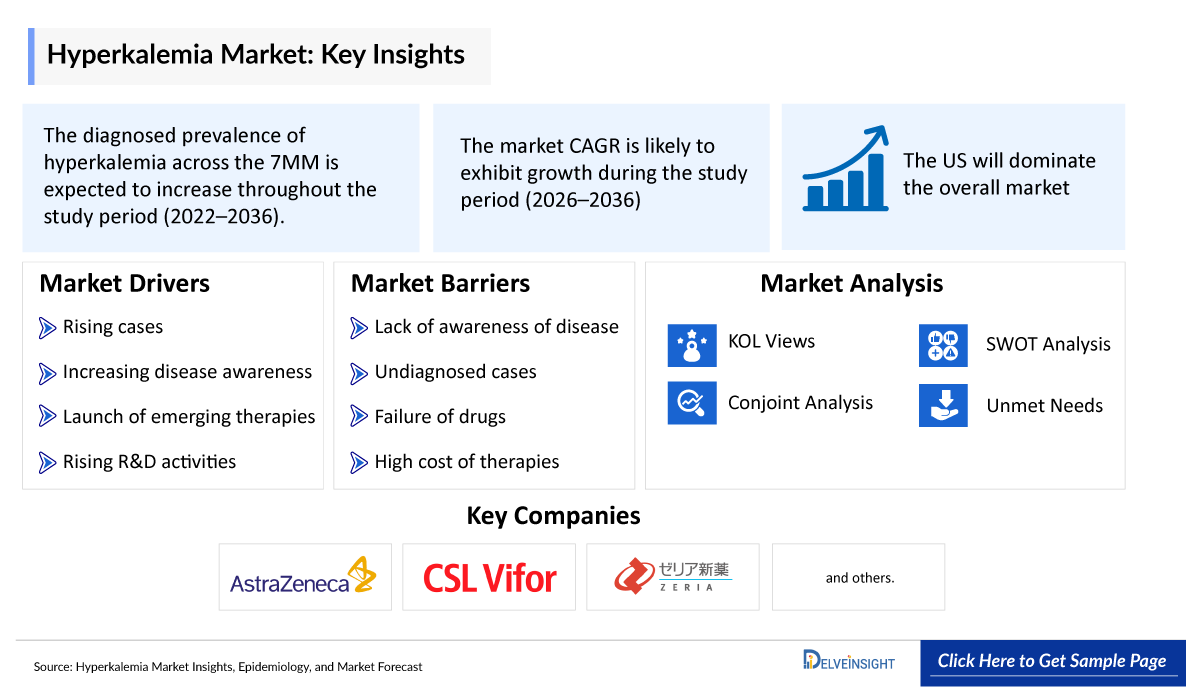
DelveInsight's ‘Hyperkalemia Market Insights, Epidemiology and Market Forecast – 2036’ report delivers an in-depth understanding of the Cervical Dysplasia, historical and forecasted epidemiology, as well as the Hyperkalemia market trends in the United States, EU4 (Germany, Spain, Italy, and France) and the United Kingdom, and Japan.
The Hyperkalemia market report delivers a comprehensive analysis of the current treatment landscape, including standards of care, clinical practices, and evolving therapeutic algorithms. It evaluates, Hyperkalemia patient burden trends, revenue & market share dynamics, peak patient share & therapy uptake analysis, and provides an in-depth market size assessment, and growth rate projections (Historical & Forecast 2022–2036) across global regions. The report highlights key unmet medical needs in Hyperkalemia and maps the competitive and clinical landscape to uncover high‑value opportunities, providing a clear outlook on future market growth potential.
|
Study Period |
2022–2036 |
|
Historical Year |
2022–2025 |
|
Forecast Period |
2026–2036 |
|
Base Year |
2026 |
|
Geographies Covered |
|
|
Hyperkalemia Market CAGR (Study period/Forecast period) |
XX% (2026–2036) |
|
Hyperkalemia Epidemiology Segmentation Analysis |
Patient Burden Assessment
|
|
Hyperkalemia Companies |
|
|
Hyperkalemia Therapies |
|
|
Hyperkalemia Market |
Segmented by
|
|
Analysis |
|
Key Factors Driving the Hyperkalemia Market
- Rising Hyperkalemia Prevalence
The increasing prevalence of Hyperkalemia, particularly among male, is a primary driver of hyperkalemia market expansion, supported by the growing burden of chronic kidney disease, heart failure, and diabetes, along with improved disease monitoring and greater utilization of potassium-lowering therapies.
- Rising Opportunities in Novel Hyperkalemia Management Approaches
Increasing understanding of potassium homeostasis, cardiorenal disease interactions, and the clinical impact of persistent hyperkalemia is driving the development of innovative approaches aimed at maintaining normokalemia, reducing complications, and improving outcomes in at-risk patient populations.
Recent Development
- In Aug 2026, Lupin received US FDA approval for its generic Sodium Zirconium Cyclosilicate for oral suspension. This formulation serves as a therapeutic equivalent to Lokelma, expanding patient access to effective treatments for hyperkalemia across the United States market.
Hyperkalemia Understanding and Treatment Algorithm
Hyperkalemia Overview and Diagnosis
Hyperkalemia is an electrolyte disorder characterized by elevated potassium levels in the blood, which can impair normal neuromuscular and cardiac function. It most commonly results from reduced renal potassium excretion, excessive potassium intake, or shifts of potassium from the intracellular to the extracellular space. Hyperkalemia is frequently associated with chronic kidney disease, heart failure, diabetes mellitus, and the use of medications such as renin–angiotensin–aldosterone system (RAAS) inhibitors and potassium-sparing diuretics. Severe hyperkalemia can lead to potentially life-threatening cardiac arrhythmias and requires timely diagnosis and treatment.
Hyperkalemia is diagnosed through clinical evaluation and laboratory assessment of elevated serum potassium levels. Diagnostic testing includes serum potassium measurement, electrolyte panels, renal function tests, and electrocardiography (ECG) to identify cardiac abnormalities associated with hyperkalemia. Additional investigations may be performed to determine the underlying cause, assess severity, and guide treatment decisions.
Note: Further details are provided in the report.
Hyperkalemia Treatment
The primary goals of hyperkalemia treatment are to lower elevated serum potassium levels, prevent cardiac complications, and maintain long-term potassium control. Management includes dietary modification, adjustment of contributing medications, potassium-binding agents, diuretics, and emergency interventions such as insulin with glucose or dialysis in severe cases. Commonly used therapies include sodium zirconium cyclosilicate (LOKELMA) and patiromer (VELTASSA). Regular monitoring of serum potassium levels and kidney function is essential for effective disease management and prevention of recurrence.
Note: Further details related to country-based variations are provided in the report.
Hyperkalemia Unmet Needs
The section “unmet needs of Hyperkalemia” outlines the critical gaps between the current state of patient care, diagnosis, and the ideal & effective management of the disease. It highlights the obstacles experienced by patients, clinicians, and researchers and identifies potential solutions for future progress.
- Need for faster and more effective potassium-lowering therapies
- Limited options for long-term potassium control
- Need to maintain RAAS inhibitor therapy without increasing hyperkalemia risk
- High recurrence rates in patients with CKD and heart failure, and others…..
Note: Comprehensive unmet needs insights and their strategic implications are provided in the full report.
Hyperkalemia Epidemiology
Key Findings from Hyperkalemia Epidemiological Analysis and Forecast
- The diagnosed prevalence of hyperkalemia across the 7MM is expected to increase throughout the study period (2022–2036).
- Among the 7MM, the United States has the highest diagnosed prevalent cases of Hyperkalemia in 2025.
- Among the EU4 & UK, Germany reported the highest diagnosed prevalent cases of Hyperkalemia in 2025, followed by UK. Spain was found to have the least cases in 2025 among all European countries.
- Based on age, diagnosed prevalent cases of hyperkalemia were categorized into 18–64 years, 65–79 years, and ≥80 years. According to DelveInsight estimates, the 18–64 years age group accounted for the largest number of diagnosed prevalent cases in 2025, primarily reflecting the larger population size of this age cohort.
- According to DelveInsight estimates, diagnosed prevalent cases of hyperkalemia associated with specific comorbidities were categorized into chronic kidney disease, heart failure, diabetes mellitus, and hypertension. In EU4 and the UK, hypertension accounted for the highest number of cases in 2025, while heart failure represented the smallest comorbidity-specific segment.
Hyperkalemia Drug Chapters & Competitive Analysis
The Hyperkalemia drug chapter provides a detailed, market-focused review of approved therapies and the emerging pipeline across Phase I–III clinical trials. It covers the mechanism of action, clinical trial data, regulatory approvals, patents, collaborations, and strategic partnerships for each therapy, along with their advantages, limitations, and recent developments. This section offers critical insights into the Hyperkalemia treatment landscape, supporting market assessment, competitive analysis, and growth forecasting for the Hyperkalemia therapeutics market.
Approved Therapies for Hyperkalemia
Sodium zirconium cyclosilicate (LOKELMA): AstraZeneca
Sodium zirconium cyclosilicate (LOKELMA), developed by AstraZeneca, is an insoluble, non-absorbed potassium-binding agent approved for the treatment of hyperkalemia. Administered orally as a powder for suspension, it selectively captures potassium ions in the gastrointestinal tract in exchange for sodium and hydrogen ions, thereby increasing fecal potassium excretion and reducing serum potassium levels. The therapy helps achieve and maintain normal potassium levels in patients with hyperkalemia. LOKELMA received its FDA approval in 2018 for the treatment of hyperkalemia in adults.
AstraZeneca's Lokelma received broader support for use within the NHS after becoming one of the first medicines evaluated under NICE's higher cost-effectiveness threshold, a decision expected to expand patient access and increase its adoption for the treatment of hyperkalemia.
Patiromer (VELTASSA): CSL Vifor/Zeria Pharmaceutical
Patiromer (VELTASSA) is an oral potassium-binding agent administered as a suspension that acts in the gastrointestinal tract, primarily in the colon, where it exchanges calcium for potassium to reduce elevated serum potassium levels and promote fecal excretion. It is indicated for the management of chronic hyperkalemia and supports continued use of RAAS inhibitor therapies at optimal doses. VELTASSA was first approved in the United States in 2015, followed by subsequent approvals in the European Union, United Kingdom, along with additional authorizations across multiple global markets, expanding its availability for patients with chronic kidney disease and heart failure–associated hyperkalemia. In terms of corporate developments, CSL Vifor continues to lead global commercialization following its acquisition by CSL in 2022, while Zeria Pharmaceutical oversees development and commercialization activities in Japan.
In September 2024, CSL Vifor announced that Japan’s MHLW approved Patiromer (VELTASSA) for adult hyperkalemia patients, bringing total approvals to 41 countries. Zeria Pharmaceutical holds exclusive rights in Japan and will commercialize the drug after National Health Insurance price listing.
|
Table 1: Competitive landscape of marketed therapies | ||||||
|
Drug/Therapy |
Company |
Indication |
Molecule Type |
RoA |
MoA |
Marketed Region |
|
Sodium zirconium cyclosilicate (LOKELMA) |
AstraZeneca |
Hyperkalemia |
Non-absorbed inorganic cation exchanger |
Oral (powder for suspension) |
Binds potassium in the gut and removes it via feces |
US: 2018 Europe: 2017 Japan: 2020 |
|
Patiromer (VELTASSA) |
CSL Vifor/Zeria Pharmaceutical |
Hyperkalemia |
Non-absorbed cation exchange polymer |
Oral (powder for suspension) |
Exchanges calcium for potassium in the colon to lower serum potassium |
US: 2015 Europe: 2017 Japan: 2024 |
Note: Detailed marketed therapies assessment will be provided in the final report.
Hyperkalemia Pipeline Analysis
The hyperkalemia pipeline remains sparse, with no notable emerging therapies currently in advanced clinical development. Limited pipeline activity reflects the relatively mature treatment landscape and reduced focus on novel drug innovation in this indication. Consequently, the near-term outlook for hyperkalemia is expected to remain largely unchanged, with minimal impact from pipeline-driven advancements over the forecast period.
Note: A detailed emerging therapies assessment will be provided in the final report
Hyperkalemia Key Players, Market Leaders and Emerging Companies
- AstraZeneca
- CSL Vifor
- Zeria Pharmaceutical, and others
Hyperkalemia Drug Updates
- In October 2025, AstraZeneca completed a USD 445 million expansion of its Coppell, Texas manufacturing facility, doubling production capacity for its hyperkalemia treatment, LOKELMA. The expansion included a new 9,000-square-foot building and two additional manufacturing lines at the product’s sole global production site. First approved in 2018, LOKELMA generated USD 542 million in sales in 2024, reflecting a 32% year-over-year increase.
- In March 2025, Zeria Pharmaceutical launched Patiromer (VELTASSA) in Japan, a once-daily oral powder for suspension in-licensed from CSL Vifor. The non-absorbed cation exchange polymer is used for the treatment of hyperkalemia by binding potassium in the gastrointestinal tract and promoting its excretion.
Drug Class Insights
Hyperkalemia Market Outlook
The hyperkalemia market is driven by the increasing prevalence of chronic kidney disease, heart failure, diabetes, and the growing use of RAAS inhibitors, all of which contribute to elevated potassium levels and the need for long-term potassium management. The current treatment landscape is supported by established therapies such as Sodium zirconium cyclosilicate (LOKELMA) and Patiromer (VELTASSA), which have improved the management of chronic hyperkalemia and enabled continued use of guideline-recommended cardiovascular and renal therapies.
Unlike many therapeutic areas, the hyperkalemia pipeline remains limited, with no notable emerging drugs in advanced stages of development. As a result, market growth is expected to be driven primarily by increasing diagnosis rates, broader adoption of existing therapies, improved disease monitoring, and expanding patient populations with chronic comorbidities rather than by the introduction of novel treatments.
Overall, the hyperkalemia market is expected to experience steady growth over the forecast period, supported by rising disease burden, greater awareness among healthcare providers, and ongoing efforts to optimize long-term potassium control in high-risk patient populations. While innovation in the pipeline remains minimal, continued expansion of existing therapies presents sustained commercial opportunities in this market. According to the estimates, the United States accounted for the largest share of the Hyperkalemia market among the major markets during the study period.
Note: Further details will be provided in the report….
Drug Class/Insights into Leading Emerging and Marketed Therapies in Hyperkalemia (2022–2036 Forecast)
The hyperkalemia treatment landscape primarily comprises potassium binders and acute potassium-lowering interventions, each designed to reduce elevated serum potassium levels through distinct mechanisms, thereby preventing life-threatening cardiac complications and enabling the continued use of essential therapies such as RAAS inhibitors.
- Potassium Binders: Therapies such as sodium zirconium cyclosilicate and patiromer act within the gastrointestinal tract to bind potassium ions and facilitate their removal through fecal excretion, effectively lowering serum potassium levels and supporting long-term potassium management.
- Rapid Potassium-Lowering Therapies: Acute interventions, including insulin with glucose, β2-adrenergic agonists, and sodium bicarbonate, promote the intracellular redistribution of potassium, providing rapid but temporary reductions in serum potassium levels during hyperkalemic emergencies.
Overall, potassium-binding agents remain the cornerstone of chronic hyperkalemia management, while acute redistribution therapies and potassium elimination strategies play critical roles in emergency treatment. Innovation in hyperkalemia remains limited, with minimal emerging pipeline activity and no significant novel mechanisms currently advancing through late-stage development.
Note: Further details will be provided in the report….
Hyperkalemia Drug Uptake
This section focuses on the uptake rate of potential drugs expected to be launched in the market during the forecast period (2026–2036). The analysis covers the Hyperkalemia market's uptake by drugs, patient uptake by therapy, and sales of each drug.
Note: Further detailed analysis of emerging therapies' drug uptake in the report…
Market Access and Reimbursement of Hyperkalemia
The report further provides detailed insights on the country-wise accessibility and reimbursement scenarios, cost-effectiveness scenario of approved therapies, programs making accessibility easier and out-of-pocket costs more affordable, insights on patients insured under federal or state government prescription drug programs, etc.
Reimbursement is a crucial factor that affects the drug’s access to the market. Often, the decision to reimburse comes down to the price of the drug relative to the benefit it produces in treated patients. To reduce the healthcare burden of these high-cost therapies, many payment models are being considered by payers and other industry insiders.
Note: Further details are provided in the final report….
Hyperkalemia Therapies Price Scenario & Trends
Pricing and analogue assessment of Hyperkalemia therapies highlights evolving price dynamics structures. This section summarizes the cost of approved treatments, closest and most appropriate analogue selection for emerging therapies, and understanding of how pricing influences market access, adherence, and long-term uptake.
Note: Further details are provided in the final report….
Industry Experts and Physician Views for Hyperkalemia
To keep up with Hyperkalemia market trends, we take Key Opinion Leaders (KOLs) and Subject Matter Experts (SMEs) opinions working in the domain through primary research to fill the data gaps and validate our secondary research. Industry experts were contacted for insights on the Hyperkalemia emerging therapies, evolving treatment landscape, patient adherence to conventional therapies, therapy switching trends, drug adoption and uptake, accessibility challenges, and epidemiology and real-world prescription patterns in Cervical Dysplasia, including MD, PhD, Instructor, Postdoctoral Researcher, Professor, Researcher, and others.
DelveInsight’s analysts connected with 10+ KOLs to gather insights; however, interviews were conducted with 6+ KOLs in the 7MM. Centers such as the University of Mississippi Medical Center, University of Bologna, and Teikyo University School of Medicine, etc. were contacted. Their opinion helps understand and validate current and emerging Hyperkalemia therapies, highlight unmet medical needs, provide epidemiological context, and support strategic decisions for market access, therapy adoption, and pipeline prioritization in Cervical Dysplasia.
|
Region |
Key Opinion Leaders (KOLs) and Subject Matter Experts (SMEs) |
|
United States |
“Hyperkalemia remains a common and potentially life-threatening complication in patients with chronic kidney disease and heart failure. Improving long-term potassium management may help optimize use of guideline-directed therapies and reduce adverse clinical outcomes.” |
|
Japan |
“Hyperkalemia continues to present a significant challenge, particularly in elderly patients with multiple comorbidities. Effective potassium control and routine monitoring are essential to support sustained treatment and improve patient management.” |
Qualitative Analysis: SWOT and Conjoint Analysis
We perform qualitative and market Intelligence analysis using various approaches, such as SWOT analysis and conjoint analysis.
In the SWOT analysis of Hyperkalemia, strengths, weaknesses, opportunities, and threats in terms of disease diagnosis, patient awareness, patient burden, competitive landscape, cost-effectiveness, and geographical accessibility of therapies are provided.
Conjoint analysis analyzes emerging therapies based on relevant attributes such as safety, efficacy, frequency of administration, route of administration, and order of entry. Scoring is given based on these parameters to analyze the effectiveness of therapy.
The team of analysts analyzes promising emerging therapies based on relevant attributes such as safety, efficacy, frequency of administration, route of administration, and order of entry. In efficacy, the trial’s primary and secondary outcome measures are evaluated, whereas the therapies’ safety is evaluated, wherein the acceptability, tolerability, and adverse events are majorly observed. In addition, the scoring is also based on the route of administration, order of entry, probability of success, and the addressable patient pool for each therapy. According to these parameters, the final weightage score and the ranking of the emerging therapies are decided.
Scope of the Report
- The report covers a segment of key events, an executive summary, a descriptive overview of Hyperkalemia, explaining its causes, signs and symptoms, pathogenesis, and currently available treatments.
- Comprehensive insight has been provided into the epidemiology segments and forecasts, the future growth potential of the diagnosis rate, and disease progression along treatment guidelines.
- Additionally, an all-inclusive account of both the current and emerging treatments, along with the elaborative profiles of late-stage and prominent therapies, will have an impact on the current treatment landscape.
- A detailed review of the Hyperkalemia market, historical and forecasted market size, market share by therapies, detailed assumptions, and rationale behind our approach is included in the report, covering the 7MM drug outreach.
- The report provides an edge while developing business strategies by understanding trends through SWOT analysis and expert insights/KOL views, patient journey, and treatment preferences that help in shaping and driving the 7MM Hyperkalemia market.
Report Insights
- Hyperkalemia Patient Population Forecast
- Hyperkalemia Therapeutics Market Size
- Hyperkalemia Pipeline Analysis
- Hyperkalemia Market Size and Trends
- Hyperkalemia Market Opportunity (Current and forecasted)
Report Key Strengths
- Epidemiology‑based (Epi‑based) Bottom‑up Forecasting
- Artificial Intelligence (AI)-enabled Market Research Report
- 11-year Forecast
- Hyperkalemia Market Outlook (North America, Europe, Asia-Pacific)
- Patient Burden Trends (by geography)
- Hyperkalemia Treatment Addressable Market (TAM)
- Hyperkalemia Competitive Landscape
- Hyperkalemia Major Companies Insights
- Hyperkalemia Price Trends and Analogue Assessment
- Hyperkalemia Therapies Drug Adoption/Uptake
- Hyperkalemia Therapies Peak Patient Share analysis
Report Assessment
- Hyperkalemia Current Treatment Practices
- Hyperkalemia Unmet Needs
- Hyperkalemia Clinical Development Analysis
- Hyperkalemia Emerging Drugs Product Profiles
- Hyperkalemia Market Attractiveness
- Hyperkalemia Qualitative Analysis (SWOT and Conjoint Analysis)
FAQs
Market Insights
- What was the Hyperkalemia market size, the market size by therapies, market share (%) distribution in 2025, and what would it look like by 2036? What are the contributing factors for this growth?
- What are the anticipated pricing variations among different geographies for the emerging therapies in the future?
- What can be the future treatment paradigm of Hyperkalemia?
- What are the disease risks, burdens, and unmet needs of Hyperkalemia?
- What will be the growth opportunities across the 7MM concerning the patient population with Hyperkalemia?
- Who is the major future competitor in the market, and how will the competitors affect their market share?
- What are the current options for the treatment of Hyperkalemia? What are the current guidelines for treating Hyperkalemia in the US, Europe, and Japan?
Reasons to Buy
- The report will help in developing business strategies by understanding the latest trends and changing treatment dynamics driving the Hyperkalemia market.
- Bottom-up forecasting builds from the affected population to product forecasts, delivering a robust, data-driven approach ideal for new therapies and novel classes.
- Insights on patient burden/disease incidence, evolution in diagnosis, and factors contributing to the change in the epidemiology of the disease during the forecast years.
- Understand the existing market opportunities in varying geographies and the growth potential over the coming years.
- Identifying strong upcoming players in the market will help devise strategies to help get ahead of competitors.
- Detailed analysis and ranking of class-wise potential current and emerging therapies under the conjoint analysis section to provide visibility around leading classes.
- To understand KOLs’ perspectives on the accessibility, acceptability, and compliance-related challenges of existing treatment to overcome barriers in the future.
- Detailed insights on the unmet needs of the existing market so that the upcoming players can strengthen their development and launch strategy.
- This Artificial Intelligence (AI) - enabled report summarize and simplify complex datasets within the report into clear, actionable insights for stakeholders, investors, and healthcare providers, enabling faster, data-driven decisions.