IBI-363 Market Summary
Key Factors Driving IBI-363 Growth
1. Strong early efficacy in first-line NSCLC (key clinical driver)
Recent PoC data in first-line NSCLC showed exceptionally high response rates:
- ORR up to 86.4% (cORR 81.8%) in PD-L1–low/negative patients
- Disease control rate 100% in the best-performing dose cohort
- Evaluated in combination with chemotherapy in treatment-naïve patients
2. First-in-class PD-1 + IL-2 “dual biology” mechanism
IBI-363 uniquely combines:
- PD-1 blockade (checkpoint release)
- IL-2α-biased stimulation (T-cell expansion)
Mechanistically:
- Expands effector CD8+ T cells
- Reduces exhaustion
- Enhances tumor infiltration
Published ASCO/JCO abstracts describe it as a cis-acting immune activation system that selectively amplifies tumor-specific T cells.
3. Activity independent of PD-L1 expression (large patient expansion potential)
A major limitation of PD-1 inhibitors is reduced efficacy in:
- PD-L1–low tumors
- “cold” tumor microenvironments
IBI-363 has demonstrated:
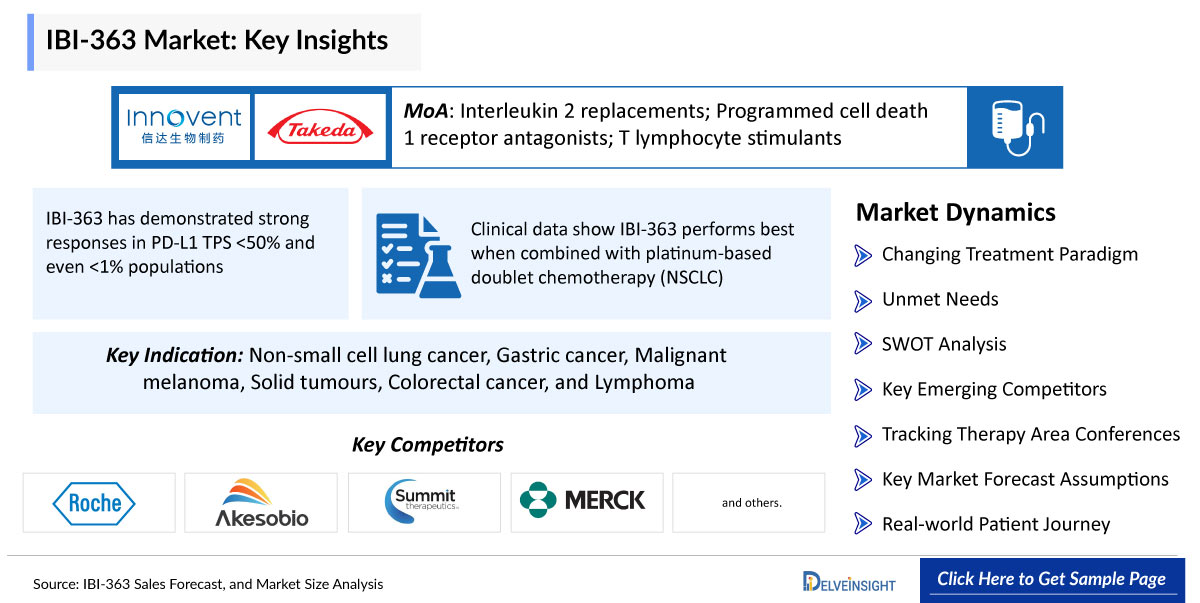
- Strong responses in PD-L1 TPS <50% and even <1% populations
- Activity regardless of histology in NSCLC cohorts
➡️ This expands eligibility far beyond checkpoint inhibitor-responsive patients.
4. Synergy with chemotherapy and combination regimens
Clinical data show IBI-363 performs best when combined with:
- Platinum-based doublet chemotherapy (NSCLC)
- Potential future combinations in CRC and other solid tumors
Chemotherapy helps by:
- Increasing antigen release
- Enhancing immune priming
➡️ Growth driver: combination backbone potential in first-line oncology
5. Expansion into multiple tumor types with breakthrough designations
Beyond NSCLC, IBI-363 is advancing in:
- Microsatellite-stable colorectal cancer (MSS/pMMR CRC)
- Other solid tumors under early development
It has also received multiple Breakthrough Therapy Designations in China for MSS CRC in combination regimens (Innovent press releases, 2026).
➡️ Growth driver: multi-indication regulatory acceleration strategy
IBI-363 Recent Developments
In October 2025, Takeda entered into a license and collaboration agreement with Innovent Biologics for the development, manufacturing and commercialization of two late-stage oncology medicines, IBI363 and IBI343, worldwide outside of Greater China. IBI363 is being evaluated in non-small cell lung and colorectal cancers and has shown potential efficacy in additional solid tumor types. IBI343 is being evaluated in gastric and pancreatic cancers. Takeda will also receive an exclusive option to license global rights outside of Greater China for IBI3001, an early-stage investigational medicine.
“IBI-363 Sales Forecast, and Market Size Analysis – 2034” report provides comprehensive insights of IBI-363 for potential indication like Non-small cell lung cancer, Gastric cancer, Malignant melanoma, Solid tumours, Colorectal cancer, and Lymphoma in the 7MM. A detailed picture of IBI-363’s existing usage in anticipated entry and performance in potential indications in the 7MM, i.e., the United States, EU4 (Germany, France, Italy, and Spain) and the United Kingdom, and Japan for the study period 2020 –2034 is provided in this report along with a detailed description of the IBI-363 for potential indications. The IBI-363 market report provides insights about IBI-363’s sales forecast, mechanism of action (MoA), dosage and administration, as well as research and development including regulatory milestones, along with other developmental activities. Further, it also consists of historical and current IBI-363 performance, future market assessments inclusive of the IBI-363 market forecast analysis for potential indications in the 7MM, SWOT, analysts’ views, comprehensive overview of market competitors, and brief about other emerging therapies in respective indications. It also provides analysis of IBI-363 sales forecasts, along with factors driving its market.
IBI-363 Drug Summary
IBI-363 is an investigational bispecific immunotherapy designed to simultaneously block the PD-1 immune checkpoint and selectively deliver IL-2 signaling to tumor-infiltrating T cells, thereby enhancing anti-tumor immune activation while reducing systemic toxicity associated with conventional IL-2 therapy. By combining PD-1 blockade with a tumor-localized IL-2 pathway agonist, IBI-363 aims to reinvigorate exhausted T cells and promote expansion of cytotoxic CD8+ T cells within the tumor microenvironment, improving immune-mediated tumor clearance. This dual mechanism is intended to overcome resistance seen with checkpoint inhibitors alone, particularly in “cold” or immunosuppressive tumors that lack sufficient T-cell infiltration. Administered via intravenous infusion in clinical trial settings, it is currently in early-stage clinical development for multiple solid tumor indications and remains unapproved, with ongoing studies evaluating its safety, pharmacokinetics, and preliminary efficacy signals. The report provides IBI-363’s sales, growth barriers and drivers, post usage and approvals in multiple indications.
Scope of the IBI-363 Market Report
The report provides insights into:
- A comprehensive product overview including the IBI-363 MoA, description, dosage and administration, research and development activities in potential indication like Non-small cell lung cancer, Gastric cancer, Malignant melanoma, Solid tumours, Colorectal cancer, and Lymphoma.
- Elaborated details on IBI-363 regulatory milestones and other development activities have been provided in IBI-363 market report.
- The report also highlights IBI-363‘s cost estimates and regional variations, reported and estimated sales performance, research and development activities in potential indications across the United States, Europe, and Japan.
- The IBI-363 market report also covers the patents information, generic entry and impact on cost cut.
- The IBI-363 market report contains current and forecasted IBI-363 sales for potential indications till 2034.
- Comprehensive coverage of the late-stage emerging therapies for respective indications.
- The IBI-363 market report also features the SWOT analysis with analyst views for IBI-363 in potential indications.
Methodology
The IBI-363 market report is built using data and information sourced primarily from internal databases, primary and secondary research and in-house analysis by DelveInsight’s team of industry experts. Information and data from the secondary sources have been obtained from various printable and nonprintable sources like search engines, news websites, global regulatory authorities websites, trade journals, white papers, magazines, books, trade associations, industry associations, industry portals and access to available databases.
IBI-363 Analytical Perspective by DelveInsight
- In-depth IBI-363 Market Assessment
This IBI-363 sales market forecast report provides a detailed market assessment of IBI-363 for potential indication like Non-small cell lung cancer, Gastric cancer, Malignant melanoma, Solid tumours, Colorectal cancer, and Lymphoma in the seven major markets, i.e., the United States, EU4 (Germany, France, Italy, and Spain) and the United Kingdom, and Japan. This segment of the report provides current and forecasted IBI-363 sales data uptil 2034.
- IBI-363 Clinical Assessment
The IBI-363 market report provides the clinical trials information of IBI-363 for potential indications covering trial interventions, trial conditions, trial status, start and completion dates.
IBI-363 Competitive Landscape
The report provides Insights on competitors and marketed products within the domain, along with a summary of emerging products and their respective launch dates, posing significant competition in the market.
IBI-363 Market Potential & Revenue Forecast
- Projected market size for the IBI-363 and its key indications
- Estimated IBI-363 sales potential (IBI-363 peak sales forecasts)
- IBI-363 Pricing strategies and reimbursement landscape
IBI-363 Competitive Intelligence
- Number of competing drugs in development (pipeline analysis)
- IBI-363 Market positioning compared to existing treatments
- IBI-363 Strengths & weaknesses relative to competitors
IBI-363 Regulatory & Commercial Milestones
- IBI-363 Key regulatory approvals & expected launch timelines
- Commercial partnerships, licensing deals, and M&A activity
IBI-363 Clinical Differentiation
- IBI-363 Efficacy & safety advantages over existing drugs
- IBI-363 Unique selling points
IBI-363 Market Report Highlights
- In the coming years, the IBI-363 market scenario is set to change due to strong adoption, increased prescriptions and broader uptake in multiple immunological indications; which would expand the size of the market.
- The IBI-363 companies are developing therapies that focus on novel approaches to treat/improve the disease condition, assess challenges, and seek opportunities that could influence IBI-363’s dominance.
- Other emerging products for Non-small cell lung cancer, Gastric cancer, Malignant melanoma, Solid tumours, Colorectal cancer, and Lymphoma are expected to give tough market competition to IBI-363 and launch of late-stage emerging therapies in the near future will significantly impact the market.
- A detailed description of regulatory milestones, and developmental activities, provide the current development scenario of IBI-363 in potential indications.
- Analyse IBI-363 cost, pricing trends and market positioning to support strategic decision-making in the immunology landscape.
- Our in-depth analysis of the forecasted IBI-363 sales data uptil 2034 will support the clients in decision-making process regarding their therapeutic portfolio by identifying the overall scenario of IBI-363 in potential indications.
Key Questions
- What is the class of therapy, route of administration and mechanism of action of IBI-363? How strong is IBI-363’s clinical and commercial performance?
- What is IBI-363’s clinical trial status in each individual indications such as Non-small cell lung cancer, Gastric cancer, Malignant melanoma, Solid tumours, Colorectal cancer, and Lymphoma and study completion date?
- What are the key collaborations, mergers and acquisitions, licensing and other activities related to the IBI-363 Manufacturers?
- What are the key designations that have been granted to IBI-363 for potential indications? How are they going to impact IBI-363’s penetration in various geographies?
- What is the current and forecasted IBI-363 market scenario for potential indications? What are the key assumptions behind the forecast?
- What are the current and forecasted sales of IBI-363 in the seven major countries, including the United States, Europe (Germany, France, Italy, Spain) and the United Kingdom, and Japan?
- What are the other emerging products available and how are these giving competition to IBI-363 for potential indications?
- Which are the late-stage emerging therapies under development for the treatment of potential indications?
- How cost-effective is IBI-363? What is the duration of therapy and what are the geographical variations in cost per patient?

