Inflammatory Myositis (IM) Market
- In 2023, the market for inflammatory myositis in the US stood out prominently among the seven major markets (7MM), reaching an impressive USD 301 million. This significant figure not only underscores the current robust demand but also highlights the substantial growth potential within this sector. As the understanding and management of inflammatory myositis evolve, the market is poised for continued expansion, with projections indicating a steady increase in market size through 2034.
- Some of the products that are likely to hit the market during the study period 2020–2034 include PF-06823859, Brepocitinib and others.
- The market for therapeutics targeting Inflammatory Myositis is projected to experience robust growth, with an anticipated compound annual growth rate (CAGR) of approximately 11.7% in the 7MM. This dynamic expansion reflects increasing demand for advanced treatment options and underscores the growing investment in addressing this serious condition.
- In June 2024, Cabaletta Pharmaceuticals unveiled promising initial clinical data from the first patient in the immune-mediated necrotizing myopathy (IMNM) cohort of their groundbreaking Phase I/II RESET-Myositis trial, showcasing three months of follow-up results. These compelling findings were highlighted at a prestigious satellite symposium during the EULAR 2024 Congress, underscoring the potential of Cabaletta's innovative approach. Patient enrollment for the RESET-Myositis trial is actively progressing, with further detailed clinical data anticipated in the latter half of 2024. This ongoing research not only represents a significant milestone in the fight against IMNM but also positions Cabaletta at the forefront of developing transformative therapies for this challenging condition.
The market for inflammatory myositis is influenced by several key factors, including the rising incidence of autoimmune diseases and increasing awareness of inflammatory muscle disorders. Advances in immunology and improvements in diagnostic techniques are contributing to market growth, as more cases of inflammatory myositis are identified and treated. Furthermore, growing investments in research and development for autoimmune conditions are driving innovation in this space. However, challenges such as the complexity of diagnosing IM, limited availability of targeted therapies, and high costs associated with advanced treatments pose significant hurdles. Additionally, the considerable unmet need for effective and personalized treatments highlights a crucial gap in the current therapeutic landscape, offering a valuable opportunity for companies to develop innovative solutions and better address the diverse needs of patients with inflammatory myositis.
DelveInsight's “Inflammatory myositis Market Insights, Epidemiology and Market Forecast– 2034” report delivers an in-depth understanding of the Inflammatory myositis, historical and forecasted epidemiology as well as the Inflammatory myositis therapeutics market trends in the United States, EU4 (Germany, Spain, Italy, and France), the United Kingdom, and Japan.
Inflammatory myositis market report provides current treatment practices, emerging drug, market size and market share of the individual therapies, current and forecasted 7MM from 2020 to 2034. The report also covers current inflammatory myositis treatment practices/algorithms and unmet medical needs to curate the best of the opportunities and assesses the underlying potential of the market.
|
Study Period |
2020 to 2034 |
|
Forecast Period |
2024-2034 |
|
Geographies Covered |
|
|
Inflammatory Myositis Market |
|
|
Inflammatory Myositiss Market Size | |
|
Inflammatory Myositis Companies |
CSL Behring, Immunoforge Co. Ltd., Argenx, Janssen, Abcuro, Inc., Horizon Therapeutics, Merck KGaA, Galapagos NV, Priovant Therapeutics, Roivant, Alexion Pharmaceuticals, Pfizer, Kezar Life Sciences, and others. |
|
Inflammatory Myositis Epidemiology Segmentation |
|
Inflammatory Myositis Treatment Market
The term myositis refers to a condition where there is inflammation of muscle. In practice, myositis tends to be associated with the inflammatory myopathies: polymyositis, dermatomyositis, myositis associated with cancer, juvenile dermatomyositis, overlap myositis, and inclusion body myositis (IBM). In contrast, myopathy refers to any abnormal condition or disease of muscle and, by definition, includes myositis.
Myositis is a rare condition that can affect multiple organs apart from muscles and often leads to severe impairment of the quality of life. According to the American College of Rheumatology, inflammatory myopathies are muscle diseases caused by inflammation. Myopathy is a general term used to describe several conditions affecting the muscles. They are autoimmune diseases where the body’s immune system mistakenly attacks its muscles. The most common inflammatory myopathies are dermatomyositis and polymyositis.
Inflammatory Myositis Diagnosis
Diagnosing myopathies involves a laboratory evaluation, imaging studies, multidisciplinary consultations, histologic examination, and potentially genetic studies. To properly diagnose the patient with muscle weakness, testing should include a thorough history and physical examination, routine laboratory tests (complete blood count, complete metabolic panel, muscle enzymes, thyroid-stimulating hormone, and other targeted studies as necessary), autoimmune serologies, imaging studies, neurologic evaluation, EMG, nerve conduction velocities and muscle biopsy. The history and physical examination allow the patient to describe the onset of the disease.
Further details related to country-based variations are provided in the report
Inflammatory Myositis Treatment
The treatment landscape for inflammatory myositis (including dermatomyositis, polymyositis, and inclusion body myositis) involves a combination of medications and supportive therapies. The specific treatment approach may vary depending on the individual’s symptoms, disease severity, and response to previous treatments. Some common treatment options are:
Corticosteroids: High-dose corticosteroids, such as prednisone, are often the first-line treatment for inflammatory myositis. They help reduce inflammation and suppress the immune response. The dosage is typically gradually reduced to find the lowest effective dose.
Immunosuppressants: Immunosuppressant medications may be added if corticosteroids are insufficient or long-term corticosteroid use is not desirable. Examples include methotrexate, azathioprine, mycophenolate mofetil, and cyclosporine. These drugs work by suppressing the immune system and reducing inflammation.
Biologic agents: In some cases, biologic agents may be used for more severe or refractory cases of inflammatory myositis. Rituximab, for example, targets specific immune cells involved in the disease process. Other biologics, such as tocilizumab or abatacept, may also be considered in certain cases.
Intravenous immunoglobulin (IVIG): IVIG is a treatment option for some individuals with dermatomyositis or polymyositis who do not respond to other therapies. It involves infusions of immunoglobulin to modulate the immune system.
It is important to note that the inclusion body myositis (IBM) treatment is particularly challenging, as it is generally less responsive to immunosuppressive therapies. Currently, no specific treatment can stop or reverse the progression of IBM; however, supportive therapies, physical therapy, and management of symptoms can help improve quality of life.
A high unmet need prevails in the current therapies for treating inflammatory myositis as current treatment approaches for inflammatory myositis typically involve immunosuppressive medications such as corticosteroids and disease-modifying antirheumatic drugs (DMARDs). However, these therapies are not always effective for all patients, and some individuals may experience inadequate response or significant side effects.
To cater to their needs, many molecules are in the pipeline to treat inflammatory myositis patients across the 7MM. Some major products are anticipated to hit the market during 2020–2034, including PF-06823859, Brepocitinib and others.
Inflammatory myositis Epidemiology
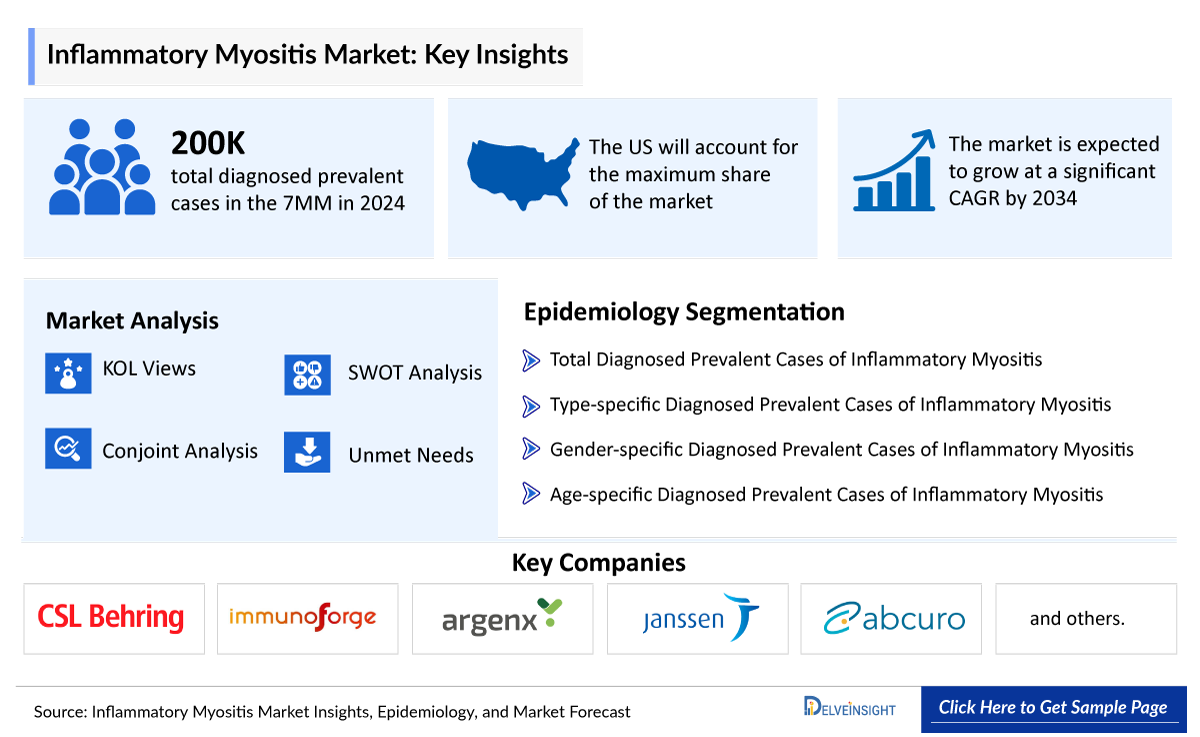
As the market is derived using a patient-based model, the Inflammatory myositis epidemiology chapter in the report provides historical as well as forecasted epidemiology segmented by Total Diagnosed Prevalent Cases of Inflammatory Myositis, Type-specific Diagnosed Prevalent Cases of Inflammatory Myositis, Gender-specific Diagnosed Prevalent Cases of Inflammatory Myositis, and Age-specific Diagnosed Prevalent Cases of Inflammatory Myositis in the 7MM covering, the United States, EU4 countries (Germany, France, Italy, and Spain), the United Kingdom, and Japan from 2020 to 2034.
- There were 188 thousand diagnosed prevalent cases of inflammatory myositis estimated to have occurred in the 7MM in 2023 of which 92 thousand of the accounted cases were estimated to be from the US alone and these cases are anticipated to increase during forecasted period.
- The diagnosed prevalent cases were further divided into type specific cases. The type-specific diagnosed prevalent cases of inflammatory myositis were further categorized into PM, DM, and IBM with 76 thousand, 84 thousand, and 27 thousand cases respectively in the 7MM in 2023 which will further increase in 2034.
- The age specific cases of inflammatory myositis was divided into 0–17 years, 18–44 years, 45–64 years, 65 years, and above, respectively with 3 thousand, 12 thousand, 25 thousand, and 29 thousand cases in the EU4 and the UK in 2023.
- The gender-specific diagnosed prevalent cases were further divided into males and females with 10 thousand and 15 thousand cases, respectively, in Japan in 2023.
Inflammatory myositis Drug Chapters
The drug chapter segment of the inflammatory myositis report encloses a detailed analysis of Inflammatory Myositis late-stage and mid-stage (Phase-III and Phase-II) pipeline drug. It also helps to understand the Inflammatory myositis clinical trial details, expressive pharmacological action, agreements and collaborations, approval and patent details, advantages and disadvantages of each included drug, and the latest news and press releases.
Inflammatory Myositis Emerging Drugs
Dazukibart (PF-06823859): Pfizer
Dazukibart (PF-06823859), an advanced investigational monoclonal antibody developed by Pfizer, is specifically engineered to target and modulate key immune system components involved in autoimmune diseases. This novel therapeutic approach is currently under evaluation for its efficacy in treating patients with inflammatory myositis, a severe and challenging autoimmune condition. These patients often present with elevated levels of pathogenic immunoglobulin G (IgG) autoantibodies, highlighting the urgent need for new and effective treatment options. PF-06823859 represents a pioneering step in addressing the unmet medical needs of this patient population, offering potential new hope where traditional therapies have proven inadequate.
Dazukibart has been granted Orphan Drug Designation (ODD) by both the US FDA and EMA, as well as Fast Track Designation (FTD) by the FDA and PRIME status by the EMA, for the treatment of Dermatomyositis and Polymyositis.
Detailed emerging therapies list will be provided in the final report...
Inflammatory myositis Market Outlook
The treatment landscape for inflammatory myositis has evolved over the years. Current treatment approaches involve a combination of immunosuppressive medications, such as corticosteroids and disease-modifying anti-rheumatic drugs (DMARDs) i.e. immunosuppressive agents, biologic agents, physical therapy, and supportive measures. However, there is still an unmet need for more effective and targeted therapies with fewer side effects. The development of novel treatments, including biologics and small molecule inhibitors, could significantly impact the market outlook by offering new options for patients.
The effectiveness and safety of intravenous immunoglobulin (IVIg) as the initial treatment for patients diagnosed with idiopathic inflammatory myopathy. First-line IVIg monotherapy demonstrated effectiveness in approximately 50% of patients with inflammatory myopathies. In most cases, treatment response was achieved within three weeks of initiating IVIg therapy among those who responded positively. If treatment with corticosteroids, immunosuppressive agents, and IVIG fails to alleviate symptoms, IV cyclophosphamide can be considered as a fourth-line treatment. However, it is associated with potential severe side effects and is typically reserved for patients with severe refractory disease, such as profound muscle weakness, swallowing difficulties, and interstitial lung disease. Treatment plans may vary depending on the individual's specific condition, disease severity, response to treatment, and the expertise of the treating physician.
In light of the above, some developmental initiatives have been taken toward the management of Inflammatory Myositis. The condition may evolve as some interesting therapies are heading down the pipeline. This would encourage reimbursement scenarios, doctors’ adoption, and patient compliance. Some companies have initiated clinical trials investigating new treatment options, including PF-06823859 (Pfizer), Brepocitinib, and others as the potential therapies lined up for forecast in the 7MM in the DelveInsight therapeutics market model.
- The total market size of Inflammatory myositis in the 7MM is approximately USD 589 million in 2023 and is projected to increase during the forecast period (2024–2034)
- The market size in the 7MM will increase at a CAGR of about 11.7% due to increasing awareness of the disease and launch of the emerging drugs.
- Among EU countries, Germany and Italy accounted for the maximum market size of USD 69 and USD 47 million in 2023 while Spain occupied the bottom of the ladder in the same year with USD 21 million in 2023.
- Japan accounts for market size of USD 72 million in 2023, but these dynamics are expected to change in the forecasted years.
Inflammatory myositis Drug Uptake
This section focuses on the rate of uptake of the potential drug expected to get launched in the market during the study period 2020–2034. For example, we estimate that PF-06823859 is anticipated to launch in the year 2027 in the US, respectively.
Further detailed analysis of emerging therapies drug uptake in the report…
Inflammatory myositis Pipeline Development Activities
The report provides insights into Inflammatory myositis clinical trials within Phase III, Phase II, and Phase I stage. It also analyzes key players involved in developing targeted therapeutics.
Pipeline Development Activities
The report covers detailed information on collaborations, acquisition and merger, licensing, and patent details for Inflammatory Myositis emerging therapies.
KOL- Views
To keep up with current market trends, we take KOLs and SMEs' opinions working in the domain through primary research to fill the data gaps and validate our secondary research. Industry Experts contacted for insights on Inflammatory myositis evolving treatment landscape, patient reliance on conventional therapies, patient’s therapy switching acceptability, drug uptake along with challenges related to accessibility, include the Division of Rheumatology at the University of California in Irvine, USA; Division of Medicine, Georgetown University Medical School, USA; Department of Medical Biotechnology, Berlin, Germany; University Paris-Saclay, France; Centre for Biomedical Investigation Network, Barcelona, Spain; Graduate School of Medicine, Chiba University, Japan, and Others.
DelveInsight’s analysts connected with 50+ KOLs to gather insights, however, interviews were conducted with 15+ KOLs in the 7MM. Centers such as the Department of Rheumatology, Department of Immunology, etc. were contacted. Their opinion helps to understand and validate current and emerging therapies and treatment patterns or Inflammatory Myositis market trends. This will support the clients in potential upcoming novel treatments by identifying the overall scenario of the market and the unmet needs.
Qualitative Analysis
We perform Qualitative and market Intelligence analysis using various approaches, such as SWOT analysis, and Conjoint Analysis. In the SWOT analysis, strengths, weaknesses, opportunities, and threats in terms of disease diagnosis, patient awareness, patient burden, competitive landscape, cost-effectiveness, and geographical accessibility of therapies are provided. These pointers are based on the Analyst’s discretion and assessment of the patient burden, cost analysis, and existing and evolving treatment landscape.
Conjoint Analysis is done to analyze multiple approved and emerging therapies based on relevant attributes such as safety, efficacy, frequency of administration, route of administration, and order of entry. Scoring is given based on these parameters to analyze the effectiveness of therapy. In efficacy, the trial’s primary and secondary outcome measures are evaluated.
Further, the safety of the drug is evaluated wherein the acceptability, tolerability, and adverse events are majorly observed, and it sets a clear understanding of the side effects posed by the drug in the trials. In addition, the scoring is also based on the route of administration, order of entry and designation, probability of success, and the addressable patient pool for each therapy. According to these parameters, the final weightage score and the ranking of the emerging therapies are decided.
Market Access and Reimbursement
The report further provides detailed insights on the country-wise accessibility and reimbursement scenarios, cost-effectiveness scenario of approved therapies, programs making accessibility easier and out-of-pocket costs more affordable, insights on patients insured under federal or state government prescription drug programs, etc.
Scope of the Inflammatory Myositis Market Report
- The report covers a segment of key events, an executive summary, descriptive overview of inflammatory myositis, explaining its causes, signs and symptoms, pathogenesis, and currently available therapies.
- Comprehensive insight has been provided into the epidemiology segments and forecasts, the future growth potential of diagnosis rate, disease progression along with treatment guidelines.
- Additionally, an all-inclusive account of both the current and emerging therapies along with the elaborative profiles of late-stage and prominent therapies will have an impact on the current treatment landscape.
- A detailed review of the inflammatory myositis market; historical and forecasted market size, market share by therapies, detailed assumptions, and rationale behind our approach is included in the report, covering the 7MM drug outreach.
- The report provides an edge while developing business strategies, by understanding trends, through SWOT analysis and expert insights/KOL views, patient journey, and treatment preferences that help in shaping and driving the 7MM Inflammatory myositis market.
Inflammatory myositis Report Insights
- Inflammatory myositis Patient Population
- Inflammatory myositis Therapeutic Approaches
- Inflammatory myositis Pipeline Analysis
- Inflammatory Myositis Market Size and Trends
- Existing and future Market Opportunity
Inflammatory myositis Report Key Strengths
- 11 Years Forecast
- 7MM Coverage
- Inflammatory myositis Epidemiology Segmentation
- Key Cross Competition
- Conjoint Analysis
- Inflammatory myositis Drug Uptake
- Key Inflammatory myositis Market Forecast Assumptions
Inflammatory myositis Report Assessment
- Current Inflammatory myositis Treatment Practices
- Inflammatory myositis Unmet Needs
- Inflammatory myositis Pipeline Product Profiles
- Inflammatory myositis Market Attractiveness
- Qualitative Analysis (SWOT and Conjoint Analysis)
- Inflammatory myositis Market Drivers
- Inflammatory myositis Market Barriers
Key Questions Answered In The Inflammatory Myositis Market Report:
Inflammatory Myositis Market Insights:
- What was the inflammatory myositis total market size, the market size by therapies, and market share (%) distribution in 2020, and how it would all look in 2034? What are the contributing factors for this growth?
- Will the coverage of drug depend on their efficacy in inflammatory myositis?
- What will be the impact on the market with the launch of emerging drug?
- How much market will be captured by PF-06823859, and Brepocitinib after their launch?
- Which drug is going to be the largest contributor to the market in 2034?
- What are the pricing variations among different geographies for approved and off-label therapies?
- How would the market drivers, barriers, and future opportunities affect the market dynamics and subsequent analysis of the associated trends?
Inflammatory Myositis Epidemiology Insights:
- What are the disease risk, burdens, and unmet needs of inflammatory myositis? What will be the growth opportunities across the 7MM with respect to the patient population pertaining to inflammatory myositis?
- What is the historical and forecasted Inflammatory myositis patient pool in the United States, EU4 (Germany, France, Italy, and Spain) the United Kingdom, and Japan?
- How many patients are of PM, DM, and IBM of inflammatory myositis?
- Age specific cases of inflammatory myositis?
- What factors are affecting the increase in the diagnosis of inflammatory myositis?
Current Inflammatory Myositis Treatment Scenario, Marketed Drug, and Emerging Therapies:
- What are the current options for the standard of care of inflammatory myositis? What are the current treatment guidelines for the treatment of Inflammatory myositis in the US and Europe?
- How many companies are developing therapies for the treatment of inflammatory myositis?
- How many emerging therapies are in the mid-stage and late stage of development for the treatment of inflammatory myositis?
- What are the recent novel therapies, targets, mechanisms of action, and technologies developed to overcome the limitation of existing therapies?
- What are the patents of emerging therapies for inflammatory myositis?
- What will be the impact on the market after the expected patent expiry of the emerging drug?
- What is the cost burden of marketed therapies on patients?
- Patient acceptability in terms of preferred treatment options as per real-world scenarios?
- What are the country-specific accessibility issues of recommended therapies? Focus on reimbursement policies.
- What are the 7MM historical and forecasted market of inflammatory myositis?
Reasons to buy Inflammatory Myositis Market Forecast Report
The report will help in developing business strategies by understanding the latest trends and changing treatment dynamics driving the Inflammatory myositis Market
- Insights on patient burden/disease prevalence, evolution in diagnosis, and factors contributing to the change in the epidemiology of the disease during the forecast years
- To understand the existing market opportunity in varying geographies and the growth potential over the coming years.
- Distribution of historical and current patient share based on real-world prescription data along with reported sales of approved products in the US, EU4 (Germany, France, Italy, and Spain), the United Kingdom, and Japan.
- Identification of strong upcoming players in the market will help in devising strategies that will help in getting ahead of competitors.
- Detailed analysis and potential of current and emerging therapies under the conjoint analysis section to provide visibility around leading emerging drug.
- Highlights of Access and Reimbursement policies of approved therapies, barriers to accessibility of off-label expensive therapies, and patient assistance programs
- To understand the perspective of Key Opinion Leaders around the accessibility, acceptability, and compliance-related challenges of existing treatment to overcome barriers in future.
- Detailed insights on the unmet need of the existing market so that the upcoming players can strengthen their development and launch strategy.



