Inherited Retinal Disease Market
- The Inherited Retinal Disease Market is projected to grow with a consistent Compound Annual Growth Rate (CAGR) during the forecast period (2024-2034). The growth in market revenue is primarily driven by the increasing genetic mutation and the increasing number of reported cases. While there is no cure for IRDs, several market drivers contribute to its ongoing research, drug development, and treatment options, like advances in genetics and genomics, collaborative research efforts, clinical trials, technological advancements, and a growing market for Precision Medicine, among other factors.
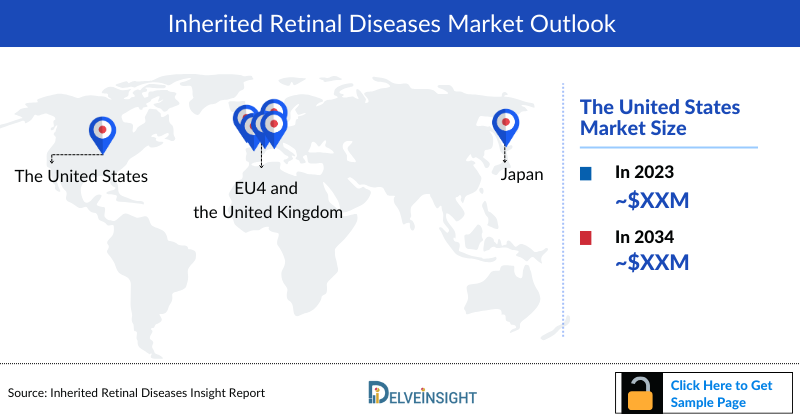
- The current Inherited Retinal Disease market is characterized by less competition as there are only a few companies available whose assets are approved for IRD treatment such as Novartis, Spark Therapeutics, and others
- In emerging economies, the Inherited Retinal Disease treatment market is anticipated to witness a slow growth primarily due to limited treatment options available for the disease. With only a few medications currently approved for IRDs but not for all IRDs, mostly addressing IRD’s complications rather than providing a definitive cure.
- To drive the Inherited Retinal Disease market in future years, several companies such as Endogena Therapeutics, Aldeyra Therapeutics, GenSight Biologics, and others are developing their assets in the mid-late stage of development. With the expected approval of these therapies during the forecast period [2024–2034], the overall therapeutic market of PSVT is likely to witness a rise at a significant CAGR.
Request for unlocking the CAGR of the "Inherited Retinal Disease Drug Market"
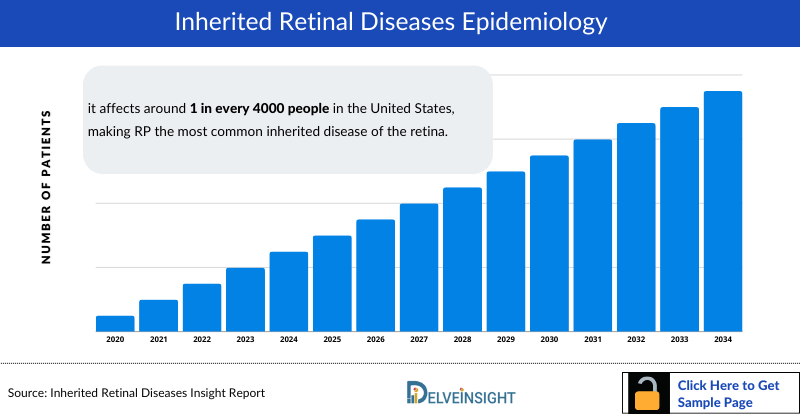
DelveInsight’s comprehensive report titled “Inherited Retinal Disease Market Insights, Epidemiology, and Market Forecast – 2034” offers a detailed analysis of IRD. The report presents historical and projected epidemiological data covering Total Prevalent Cases and Diagnosed Prevalent Cases of IRD, further segmented by Type (Retinitis Pigmentosa (RP), Choroideremia, and others). In addition to epidemiology, the market report encompasses various aspects related to the patient population. These aspects include the diagnosis process, prescription patterns, physician perspectives, market accessibility, treatment options, and prospective developments in the market across seven major markets: the United States, EU4 (Germany, France, Italy, and Spain), the United Kingdom, and Japan, spanning from 2020 to 2034.
The report analyzes the existing treatment practices and unmet medical requirements in Inherited Retinal Disease. It evaluates the market potential and identifies potential business prospects for enhancing therapies or interventions. This valuable information enables stakeholders to make well-informed decisions regarding product development and strategic planning for the market.
|
Study Period |
2020–2034 |
|
Forecast Period |
2024–2034 |
|
Geographies Covered |
US, EU4 (Germany, France, Italy, and Spain) and the UK, and Japan |
|
IRD Epidemiology |
|
|
IRD Market |
|
|
Market Analysis |
|
|
IRD Market players |
|
|
Future opportunity |
The development of breakthrough therapies, disease-modifying treatments, increased awareness and access to care, advancements in genetic research, and personalized medicine may open up new avenues for targeted treatments, providing further opportunities for market growth. |
Inherited Retinal Disease Overview
Inherited retinal diseases (IRDs) are a clinically and genetically heterogeneous group of disorders characterized by photoreceptor degeneration or dysfunction. These disorders typically present with severe vision loss that can be progressive, with disease onset ranging from congenital to late adulthood.
IRDs are caused by a change or ‘mistake’ in one or more genes. Therefore, cells in the retina don’t work as they are supposed to and over time you lose vision. Currently, there are around 250 genes known to cause IRD. There are many more genes, but they haven’t been discovered yet.
Some common symptoms of IRDs include finding it hard to see in dim or dark settings, reduced side vision – bumping into objects or people, glare and difficulty in bright light and many more.
There are a many types of IRDs identified. The most common types of IRDs include Retinitis Pigmentosa (RP), Choroideremia, Stargardt Disease, Cone-rod Dystrophy, and Leber Congenital Amaurosis among others.
Inherited Retinal Disease Diagnosis and Treatment Algorithm
The diagnosis of IRDs involves a combination of patient history, family history, and clinical eye examinations such as eye dilation, visual acuity assessment, slit lamp examination, and indirect ophthalmoscopy. Depending on the disease suspected, testing may include imaging tests such as retinal photographs, Optical coherence tomography (OCT), fundus autofluorescence, and infrared autofluorescence are also used. Additionally, visual field testing, electroretinography, and genetic testing may be part of the diagnostic process.
There is no cure for IRD. Currently, there may be a possible treatment for a very rare IRD caused by a specific gene. But for most IRDs, there is no potential medicine, surgery, or ability to cure vision loss. These therapies aim to stop the disease from advancing, to return some degree of sight to patients through targeted therapies, or to actively simulate sight through a device called a “retinal prosthetic.”
The management of IRD requires a multidisciplinary approach involving healthcare professionals from various specialties to address the specific needs of affected individuals comprehensively. There is a lot of promising research into gene therapy, stem cell technology, and upcoming clinical trials.
Inherited Retinal Disease Epidemiology
The Inherited Retinal Disease Epidemiology Market report offers information on the patient populations, including historical and projected trends for each of the seven major markets. Examining key opinion leader views from physicians or clinical experts can assist in identifying the reasons behind historical and projected trends. The diagnosed patient pool, their trends, and the underlying assumptions are all included in this section of the report.
This section also presents the data with relevant tables and graphs, offering a clear and concise view of the prevalence of Inherited Retinal Disease. Additionally, the report discloses the assumptions made during the analysis, ensuring data interpretation and presentation transparency. This epidemiological data is valuable for understanding the disease burden and its impact on the patient population across various regions.
Key Findings
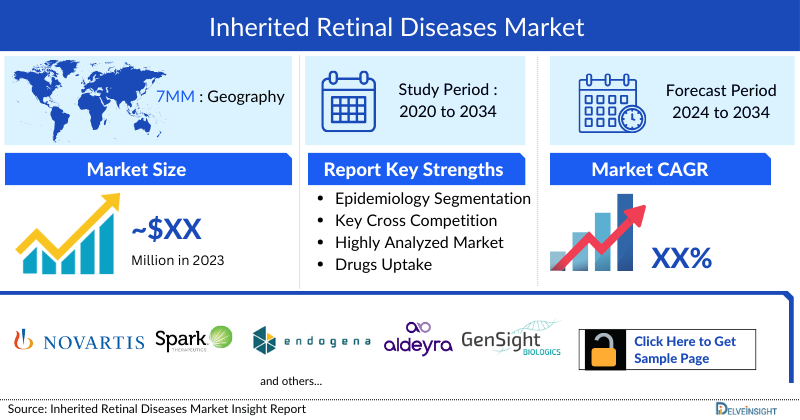
During the Inherited Retinal Disease Market Analysis, it is found that RP is not a single entity but rather a group of disorders that produce a gradual loss of vision. Also known as hereditary retinal dystrophy, it affects around 1 in every 4000 people in the United States, making RP the most common inherited disease of the retina.
The analysis indicated that the prevalence of choroideremia is found to be approximately 1:50,000 in people of European descent.
It is found that the RP affects around 1 in 4,000 to 8,000 people in Japan. The epidemiology of IRD is expected to change during the forecast period (2020-2034).
During the analysis, it was found that, in the UK, the reported prevalence of Symptomatic RP cases based on the age groups was observed to be highest among those aged 45–64 years, followed by the number of patients in the age group 15-29 years. On the other hand, for the age group 0–14 years, the least number of cases were reported.
Inherited Retinal Disease Market Outlook
The treatment goal for IRD is to alleviate symptoms, improve the affected individuals’ quality of life, and potentially slow down the condition’s progression. While there is no cure, supportive care, management of complications, and ongoing research aim to enhance the overall well-being of individuals living with IRD.
Depending on the condition, there may be care options such as prescription glasses to improve visual clarity, tints and filters that can lessen the sensitivity to light, or surgery to repair the retina for those with advanced X-linked retinoschisis or those associated with complications from very high myopia.
In December 2017, The US Food and Drug Administration (FDA) approved LUXTURNA (voretigene neparvovec-rzyl), a new gene therapy, to treat children and adult patients with an inherited form of vision loss that may result in blindness. LUXTURNA is the first directly administered gene therapy approved in the US that targets a disease caused by mutations in a specific gene.
With ongoing research and continued dedication, the future holds hope for even more effective treatments and, ultimately, a cure for this challenging condition. According to DelveInsight, the IRD market in the 7MM is expected to change significantly during the study period 2020–2034..
Inherited Retinal Disease Drug Chapters
Marketed Inherited Retinal Disease Drugs
LUXTURNA: Spark Therapeutics/Novartis
LUXTURNA (voretigene neparvovec-rzyl), developed by Spark Therapeutics in the US and Novartis outside the US, is a one-time gene therapy product indicated for the treatment of patients with confirmed biallelic RPE65 mutation-associated retinal dystrophy. LUXTURNA should only be administered to patients with mutations on both copies of the RPE65 gene who have sufficient viable retinal cells as determined by their treating physicians. The drug was approved in the US in December 2017 and in Europe in November 2018.
Note: Detailed marketed therapies assessment will be provided in the final report.
Inherited Retinal Disease Emerging Drugs
The IRD market is expected to experience gradual changes, mainly due to the limited availability of emerging therapies in this area. Key market players, including GenSight Biologics, Endogena Therapeutics, Aldeyra Therapeutics, and others, have demonstrated a keen interest in this rare condition and are actively pursuing the development of potential treatments.
GS030: GenSight Biologics
GS030 leverages GenSight Biololgics’ optogenetics technology platform, a novel approach to restore vision in blind patients using a combination of ocular gene therapy and tailored light-activation of treated retinal cells. The gene therapy, which is delivered via a single intravitreal injection, introduces a gene encoding for a light-sensitive protein (ChrimsonR-tdT) into retinal ganglion cells, making them responsive to light and bypassing photoreceptors killed off by diseases such as retinitis pigmentosa (RP). GS030 has been granted Orphan Drug Designation in the United States and Europe, and Fast Track designation by the US FDA. It is currently in Phase I/II stage of clinical development.
EA-2353: Endogena Therapeutics
Endogena Therapeutics is developing a photoreceptor regeneration treatment, EA-2353, for retinitis Pigmentosa (RP). EA-2353 has been granted orphan drug designation by the US FDA in May 2021. It is currently in Phase I/IIa stage of clinical development.
ADX-2191: Aldeyra Therapeutics
ADX-2191, the intravitreal formulation of methotrexate, is a compound that inhibits cellular replication and activation. In vivo research has identified the activity of methotrexate in inducing misfolded rhodopsin clearance, suggesting the potential to treat forms of retinitis Pigmentosa that are characterized by misfolded rhodopsin. ADX-2191 has been granted Orphan drug designation by the US FDA for the treatment of retinitis Pigmentosa. It is currently in Phase II stage of clinical development for RP.
Note: Detailed emerging therapies assessment will be provided in the final report.
Inherited Retinal Disease Market Segmentation
DelveInsight’s ‘IRD Market Insights, Epidemiology, and Market Forecast – 2034’ report provides a detailed outlook of the current and future IRD market, segmented within countries, by therapies, and by classes. Further, the market of each region is then segmented by each therapy to provide a detailed view of the current and future market share of all therapies.
Inherited Retinal Disease Market Size by Countries
The IRD market size is assessed separately for various countries, including the United States, EU4 (Germany, France, Italy, and Spain), the UK, and Japan. In 2022, the United States held a significant share of the overall 7MM (Seven Major Markets) IRD market, primarily attributed to the country's higher prevalence of the condition and the elevated cost of the available treatments. This dominance is projected to persist, especially with the potential early introduction of new products.
Inherited Retinal Disease Market Size by Therapies
IRD Market Size by Therapies is categorized into current and emerging markets for the study period 2020–2034. One of the emerging drugs anticipated to launch during the forecast period is GS030 under the developmental pipeline of GenSight Biologics.
Note: Detailed market segment assessment will be provided in the final report.
Inherited Retinal Disease Drugs Uptake
This section focuses on the sales uptake of potential IRD drugs that have recently been launched or are anticipated to be launched in the IRD market between 2020 and 2034. It estimates the market penetration of IRD drugs for a given country, examining their impact within and across classes and segments. It also touches upon the financial and regulatory decisions contributing to the probability of success (PoS) of the drugs in the IRD market.
The emerging IRD therapies are analyzed based on various attributes such as safety and efficacy in randomized clinical trials, order of entry and other market dynamics, and the unmet need they fulfill in the IRD market.
Note: Detailed assessment of drug uptake and attribute analysis will be provided in the full report on IRD.
Inherited Retinal Disease Market Access and Reimbursement
DelveInsight’s ‘Inherited Retinal Disease Market Insights, Epidemiology, and Market Forecast – 2034’ report provides a descriptive overview of the market access and reimbursement scenario of IRD.
This section includes a detailed analysis of the country-wise healthcare system for each therapy, enlightening the market access, reimbursement policies, and health technology assessments.
KOL Views
To keep up with current IRD market trends and fill gaps in secondary findings, we interview KOLs and SMEs’ working in the IRD domain. Their opinion helps understand and validate current and emerging therapies and treatment patterns or IRD market trends. This will support the clients in potential upcoming novel treatments by identifying the overall scenario of the market and the IRD unmet needs.
IRD: KOL Insights
DelveInsight’s analysts connected with 50+ KOLs to gather insights; however, interviews were conducted with 15+ KOLs in the 7MM. These KOLs were from organizations, institutes, and hospitals, such as the Louisiana State University HSC Moorfields Eye Hospital NIHR Biomedical Research Centre, London, UK, Department of Ophthalmology, Juntendo University, and Graduate School of Medicine, Tokyo, Japan among others.
“Awareness of the importance of genetic testing for IRD in the clinical setting is increasing with the recent development of new therapeutic strategies, such as gene therapy.”
Note: Detailed assessment of KOL Views will be provided in the full report on IRD.
Inherited Retinal Disease Competitive Intelligence Analysis
We conduct a Competitive and Market Intelligence analysis of the IRD Market, utilizing various Competitive Intelligence tools such as SWOT analysis and Market entry strategies. The inclusion of these analyses is contingent upon data availability, ensuring a comprehensive and well-informed assessment of the market landscape and competitive dynamics.
Inherited Retinal Disease Pipeline Development Activities
The report offers an analysis of therapeutic candidates in Phase II and III stages and examines companies involved in developing targeted therapeutics for IRD. It provides valuable insights into the advancements and progress of potential treatments in clinical development for this condition.
The report covers information on collaborations, acquisition and merger, licensing, patent details, and other information for emerging IRD therapies.
Inherited Retinal Disease Report Insights
- IRD Patient Population
- Therapeutic Approaches
- IRD Pipeline Analysis
- IRD Market Size and Trends
- IRD Market Opportunities
- Impact of Upcoming Therapies
Inherited Retinal Disease Report Key Strengths
- 11 Years Forecast
- The 7MM Coverage
- IRD Epidemiology Segmentation
- Key Cross Competition
- Highly Analyzed IRD Market
- IRD Drugs Uptake
Inherited Retinal Disease Report Assessment
- IRD Current Treatment Practices
- Unmet Needs
- IRD Pipeline Product Profiles
- IRD Market Attractiveness
Key Questions
- How common is Inherited Retinal Disease?
- What are the key findings of Inherited Retinal Disease epidemiology across the 7MM, and which country will have the highest number of patients during the study period (2020–2034)?
- What are the currently availableInherited Retinal Disease treatments?
- What is the disease risk, burden, and unmet needs of Inherited Retinal Disease?
- At what CAGR is the IRD market and its epidemiology expected to grow in the 7MM during the forecast period (2024–2034)?
- How would the unmet needs impact the IRD market dynamics and subsequently influence the analysis of the related trends?
- What would be the forecasted patient pool of IRD in the 7MM covering the United States, EU4 (Germany, France, Italy, and Spain), the UK, and Japan?
- Among EU4 and the UK, which country will have the highest number of patients during the forecast period (2024–2034)?
- How many companies are currently developing therapies for the Inherited Retinal Disease treatment?
Ready to Dive Deeper? Purchase the Complete Report for in-depth Market Analysis by Clicking Here @ Inherited Retinal Disease Treatment Market Report
Access Exclusive Data Now! Click here to Read More about the Related Articles @ Latest DelveInsight Blog