
Insulin Delivery Devices Market Summary
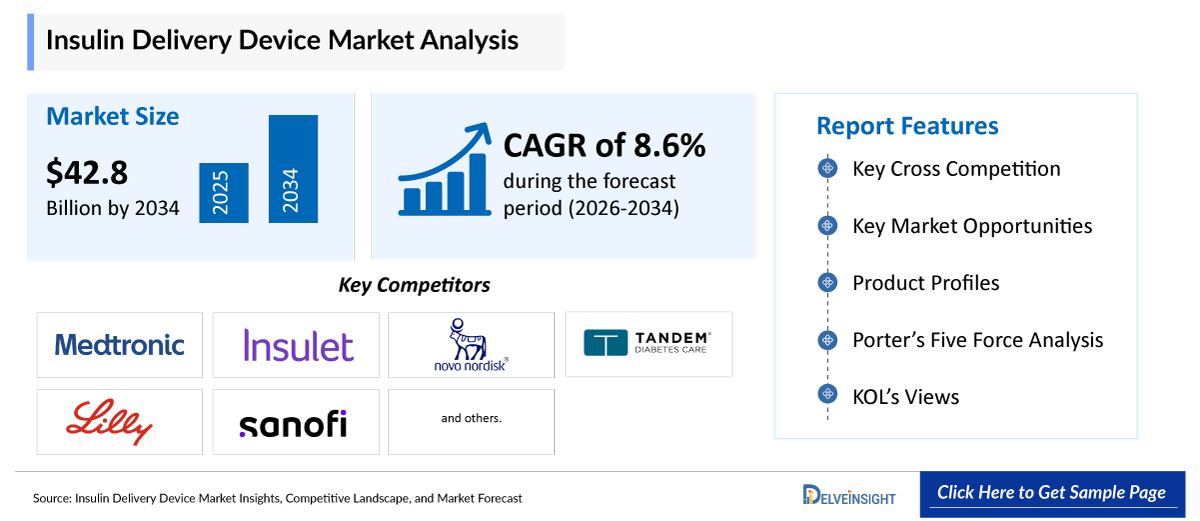
- The global insulin delivery device market size was valued at USD 20.4 billion in 2025 and is projected to reach USD 42.8 billion by 2034.
- The market is expected to expand at a CAGR of 8.6% during the forecast period 2026-2034, supported by the rising global prevalence of diabetes, the accelerating shift toward automated insulin delivery and closed-loop systems, growing adoption of smart and connected insulin pens, and the expanding indications of leading device platforms to insulin-requiring type 2 diabetes populations.
- By product type, the insulin pens segment dominated the insulin delivery device market with a 43% share in 2025.
- By system type, conventional (open-loop) insulin delivery accounted for the largest share of the market in 2025, while automated insulin delivery (AID) systems represented the fastest-growing system type.
- By diabetes type, the type 2 diabetes segment dominated the insulin delivery device market with a 58% share in 2025, reflecting the much larger global type 2 patient population, while type 1 diabetes continues to account for the majority of insulin pump and AID system usage.
- By end-user, the homecare settings segment dominated the insulin delivery device market with a 66% share in 2025.
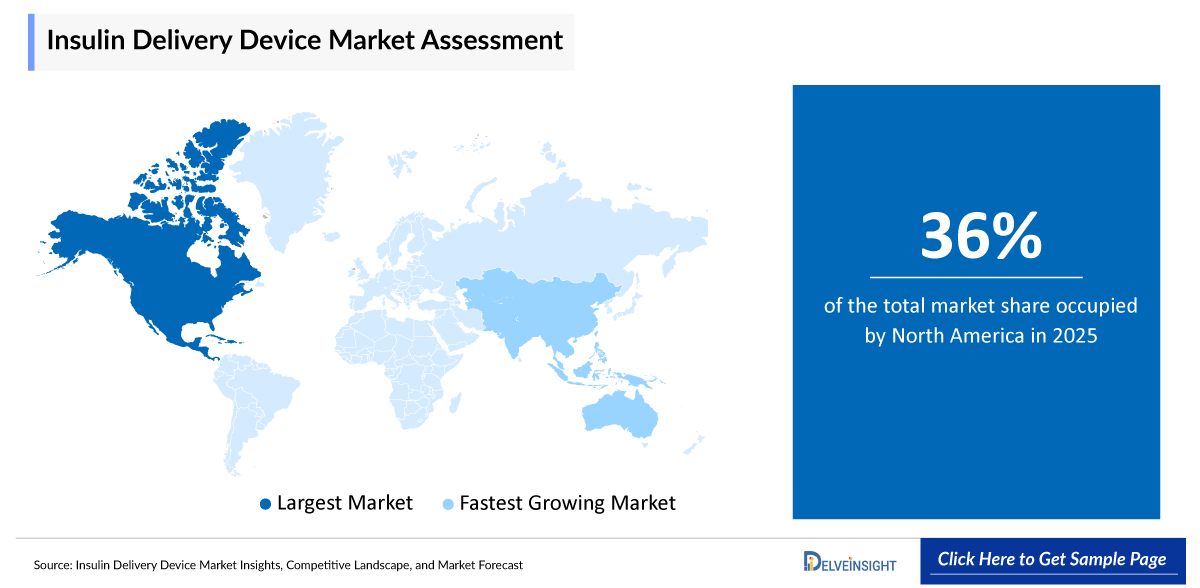
- North America accounted for the largest share of the insulin delivery device market at 36% in 2025, while Asia-Pacific is anticipated to register the fastest growth through 2034.
Insulin delivery devices are medical tools used to administer insulin to people with diabetes, since insulin cannot be taken orally and must be delivered into subcutaneous tissue. The scope encompasses insulin pens, including reusable pens such as Novo Nordisk's NovoPen 6 and Eli Lilly's Tempo Pen, disposable prefilled pens such as Novo Nordisk's FlexTouch, Eli Lilly's KwikPen, and Sanofi's SoloStar, and smart or connected pens such as Medtronic's InPen and Novo Nordisk's NovoPen Echo Plus; insulin pumps, including tethered or durable pumps such as Medtronic's MiniMed platform, Tandem Diabetes Care's t: slim X2 and Tandem Mobi, Ypsomed's YpsoPump, and SOOIL's DANA pumps, and patch or tubeless pumps such as Insulet's Omnipod, EOFLOW's EOPatch, and CeQur's Simplicity; automated insulin delivery (AID) systems that bundle a pump, continuous glucose monitor, and dosing algorithm, including Medtronic's MiniMed 780G, Tandem's Control-IQ+ platform, Insulet's Omnipod 5, and Beta Bionics' iLet Bionic Pancreas; insulin syringes from Becton Dickinson, Terumo, and Owen Mumford; and insulin jet injectors and needle-free delivery systems. The market spans homecare, hospital, and diabetes clinic settings across type 1 and type 2 diabetes populations.
Insulin Delivery Device Market Key Growth Drivers
- Rising global prevalence of diabetes, with an estimated 591 million people living with diabetes in 2025 and this figure projected to approach 854 million by 2050, sustaining broad-based demand for insulin administration devices.
- Accelerating shift toward automated insulin delivery (AID) and closed-loop systems that bundle pump, continuous glucose monitoring, and dosing algorithms to reduce patient burden and improve glycemic control.
- Growing adoption of smart and connected insulin pens that provide dose logging, insulin-on-board calculation, and continuous glucose monitor integration for patients on multiple daily injections.
- Expanding regulatory indications of leading device platforms to insulin-requiring type 2 diabetes populations, pregnancy, and pediatric age groups, broadening the eligible patient base.
- Rising preference for home-based diabetes management that favors self-administered, discreet, and connected insulin delivery devices over hospital-based insulin therapy.
- Increasing patient education and awareness initiatives from diabetes associations and healthcare providers that drive earlier adoption of advanced insulin delivery technology.
- Ongoing product innovation and competitive launch activity among leading manufacturers, including next-generation patch pumps, tubeless AID systems, and interoperable automated insulin dosing components.
Key Companies in Insulin Delivery Device Market
The leading participants in the insulin delivery device market include the following:
- Medtronic plc
- Insulet Corporation
- Tandem Diabetes Care, Inc.
- Novo Nordisk A/S
- Eli Lilly and Company
- Sanofi
- Ypsomed Holding AG
- Becton, Dickinson and Company
- Beta Bionics, Inc.
- Terumo Corporation, and others
For illustrative purposes, only the top 10 companies are listed in the Table of Contents. The report may include analysis and references to additional companies relevant to the market assessment.
Insulin Delivery Device Market Size
The following table summarizes the headline market metrics for the global insulin delivery device market across the base year and the forecast horizon.
|
Report Metrics |
Details |
|
2025 Market Size |
USD 20.4 billion |
|
2034 Projected Market Size |
USD 42.8 billion |
|
Growth Rate (2026-2034) |
8.6% CAGR |
|
Largest Market |
North America (36% share in 2025) |
|
Fastest Growing Market |
Asia-Pacific |
|
Market Structure |
Consolidated |
All market values are expressed in USD and represent DelveInsight estimates synthesized from primary and secondary research.
Factors Contributing to the Growth of the Insulin Delivery Device Market
Insulin Delivery Device Market Drivers
- Rising Global Prevalence of Diabetes: The foundational driver of the insulin delivery device market is the rising global prevalence of diabetes, with an estimated 591 million people living with diabetes worldwide in 2025 and this figure projected to rise to approximately 854 million by 2050, a 46% increase. More than 90% of these cases are type 2 diabetes, and a growing share of this population requires insulin therapy as oral medications and other therapies become insufficient over the course of disease progression. As the global diabetic population continues to expand, driven by aging populations, rising obesity prevalence, and urbanization, the base of patients requiring regular and precise insulin administration grows correspondingly, sustaining demand across the full range of insulin delivery device categories throughout the forecast period.
- Accelerating Shift Toward Automated Insulin Delivery Systems: The accelerating shift toward automated insulin delivery (AID) and closed-loop systems is reshaping the competitive and technological center of gravity of the insulin delivery device market. Systems including Medtronic's MiniMed 780G, Insulet's Omnipod 5, Tandem's Control-IQ+ platform, and Beta Bionics' iLet Bionic Pancreas integrate continuous glucose monitoring data with automated dosing algorithms to adjust insulin delivery in real time, reducing the burden of manual dosing decisions and improving time-in-range outcomes. In March 2024, the FDA cleared the Sequel Twist AID system, the first automated insulin delivery system to directly measure the volume and flow of delivered insulin, enhancing detection of blockages and delivery issues. As clinical evidence continues to demonstrate the glycemic and quality-of-life benefits of AID systems, and as regulatory clearances expand the eligible patient population, demand for AID technology grows as the fastest-growing system type across the forecast period.
- Growing Adoption of Smart and Connected Insulin Pens: The growing adoption of smart and connected insulin pens is extending automation and data connectivity benefits to the much larger population of patients managing diabetes through multiple daily injections rather than pump therapy. Devices including Medtronic's InPen, Novo Nordisk's NovoPen 6 and NovoPen Echo Plus, and Novo Nordisk's Mallya connected pen cap, acquired through its 2023 acquisition of Biocorp, record dose timing and amount, calculate insulin-on-board, and integrate with continuous glucose monitor data to support dosing decisions. Clinical data has shown that patients who respond promptly to smart pen alerts can achieve meaningfully higher time-in-range outcomes compared to standard multiple daily injection therapy. As manufacturers continue to expand smart pen connectivity with continuous glucose monitoring ecosystems and mobile health platforms, adoption of connected pen technology grows across the forecast period, notwithstanding periodic portfolio adjustments such as Eli Lilly's 2026 discontinuation of its Tempo Pen.
- Expanding Regulatory Indications to Type 2 Diabetes and Broader Populations: The expanding regulatory indications of leading device platforms to insulin-requiring type 2 diabetes populations, pregnancy, and pediatric age groups broaden the eligible patient base for advanced insulin delivery technology. In July 2025, Medtronic received CE Mark approval to expand the indicated population for its MiniMed 780G system to include individuals as young as two years old, pregnant women, and people with insulin-requiring type 2 diabetes, extending automated insulin delivery beyond its historical type 1 diabetes core market. As device manufacturers pursue label expansions that reflect the reality that the large majority of the global insulin-treated population has type 2 diabetes, the addressable market for insulin pumps, AID systems, and patch pumps grows beyond its traditional base across the forecast period.
- Rising Preference for Home-Based Diabetes Management: The rising preference for home-based diabetes management favors self-administered, discreet, and connected insulin delivery devices over hospital-based insulin therapy. Modern insulin pens, patch pumps, and AID systems empower patients to manage their condition independently, reducing the need for frequent clinical visits while enabling remote monitoring by healthcare providers through companion mobile applications. As health systems continue to prioritize outpatient and home-based chronic disease management to reduce cost and improve patient quality of life, demand for insulin delivery devices designed for self-administration and remote data sharing grows across the forecast period.
- Product Innovation and Competitive Launch Activity: Ongoing product innovation and competitive launch activity among leading manufacturers sustains demand through continuous replacement and upgrade cycles. Recent examples include Tandem Diabetes Care's February 2024 launch of the Tandem Mobi, a miniaturized tubeless-adjacent pump, Insulet's April 2024 Health Canada approval of Omnipod 5, and PharmaSens' January 2024 FDA submission for its niia essential patch pump system following ISO 13485 certification. As manufacturers continue to compete on device miniaturization, tubeless form factors, interoperable automated insulin dosing components, and CGM interoperability, patients and clinicians gain access to an expanding range of differentiated options, sustaining replacement and upgrade-driven demand across the forecast period.
Insulin Delivery Device Market Restraints
The insulin delivery device market faces several interrelated restraints that temper its growth. The continued availability and clinical effectiveness of oral antidiabetic medications for a substantial share of the type 2 diabetes population delays the transition to injectable or pump-based insulin therapy for many patients. An increased number of device-related product recalls in recent years has raised safety and reliability concerns among patients, clinicians, and regulators, and has required manufacturers to invest in quality system improvements. High device and consumable costs, combined with limited insurance reimbursement in many geographies outside North America and Western Europe, constrain adoption of advanced pumps, AID systems, and smart pens, particularly in price-sensitive and lower-resource markets. Recently implemented tariffs on imported medical devices and components in the United States have increased production costs for manufacturers reliant on global supply chains, a cost pressure that may be passed through to patients and could reduce access to advanced insulin delivery devices, particularly among patients with limited insurance coverage. The steep learning curve associated with advanced pump and AID system technology can limit adoption among older patients and those less comfortable with connected digital health tools. The lack of full interoperability between devices from different manufacturers, despite regulatory frameworks intended to support interoperable automated insulin dosing components, continues to limit patient choice and system flexibility. Together, these factors moderate the pace of adoption and require vendors to demonstrate reliability, affordability, and ease of use to sustain growth.
Insulin Delivery Device Market Segment Analysis
The global insulin delivery device market is segmented by product type (insulin pens [reusable, disposable/prefilled, and smart/connected], insulin pumps [tethered/durable and patch/tubeless], insulin syringes, insulin jet injectors, and others), by system type (automated insulin delivery (AID)/closed-loop systems and conventional/open-loop insulin delivery), by diabetes type (type 1 diabetes and type 2 diabetes), by end-user (homecare settings, hospitals, diabetes and specialty clinics, and others), and by geography (North America, Europe, Asia-Pacific, and the Rest of the World).
By Product Type
Dominant Subsegment: Insulin Pens.
The insulin pens category is expected to dominate the market. The insulin pens segment accounted for a 43% share of the insulin delivery device market in 2025. Insulin pens, spanning reusable pens such as Novo Nordisk's NovoPen 6, disposable prefilled pens such as Eli Lilly's KwikPen and Sanofi's SoloStar, and smart connected pens such as Medtronic's InPen and Novo Nordisk's NovoPen Echo Plus, are the leading product category because pens remain the most widely prescribed insulin delivery method globally, particularly among the much larger type 2 diabetes population and in emerging markets where pump therapy penetration remains limited. The dominance of the segment reflects the breadth of pen options across price points and features, and the sustained global volume of prefilled pen prescriptions, even as smart and connected pens represent the fastest-growing pen subcategory. While insulin pumps, syringes, and jet injectors are substantial and, in the case of patch and AID-integrated pumps, faster-growing categories, particularly within the type 1 diabetes population, the breadth of global pen prescribing and the scale of the type 2 diabetes population sustain the leadership of the segment across the forecast period.
By System Type
Dominant Subsegment: Conventional (Open-Loop) Insulin Delivery.
Conventional, open-loop insulin delivery, encompassing standard pens, syringes, and manually programmed insulin pumps without integrated automated dosing algorithms, accounted for the largest share of the insulin delivery device market in 2025, reflecting the scale of the installed base of pen and syringe users worldwide who are not candidates for or have not yet adopted pump therapy. Automated insulin delivery (AID) systems, including Medtronic's MiniMed 780G, Insulet's Omnipod 5, Tandem's Control-IQ+ platform, and Beta Bionics' iLet Bionic Pancreas, represented the fastest-growing system type in 2025, as expanding regulatory indications, growing clinical evidence of glycemic benefit, and continued device miniaturization drive adoption beyond the historical type 1 diabetes core market. As AID systems continue to expand into type 2 diabetes, pediatric, and pregnancy indications, the system type segmentation is expected to shift progressively toward automated delivery, even as conventional delivery methods retain the larger share of overall device volume by unit count across the forecast period.
By Diabetes Type
Dominant Subsegment: Type 2 Diabetes.
The type 2 diabetes category is expected to dominate the market. The type 2 diabetes segment accounted for a 58% share of the insulin delivery device market in 2025, reflecting the epidemiological reality that more than 90% of the global diabetic population has type 2 diabetes, a large share of which requires insulin therapy as the disease progresses or as oral medications become insufficient. Products including CeQur's Simplicity patch pump and Valeritas's V-Go, both indicated specifically for basal-bolus insulin therapy in adults with type 2 diabetes, and the expanded type 2 diabetes indications for Medtronic's MiniMed 780G and Insulet's Omnipod 5, reflect the growing manufacturer focus on this population. While type 1 diabetes continues to account for the majority of insulin pump and AID system usage by device penetration, given the universal insulin dependence of type 1 patients from diagnosis, the sheer scale of the type 2 diabetes population and its growing access to advanced insulin delivery technology sustain the leadership of the segment across the forecast period.
By End-User
Dominant Subsegment: Homecare Settings.
The homecare settings category is expected to dominate the market. The homecare settings segment accounted for a 66% share of the insulin delivery device market in 2025. Homecare settings are the principal setting for insulin delivery device use because the overwhelming majority of insulin therapy, whether delivered by pen, syringe, or pump, is self-administered by patients in their daily lives rather than administered in clinical settings, and because modern devices are specifically designed for safe, accurate self-administration with remote data sharing to healthcare providers. The dominance of the segment reflects the chronic, lifelong nature of insulin therapy and the strong policy and patient preference for home-based diabetes management over frequent hospital or clinic visits. While hospitals and diabetes and specialty clinics remain significant settings for device initiation, training, and inpatient insulin management, the sustained shift toward home-based self-management sustains the leadership of the segment across the forecast period.
Insulin Delivery Device Market Region Analysis
Dominant Region: North America
North America accounted for a 36% share of the global insulin delivery device market in 2025, representing the highest regional market share globally. The leadership of the region reflects the high burden of diabetes, with more than 38 million people, or 11.6% of the United States population, living with diabetes according to the Centers for Disease Control and Prevention, combined with a robust healthcare infrastructure and strong adoption of innovative medical technologies. The United States is the largest national market, supported by high healthcare expenditure, favorable reimbursement policies for advanced pumps, AID systems, and smart pens, and the concentration of leading manufacturers including Medtronic, Insulet, Tandem Diabetes Care, and Beta Bionics. The concentration of vendors, reimbursement maturity, and diabetes prevalence reinforce the position of North America as the largest regional market across the forecast period.
Fastest Growing Region: Asia-Pacific
Asia-Pacific is projected to register the fastest compound annual growth rate through 2034. The region faces a rapidly escalating diabetes burden driven by urbanization, increasingly sedentary lifestyles, and evolving dietary habits, with China and India at the forefront; recent estimates indicate that 77 million people over the age of 18 in India live with type 2 diabetes, with an additional 25 million considered prediabetic. China, Japan, and India are the principal national markets, supported by expanding healthcare infrastructure, government-led diabetes awareness and early diagnosis campaigns, and the growing presence of global manufacturers establishing local partnerships and pursuing regulatory approvals tailored to regional affordability needs. As diagnosis rates rise and modern insulin delivery devices become more accessible and affordable, the region increases its adoption of insulin delivery devices from a growing base, positioning Asia-Pacific as the fastest-growing regional market across the forecast period.
Insulin Delivery Device Market Regional Commentary
North America
North America leads the market, supported by high diabetes prevalence, a mature healthcare infrastructure, favorable reimbursement, and the concentration of leading device manufacturers. The United States dominates the region through its concentration of manufacturers, healthcare expenditure, and diabetes awareness programs.
Europe
Europe is a significant market shaped by robust healthcare infrastructure, rising diabetes prevalence approaching 60 million people in 2024 and projected to reach 72.4 million by 2050 according to the International Diabetes Federation, and favorable reimbursement policies that support adoption of reusable pens, insulin pumps, and smart devices. Germany, the United Kingdom, France, Italy, and Spain are the principal national markets, and the region continues to be a hub for regulatory innovation, exemplified by Medtronic's 2025 CE Mark label expansion for the MiniMed 780G system.
Asia-Pacific
Asia-Pacific is the fastest-growing region, driven by a rapidly escalating diabetes burden, expanding healthcare infrastructure, and increasing government investment in diabetes awareness and early diagnosis across China, Japan, and India.
Rest of World
The Rest of World, spanning Latin America, the Middle East, and Africa, represents an emerging opportunity as diabetes prevalence rises and healthcare infrastructure expands, though adoption of advanced insulin delivery devices remains concentrated in leading urban centers and private healthcare systems.
Insulin Delivery Device Market Competitive Landscape
The global insulin delivery device market is classified as Consolidated. A small group of established medical technology and pharmaceutical companies holds the majority of the market through comprehensive portfolios spanning pens, pumps, and AID systems, supported by digital platforms that connect devices to mobile applications and cloud-based data systems. Competition centers on the breadth of the automated insulin delivery portfolio, integration with continuous glucose monitoring ecosystems, device miniaturization and tubeless form factors, and the ability to secure regulatory approvals and insurance reimbursement across major markets.
The competitive landscape is evaluated across the following dimensions:
- Market concentration: Consolidated, with Medtronic, Insulet, Tandem Diabetes Care, Novo Nordisk, Sanofi, Eli Lilly, Roche, and Ypsomed collectively dominating the market, alongside specialist and regional vendors including Becton Dickinson, Beta Bionics, Terumo, Abbott, CeQur, EOFLOW, and Biocon.
- Leading players: Medtronic and Insulet lead in automated insulin delivery systems through the MiniMed 780G and Omnipod 5 platforms, respectively; Tandem Diabetes Care leads in tethered pump miniaturization through the Tandem Mobi; Novo Nordisk, Eli Lilly, and Sanofi lead in global insulin pen volume; and Beta Bionics leads in autonomous, algorithm-driven closed-loop delivery through the iLet Bionic Pancreas.
- Geographic reach: Medtronic, Novo Nordisk, Sanofi, and Eli Lilly operate global commercial and regulatory organizations, while specialist vendors including Beta Bionics, CeQur, and EOFLOW maintain more concentrated footprints centered on specific regions and device categories.
- Product portfolio strength: Competitive advantage rests on the breadth across pens, pumps, and AID systems, and on the integration of devices with continuous glucose monitoring ecosystems and mobile health platforms.
- Pipeline strength: Development is concentrated in tubeless and miniaturized AID systems, interoperable automated insulin dosing components, and smart pen and CGM interoperability.
- Strategic partnerships: Collaboration spans CGM integration partnerships, exemplified by Insulet's compatibility agreement for the Abbott FreeStyle Libre 2 Plus sensor with Omnipod 5, and Abbott's collaboration with Medtronic linking its CGM platform to Medtronic's insulin pump ecosystem.
- M&A activity: Consolidation has shaped the field, exemplified by Novo Nordisk's acquisition of Biocorp to strengthen its connected insulin pen portfolio and Abbott's acquisition of Bigfoot Biomedical, a developer of smart insulin management systems.
- Innovation focus: Innovation is concentrated in tubeless and miniaturized AID systems, direct insulin flow measurement technology such as the Sequel Twist system, and interoperable, algorithm-driven closed-loop platforms.
- Regulatory standing: FDA clearance and CE Mark approval, particularly for automated insulin dosing system components and expanded pediatric, pregnancy, and type 2 diabetes indications, are decisive competitive credentials across this consolidated, innovation-driven market.
Insulin Delivery Device Market Recent Developmental Activities
- In July 2025, Medtronic received CE Mark approval to expand the indicated population for its MiniMed 780G automated insulin delivery system to include individuals as young as two years old, pregnant women, and people with insulin-requiring type 2 diabetes. Strategic significance: the expansion broadened Medtronic's addressable AID market beyond its historical type 1 diabetes core base.
- In May 2025, GO-Pen ApS received FDA 510(k) clearance for the GO-PEN, a user-filled reusable insulin pen compatible with standard insulin vials. Strategic significance: the clearance introduced a more affordable and sustainable alternative to traditional prefilled disposable pens.
- In March 2024, the FDA cleared the Sequel Twiist automated insulin delivery system, the first AID system to directly measure the volume and flow of delivered insulin. Strategic significance: the clearance introduced a differentiated safety mechanism for detecting delivery blockages and dosing errors.
- In February 2024, Tandem Diabetes Care launched the Tandem Mobi, a miniaturized tubeless-adjacent insulin pump. Strategic significance: the launch reinforced Tandem's competitive position in device miniaturization within the tethered pump category.
- In February 2024, Insulet received CE Mark approval under the European Medical Device Regulation for compatibility of the Abbott FreeStyle Libre 2 Plus sensor with its Omnipod 5 automated insulin delivery system for individuals aged two years and older with type 1 diabetes. Strategic significance: the approval expanded Omnipod 5's CGM interoperability in the European market.
- In April 2024, Omnipod 5 received Health Canada approval. Strategic significance: the approval extended Insulet's automated insulin delivery system into the Canadian market.
- In 2023, Novo Nordisk acquired Biocorp to strengthen its portfolio of connected insulin pen technology, including the Mallya smart pen cap. Strategic significance: the acquisition reinforced Novo Nordisk's position in the smart and connected insulin pen category.
- In 2023, Abbott acquired Bigfoot Biomedical, a developer of smart insulin management systems including the Bigfoot Unity smart pen cap. Strategic significance: the acquisition extended Abbott's diabetes technology footprint from continuous glucose monitoring into connected insulin delivery.
- In 2026, Eli Lilly discontinued its Tempo Pen smart insulin pen. Strategic significance: the discontinuation signaled a strategic recalibration within the smart pen category and underscored the commercial challenges of sustaining standalone connected pen hardware against larger, more established competitors.
Insulin Delivery Device Market Segmentation
- Insulin Delivery Device Market Assessment by Product Type
- Insulin Pens
- Reusable Insulin Pens
- Disposable/Prefilled Insulin Pens
- Smart/Connected Insulin Pens
- Insulin Pumps
- Tethered/Durable Pumps
- Patch/Tubeless Pumps
- Insulin Syringes
- Insulin Jet Injectors
- Others
- Insulin Pens
- Insulin Delivery Device Market Assessment by System Type
- Automated Insulin Delivery (AID)/Closed-Loop Systems
- Conventional (Open-Loop) Insulin Delivery
- Insulin Delivery Device Market Assessment by Diabetes Type
- Type 1 Diabetes
- Type 2 Diabetes
- Insulin Delivery Device Market Assessment by End-User
- Homecare Settings
- Hospitals
- Diabetes and Specialty Clinics
- Others
Insulin Delivery Device Market Assessment by Geography
- North America Insulin Delivery Device Market Assessment
- United States Insulin Delivery Device Market Size in USD million (2023-2034)
- Canada Insulin Delivery Device Market Size in USD million (2023-2034)
- Mexico Insulin Delivery Device Market Size in USD million (2023-2034)
- Europe Insulin Delivery Device Market Assessment
- Germany Insulin Delivery Device Market Size in USD million (2023-2034)
- United Kingdom Insulin Delivery Device Market Size in USD million (2023-2034)
- France Insulin Delivery Device Market Size in USD million (2023-2034)
- Italy Insulin Delivery Device Market Size in USD million (2023-2034)
- Spain Insulin Delivery Device Market Size in USD million (2023-2034)
- Rest of Europe Insulin Delivery Device Market Size in USD million (2023-2034)
- Asia-Pacific Insulin Delivery Device Market Assessment
- China Insulin Delivery Device Market Size in USD million (2023-2034)
- Japan Insulin Delivery Device Market Size in USD million (2023-2034)
- India Insulin Delivery Device Market Size in USD million (2023-2034)
- Australia Insulin Delivery Device Market Size in USD million (2023-2034)
- South Korea Insulin Delivery Device Market Size in USD million (2023-2034)
- Rest of Asia-Pacific Insulin Delivery Device Market Size in USD million (2023-2034)
- Rest of the World Insulin Delivery Device Market Assessment
- Middle East Insulin Delivery Device Market Size in USD million (2023-2034)
- Africa Insulin Delivery Device Market Size in USD million (2023-2034)
- South America Insulin Delivery Device Market Size in USD million (2023-2034)
Insulin Delivery Device Market Recent Industry Trends and Milestones (2023-2026):
|
Category |
Key Developments |
|
Insulin Delivery Device Market Product Advancement |
The period was defined by the advancement of automated insulin delivery systems and smart pen connectivity. Medtronic advanced and expanded the indications for its MiniMed 780G, Insulet advanced Omnipod 5 and its CGM interoperability, Tandem launched the miniaturized Tandem Mobi, Beta Bionics advanced its autonomous iLet Bionic Pancreas, and the Sequel Twist system introduced direct insulin flow measurement. |
|
Insulin Delivery Device Market Product Expansion |
Product expansion advanced along three axes. The first is automated insulin delivery system indication expansion into type 2 diabetes, pregnancy, and pediatric populations. The second is smart and connected pen technology extending automation benefits to multiple daily injection users. The third is patch and tubeless pump miniaturization for improved discretion and wearability. |
|
Insulin Delivery Device Market Investment |
Investment was shaped by portfolio consolidation and connected-device strategy among diversified diabetes technology companies. Novo Nordisk's acquisition of Biocorp and Abbott's acquisition of Bigfoot Biomedical reinforced connected insulin pen and smart cap capabilities, while PharmaSens and Sequel Med Tech invested in next-generation patch pump and AID system development. |
|
Company Strategy |
The unifying strategic theme is the delivery of automated, connected, and interoperable insulin therapy integrated with continuous glucose monitoring ecosystems. Medtronic, Insulet, and Tandem Diabetes Care are advancing broad AID system portfolios, Novo Nordisk, Eli Lilly, and Sanofi are advancing global pen portfolios alongside selective smart pen investment, and Beta Bionics, CeQur, and EOFLOW are competing across specialized autonomous and patch pump categories. Medtronic has also announced plans to separate its diabetes business into an independent entity to enhance strategic focus. |
|
Emerging Technology |
The defining emerging technologies are automated insulin delivery systems with direct insulin flow measurement and interoperable automated insulin dosing components; smart and connected insulin pens and pen caps that extend automation to injection therapy; glucose-responsive smart insulin formulations under early-stage development; and wearable, tubeless patch pump platforms. Across these, the trajectory is toward insulin delivery that is more automated, more connected, and increasingly tailored to the much larger global type 2 diabetes population. |
Insulin Delivery Device Market Startup Funding and Investment Trends
Investment in the insulin delivery device field has concentrated on technologies that extend automation and miniaturization into new form factors, namely next-generation patch pumps, autonomous closed-loop systems, and connected pen hardware. Because the market is consolidated among Medtronic, Insulet, Tandem Diabetes Care, Novo Nordisk, Sanofi, Eli Lilly, Roche, and Ypsomed with comprehensive portfolios spanning pens, pumps, and AID systems, innovators pursue differentiated patch pump, autonomous dosing, or connected pen technology that serves defined patient needs or that a larger company can absorb. The table below summarizes representative companies advancing insulin delivery device innovation.
|
Company |
Total Funding |
Funding Stage |
Main Product/Offering |
Core Technology |
|
Beta Bionics, Inc. |
$60 million (Series E) |
Commercial stage |
iLet Bionic Pancreas |
Autonomous, algorithm-driven closed-loop insulin delivery |
|
Request for unlocking the report of the @ Insulin Delivery Device Market Insights | ||||
Key Takeaways from the Insulin Delivery Device Market Report Study
- Market size analysis for the current insulin delivery device market size (2025), and market forecast for 9 years (2026 to 2034).
- Top key product and technology developments, mergers, acquisitions, partnerships, and joint ventures that happened over the last 3 years.
- Key companies dominating the global insulin delivery device market.
- Various opportunities available for competitors in the insulin delivery device market space.
- What are the top-performing segments in 2025? How will these segments perform in 2034?
- Which are the top-performing regions and countries in the current insulin delivery device market scenario?
- Which are the regions and countries where companies should concentrate their opportunities for insulin delivery device market growth in the future?
Target audience who can benefit from this insulin delivery device market report study
- Insulin delivery device and diabetes technology providers
- Research organizations and consulting companies
- Diabetes and endocrinology-related organizations, associations, forums, and other alliances
- Government and corporate offices
- Start-up companies, venture capitalists, and private equity firms
- Distributors and traders dealing in insulin delivery devices
- Various end-users who want to know more about the insulin delivery device market and the latest technological developments in the insulin delivery device market.

