Interstitial Cystitis Market Summary
- Interstitial cystitis is a chronic pelvic condition characterized by pain, pressure, or discomfort linked to the bladder. It involves persistent inflammation and lower urinary tract symptoms, such as urgency and frequency, without any identifiable infection or clear underlying cause.
- Interstitial cystitis is classified into ulcerative and nonulcerative types. The ulcerative form is defined by the presence of Hunner lesions, reddish erosions with surrounding scarring, while the non-ulcerative type lacks Hunner lesions and typically involves similar symptoms with less inflammation.
- Diagnosis is primarily based on clinical symptoms such as persistent pelvic pain, urinary urgency, and frequency in the absence of infection.
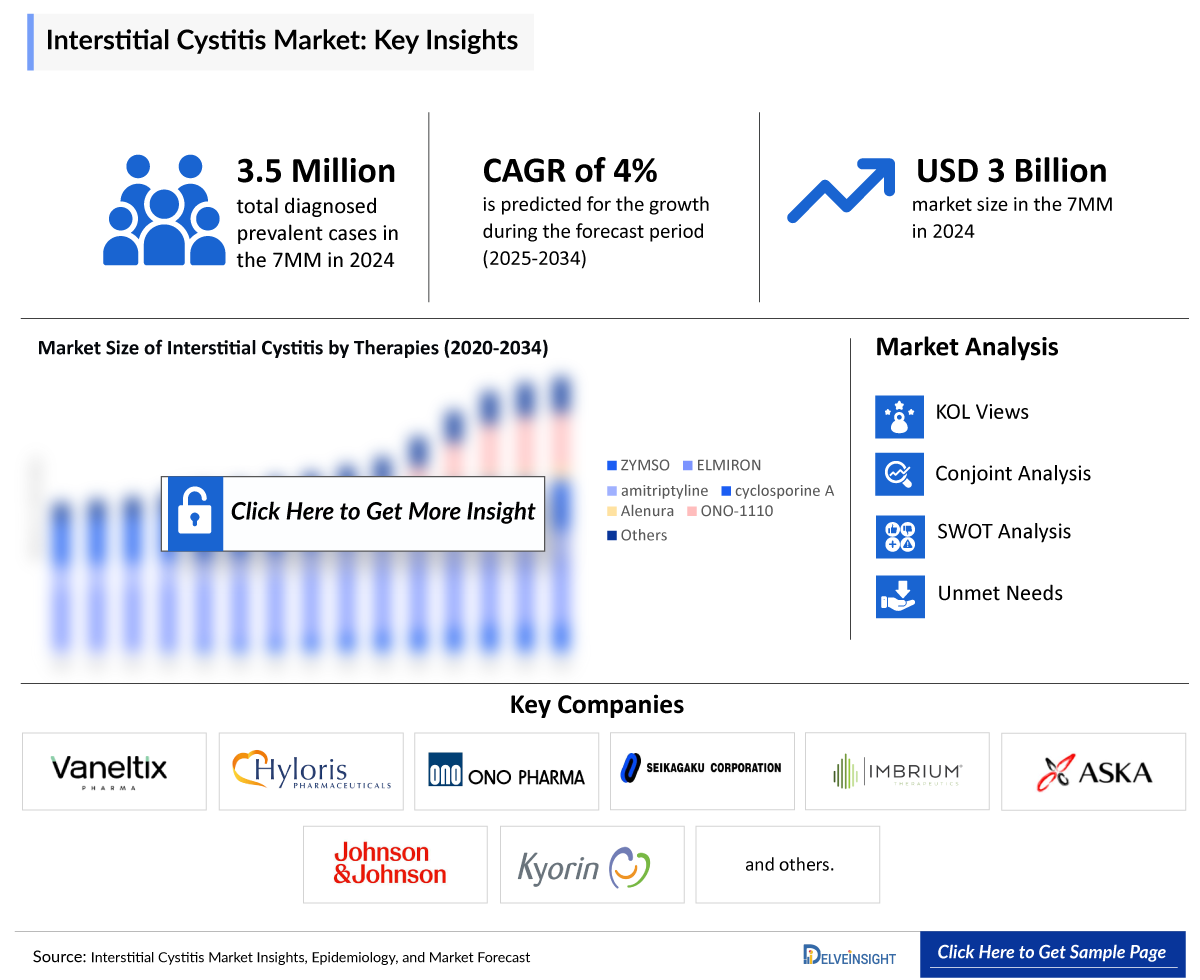
- In 2025, the total diagnosed prevalent cases of interstitial cystitis were approximately 3.5 million in the 7MM, reflecting a significant clinical burden.
DelveInsight analysis indicates that in 2025, the US accounted for the largest share of interstitial cystitis cases in the 7MM, representing more than 55% of the total prevalent cases. - Treatment typically begins with lifestyle and dietary modifications, pelvic floor physical therapy, and bladder retraining to reduce symptom burden and avoid known triggers.
- When conservative measures are ineffective, treatment may involve pharmacologic options like amitriptyline, cyclosporine A, or intravesical agents such as DMSO, heparin, or lidocaine, tailored to symptom severity and the presence of Hunner lesions. For refractory cases, advanced therapies including botulinum toxin A, sacral neuromodulation, or surgery may be considered.
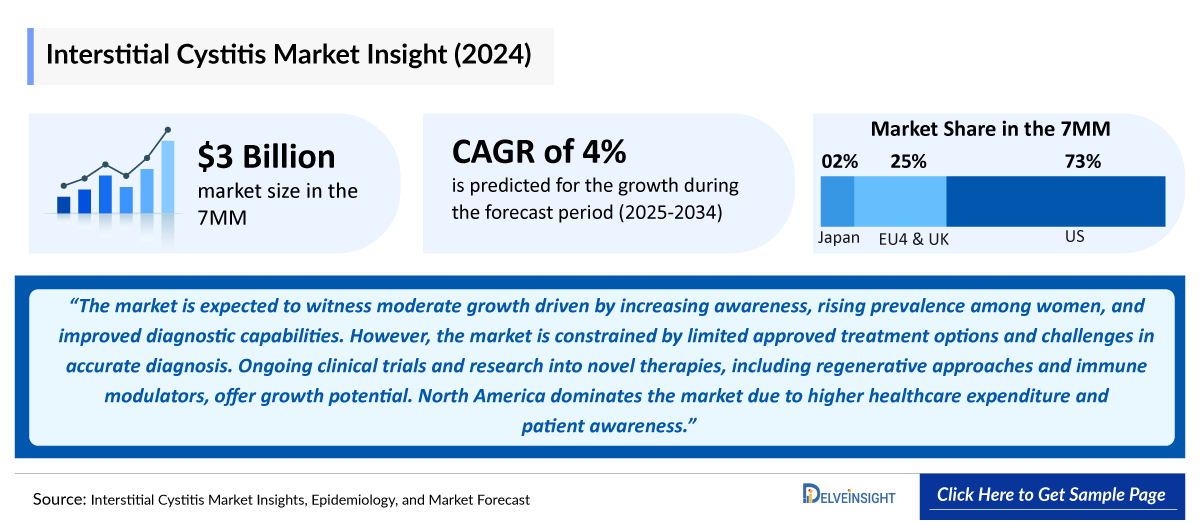
- In 2025, the United States accounted for the largest share of the interstitial cystitis market among the 7MM, with more than USD 2 billion, highlighting its significant patient population and established treatment landscape.
Within the EU4 and the UK, Germany had the highest market size at ~USD 290 million in 2025, followed by the UK (USD ~190 million) and France (USD ~100 million). These markets are expected to experience consistent growth over the forecast period. - The interstitial cystitis pipeline shows promising advancement with diverse therapies under development, including Vaneltix Pharma’s ALENURA, Ono Pharmaceutical’s ONO-1110, Seikagaku Corporation’s SI-722, Imbrium Therapeutics Sunobinop, and Aska Pharmaceutical’s AKP-021. These candidates aim to improve symptom control through novel mechanisms, reflecting growing efforts to address the condition’s significant unmet need.
Factors Impacting the Interstitial Cystitis Market Growth
Increasing Interstitial Cystitis Prevalence and Awareness
The rising prevalence of interstitial cystitis, particularly among women, is a primary driver for the interstitial cystitis market growth. In 2025, females represented approximately 60% of interstitial cystitis cases in the US, while males accounted for about 40% cases. This gender disparity reflects a significantly higher burden of disease among women, emphasizing the need for tailored research and treatment strategies. Enhanced awareness among healthcare providers and patients is leading to better diagnosis and treatment, thereby expanding the patient base and market demand.
Advancements in Diagnostic Techniques
Improvements in diagnostic methods are facilitating earlier and more accurate detection of interstitial cystitis, which is crucial for effective treatment and management.
Emerging Therapies for Interstitial Cystitis
The interstitial cystitis treatment landscape is evolving, with several promising therapies currently in the pipeline, including ALENURA (lidocaine + heparin) by Vaneltix Pharma/Hyloris Pharma, ONO-1110 by Ono Pharmaceutical, SI-722 by Seikagaku Corporation, Sunobinop (V117957) by Imbrium Therapeutics, and AKP-021 by Aska Pharmaceutical.
Interstitial Cystitis Market Report Summary
- The report offers extensive knowledge regarding the epidemiology segments and predictions, presenting a deep understanding of the potential future growth in diagnosis rates, disease progression, and treatment guidelines. It provides comprehensive insights into these aspects, enabling a thorough assessment of the subject matter.
- Additionally, an all-inclusive account of the current management techniques and emerging therapies and the elaborative profiles of late-stage (Phase III and Phase II) and prominent therapies that would impact the current treatment landscape and result in an overall market shift has been provided in the report.
- The report also encompasses a comprehensive analysis of the interstitial cystitis market, providing an in-depth examination of its historical and projected market size (2022–2036). It also includes the market share of therapies, detailed assumptions, and the underlying rationale for our methodology. The report also includes drug outreach coverage in the 7MM region.
- The report includes qualitative insights that provide an edge while developing business strategies by understanding trends through SWOT analysis and expert insights/KOL views, including experts from various hospitals and prominent universities, patient journey, and treatment preferences that help shape and drive the 7MM interstitial cystitis market.
The table given below further depicts the key segments provided in the report:
|
Study Period |
2022–2036 |
|
Forecast Period |
2026–2036 |
|
Geographies Covered |
US, EU4 (Germany, France, Italy, and Spain) and the UK, and Japan |
|
Epidemiology |
Segmented by:
|
|
Market |
Segmented by:
|
|
Market Analysis |
|
Interstitial Cystitis Drug Analysis
The section dedicated to drugs in the interstitial cystitis report provides an in-depth evaluation of late-stage pipeline drugs (Phase III and Phase II) related to interstitial cystitis. The drug chapters section provides valuable information on various aspects related to clinical trials of interstitial cystitis, such as the pharmacological mechanisms of the drugs involved, designations, approval status, patent information, and a comprehensive analysis of the pros and cons associated with each drug. Furthermore, it presents the most recent news updates and press releases on drugs targeting interstitial cystitis.
Interstitial Cystitis Marketed Therapies
ELMIRON (pentosan polysulfate sodium): Johnson & Johnson
ELMIRON is a semi-synthetically produced heparin-like macromolecular carbohydrate derivative, which chemically and structurally resembles glycosaminoglycans. It is a white odorless powder, slightly hygroscopic and soluble in water to 50% at pH 6. ELMIRON is supplied in white opaque hard gelatin capsules containing 100 mg pentosane polysulfate sodium, microcrystalline cellulose, and magnesium stearate. It is formulated for oral use.
In June 2017, ELMIRON received marketing authorisation from the European Commission, granting approval across the entire European Union for the treatment of interstitial cystitis.
ZYMSO (Dimethyl Sulfoxide): KYORIN Pharmaceuticals
ZYMSO is an intravesical solution containing 50% dimethyl sulfoxide (DMSO). ZYMSO offers a targeted, non-systemic option for patients with refractory Hunner-type interstitial cystitis. By administering high-concentration DMSO directly into the bladder, it delivers potent local anti-inflammatory and analgesic effects with a known safety profile.
In January 2021, Kyorin Pharmaceutical obtained marketing authorization from the Ministry of Health, Labour and Welfare (MHLW) for ZYMSO Intravesical Solution 50%, a treatment developed for interstitial cystitis.
|
Drug Name |
Company |
Indication |
Approval |
RoA |
MoA |
Molecule Type |
|
ELMIRON (pentosan polysulfate sodium) |
Johnson & Johnson |
Interstitial cystitis | US: 1996; EU: 2017 |
Oral |
Cell membrane permeability inhibitors |
Low molecular weight heparin-like compound |
|
ZYMSO (Dimethyl Sulfoxide) |
KYORIN Pharmaceuticals |
Hunner type interstitial cystitis |
JP: 2021 |
Intravesical instillation |
Anti-inflammatory and analgesic effects |
Small molecule |
Interstitial Cystitis Emerging Therapies
ALENURA (Lidocaine + Heparin): Vaneltix Pharma/Hyloris Pharma
ALENURA is a combination product of the glycosaminoglycan heparin and alkalinized lidocaine, which provides immediate pain relief to patients experiencing acute painful episodes of interstitial cystitis. ALENURA is supplied as a prefilled syringe for intravesicular installation into the bladder for on-demand relief of acute pain episodes. As of 2026, a second Phase II clinical trial of ALENURA is underway an open-label study evaluating the safety and efficacy of multiple doses in patients experiencing episodes of acute bladder pain and interstitial cystitis. The trial is currently in the recruiting phase.
|
Drug Name |
Company |
MoA |
RoA |
Phase |
Molecule Type |
Patient Segment |
|
ALENURA (Lidocaine + Heparin) |
Vaneltix Pharma/Hyloris Pharma |
Dual target (anaesthetic/augments the natural GAG layer)/glycosaminoglycan stimulants |
Intravesical instillation |
II |
Small molecule |
Bladder pain in patients with IC/BPS who have an episode of acute bladder pain of moderate-to-severe intensity, and ≥ 18 years of age. |
|
ONO-1110 |
Ono Pharmaceutical |
Endocannabinoid regulation |
Oral |
II |
Small molecules |
Hunner type interstitial cystitis and 18 years and older |
|
SI-722 |
Seikagaku Corporation |
Steroid conjugated with chondroitin sulfate |
Intravesical instillation |
I/II |
Small molecules |
IC/BPS subjects conditions |
|
Sunobinop (V117957) |
Imbrium Therapeutics |
Nociceptin/orphanin-FQ peptide receptor agonists |
Oral |
I |
Small molecules |
Female subjects with IC/BPS |
|
AKP-021 |
Aska Pharmaceutical |
mPGES-1 inhibitor |
-- |
I |
Small molecules |
Heathy patients |
Interstitial Cystitis Market Outlook
During the forecast period (2026–2036), pipeline candidates such as Vaneltix Pharma’s ALENURA, Ono Pharmaceutical’s ONO-1110, Seikagaku Corporation’s SI-722, Imbrium Therapeutics Sunobinop, and Aska Pharmaceutical’s AKP-021, and others are expected to drive the rise in interstitial cystitis market size
- During the forecast period (2026–2036), pipeline candidates such as Vaneltix Pharma’s ALENURA, Ono Pharmaceutical’s ONO-1110, Seikagaku Corporation’s SI-722, Imbrium Therapeutics Sunobinop, and Aska Pharmaceutical’s AKP-021, and others are expected to drive the rise in interstitial cystitis market size
- In 2025, the market size of interstitial cystitis in the 7MM was approximately USD 3 billion, and it is projected to grow steadily through 2036.
- Within the EU4 and the UK, Germany had the highest market size at approximately USD 290 million in 2025, followed by the UK (USD ~190 million) and France (USD ~100 million).
- The interstitial cystitis market in Japan was valued at around USD ~60 million in 2026, reflecting a smaller but gradually expanding patient population and growing awareness of the condition.
- Overall, the 7MM interstitial cystitis market is projected to grow steadily, driven by increasing diagnosis rates, rising patient awareness, and continued adoption of both established and emerging therapies.
Further details are provided in the report…
Interstitial Cystitis Disease Understanding
Interstitial Cystitis Overview
Interstitial cystitis, is a chronic pelvic condition lasting over six weeks, characterized by bladder-related pain, pressure, or discomfort. It involves ongoing inflammation and urinary symptoms like urgency and frequency, without evidence of infection or another identifiable cause.
Patients often experience bladder or suprapubic pain with an urgent need to urinate, which worsens as the bladder fills and eases temporarily after voiding—leading to frequent day and night urination. Additional symptoms may include burning during urination and sexual discomfort, significantly impacting emotional, psychological, and social well-being.
The pathophysiology of interstitial cystitis is not fully understood, but it involves chronic inflammation, nerve hypersensitivity, mast cell activation, urothelial damage, and GAG layer dysfunction. Inflammatory markers like CRP, TNF-a, and NGF support inflammation as a central mechanism. The condition may manifest with or without visible inflammation, is often linked to autoimmune disorders, and is exacerbated by chronic stress and central sensitization.
Further details are provided in the report…
Interstitial Cystitis Diagnosis
Interstitial cystitis is primarily diagnosed based on clinical symptoms and by ruling out other urological, gynecological, or infectious conditions. According to AUA guidelines, cystoscopy and urodynamic studies are not mandatory but may be useful in unclear or severe cases. Laboratory tests such as CBC, CMP, urinalysis, and STI screening are typically performed. Hunner ulcers, when present, are considered diagnostic and may warrant targeted treatments like fulguration or steroid injections.
Biomarkers like TNF-a and IL-6 may be elevated, though their diagnostic role is still under review. Cystoscopy with hydrodistension and bladder biopsy can help exclude malignancy, especially in older patients. Glomerulations are nonspecific and not diagnostic on their own. Ultimately, diagnosis is based on persistent symptoms lasting over six weeks, exclusion of other causes, and, when applicable, supportive cystoscopic findings.
Further details related to country-based variations are provided in the report…
Interstitial Cystitis Treatment
Interstitial cystitis management primarily aims at symptom relief through a trial-and-error approach, as no single therapy proves universally effective. Initial treatment focuses on conservative measures, including dietary modifications, bladder training, stress management, and pelvic floor relaxation. Standard pelvic exercises like Kegels are discouraged as they may worsen symptoms.
Pharmacological options include oral agents such as amitriptyline, cyclosporine A, hydroxyzine, gabapentin, and pentosan polysulfate, although their efficacy and tolerability vary. Intravesical therapies like DMSO, heparin, lidocaine, and triamcinolone are often used in combination. Botulinum toxin A is reserved for refractory cases and requires patients to be capable of self-catheterization. Advanced options include sacral or tibial neuromodulation, cystoscopy-guided fulguration of Hunner lesions, and, in severe cases, surgical interventions like bladder augmentation or urinary diversion.
Investigational therapies under study include monoclonal antibodies, stem cells, PRP, liposomes, and antiviral agents such as valacyclovir. These approaches reflect an evolving treatment landscape targeting the diverse and often unclear pathophysiology of interstitial cystitis.
Further details related to treatment and management are provided in the report…
Interstitial Cystitis Epidemiology
The interstitial cystitis epidemiology chapter in the report provides historical as well as forecasted epidemiology segmented by prevalent cases, total diagnosed prevalent cases, age-specific cases of interstitial cystitis, gender-specific cases, severity-specific cases, type-specific cases, total treated cases of interstitial cystitis in the United States, EU4 countries (Germany, France, Italy, Spain) and the United Kingdom, and Japan from 2020 to 2034.
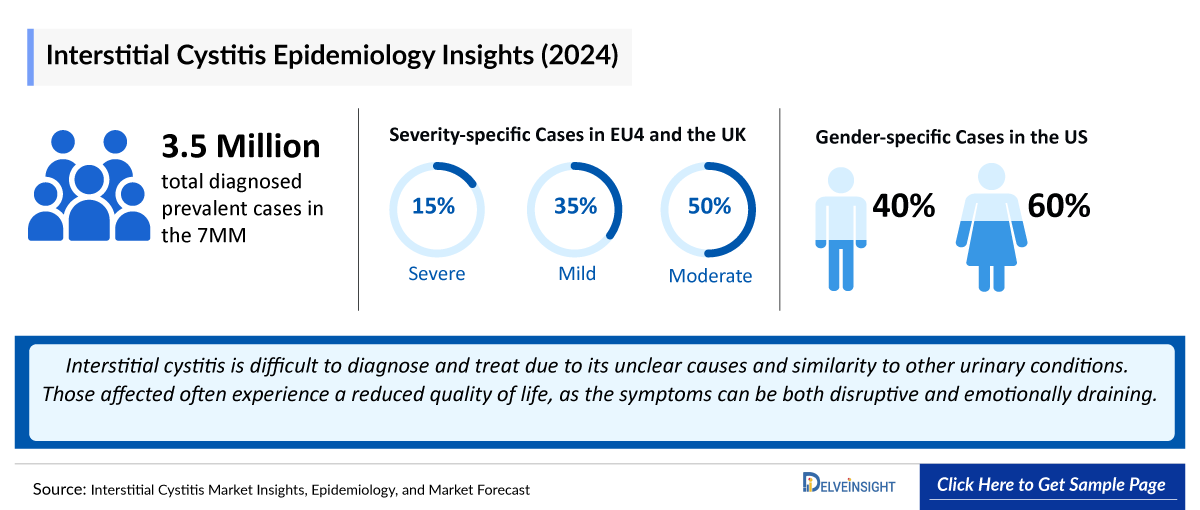
- In 2025, the total diagnosed prevalent cases of Interstitial Cystitis in the 7MM were approximately 3.5 million.
- DelveInsight analysis indicates that in 2025, the US accounted for the largest share of interstitial cystitis cases in the 7MM, representing more than 55% of the total prevalent cases.
- In 2025, females represented approximately 60% of interstitial cystitis cases in the US, while males accounted for about 40% cases, indicating a clear female predominance. The persistent gender disparity highlights a significantly higher burden of disease among women.
Latest KOL Views on Interstitial Cystitis
To stay abreast of the latest trends in the market, we conduct primary research by seeking the opinions of Key Opinion Leaders (KOLs) and Subject Matter Experts (SMEs) who work in the relevant field. This helps us fill any gaps in data and validate our secondary research.
We have reached out to industry experts to gather insights on various aspects of interstitial cystitis, including the evolving treatment landscape, patients’ reliance on conventional therapies, their acceptance of therapy switching, drug uptake, and challenges related to accessibility. The experts we contacted included medical/scientific writers, professors, and researchers from prestigious universities in the US, Europe, the UK, and Japan.
Our team of analysts at Delveinsight connected with more than 10 KOLs across the 7MM. We contacted institutions such as the University of Munich, the University of Tokyo, Brady Urological Institute, and University of Minnesota, etc., among others. By obtaining the opinions of these experts, we gained a better understanding of the current and emerging treatment patterns in the interstitial cystitis market, which will assist our clients in analyzing the overall epidemiology and market scenario.
Interstitial Cystitis Report Qualitative Analysis
We perform Qualitative and Market Intelligence analysis using various approaches, such as SWOT analysis. In the SWOT analysis, strengths, weaknesses, opportunities, and threats in terms of disease diagnosis, patient awareness, patient burden, competitive landscape, cost-effectiveness, and geographical accessibility of therapies are provided. These pointers are based on the Analyst’s discretion and assessment of the patient burden, cost analysis, and existing and evolving treatment landscape.
Interstitial Cystitis Market Access and Reimbursement
Because newly authorized drugs are often expensive, some patients escape receiving proper treatment or use off-label, less expensive prescriptions. Reimbursement plays a critical role in how innovative treatments can enter the market. The cost of the medicine, compared to the benefit it provides to patients who are being treated, sometimes determines whether or not it will be reimbursed. Regulatory status, target population size, the setting of treatment, unmet needs, the number of incremental benefit claims, and prices can all affect market access and reimbursement possibilities.
Johnson and Johnson offers the ELMIRON Savings Program to reduce prescription costs for eligible patients. Those with commercial or private insurance may pay as little as USD 25 for a 30-day supply, with a monthly benefit cap of USD 300 and an annual maximum of USD 3,600. The program is not available to patients enrolled in Medicare, Medicaid, or other government-funded insurance plans. Eligibility requirements apply, and the offer is subject to change or discontinuation at any time. Cost assistance is provided directly to patients and is not intended for insurers or their affiliates.
The report further provides detailed insights on the country-wise accessibility and reimbursement scenarios, cost-effectiveness scenario of approved therapies, programs making accessibility easier and out-of-pocket costs more affordable, insights on patients insured under federal or state government prescription drug programs, etc.
Recent developments
- In March 2025, Hyloris Pharmaceuticals announced a positive interim review outcome for the ALENURA clinical trial, with the Independent Data Monitoring Committee (IDMC) recommending continuation of the study. Patient enrollment is expected to be completed by the end of 2025. ALENURA is being developed as a potential first-line treatment for interstitial cystitis.
- As of 2025, Ono Pharmaceutical’s ONO-1110 continued in Phase II clinical development for interstitial cystitis and related pain disorders. In 2026, a Phase IIa randomized placebo-controlled study evaluating ONO-1110 in patients with Hunner Type Interstitial Cystitis was reported as active and ongoing.
- In March 2025, Imbrium Therapeutics, a subsidiary of Purdue Pharma, announced completion of the final patient visit in its Phase 1b clinical trial evaluating Sunobinop (V117957) for interstitial cystitis/bladder pain syndrome (IC/BPS).
- In September 2025, Purdue Pharma announced positive preliminary Phase 1b results for Sunobinop, showing improvements in bladder pain, urinary urgency, and urinary frequency in IC/BPS patients.
Interstitial Cystitis Report Insights
- Patient Population
- Therapeutic Approaches
- Interstitial Cystitis Market Size and Trends
- Existing Market Opportunity
Interstitial Cystitis Report Key Strengths
- Ten-year Forecast
- The 7MM Coverage
- Interstitial Cystitis Epidemiology Segmentation
- Key Cross Competition
Interstitial Cystitis Report Assessment
- Current Treatment Practices
- Reimbursements
- Market Attractiveness
- Qualitative Analysis (SWOT, Unmet needs)
Key Questions Answered in the Interstitial Cystitis Report
- Would there be any changes observed in the current treatment approach?
- Will there be any improvements in interstitial cystitis management recommendations?
- Would research and development advances pave the way for future tests and therapies for interstitial cystitis?
- Would the diagnostic testing space experience a significant impact and lead to a positive shift in the treatment landscape of interstitial cystitis?
- What kind of uptake will the new therapies witness in the coming years in interstitial cystitis patients?