Intracranial Pressure Monitoring Devices Market Summary
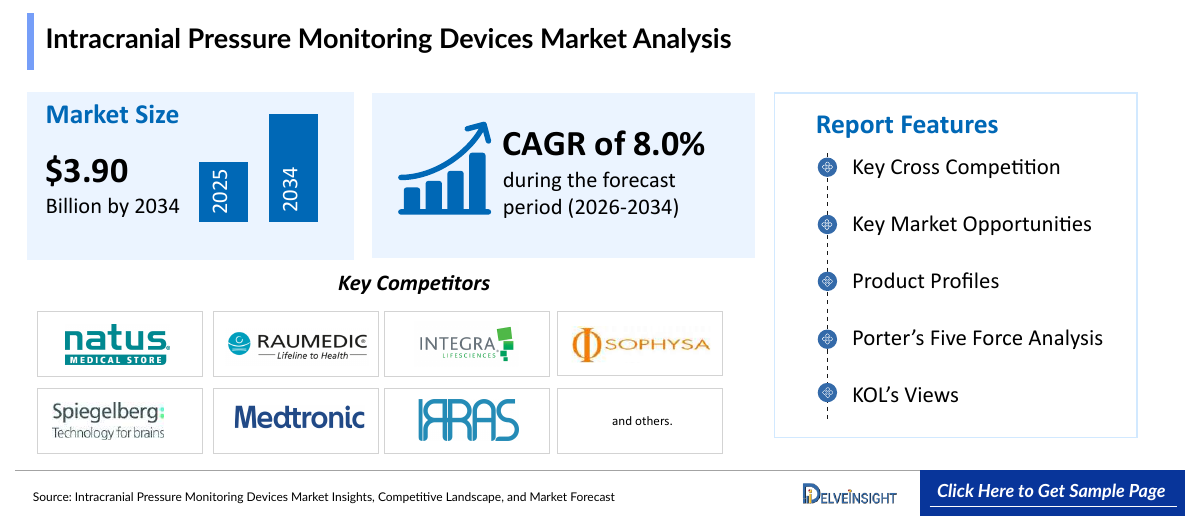
- The Intracranial Pressure Monitoring Devices market is estimated at USD 1.95 billion in 2025 and is projected to reach USD 3.90 billion by 2034. Growth is anchored in the rising burden of traumatic brain injury and other neurological emergencies, guideline-supported adoption of ICP monitoring in neurocritical care, and continued innovation in microtransducer, multimodal, and noninvasive monitoring technologies.
- The global Intracranial Pressure Monitoring Devices market is growing at a CAGR of 8.0% during the forecast period from 2026 to 2034.
- By technique, the invasive segment dominated the Intracranial Pressure Monitoring Devices market with a 78% share in 2025.
- By product type, the catheters and kits segment dominated the Intracranial Pressure Monitoring Devices market with a 41% share in 2025.
- By application, the traumatic brain injury segment dominated the Intracranial Pressure Monitoring Devices market with a 61% share in 2025.
- By end-user, the hospitals segment dominated the Intracranial Pressure Monitoring Devices market with an 86% share in 2025.
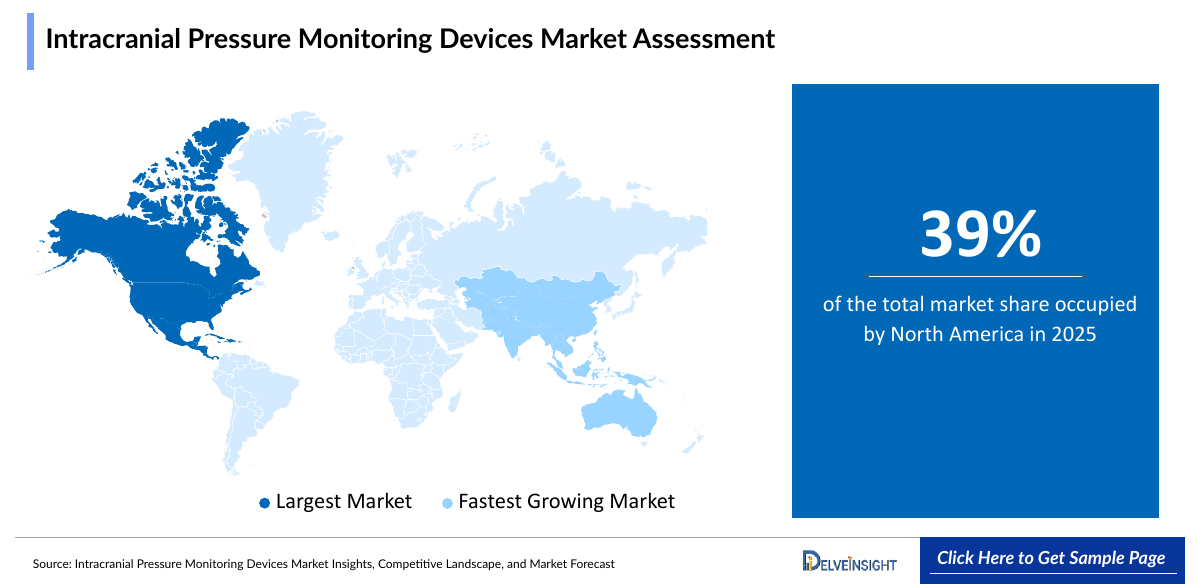
- North America dominated the global Intracranial Pressure Monitoring Devices market revenue with a 39% share in 2025, representing the highest regional market share globally.
Intracranial pressure (ICP) monitoring devices measure the pressure inside the skull in patients at risk of intracranial hypertension, enabling clinicians to guide cerebral perfusion pressure, cerebrospinal fluid (CSF) drainage, and other neurocritical care interventions. Elevated ICP can reduce cerebral blood flow and cause brain herniation, so continuous measurement is a cornerstone of care for patients with severe traumatic brain injury, intracerebral hemorrhage, meningitis, hydrocephalus, and other acute neurological conditions. The devices span monitors that display and record pressure waveforms; probes and microtransducer sensors placed in the brain parenchyma; catheters and kits used for external ventricular drainage (EVD), which both measure pressure and drain CSF; and accessories. The market is organized by technique across invasive methods, including EVD and microtransducer ICP monitoring, and noninvasive methods, including transcranial Doppler ultrasonography and MRI/CT; by product type across monitors, probes, catheters and kits, and others; by application across traumatic brain injury, intracerebral hemorrhage, meningitis, and others; by end-user across hospitals, homecare, and others; and by geography. Driven by the growing neurotrauma burden, expanding neurocritical care capacity, and ongoing innovation toward wireless, multimodal, and noninvasive monitoring, ICP monitoring devices have become essential infrastructure in the management of acute brain injury.
Intracranial Pressure Monitoring Devices Market Key Growth Drivers
- The rising burden of traumatic brain injury (TBI) is driving demand, with an estimated 69 million people worldwide sustaining a TBI each year according to a widely cited 2018 Journal of Neurosurgery analysis.
- Clinical guidelines, including the Brain Trauma Foundation guidelines for severe TBI, support ICP monitoring in high-risk patients, sustaining routine use in trauma centers and neurointensive care units.
- The growing incidence of intracerebral hemorrhage, stroke, meningitis, and hydrocephalus, together with population aging and fall-related head injuries, is widening the pool of patients who require ICP assessment.
- Technological advances, including MR-conditional microtransducer sensors, multimodal monitoring that combines ICP with brain oxygenation and temperature, and FDA-cleared noninvasive systems, are expanding clinical options and improving accuracy.
- Expansion of neurocritical care, trauma-center networks, and neurosurgical capacity, particularly across Asia-Pacific and other emerging regions, is increasing access to ICP monitoring.
- Integrated platforms that combine ICP monitoring with therapeutic functions, such as active intracranial fluid exchange with continuous ICP measurement, are creating new value and procedure volumes.
- The convergence of neurotrauma burden, guideline support, technological innovation, and industry consolidation is expected to sustain solid high-single-digit growth in the market through 2034.
Key Companies in Intracranial Pressure Monitoring Devices Market
The competitive landscape is led by the following active manufacturers:
- Natus Medical Incorporated
- RAUMEDIC AG
- Integra LifeSciences
- Sophysa
- Spiegelberg GmbH & Co. KG
- Medtronic
- IRRAS AB
- Luciole Medical AG
- Saeum Meditec
- Recorders & Medicare Systems P Ltd.
For illustrative purposes, only the top 10 companies are listed in the Table of Contents. The report may include analysis and references to additional companies relevant to the market assessment.
Intracranial Pressure Monitoring Devices Market Size
The following snapshot summarizes the principal report metrics for the Intracranial Pressure Monitoring Devices market.
|
Report Metrics |
Details |
|
2025 Market Size |
USD 1.95 billion |
|
2034 Projected Market Size |
USD 3.90 billion |
|
Growth Rate (2026-2034) |
8.0% CAGR |
|
Largest Market |
North America |
|
Fastest Growing Market |
Asia-Pacific |
|
Market Structure |
Moderately Concentrated |
All market values are expressed in USD and represent DelveInsight estimates synthesized from primary and secondary research.
Factors Contributing to the Growth of the Intracranial Pressure Monitoring Devices Market
Market Drivers
Rising Burden of Traumatic Brain Injury and Neurological Emergencies
The most powerful driver of the Intracranial Pressure Monitoring Devices market is the rising burden of traumatic brain injury and other acute neurological conditions. An estimated 69 million people worldwide sustain a TBI each year, with road traffic crashes, falls, and violence the leading causes, and a meaningful share of cases are moderate to severe and require neurocritical care. Severe TBI, intracerebral hemorrhage, aneurysmal subarachnoid hemorrhage, and meningitis can all cause intracranial hypertension, which reduces cerebral perfusion and can lead to herniation, secondary injury, and death if not detected and treated promptly. ICP monitors, probes, and EVD catheters allow clinicians to track pressure continuously and to titrate osmotherapy, CSF drainage, sedation, and surgical decisions. As trauma incidence rises, particularly in rapidly motorizing economies, and as ageing populations experience more fall-related head injuries and hemorrhagic events, demand for ICP monitoring devices expands directly, anchoring market growth through 2034.
Guideline Support for ICP Monitoring in Severe Brain Injury
Clinical guidelines and expert consensus reinforce routine use of ICP monitoring in high-risk patients. The Brain Trauma Foundation guidelines for the management of severe TBI recommend ICP monitoring in salvageable patients with severe injury and abnormal imaging, and the 2019 Seattle International Severe Traumatic Brain Injury Consensus Conference set out practical, tiered recommendations on when and how to monitor and treat ICP. Level 1 trauma centers and neurointensive care units build their protocols around these standards, creating durable, repeatable demand for monitors, probes, and disposable catheter kits. Although the 2012 BEST-TRIP randomized trial in Bolivia and Ecuador found no outcome advantage for ICP-guided care over care guided by imaging and clinical examination, it has refined rather than removed the role of monitoring, sharpening focus on protocol-driven, goal-directed management. Guideline alignment therefore continues to support procurement and standardization of ICP monitoring across hospital systems.
Growing Incidence of Intracerebral Hemorrhage, Stroke, and CNS Infections
Beyond trauma, a broadening set of neurological conditions requires ICP assessment. Intracerebral hemorrhage, ischemic stroke with malignant edema, hydrocephalus, subarachnoid hemorrhage, and bacterial or fungal meningitis can each raise intracranial pressure, and incidence is increasing as populations age and cardiovascular risk factors such as hypertension persist. Hemorrhagic stroke in particular is associated with high mortality and frequently requires EVD placement for CSF diversion and pressure monitoring. Meningitis remains a significant cause of morbidity in low- and middle-income regions, where ICP management in the intensive care unit is gradually expanding. These applications extend the addressable patient population beyond TBI and encourage hospitals to maintain a full range of EVD, microtransducer, and noninvasive options. As diagnosis improves and more patients survive the acute phase, the number of patients who need structured ICP assessment rises, supporting sustained market growth across the forecast period.
Technological Advancement and Noninvasive Innovation
Continuous innovation is improving the accuracy, safety, and convenience of ICP monitoring. Microtransducer systems offer low drift and MR-conditional capability, as illustrated by Integra LifeSciences' April 2024 relaunch of its CereLink ICP Monitoring System, while integrated platforms combine EVD, ICP, and temperature measurement in a single catheter. Multimodal monitoring that pairs ICP with brain tissue oxygenation, cerebral blood flow, and temperature is gaining traction, with players such as Luciole Medical developing minimally invasive optical sensors for brain oxygenation, ICP, and blood flow. In parallel, noninvasive approaches, including transcranial Doppler ultrasonography, optic nerve sheath diameter assessment, and wearable pulsatile-waveform sensors such as the FDA-cleared brain4care system, aim to identify patients who need invasive monitoring and to extend monitoring to settings where neurosurgical placement is impractical. Noninvasive devices are projected to be the fastest-growing technique segment, widening the market beyond traditional neurosurgical settings.
Expansion of Neurocritical Care and Trauma Infrastructure
Investment in neurocritical care capacity is a structural growth engine. Governments and hospital groups across Asia-Pacific, the Middle East, and Latin America are building trauma centers, neurosurgical units, and dedicated neuro-intensive care beds, and training intensivists and neurosurgeons to use ICP monitoring protocols. In China, India, South Korea, and Southeast Asia, rapid urbanization, increasing vehicle ownership, and rising road-traffic injuries create a large neurotrauma caseload, while public-health programs improve pre-hospital transport and emergency neurosurgical response. In mature markets, consolidation of stroke and trauma care into comprehensive centers concentrates procedure volumes and standardizes device purchasing. This infrastructure build-out expands the installed base of monitors and drives recurring consumption of probes, catheters, and kits, supporting both volume and geographic diversification of demand through 2034.
Integrated Therapeutic and Monitoring Platforms
A growing set of products combines monitoring with active therapy, creating new procedure volumes and higher-value disposables. The IRRAflow system, for example, integrates continuous irrigation, aspiration, and real-time ICP monitoring through a proprietary dual-lumen catheter for conditions such as intracerebral hemorrhage and chronic subdural hematoma, and has been commercialized in the United States with support from a Medtronic sales agency agreement signed in November 2022. Hybrid EVD systems that combine drainage, pressure monitoring, and temperature sensing, and monitor platforms that connect to bedside multimodal systems, increase the clinical value of each placement and encourage hospitals to adopt integrated portfolios. These platforms also support emerging concepts such as targeted intracranial drug delivery. As clinicians move from passive pressure measurement toward active, closed-loop management of intracranial fluid, demand for advanced catheters, kits, and control units is expected to rise through the forecast period.
Industry Consolidation and Strategic Investment
Active consolidation and strategic investment are strengthening the supply base and accelerating innovation. ArchiMed completed its acquisition of Natus Medical, owner of the Camino ICP franchise, in a transaction valued at roughly USD 1.2 billion in 2022. Luciole Medical AG acquired Spiegelberg GmbH & Co. KG in 2023 to combine its next-generation brain-monitoring sensors with Spiegelberg's manufacturing, regulatory, and commercial reach across more than sixty countries, and ClearPoint Neuro agreed in November 2025 to acquire IRRAS, maker of the IRRAflow system. These transactions bring capital, regulatory expertise, and global distribution to specialized neuro-monitoring technologies and signal confidence in the long-term growth of neurocritical care. Consolidation also encourages portfolio breadth across monitors, probes, and catheters, supports broader geographic reach, and sharpens competition around product differentiation and clinical evidence across the forecast period.
Market Restraints
Despite solid momentum, the Intracranial Pressure Monitoring Devices market faces material constraints. Invasive monitoring requires neurosurgical placement and carries risks of infection, hemorrhage, catheter malfunction, and device-related complications, which can limit use in lower-risk patients and in settings without neurosurgical expertise. The high cost of monitors, microtransducer probes, and disposable kits, together with the cost of the neurosurgical procedures and intensive care stays that accompany them, restricts adoption in cost-sensitive health systems and emerging economies. Noninvasive techniques such as transcranial Doppler ultrasonography and imaging remain limited by operator dependence, intermittent rather than continuous measurement, and the lack of sufficient validation against invasive gold standards, which tempers their clinical acceptance. Evidence debates, including the BEST-TRIP trial result that ICP-guided care did not outperform imaging- and examination-guided care, encourage selective rather than universal monitoring. A shortage of trained neurosurgeons and neurointensivists, uneven reimbursement, and stringent regulatory requirements, including FDA 510(k) clearance and compliance with the EU Medical Device Regulation, lengthen development timelines and raise costs. Post-market quality events, such as software-related field safety notices, can also disrupt supply and erode clinician confidence. Together, these clinical, economic, evidence, workforce, and regulatory barriers temper the pace of growth, even as the underlying drivers of neurotrauma burden, guideline support, and technological innovation remain firmly intact.
Intracranial Pressure Monitoring Devices Market Segment Analysis
The Intracranial Pressure Monitoring Devices Market is segmented by technique (invasive [external ventricular drainage (EVD), microtransducer ICP monitoring], noninvasive [Transcranial Doppler Ultrasonography, MRI/CT, others]), product type (monitors, probes, catheters and kits, others), application (traumatic brain injury, intracerebral hemorrhage, meningitis, others), end-user (hospitals, homecare, and others), and geography (North America, Europe, Asia-Pacific, and Rest of World).
By Technique
Dominant Subsegment: Invasive ICP Monitoring.
The invasive segment accounted for 78% of the Intracranial Pressure Monitoring Devices market in 2025. Invasive monitoring remains the leading technique because it is the clinical reference standard for continuous, quantitative ICP measurement and is explicitly referenced in severe TBI guidelines. External ventricular drainage is widely regarded as the gold standard because it measures pressure while also allowing therapeutic CSF drainage and sampling, and is the default choice for patients with hydrocephalus, intraventricular hemorrhage, or subarachnoid hemorrhage. Microtransducer systems, which place a fiberoptic or strain-gauge sensor in the brain parenchyma, deliver low-drift, high-fidelity readings with a lower infection and blockage burden than fluid-coupled systems and are increasingly MR-conditional. The depth of installed base, established neurosurgical workflows, and recurring demand for disposable catheters and probes secure the segment's dominance. Noninvasive techniques, including transcranial Doppler ultrasonography, MRI/CT-based assessment, and wearable waveform sensors, are the fastest-growing technique segment as clinicians seek bedside, lower-risk screening tools, but they are used mainly to triage patients or complement rather than replace invasive monitoring, which keeps the invasive segment in clear leadership across the forecast period.
By Product Type
Dominant Subsegment: Catheters And Kits.
The catheters and kits segment accounted for 41% of the Intracranial Pressure Monitoring Devices market in 2025. Catheters and kits lead the product mix because they are single-use consumables required for every EVD and many parenchymal placements, generating recurring revenue tied directly to procedure volumes. EVD kits typically bundle ventricular catheters, drainage bags, transducers, and insertion accessories, and newer designs integrate pressure and temperature sensing or antimicrobial coatings to reduce infection risk. Hospitals prefer standardized, sterile, ready-to-use kits that shorten setup time and reduce contamination risk in the operating room and ICU. Monitors form a capital-equipment base that is replaced on multi-year cycles, while probes, which carry the microtransducer sensor, are premium-priced and growing steadily as parenchymal monitoring gains share. The recurring, high-volume nature of consumable catheters and kits secures the segment's leadership across the forecast period.
By Application
Dominant Subsegment: Traumatic Brain Injury.
The traumatic brain injury segment accounted for 61% of the Intracranial Pressure Monitoring Devices market in 2025. TBI is the leading application because severe injury is the principal clinical indication for ICP monitoring in established guidelines and generates the largest volume of monitoring placements across trauma centers. The global TBI burden is very large, driven by road traffic crashes, falls, sports and occupational injuries, and violence, and survivors of severe injury frequently require invasive monitoring in the first days after trauma. Neurocritical care protocols for severe TBI, including the Brain Trauma Foundation guidelines and the 2019 Seattle consensus, embed ICP thresholds and targets into treatment algorithms, reinforcing device use. Intracerebral hemorrhage is a major and growing application as EVD and integrated drainage-and-monitoring systems are used in hemorrhagic stroke, while meningitis and hydrocephalus sustain steady demand for pressure assessment and CSF diversion. The size of the neurotrauma population and the strength of guideline support secure TBI's leadership across the forecast period.
By End-User
Dominant Subsegment: Hospitals.
The hospitals segment accounted for 86% of the Intracranial Pressure Monitoring Devices market in 2025. Hospitals, including trauma centers, neurosurgical departments, and neuro-intensive care units, are the overwhelming end-user because invasive ICP monitoring requires surgical placement, sterile technique, and continuous clinical supervision that exist only in acute-care settings. Hospitals concentrate neurotrauma and stroke admissions, own the capital equipment and bedside monitoring infrastructure, and purchase the consumable catheters, probes, and kits used in each procedure. Procurement is typically made through neurosurgery and critical-care departments and standardized across hospital systems. Homecare and other settings, which include specialty clinics and ambulatory facilities, are the fastest-growing end-users as noninvasive, portable, and wireless systems enable follow-up monitoring of conditions such as shunted hydrocephalus outside the hospital. Nonetheless, the acute, procedure-driven nature of ICP monitoring keeps hospitals the dominant end-user across the forecast period.
Intracranial Pressure Monitoring Devices Market Region Analysis
Dominant Region: North America
North America accounted for 39% of the global Intracranial Pressure Monitoring Devices market revenue in 2025, representing the highest regional market share globally. The region's dominance reflects a high neurotrauma and stroke caseload, a dense network of Level I and comprehensive stroke centers, advanced neurocritical care capacity, and clear FDA regulatory pathways, particularly in the United States. North America is home to leading manufacturers and hosts the earliest adoption of new technologies, including microtransducer upgrades such as the CereLink relaunch and integrated platforms such as IRRAflow. Strong reimbursement for neurosurgical and intensive care procedures, guideline-driven clinical practice, and high per-capita healthcare spending support premium-priced probes, catheters, and kits. Ongoing consolidation, including ClearPoint Neuro's agreement to acquire IRRAS, and sustained investment in noninvasive ICP technologies reinforce the region's innovation leadership and anchor its continued dominance across the forecast period.
Fastest Growing Region: Asia-Pacific
Asia-Pacific is the fastest-growing region in the Intracranial Pressure Monitoring Devices market. The region's elevated CAGR is driven by a large and growing neurotrauma burden, rising road-traffic injuries, expanding neurosurgical and neurocritical care infrastructure, and growing healthcare investment across China, Japan, India, South Korea, and Australia. China and India are building trauma-center networks and increasing access to ICU monitoring, Japan has an ageing population with rising stroke and fall-related head injuries, and South Korea and Australia maintain advanced neurosurgical capability. Local manufacturers such as Saeum Meditec and Recorders & Medicare Systems expand affordable options, while global players broaden distribution partnerships. Rising awareness of guideline-based care, government health programs, and gradual adoption of noninvasive and portable systems are accelerating uptake, positioning Asia-Pacific as the principal source of incremental growth over the forecast period.
Regional Commentary
North America
North America accounted for 39% of the global Intracranial Pressure Monitoring Devices market revenue in 2025. The United States dominates on the strength of its trauma and stroke center network, advanced neurocritical care, FDA regulatory clarity, and strong reimbursement, while early adoption of integrated platforms, microtransducer innovations, and noninvasive technologies reinforces its leadership. Canada and Mexico contribute steady demand supported by expanding neurosurgical capacity.
Europe
Europe is a large and advanced regional market, supported by well-developed neurosurgical networks, established guideline-based care, and a concentrated base of ICP device manufacturers, including RAUMEDIC and Spiegelberg in Germany, Sophysa in France, Luciole Medical in Switzerland, and IRRAS in Sweden. Compliance with the EU Medical Device Regulation shapes product development and lifecycle management, while national health systems in Germany, France, the United Kingdom, Italy, and Spain sustain stable procedure volumes and standardized procurement of EVD and parenchymal monitoring products.
Asia-Pacific
Asia-Pacific is the fastest-growing region, propelled by a large neurotrauma burden, rapid expansion of neurocritical care infrastructure, and growing healthcare investment across China, Japan, India, South Korea, and Australia. Rising road-traffic injuries, ageing populations, domestic manufacturing by firms such as Saeum Meditec and Recorders & Medicare Systems, and increasing adoption of portable and noninvasive systems are accelerating regional growth.
Rest of World
The Rest of World region, spanning Latin America, the Middle East, and Africa, is an emerging growth frontier. Expanding trauma and neurosurgical capacity, a high burden of road-traffic injuries and CNS infections, and growing interest in affordable noninvasive technologies, supported by regional innovators such as Brazil's brain4care and clinical research in Latin America, are gradually broadening access to ICP monitoring, although affordability and workforce constraints persist.
Intracranial Pressure Monitoring Devices Market Competitive Landscape
The Intracranial Pressure Monitoring Devices market is classified as Moderately Concentrated. A group of established neurosurgical and neuro-monitoring leaders, including Integra LifeSciences, Natus Medical, Medtronic, and RAUMEDIC, anchors the top tier through broad portfolios, installed monitor bases, and long-standing hospital relationships, while specialized and fast-evolving providers such as Sophysa, Spiegelberg (now part of Luciole Medical), IRRAS, Saeum Meditec, and Recorders & Medicare Systems compete through product differentiation, integrated drainage-and-monitoring systems, minimally invasive sensors, and regional cost-competitiveness, increasing competition in noninvasive and integrated platforms.
The competitive landscape can be evaluated across the following dimensions:
- Market concentration: Moderately concentrated, with established multi-product neurosurgical players leading and a growing field of specialized sensor, drainage, and noninvasive technology providers.
- Leading players: Integra LifeSciences (Codman, CereLink, Licox), Natus Medical (Camino), Medtronic, and RAUMEDIC anchor the top tier through broad catheter, probe, and monitor portfolios.
- Geographic reach: Leaders operate global distribution networks; Spiegelberg supplies ICP and CSF drainage products in more than sixty countries, while regional players such as Saeum Meditec and Recorders & Medicare Systems serve Asia-Pacific markets.
- Product portfolio strength: Top players offer monitors, microtransducer probes, EVD catheters, and accessories, increasingly bundled into integrated kits and connected to multimodal monitoring systems.
- Clinical evidence and regulatory standing: FDA 510(k) clearance, CE marking under the EU MDR, MR-conditional labeling, and clinical validation against invasive gold standards are decisive competitive advantages.
- Strategic partnerships: Commercial tie-ups such as the November 2022 Medtronic sales agency agreement for IRRAS' IRRAflow system in the United States extend reach and accelerate adoption of new technologies.
- M&A activity: Active consolidation, including ArchiMed's roughly USD 1.2 billion acquisition of Natus Medical (2022), Natus' earlier purchase of the Camino ICP line from Integra for USD 47.5 million (2017), Luciole Medical's acquisition of Spiegelberg (2023), and ClearPoint Neuro's agreement to acquire IRRAS (November 2025).
- Manufacturing capabilities: Precision sensor fabrication, sterile single-use catheter production, quality systems, and regulatory compliance are key competitive moats.
- Innovation focus: MR-conditional low-drift microtransducers, multimodal brain monitoring, wireless and implantable sensors, noninvasive ICP estimation, and integrated drainage-and-monitoring systems.
Intracranial Pressure Monitoring Devices Market Recent Developmental Activities
In November 2025, IRRAS AB agreed to be acquired by ClearPoint Neuro for USD 5 million in cash, 1,325,000 ClearPoint shares, and a revenue share on certain products. Strategic significance: Brings the IRRAflow active fluid exchange system, which combines irrigation, aspiration, and continuous ICP monitoring, into a larger neuro-focused commercial platform.
In November 2025, Sophysa issued a field safety notice (FSN2025-04) for the Pressio2 intracranial pressure monitor, covering specified software versions and associated Pressio monitoring kits, with corrective action requested by the end of December 2025. Strategic significance: Illustrates the importance of post-market surveillance and software quality in connected ICP monitoring systems.
In April 2024, Integra LifeSciences relaunched its CereLink ICP Monitoring System and featured it at the AANS Annual Scientific Meeting in Chicago, highlighting minimal drift, MR-conditional capability, durable flexible sensors, and advanced data presentation. Strategic significance: Strengthens Integra's microtransducer ICP offering within its broad Codman neurosurgical portfolio.
In June 2023, Luciole Medical AG announced the acquisition of Spiegelberg GmbH & Co. KG from SHS Capital, combining Luciole's minimally invasive brain oxygenation, ICP, and blood-flow sensors with Spiegelberg's manufacturing, regulatory, and commercial capabilities. Strategic significance: Creates an integrated brain-monitoring developer and provider with a global supply network and an established ICP probe franchise.
Intracranial Pressure Monitoring Devices Market Segmentation
Intracranial Pressure Monitoring Devices Market by Technique
- Invasive
- External Ventricular Drainage (EVD)
- Microtransducer ICP Monitoring
- Noninvasive
- Transcranial Doppler Ultrasonography
- MRI/CT
- Others
Intracranial Pressure Monitoring Devices Market by Product Type
- Monitors
- Probes
- Catheters And Kits
- Others
Intracranial Pressure Monitoring Devices Market by Application
- Traumatic Brain Injury
- Intracerebral Hemorrhage
- Meningitis
- Others
Intracranial Pressure Monitoring Devices Market by End-User
- Hospitals
- Homecare
- Others
Intracranial Pressure Monitoring Devices Market by Geography
- North America Intracranial Pressure Monitoring Devices Market
- United States Intracranial Pressure Monitoring Devices Market Size in USD million (2023-2034)
- Canada Intracranial Pressure Monitoring Devices Market Size in USD million (2023-2034)
- Mexico Intracranial Pressure Monitoring Devices Market Size in USD million (2023-2034)
- Europe Intracranial Pressure Monitoring Devices Market
- Germany Intracranial Pressure Monitoring Devices Market Size in USD million (2023-2034)
- United Kingdom Intracranial Pressure Monitoring Devices Market Size in USD million (2023-2034)
- France Intracranial Pressure Monitoring Devices Market Size in USD million (2023-2034)
- Italy Intracranial Pressure Monitoring Devices Market Size in USD million (2023-2034)
- Spain Intracranial Pressure Monitoring Devices Market Size in USD million (2023-2034)
- Rest of Europe Intracranial Pressure Monitoring Devices Market Size in USD million (2023-2034)
- Asia-Pacific Intracranial Pressure Monitoring Devices Market
- China Intracranial Pressure Monitoring Devices Market Size in USD million (2023-2034)
- Japan Intracranial Pressure Monitoring Devices Market Size in USD million (2023-2034)
- India Intracranial Pressure Monitoring Devices Market Size in USD million (2023-2034)
- Australia Intracranial Pressure Monitoring Devices Market Size in USD million (2023-2034)
- South Korea Intracranial Pressure Monitoring Devices Market Size in USD million (2023-2034)
- Rest of Asia-Pacific Intracranial Pressure Monitoring Devices Market Size in USD million (2023-2034)
- Rest of the World (RoW) Intracranial Pressure Monitoring Devices Market
- Middle East Intracranial Pressure Monitoring Devices Market Size in USD million (2023-2034)
- Africa Intracranial Pressure Monitoring Devices Market Size in USD million (2023-2034)
- South America Intracranial Pressure Monitoring Devices Market Size in USD million (2023-2034)
Intracranial Pressure Monitoring Devices Market Recent Industry Trends and Milestones (2023-2026)
|
Category |
Key Developments |
|
Intracranial Pressure Monitoring Devices Market Product Approval |
Regulatory clearances and product relaunches are expanding clinical options. Integra LifeSciences relaunched its CereLink ICP Monitoring System in April 2024, emphasizing low drift, MR-conditional capability, and durable flexible sensors. The IRRAflow active fluid exchange system, which integrates irrigation, aspiration, and continuous ICP monitoring, is FDA-cleared and CE-marked and is being scaled commercially, while the Camino platform, comprising fiberoptic and strain-gauge catheters, remains widely used across U.S. centers. In noninvasive monitoring, the brain4care wearable system received FDA 510(k) clearance (K201989) for detecting intracranial hypertension from pulsatile cranial expansion waveforms, and transcranial Doppler and imaging-based approaches continue to broaden screening options. Each clearance and relaunch supports hospital adoption and refreshes demand for monitors, probes, and kits. |
|
Intracranial Pressure Monitoring Devices Market Expansion |
Manufacturers broadened portfolios across drainage, monitoring, and multimodal sensing. Luciole Medical added Spiegelberg's ICP probe, CSF drainage, and intra-abdominal pressure product lines to its minimally invasive brain oxygenation and blood-flow platform, creating a supplier with reach in more than sixty countries. Medtronic extended its neurosurgical offering through an IRRAflow sales agency, and Sophysa continued to develop its Pressio ICP monitoring system, including updates to the Pressio2 monitor. Integrated EVD-plus-monitoring kits, MR-conditional sensors, and connectivity with bedside multimodal systems expanded across suppliers. |
|
Intracranial Pressure Monitoring Devices Market Investment |
Capital and consolidation shaped the sector. ArchiMed completed its roughly USD 1.2 billion acquisition of Natus Medical in July 2022, Luciole Medical acquired Spiegelberg in June 2023 following a USD 5.5 million (CHF 5.3 million) Series A financing, and ClearPoint Neuro agreed in November 2025 to acquire IRRAS for USD 5 million in cash, 1,325,000 shares, and a revenue share. These transactions reflect investor interest in neurocritical care technologies, with acquirers seeking integrated portfolios, clinical differentiation, and wider geographic reach. |
|
Company Strategy |
Integra LifeSciences: Broad neurosurgical leadership through Codman, CereLink, and Licox, with the CereLink relaunch. Natus Medical Incorporated: Camino ICP franchise supported by private-equity ownership under ArchiMed. RAUMEDIC AG: Precision sensor and probe manufacturing for neurological monitoring. Sophysa: Pressio ICP monitoring and CSF management portfolio. Spiegelberg GmbH & Co. KG and Luciole Medical AG: Combined ICP probe franchise and next-generation minimally invasive brain monitoring. Medtronic: Neurosurgical portfolio extended through the IRRAflow sales agency. IRRAS AB: Integrated irrigation, aspiration, and ICP monitoring platform now joining ClearPoint Neuro. Saeum Meditec and Recorders & Medicare Systems P Ltd.: Cost-competitive regional supply in Asia-Pacific. |
|
Emerging Technologies |
Noninvasive and minimally invasive innovation is the leading edge of technology, with wearable pulsatile-waveform sensors, transcranial Doppler, optic nerve sheath assessment, and optical brain oxygenation and ICP sensors advancing toward broader clinical use. MR-conditional, low-drift microtransducers, wireless and implantable sensors, and multimodal monitoring that integrates ICP with brain oxygen, temperature, and blood flow improve data quality and clinical decision-making. Artificial intelligence and machine learning are increasingly applied to ICP waveform analysis for early detection of intracranial hypertension and prediction of deterioration, while cloud connectivity and telemonitoring enable remote review and follow-up, including in homecare settings. Integrated drainage-and-monitoring systems and emerging concepts of targeted intracranial drug delivery are expanding the role of ICP platforms beyond passive measurement. |
Intracranial Pressure Monitoring Devices Market Startup Funding and Investment Trends
|
Company |
Total Funding |
Funding Stage |
Main Offering |
Core Technology |
|
IRRAS AB |
USD 5 million cash + 1,325,000 shares (acquisition) |
Acquired by ClearPoint Neuro (2025) |
Intracranial fluid management with ICP monitoring |
Active fluid exchange (IRRAflow) |
|
Request to unlock the report on the @ Intracranial Pressure Monitoring Devices Market | ||||
Investment in the Intracranial Pressure Monitoring Devices ecosystem has concentrated on minimally invasive and noninvasive sensing, integrated drainage-and-monitoring platforms, and consolidation of specialized neurocritical care technologies. The following companies illustrate recent funding and investment activity and technology focus.
Capital is flowing toward technologies that make brain monitoring less invasive, more integrated, and more broadly deployable. ClearPoint Neuro's agreement to acquire IRRAS for USD 5 million in cash, 1,325,000 shares, and a revenue share, ArchiMed's roughly USD 1.2 billion acquisition of Natus Medical, and Luciole Medical's Series A financing and subsequent purchase of Spiegelberg illustrate the strategic value placed on ICP monitoring franchises and minimally invasive sensor platforms. Emerging innovators such as brain4care, with its FDA-cleared noninvasive system, are extending ICP assessment beyond the operating room and ICU. Collectively, these investments signal conviction that MR-conditional microtransducers, multimodal monitoring, noninvasive screening, and integrated therapy-and-monitoring platforms will define the next phase of competitive advantage in the global Intracranial Pressure Monitoring Devices market.
Key Takeaways from the Intracranial Pressure Monitoring Devices Market Report Study
- Market size analysis for the current Intracranial Pressure Monitoring Devices market size (2025), and market forecast for 9 years (2026 to 2034).
- Top key product/technology developments, mergers, acquisitions, partnerships, and joint ventures that happened over the last 3 years.
- Key companies dominating the global Intracranial Pressure Monitoring Devices market.
- Various opportunities available for competitors in the Intracranial Pressure Monitoring Devices market space.
- What are the top-performing segments in 2025? How will these segments perform in 2034?
- Which are the top-performing regions and countries in the current Intracranial Pressure Monitoring Devices market scenario?
- Which are the regions and countries where companies should concentrate their opportunities for Intracranial Pressure Monitoring Devices market growth in the future?
Target audience who can benefit from this Intracranial Pressure Monitoring Devices market report study
- Intracranial Pressure Monitoring Devices product providers
- Research organizations and consulting companies
- Neurodegenerative disease therapeutics-related organizations, associations, forums, and other alliances
- Government and corporate offices
- Start-up companies, venture capitalists, and private equity firms
- Distributors and traders dealing in Intracranial Pressure Monitoring Devices
- Various end-users who want to know more about the Intracranial Pressure Monitoring Devices market and the latest technological developments in the Intracranial Pressure Monitoring Devices market.