
IRL201104 Sales Forecast Summary
Key Factors Driving IRL201104 Growth
Broad Immunomodulatory Mechanism with Multi-Indication Potential
- IRL201104 is an immunomodulatory peptide candidate developed by Revolo Biotherapeutics that originates from Mycobacterium tuberculosis chaperonin 60.1 and is designed to modulate innate immune responses. It is being evaluated across a range of inflammatory and allergic conditions.
- The molecule’s multiple routes of administration (intravenous and subcutaneous in research settings) and proposed mechanism suggest versatility across immune-mediated diseases such as seasonal allergic rhinitis, asthma, food allergy, and inflammatory disorders.
- This broad immunoregulatory profile has the potential to address multiple high-prevalence conditions, which theoretically expands the future addressable population compared with very targeted biologics.
Advancing Clinical Development in Key Indications
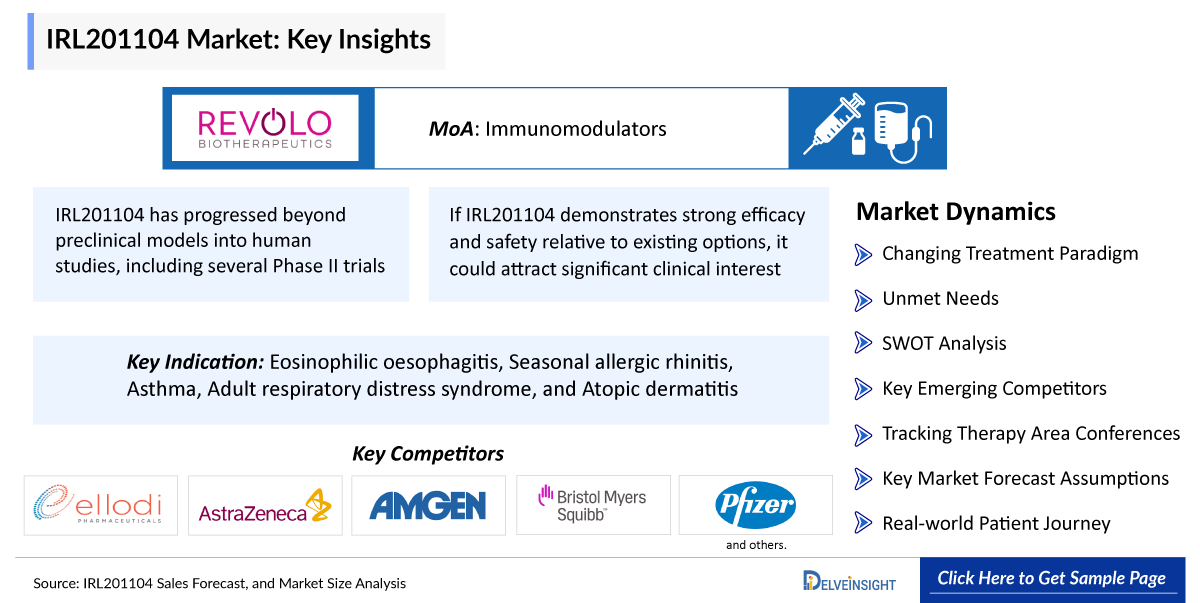
- IRL201104 has progressed beyond preclinical models into human studies, including several Phase II trials. A Phase IIa study in eosinophilic esophagitis (EoE) has been completed, with results posted in 2025.
- Another Phase IIa allergen challenge study in seasonal allergic rhinitis has also been completed, indicating the drug’s potential efficacy in an atopic respiratory setting.
- These Phase II results help establish early evidence of safety, tolerability, and biologic activity — critical steps that support progression toward Phase III and, ultimately, regulatory filings.
Favorable Likelihood of Advancement Trends
- Industry data models Likelihood of Approval (LoA) and Phase Transition Success Rate (PTSR) analytics are used by pharmaceutical strategists to benchmark developmental risk. For IRL201104:
- For allergy indications, Phase II candidates historically show a ~54 % probability of progressing to Phase III, suggesting an intermediate likelihood of clinical advancement.
- For inflammation settings, Phase I–II progression benchmarks hover around 44 %, implying that continued positive clinical data could substantially improve its developmental trajectory.
- While these are probabilistic models (and not guarantees of approval), they signal that IRL201104 remains within a trackable range where successful data could materially improve its attractiveness to investors and partners.
Large Addressable Patient Populations in Targeted Diseases
- The conditions being explored with IRL201104 — including seasonal allergic rhinitis, asthma, and EoE — collectively represent hundreds of millions of patients globally. For instance:
- Seasonal allergic rhinitis affects a significant portion of the population, and the seasonal allergic rhinitis market is forecast to grow toward 2032 with multiple emerging therapies in development, indicating robust future demand for effective agents.
- EoE and other atopic and Th2-mediated conditions have seen a rapid expansion in pipeline activity, suggesting high unmet needs and growing interest from biopharma companies.
- Targeting these larger patient pools increases the theoretical revenue potential once (and if) IRL201104 gains approval. However, specific numeric sales forecasts for this asset do not yet exist due to its early stage.
Strategic Positioning Within Competitive Allergy and Immunology Markets
- Emerging immune-modulating therapies are becoming a major focus in allergic and inflammatory disease markets, as biologic and small-molecule competitors expand their indications.
- If IRL201104 demonstrates strong efficacy and safety relative to existing options (e.g., monoclonal antibodies or other peptides), it could attract significant clinical interest — particularly if it offers advantages such as dosing convenience, broad immunomodulation, or cost benefits.
- However, market dynamics in allergy and inflammatory diseases are competitive, requiring clear differentiation to secure market share.
IRL201104 Recent Developments
- In February 2026, Revolo Biotherapeutics Limited (“Revolo”) announced that it will present a poster on its lead candidate, IRL201104 (‘1104), at the 2026 American Academy of Allergy, Asthma and Immunology (AAAAI) Annual Meeting in Philadelphia, PA.
- In August 2025, Revolo Biotherapeutics Limited (“Revolo”) announced its decision to accelerate the advancement of a sublingual, placed under the tongue tablet, formulation of ‘1104 into the clinic. This decision is driven by positive preclinical data and a differentiated upstream mechanistic profile that has been demonstrated in Phase II trials with an intravenous (IV) formulation.
“IRL201104 Sales Forecast, and Market Size Analysis – 2034” report provides comprehensive insights of IRL201104 for potential indication like Eosinophilic oesophagitis, Seasonal allergic rhinitis, Asthma, Adult respiratory distress syndrome, and Atopic dermatitis in the 7MM. A detailed picture of IRL201104’s existing usage in anticipated entry and performance in potential indications in the 7MM, i.e., the United States, EU4 (Germany, France, Italy, and Spain) and the United Kingdom, and Japan for the study period 2020 –2034 is provided in this report along with a detailed description of the IRL201104 for potential indications. The IRL201104 market report provides insights about IRL201104’s sales forecast, mechanism of action (MoA), dosage and administration, as well as research and development including regulatory milestones, along with other developmental activities. Further, it also consists of historical and current IRL201104 performance, future market assessments inclusive of the IRL201104 market forecast analysis for potential indications in the 7MM, SWOT, analysts’ views, comprehensive overview of market competitors, and brief about other emerging therapies in respective indications. It also provides analysis of IRL201104 sales forecasts, along with factors driving its market.
IRL201104 Drug Summary
IRL201104 (also known as '1104) is a first-in-class, low molecular weight immunomodulatory peptide derived from the natural immune-regulatory protein Mycobacterium tuberculosis chaperonin 60.1 (mTB Cpn60.1), designed to reset dysregulated immune responses by suppressing pro-allergic T cell responses (Th2, Th2A, Tfh), inducing immune deviation toward Th1 phenotypes, and increasing regulatory T cells (Tregs) and B cells (Bregs) to exert broad anti-inflammatory effects despite its short half-life (~10-15 minutes). Developed by Revolo Biotherapeutics primarily as an intravenous (IV) formulation for eosinophilic esophagitis (EoE) and expanding to asthma, atopic dermatitis, seasonal allergic rhinitis, and other allergic/inflammatory diseases, it has demonstrated long-lasting efficacy (up to 14 days post-dose) in preclinical models of allergic inflammation, reducing inflammatory infiltrates, cytokines (IL-4, IL-5, IL-13, TNF-α, IL-6), chemokines (eotaxin, MCP-1), IgE levels, and tissue pathology even after viral exacerbation, comparable to or better than dexamethasone without steroid resistance. Early clinical data from Phase I/II trials in EoE showed dose-dependent reductions in peak esophageal eosinophils (~50%), improved dysphagia symptoms (DSQ scores), endoscopic findings, and Treg increases with no serious adverse events or discontinuations at doses up to 64 mg IV, supporting planned Phase IIb studies; alternative routes like subcutaneous (SQ), sublingual orally disintegrating tablet (ODT), and intranasal are in preclinical validation for broader allergic indications. As of early 2026, it remains investigational with no FDA approvals or designations noted. The report provides IRL201104’s sales, growth barriers and drivers, post usage and approvals in multiple indications.
Scope of the IRL201104 Market Report
The report provides insights into:
- A comprehensive product overview including the IRL201104 MoA, description, dosage and administration, research and development activities in potential indication like Eosinophilic oesophagitis, Seasonal allergic rhinitis, Asthma, Adult respiratory distress syndrome, and Atopic dermatitis.
- Elaborated details on IRL201104 regulatory milestones and other development activities have been provided in IRL201104 market report.
- The report also highlights IRL201104‘s cost estimates and regional variations, reported and estimated sales performance, research and development activities in potential indications across the United States, Europe, and Japan.
- The IRL201104 market report also covers the patents information, generic entry and impact on cost cut.
- The IRL201104 market report contains current and forecasted IRL201104 sales for potential indications till 2034.
- Comprehensive coverage of the late-stage emerging therapies for respective indications.
- The IRL201104 market report also features the SWOT analysis with analyst views for IRL201104 in potential indications.
Methodology
The IRL201104 market report is built using data and information sourced primarily from internal databases, primary and secondary research and in-house analysis by DelveInsight’s team of industry experts. Information and data from the secondary sources have been obtained from various printable and nonprintable sources like search engines, news websites, global regulatory authorities websites, trade journals, white papers, magazines, books, trade associations, industry associations, industry portals and access to available databases.
IRL201104 Analytical Perspective by DelveInsight
- In-depth IRL201104 Market Assessment
This IRL201104 sales market forecast report provides a detailed market assessment of IRL201104 for potential indication like Eosinophilic oesophagitis, Seasonal allergic rhinitis, Asthma, Adult respiratory distress syndrome, and Atopic dermatitis in the seven major markets, i.e., the United States, EU4 (Germany, France, Italy, and Spain) and the United Kingdom, and Japan. This segment of the report provides current and forecasted IRL201104 sales data uptil 2034.
- IRL201104 Clinical Assessment
The IRL201104 market report provides the clinical trials information of IRL201104 for potential indications covering trial interventions, trial conditions, trial status, start and completion dates.
IRL201104 Competitive Landscape
The report provides Insights on competitors and marketed products within the domain, along with a summary of emerging products and their respective launch dates, posing significant competition in the market.
IRL201104 Market Potential & Revenue Forecast
- Projected market size for the IRL201104 and its key indications
- Estimated IRL201104 sales potential (IRL201104 peak sales forecasts)
- IRL201104 Pricing strategies and reimbursement landscape
IRL201104 Competitive Intelligence
- Number of competing drugs in development (pipeline analysis)
- IRL201104 Market positioning compared to existing treatments
- IRL201104 Strengths & weaknesses relative to competitors
IRL201104 Regulatory & Commercial Milestones
- IRL201104 Key regulatory approvals & expected launch timelines
- Commercial partnerships, licensing deals, and M&A activity
IRL201104 Clinical Differentiation
- IRL201104 Efficacy & safety advantages over existing drugs
- IRL201104 Unique selling points
IRL201104 Market Report Highlights
- In the coming years, the IRL201104 market scenario is set to change due to strong adoption, increased prescriptions and broader uptake in multiple immunological indications; which would expand the size of the market.
- The IRL201104 companies are developing therapies that focus on novel approaches to treat/improve the disease condition, assess challenges, and seek opportunities that could influence IRL201104’s dominance.
- Other emerging products for corneal disorders are expected to give tough market competition to IRL201104 and launch of late-stage emerging therapies in the near future will significantly impact the market.
- A detailed description of regulatory milestones, and developmental activities, provide the current development scenario of IRL201104 in potential indications.
- Analyse IRL201104 cost, pricing trends and market positioning to support strategic decision-making in the immunology landscape.
- Our in-depth analysis of the forecasted IRL201104 sales data uptil 2034 will support the clients in decision-making process regarding their therapeutic portfolio by identifying the overall scenario of IRL201104 in potential indications.
Key Questions
- What is the class of therapy, route of administration and mechanism of action of IRL201104? How strong is IRL201104’s clinical and commercial performance?
- What is IRL201104’s clinical trial status in each individual indications such as Eosinophilic oesophagitis, Seasonal allergic rhinitis, Asthma, Adult respiratory distress syndrome, and Atopic dermatitis and study completion date?
- What are the key collaborations, mergers and acquisitions, licensing and other activities related to the IRL201104 Manufacturers?
- What are the key designations that have been granted to IRL201104 for potential indications? How are they going to impact IRL201104’s penetration in various geographies?
- What is the current and forecasted IRL201104 market scenario for potential indications? What are the key assumptions behind the forecast?
- What are the current and forecasted sales of IRL201104 in the seven major countries, including the United States, Europe (Germany, France, Italy, Spain) and the United Kingdom, and Japan?
- What are the other emerging products available and how are these giving competition to IRL201104 for potential indications?
- Which are the late-stage emerging therapies under development for the treatment of potential indications?
- How cost-effective is IRL201104? What is the duration of therapy and what are the geographical variations in cost per patient?

