
Ivacaftor Sales Forecast Summary
Key Factors Driving Ivacaftor Growth
Market Share Gains and New Patient Starts
- Ivacaftor (KALYDECO), developed by Vertex Pharmaceuticals, was the first CFTR modulator approved for cystic fibrosis (CF) and established the precision-medicine paradigm in this disease.
- Although newer combination regimens (e.g., Trikafta/Kaftrio) now dominate the overall CF market, Ivacaftor continues to maintain steady new patient starts in genetically eligible populations and pediatric patients.
- Ongoing genetic screening and early diagnosis programs continue to identify patients with gating and residual-function mutations, supporting sustained demand.
Expansion Across Key Indications
- Cystic Fibrosis (CF): Ivacaftor is approved for patients with specific CFTR mutations (gating and residual function), restoring channel activity rather than only treating symptoms.
- It is used as monotherapy in patients with responsive mutations and as a backbone molecule in combination regimens (e.g., lumacaftor/Ivacaftor, tezacaftor/Ivacaftor).
- Pipeline life-cycle strategies and mutation-expansion studies have historically increased the eligible CF population, reinforcing long-term relevance.
Geographic Expansion
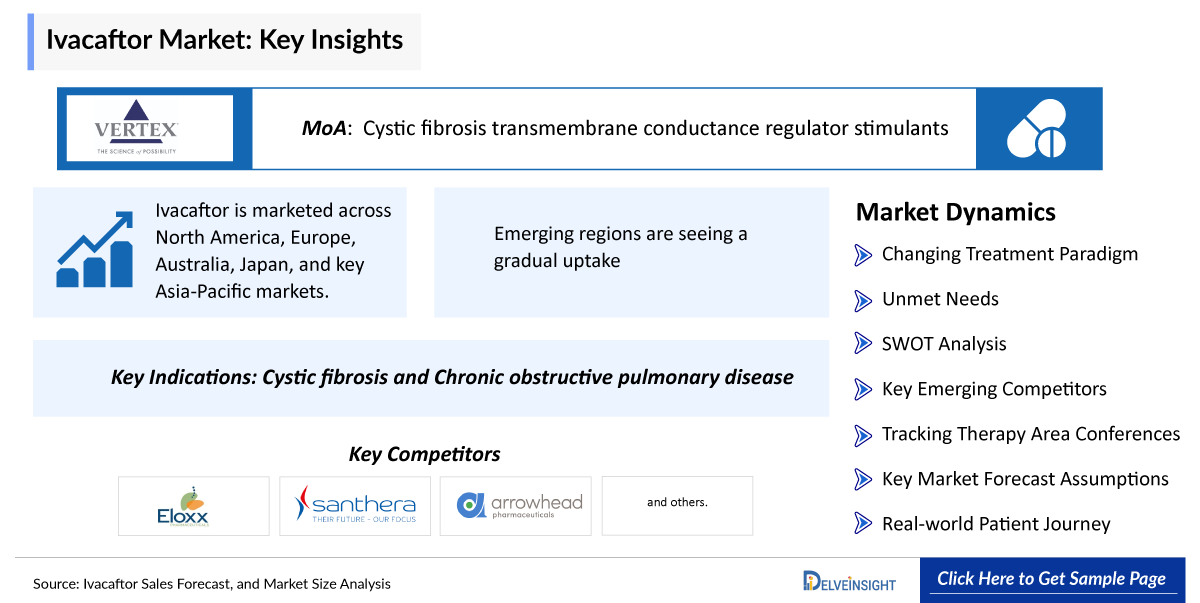
- Ivacaftor is marketed across North America, Europe, Australia, Japan, and key Asia-Pacific markets.
- Emerging regions are seeing gradual uptake due to improved CF registries, neonatal screening, and better access to genetic testing.
- Vertex continues to strengthen regional reimbursement frameworks and compassionate-use programs to expand access globally.
New Indication Approvals
- Regulatory agencies have expanded ivacaftor’s mutation eligibility multiple times, increasing the number of CF patients who can benefit from treatment.
- Pediatric label expansions have enabled treatment in younger age groups, allowing early disease modification and long-term outcome improvement.
- These regulatory updates significantly broadened ivacaftor’s clinical footprint beyond its initial narrow population.
Strong Volume Momentum
- Although many patients transition to next-generation triple combinations, Ivacaftor continues to show stable prescription volumes in mutation-specific subgroups.
- Pediatric and newly diagnosed patients remain key contributors to ongoing volume.
- Long-term real-world data demonstrate durable lung function improvement and reduced exacerbations, supporting continued use.
Competitive Differentiation and Market Trends
- Ivacaftor is a CFTR potentiator, directly improving the function of defective CFTR channels — a true disease-modifying approach.
- It remains the scientific foundation for all Vertex CF combination therapies.
- Broader trends such as genomic medicine, newborn screening, and personalized treatment pathways strongly favor CFTR modulators.
- Growing reliance on real-world evidence and registry data continues to reinforce payer and clinician confidence.
Ivacaftor Recent Developments
- Vertex continues to report strong global CF franchise performance, with ivacaftor-based combinations contributing to sustained revenue growth.
- Expanded access agreements in Europe, Japan, and emerging markets have increased availability of ivacaftor-containing regimens.
- Long-term registry studies presented at major respiratory and genetic conferences confirm durability of benefit and improved survival trends for patients treated with ivacaftor-based therapies.
“Ivacaftor Sales Forecast, and Market Size Analysis – 2034” report provides comprehensive insights of Ivacaftor for approved indication like Cystic fibrosis; as well as potential indication like Chronic obstructive pulmonary disease in the 7MM. A detailed picture of Ivacaftor’s existing usage in approved and anticipated entry and performance in potential indications in the 7MM, i.e., the United States, EU4 (Germany, France, Italy, and Spain) and the United Kingdom, and Japan for the study period 2020 –2034 is provided in this report along with a detailed description of the Ivacaftor for approved and potential indications. The Ivacaftor market report provides insights about Ivacaftor’s sales forecast, mechanism of action (MoA), dosage and administration, as well as research and development including regulatory milestones, along with other developmental activities. Further, it also consists of historical and current Ivacaftor performance, future market assessments inclusive of the Ivacaftor market forecast analysis for approved and potential indications in the 7MM, SWOT, analysts’ views, comprehensive overview of market competitors, and brief about other emerging therapies in respective indications. It also provides analysis of Ivacaftor sales forecasts, along with factors driving its market.
Ivacaftor Drug Summary
Ivacaftor (KALYDECO) is a small-molecule cystic fibrosis transmembrane conductance regulator (CFTR) potentiator approved as monotherapy or in combination (e.g., with lumacaftor, tezacaftor, or elexacaftor/tezacaftor) for treating cystic fibrosis in patients aged ≥1 month with specific CFTR mutations (e.g., gating mutations like G551D or residual function mutations like R117H, F508del with correctors), a genetic disorder caused by CFTR gene mutations impairing chloride ion transport across epithelial cell membranes, leading to viscous mucus buildup in lungs, pancreas, and other organs. It binds directly to CFTR at the cell surface to increase the channel's open probability and chloride conductance independently of ATP hydrolysis or cAMP regulation, thereby improving airway surface hydration, mucociliary clearance, and lung function (e.g., FEV1 gains of 8-10% in G551D patients), reducing pulmonary exacerbations by ~55%, sweat chloride, and pancreatic insufficiency symptoms. Administered orally every 12 hours (e.g., 150 mg tablets or oral granules dosed by weight, with high-fat meals to enhance absorption due to CYP3A substrate status), it requires genotyping confirmation and monitoring for elevated liver enzymes. The report provides Ivacaftor’s sales, growth barriers and drivers, post usage and approvals in multiple indications.
Scope of the Ivacaftor Market Report
The report provides insights into:
- A comprehensive product overview including the Ivacaftor MoA, description, dosage and administration, research and development activities in approved indications like Cystic fibrosis; as well as potential indication like Chronic obstructive pulmonary disease.
- Elaborated details on Ivacaftor regulatory milestones and other development activities have been provided in Ivacaftor market report.
- The report also highlights Ivacaftor‘s cost estimates and regional variations, reported and estimated sales performance, research and development activities in approved and potential indications across the United States, Europe, and Japan.
- The Ivacaftor market report also covers the patents information, generic entry and impact on cost cut.
- The Ivacaftor market report contains current and forecasted Ivacaftor sales for approved and potential indications till 2034.
- Comprehensive coverage of the late-stage emerging therapies for respective indications.
- The Ivacaftor market report also features the SWOT analysis with analyst views for Ivacaftor in approved and potential indications.
Methodology
The Ivacaftor market report is built using data and information sourced primarily from internal databases, primary and secondary research and in-house analysis by DelveInsight’s team of industry experts. Information and data from the secondary sources have been obtained from various printable and nonprintable sources like search engines, news websites, global regulatory authorities websites, trade journals, white papers, magazines, books, trade associations, industry associations, industry portals and access to available databases.
Ivacaftor Analytical Perspective by DelveInsight
In-depth Ivacaftor Market Assessment
This Ivacaftor sales market forecast report provides a detailed market assessment of Ivacaftor for approved indication like Cystic fibrosis; as well as potential indication like Chronic obstructive pulmonary disease in the seven major markets, i.e., the United States, EU4 (Germany, France, Italy, and Spain) and the United Kingdom, and Japan. This segment of the report provides current and forecasted Ivacaftor sales data uptil 2034.
Ivacaftor Clinical Assessment
The Ivacaftor market report provides the clinical trials information of Ivacaftor for approved and potential indications covering trial interventions, trial conditions, trial status, start and completion dates.
Ivacaftor Competitive Landscape
The report provides Insights on competitors and marketed products within the domain, along with a summary of emerging products and their respective launch dates, posing significant competition in the market.
Ivacaftor Market Potential & Revenue Forecast
- Projected market size for the Ivacaftor and its key indications
- Estimated Ivacaftor sales potential (Ivacaftor peak sales forecasts)
- Ivacaftor Pricing strategies and reimbursement landscape
Ivacaftor Competitive Intelligence
- Number of competing drugs in development (pipeline analysis)
- Ivacaftor Market positioning compared to existing treatments
- Ivacaftor Strengths & weaknesses relative to competitors
Ivacaftor Regulatory & Commercial Milestones
- Ivacaftor Key regulatory approvals & expected launch timelines
- Commercial partnerships, licensing deals, and M&A activity
Ivacaftor Clinical Differentiation
- Ivacaftor Efficacy & safety advantages over existing drugs
- Ivacaftor Unique selling points
Ivacaftor Market Report Highlights
- In the coming years, the Ivacaftor market scenario is set to change due to strong adoption, increased prescriptions and broader uptake in multiple immunological indications; which would expand the size of the market.
- The Ivacaftor companies are developing therapies that focus on novel approaches to treat/improve the disease condition, assess challenges, and seek opportunities that could influence Ivacaftor’s dominance.
- Other emerging products for Cystic fibrosis; as well as potential indication like Chronic obstructive pulmonary disease are expected to give tough market competition to Ivacaftor and launch of late-stage emerging therapies in the near future will significantly impact the market.
- A detailed description of regulatory milestones, and developmental activities, provide the current development scenario of Ivacaftor in approved and potential indications.
- Analyse Ivacaftor cost, pricing trends and market positioning to support strategic decision-making in the immunology landscape.
- Our in-depth analysis of the forecasted Ivacaftor sales data uptil 2034 will support the clients in decision-making process regarding their therapeutic portfolio by identifying the overall scenario of Ivacaftor in approved and potential indications.
Key Questions
- What is the class of therapy, route of administration and mechanism of action of Ivacaftor? How strong is Ivacaftor’s clinical and commercial performance?
- What is Ivacaftor’s clinical trial status in each individual indications such as Cystic fibrosis; as well as potential indication like Chronic obstructive pulmonary disease and study completion date?
- What are the key collaborations, mergers and acquisitions, licensing and other activities related to the Ivacaftor Manufacturers?
- What are the key designations that have been granted to Ivacaftor for approved and potential indications? How are they going to impact Ivacaftor’s penetration in various geographies?
- What is the current and forecasted Ivacaftor market scenario for approved and potential indications? What are the key assumptions behind the forecast?
- What are the current and forecasted sales of Ivacaftor in the seven major countries, including the United States, Europe (Germany, France, Italy, Spain) and the United Kingdom, and Japan?
- What are the other emerging products available and how are these giving competition to Ivacaftor for approved and potential indications?
- Which are the late-stage emerging therapies under development for the treatment of approved and potential indications?
- How cost-effective is Ivacaftor? What is the duration of therapy and what are the geographical variations in cost per patient?

