
Leadless Pacemakers Market Summary
- The Leadless Pacemakers market is estimated at USD 427.7 million in 2025 and is projected to reach USD 1,000.1 million by 2034. Growth is anchored in the rising global burden of bradyarrhythmia, the clinical shift toward minimally invasive, lead-free cardiac rhythm management, and the commercial expansion of dual-chamber and cardiac resynchronization therapy (CRT) indications.
- The global Leadless Pacemakers market is growing at a CAGR of 9.6% during the forecast period from 2026 to 2034.
- By product type, the single-chamber leadless pacemakers segment dominated the Leadless Pacemakers market with a 68% share in 2025.
- By technology, the active fixation technology segment dominated the Leadless Pacemakers market with a 58% share in 2025.
- By indication, the bradycardia segment dominated the Leadless Pacemakers market with a 52.3% share in 2025.
- By end-user, the hospitals segment dominated the Leadless Pacemakers market with a 55.9% share in 2025.
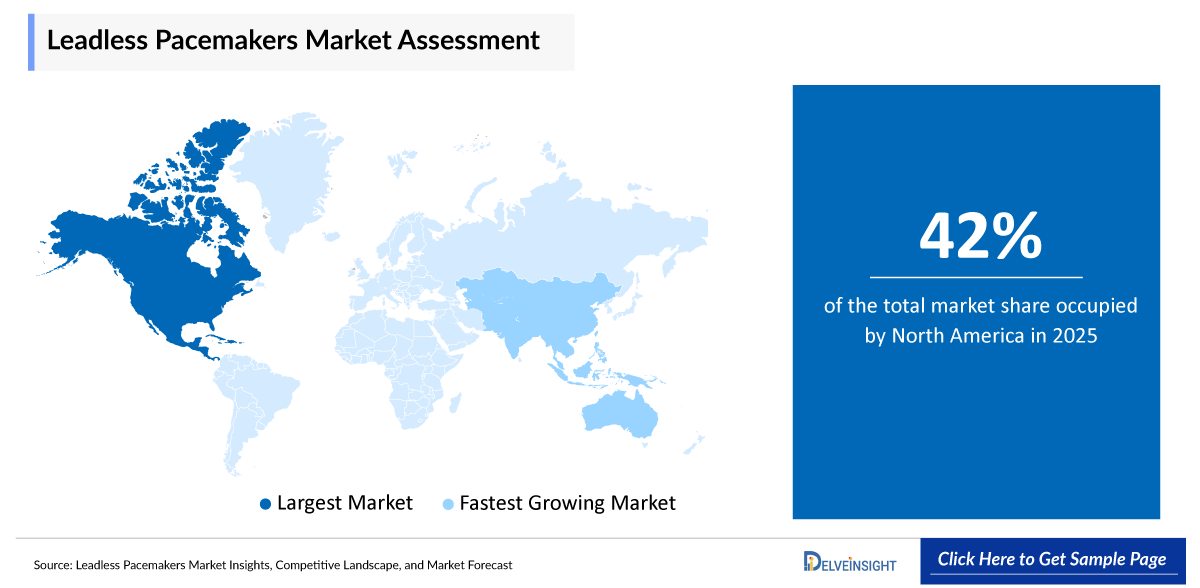
- North America dominated the global Leadless Pacemakers market revenue with a 42% share in 2025, representing the highest regional market share globally.
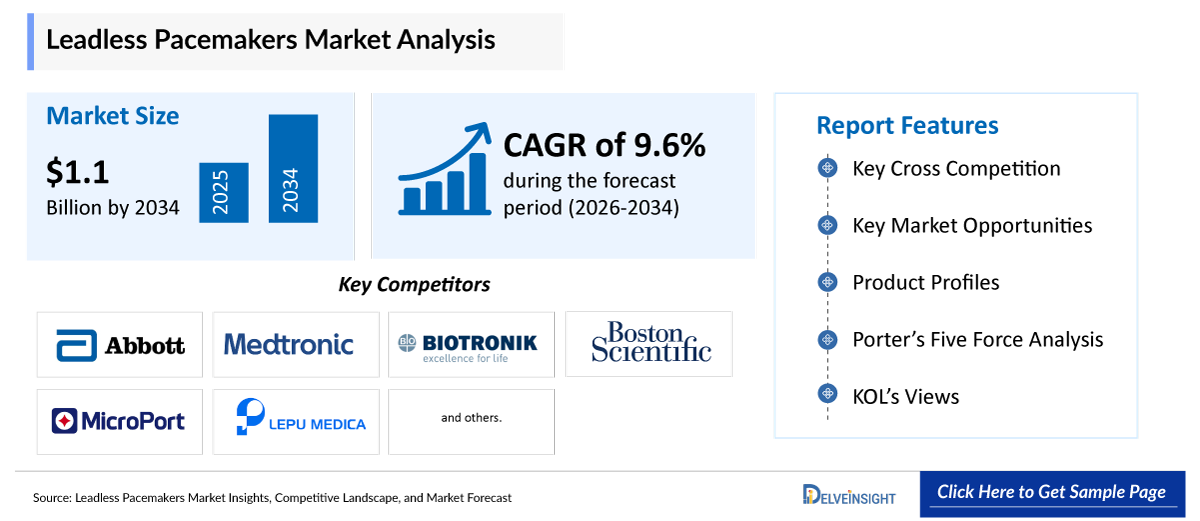
A leadless pacemaker is a miniaturized, self-contained cardiac rhythm management device that is implanted directly inside a heart chamber via a minimally invasive, catheter-based transvenous approach, eliminating the transvenous leads and subcutaneous pulse-generator pocket required by conventional pacemakers. Roughly one-tenth the size of a traditional pacemaker, these devices combine the battery, electronics, and pacing electrode within a single capsule that is fixed to the endocardium, reducing exposure to lead-related and pocket-related complications such as fracture, dislodgement, infection, and venous obstruction. The market is organized by product type across single-chamber and dual-chamber systems; by technology, including passive fixation, active fixation, wireless device-to-device communication, and other emerging approaches; by indication, led by bradycardia, atrioventricular (AV) block, and atrial fibrillation; and by end-user, spanning hospitals, cardiac specialty centers, and ambulatory surgical centers. Driven by the commercial rollout of dual-chamber implant-to-implant (i2i) communication technology, the entry of leadless left ventricular endocardial pacing for CRT, and an aging population with rising bradyarrhythmia incidence, leadless pacemakers have become an increasingly mainstream alternative within the global cardiac rhythm management landscape.
Leadless Pacemakers Market Key Growth Drivers
- The commercial expansion of dual-chamber leadless pacing is driving demand, with Abbott's Aveir DR system, approved by the FDA in July 2023, unlocking leadless therapy for the roughly 80% of pacemaker patients who require pacing in two heart chambers.
- The rising global burden of cardiovascular disease and bradyarrhythmia is expanding demand for pacing therapy, with the World Health Organization attributing nearly 17.9 million deaths annually to cardiovascular disease.
- Hospitals and electrophysiology centers are increasingly adopting leadless systems over transvenous pacemakers to reduce lead- and pocket-related infection, dislodgement, and reintervention risk, shortening recovery time and procedural burden.
- Next-generation product approvals and label expansions, including Medtronic's Micra AV2 and VR2 (FDA approval May 2023; CE Mark January 2024) offering longer battery life and automated AV-synchrony algorithms, are broadening clinical adoption.
- The April 2025 FDA approval of EBR Systems' WiSE CRT System, the first leadless left ventricular endocardial pacing device for cardiac resynchronization therapy, is extending leadless technology into the heart-failure and CRT segment.
- Favorable reimbursement momentum, including CMS Coverage with Evidence Development studies for Aveir VR, AR, and DR and a Medicare coverage decision supporting WiSE CRT, is easing adoption barriers in the largest market.
- Growing physician training, expanding electrophysiology infrastructure, and rising implant volumes in emerging markets such as India, where Abbott and Max Hospital, Saket launched the country's first dual-chamber Aveir implant in October 2025, are widening geographic reach.
- The convergence of dual-chamber commercialization, CRT expansion, an aging population, and favorable reimbursement is expected to sustain high-single-digit to low-double-digit growth in the market through 2034.
Key Companies in Leadless Pacemakers Market
The competitive landscape is led by the following active manufacturers:
- Abbott
- Medtronic
- BIOTRONIK
- Boston Scientific
- MicroPort Scientific Corporation
- Lepu Medical
- OSYPKA
- Shree Pacetronix
- EBR Systems
- Oscor
For illustrative purposes, only the top 10 companies are listed in the Table of Contents. The report may include analysis and references to additional companies relevant to the market assessment.
Leadless Pacemakers Market Size
The following snapshot summarizes the principal report metrics for the Leadless Pacemakers market.
|
Report Metrics |
Details |
|
2025 Market Size |
USD 427.7 million |
|
2034 Projected Market Size |
USD 1,000.1 million |
|
Growth Rate (2026-2034) |
9.6% CAGR |
|
Largest Market |
North America |
|
Fastest Growing Market |
Asia-Pacific |
|
Market Structure |
Highly Concentrated |
All market values are expressed in USD and represent DelveInsight estimates synthesized from primary and secondary research.
Factors Contributing to the Growth of the Leadless Pacemakers Market
Market Drivers
Commercial Expansion of Dual-Chamber Leadless Pacing
The most powerful driver of the Leadless Pacemakers market is the commercial rise of dual-chamber leadless pacing. Abbott's Aveir DR system, approved by the FDA in July 2023, was the world's first dual-chamber leadless pacing system, pairing the previously approved Aveir VR ventricular device with the newly authorized Aveir AR atrial device through implant-to-implant (i2i) communication technology. Because roughly 80% of patients who require pacing need therapy in two chambers of the heart, dual-chamber approval materially widens the addressable population beyond the single-chamber bradycardia patients historically served by leadless systems. Abbott reported that accelerating adoption of its Aveir portfolio drove double-digit sales growth in its Cardiac Rhythm Management business through 2025, and further clinical and geographic rollout, including the October 2025 launch of India's first dual-chamber Aveir implant, is expected to sustain demand through the forecast period.
Rising Global Cardiovascular Disease and Bradyarrhythmia Burden
The growing global burden of cardiovascular disease is expanding demand for pacing therapy and the devices that deliver it. The World Health Organization attributes nearly 17.9 million deaths annually to cardiovascular disease, and aging populations across North America, Europe, and Asia-Pacific are experiencing rising incidence of bradycardia, atrioventricular block, and other conduction disorders that require permanent pacing. Leadless pacemakers are increasingly considered a first-line option for these patients because they eliminate the lead- and pocket-related complications associated with conventional systems. As the prevalence of arrhythmia and conduction disease rises alongside an aging population, the volume of implant procedures and the CDMO-like manufacturing and clinical infrastructure that supports them is expected to grow steadily through 2034.
Shift Toward Minimally Invasive, Lead-Free Rhythm Management
A structural shift toward minimally invasive cardiac care is a central growth engine for the market. Conventional transvenous pacemakers require a surgical pocket and leads that traverse the venous system, exposing patients to risks of lead fracture, dislodgement, venous obstruction, and pocket infection. Leadless devices are implanted directly into the heart through a catheter-based femoral approach, eliminating these failure points, reducing recovery time, and leaving no visible scar or restriction on arm movement. Hospitals and electrophysiology centers are increasingly favoring leadless systems for patients at elevated infection risk, including those with prior device infections, renal failure, or immunocompromised status, reinforcing structural demand growth as clinical evidence accumulates.
Next-Generation Product Approvals and Label Expansions
A growing wave of next-generation approvals is increasing clinical adoption. In May 2023, the FDA approved Medtronic's Micra AV2 and Micra VR2, offering approximately 40% more battery life, a projected median device longevity of 16 to 17 years, and automated AV-synchrony algorithms, with CE Mark approval following in January 2024. Abbott's Aveir DR, approved in 2023, incorporates a retrievable helix-fixation design and i2i wireless synchronization. Each new-generation approval reduces device replacement frequency, improves procedural outcomes, and expands the eligible patient population, creating durable, recurring demand for compliant, technologically advanced leadless systems across the forecast period.
Entry of Leadless Technology into Cardiac Resynchronization Therapy
The extension of leadless technology into cardiac resynchronization therapy (CRT) is opening a substantial new addressable market. In April 2025, the FDA approved EBR Systems' WiSE CRT System, the world's first and only leadless left ventricular endocardial pacing (LVEP) device, which uses a subcutaneous ultrasound transmitter to power a rice-sized endocardial electrode without a transvenous left-ventricular lead. EBR has estimated a USD 3.6 billion addressable opportunity across high-risk upgrade, lead-failure, and leadless CRT expansion categories. As commercial rollout progresses following a limited 2025 market release and full-scale 2026 launch, and as Medicare coverage for the technology advances, this segment is expected to become an increasingly meaningful contributor to overall market growth.
Favorable Reimbursement and Payer Coverage Momentum
Improving reimbursement and payer coverage are easing adoption barriers in the largest markets. The Centers for Medicare & Medicaid Services has approved multiple Coverage with Evidence Development studies for Abbott's Aveir VR, AR, and DR systems, and has evaluated national coverage for EBR Systems' WiSE CRT System following its 2025 approval. Supportive reimbursement pathways in the United States, combined with growing private-insurance recognition of leadless therapy's reduced complication and reintervention costs relative to conventional pacemakers, are expected to sustain procedural volume growth and support continued market expansion.
Expanding Emerging-Market Access and Physician Training
Expanding access in emerging markets and growing physician training are broadening the market's geographic base. Abbott launched its Aveir VR leadless pacemaker in India in November 2024 following CDSCO approval, and partnered with Max Hospital, Saket, to perform the country's first dual-chamber Aveir implant in October 2025. Regional manufacturers, including MicroPort Scientific Corporation and Lepu Medical, continue to localize cardiac rhythm management portfolios across China, while training programs for electrophysiologists expand implant capability beyond the small number of high-volume centers that pioneered the technology. This broadening base of trained implanters and approved indications is expected to widen adoption across the forecast period.
Market Restraints
Despite strong momentum, the Leadless Pacemakers market faces material constraints. The high upfront cost of leadless devices relative to conventional transvenous pacemakers remains a significant barrier, particularly in price-sensitive and lower-reimbursement healthcare systems, and can limit adoption outside well-resourced hospitals and specialty centers. Procedural complexity and the need for specialized electrophysiology training constrain the pool of physicians able to perform implants, and the 2021 FDA safety communication highlighting a potential risk of cardiac perforation associated with early leadless pacemaker generations continues to inform cautious adoption in some clinical settings. Device retrieval and long-term multi-device management, particularly as patients accumulate more than one leadless implant over a lifetime, raise unresolved questions around chronic vessel and endocardial burden. Reimbursement policy for newer dual-chamber and CRT-indicated leadless systems remains uneven outside the United States and a small number of developed markets, and the market remains concentrated among a limited number of approved manufacturers, which can constrain price competition and slow adoption in cost-constrained health systems. Together, these cost, training, safety-surveillance, and reimbursement barriers temper the pace of growth even as the underlying drivers of minimally invasive adoption, an aging population, and expanding indications remain firmly intact.
Leadless Pacemakers Market Segment Analysis
The leadless pacemakers market by product type (single-chamber leadless pacemakers and dual-chamber leadless pacemakers), technology (passive fixation technology, active fixation technology, wireless device-to-device communication, and others), indication (bradycardia, atrioventricular (av) block, atrial fibrillation, and other), end-users (hospitals, cardiac specialty centers, ambulatory surgical centers, and others), and geography (North America, Europe, Asia-Pacific, and Rest of World).
By Product Type
Dominant Subsegment: Single-Chamber Leadless Pacemakers.
The single-chamber leadless pacemakers segment accounted for 68% of the Leadless Pacemakers market in 2025. Single-chamber devices, such as Medtronic's Micra VR/VR2 and Abbott's Aveir VR, are the leading product type because they address the largest historically approved patient population, those requiring ventricular-only pacing for bradycardia with normal sinus rhythm, and because they carry the longest clinical track record, the broadest base of trained implanters, and the most established reimbursement pathways. Their smaller regulatory and procedural footprint has allowed single-chamber systems to achieve the widest hospital and specialty-center penetration to date. While dual-chamber leadless pacemakers are the fastest-growing product type, propelled by Abbott's Aveir DR i2i platform unlocking therapy for patients needing atrioventricular synchrony, the depth of clinical experience, established indications, and procedural simplicity of single-chamber systems secure the segment's leadership across the forecast period.
By Technology
Dominant Subsegment: Active Fixation Technology.
The active fixation technology segment accounted for 58% of the Leadless Pacemakers market in 2025. Active fixation, in which a helix or screw-in mechanism secures the device directly to the endocardium, is the leading technology because it provides more reliable long-term lead-free attachment, lower dislodgement risk, and, in systems such as Abbott's Aveir platform, enables device retrievability for replacement or repositioning. Nearly all commercially approved leadless pacemakers, including Medtronic's Micra family and Abbott's Aveir VR, AR, and DR systems, rely on active fixation, reinforcing its dominant position. Wireless device-to-device communication, the enabling technology behind dual-chamber i2i synchronization and future multi-device coordination, is the fastest-growing technology category as dual-chamber and CRT-oriented systems scale, while passive fixation and other emerging approaches, including EBR Systems' ultrasound-based leadless left ventricular endocardial pacing, represent smaller but strategically important niches. Nonetheless, the proven reliability and retrievability advantages of active fixation secure its leadership across the forecast period.
By Indication
Dominant Subsegment: Bradycardia.
The bradycardia segment accounted for 52.3% of the Leadless Pacemakers market in 2025. Bradycardia is the leading indication because it represents the original and most established use case for leadless pacing, encompassing patients with sinus node dysfunction and slow heart rhythms who require single- or dual-chamber ventricular support. The long-term safety and efficacy data generated by pivotal Micra and Aveir trials were built primarily around bradycardia populations, giving physicians the deepest evidence base and reimbursement clarity for this indication. Atrioventricular (AV) block is a significant and growing indication, particularly as dual-chamber systems such as Aveir DR extend leadless therapy to patients requiring atrioventricular synchrony, while atrial fibrillation-related pacing needs, including rate control in permanent AF, represent a fast-growing niche supported by atrial leadless devices. Despite this diversification, the breadth of the approved bradycardia population and its foundational role in clinical evidence secure the segment's leadership across the forecast period.
By End-Users
Dominant Subsegment: Hospitals.
The hospitals segment accounted for 55.9% of the Leadless Pacemakers market in 2025. Hospitals are the leading end-user because leadless pacemaker implantation requires catheterization-lab infrastructure, fluoroscopic guidance, on-site electrophysiology expertise, and post-procedural monitoring capabilities that are concentrated in hospital settings, particularly for complex dual-chamber and CRT-indicated procedures. Tertiary and academic hospitals also serve as the primary training sites for the specialized implant technique, reinforcing their central role in procedural volume. Cardiac specialty centers represent a fast-growing end-user category as dedicated electrophysiology and cardiac catheterization facilities expand implant capacity, while ambulatory surgical centers are gradually beginning to adopt leadless implantation as devices and delivery systems become more streamlined. Nonetheless, the infrastructure requirements and procedural complexity of leadless pacemaker implantation secure the hospital segment's leadership across the forecast period.
Leadless Pacemakers Market Region Analysis
Dominant Region: North America
North America accounted for 42% of the global Leadless Pacemakers market revenue in 2025, representing the highest regional market share globally. The region's dominance reflects the concentration of pioneering FDA approvals, including Medtronic's original 2016 Micra approval and Abbott's Aveir VR, AR, and DR approvals, alongside a dense network of high-volume electrophysiology centers, favorable CMS reimbursement pathways, and rapid physician adoption of dual-chamber and CRT-indicated leadless technology. The United States hosts the largest concentration of leadless implant volume and the broadest base of trained implanting physicians, and Abbott has reported accelerating Aveir adoption driving double-digit growth in its cardiac rhythm management business. Ongoing CMS Coverage with Evidence Development studies and the 2025 approval and Medicare evaluation of EBR Systems' WiSE CRT System further reinforce the region's regulatory and reimbursement leadership, anchoring North America's continued dominance across the forecast period.
Fastest Growing Region: Asia-Pacific
Asia-Pacific is the fastest-growing region in the Leadless Pacemakers market. The region's elevated CAGR is driven by rising cardiovascular disease prevalence, expanding electrophysiology infrastructure, and growing healthcare investment across China, Japan, India, South Korea, and Australia. China's domestic manufacturers, including MicroPort Scientific Corporation and Lepu Medical, are localizing cardiac rhythm management portfolios and building implant capability; Japan is expanding electrophysiology training, and India is scaling access following Abbott's November 2024 Aveir VR launch and the October 2025 launch of the country's first dual-chamber Aveir implant at Max Hospital, Saket. Government healthcare investment, an expanding base of trained implanting physicians, and rising awareness of minimally invasive pacing options are accelerating adoption, positioning Asia-Pacific as the principal source of incremental growth over the forecast period.
Regional Commentary
North America
North America accounted for 42% of the global Leadless Pacemakers market revenue in 2025. The United States dominates on the strength of its pioneering FDA approval history, dense electrophysiology infrastructure, favorable CMS reimbursement pathways, and the accelerating commercial rollout of Abbott's Aveir DR dual-chamber and EBR Systems' WiSE CRT platforms, while ongoing Coverage with Evidence Development studies reinforce continued adoption.
Europe
Europe is a large and advanced regional market, supported by established CE Mark regulatory pathways, a strong base of academic electrophysiology centers, and growing adoption of next-generation devices such as Medtronic's Micra AV2 and VR2, which received CE Mark approval in January 2024. Manufacturers including BIOTRONIK and OSYPKA maintain a strong regional manufacturing and clinical presence across Germany, France, the United Kingdom, Italy, and Spain, supporting continued adoption of leadless pacing technology.
Asia-Pacific
Asia-Pacific is the fastest-growing region, propelled by rising cardiovascular disease incidence, expanding electrophysiology infrastructure, and growing healthcare investment across China, Japan, India, South Korea, and Australia. Localization efforts by MicroPort Scientific Corporation and Lepu Medical in China, alongside Abbott's expanding Aveir footprint in India, are accelerating regional adoption and clinical-training activity.
Rest of World
The Rest of World region, spanning Latin America, the Middle East, and Africa, is an emerging growth frontier. Expanding cardiac-care infrastructure, rising diagnosis rates for bradyarrhythmia and conduction disorders, and gradual introduction of leadless pacing technology by global manufacturers are broadening access, while training partnerships and distributor relationships support the build-out of regional implant capability.
Leadless Pacemakers Market Competitive Landscape
The Leadless Pacemakers market is classified as Highly Concentrated. Abbott and Medtronic together anchor the top tier through deep patent estates, long-running registry datasets, and captive delivery-tool ecosystems, with Abbott leveraging i2i communication for dual-chamber pacing and Medtronic sustaining broad payer coverage through its accelerometer-based AV-synchrony algorithm. Boston Scientific is advancing its Empower Modular Pacing System, aiming to integrate subcutaneous ICD therapy with leadless pacing, while EBR Systems has established a differentiated position in leadless CRT following its 2025 WiSE System approval. Established cardiac rhythm management manufacturers, including BIOTRONIK, MicroPort Scientific Corporation, Lepu Medical, OSYPKA, Shree Pacetronix, and Oscor, compete through regional manufacturing strength, distribution reach, and adjacent device portfolios, increasing competitive intensity as leadless technology adoption broadens.
The competitive landscape can be evaluated across the following dimensions:
- Market concentration: Highly concentrated, with Abbott and Medtronic anchoring the market and a growing field of specialized and regional challengers.
- Leading players: Abbott and Medtronic lead through deep patent estates, long-running registry data, and captive delivery-tool ecosystems.
- Geographic reach: Leaders operate global commercial networks with deep penetration in North America and Europe and expanding footprints in Asia-Pacific.
- Product portfolio strength: Top players offer single-chamber, dual-chamber, and, increasingly, CRT-oriented leadless platforms with wireless device-to-device communication.
- Clinical evidence base: Long-term registry and Coverage with Evidence Development data, including Micra CED and Aveir VR, AR, and DR studies, is a decisive competitive advantage.
- Strategic partnerships: Collaborations such as Orchestra BioMed's 2025 financing from Medtronic and Ligand Pharmaceuticals to advance late-stage cardiology programs extend innovation reach.
- Regional manufacturing: Companies including MicroPort Scientific Corporation and Lepu Medical are localizing cardiac rhythm management manufacturing in China to build domestic volume advantage.
- Manufacturing capabilities: Miniaturized capsule engineering, active-fixation delivery systems, and wireless synchronization electronics are key competitive moats.
- Innovation focus: Dual-chamber synchronization, leadless CRT, extended battery life, device retrievability, and multi-device compatibility.
Leadless Pacemakers Market Recent Developmental Activities
In October 2025, Abbott and Max Hospital, Saket, announced the launch of India's first dual-chamber leadless Aveir pacemaker implant, expanding access to next-generation cardiac rhythm management technology.
In 2025, Abbott reported that accelerating adoption of its AVEIR leadless pacemaker portfolio drove double-digit growth in its Cardiac Rhythm Management business, following the 2023 approval of the dual-chamber AVEIR DR system.
In April 2025, EBR Systems, Inc. received FDA approval for its WiSE CRT System, the world's first and only leadless left ventricular endocardial pacing device for cardiac resynchronization therapy, ahead of a limited 2025 market release and full commercial launch in early 2026.
In July 2025, Orchestra BioMed Holdings, Inc. secured USD 70 million in new capital from Ligand Pharmaceuticals and Medtronic to advance its late-stage cardiology programs.
In March 2025, MicroPort CRM launched a localized version of its TEN pacemaker family in China through its associated company MicroPort CRM Shanghai, expanding its domestic cardiac rhythm management portfolio.
In January 2024, Medtronic plc received CE Mark approval for its Micra AV2 and Micra VR2 next-generation leadless pacemakers, following FDA approval in May 2023.
In November 2024, Abbott launched its AVEIR VR leadless pacemaker in India following approval by the Central Drugs Standard Control Organization.
In May 2023, Medtronic plc received FDA approval for its Micra AV2 and Micra VR2 leadless pacemakers, offering approximately 40% more battery life and automated AV-synchrony algorithms.
In July 2023, Abbott received FDA approval for its AVEIR DR system, the world's first dual-chamber leadless pacemaker, combining the AVEIR VR and AVEIR AR devices through implant-to-implant (i2i) wireless communication.
In 2023-2025, Boston Scientific continued clinical development of its Empower Modular Pacing System, designed to enable communication between a subcutaneous ICD and a leadless pacemaker for antitachycardia pacing.
Leadless Pacemakers Market Segmentation
Leadless Pacemakers Market by Product Type
- Single-Chamber Leadless Pacemakers
- Dual-Chamber Leadless Pacemakers
Leadless Pacemakers Market by Technology
- Passive Fixation Technology
- Active Fixation Technology
- Wireless Device-to-Device Communication
- Others
Leadless Pacemakers Market by Indication
- Bradycardia
- Atrioventricular (AV) Block
- Atrial Fibrillation
- Other
Leadless Pacemakers Market by End-User
- Hospitals
- Cardiac Specialty Centers
- Ambulatory Surgical Centers
- Others
Leadless Pacemakers Market by Geography
- North America Leadless Pacemakers Market
- United States Leadless Pacemakers Market Size in USD million (2023-2034)
- Canada Leadless Pacemakers Market Size in USD million (2023-2034)
- Mexico Leadless Pacemakers Market Size in USD million (2023-2034)
- Europe Leadless Pacemakers Market
- Germany Leadless Pacemakers Market Size in USD million (2023-2034)
- United Kingdom Leadless Pacemakers Market Size in USD million (2023-2034)
- France Leadless Pacemakers Market Size in USD million (2023-2034)
- Italy Leadless Pacemakers Market Size in USD million (2023-2034)
- Spain Leadless Pacemakers Market Size in USD million (2023-2034)
- Rest of Europe Leadless Pacemakers Market Size in USD million (2023-2034)
- Asia-Pacific Leadless Pacemakers Market
- China Leadless Pacemakers Market Size in USD million (2023-2034)
- Japan Leadless Pacemakers Market Size in USD million (2023-2034)
- India Leadless Pacemakers Market Size in USD million (2023-2034)
- Australia Leadless Pacemakers Market Size in USD million (2023-2034)
- South Korea Leadless Pacemakers Market Size in USD million (2023-2034)
- Rest of Asia-Pacific Leadless Pacemakers Market Size in USD million (2023-2034)
- Rest of the World (RoW) Leadless Pacemakers Market
- Middle East Leadless Pacemakers Market Size in USD million (2023-2034)
- Africa Leadless Pacemakers Market Size in USD million (2023-2034)
- South America Leadless Pacemakers Market Size in USD million (2023-2034)
Leadless Pacemakers Market Recent Industry Trends and Milestones (2023-2026)
|
Category |
Key Developments |
|
Leadless Pacemakers Market Product Approval |
Regulatory momentum is expanding commercial adoption. The FDA approved Abbott's AVEIR DR dual-chamber leadless pacemaker in July 2023 and Medtronic's next-generation Micra AV2 and VR2 in May 2023, with CE Mark following in January 2024. EBR Systems received FDA approval for its WiSE CRT leadless left ventricular endocardial pacing system in April 2025. Each approval expands the eligible patient population and creates durable demand for compliant manufacturing, clinical training, and reliable device supply. |
|
Leadless Pacemakers Market Expansion |
Manufacturers broadened commercial reach across the value chain. Abbott launched AVEIR VR in India in November 2024 and, with Max Hospital, Saket, performed the country's first dual-chamber AVEIR implant in October 2025. MicroPort CRM localized its TEN pacemaker family in China in March 2025. EBR Systems progressed from a limited 2025 market release toward a full-scale 2026 commercial launch of its WiSE CRT System. |
|
Leadless Pacemakers Market Investment |
Capital and strategic investment accelerated. Orchestra BioMed secured USD 70 million in new capital from Ligand Pharmaceuticals and Medtronic in July 2025 to advance late-stage cardiology programs. EBR Systems raised additional financing following its 2025 FDA approval, and Abbott reported double-digit growth in its Cardiac Rhythm Management business driven by accelerating AVEIR adoption. |
|
Company Strategy |
Abbott: Dual-chamber leadless leadership through i2i wireless communication and expanding global commercial rollout. Medtronic: Next-generation single- and dual-chamber portfolio depth through Micra AV2/VR2 and strategic investment in adjacent cardiology innovation. Boston Scientific: Modular architecture through the Empower Modular Pacing System. EBR Systems: First-mover leadership in leadless cardiac resynchronization therapy. BIOTRONIK, MicroPort Scientific Corporation, Lepu Medical, OSYPKA, Shree Pacetronix, and Oscor: Regional manufacturing strength, distribution reach, and adjacent cardiac rhythm management portfolios. |
|
Emerging Technologies |
Wireless device-to-device communication and leadless cardiac resynchronization therapy are the leading edges of innovation, with dual-chamber i2i synchronization scaling on the back of Abbott's AVEIR DR platform and ultrasound-based leadless left ventricular endocardial pacing advancing through EBR Systems' WiSE System. Longer battery life, automated AV-synchrony algorithms, and device retrievability are improving long-term outcomes, while academic research, including Northwestern University's 2025 unveiling of a 1.8-millimeter experimental leadless pacemaker, points toward continued miniaturization. Collaborations between device manufacturers, academic institutions, and healthcare facilities are accelerating clinical translation of new leadless technologies. |
Leadless Pacemakers Market Startup Funding and Investment Trends
Investment in the Leadless Pacemakers ecosystem has concentrated on dual-chamber synchronization, leadless cardiac resynchronization therapy, and next-generation battery and fixation technology. The following companies illustrate recent funding and investment activity and technology focus.
|
Company |
Total Funding |
Funding Stage |
Main Offering |
Core Technology |
|
Orchestra BioMed Holdings, Inc. |
USD 70 million (2025) |
Late-stage growth financing |
Cardiac rhythm and interventional cardiology programs |
AV-synchrony and combination device-drug therapies |
|
Request for unlocking the report of the @ Leadless Pacemakers Market | ||||
Capital continues to flow toward providers that can demonstrate dual-chamber synchronization, expand indications into cardiac resynchronization therapy, and secure reimbursement. EBR Systems' April 2025 FDA approval and its estimated USD 3.6 billion addressable market underscore the strategic value of leadless CRT infrastructure, while Orchestra BioMed's USD 70 million financing from Ligand Pharmaceuticals and Medtronic highlights continued big-medtech interest in next-generation cardiac rhythm management innovation. Collectively, these investments signal conviction that dual-chamber pacing, leadless CRT, and extended-longevity device technology will define the next phase of competitive advantage in the global Leadless Pacemakers market.
Key Takeaways from the Leadless Pacemakers Market Report Study
- Market size analysis for the current leadless pacemakers market size (2025), and market forecast for 9 years (2026 to 2034).
- Top key product/technology developments, mergers, acquisitions, partnerships, and joint ventures that happened over the last 3 years.
- Key companies dominating the global leadless pacemakers market.
- Various opportunities available for competitors in the leadless pacemakers market space.
- What are the top-performing segments in 2025? How will these segments perform in 2034?
- Which are the top-performing regions and countries in the current leadless pacemakers market scenario?
- Which are the regions and countries where companies should concentrate their opportunities for leadless pacemakers market growth in the future?
Target audience who can benefit from this leadless pacemakers market report study
- Leadless pacemakers product providers
- Research organizations and consulting companies
- Neurodegenerative disease therapeutics-related organizations, associations, forums, and other alliances
- Government and corporate offices
- Start-up companies, venture capitalists, and private equity firms
- Distributors and traders dealing in leadless pacemakers
- Various end-users who want to know more about the leadless pacemakers market and the latest technological developments in the leadless pacemakers market.

